pith. machine review for the scientific record. sign in

math

Mathematics

0
math.HO 2026-05-14 2 theorems

Infinitesimals formalized without axiom of choice

A philosophical history of infinitesimals

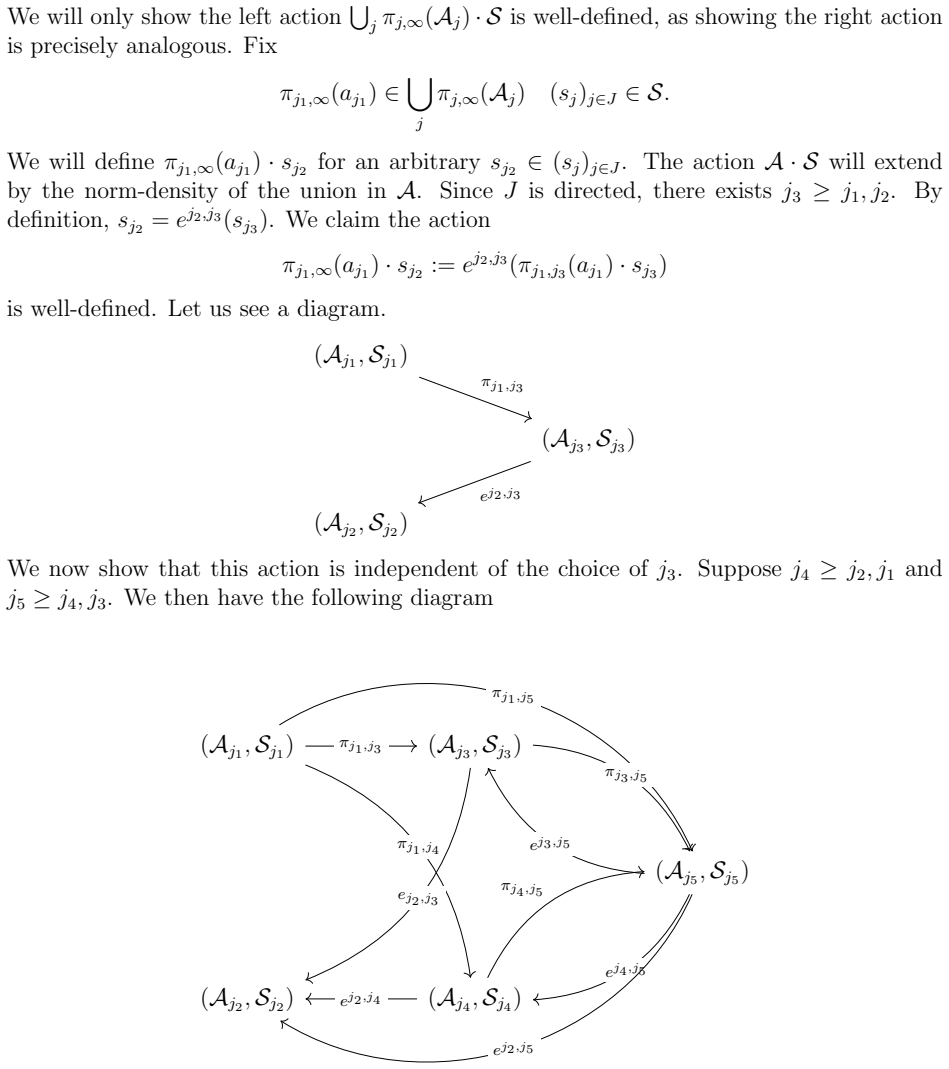
Ringinals enable Leibnizian analysis in a conservative extension of ZF set theory, challenging standard philosophical assumptions.

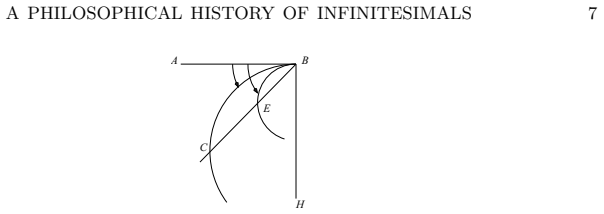
Figure from the paper full image
abstract click to expand
We explore the issue of providing a foundational framework for Leibnizian infinitesimals in the light of modern standard and nonstandard approaches. We outline a trichotomy of ordinals, cardinals and ringinals as a historiographic tool. A ringinal is a concept of infinite number, arithmetic in nature, different from Cantor's transfinite ordinals and cardinals. The continuum is not necessarily identifiable with R; even if one seeks such an identification, infinitesimals are not ruled out. Analysis with unlimited numbers (via the predicate standard) is possible in a conservative extension of Zermelo-Fraenkel set theory and in this sense is epistemologically 'safe'. We sketch a recent theory of infinitesimal analysis that formalizes Leibnizian definitions and heuristic principles while eschewing both the axiom of choice and ultrafilters, thus challenging received philosophical views on the nature of infinitesimals.
0
0
math.GT 2026-05-14 2 theorems

Multi-virtual twin groups admit exactly eight 2-local representation types

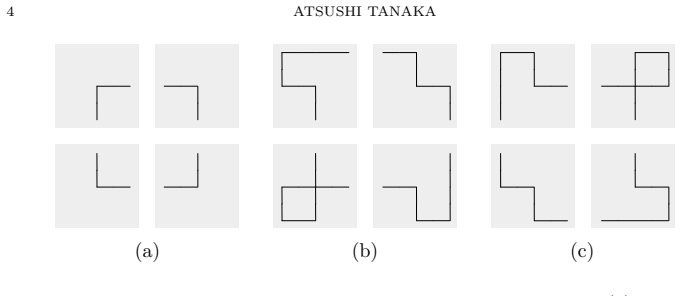
Presentations and Representations of the Multi-Virtual Twin Group and Associated Subgroups

The complete list into GL_n(C) for n at least 3 consists of eight families that are mostly unfaithful yet irreducible under explicit rules.

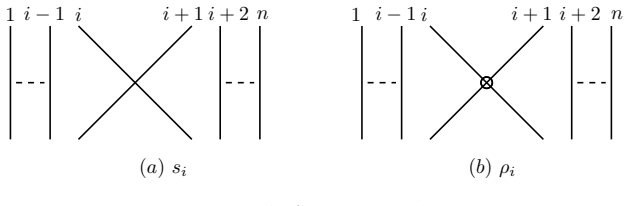
Figure from the paper full image
abstract click to expand
Motivated by the notion of the multi-virtual braid group introduced by L. Kauffman and by the study of extensions of the well-known twin group T_n, n >= 2, we introduce a new group called the multi-virtual twin group M_kVT_n, where k >= 1 and n >= 2, together with two associated subgroups: the multi-virtual pure twin group M_kVPT_n and the multi-virtual semi-pure twin group M_kVHT_n.We classify all homogeneous 2-local representations of M_kVT_n into GL_n(C) for all k >= 1 and n >= 3, and show that they fall into exactly eight distinct types. We also investigate their main properties, including faithfulness and irreducibility, proving that they are generally unfaithful and providing necessary and sufficient conditions for their irreducibility.Furthermore, for certain values of k and n, we construct non-local representations of M_kVPT_n induced from those of M_kVT_n, and we determine the conditions under which these induced representations are irreducible. Finally, we present several problems for future research in this area.
0
0
math.GT 2026-05-14 2 theorems

Mapping class subgroups have dense Teichmüller lengths

Non-arithmeticity of length spectra of subgroups of mapping class groups

Non-elementary subgroups generate a dense additive subgroup of R from pseudo-Anosov translation lengths.

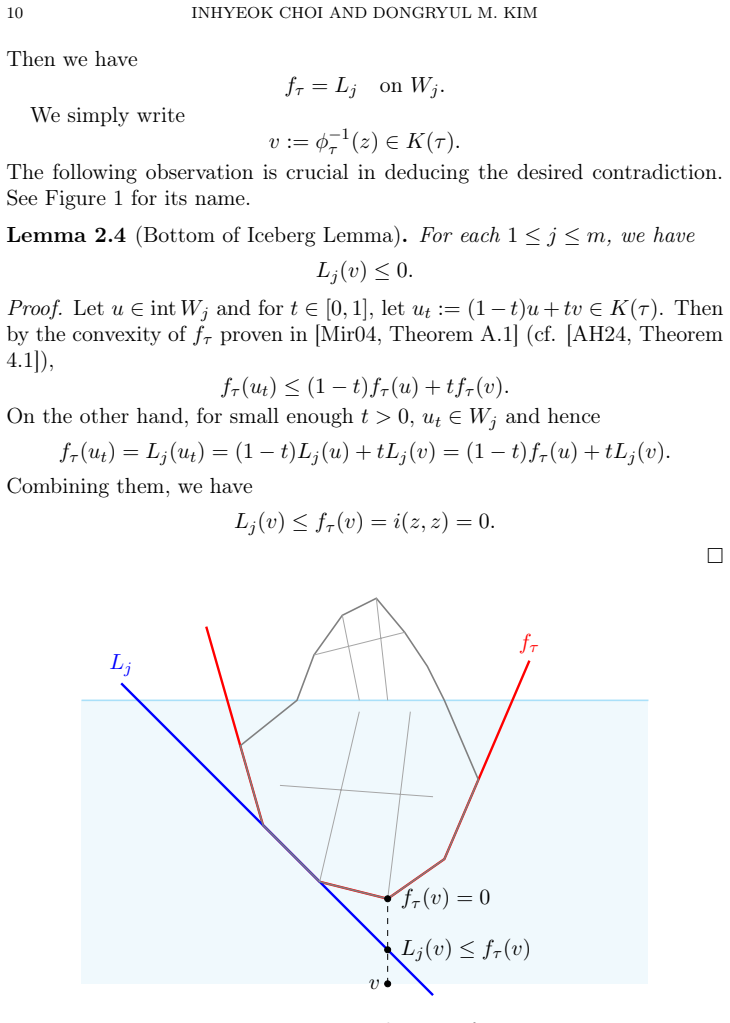
Figure from the paper full image
abstract click to expand
In this paper, we prove that every non-elementary subgroup of the mapping class group of a surface has non-arithmetic Teichm\"uller length spectrum. Namely, Teichm\"uller translation lengths of its pseudo-Anosov elements generate a dense additive subgroup of $\mathbb{R}$. We prove this by introducing the notion of cross-ratios on $\mathcal{MF}$ and $\mathcal{PMF}$, and studying its geometric and dynamical properties, despite the lack of negatively curved features of the Teichm\"uller space nor the conformal geometry on $\mathcal{PMF}$.
0
0
math.DG 2026-05-14 Recognition

Separable CMC surfaces are only revolution or z=f(x)+g(y)

Separable surfaces that are critical points of the Dirichlet energy

For nonzero Λ the PDE forces every surface written as f(x)+g(y)+h(z)=0 to belong to one of two explicit families with closed-form parametriz

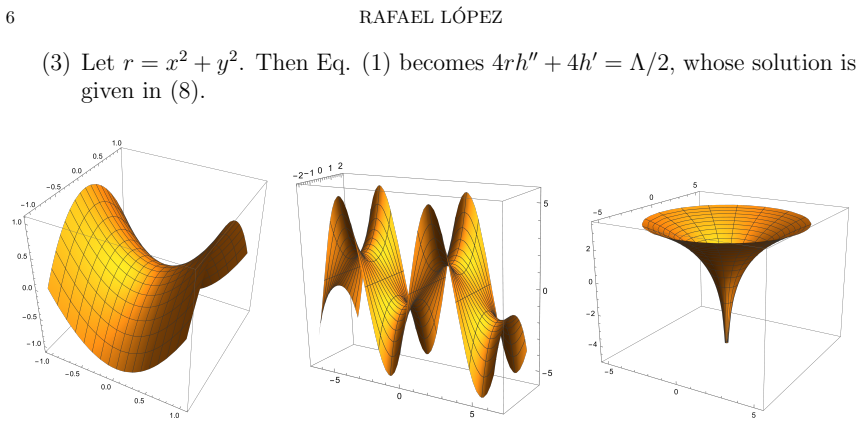
Figure from the paper full image
abstract click to expand
In this paper, we study surfaces $z=\varphi(x,y)$ in Euclidean space that satisfy the equation $\varphi_{xx}+\varphi_{yy}=\frac{\Lambda}{2}$ where $\Lambda\in\r$ is a real constant. We classify these surfaces when they are the zero level sets of an implicit equation of the type $f(x)+g(y)+h(z)=0$, where $f$, $g$ and $h$ are smooth functions of one variable. If $\Lambda=0$, we find a large family of surfaces with interesting symmetry properties. However, if $\Lambda\not=0$, we show that the surfaces must be either surfaces of revolution or of the type $z=f(x)+g(y)$; furthermore, explicit parametrizations of these surfaces are obtained.
0
0
math.RT 2026-05-14 Recognition

τ-regular modules are those with maximal rank projective presentations

On the additivity of projective presentations of maximal rank

The equivalence shows these modules form open sets in module varieties and connects additivity of presentations to reductions in projective

abstract click to expand
We study projective presentations of finite-dimensional modules over finite-dimensional algebras. We discuss if projective presentations of maximal rank behave additively. More precisely, we ask if the direct sum of copies of a projective presentation of maximal rank is again of maximal rank. The modules which have a projective presentation of maximal rank are exactly the $\tau$-regular modules. This class of modules can be seen as a generalization of modules of projective dimension at most one, and of $\tau$-rigid modules. The $\tau$-regular modules form open subsets of module varieties. Their closures are therefore unions of irreducible components, which are called generically $\tau$-regular. We discuss when a $\tau$-regular module or a generically $\tau$-regular component can be reduced to a module or component of projective dimension at most one, and we show that this is closely related to the question on the additivity of maximal rank presentations.
0
0
math.DG 2026-05-14 2 theorems

Curves on cylinders obey ODE in curvature and torsion

A necessary condition for cylindrical curves in terms of curvature and torsion

Necessary condition reduces cylinder inclusion to one differential equation using only κ and τ.

abstract click to expand
We establish necessary conditions for a regular curve to lie on a circular cylinder in terms of its curvature $\kappa$ and torsion $\tau$. By identifying a fundamental function $\psi = \sin^2 \alpha$, representing the squared sine of the angle between the tangent vector and the axis of the cylinder, we reduce the geometric inclusion problem to a compatibility condition between an explicit eighth-degree polynomial equation and a differential equation for $\psi$. This approach yields a single ODE involving only $\kappa$ and $\tau$ that governs the inclusion of the curve in the cylinder. The robustness of this framework is demonstrated through specific examples of cylindrical curves. Furthermore, we analyze the case of curves with constant curvature $\kappa_0$, obtaining an explicit ODE for the torsion. Remarkably, we prove that if $\kappa_0 = 1/\rho$, this equation admits an explicit, exact solution for $\tau$.
0
0
math.OA 2026-05-14 2 theorems

Left ideals give representation-free quantum graph morphisms

Categorical (Co)Limits of Quantum Graphs

This yields categorical colimits that agree with earlier definitions for quantum graphs.

Figure from the paper full image
abstract click to expand
We begin with the characterization of quantum graphs as left ideals in $\mathcal M \otimes_{eh} \mathcal M$ (the extended Haagerup tensor product of $\mathcal M$ with itself) to avoid technicalities surrounding representation dependence of quantum graphs. These left ideals roughly correspond to a canonical complement of a quantum graph. Using these left ideals and some operator space theory, we find a new, representation-free characterization of a morphism of quantum graphs compatible with previous representation-dependent morphisms. A notion of categorical (co)limit of quantum graphs follows. We also briefly explore an alternative quantization of graphs as bimodules over $C^*$-algebras ($C^*$-graphs), mostly to emphasize the point that a morphism of $C^*$-graphs is not a morphism of $C^*$-correspondences.
0
0
math.GT 2026-05-14 2 theorems

Alternating knot traces admit PALFs whose fibers match white-region count

Lefschetz Fibrations on Knot Traces of Alternating and Extended Alternating Knots

Genus equals white regions in the planar graph, giving genus s-1 for pretzel knots and genus 1 for torus knots.

Figure from the paper full image
abstract click to expand
In our previous work, we introduced a simple and explicit method for constructing a positive allowable Lefschetz fibration (PALF) from a $2$-handlebody decomposition of any given compact Stein surface. In this paper, we apply this construction to knot traces whose attaching circles are either alternating knots or \emph{extended alternating knots} (a generalized class introduced herein). We demonstrate that each such knot trace admits a PALF whose regular fiber has a genus exactly equal to the number of white regions in the associated planar graph, yielding PALFs whose regular fibers have a significantly small genus. As immediate corollaries, we prove that knot traces of positive pretzel knots with $s$ rows admit PALFs with regular fibers of genus $s-1$, and those of positive torus knots admit PALFs with regular fibers of genus $1$. Furthermore, we define \emph{positive torus-pretzel knots} by replacing each twist block of a positive pretzel knot with the crossings of a positive torus knot, and we establish that their knot traces also admit PALFs with regular fibers of genus $s-1$.
0
0
math.GT 2026-05-14 Recognition

Fold curves must cross themselves a minimum number of times

A Lower Bound on the Self-intersections of Fold Singularities

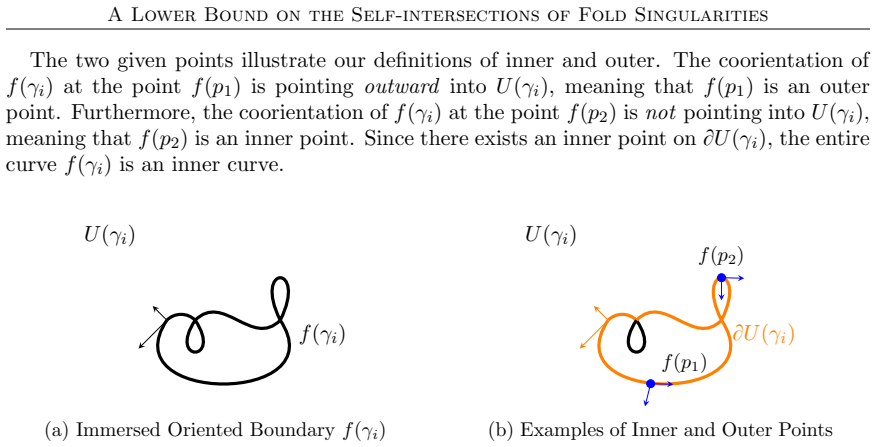
The bound is obtained by treating singular components as boundaries of immersed surface pieces.

Figure from the paper full image
abstract click to expand
For an oriented surface $S$, the singular set of a fold map $f:S\rightarrow \mathbb{R}^2$ is a collection of smooth curves, also known as fold singularities. We construct a sharp lower bound on the number of self-intersections of such fold singularities. This is done by first establishing a sharp lower bound on the number of self-intersections of the boundary of a surface immersed in $\mathbb{R}^2$. We then construct a sharp lower bound for the number of self-intersections of the singular set of a simple stable fold map of a surface to $\mathbb{R}^2$ by viewing the connected components of the singular set as the boundary components of smaller surface components, and invoking the previously constructed lower bound for the number of self-intersections of an immersed boundary.
0
0
math.SG 2026-05-14

Elementary invariants prove Reeb orbit results in 3D

Elementary spectral invariants and three-dimensional Reeb dynamics

Modified ECH capacities define simpler spectral invariants that establish periodic orbit existence for Reeb flows.

abstract click to expand
We survey various recent results on the existence and properties of periodic orbits of Reeb vector fields in three dimensions. We give an introduction to the "elementary spectral invariants" of contact three-manifolds, and we explain how they can be used to prove some of these results. (The remaining results can be proved using spectral invariants from embedded contact homology, of which the elementary spectral invariants are a simplification.) We then review the "alternative ECH capacities" of symplectic four-manifolds, and explain how these can be modified to define the elementary spectral invariants.
0
0
math.GT 2026-05-14

The authors construct an irreducible embedded real projective plane inside the 4-sphere

An irreducible real projective plane in the 4-sphere

An irreducible embedded projective plane is constructed in S^4, countering the Kinoshita conjecture via a peripheral map with kernel of…

abstract click to expand
We construct an irreducible embedded projective plane in $S^4$. This gives a counterexample to the Kinoshita conjecture and answers Problem 4.37 of the K3 problem list. Moreover, we answer both Questions (i) and (ii) of Problem 4.37: (i) the connected sum $R\# R$ is a Klein bottle in $S^4$ with extremal normal Euler number that does not admit an unknotted projective plane summand, and (ii) we show that our projective plane $R$ is irreducible by showing that the peripheral map $\pi_1 (\partial (S^4\setminus\mathring{N}(R)))\to \pi_1 (S^4 \setminus \mathring{N}(R))$ has kernel of order $2$.
0
0
math.PR 2026-05-13 2 theorems

CLT proven for homozygosity in hierarchical Pitman-Yor process

Central limit theorem for the homozygosity of the hierarchical Pitman-Yor process

Explicit variances show how each level in the hierarchy shapes Gaussian fluctuations in the weights.

abstract click to expand
The hierarchical Pitman-Yor process is a discrete random measure used as a prior in Bayesian nonparametrics. It is motivated by the study of groups of clustered data exhibiting power law behavior. Our focus in this paper is on the Gaussian behavior of a family of statistics, namely the power sum symmetric polynomials for the vector of weights of the process, as the concentration parameters tend to infinity. We establish a central limit theorem and obtain explicit representations for the asymptotic variance, with the latter clearly showing the impact of each component in the hierarchical structure. These results are crucial for understanding the asymptotic behavior of the sampling formulas associated with the process. In comparison with the known results for the hierarchical Dirichlet process, the results for the hierarchical Pitman-Yor process are mathematically more challenging and structurally more revealing of power law behavior.
0
0
math.SG 2026-05-13 2 theorems

Reeb orbits grow like T/log(T) on star-shaped hypersurfaces

On the growth rate of Reeb orbit on star-shaped hypersurfaces

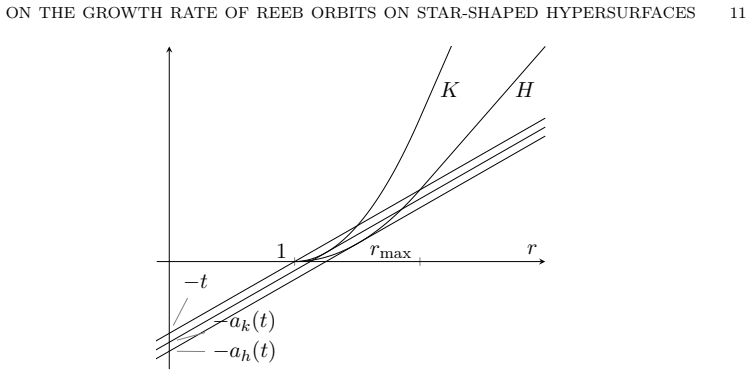
A topological condition on the base ensures infinitely many simple closed orbits with prime-number-like counting for any such hypersurface.

Figure from the paper full image
abstract click to expand
In this article, we study the growth rate of Reeb orbits on fiberwise star-shaped hypersurfaces in the cotangent bundle of a closed manifold. We prove that under a suitable topological condition on the base manifold the Reeb flow on any such hypersurface carries infinitely many simple closed orbits. Moreover, the number of simple Reeb orbits with period at most T grows at least like the prime numbers, that is, like T/log(T). The topological condition we assume is the existence of a non-nilpotent class in the homology of the free loop space of the manifold, with respect to the Chas-Sullivan product, lying in a connected component associated to a non-torsion class in the first homology of the manifold. In particular, for any Riemannian metric on a manifold satisfying such a topological condition, the number of geometrically distinct closed geodesics with length at most l grows at least like l/log(l). We also prove, using symplectic homology, that if a Liouville domain of dimension at least 4 with vanishing first Chern class admits a Reeb symplectically degenerate maximum representing a non-torsion first homology class of the domain, then the number of simple Reeb orbits with period at most T grows at least like T/log(T).
0
0
math.ST 2026-05-13 Recognition

Sampler matches smooth-case rate for composite log-concave densities

A proximal gradient algorithm for composite log-concave sampling

The proximal gradient method uses a restricted Gaussian oracle and reaches epsilon total variation error in O(kappa sqrt(d) log^4(1/eps)) it

abstract click to expand
We propose an algorithm to sample from composite log-concave distributions over $\mathbb{R}^d$, i.e., densities of the form $\pi\propto e^{-f-g}$, assuming access to gradient evaluations of $f$ and a restricted Gaussian oracle (RGO) for $g$. The latter requirement means that we can easily sample from the density $\text{RGO}_{g,h,y}(x) \propto \exp(-g(x) -\frac{1}{2h}||y-x||^2)$, which is the sampling analogue of the proximal operator for $g$. If $f + g$ is $\alpha$-strongly convex and $f$ is $\beta$-smooth, our sampler achieves $\varepsilon$ error in total variation distance in $\widetilde{\mathcal O}(\kappa \sqrt d \log^4(1/\varepsilon))$ iterations where $\kappa := \beta/\alpha$, which matches prior state-of-the-art results for the case $g=0$. We further extend our results to cases where (1) $\pi$ is non-log-concave but satisfies a Poincar\'e or log-Sobolev inequality, and (2) $f$ is non-smooth but Lipschitz.
0
0
math.RA 2026-05-13 2 theorems

Endomorphism rings of uniserial modules admit one-sided trace ideals

Trace ideals and uniserial modules

An intrinsic description separates right and left trace ideals and yields an alternative construction of non-serial summands inside serial模块

abstract click to expand
We thoroughly investigate the trace ideals of projective modules over the endomorphism ring of a uniserial module. After the work of Dubrovin and Puninski, it is known that this class of rings provides examples of trace ideals of projective right modules that are not trace ideals of projective left modules. In this paper we further investigate when this happens, giving an intrinsic description of such trace ideals and their properties. We also use the theory associated to lifting projective modules modulo a trace ideal to give an alternative approach to Puninski's construction of a direct summand of a serial module that is not serial.
0
0
math.FA 2026-05-13 Recognition

Strongly integrable operator functions generate norm-countably additive measures

Strongly Integrable Operator-Valued Functions, Generated Vector Measures and Compactness of Integrals

The key theorem requires only that X* contain no copy of c0 and yields compactness and spectral-radius results for integrals.

abstract click to expand
Gel'fand integral of a family of compact operators on a Hilbert space is not always compact, even with additional property of positivity and commutativity. We prove that integrals of a family, consisting of compact operators, in the space $L_{s}^1(\Omega,\mu,\mathcal{B}(X, Y))$ of strongly integrable families are compact whenever $X$ does not contain an isomorphic copy of $\ell^1$. In addition, we prove an integral inequality for spectral radius $$r\left(\int_\Omega\mathscr{A} \,d\mu\right)\leqslant\int_\Omega r(\mathscr{A}_t)\,d\mu(t)$$ for a mutually commuting family $\mathscr{A}$ in $L_s^1(\Omega,\mu,\mathcal{B}(X))$, which generalizes a recent result obtained under a stronger assumption of Bochner integrability. We prove also approximation results in $L_s^1(\Omega,\mu,\mathcal{B}(X))$ in the case $X$ has finite dimensional Schauder decomposition. All these results are based on a key theorem of this paper which states that every function in $L_{s}^1(\Omega,\mu, \mathcal{B}(X, Y))$ generates a countably additive, in operator norm, $\mathcal{B}(X, Y)$-valued measure whenever $X^*$ does not contain an isomorphic copy of $c_0$.
0
0
math.DS 2026-05-13 2 theorems

Timed dengue controls suppress transmission risk in seasonal models

Optimal Scheduling of Dengue Vector Control

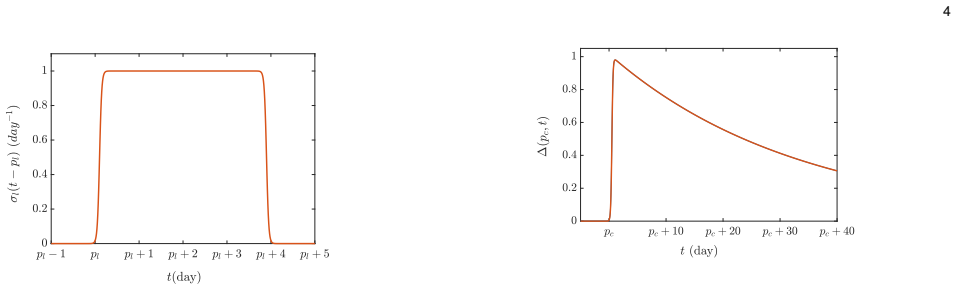
Miami temperature simulations show that adjoint-optimized schedules of larvicide, adulticide and breeding-site reduction lower the time-var

Figure from the paper full image
abstract click to expand
Dengue transmission is shaped by the population dynamics of the Aedes aegypti mosquito, making vector control a central strategy for disease mitigation. The impact of interventions such as larvicide, adulticide, and breeding-site reduction depends critically on their timing under fluctuating environmental conditions. We build on a high-fidelity, non-Markovian mechanistic model of the Aedes life cycle that captures stage-structured, temperature-dependent developmental delays, and mortality, and extend it to incorporate multiple vector control measures. Rather than using continuous abstract control amplitudes as in standard optimal control formulations, we introduce intervention-specific temporal profiles that better reflect operational practice. We then develop an adjoint-based gradient descent framework to compute the optimal timing of a sequence of interventions by minimizing the time-dependent dengue reproduction number, R0. Numerical simulations based on seasonal temperature data from Miami, Florida, show that appropriately timed combinations of interventions can substantially suppress transmission risk, with outcomes strongly influenced by seasonal temperature variation and intervention duration. We further propose embedding the resulting optimization framework within a Model Predictive Control architecture, yielding a closed-loop approach for real-time, surveillance-driven vector management under environmental and operational uncertainty.
0
0
math.CA 2026-05-13 2 theorems

Graph vertex count sets ℓ^p bounds for distance forms

ell^{p} improving estimates for multilinear forms motivated by distance graphs

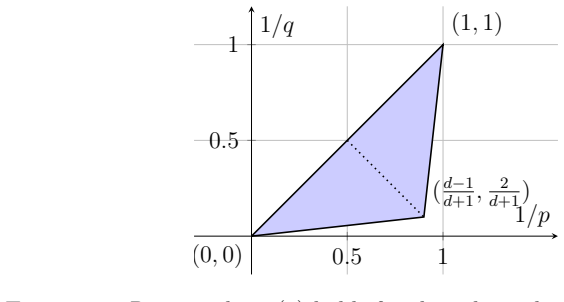
Multilinear operators on Z^d show uniform improving estimates whenever the number of points is fixed, even as edge patterns change.

Figure from the paper full image
abstract click to expand
We undertake a systematic study of the mapping properties of forms based on distance graphs in $\mathbb{Z}^{d}$ to see how the structure of a graph, $G$, affects the $\ell^{p}$ improving estimates of the form, $\Lambda_{G}$, based on $G$. This extends previous work on $\ell^{p}$ improving properties for the spherical averaging operator, which corresponds to a distance graph of a single distance. We obtain $\ell^{p}$ improving estimates for the collection of forms based on all graphs with 2, 3, and 4 vertices, as well as chains and simplexes of any size in $\mathbb{Z}^{d}$. Surprisingly, certain mapping properties only seem to depend on the number of vertices in the graph, not its structure, and forms based on subgraphs of a graph, $G$, do not necessarily inherit all mapping properties from $G$.
0
0
math.OC 2026-05-13 2 theorems

Alternation cuts cost in multi-objective stochastic optimization

Stochastic block coordinate and function alternation for multi-objective optimization and learning

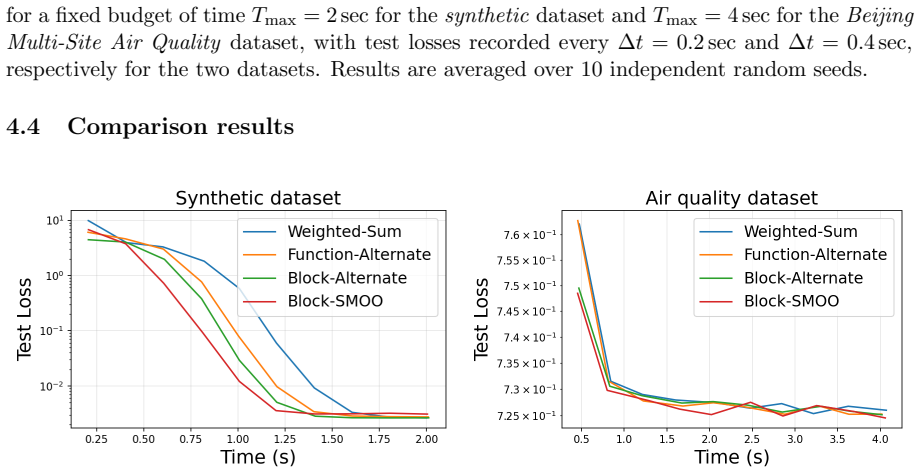
Cycling through objectives and variable blocks matches single-objective convergence rates while lowering per-iteration cost.

Figure from the paper full image
abstract click to expand
Multi-objective optimization is central to many engineering and machine learning applications, where multiple objectives must be optimized in balance. While multi-gradient based optimization methods combine these objectives in each step, such methods require computing gradients with respect to all variables at every iteration, resulting in high computational costs in large-scale settings. In this work, we propose a framework that simultaneously alternates the optimization of each objective and the (stochastic) gradient update with respect to each variable block. Our framework reduces per-iteration computational cost while enabling exploration of the Pareto front by allocating a prescribed number of gradient steps to each objective. We establish rigorous convergence guarantees across several stochastic smooth settings, including convex, non-convex, and Polyak-Lojasiewicz conditions, recovering classical convergence rates of single-objective methods. Numerical experiments demonstrate that our framework outperforms non-alternating methods on multi-target regression and produces a competitive Pareto front approximation, highlighting its computational efficiency and practical effectiveness.
0
0
math.DG 2026-05-13 2 theorems

Gaps in torus laminations contain non-minimizing minimal surfaces

A min-max gap characterization of minimal foliations on the torus

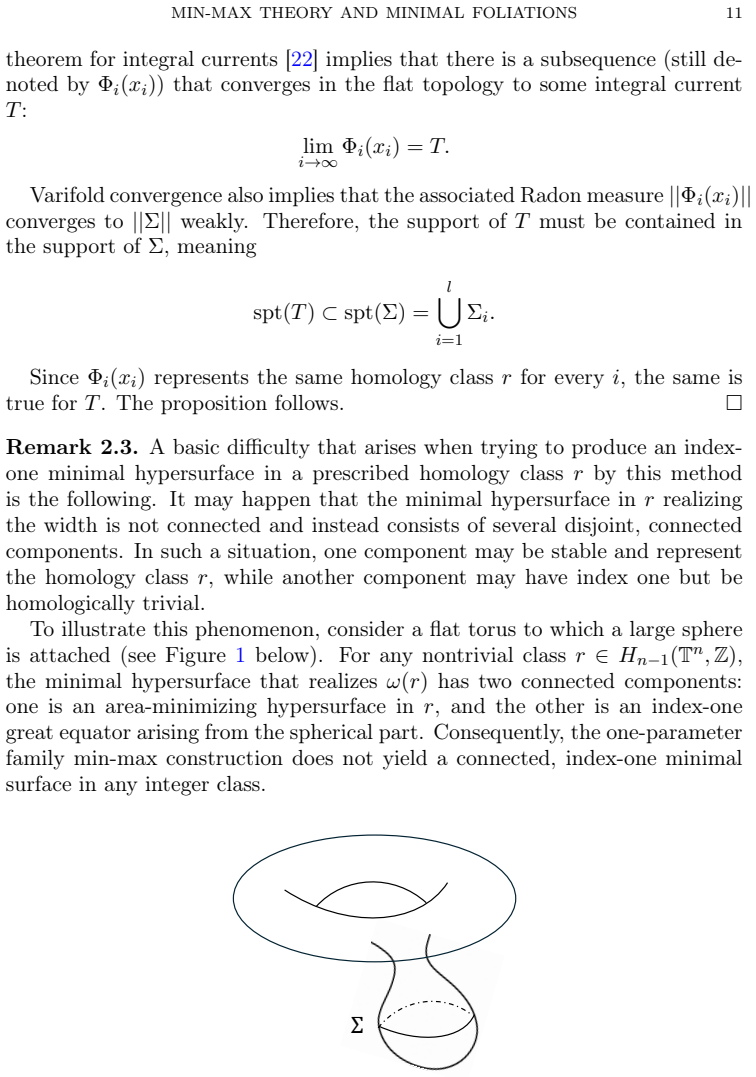
For generic metrics, any gap in an area-minimizing hypersurface lamination on the n-torus contains an additional minimal hypersurface, with

Figure from the paper full image
abstract click to expand
We extend an energy introduced by Mather to the setting of Almgren-Pitts min-max theory and obtain a parametric, higher-dimensional analogue of Mather's variational barrier theory for twist maps and geodesics on tori. We use this energy to establish several criteria for the existence of foliations of the $n$-torus by minimal hypersurfaces. We show that for a generic metric, whenever a lamination by area-minimizing hypersurfaces of the $n$-torus contains a gap, there exists a minimal hypersurface inside the gap that is not area-minimizing. As an application, we derive a recurrence property for totally irrational minimal foliations.
0
0
math.NA 2026-05-13 2 theorems

LS weak Galerkin method achieves optimal H2 error estimates

A Least-Squares Weak Galerkin Method for Second-Order Elliptic Equations in Non-Divergence Form

The discrete weak Hessian produces symmetric positive definite systems on general meshes with proven optimal convergence.

Figure from the paper full image
abstract click to expand
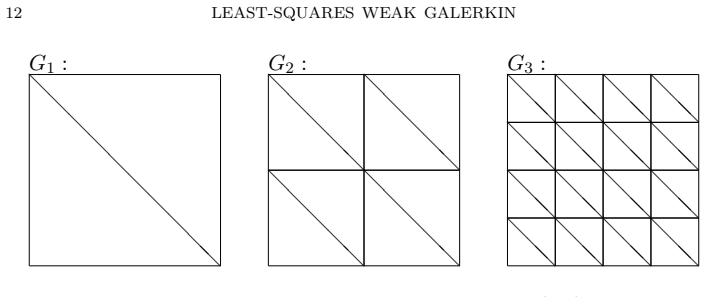
This article proposes a novel least-squares weak Galerkin (LS-WG) method for second-order elliptic equations in non-divergence form. The approach leverages a locally defined discrete weak Hessian operator constructed within the weak Galerkin framework. A key feature of the resulting algorithm is that it yields a symmetric and positive definite linear system while remaining applicable to general polygonal and polyhedral meshes. We establish optimal-order error estimates for the approximation in a discrete $H^2$-equivalent norm. Finally, comprehensive numerical experiments are presented to validate the theoretical analysis and demonstrate the efficiency and robustness of the method.
0
0
math.DG 2026-05-13 2 theorems

Sublinear volume growth yields mean-concave exhaustions on manifolds

Curvature-free effects from volume growth and ends-counting and their applications

The same volume and ends data also produce escaping geodesics and recover classical theorems for Ricci, scalar, and Kähler curvature without

abstract click to expand
In this paper, we investigate two curvature-free effects from volume growth and ends-counting, respectively. Motivated by generalizing classical results from Ricci curvature to other common curvatures, we establish two main theorems. First, any complete non-compact manifold with lower sublinear volume growth admits a smooth bounded mean-concave exhaustion. Second, any complete manifold with infinitely many ends contains escaping geodesic lines outside every compact subset. As applications, we provide new proofs of the Calabi--Yau minimal volume growth theorem and the Cai--Li--Tam finite-ends theorem for nonnegative Ricci curvature, without relying on the Bishop--Gromov volume comparison theorem or analytic tools specific to Ricci curvature. We further extend these results to Riemannian manifolds with nonnegative scalar curvature and K\"ahler manifolds with positive holomorphic sectional curvature.
0
0
math.CO 2026-05-13 Recognition

18 pairs of Type-2 isomorphic circulants on 48 vertices

A study on Type-2 isomorphic circulant graphs. Part 5: Type-2 isomorphic circulant graphs of orders 48, 81, 96

The count rises to 72 pairs on 96 vertices and 27 triples on 81 vertices under the same enumeration method.

abstract click to expand
This study is the $5^{th}$ part of a detailed study on Type-2 isomorphic circulant graphs having ten parts \cite{v2-1}-\cite{v2-10} and is a continuation of Part 4. Here, we study Type-2 isomorphic circulant graphs of $C_{48}(r_1,r_2,r_3)$, $C_{81}(r_1,r_2,r_3)$ and $C_{96}(r_1,r_2,r_3,r_4)$. We find that the total number of pairs of isomorphic circulant graphs of Type-2 w.r.t. $m$ = 2 of the forms $C_{n}(r_1,r_2,r_3)$ and $C_{n}(s_1,s_2,s_3)$ are 18 and 72 for $n$ = 48, 96, respectively and the total number of triples of isomorphic circulant graphs of Type-2 w.r.t. $m$ = 3 of the form $C_{81}(x_1,x_2,x_3)$, $C_{81}(y_1,y_2,y_3)$ and $C_{81}(z_1,z_2,z_3)$ are 27.
0
0
math.AP 2026-05-13 Recognition

New sampling method sizes clamped obstacles from one wave

Novel implementation of the extended sampling method for inverse biharmonic scattering

Derived from factorization analysis, the ESM uses sound-hard and soft disks to find location and size with noisy limited data.

Figure from the paper full image
abstract click to expand
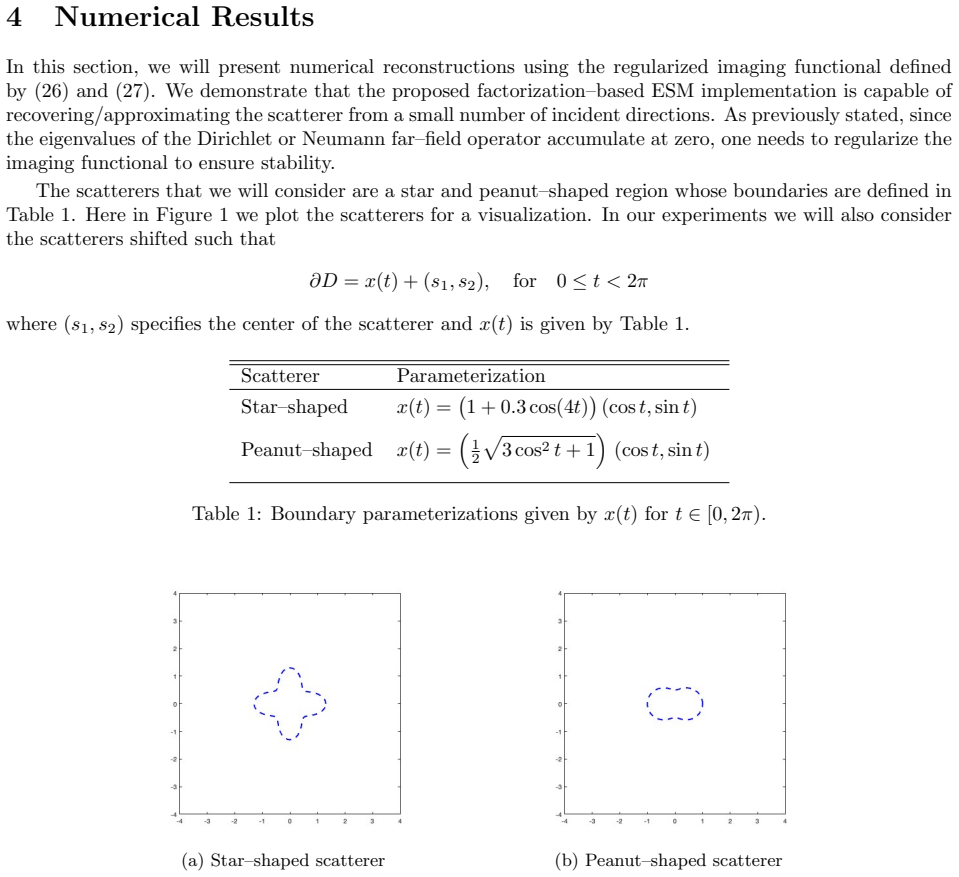
This paper considers an inverse shape problem for recovering an unknown clamped obstacle in two dimensions from far--field measurements generated by a single incident wave or just a few incident waves for the biharmonic (flexural) wave equation. Here we will develop a new extended sampling method (ESM) that is derived using the analysis of the well--known factorization method. We will also consider an ESM using both sound--soft and sound--hard sampling disks to identify sampling points where the reference disk intersects the unknown cavity. The use of a sound--hard sampling disk has not been studied in the literature whereas the sound--soft sampling disk has been used in most recent works. Traditionally the ESM seeks to find the location of the scatterer from limited incident directional data. Here, our method acts more like the factorization method to obtain the location as well as the size (and possibly the shape) of the obstacle. We present numerical experiments with synthetic data that demonstrate how effective this new implementation is with respect to noisy data and illustrate the influence of the reference disk radius on the reconstruction.
0
0
math.GR 2026-05-13 Recognition

l2-Dirichlet spaces coincide on nilpotents iff virtually abelian

Asymmetry of ell²-cohomology via skewed F{o}lner geometry

A skewed Følner construction detects the asymmetry and produces one-sided Bernoulli dynamics over amenable groups.

abstract click to expand
We study the two canonical $\ell^{2}$-Dirichlet structures on a finitely generated group $G$, arising from the left and right regular actions on $\mathbb{R}^{G}$. Although the left and right regular representations are unitarily equivalent, their $\ell^{2}$-Dirichlet spaces need not coincide as subspaces of $\mathbb{R}^{G}$. We prove that for finitely generated nilpotent groups $G$ this $\ell^{2}$-asymmetry is governed exactly by virtual commutativity: $$\mathcal{D}_{2}\left(G,\lambda\right)=\mathcal{D}_{2}\left(G,\rho\right)\quad\Longleftrightarrow\quad G \text{ is virtually abelian}.$$ The proof introduces a skewed F{\o}lner-geometric mechanism, called a left scheme, combining summability of left boundaries with displacement under right translation. By refining this mechanism into recurrent left scheme, we further show that every non-virtually abelian finitely generated nilpotent group admits Bernoulli schemes whose left shift is nonsingular and weakly mixing whereas the right shift is singular. These are the first constructions of such Bernoulli schemes over amenable groups. In addition to nilpotent groups, our techniques are robust enough to cover all amenable wreath products over $\mathbb{Z}$ and solvable Baumslag--Solitar groups. We also classify the virtually cyclic case, where $\ell^{2}$-asymmetry arises from one-sided commensurable ends rather than from left schemes.
0
0
math.DG 2026-05-13 2 theorems

Toric ALE/ALF 4-manifolds mass bounded below by instanton

A Comparison Theorem For the Mass of ALE and ALF Toric 4-Manifolds

The lower bound equals the instanton mass plus conical defect terms, with equality only for the instanton itself.

abstract click to expand
We establish sharp lower bounds for the mass of asymptotically locally Euclidean (ALE) and asymptotically locally flat (ALF) toric 4-manifolds, in terms of equilibrium geometries consisting of gravitational instantons. More precisely, the mass of a complete ALE or ALF toric 4-manifold with nonnegative scalar curvature is bounded below by a sum comprised of the following quantities: the mass of the corresponding toric gravitational instanton having the same orbit space (rod) structure as the original ALE/ALF manifold, and an expression determined by the conical angle defects of totally geodesic 2-spheres within the instanton that serve as generators for its second homology. The inequality may be generalized to the situation in which the ALE/ALF manifold also possesses conical singularities as well as orbifold singularities, and it suggests a refined notion of `total mass' in which the result simply states that the total mass of the ALE/ALF manifold is not less than that of the corresponding gravitational instanton. Furthermore, we prove rigidity for these statements, namely the inequality is saturated only when the ALE/ALF manifold is Ricci flat and in fact agrees with the corresponding instanton. These results may be viewed in the context of positive mass theorems, providing an explanation of how positivity can fail in the ALE/ALF setting. Moreover, the main theorem may be interpreted as yielding a variational characterization of the relevant toric gravitational instantons.
0
0
math.LO 2026-05-13 Recognition

Sequent calculi for CS, CSM, ER prove Lyndon interpolation

Proof Theory for Bimodal Provability Logics

First non-labelled systems for these bimodal provability logics also deliver cut-elimination and uniform interpolation.

Figure from the paper full image
abstract click to expand
We provide the first (non-labelled) sequent calculi for bimodal provability logics with "usual" provability predicates. In particular, we introduce calculi for the logics CS, CSM and ER. Additionally, we present non-wellfounded versions of our calculi, and use them to establish a cut-elimination procedure. Finally, we prove the first interpolation results for these logics showing that they all enjoy the uniform Lyndon interpolation property.
0
0
math.RA 2026-05-13 1 theorem

Even restrictions yield explicit groups and monoids of permutations

Groups of permutations that are even on maximal proper subsets, and related monoids

Γ_n, Δ_n and Σ_n defined by evenness on every (n-1)-subset receive full descriptions, sizes, ranks and minimal generators.

abstract click to expand
Let $n$ be a positive integer and let $[n]=\{1,2,\ldots,n\}$. Let $\Gamma_n$ denote the group of permutations on $[n]$ whose restrictions to maximal proper subsets of $[n]$ are even, let $\Sigma_n$ denote the monoid of transformations on $[n]$ whose injective restrictions to maximal proper subsets of $[n]$ are even and let $\Delta_n$ denote the submonoid of $\Sigma_n$ generated by transformations of rank at least $n-1$. In this paper, we present descriptions of $\Gamma_n$, $\Delta_n$ and $\Sigma_n$, determine their cardinalities and ranks, and provide minimal generating sets for each of them.
0
0
math.LO 2026-05-13 2 theorems

Model theories reduce to infinite-dimensional spaces over simpler bases

Trace definability III: Infinite dimensional space over a model of T

Trace equivalence shows that complex T* match the theory of κ-dimensional vector space over a model of simpler T.

abstract click to expand
We show that for a number of theories $T^*$ of model-theoretic interest there is a simpler theory $T$ and $\kappa \ge \aleph_0$ such that $T^*$ is trace equivalent to the theory of $\kappa$-dimensional space over a model of $T$.
0
0
math.CO 2026-05-13 1 theorem

Recursive rules build all matroid polytopes in ranks 2 and 3

The polytope of all matroids in ranks 2 and 3

The constructions generate the convex hull of every valid indicator vector for arbitrary ground-set size and enable explicit computation up

Figure from the paper full image
abstract click to expand
We give explicit recursive constructions for the polytope of all matroids $\Omega_{r,n}$ in ranks 2 and 3 for all ground set sizes. This polytope was introduced in recent work by Ferroni and Fink as a tool for checking positivity conjectures for valuative invariants. We supplement our theoretical construction by an implementation, which allows for the computation of $\Omega_{2,n}$ for $n\leq 33$ and $\Omega_{3,n}$ for $n\leq 10$. Further, we compute Schubert expansions for all isomorphism classes of matroids of rank $2$ up to $n = 80$, and for rank $3$ up to $n = 11$.
0
0
math.LO 2026-05-13 Recognition

Field appears in Shelah completion of group-free weakly o-minimal structure

Trace definability II: model-theoretic linearity

The example shows algebraic structure can emerge after completing an NIP structure that originally interprets no infinite groups.

abstract click to expand
We give examples of $\mathrm{NIP}$ structures in which new algebraic structure appears in the Shelah completion. In particular we construct a weakly o-minimal structure $\mathscr{M}$ such that $\mathscr{M}$ does not interpret an infinite group but the Shelah completion of $\mathscr{M}$ interprets an infinite field. We introduce a weak notion of interpretability called local trace definability between first order structures and an associated weak notion of equivalence. We give a dichotomy between ``linearity" and ``field structure" for dp-minimal expansions of archimedean ordered abelian groups. We also prove several other results about trace definability and local trace definability between various classes of structures.
0
0
math.CO 2026-05-13 Recognition

Stepping-up lemma gives linear-height towers for p-colored path Ramsey numbers

A stepping-up lemma for monotone paths with bounded color complexity

For any fixed p the largest q-colored k-uniform hypergraph avoiding a p-colored tight monotone path of length n is at least a tower of size

abstract click to expand
For positive integers $n, k, q, p$, let $A_k(n; q, p)$ be the largest integer $N$ such that there exists an edge coloring of $K_N^{(k)}$ with $q$ colors that does not contain a tight monotone path of length $n$ that consists of at most $p$ colors. In the case $p = 1$, this coincides with the ordinary Ramsey number of a tight monotone path, and it is known that $A_k(n; q, 1) = T_{k-2}(n^{\Theta(q)})$, proved by Moshkovitz and Shapira. Recently, Mulrenin, Pohoata, and Zakharov showed that whenever $p > \frac{q}{2}$, an improved upper bound $A_k(n; q, p) \leq T_{k-3}(n^{O(q)})$ holds, without any accompanying lower bounds. In this paper, we obtain the first non-trivial lower bound by developing a novel variant of the classical stepping-up lemma applicable to an Erd\H{o}s--Szekeres-type problem in which one seeks a tight monotone path spanning at most $p$ colors. In particular, we show that for any fixed $p \geq 1$, there exists a constant $C_p > 0$ that only depends on $p$ such that $$ A_{k}(n; q, p) \geq T_{\lfloor k/ C_p \rfloor}\left(n^{\omega_q(1)}\right) $$ holds for all sufficiently large $n, k, q$ compared with $p$, that is, a tower function whose height grows linearly in $k$. A key ingredient in our proof is establishing a finite analogue of the celebrated Morse--Hedlund theorem, which may be of independent interest.
0
0
math.DG 2026-05-13 Recognition

Abnormal extremals imply finite symmetries for distributions

Generalized pseudo-product structures and finite type distributions via abnormal extremals

Singularly transitive distributions in the real analytic category have finite-dimensional symmetry algebras, settling a 2013 open problem.

abstract click to expand
We generalize the classical Tanaka result on the finiteness of symmetry algebra for non-degenerate pseudo-product structures to the case when the completely-integrable distributions defining the pseudo-product structure are no longer concentrated in the degree $-1$. In order to do this, we modify the notion of universal prolongation of graded nilpotent Lie algebras and generalize the original finiteness criterion of Tanaka. Using this result, we demonstrate that in real analytic category, distributions that are controllable by regular abnormal extremal trajectories, also known as singularly transitive, have finite-dimensional symmetries. This result settles Problem V in the affirmative from the 2013 list of open problems by Andrei Agrachev. Additionally, we discuss applications to symmetries and natural equivalence problems for systems of ODEs of mixed order.
0
0
math.AG 2026-05-13 Recognition

Degree-6 polynomial maps R2 to R2 with non-zero Jacobian are injective

The real Jacobian conjecture for maps with one component having degree 6

This settles injectivity at degree 6 and, with prior work, confirms the real Jacobian conjecture for maps having one coordinate of degree at

Figure from the paper full image
abstract click to expand
We show that if $F=(p,q):\mathbb R^2\to \mathbb R^2$ is a polynomial map such that the degree of $p$ is $6$ and whose Jacobian determinant is nowhere zero, then $F$ is injective. This together with previous works in the literature, guarantees the validity of the real Jacobian conjecture in the plane provided that one of the coordinate functions of the map has degree smaller than $7$.
0
0
math.GR 2026-05-13 Recognition

Branching conditions imply rigidity for RAAG quasiisometric embeddings

Quasiisometric embeddings between right-angled Artin groups: rigidity

Under mild codomain conditions, such embeddings induce extension graph embeddings, enabling classifications and obstructions.

Figure from the paper full image
abstract click to expand
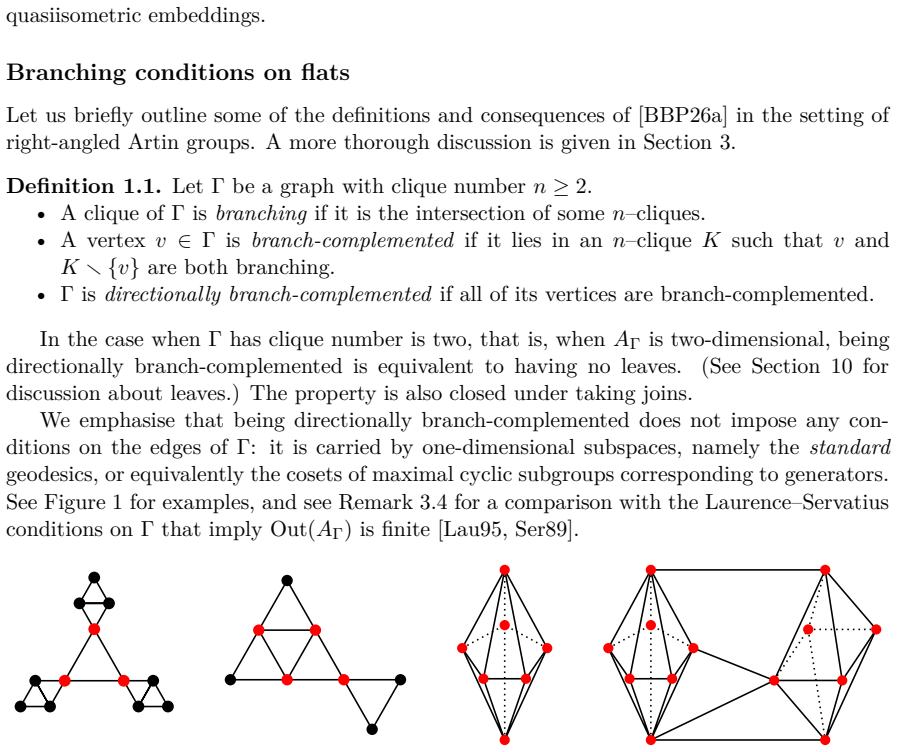
By introducing branching conditions on the defining graph, we prove a range of rigidity results for quasiisometric embeddings between right-angled Artin groups. The starting point for these is that, under mild conditions on the codomain, the branching conditions imply that a quasiisometric embedding induces an embedding between the associated extension graphs. Among other things, we: (1) provide obstructions to the existence of quasiisometric embeddings into products of trees; (2) prove that if the direct product $F_2^n\times A_{C_5}^m$ can be quasiisometrically embedded in a RAAG of the same dimension, then this can be seen from its defining graph; (3) classify all self--quasiisometric-embeddings of RAAGs defined on cycles; (4) show that no $n$--dimensional RAAG is a universal receiver for quasiisometric embeddings of $n$--dimensional RAAGs. We also establish a strong rigidity theorem for the quasiisometric images of 2--flats in RAAGs defined by triangle-free graphs that are not stars, generalising a theorem of Bestvina--Kleiner--Sageev.
0
0
math.ST 2026-05-13 Recognition

Pattern tests for independence get explicit null limits

Efficiency of pattern-based independence test

Complete limiting distributions and asymptotic efficiencies provided for length-four pattern sets

abstract click to expand
Tests of independence are an important tool in applications, specifically in connection with the detection of a relationship between variables; they also have initiated many developments in statistical theory. In the present paper we build upon and extend a recently established link to Discrete Mathematics and Theoretical Computer Science, exemplified by the appearance of copulas in connection with limits of permutation sequences, and by the connection between quasi-randomness and consistency of pattern-based tests of independence. The latter include classical procedures, such as Kendall's tau, which uses patterns of length two. Longer patterns lead to tests that are consistent against large classes of alternatives, as first shown by Hoeffding (1948) with patterns of length five, and by Yanagimoto (1970) and Bergsma and Dassios (2014) for patterns of length four. More recently Chan et al.\ (2020) characterized quasi-randomness for sets of patterns of length four, which leads to several new consistent pattern-based test for independence. We give a detailed and complete description of the respective limiting null distributions. In connection with the power performance of the tests, which is of interest for practical purposes, we provide results on their (local) asymptotic relative efficiencies. We also include a small simulation study that supports our theoretical findings.
0
0
math.CO 2026-05-13 2 theorems

Field multiplication symmetric tensor rank matches its Gabidulin code rank

Symmetric Tensor Decompositions over Finite Fields

The ranks coincide for the one-dimensional Gabidulin code from finite field multiplication, via reformulation as spanning by rank-one forms.

abstract click to expand
We study the symmetric tensor rank of multiplication over finite field extensions using linearized polynomials. Via field trace, symmetric linearized polynomials are identified with symmetric bilinear forms and symmetric matrices, allowing symmetric tensor decompositions to be reformulated as spanning problems by rank-one symmetric linearized polynomials. We translate these spanning conditions into explicit linear systems over finite fields and use the Frobenius automorphism to obtain computationally effective criteria. As applications, we recover known values of the symmetric bilinear complexity for small extension degrees and obtain explicit symmetric decompositions for several parameters. We also introduce the symmetric tensor-rank of a symmetric rank-metric code and show that, for the natural one-dimensional Gabidulin code associated with finite field multiplication, this invariant coincides with the symmetric tensor rank of the multiplication map.
0
0
math.CO 2026-05-13 2 theorems

Planar digraph feedback vertex sets bounded by (n-2)/(g-2)

Feedback vertex sets of planar digraphs with fixed digirth

A cycle-packing min-max theorem gives the upper bound and narrows the asymptotic gap for every fixed digirth g.

Figure from the paper full image
abstract click to expand
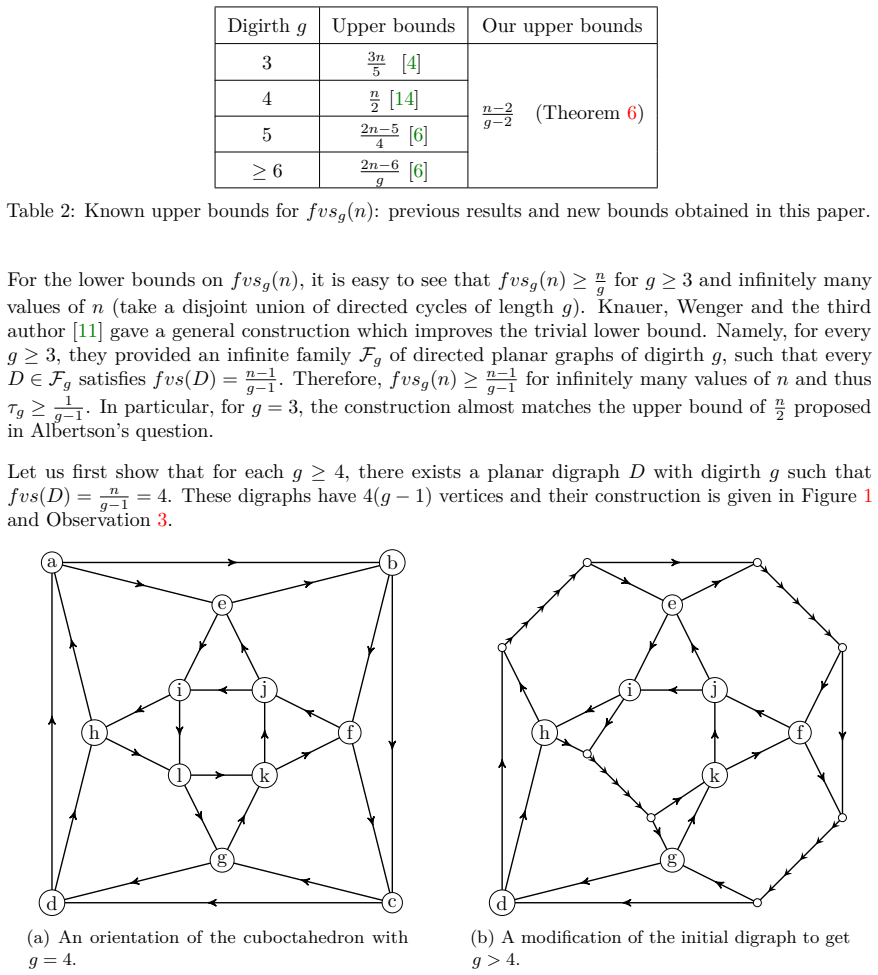
Let $fvs(G)$ denote the size of a minimum feedback vertex set of a digraph $G$. We study $fvs_g(n)$, which is the maximum $fvs(G)$ over all $n$-vertex planar digraphs $G$ of digirth $g$. It is known in the literature that $\lfloor\frac{n-1}{g-1}\rfloor \le fvs_g(n)$ and $fvs_3(n)\le \frac{3n}{5}$, $fvs_4(n)\le \frac{n}{2}$, $fvs_5(n)\le \frac{2n-5}{4}$ and $\lfloor\frac{n-1}{g-1}\rfloor \le fvs_g(n) \le \frac{2n-6}{g}$ for $g \ge 6$. In particular for $g \ge 6$, $\frac{1}{g-1}\le \sup_{n \ge 1} \frac{fvs_g(n)}{n} \le \frac{2}{g}$. We improve all lower and upper bounds starting with digirth 4. Namely, we show that $fvs_g(n)\le \frac{n-2}{g-2}$ for all $g\geq 3$, by proving that the minimum feedback vertex set is at most the maximum packing of a special type of directed cycles. This last result is a planar-digraph analogue of the celebrated Lucchesi-Younger theorem and is of independent interest. On the other hand, we develop a new tool to construct planar digraphs of fixed digirth and large $fvs$ by connecting arc-disjoint directed cycles. Using it, we provide constructions of infinite families of planar digraphs of digirth $g\ge 4$ and large $fvs$. These constructions together with our upper bound show that $\frac{g+2}{g^2} \le \sup_{n \ge 1} \frac{fvs_g(n)}{n} \le \frac{1}{g-2}$ for all values $g \ge 6$, except $g =7$, for which the lower bound is different. We thus decrease the gap between the lower and the upper bound for $\sup_{n \ge 1} \frac{fvs_g(n)}{n}$ from $\frac{g-2}{g(g-1)}$ to $\frac{4}{g^2(g-2)}$. For $g = 7$ this gap goes from $\frac{5}{42}$ to $\frac{1}{55}$. For digirth 4 and 5, both improvements are by an additive constant.
0
0
math.DG 2026-05-13 2 theorems

Stable capillary surfaces near 0 or π angles are classified

Tangential limits of stable minimal capillary surfaces

Curvature estimates on sequences with angles tending to extremes classify all compact embedded examples on finite-curvature minimal or mean-

Figure from the paper full image
abstract click to expand
We characterize all compact embedded stable minimal capillary surfaces with capillary angle close to either $0$ or $\pi$ that are supported on a complete embedded minimal surface with finite total curvature that is not an affine plane. Moreover, we characterize all compact embedded weakly stable minimal capillary surfaces with capillary angle close to either $0$ or $\pi$ that are supported on a closed surface whose mean curvature is positive and has no degenerate maxima. An important ingredient in our work are curvature estimates for sequences of weakly stable minimal capillary surfaces with capillary angles tending to $0$ or $\pi$ that enable us to analyze the tangential limits of such sequences at suitable scales.
0
0
math.PR 2026-05-13 Recognition

Itô integral defined for two-sided Lévy processes

It\^o integral for a two-sided L\'evy process

Moment bounds follow from martingale approximations and equivalence to the Hitsuda-Skorohod integral is proved via Poisson-Malliavin methods

abstract click to expand
In this article, we construct an It\^o integral with respect to a two-sided finite-variance L\'evy process $\{L(x)\}_{x\in \mathbb{R}}$, without a Gaussian component. Using Rosenthal inequality for discrete-time martingales, we give an estimate for the $p$-th moment of this integral, for any even integer $p\geq 2$. Then, using Poisson-Malliavin calculus, we show that the It\^o integral is an extension of the Hitsuda-Skorohod integral with respect to the compensated Poisson random measure associated to the L\'evy process.
0
0
math.NT 2026-05-13 Recognition

Rational simplices allow any positive rational squared edge length above codim 2

Squared edge lengths of regular simplices with rational vertices

The classification via quadratic forms shows complete freedom once ambient dimension exceeds simplex dimension by three or more.

abstract click to expand
We determine exactly which positive rational numbers occur as squared edge lengths of regular $d$-simplices with vertices in $\mathbb{Q}^n$. The answer exhibits a sharp stabilization phenomenon: once $n-d\geq 3$, every positive rational number occurs, while codimensions $0$, $1$, and $2$ are governed by explicit square-class, norm-group, and Hilbert-symbol conditions. The proof reduces simplex realizability to the Hasse--Minkowski classification of rational quadratic forms.
0
0
math.CO 2026-05-13 2 theorems

Outer-k-string recognition is NP-hard for any fixed k

Two Results on Outer-String Graphs

The result holds even when crossings between curves are bounded; ordered C3-C5-free graphs remain polynomial-time decidable via one avoided

abstract click to expand
An \emph{outer-string representation} of a graph $G$ is an intersection representation of $G$ where vertices are represented by curves (strings) inside the unit disk and each curve has exactly one endpoint on the boundary of the unit disk (the anchor of the curve). Additionally, if each two curves are allowed to cross at most once, we call this an \emph{outer-$1$-string representation} of $G$. If we impose a cyclic ordering on the vertices of $G$ and require the cyclic order of the anchors to respect this cyclic order, such a representation is called a \emph{constrained outer-string representation}. In this paper, we present two results about graphs admitting outer-string representations. Firstly, we show that for a bipartite graph $G$ (and, more generally, for any $\{C_3,C_5\}$-free graph $G$) with a given cyclic order of vertices, we can decide in polynomial time whether $G$ admits a constrained outer-string representation. Our algorithm follows from a characterization by a single forbidden configuration, similar to that of Biedl et al. [GD 2024] for chordal graphs. Secondly, we answer an open question from the same authors and show that determining whether a given graph admits an outer-1-string representation is NP-hard. More generally, we show that it is NP-hard to determine if a given graph $G$ admits an outer-$k$-string representation for any fixed $k\ge1$.
0
0
math.DS 2026-05-13 Recognition

Entropy monotonicity holds for power-law unimodal maps

Topological Entropy for Power-Law Unimodal Maps

Kneading sequences increase with a for any critical exponent r > 1, preserving the quadratic-family structure

abstract click to expand
In this paper we prove that the monotonicity of kneading sequences and topological entropy, a fundamental structural property of the quadratic family, extends to the class of power-law unimodal maps $f_a(x)=a-|x|^r$ for arbitrary critical exponent $r>1$. This generalization is nontrivial: the absence of polynomial structure and the presence of non-integer criticality preclude the direct use of classical arguments. Our approach adapts and extends the Milnor-Thurston framework by introducing a Thurston-type operator associated with the critical orbit and establishing a determinant identity that relates its linearization to the parameter derivative of the orbit. The main difficulty proving positivity of this determinant in the absence of algebraic structure - is resolved via a contraction argument on an associated Torelli space endowed with the Teichm\"uller metric, extending Thurston's pullback construction beyond the polynomial setting, that is to critical powers $r=2^\nu/k$, $\nu\geq 1$, $k$ odd, and finally use continuity in $r$. As a consequence, we show that the kneading sequence varies monotonically with the parameter, and hence that the topological entropy is an increasing function of $a$. Our results show that the combinatorial organization of parameter space familiar from the quadratic family persists for unimodal maps with arbitrary power-law criticality, indicating that monotonicity of entropy is a robust phenomenon beyond polynomial dynamics.
0
0
math.CO 2026-05-13 2 theorems

Manipulated lifting yields first set-like sunflower-free subspace families

On set-like sunflower-free families of subspaces over finite fields

Earlier general-position constructions contain set-like sunflowers under the weaker kernel definition; a controlled adjustment of lifting ev

abstract click to expand
The Erd\H{o}s--Rado sunflower problem admits two natural analogues in finite vector spaces, corresponding to two different ways of generalising the set-theoretic notion of a sunflower. The first, used by Ihringer and Kupavskii [FFA 110 (2026) 102746], requires the petals to be in general position over the kernel; the second, used in the subspace codes literature (cf.\ Etzion--Raviv [DAM 186 (2015) 87-97], Blokhuis--De Boeck--D'haeseleer [DCC 90 (2022) 2101-2111]), requires only that the kernel equals the pairwise intersection of distinct petals. We refer to the second version as a \emph{set-like sunflower}, following Ihringer and Kupavskii. In this note, we focus on the set-like setting. We observe that the constructions of Ihringer--Kupavskii, although correct under their (stronger) definition, do not yield set-like sunflower-free families: we exhibit explicit set-like sunflowers inside their Example~3.1. We then present a construction of set-like $s$-sunflower-free families of $k$-spaces, based on a manipulated version of the lifting construction. To our knowledge, this is the first systematic construction tailored to this setting.
0
0
math.OC 2026-05-13 2 theorems

Mixed scores in diffusion reduce to geometric potential

Geometric Asymptotics of Score Mixing and Guidance in Diffusion Models

Small-time dynamics governed by weighted squared distances to data supports, for both mixture and amplified guidance

Figure from the paper full image
abstract click to expand
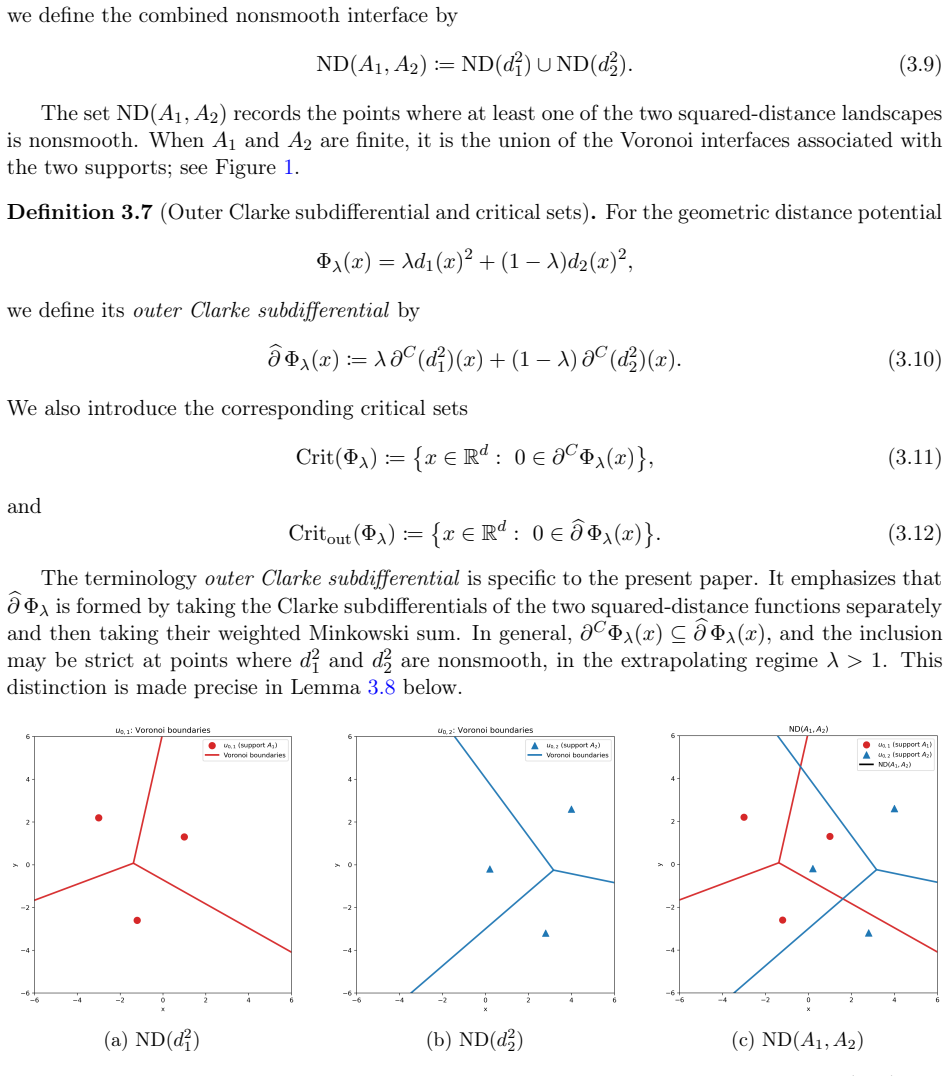
Diffusion models are routinely guided in practice by combining multiple score fields, yet the mathematical structure of score mixing is still poorly understood. We study the small-time generation dynamics driven by mixed scores $$ s=\lambda\,\nabla\log u_1+(1-\lambda)\,\nabla\log u_2,\qquad \lambda\ge 0, $$ in the heat-flow framework, where $u_1,u_2$ are heat evolutions of two compactly supported probability measures. This single formulation covers both the mixture-of-experts regime $(0\leq \lambda\leq 1)$ and the classifier-free guidance regime $(\lambda>1)$. Exploiting a Laplace-Varadhan principle under a similarity-time rescaling, we show that the small-time generation dynamics is governed by the explicit geometric potential $$ \Phi_\lambda=\lambda d_1^2+(1-\lambda)d_2^2, $$ which depends only on the supports of the initial measures and on the mixing parameter. This gives a rigorous reduction from a singular, non-autonomous score-driven dynamics to autonomous Clarke-type subgradient inclusions. In the empirical setting of finite Dirac mixtures, the limiting potential is piecewise quadratic with a Voronoi-type structure; this rigidity yields convergence of all autonomous limiting trajectories to critical points and a conditional convergence criterion for the original generation flow toward local minimizers of the potential, with rate $\mathcal O(\sqrt t)$ in the smooth stable case.
0
0
math.OC 2026-05-13 2 theorems

Dynamical systems converge strongly to min-norm saddle solutions

Convergence Analysis of Hessian-Damped Tikhonov Regularized Dynamics with Oscillation Control for Convex-Concave Bilinear Saddle Point Problems

Hessian-driven damping in second-order primal-dual dynamics reduces oscillations while guaranteeing strong convergence under time-varying Tâ

abstract click to expand
In this paper, we propose a class of general second-order primal-dual dynamical systems with Tikhonov regularization and Hessian-driven damping for solving convex-concave bilinear saddle point problems. The proposed dynamical system incorporates five general time-varying terms: viscous damping, time scaling, extrapolation, Tikhonov regularization, and Hessian-driven damping parameters. Under suitable parametric conditions, we analyze the asymptotic convergence properties of the dynamical system by constructing appropriate Lyapunov functions. Specifically, we obtain the convergence rate of the primal-dual gap and the boundedness of trajectories in the proposed dynamical system, and provide some integral estimates. Furthermore, we theoretically prove that the trajectories generated by the dynamical system converge strongly to the minimum-norm solution of the saddle point problem, and fully demonstrate that Hessian-driven damping can effectively alleviate oscillations. Finally, numerical experiments are conducted to verify the validity of the above theoretical results.
0
0
math.OA 2026-05-13 1 theorem

Regular inclusions of simple C*-algebras are twisted crossed products

Regular irreducible inclusions of simple C^*-algebras and crossed product structure

A generalized quasi-basis shows every regular irreducible inclusion equals a reduced twisted crossed product by the Weyl group.

abstract click to expand
We study regular irreducible inclusions $B\subset A$ of simple unital $C^*$-algebras admitting a conditional expectation. We introduce a generalized notion of quasi-basis extending Watatani's framework and show that such inclusions admit a unitary orthonormal generalized quasi-basis. As a consequence, we prove that every regular irreducible inclusion in this setting is canonically isomorphic to a reduced twisted crossed product of $B$ by its Weyl group. This extends earlier crossed product characterizations beyond the finite-index setting.
0
0
math.AG 2026-05-13 1 theorem

Reeb spaces stay 1D graphs even without CW structure

Representations of Reeb spaces via simplified graphs and examples

Nice Hausdorff spaces with continuous functions yield one-dimensional Reeb spaces that admit simplified graph representations and explicit例子

abstract click to expand
Reeb spaces of continuous real-valued functions on topological spaces are fundamental and strong tools in investigating the spaces. The Reeb space is the natural quotient space of the space of the domain represented by connected components of its level sets. They have appeared in theory of Morse functions in the last century and as important topological objects, they are shown to be graphs for tame functions on (compact) manifolds such as Morse(-Bott) functions and naturally generalized ones. Related general theory develops actively, recently, mainly by Gelbukh and Saeki. For nice Haudorff spaces and continuous functions there, they are "$1$-dimensional". We concentrate on Reeb spaces which are not CW complexes and study their representations by graphs and nice examples. Reconstructing nice smooth functions with given Reeb graphs is of related studies and pioneered by Sharko and followed by Masumoto, Michalak, Saeki, and so on. The author has also contributed to it.
0
0
math.CO 2026-05-13 2 theorems

Circular words contain at most 5/3 n distinct squares

A Tighter Upper Bound for the Number of Distinct Squares in Circular Words

New bound improves the prior 1.8 n limit and reduces the gap to the conjectured 1.5 n for squares in any rotations of a word.

Figure from the paper full image
abstract click to expand
A \emph{square} is a word of the form $uu$, where $u$ is a nonempty finite word. Given a finite word $w$ of length $n$, let $[w]$ denote the corresponding \emph{circular word}, i.e., the set of all cyclic rotations of $w$. We study the number of distinct square factors of the elements of $[w]$. Amit and Gawrychowski first showed that this number is upper bounded by $3.14n$. In a recent article, Charalampopoulos et al. improved this upper bound to $1.8n$ and conjectured that the sharp upper bound is $1.5n$. In this note, we improve this upper bound to $\frac{5}{3}n$.
0
0
math.OC 2026-05-13 2 theorems

SDP hierarchy solves quaternion polynomial optimization to global optimum

A Moment-QSOS Hierarchy for a Class of Quaternion Polynomial Optimization Problems

Moment-QSOS relaxations formulated directly in quaternions give monotonic lower bounds and scale via sparsity.

abstract click to expand
This paper introduces a Moment-Quaternion-Sum-of-Squares (QSOS) hierarchy for solving a class of quaternion polynomial optimization problems. This hierarchy is formulated directly in the quaternion domain and consists of a sequence of semidefinite programming (SDP) relaxations that provide monotonic lower bounds on the optimal value. To improve scalability, we incorporate correlative sparsity, which can significantly reduce the size of the resulting SDPs for large-scale sparse problems. Furthermore, we introduce a strengthened QSOS relaxation, which enhances the tightness of the standard relaxation by enlarging the monomial basis in a controlled manner. Our various Numerical experiments show that our approach provides comparable bounds to existing approaches, while significantly reducing computation time and memory usage. In particular, applications to the quaternion-based maximum margin criterion problem and the classical orientation synchronization problem illustrate the practical effectiveness of the framework.
0
0
math.NA 2026-05-13 Recognition

Complex coupling reconstructs unknown Robin boundaries

Cavity shape reconstruction with a homogeneous Robin condition via a constrained coupled complex boundary method with ADMM

Minimizing the imaginary part of the coupled solution with ADMM constraints recovers cavity shapes from partial Cauchy measurements.

Figure from the paper full image
abstract click to expand
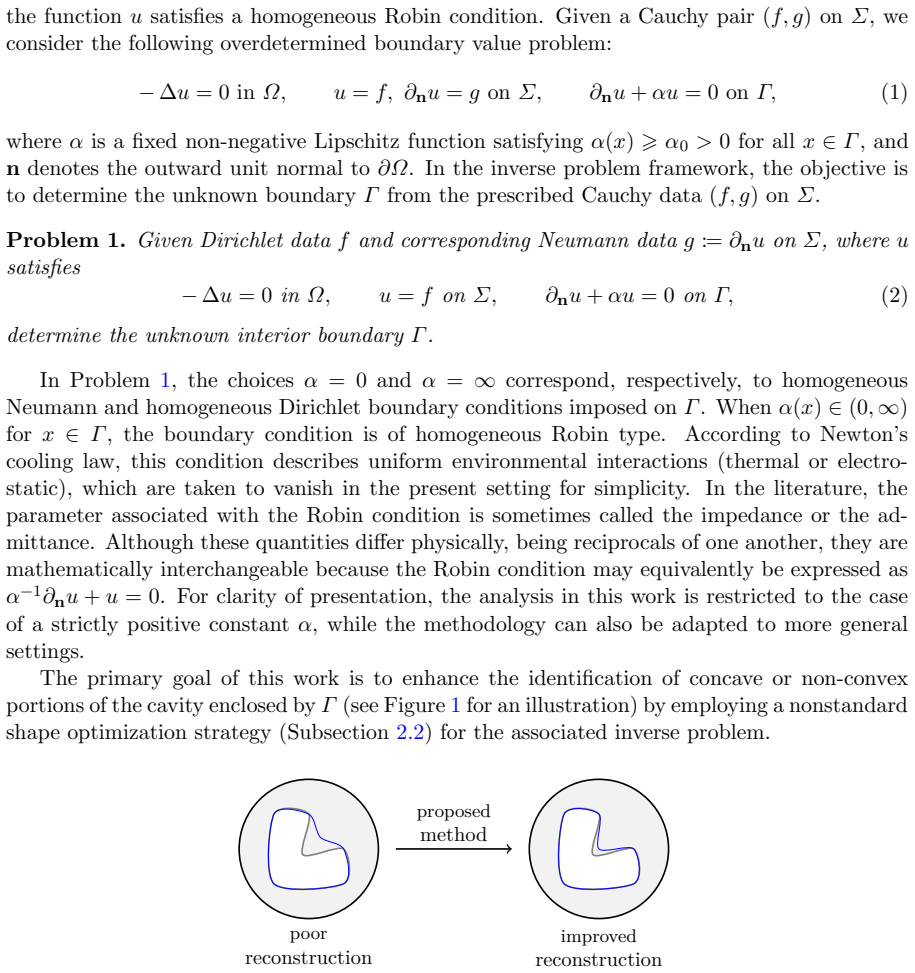
We revisit the problem of identifying an unknown portion of a boundary subject to a Robin condition based on a pair of Cauchy data on the accessible part of the boundary. It is known that a single measurement may correspond to infinitely many admissible domains. Nonetheless, numerical strategies based on shape optimization have been shown to yield reasonable reconstructions of the unknown boundary. In this study, we propose a new application of the coupled complex boundary method to address this class of inverse boundary identification problems. The overdetermined problem is reformulated as a complex boundary value problem with a complex Robin condition that couples the Cauchy data on the accessible boundary. The reconstruction is achieved by minimizing a cost functional constructed from the imaginary part of the complex-valued solution. To improve stability with respect to noisy data and initialization, we augment the formulation with inequality constraints through prior admissible bounds on the state, leading to a constrained shape optimization problem. The shape derivative of the complex state and the corresponding shape gradient of the cost functional are derived, and the resulting problem is solved using an alternating direction method of multipliers (ADMM) framework. The proposed approach is implemented using the finite element method and validated through various numerical experiments.
0
0
math.PR 2026-05-13 2 theorems

SE(2) Langevin dynamics yield effective diffusion on R²

Hypocoercive Langevin dynamics on the Lie group SE(2)

Averaging over the compact rotation subgroup extracts macroscopic plane diffusion from the oriented generator via kernel projection.

abstract click to expand
We consider a Langevin-type diffusion on the planar motion group $\mathrm{SE}(2)$, describing the coupled evolution of position and orientation with degenerate noise acting only in the rotational direction. Although hypocoercivity for related models on $\mathbb{R}^2 \times \mathbb{S}^1$ is well understood, our purpose is to present an intrinsic formulation on the Lie group $\mathrm{SE}(2)$, and to highlight the underlying geometric mechanism. By expressing the generator in terms of invariant vector fields and using the natural projection onto the kernel of the symmetric part, we show how an effective macroscopic diffusion on $\mathbb{R}^2$ emerges through averaging over the compact rotation subgroup.
0
0
math.DS 2026-05-13 Recognition

Conformable Laplace transform solves diffusion equations

On solution of Diffusion Equation using Conformable Laplace Transform

Inversion and convolution theorems allow closed-form solutions for initial-boundary value problems.

abstract click to expand
The inversion theorem and convolution theorem of the conformable fractional Laplace transforms are developed. All the elementary properties of the classical Laplace transform are extended to the conformable fractional transform, and using these properties, we found analytical solutions to the initial-boundary value problems of the diffusion equation.
0
0
math.CO 2026-05-13 2 theorems

Weight distributions now closed for five perfect-code families

Closed Expressions for the Weight Distributions of Codes Associated with Perfect Codes

Elementary combinatorial counts supply full expressions for 1-perfect, extended, nearly perfect covering, and diamond codes.

abstract click to expand
Perfect codes are arguably the most fascinating structures in combinatorial coding theory, and their classification and weight distribution are of considerable interest. This classification also involves the analysis of some related structures. This paper considers five closely related structures, but all of them have never been tied together before. These structures are 1-perfect codes, extended 1-perfect codes, nearly perfect 1-covering codes, extended nearly perfect 1-covering codes, and one family of completely regular codes (to be called diamond codes). The current work concentrates on the weight distributions of these five families of codes. In the past, some of these weight distributions were not computed, some required heavy tools, and for some only the weight enumerator was presented. We provide complete weight distributions for all five families using some methods that do not require any heavy tools.
0
0
math.PR 2026-05-13 2 theorems

Filtering equations now cover predictable jumps

Nonlinear filtering with stochastic discontinuities

Kushner-Stratonovich and Zakai equations are derived for signals and observations that jump at known times, covering clinical visits and div

Figure from the paper full image
abstract click to expand
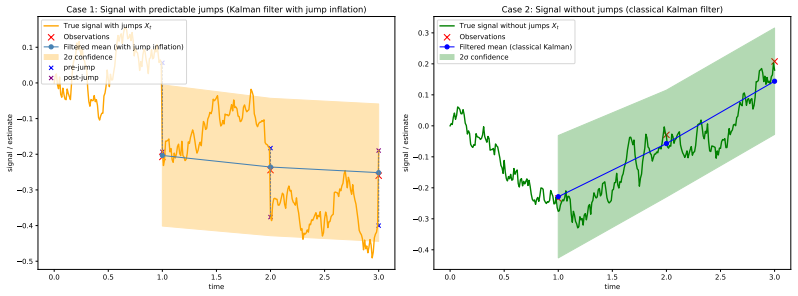
Filtering problems with jumps in both the signal and the observation have been extensively studied, typically under the assumption that jump times are totally inaccessible. In many applications, however, jump times are known in advance (i.e., predictable), such as scheduled clinical visits, dividend payment dates, or inspection times in engineering systems. Taking predictable jump times as a starting point, we investigate a filtering problem in which both the signal and the observations can exhibit jumps at predictable times. We derive the corresponding Kushner-Stratonovich and Zakai equations, thereby extending classical nonlinear filtering results to a setting with predictable discontinuities. We illustrate the framework on a Kalman filtering model with predictable jumps and on applications to longitudinal clinical studies, such as spinal muscular atrophy (SMA), as well as to machine learning models (neural jump ODEs) and credit risk.
0
0
math.FA 2026-05-13 Recognition

ISS open problem resolved via structured maximal regularity

Implications of structured continuous maximal regularity

When spatial norms differ from the supremum norm, estimates improve via weak compactness for abstract systems.

abstract click to expand
We study how maximal regularity estimates with respect to the continuous functions improve automatically in cases where the spatial norm is fundamentally different from the supremum norm. More precisely, we invoke properties such as weak compactness of convolution-type operators related to the mild solutions of the underlying linear evolution equations to sharpen the a priori estimates. These results have several applications: such as a new proof of Guerre-Delabriere's result on $\mathrm{L}^1$-maximal regularity and an extension of Baillon's theorem; a simplification for well-known perturbation theorems for generation of $\mathrm{C}_0$-semigroups; and we resolve an open problem on input-to-state stability from control theory for a general abstract class of systems.
0
0
math.FA 2026-05-13 Recognition

Conditions equate norm attainment and weak continuity for multilinear maps

Norm attainment for multilinear operators and polynomials on Banach Spaces and Banach lattices

Sufficient conditions on Banach spaces make every multilinear operator and polynomial attain its norm if and only if it is weakly sequential

abstract click to expand
We study norm attainment for multilinear operators and homogeneous polynomials between Banach spaces, as well as for positive multilinear operators between Banach lattices. We establish multilinear and polynomial versions of [23, Theorem B] and [35, Theorem 2.12]. More precisely, we provide sufficient conditions on Banach spaces $X_1, \dots, X_n$ and $Y$ ensuring that every $A \in \mathcal{L}(X_1, \dots, X_n; Y)$ (respectively, $P \in \mathcal{P}(^n X_1; Y)$) is weakly sequentially continuous if and only if it attains its norm. We also obtain analogous results for positive $n$-linear operators and positive $n$-homogeneous polynomials in the setting of Banach lattices.
0
0
math.QA 2026-05-13 2 theorems

Localized stated skein algebras equal quantum cluster algebras on polygons

Quantum cluster algebra realization for stated {rm SL}_n-skein algebras and rotation-invariant bases for polygons

The match supplies rotation-invariant bases from the theta basis, carrying positivity and natural parametrization.

Figure from the paper full image
abstract click to expand
We construct a quantum cluster structure on the skew-field of fractions ${\rm Frac}({\mathscr S}_\omega(\mathfrak{S}))$ of the stated ${\rm SL}_n$-skein algebra ${\mathscr S}_\omega(\mathfrak{S})$, where $\mathfrak{S}$ is a triangulable pb surface without interior punctures. This work complements the construction for the projected stated skein algebra $\widetilde{\mathscr S}_\omega(\mathfrak{S})$ given by the last two authors. Let ${\mathscr S}_\omega^{\rm fr}(\mathfrak{S})$ denote the localization of ${\mathscr S}_\omega(\mathfrak{S})$ at the multiplicative set generated by all frozen variables. Let ${\mathscr A}_\omega^{\rm fr}(\mathfrak{S})$ and ${\mathscr U}_\omega^{\rm fr}(\mathfrak{S})$ (respectively $\overline{\mathscr A}_\omega(\mathfrak{S})$ and $\overline{\mathscr U}_\omega(\mathfrak{S})$) denote the quantum cluster algebra and quantum upper cluster algebra associated to ${\rm Frac}({\mathscr S}_\omega(\mathfrak{S}))$ (respectively ${\rm Frac}(\widetilde{\mathscr S}_\omega(\mathfrak{S}))$). We prove that \[ \widetilde{\mathscr S}_\omega(\mathfrak{S}) = \overline{\mathscr A}_\omega(\mathfrak{S}) = \overline{\mathscr U}_\omega(\mathfrak{S}) \quad \text{and} \quad {\mathscr S}_\omega^{\rm fr}(\mathfrak{S}) = {\mathscr A}_\omega^{\rm fr}(\mathfrak{S}) = {\mathscr U}_\omega^{\rm fr}(\mathfrak{S}) \] whenever $\mathfrak{S}$ is a polygon. As a consequence, when $\mathfrak{S}$ is a polygon, we show that the theta basis of $\overline{\mathscr U}_\omega(\mathfrak{S})$ (respectively ${\mathscr U}_\omega^{\rm fr}(\mathfrak{S})$) yields a rotation-invariant basis of $\overline{\mathscr S}_\omega(\mathfrak{S})$ (respectively ${\mathscr S}_\omega^{\rm fr}(\mathfrak{S})$) with several desirable properties, including positivity and a natural parametrization.
0
0
math.AP 2026-05-13 2 theorems

Stability bounds enable point-source gas leak recovery

Leak localisation with a measure source convection-diffusion model

Convection-diffusion model with Radon measure and joint parameter estimation locates leaks from concentration data.

abstract click to expand
We study the inverse problem of locating gas leaks from line-of-sight concentration measurements using a convection-diffusion model with the source term a Radon measure. By imposing sparsity-promoting regularisation on this measure, we recover point sources - identifying both their locations and intensities - rather than diffuse approximations. We jointly estimate the underlying physical convection (wind) and diffusion parameters. Our main theoretical contribution is the stability analysis of the convection-diffusion equation with respect to its parameters: the measure, and the convection and diffusion fields. Numerically, we employ a semi-grid-free optimisation approach for reconstructing the source measure. Our experiments demonstrate accurate localisation, highlighting the potential of the method for practical gas emission detection.
0
0
math.NA 2026-05-13 2 theorems

Stochastic line-search method speeds 3D CT reconstruction

A Line--Search--Based Stochastic Gradient Method for 3D Computed Tomography

Mini-batches of full 2D projections cut early iteration time while preserving acquisition geometry and needing no training data.

Figure from the paper full image
abstract click to expand
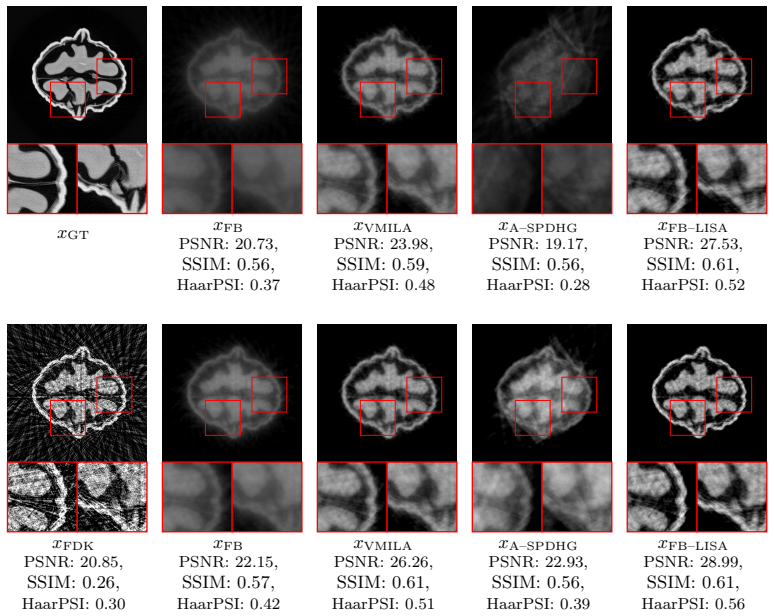
We introduce FB-LISA, a forward-backward (FB) generalization of a recently proposed line-search-based stochastic gradient algorithm to address the imaging problem of volumetric reconstruction in Computed Tomography, a substantially high demanding problem, which involves orders of magnitude of data, a high computational burden for forward and backprojection, and memory requirements that push current GPU architectures to their limits. Our formulation employs stochastic mini-batches composed of full 2D projections, preserving the physical structure of the acquisition process while enabling significant speed-ups during early iterations. The resulting method demonstrates how concepts traditionally associated with deep learning can be repurposed to accelerate large-scale inverse problems, without relying on training data or learned priors.
0
0
math.RT 2026-05-13 Recognition

Classifying real isometries where linear conjugacy equals orthogonal conjugacy

Conjugacy of Isometries in Real Orthogonal Groups

The work identifies exactly which orthogonal transformations on finite-dimensional real quadratic spaces satisfy the property.

abstract click to expand
We determine all orthogonal transformations of a quadratic space over reals such that any orthogonal transformation which is conjugate to one of them in the linear group is conjugate in the orthogonal group.
0
0
math.NA 2026-05-13 2 theorems

Mass lumping produces intrinsic fractional box discretization

Finite element and box-method discretizations for fractional elliptic problems with quadrature and mass lumping

A unified admissible inner product framework recovers the fractional box method from finite elements and supplies explicit error bounds that

Figure from the paper full image
abstract click to expand
We analyze numerical approximation of the fractional elliptic problem $L^{\beta}u=f$, ${\beta>0}$, where $L$ is a second-order self-adjoint elliptic operator with homogeneous Dirichlet or Neumann boundary conditions. The paper develops a unified conforming piecewise linear framework that covers both the standard finite element discretization and the box-method discretization of fractional powers. The key point is that the discrete fractional operator is defined with respect to an admissible inner product on the trial space. This includes, in particular, the standard $L^{2}$ inner product and the quadrature-based mass-lumped inner product, and we also identify a broader family of admissible inner products interpolating between these two realizations. Within this framework, we show that the mass-lumped choice yields the intrinsic fractional box discretization, namely the one obtained by taking fractional powers of the nonfractional box solution operator. For both the finite element and box-method realizations, we establish error estimates under natural consistency assumptions, making explicit the effect of load quadrature in the box case. The analysis applies directly to practical schemes and is supported by numerical experiments in one and two space dimensions.
0
0
math.CO 2026-05-13 2 theorems

Planar 4-regular graphs always have conflict-free cuts except the octahedron

Conflict-Free Cuts in Planar and 3-Degenerate Graphs with 1-Regular Conflicts

When edge conflicts form disjoint pairs, such a cut exists in every 4-regular planar graph but one; deciding existence is NP-complete at max

Figure from the paper full image
abstract click to expand
A conflict-free cut $F$ on a simple connected graph $G = (V, E)$ is defined as a set of edges $F \subseteq E$ such that $G-F$ is disconnected, and no two edges in $F$ are conflicting. The notion of conflicting edges is represented using an associated conflict graph $\widehat{G} = (\widehat{V}, \widehat{E})$ where $\widehat{V} = E$. Deciding if a given planar graph $G$, with an associated conflict graph $\widehat{G}$, has a conflict-free cut is known to be NP-complete, when $G$ has maximum degree four and $\widehat{G}$ is a line graph of $G$ [Bonsma, JGT 2009]. In this paper, we prove the following for the case when $\widehat{G}$ is 1-regular. * We completely resolve the complexity of the decision problem when $G$ is planar. Towards this end, we show that (a) there always exists a conflict-free cut when the graph is planar and 4-regular unless it is the octahedron graph and (b) the decision problem is NP-complete, even in the case when $G$ is planar with maximum degree 5. * We also show that the decision problem is NP-complete when $G$ is a 3-degenerate graph with maximum degree 5. This completely resolves the complexity status of the problem when $G$ is 3-degenerate. * We construct families of graphs with 1-regular conflict graphs that do not have a conflict-free cut. Our results answer the questions posed in [Rauch, Rautenbach and Souza, IPL 2025].
0
0
math.DG 2026-05-13 2 theorems

Systematic criteria found for curve singularities of finite multiplicity

Criteria and Curvatures for Singularities of Finite Multiplicities of Curves in boldsymbol{R}^N

The construction yields explicit tests up to multiplicity four in any dimension and extends curvature notions to recover uniqueness results.

Figure from the paper full image
abstract click to expand
First, this paper presents a systematic procedure for constructing criteria for singularities of curves of finite multiplicities in $\boldsymbol{R}^N$. Based on this method, we provide explicit criteria for singularities of multiplicities two, three, and four, including specific cusps appearing only in dimensions three or higher. Furthermore, we generalize the normalized curvature functions and the cuspidal curvature to singular curves in $\boldsymbol{R}^N$. Using these generalized curvatures, we reinterpret the existence and uniqueness theorem given by Fukui for curves in $\boldsymbol{R}^N$ of finite multiplicities.
0
0
math.AP 2026-05-13 2 theorems

Fractional p-Laplacian derivative yields logarithmic nonlocal operator

On the fractional logarithmic p-Laplacian

The resulting operator admits an integral formula that enables critical compactness and eigenvalue results in adapted spaces.

abstract click to expand
In this paper, we introduce and investigate the fractional logarithmic $p$-Laplacian $(-\Delta)_{p}^{s+\log}$, defined as the first-order derivative with respect to the parameter $t$ of the fractional $p$-Laplacian $(-\Delta)_{p}^{t}$ evaluated at $t=s$. We establish that this operator admits the following integral representation \[ \begin{aligned} (-\Delta)_{p}^{s+\log} u(x) &= B(N,s,p)(-\Delta)_{p}^{s}u(x)\\ &\quad -pC(N,s,p)\mathrm{P.V.}\int_{\mathbb{R}^{N}}\frac{|u(x)-u(y)|^{p-2}(u(x)-u(y))\ln |x-y|}{|x-y|^{N+sp}}dy, \end{aligned} \] where $C(N,s,p)$ denotes the standard normalization constant associated with the fractional $p$-Laplacian, and $B(N,s,p)=\frac{d}{ds}\left(\ln C(N,s,p)\right)$. As a consequence of this representation, it follows that the operator is nonlocal and of logarithmic type, and may be viewed as a nonlinear analogue of the fractional logarithmic Laplace operator recently introduced by Chen et al. \cite{Chen-Chen-Hauer}. We further develop the associated functional framework in both $\mathbb{R}^{N}$ and bounded Lipschitz domains by introducing the natural energy spaces adapted to problems driven by $(-\Delta)_{p}^{s+\log}$. Within this framework, fundamental functional inequalities are established, in particular Pohozaev-type identities and D\'{\i}az-Saa inequalities, which are of independent interest and applicable to a broader class of problems. Moreover, we derive results concerning density, continuity, and compact embedding properties. We emphasize that the compactness of the embedding is proved at the critical exponent $p^{*}_{s}=\frac{Np}{N-sp}$, which distinguishes the present setting from the classical Sobolev and fractional Sobolev frameworks. Finally, as an application, we investigate the associated Dirichlet eigenvalue problem and derive existence, uniqueness, and boundedness results for the corresponding solutions.
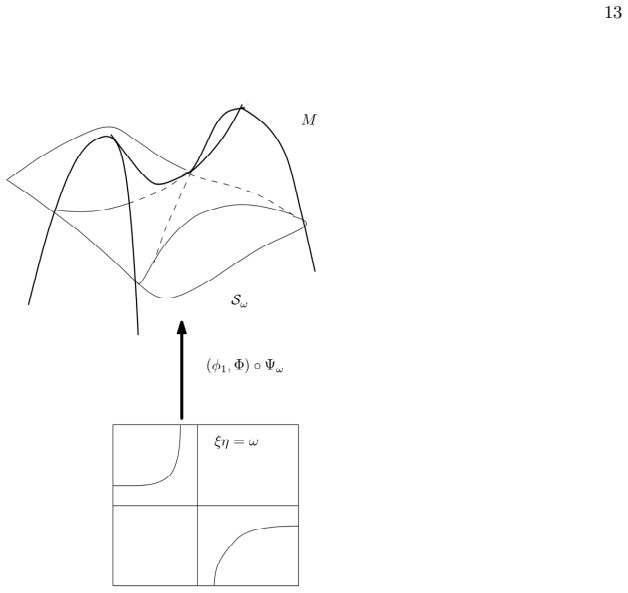
0
0
math.NA 2026-05-13 Recognition

Semismooth* Newton method speeds up TV regularization for large tomography problems

Efficient TV regularization of large-scale linear inverse problems via the SCD semismooth* Newton method with applications in tomography

The tailored SCD solver achieves locally superlinear convergence on nonsmooth TV penalties without smoothing approximations.

Figure from the paper full image
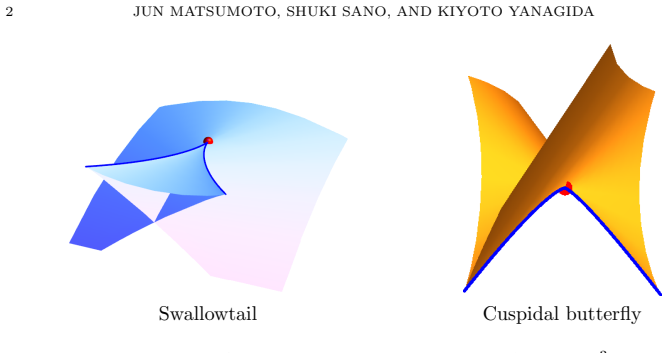
abstract click to expand
In this paper, we consider the efficient numerical minimization of Tikhonov functionals resulting from total-variation (TV) regularization of linear inverse problems. Since the TV penalty is non-smooth, this is typically done either via smooth approximations, which are inexact, or using non-smooth optimization techniques, which can often be numerically expensive, in particular for large-scale problems. Here, we present a numerically efficient minimization approach based on the recently proposed semismooth* Newton method, which employs a novel concept of graphical derivatives and exhibits locally superlinear convergence. The proposed approach is specifically tailored to TV regularization, suitable for large-scale inverse problems, and supported by strong mathematical convergence guarantees. Furthermore, we demonstrate its performance on two (large-scale) tomographic imaging problems and compare our results to those obtained via other state-of-the-art TV regularization approaches.
0
0
math.OC 2026-05-13 2 theorems

Self-exciting SDE control obeys a stochastic maximum principle

Stochastic control with self-exciting processes

Sufficient and necessary conditions via martingales replace dynamic programming for non-Markovian problems with event feedback.

Figure from the paper full image
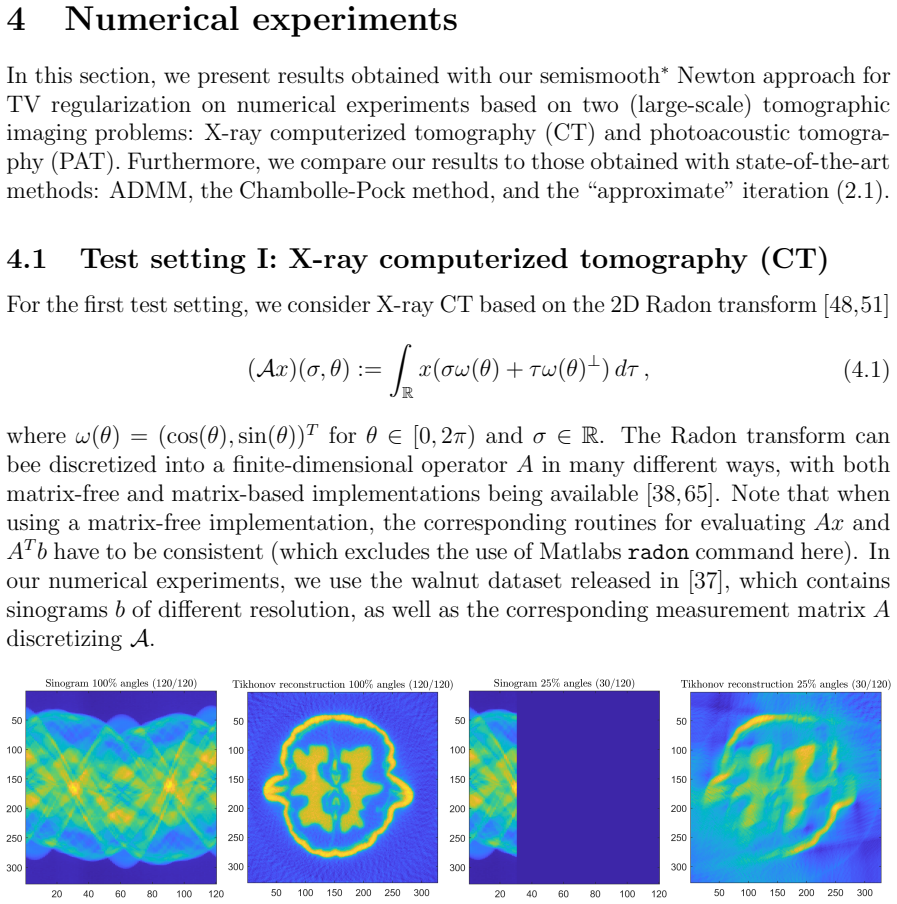
abstract click to expand
We analyze the problem of stochastic optimal control of SDEs where the driver includes a self-exciting stochastic process. Due to the non-Markovian nature of the problem, we apply the stochastic maximum principle approach. We derive a sufficient stochastic maximum principle under this framework. We also derive an expression via martingales of both the self-exciting process and its quadratic covariation. Furthermore, we derive a necessary maximum (equivalence principle) for the self-exciting stochastic control problem. Finally, we look at an application to log-utility.
0
0
math.OC 2026-05-13 2 theorems

Funnel control guarantees error bounds for drill bit velocity

Analysis and funnel control for nonlinear drill strings

The design adapts the reference for wave delays in the nonlinear PDE-ODE model, keeping tracking error inside a pre-set funnel as shown in 1

abstract click to expand
We study the output tracking problem for a vertically driven drill string system described by a nonlinear boundary-coupled PDE-ODE model. Solvability analysis of the drill string model is achieved by first casting the model in an abstract boundary value problem involving set-valued operators on an appropriate Hilbert space. The governing equation here consists of evolution and the damping part. Existence of solutions is established within the framework of maximal monotone operators where one first proves that the evolution operator is a linear skew-adjoint operator and the distributed damping term is a Nemytskii relation which is then proven to be maximal monotone. Maximal monotonicity of the combined operator is then a consequence of Rockafellar's theorem. Furthermore, we propose a novel funnel control design that ensures the angular velocity of the drill bit follows a dynamically adjusted reference trajectory, while the tracking error remains confined within a pre-specified performance funnel. The reference adjustment mechanism adapts in response to large wave traveling times that may cause performance degradation. The corresponding feasibility result is illustrated by some simulations.
0
0
math.CO 2026-05-13 2 theorems

Kneser chromatic number equals incidence-free number for projective planes

A note on the chromatic number of Kneser graphs on chambers of projective planes and incidence-free sets

An elementary matching theorem in symmetric designs shows the two quantities are identical for any such plane.

abstract click to expand
Let $D=(\mathcal{P},\mathcal{B})$ be a symmetric $(v,k,\lambda)$-design and let $(X,Y)$ be an equinumerous incidence-free pair, with $X\subseteq \mathcal{P}$ and $Y\subseteq \mathcal{B}$. In this note, we give an elementary proof which shows the existence of a perfect matching between $\mathcal{P} \setminus X$ and $\mathcal{B}\setminus Y$ in the incidence graph of $D$. This recovers a result of Spiro, Adriaensen and Mattheus, who already showed this using different arguments for $k\geq 36$. We use this to connect some dots in the literature and prove that finding the chromatic number of the Kneser graph on chambers of a projective plane is equivalent to finding the incidence-free number of the incidence graph of the plane.
0
0
math.PR 2026-05-13 3 theorems

ℓ_p-balls have intrinsic volumes given by one-dimensional integrals

Intrinsic volumes of ell_p-balls and a continuum of Maxwell--Poincar\'e--Borel laws for their curvature measures

Curvature measures yield limit laws in which scaled boundary coordinates become independent draws from an explicit distribution depending on

abstract click to expand
For $p>1$, we derive explicit formulas for the intrinsic volumes $V_0(\mathbb B_p^n),\dots,V_{n-1}(\mathbb B_p^n)$ of the $n$-dimensional $\ell_p$-balls $$ \mathbb B_p^n = \{x\in\mathbb R^n:\ |x_1|^p+\ldots+|x_n|^p\le 1\} $$ and, more generally, of their coordinate-weighted analogues. The formula is given in terms of a one-dimensional integral involving the special function $$ \mathcal F_p(t;\nu) = \int_{\mathbb R}|u|^\nu e^{-|u|^p-t|u|^{2p-2}}\,du. $$ Previously known formulas for the intrinsic volumes of ellipsoids, weighted crosspolytopes, and rectangular boxes arise as special or limiting cases. We also obtain asymptotic formulas for $V_{j(n)}(\mathbb B_p^n)$ in the high-dimensional regime $n\to\infty$, where the index $j(n)$ is allowed to depend on $n$. We further investigate the curvature measures of $\mathbb B_p^n$. These are finite measures $$ \Phi_0(\mathbb B_p^n,\cdot),\dots,\Phi_{n-1}(\mathbb B_p^n,\cdot) $$ on $\partial\mathbb B_p^n$ that localize the intrinsic volumes. We prove a Maxwell--Poincar\'{e}--Borel type limit theorem: if $X_n$ is a random boundary point of $\mathbb B_p^n$ distributed according to the normalized curvature measure $\Phi_{j(n)}(\mathbb B_p^n,\cdot)/V_{j(n)}(\mathbb B_p^n)$, where $j(n)/n\to\alpha\in[0,1]$ as $n\to\infty$, then for every fixed $r\in\mathbb N$, the joint distribution of the first $r$ coordinates of $n^{1/p}X_n$ converges weakly to the product measure $\nu_{p,\alpha}^{\otimes r}$. Here $\nu_{p,\alpha}$ is an explicit probability measure on $\mathbb R$ depending on $p>1$ and $\alpha\in[0,1]$. The main tool underlying these results is an explicit characterization of the curvature measures of coordinate-weighted $\ell_p$-balls, and in particular an explicit formula for their mixed moments.
0
0
math.NA 2026-05-13 2 theorems

New algorithm avoids invalid material mixtures during optimization

The SiMPL Method for Multi-Material Topology Optimization

A geometry-matched penalty on each update keeps one material per point by construction, then a small dual step meets global limits.

Figure from the paper full image
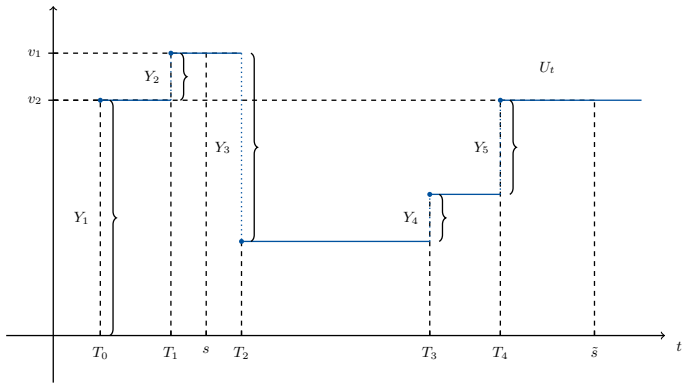
abstract click to expand
We introduce an efficient and scalable method for density-based multi-material topology optimization, integrating classical mirror descent techniques with point-wise polytopal design constraints. Such constraints arise naturally in this class of problems, wherein the vertices of convex polytopes correspond to distinct design states, only one of which should be occupied at each point in space. The framework generates a descending sequence of iterates by penalizing the design space around the previous iterate with a generalized distance function tailored to the convex geometry of the $n$-dimensional polytope. This distance function, called a Bregman divergence, smooths the optimization landscape, ensuring that each iterate strictly satisfies the point-wise constraints. Subsequently, global constraints (e.g., bounds on the structural mass) can be enforced easily by solving a small, finite-dimensional dual problem. The resulting method is simple to implement and demonstrates robustness and efficiency when combined with an Armijo-type line search algorithm. We validate the method in structural design problems involving the optimal arrangement of both isotropic and anisotropic materials, as well as magnetic flux optimization in electric motors.
0
0
math.OC 2026-05-13 2 theorems

Diversified routes nullify correlation value in energy resilience

Securing the Flow: Maritime Energy Resilience under Correlated and Decision-Dependent Disruptions

Indian maritime imports show the same hedging works for joint or single chokepoint disruptions across stress tests.

Figure from the paper full image
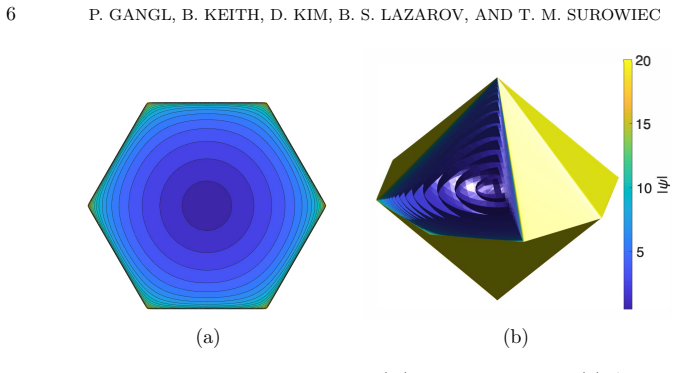
abstract click to expand
We develop a two-stage stochastic multi-commodity flow model to design a resilient maritime energy supply network under correlated chokepoint disruptions. A planner selects strategic inventories and infrastructure activations prior to uncertainty resolution, then routes crude oil, LNG, LPG, and fertilizer through a capacitated network. Three features distinguish this model: disruption scenarios are \emph{correlated}, reflecting the reality that proximate chokepoints (e.g., Hormuz, Bab el-Mandeb) fail jointly; scenario probabilities depend endogenously on first-stage decisions via affine distortion, formalizing \emph{risk exposure through utilization}; and a mean-CVaR objective mitigates tail-risk shortages. Methodologically, the decision-dependent probability model admits an exact MILP reformulation via McCormick linearization. CVaR preserves scenario-wise decomposability, and our Benders decomposition with corridor-based group-failure cuts converges finitely. The model is calibrated to Indian maritime energy imports (16 nodes, 28 arcs) using EIA, UNCTAD, World Bank, and operational data from the 2026 Hormuz crisis. Benders recovers the extensive-form optimum for scenario sizes up to $|S|=729$ with a constant iteration count (10-11). Empirically, the value of the stochastic solution (VSS) is 14.8%; the value of decision-dependent probabilities (VEP) ranges from 0.93% to 8.18%. The mean-CVaR frontier exhibits a design phase transition at confidence level $\alpha\approx 0.75$. Notably, the value of modeling correlation is identically zero across stress tests: the network's diversified portfolio absorbs joint-corridor disruptions using the same hedging mechanisms as single-corridor disruptions (\emph{structural joint-failure resilience}). Finally, LPG emerges as the most exposed commodity, whereas crude oil is fully hedgeable via reserves and pipeline bypasses.
0
0
math.RT 2026-05-13 Recognition

Nonvanishing character sets may control local behavior better than Sylow normalizers

Alperin's Main Problem of Block Theory

A framework for Alperin's 1976 problem uses Irr^x(G) and Sub_G(x) to link global and local data, recovering McKay's conjecture as a special

abstract click to expand
This paper proposes a conjectural framework for Alperin's Main Problem of Block Theory from 1976. The character sets considered here are defined by nonvanishing at given elements, not only by degree conditions. From this point of view, McKay's conjecture is usually recovered as a first degree-level consequence. The guiding idea is that the right local objects governing character values are not, in general, the sets ${\rm Irr}_{p'}(G)$ and the normalizers of Sylow $p$-subgroups, but rather the sets ${\rm Irr}^x(G)$ of irreducible characters not vanishing at a given element $x$, together with the subnormalizer subgroup ${\rm Sub}_G(x)$. I state the basic conjectures of this theory, propose stronger versions, and verify the main conjectures in several families, including the simple groups with TI Sylow $p$-subgroups. I also show how this perspective reorganizes several classical questions in character theory.
0
0
math.NA 2026-05-13 Recognition

Optimized two-step propagator cuts parareal convergence factor to 0.0064

Optimized Two-Step Coarse Propagators in Parareal Algorithms

Error-bound design yields faster iterations for parabolic PDE solvers at moderate cost.

abstract click to expand
In this work, we propose a novel framework for accelerating the parareal algorithm, in which the coarse propagator is formulated as a two-step method and optimized with respect to the convergence factor.} We derive a rigorous error estimate for the proposed two-step parareal algorithm, yielding an explicit bound on the linear convergence factor. This estimate is not only of theoretical interest: it provides a quantitative guideline for selecting and designing coarse propagators. Guided by this estimate, we {consider the linear parabolic equation as an illustrative example and }construct an optimized two-step coarse propagator~(O2CP) that delivers very fast convergence in practice. The resulting method attains an optimized convergence factor of approximately $0.0064$, substantially smaller than that of commonly used practical coarse propagators in the classical parareal setting, while keeping the computational cost moderate. Numerical experiments on linear and nonlinear parabolic equations fully support the theoretical analysis and demonstrate rapid convergence of the two-step parareal algorithm equipped with the O2CP.
0
0
math.AP 2026-05-13 Recognition

Unique weak solution exists near homogenized limit for small parameters

An H-convergence-based implicit function theorem for homogenization of nonlinear non-smooth elliptic systems

H-convergence of diffusion tensors plus non-degeneracy of the limit solution yields exactly one nearby solution to the heterogeneous problem

abstract click to expand
We consider homogenization of Dirichlet problems for semilinear elliptic systems with non-smooth data. We suppose that the diffusion tensors H-converge if the homogenization parameter tends to zero. Our result is of implicit function theorem type: For small homogenization parameter there exists exactly one weak solution close to a given non-degenerate weak solution to the homogenized problem. For the proofs we use gradient estimates of Meyers (if the space dimension is two) or Morrey (if the diffusion tensors are triangular) type for solutions to linear elliptic systems.
0
0
math.ST 2026-05-13 Recognition

Weaker likelihood ratio shapes still give stochastic orders

Stochastic Ordering under Weaker Likelihood-Ratio Shape Conditions

Unimodality or two sign changes in the ratio minus one preserve endpoint criteria for hazard-rate and usual orders.

Figure from the paper full image
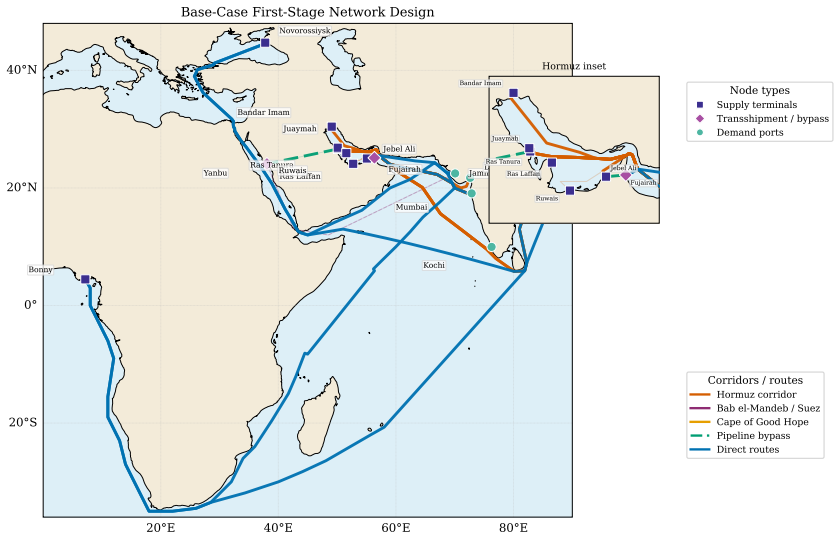
abstract click to expand
We show that the shape hypothesis on a likelihood ratio can be weakened while retaining endpoint criteria for the hazard-rate and usual stochastic orders. The endpoint reduction persists under unimodality of the likelihood ratio and under a sign-pattern condition on the likelihood ratio minus one, with at most two sign changes and a negative right tail. It also follows from a direct superlevel-set criterion involving the same expression, which is useful in particular for discontinuous likelihood ratios.
0
0
math.NT 2026-05-13 3 theorems

Weil group fails to make number fields K(π,1) spaces

Weil-Moore anima

A new anima with the Weil group as fundamental group adds higher homotopy to produce better-behaved cohomology.

abstract click to expand
The Weil group of a number field is a refinement of its absolute Galois group arising from class field theory. The passage from Galois to Weil is important in several places in number theory. However, we will argue that while from the Galois perspective, a number field is a ``K($\pi$,1)'', from the Weil perspective it is not. Thus we are led to further refine the Weil group, by constructing an object, the Weil-Moore anima, which has the Weil group as its fundamental group, but with nontrivial higher homotopy groups. Our motivation is that the cohomological properties of Weil-Moore anima are in several ways nicer than those of the Weil or Galois groups.
0
0
math.CO 2026-05-13 1 theorem

Asymptotics of t-union-free r-hypergraphs determined for most t,r

Sharp bounds for uniform union-free hypergraphs

The maximum edge count is pinned down up to lower-order terms, extending the only two cases previously known.

abstract click to expand
An $r$-uniform hypergraph is called $t$-union-free if any two distinct subsets of at most $t$ edges have distinct union. The study of union-free hypergraphs has multiple origins and a long history, dating back to the works of Kautz and Singleton (1964) in coding theory, Bollob\'as and Erd\H{o}s (1976) in combinatorics, and Hwang and S\'os (1987) in group testing. Let $U_t(n,r)$ denote the maximum number of edges in an $n$-vertex $t$-union-free $r$-uniform hypergraph. In this paper, we determine the asymptotic behavior of $U_t(n,r)$, up to a lower order term, for almost all $t\ge 3$ and $r\ge 3$. This significantly advances the understanding of this extremal function, as previously, only the asymptotics of $U_2(n,3)$ and $U_2(n,4)$ were known. As a key ingredient of our proof, we establish the existence of near-optimal locally sparse induced hypergraph packings, which is of independent interest.
0

browse all of math → full archive · search · sub-categories