REVIEW 4 major objections 5 minor 1 cited by
Physics consistent machine learning framework for inverse modeling with applications to ICF capsule implosions
T0 review · 4 major / 5 minor · reviewed 2026-08-10 · deepseek-v4-flash
Pith's one-line read A two-stage neural pipeline can recover initial conditions and equation-of-state parameters for ICF capsules from time series of noisy radiographs, then replay them through a hydrodynamics code to obtain density fields, shocks, and…
desk verdict A solid synthetic-data pipeline for inferring ICF parameters from radiographs, with honest limits that the abstract oversteps. read the letter →
The pith
A machine-rendered reading of the paper's core claim, the machinery that carries it, and where it could break.
The reading
What carries the argument
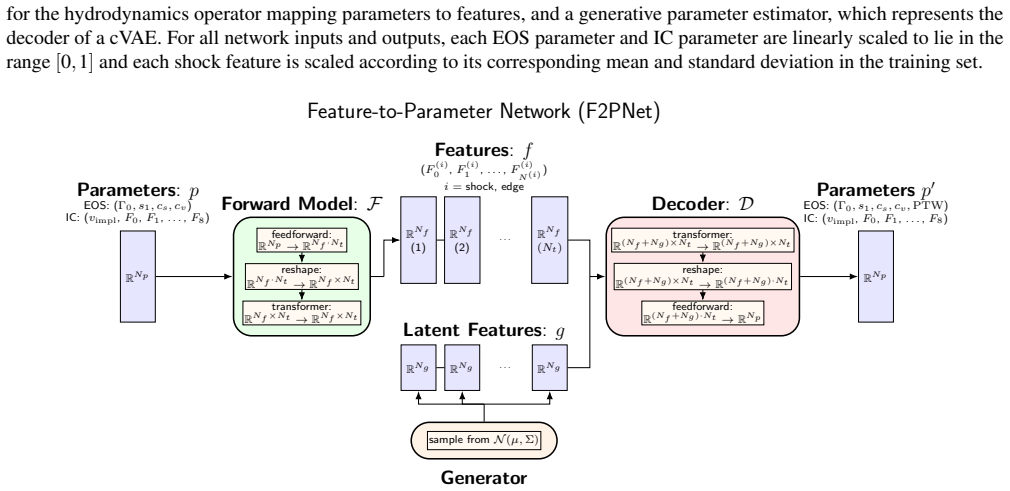
The load-bearing object is the cosine-harmonic feature representation of the outgoing shock and outer edge, computed by subpixel feature extraction from synthetic radiographs and compressed to $N^{\mathrm{shock}}=8$ and $N^{\mathrm{edge}}=5$ harmonics. This low-dimensional curve representation is what R2FNet learns to predict from noisy projections and what F2PNet learns to invert; the forward surrogate inside F2PNet, built with transformer layers, provides the parameters-to-features map that allows training with a self-consistency loss. The same features, once parameters are estimated, can be used to initialize a full-order hydrodynamics solve, which is what enforces thermodynamic and hydrodynamic consistency.
What would settle it
A direct test would be to take an experimentally recorded radiograph sequence from an ICF or double-shell implosion (or a synthetic radiograph generated with a substantially different EOS table, noise model, or perturbation profile outside the training cube), run the trained R2FNet-F2PNet pipeline, and compare the predicted shock/edge features and the hydro-code density fields against the measured or ground-truth fields; large feature errors or density RMSEs would falsify the claim that the sparse cosine representation is EOS-invariant and covers the relevant feature space.
Extended reading notes
Core claim
The central discovery is that a sparse set of hydrodynamic features—the radius of the outgoing shock and the outer material edge, each expanded as $\sum_j F_j^{(i)}\cos(2j\theta)$ with 8 and 5 harmonics respectively—forms an information bottleneck through which the inverse problem becomes tractable. From four noisy radiographs at times $n=25,30,35,40$, the R2FNet extracts these features; the F2PNet, a conditional variational autoencoder with a transformer-based forward surrogate, then produces a distribution of EOS parameters $\{c_s, s_1, \Gamma_0, c_V\}$ and initial-condition parameters (implosion velocity and harmonic coefficients $F_1,\dots,F_8$). The paper shows that these estimates, fed into the full hydrodynamics code, yield density fields and RMI topologies consistent with the ground truth to numerical accuracy, and that most parameters are recovered with high correlation on the test set, with $\Gamma_0$ and $c_V$ evidently not constrained by the late-time features.
Load-bearing premise
The approach assumes that the 14,400 synthetic simulations—built from 20 hand-chosen perturbation profiles, 4 velocities, and a coarse grid of Mie-Grüneisen parameters—cover the feature space of any real or alternative-EOS radiograph the network will see; the paper's own Sesame EOS result and the degraded leave-one-out performance on profile 20 show that this coverage can fail.
Editorial extensions
If this is right
- Estimated parameters can be fed into a full hydrodynamics solver rather than only a surrogate, yielding density fields, shock and edge locations, and RMI peak-to-trough growth that are consistent with the noisy radiographs.
- The 0th shock harmonic alone suffices to recover $v_{\mathrm{impl}}$, $s_1$, and $c_s$ with high correlation, so even a very degraded radiograph may still constrain these parameters.
- Parameter recovery degrades when features are taken only from later times, so early-time features (frames 25–40) carry more useful information; larger time spans improve inference.
- Features generated under the Tillotson EOS map onto Mie-Grüneisen parameters well enough to reproduce the density field, suggesting a single analytical EOS family can represent some unseen EOS models; the Sesame case shows the limitations.
- The generative decoder produces a distribution of parameter estimates, providing an uncertainty estimate along with the point prediction.
Reading between the lines
- Inference: a natural extension, one the paper does not carry out, is to use the same feature set as the observation operator in a Bayesian or variational data-assimilation loop on real experimental radiographs; the paper's synthetic-radiograph model would need validation against measured noise and scatter first.
- Inference: the insensitivity of $\Gamma_0$ and $c_V$ suggests that late-time shock and edge features alone cannot identify the full Mie-Grüneisen parameter set; adding an independent measurement (e.g., velocity interferometry or a material-release diagnostic) may be needed to constrain them.
- Inference: the leave-one-profile-out failure for profile 20 implies a practical rule for designing training sets: profiles should be chosen to cover feature-space clusters, not just parameter-space combinations; one could quantify this by clustering the cosine-harmonic features of prospective simulations.
- Inference: if the EOS-invariance claim holds more broadly, the framework could be used to map a tabular or unknown EOS onto a parameterized analytical model, effectively providing a reduced-order EOS surrogate for use in other simulations.
Signed reviews
Editorial analysis
A structured set of objections, weighed in public.
Referee Report
Summary. The paper proposes an ML pipeline for inferring initial conditions (implosion velocity and inner-surface perturbation harmonics) and Mie-Grüneisen EOS parameters (cs, s1, Γ0, cv) from a time series of noisy radiographs of an ICF capsule implosion. A radiograph-to-features network extracts sparse cosine-harmonic representations of the outgoing shock and outer edge, and a conditional-VAE/transformer features-to-parameters network predicts a posterior distribution over the parameters; a forward surrogate is jointly trained with a consistency loss. The authors test the pipeline on held-out synthetic cases, show that the estimated parameters, when fed into a full-order hydrodynamic solver, reproduce density fields, shock/edge features, and Richtmyer-Meshkov peak-to-trough growth within reported errors, and examine transfer to Tillotson and Sesame EOS models.
Significance. If the claims were fully supported, the framework would be a useful step toward quantitative inference of initial conditions and material parameters from radiographic sequences in HEDP, and the idea of closing the loop with a full-order hydrodynamic solver to enforce physical consistency is a valuable design principle. The paper provides a clear in-silico demonstration with a large simulation dataset, a two-stage radiograph-to-features and features-to-parameters architecture, and an external consistency check using a full-order hydrodynamics code. It also honestly reports model-mismatch and identifiability failures. However, the strong generalization and EOS-invariance claims go beyond the presented evidence, so the significance is real but more modest than the abstract suggests.
major comments (4)
- [Abstract and §3.3] The abstract states that 'features resulting from an unknown EOS model can be successfully mapped onto parameters of a chosen analytical EOS model, implying that network predictions are learning physics, with a degree of invariance to the underlying choice of EOS model,' yet the Sesame EOS case in Figure 11b shows large errors in the density field and shock, which the text attributes to out-of-distribution features. The 'degree of invariance' claim is therefore supported only by the Tillotson case, and the manuscript should qualify this claim or restrict it to EOS models whose features lie within the training manifold.
- [§3.1 and Tables 2–3] The reported correlation coefficients for Γ0 and cv are essentially zero across all training-set sizes and time-frame choices (e.g., Table 2, row 70%: Γ0 = 0.252, cv = -0.023), indicating that these parameters are not identifiable from the chosen features. The text in §3.1 acknowledges this, but the abstract and introduction state without qualification that the framework 'directly infer[s] such parameters' and 'accurately infer[s] initial conditions and EOS parameters.' The parameter-recovery claim should be restricted to the identifiable subset (vimpl, perturbation harmonics, s1, cs) or accompanied by a clear identifiability caveat.
- [§3.2, Figure 7] The leave-one-profile-out study shows that profile 20, which forms its own cluster in the feature space, leads to degraded parameter correlations (vimpl = 0.571, cs = 0.660). This is direct evidence that the pipeline interpolates within the sampled training manifold but does not generalize to initial-condition profiles that are not represented in the training set. Because one of the stated applications is an experimental diagnostic for unseen capsule perturbations, the generalizability claim should be tempered and the limitation stated explicitly in the abstract and conclusions.
- [§2.1 and §3.3] The training set is built from 20 discrete perturbation profiles, 4 velocities, and a coarse grid of EOS parameters, and the model-mismatch study demonstrates failure when a target EOS (Sesame) produces features outside this range. The framework should be presented as an interpolation tool within the training distribution, not as a general inverse-mapping method, unless additional coverage experiments (e.g., interpolation over a denser parameter grid or a larger profile library) are provided.
minor comments (5)
- [§3.1] The opening sentence refers to 'R2PNet' but the network is called R2FNet elsewhere in the paper; please make the acronym consistent.
- [§3.3 and Figure 13] The text contains the typo 'The the L2 errors', and the caption of Figure 13 as well as Section 3.3 use 'Mie-Grünieson'; the correct spelling is 'Mie-Grüneisen'.
- [Abstract and §4] The misspelling 'Ritchmeyer-Meshkov' appears in the abstract and in Section 4; the standard form is 'Richtmyer-Meshkov'.
- [Abstract and §4] The claim of being the 'first demonstration of recovering both thermodynamic and hydrodynamic consistent density fields from noisy radiographs' would benefit from a more explicit comparison with prior works (e.g., Refs. 47, 59, 62), since those works also recover density fields from noisy radiographs but without the full parameter-estimation-plus-hydrodynamics loop.
- [Data availability] The data availability statement says data are 'available from the corresponding author on reasonable request'; providing the trained network weights and the preprocessed feature datasets would improve reproducibility.
Circularity Check
No significant circularity: the parameter-recovery claim is validated on held-out simulations and with a full-order hydrodynamics solver, not by construction.
full rationale
The paper's derivation chain is a supervised train/test pipeline: synthetic radiographs are passed through R2FNet to predict shock/edge cosine-harmonic features, F2PNet maps those features to Mie-Grüneisen EOS parameters and initial conditions, and the recovered parameters are then run through a full-order hydrodynamics solver to produce density fields that are compared with ground-truth simulations on a held-out portion of the data. None of the tested quantities is used to define the network targets in a way that forces the comparison: the parameters are inferred from radiographic features, and the density fields are produced by a separate forward solve rather than by the networks. The self-consistency loss L_consistency is an internal training objective, and the paper separately evaluates against the true forward model in Section 3.3. Self-citations to Refs. [47, 59, 76] are contextual support for feature robustness and are not load-bearing for the central inverse-modeling result. The reported failures for profile 20 and for the Sesame EOS are explicit out-of-distribution coverage limitations, not evidence that a fitted quantity was renamed as a prediction. No equation or parameter in the paper reduces to its own input by construction, and no uniqueness theorem is imported from the authors' prior work. The claim of 'first demonstration' is an overstatement risk, but it is not a circularity.
Assumptions & free parameters
free parameters (5)
- Cosine harmonic truncation N_shock=8, N_edge=5
- Consistency loss weight alpha =
1 after pretraining (alpha=0)
- cVAE latent dimension, transformer depth, heads, feedforward sizes =
k=64, H=8, 2 transformer blocks, FFN inner dimension 2048 and hidden 200
- Number of generator latent samples per posterior estimate =
25
- Time frames used for training features =
Baseline {25,30,35,40}; alternatives tested
assumptions (7)
- domain assumption Compressible Euler equations without radiation govern the implosion, with air substituted for D-T fuel.
- domain assumption The Mie-Grüneisen EOS with fixed rho0 and T0 and unknown {cs, s1, Gamma0, cv} is adequate for the materials and regimes studied.
- domain assumption Azimuthal symmetry allows a 2D cylindrical description of a pseudo-3D implosion.
- domain assumption The synthetic radiograph model, including cone-beam projection, blur, scatter, and Poisson noise, produces images statistically similar to experimental radiographs.
- ad hoc to paper Maximal-gradient detection plus subpixel partial-area fitting identifies the true shock and outer edge, and truncation to 8 and 5 cosine harmonics preserves the information needed for parameter inference.
- ad hoc to paper A sufficiently expansive analytical EOS parameterization can represent an unknown EOS model, so features generated by another EOS can be mapped to MG parameters that reproduce the features.
- domain assumption The random 80/10/10 split of the 14,400 simulations produces a test set that represents the relevant feature space.
Cite this review
Pith. "Pith review of Physics consistent machine learning framework for inverse modeling with applications to ICF capsule implosions." pith.science (2026). https://pith.science/paper/CARHIFGH
@misc{pith2026241220192,
  author       = {Pith},
  title        = {Pith review of: Physics consistent machine learning framework for inverse modeling with applications to ICF capsule implosions},
  year         = {2026},
  howpublished = {\url{https://pith.science/paper/CARHIFGH}},
  note         = {Machine review of arXiv:2412.20192}
}
read the original abstract
In high energy density physics (HEDP) and inertial confinement fusion (ICF), predictive modeling is complicated by uncertainty in parameters that characterize various aspects of the modeled system, such as those characterizing material properties, equation of state (EOS), opacities, and initial conditions. Typically, however, these parameters are not directly observable. What is observed instead is a time sequence of radiographic projections using X-rays. In this work, we define a set of sparse hydrodynamic features derived from the outgoing shock profile and outer material edge, which can be obtained from radiographic measurements, to directly infer such parameters. Our machine learning (ML)-based methodology involves a pipeline of two architectures, a radiograph-to-features network (R2FNet) and a features-to-parameters network (F2PNet), that are trained independently and later combined to approximate a posterior distribution for the parameters from radiographs. We show that the estimated parameters can be used in a hydrodynamics code to obtain density fields and hydrodynamic shock and outer edge features that are consistent with the data. Finally, we demonstrate that features resulting from an unknown EOS model can be successfully mapped onto parameters of a chosen analytical EOS model, implying that network predictions are learning physics, with a degree of invariance to the underlying choice of EOS model.
Figures


Figures from the paper (10 more)


Forward citations
Cited by 1 Pith paper
-
Learning robust parameter inference and density reconstruction in flyer plate impact experiments
A conditional variational autoencoder can infer Mie-Grüneisen and P-alpha porosity parameters from radiographs, but only when trained on both low and high impact velocity data.
Reference graph
Works this paper leans on
-
[2]
Fryxell, B.et al.Flash: An adaptive mesh hydrodynamics code for modeling astrophysical thermonuclear flashes.The Astrophys. J. Suppl. Ser.131, 273 (2000)
work page 2000
-
[3]
Marinak, M., Haan, S., Dittrich, T., Tipton, R. & Zimmerman, G. A comparison of three-dimensional multimode hydrodynamic instability growth on various national ignition facility capsule designs with hydra simulations.Phys. Plasmas5, 1125–1132 (1998)
work page 1998
-
[4]
Zimmerman, G., Kershaw, D., Bailey, D. & Harte, J. Lasnex code for inertial confinement fusion. Tech. Rep., California Univ. (1977)
work page 1977
-
[5]
InAPS Division of Plasma Physics Meeting Abstracts, vol
Keller, D.et al.Draco—a new multidimensional hydrocode. InAPS Division of Plasma Physics Meeting Abstracts, vol. 41, BP1–39 (1999)
work page 1999
-
[6]
Haines, B. M.et al.The development of a high-resolution eulerian radiation-hydrodynamics simulation capability for laser-driven hohlraums.Phys. Plasmas29(2022)
work page 2022
-
[7]
McGlaun, J. M., Thompson, S. & Elrick, M. Cth: A three-dimensional shock wave physics code.Int. J. Impact Eng.10, 351–360 (1990)
work page 1990
-
[8]
Weseloh, W. N. Pagosa: a multi-dimensional, multi-material parallel hydrodynamics code for material flow and deformation (u). Tech. Rep., Los Alamos National Laboratory (LANL), Los Alamos, NM (United States) (2011)
work page 2011
-
[9]
Summers, R., Wong, M., Boucheron, E. & Weatherby, J. Alegra–a massively parallel h-adaptive code for solid dynamics. Tech. Rep., Sandia National Lab.(SNL-NM), Albuquerque, NM (United States) (1997)
work page 1997
Show all 74 references
-
[10]
review letters129, 075001 (2022)
Abu-Shawareb, H.et al.Lawson criterion for ignition exceeded in an inertial fusion experiment.Phys. review letters129, 075001 (2022). 11.Weber, C.et al.Improving ICF implosion performance with alternative capsule supports.Phys. Plasmas24(2017)
2022
-
[12]
13.Lindl, J
Gaffney, J.et al.A review of equation-of-state models for inertial confinement fusion materials.High Energy Density Phys.28, 7–24 (2018). 13.Lindl, J. Icf: recent achievements and perspectives.Il Nuovo Cimento A (1965-1970)106, 1467–1487 (1993). 14.Rosen, M. The physics of rad...
2018
-
[16]
Rosen, M. D. The physics issues that determine inertial confinement fusion target gain and driver requirements: A tutorial. Phys. Plasmas6, 1690–1699 (1999)
1999
-
[17]
Thomas, V . A. & Kares, R. J. Drive asymmetry and the origin of turbulence in an icf implosion.Phys. review letters109, 075004 (2012)
2012
-
[18]
& Hollenbach, R
Barker, L. & Hollenbach, R. Laser interferometer for measuring high velocities of any reflecting surface.J. Appl. Phys.43, 4669–4675 (1972)
1972
-
[19]
M.et al.Overview of the line-imaging visar diagnostic at the national ignition facility (nif)
Malone, R. M.et al.Overview of the line-imaging visar diagnostic at the national ignition facility (nif). InInternational Optical Design Conference, ThA5 (Optica Publishing Group, 2006)
2006
-
[20]
scientific instruments75, 4916–4929 (2004)
Celliers, P.et al.Line-imaging velocimeter for shock diagnostics at the omega laser facility.Rev. scientific instruments75, 4916–4929 (2004)
2004
-
[21]
McCoy, C. A. & Knudson, M. D. Lagrangian technique to calculate window interface velocity from shock velocity measurements: Application for quartz windows.J. Appl. Phys.122(2017). 15/18
2017
-
[22]
J., Gust, W
Ahrens, T. J., Gust, W. & Royce, E. Material strength effect in the shock compression of alumina.J. Appl. Phys.39, 4610–4616 (1968)
1968
-
[23]
& Lipkin, J
Asay, J. & Lipkin, J. A self-consistent technique for estimating the dynamic yield strength of a shock-loaded material.J. Appl. Phys.49, 4242–4247 (1978)
1978
-
[24]
& Asay, J
Lipkin, J. & Asay, J. Reshock and release of shock-compressed 6061-t6 aluminum.J. applied physics48, 182–189 (1977)
1977
-
[25]
& Ding, J
Brown, J., Alexander, C., Asay, J., V ogler, T. & Ding, J. Extracting strength from high pressure ramp-release experiments. J. Appl. Phys.114(2013)
2013
-
[26]
F., Blewett, P
Barnes, J. F., Blewett, P. J., McQueen, R. G., Meyer, K. A. & Venable, D. Taylor instability in solids.J. Appl. Phys.45, 727–732 (1974)
1974
-
[27]
& Weber, S
Colvin, J., Legrand, M., Remington, B., Schurtz, G. & Weber, S. A model for instability growth in accelerated solid metals. J. applied physics93, 5287–5301 (2003). 28.Barton, N. R.et al.A multiscale strength model for extreme loading conditions.J. applied physics109(2011). 29....
2003
-
[30]
R., Cela, J
Piriz, A. R., Cela, J. L., Tahir, N. A. & Hoffmann, D. H. Richtmyer-meshkov instability in elastic-plastic media.Phys. Rev. E78, 056401 (2008)
2008
-
[31]
Piriz, A., Cela, J. L. & Tahir, N. Richtmyer–meshkov instability as a tool for evaluating material strength under extreme conditions.Nucl. Instruments Methods Phys. Res. Sect. A: Accel. Spectrometers, Detect. Assoc. Equip.606, 139–141 (2009)
2009
-
[32]
review letters107, 264502 (2011)
Dimonte, G.et al.Use of the richtmyer-meshkov instability to infer yield stress at high-energy densities.Phys. review letters107, 264502 (2011)
2011
-
[33]
Fluid Mech.703, 60–84 (2012)
Buttler, W.et al.Unstable richtmyer–meshkov growth of solid and liquid metals in vacuum.J. Fluid Mech.703, 60–84 (2012)
2012
-
[34]
L., Lombardini, M., Pullin, D
Ortega, A. L., Lombardini, M., Pullin, D. & Meiron, D. Numerical simulations of the richtmyer-meshkov instability in solid-vacuum interfaces using calibrated plasticity laws.Phys. Rev. E89, 033018 (2014). 35.Mikaelian, K. O. Shock-induced interface instability in viscous fluid...
2014
-
[36]
Plohr, J. N. & Plohr, B. J. Linearized analysis of richtmyer–meshkov flow for elastic materials.J. Fluid Mech.537, 55–89 (2005)
2005
-
[37]
B.et al.Using richtmyer–meshkov instabilities to estimate metal strength at very high rates
Prime, M. B.et al.Using richtmyer–meshkov instabilities to estimate metal strength at very high rates. InDynamic Behavior of Materials, Volume 1: Proceedings of the 2015 Annual Conference on Experimental and Applied Mechanics, 191–197 (Springer, 2016)
2015
-
[38]
Thomas, V . A. & Kares, R. J. Drive asymmetry, turbulence and ignition failure in high convergence icf implosions. Tech. Rep., Los Alamos National Laboratory (LANL), Los Alamos, NM (United States) (2013)
2013
-
[39]
Plasmas27(2020)
Weber, C.et al.Mixing in icf implosions on the national ignition facility caused by the fill-tube.Phys. Plasmas27(2020)
2020
-
[40]
Experimental study of the initial conditions of the rayleigh-taylor instability at the ablation front in inertial confinement fusion
Delorme, B. Experimental study of the initial conditions of the rayleigh-taylor instability at the ablation front in inertial confinement fusion. Tech. Rep., Universite de Bordeaux (2015)
2015
-
[41]
Plasmas26 (2019)
Zhou, Y .et al.Turbulent mixing and transition criteria of flows induced by hydrodynamic instabilities.Phys. Plasmas26 (2019)
2019
-
[42]
Proano, E. S. & Rollin, B. Toward a better understanding of hydrodynamic instabilities in inertial fusion approaches. In 53rd AIAA/SAE/ASEE Joint Propulsion Conference, 4676 (2017). 43.Schaeffer, D. B.et al.Proton imaging of high-energy-density laboratory plasmas.Rev. Mod. Phy...
2017
-
[45]
& Tommasini, R
Kozioziemski, B., Bachmann, B., Do, A. & Tommasini, R. X-ray imaging methods for high-energy density physics applications.Rev. Sci. Instruments94(2023)
2023
-
[46]
review letters74, 3608 (1995)
Endo, T.et al.Dynamic behavior of rippled shock waves and subsequently induced areal-density-perturbation growth in laser-irradiated foils.Phys. review letters74, 3608 (1995)
1995
-
[47]
A., Klasky, M
Serino, D. A., Klasky, M. L., Nadiga, B. T., Xu, X. & Wilcox, T. Reconstructing Richtmyer-Meshkov instabilities from noisy radiographs using low dimensional features and attention-based neural networks.Opt. Express32, 43366–43386, DOI: 10.1364/OE.538495 (2024). 16/18
2024 doi
-
[48]
& Luo, X
Zhai, Z., Zou, L., Wu, Q. & Luo, X. Review of experimental richtmyer–meshkov instability in shock tube: from simple to complex.Proc. Inst. Mech. Eng. Part C: J. Mech. Eng. Sci.232, 2830–2849 (2018)
2018
-
[49]
A.et al.Studying the richtmyer–meshkov instability in convergent geometry under high energy density conditions using the decel platform.Phys
Yager-Elorriaga, D. A.et al.Studying the richtmyer–meshkov instability in convergent geometry under high energy density conditions using the decel platform.Phys. Plasmas29(2022)
2022
-
[50]
Do, A.et al.High spatial resolution and contrast radiography of hydrodynamic instabilities at the national ignition facility. Phys. Plasmas29(2022)
2022
-
[51]
& Luo, X
Si, T., Long, T., Zhai, Z. & Luo, X. Experimental investigation of cylindrical converging shock waves interacting with a polygonal heavy gas cylinder.J. Fluid Mech.784, 225–251 (2015)
2015
-
[52]
Shock-interface interaction: current research on the Richtmyer-Meshkov problem
Rupert, V . Shock-interface interaction: current research on the Richtmyer-Meshkov problem. InShock Waves: Proceedings of the 18th International Symposium on Shock Waves, Held at Sendai, Japan 21–26 July 1991, 83–94 (Springer, 1992). 53.Brouillette, M. The Richtmyer-Meshkov in...
2002
-
[54]
D: Nonlinear Phenom.423, 132838 (2021)
Zhou, Y .et al.Rayleigh–Taylor and Richtmyer–Meshkov instabilities: A journey through scales.Phys. D: Nonlinear Phenom.423, 132838 (2021)
2021
-
[55]
Leinov, E.et al.Experimental and numerical investigation of the Richtmyer–Meshkov instability under re-shock conditions. J. Fluid Mech.626, 449–475 (2009)
2009
-
[56]
L.et al.Richtmyer–Meshkov instability growth: experiment, simulation and theory.J
Holmes, R. L.et al.Richtmyer–Meshkov instability growth: experiment, simulation and theory.J. Fluid Mech.389, 55–79 (1999)
1999
-
[57]
Rayleigh–Taylor and Richtmyer–Meshkov instability induced flow, turbulence, and mixing
Zhou, Y . Rayleigh–Taylor and Richtmyer–Meshkov instability induced flow, turbulence, and mixing. II.Phys. Reports 723, 1–160 (2017)
2017
-
[58]
& Graham, M
Zhang, Q. & Graham, M. J. A numerical study of Richtmyer–Meshkov instability driven by cylindrical shocks.Phys. Fluids10, 974–992 (1998)
1998
-
[59]
Express30, 14432–14452 (2022)
Hossain, M.et al.High-precision inversion of dynamic radiography using hydrodynamic features.Opt. Express30, 14432–14452 (2022)
2022
-
[60]
D., Kolev, T
Bello-Maldonado, P. D., Kolev, T. V ., Rieben, R. N. & Tomov, V . Z. A matrix-free hyperviscosity formulation for high-order ale hydrodynamics.Comput. & Fluids205, 104577 (2020)
2020
-
[61]
A., Klasky, M., Burby, J
Serino, D. A., Klasky, M., Burby, J. W. & Schei, J. L. Density reconstruction from noisy radiographs using an attention- based transformer network. InOptica Imaging Congress (3D, COSI, DH, FLatOptics, IS, pcAOP), JW2A.4 (Optica Publishing Group, 2023)
2023
-
[62]
Nadiga, B. T. & Klasky, M. L. Degeneracy and deterministic/probabilistic inversions of radiographic data. LA-UR-23-25917 (2023). Sponsor: USDOE National Nuclear Security Administration (NNSA) ; USDOE ; LDRD
2023
-
[63]
Le Pape, S.et al.Observation of a reflected shock in an indirectly driven spherical implosion at the national ignition facility.Phys. Rev. Lett.112, 225002 (2014). 64.Asch, M., Bocquet, M. & Nodet, M.Data assimilation: methods, algorithms, and applications(SIAM, 2016). 65.Smit...
2014
-
[66]
& Liu, M
Cai, Z., Chen, J. & Liu, M. Least-squares relu neural network (lsnn) method for scalar nonlinear hyperbolic conservation law.Appl. Numer. Math.174, 163–176 (2022)
2022
-
[67]
T., Ghattas, O., Heinkenschloss, M
Biegler, L. T., Ghattas, O., Heinkenschloss, M. & van Bloemen Waanders, B. Large-scale pde-constrained optimization: an introduction. InLarge-scale PDE-constrained optimization, 3–13 (Springer, 2003)
2003
-
[68]
K., Southworth, B
Tran, B. K., Southworth, B. S. & Leok, M. On properties of adjoint systems for evolutionary pdes.J. Nonlinear Sci.34, 95 (2024)
2024
-
[69]
& Karniadakis, G
Raissi, M., Perdikaris, P. & Karniadakis, G. E. Physics-informed neural networks: A deep learning framework for solving forward and inverse problems involving nonlinear partial differential equations.J. Comput. physics378, 686–707 (2019)
2019
-
[70]
Cuomo, S.et al.Scientific machine learning through physics–informed neural networks: Where we are and what’s next.J. Sci. Comput.92, 88 (2022)
2022
-
[71]
A.et al.Data-driven prediction of scaling and ignition of inertial confinement fusion experiments.Phys
Gaffney, J. A.et al.Data-driven prediction of scaling and ignition of inertial confinement fusion experiments.Phys. Plasmas31, 092702, DOI: 10.1063/5.0215962 (2024). https://pubs.aip.org/aip/pop/article-pdf/doi/10.1063/5.0215962/ 20162047/092702_1_5.0215962.pdf. 17/18
2024 doi
-
[72]
& Libby, S
Gaffney, J., Clark, D., Sonnad, V . & Libby, S. Development of a bayesian method for the analysis of inertial confinement fusion experiments on the nif.Nucl. Fusion53, 073032, DOI: 10.1088/0029-5515/53/7/073032 (2013)
2013 doi
-
[73]
Hatfield, P.et al.Using sparse gaussian processes for predicting robust inertial confinement fusion implosion yields.IEEE Transactions on Plasma Sci.48, 14–21, DOI: 10.1109/TPS.2019.2944416 (2020)
2020
-
[74]
& Peterson, J
Wang, J., Chiang, N., Gillette, A. & Peterson, J. L. A multifidelity bayesian optimization method for inertial confinement fusion design.Phys. Plasmas31, 032706, DOI: 10.1063/5.0191543 (2024). https://pubs.aip.org/aip/pop/article-pdf/doi/10. 1063/5.0191543/19850210/032706_1_5....
2024 doi
-
[75]
Knapp, P. F. & Lewis, W. E. Advanced data analysis in inertial confinement fusion and high energy density physics. Rev. Sci. Instruments94, 061103, DOI: 10.1063/5.0128661 (2023). https://pubs.aip.org/aip/rsi/article-pdf/doi/10.1063/5. 0128661/17972327/061103_1_5.0128661.pdf
2023 doi
-
[76]
Gautam, S.et al.Learning robust features for scatter removal and reconstruction in dynamic icf x-ray tomography.arXiv preprint arXiv:2408.12766(2024)
2024
-
[77]
C.et al.Experimental study of energy transfer in double shell implosions.Phys
Merritt, E. C.et al.Experimental study of energy transfer in double shell implosions.Phys. Plasmas26, 052702, DOI: 10. 1063/1.5086674 (2019). https://pubs.aip.org/aip/pop/article-pdf/doi/10.1063/1.5086674/15643290/052702_1_online.pdf
2019 doi
-
[78]
Hertel, E. S. Jr. & Kerley, G. I. CTH Reference Manual: The Equation of State Package. report SAND98-0947, Sandia National Laboratories (1998)
1998
-
[79]
Ultramicroscopy157, 35–47, DOI: https://doi.org/10.1016/j.ultramic.2015.05.002 (2015)
van Aarle, W.et al.The ASTRA toolbox: A platform for advanced algorithm development in electron tomography. Ultramicroscopy157, 35–47, DOI: https://doi.org/10.1016/j.ultramic.2015.05.002 (2015)
2015 doi
-
[80]
& Santana-Cedrés, D
Trujillo-Pino, A., Krissian, K., Alemán-Flores, M. & Santana-Cedrés, D. Accurate subpixel edge location based on partial area effect.Image Vis. Comput.31, 72–90, DOI: https://doi.org/10.1016/j.imavis.2012.10.005 (2013)
2013 doi
-
[81]
Tillotson, J. H. Metallic equations of state for hypervelocity impact.Gen. At. Rep. GA-3216. 1962. Tech. Rep.3216 (1962)
1962
-
[82]
The sesame database
Johnson, J. The sesame database. Tech. Rep. LA-UR-94-1451, Los Alamos National Lab.(LANL), Los Alamos, NM (United States) (1994)
1994
-
[83]
In2022 IEEE/CVF Conference on Computer Vision and Pattern Recognition (CVPR), 16272–16282, DOI: 10.1109/CVPR52688.2022.01581 (2022)
Whang, J.et al.Deblurring via stochastic refinement. In2022 IEEE/CVF Conference on Computer Vision and Pattern Recognition (CVPR), 16272–16282, DOI: 10.1109/CVPR52688.2022.01581 (2022)
2022
-
[84]
& Simonyan, K
Brock, A., Donahue, J. & Simonyan, K. Large scale gan training for high fidelity natural image synthesis (2019). 1809.11096. 85.Kingma, D. P. & Ba, J. Adam: A method for stochastic optimization (2017). 1412.6980. 86.Kingma, D. P. & Welling, M. Auto-encoding variational Bayes.C...
2019 arXiv
-
[87]
P., Marins, M
Cinelli, L. P., Marins, M. A., Da Silva, E. A. B. & Netto, S. L.Variational methods for machine learning with applications to deep networks(Springer, 2021)
2021
-
[88]
P., Mohamed, S., Jimenez Rezende, D
Kingma, D. P., Mohamed, S., Jimenez Rezende, D. & Welling, M. Semi-supervised learning with deep generative models. Adv. Neural Inf. Process. Syst.27(2014)
2014
-
[89]
In Guyon, I.et al.(eds.)Advances in Neural Information Processing Systems, vol
Vaswani, A.et al.Attention is all you need. In Guyon, I.et al.(eds.)Advances in Neural Information Processing Systems, vol. 30 (Curran Associates, Inc., 2017). Acknowledgements This work was supported by the Laboratory Directed Research and Development program of Los Alamos Na...
2017
Reviewed August 10, 2026 · model on record in the stance chip above.
Discussion (0). Continue with ORCID to comment.