REVIEW 5 major objections 6 minor 59 references
A Statistical Test for Comparing the Linkage and Admixture Model Based on Central Limit Theorems
T0 review · 5 major / 6 minor · reviewed 2026-08-04 · deepseek-v4-flash
Pith's one-line read A likelihood-ratio test for choosing between linkage and admixture genetic models is proven to be an asymptotic level-alpha test.
desk verdict The advertised level-alpha test is not proven—boundary problem at r=∞ breaks the Wilks argument—but the consistency and CLT results for the Linkage Model are real contributions worth a referee's time. read the letter →
The pith
A machine-rendered reading of the paper's core claim, the machinery that carries it, and where it could break.
The reading
What carries the argument
The test statistic Lambda = -2 log(LR) (Definition 2.4) is the central object. Its asymptotic behavior is inherited from the asymptotic normality of the MLE, which is established via the representation of the log-likelihood as a sum of conditional log-likelihood increments and a martingale central limit theorem for the score. The transition matrix of the hidden ancestry chain (equation 2) is the core mechanism: it defines the Linkage Model, has q as its invariant measure at every marker, and is uniformly ergodic under the paper's assumptions, which is what makes the martingale arguments work.
What would settle it
Simulate data under the Admixture Model (r = infinity) with K = 3 populations and many markers satisfying Assumption 3.1, and estimate the distribution of Lambda. If the empirical Type I error does not approach the nominal level alpha as the number of markers grows, Theorem 3 is false. Alternatively, exhibit two different pairs (q, r) with K = 3 that produce identical marginal distributions for the observed alleles, which would refute the identifiability assumption on which the MLE theory rests.
Extended reading notes
Core claim
The central claim of the paper is Theorem 3: the test statistic Lambda = -2 log(LR) converges in distribution to a chi-square distribution with one degree of freedom under the null hypothesis that the recombination parameter r is infinite, so the test that rejects when Lambda exceeds the 1-alpha quantile is an asymptotic level-alpha test. This is obtained by first proving that the maximum likelihood estimator in the Linkage Model is consistent (Theorem 1) and asymptotically normal (Theorem 2), and then invoking classical likelihood-ratio asymptotics. The key technical step is a martingale central limit theorem for the score function, using the fact that the hidden Markov chain is uniformly e
Load-bearing premise
The paper assumes, without proof for K > 2, that the parameters (q, r) are identifiable from the marginal distribution of the observations; it also invokes classical likelihood-ratio asymptotics even though the null value r = infinity lies on the boundary of the parameter space, where that asymptotics is not automatically valid.
Editorial extensions
If this is right
- The test offers a data-driven way to choose between the Admixture Model and the Linkage Model for a given individual or population, with an asymptotically controlled false-rejection rate.
- The central limit theorem provides the first uncertainty quantification for MLEs of ancestry and recombination rate in the Linkage Model, enabling confidence regions for these quantities.
- The consistency and uniqueness results extend known asymptotic theory for the Admixture Model to the Linkage Model, covering hidden Markov models with time-inhomogeneous transitions but a constant stationary distribution.
- Applied to real human genetic data, the test indicates that the Admixture Model is sufficient for a minority of individuals, with substantial variation across continental groups, so a single global model choice is not appropriate.
Reading between the lines
- The boundary issue: because the null value r = infinity lies at the boundary of the parameter space, the chi-square approximation may need modification; this is an editorial concern, not addressed in the paper.
- The identifiability gap: the proof of identifiability is given only for K = 2; for K > 2 the paper assumes it, so the general-K results rest on an unproven premise.
- Power limitations: for large recombination rates r or small genetic distances d, the Linkage and Admixture models become nearly indistinguishable, so the test's power is expected to drop; this is consistent with the paper's own simulation results.
- A practical extension would be to use the test to select marker sets that maximize power to detect linkage, or to adapt it to unsupervised settings where allele frequencies are estimated.
Signed reviews
Editorial analysis
A structured set of objections, weighed in public.
Referee Report
Summary. The paper defines the Linkage Model as a time-inhomogeneous hidden Markov model with stationary distribution q, and the Admixture Model as its r=∞ limit. It claims consistency (Theorem 1) and asymptotic normality (Theorem 2) of the MLE for (q,r) under Assumption 3.1, and then, invoking Wilks (1938), claims in Theorem 3 that the likelihood-ratio test statistic Λ for H0:r=∞ versus H1:r<∞ converges in distribution to χ²(1) under H0, making the test an asymptotic level-α test. The paper also reports simulations and a real-data application to 1000 Genomes data with K=5 and C=20.
Significance. If the central claims were correct, the paper would fill a real gap in MLE asymptotics for an inhomogeneous HMM whose stationary distribution is constant across time, and would provide the first model-selection test between the Admixture and Linkage Models with a stated asymptotic error rate. The author provides code and attempts numerical evaluation. However, the central theorem depends on an invalid application of Wilks' theorem to a boundary null with singular Fisher information, and on an unproved identifiability assumption for K>2. As it stands, the claimed distributional result and therefore the level-α justification are not established.
major comments (5)
- [Section 3, Theorem 3 and Definition 2.4] The null hypothesis r=∞ lies on the boundary of Θ=[r_lb,∞], not in the interior. Moreover, the transition probabilities depend on r only through e^{-d_m r}, whose derivatives with respect to r vanish at r=∞. Hence the Fisher information J(q0,∞) is not positive definite, and Theorem 2 — which explicitly requires interior parameters and J≻0 — cannot be applied under H0. The sentence 'According to Wilks (1938)...' does not verify any of Wilks' conditions. Standard boundary asymptotics (Self and Liang 1987) give a mixture distribution with point mass at 0, not χ²(1). The simulation in Sec. 4.1 (100 replicates per cell; type-1 error 'below 0.05') is consistent with a conservative boundary mixture and does not validate the χ²(1) claim.
- [Section 5.1, after Lemma 5.1] For general K>2, identifiability of (q,r) from the marginal distribution is assumed without proof: 'we will, without a proof, just assume that the parameters are identifiable... The proof is basically the same.' This is load-bearing: identifiability is used for uniqueness of the MLE (Theorem 4), consistency (Theorem 1), and the CLT (Theorem 2), and is also needed for the real-data application with K=5. The Kruskal-type rank conditions for K>2 are not stated, and no proof is provided.
- [Section 5.1, Lemma 5.1] The algebraic analysis of the K=2 identifiability proof is incorrect in a stated detail. For the displayed matrix B2, det(B2)=q1 p1,2 −(1−q1)p2,2, which vanishes when q1=p2,2/(p1,2+p2,2), not when q1=p1,2/(p1,2+p2,2) as written. Thus the rank condition excludes a different value of q from the one stated, and the proof does not establish full rank for all admissible q. The claim that the second factor in det(M1) has roots outside [0,1] may be true, but the surrounding rank analysis therefore remains incomplete.
- [Section 5.3, Proposition 5.10] The proof asserts that the three conditions of the martingale CLT in Hall and Heyde (2014) 'follow directly' from uniform boundedness, but conditional variance convergence and the Lindeberg condition are never verified. More seriously, the object M_n as displayed does not appear to be a martingale: it is a sum Σ N_k plus a terminal conditional-expectation correction, not a sum of martingale differences; E[M_n−M_{n−1} | F_{n−1}] is not shown to vanish. In addition, the score ∇D is vector-valued, while σ_n is treated as scalar. Hence the proof of Theorem 2 is incomplete even for finite r.
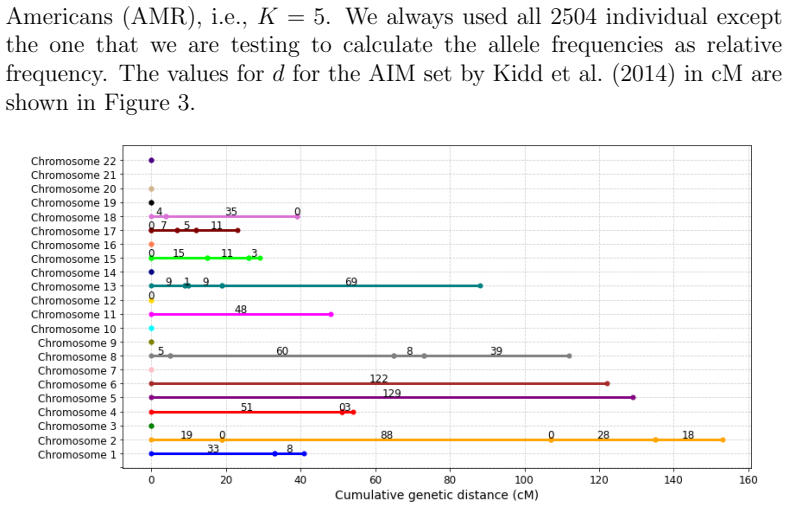
- [Section 4.2 versus Assumption 3.1] The real-data application violates Assumption 3.1, which fixes C=1 and haploid individuals. The 1000 Genomes analysis uses C=20 and diploid individuals, and the allele frequencies are estimated from the remaining individuals rather than being known. No extension theorem is proved. Consequently the reported real-data results are not covered by Theorems 1–3.
minor comments (6)
- [General] 'Fischer information' should be 'Fisher information' throughout (e.g., Theorem 2, Remark 3.3).
- [Section 5.1, Lemma 5.5] The definition of h_i is garbled: 'h_i = 1− fi−1 Eπ0(fi)−1' is not readable. Please clarify the formula and the role of f_i.
- [Section 4.1] Only 100 simulation replicates are used per cell. At a nominal 5% level, the Monte Carlo standard error is about 2.2 percentage points, so 'type-1 error below 0.05' cannot be distinguished from 0.05 and is not evidence for the χ²(1) approximation.
- [Assumption 3.1 / A3] Assumption 3.1 sets C=1, but condition (A3) is written with a product over c=1,...,C. The notation is inconsistent. Also, since each λ_{c,m}<1 under Assumption 3.1, the product automatically tends to 0, so the intended condition and its role in the proofs should be clarified.
- [Definition 2.1] The parameter space Θ includes r=∞, making it non-compact as a subset of R^{K+1}. The paper should state explicitly how maxima over this extended parameter space are defined and why they exist.
- [Section 2, Definition 2.4] The test statistic maximizes over q∈S^K in the numerator but over Θ in the denominator. Since Θ includes r=∞, the numerator is a restricted version of the denominator; this is fine, but the existence and uniqueness of all maximizers should be stated.
Circularity Check
No significant circularity: the derivation is a conventional MLE/CLT plus Wilks chain; unverified regularity conditions are correctness risks, not circularity.
full rationale
The paper's claimed derivation is a standard chain: define the Linkage Model; prove asymptotic uniqueness, consistency, and a CLT for the MLE under Assumption 3.1 (Theorems 1-2); then invoke Wilks' theorem to claim the likelihood-ratio statistic is asymptotically chi-square (Theorem 3). The test statistic is the ordinary likelihood ratio, not a quantity fitted to the data and then renamed a prediction, and no parameter is estimated from the simulations or real-data application and then used as the target of inference. The CLT proof relies on external martingale theory (Hall & Heyde 2014), HMM results (van Handel 2008; Douc et al. 2011), and identifiability arguments (Kruskal 1977; Allman et al. 2009), not on the paper's own conclusions. The self-citations to Heinzel (2025) and Heinzel et al. (2025) appear as background for the Admixture Model and are not load-bearing for the Linkage Model CLT or the LR statistic's claimed null distribution. What is missing is not circularity but regularity: Section 5.1 explicitly assumes without proof that parameters are identifiable for general K ('In the latter, we will – without a proof – just assume that the parameters are identifiable from the marginal density of the observations'), and Theorem 3 applies Wilks (1938) to H0: r=∞, which lies on the boundary of Θ=[rlb,∞] and where the Fisher information in r is singular; these are correctness and rigor concerns, not cases where the derivation reduces to its own inputs. Similarly, the real-data application uses diploid individuals with C=20, violating Assumption 3.1, but that is an applicability limitation, not a circular step. Therefore there is no significant circularity in the paper's logical structure.
Assumptions & free parameters
assumptions (9)
- domain assumption Allele frequencies are bounded away from 0 and 1 (Assumption A1).
- domain assumption Allele frequencies differ between populations at infinitely many markers (A2).
- domain assumption Product of second eigenvalues of the transition matrices tends to zero (A3).
- domain assumption Genetic distances are bounded below and above (A4, A5).
- domain assumption True parameters lie in the interior of the parameter space.
- domain assumption Fisher information matrix J(q0,r0) is positive definite.
- ad hoc to paper Parameters (q,r) are identifiable from the marginal distribution for general K > 2.
- domain assumption Martingale CLT conditions in Proposition 5.10 hold
- domain assumption Allele frequencies and genetic distances are known exactly.
Cite this review
Pith. "Pith review of A Statistical Test for Comparing the Linkage and Admixture Model Based on Central Limit Theorems." pith.science (2026). https://pith.science/paper/3KTW5ALZ
@misc{pith2026250912734,
  author       = {Pith},
  title        = {Pith review of: A Statistical Test for Comparing the Linkage and Admixture Model Based on Central Limit Theorems},
  year         = {2026},
  howpublished = {\url{https://pith.science/paper/3KTW5ALZ}},
  note         = {Machine review of arXiv:2509.12734}
}
abstract
In the Admixture Model, the probability that an individual carries a certain allele at a specific marker depends on the allele frequencies in $K$ ancestral populations and the proportion of the individual's genome originating from these populations. The markers are assumed to be independent. The Linkage Model is a Hidden Markov Model (HMM) that extends the Admixture Model by incorporating linkage between neighboring loci. We prove consistency and asymptotic normality of maximum likelihood estimators (MLEs) for the ancestry of individuals in the Linkage Model, complementing earlier results by \citep{pfaff2004information, pfaffelhuber2022central, HEINZEL2025} for the Admixture Model. These results are used to prove that a statistical test that allows for model selection between the Admixture Model and the Linkage Model is an asymptotic level-$\alpha$-test. Finally, we demonstrate the practical relevance of our results by applying the test to real-world data from the 1000 Genomes Project.
Figures


Figures from the paper (2 more)


Reference graph
Works this paper leans on
-
[1]
Enhancements to the admixture algorithm for individual ancestry estimation
David H Alexander and Kenneth Lange. Enhancements to the admixture algorithm for individual ancestry estimation. BMC bioinformatics, 12: 0 1--6, 2011
2011
-
[2]
Fast model-based estimation of ancestry in unrelated individuals
David H Alexander, John Novembre, and Kenneth Lange. Fast model-based estimation of ancestry in unrelated individuals. Genome research, 19 0 (9): 0 1655--1664, 2009
2009
-
[3]
Identifiability of parameters in latent structure models with many observed variables
Elizabeth S Allman, Catherine Matias, and John A Rhodes. Identifiability of parameters in latent structure models with many observed variables. 2009
2009
-
[4]
Haplotype-resolved whole-genome sequencing by contiguity-preserving transposition and combinatorial indexing
Sasan Amini, Dmitry Pushkarev, Lena Christiansen, Emrah Kostem, Tom Royce, Casey Turk, Natasha Pignatelli, Andrew Adey, Jacob O Kitzman, Kandaswamy Vijayan, et al. Haplotype-resolved whole-genome sequencing by contiguity-preserving transposition and combinatorial indexing. Nature genetics, 46 0 (12): 0 1343--1349, 2014
2014
-
[5]
Model selection and multi-model inference
David Anderson and Kenneth Burnham. Model selection and multi-model inference. Second. NY: Springer-Verlag, 63 0 (2020): 0 10, 2004
2020
-
[6]
Statistical inference for probabilistic functions of finite state markov chains
Leonard E Baum and Ted Petrie. Statistical inference for probabilistic functions of finite state markov chains. The annals of mathematical statistics, 37 0 (6): 0 1554--1563, 1966
1966
-
[7]
Asymptotic normality of the maximum-likelihood estimator for general hidden markov models
Peter J Bickel, Ya’acov Ritov, and Tobias Ryden. Asymptotic normality of the maximum-likelihood estimator for general hidden markov models. The Annals of Statistics, 26 0 (4): 0 1614--1635, 1998
1998
-
[8]
On the identifiability problem for functions of finite markov chains
David Blackwell and Lambert Koopmans. On the identifiability problem for functions of finite markov chains. The Annals of Mathematical Statistics, pages 1011--1015, 1957
1957
Show all 59 references
-
[9]
Asymptotic properties of mle for partially observed fractional diffusion system
Alexandre Brouste and Marina Kleptsyna. Asymptotic properties of mle for partially observed fractional diffusion system. Statistical Inference for Stochastic Processes, 13: 0 1--13, 2010
2010
-
[10]
Capp \'e , E
O. Capp \'e , E. Moulines, and T. Ryd \'e n. Inference in Hidden Markov Models. Springer Series in Statistics. Springer, 2005. ISBN 9780387402642. URL https://books.google.de/books?id=-3_A3_l1yssC
2005
-
[11]
Comparison of phasing strategies for whole human genomes
Yongwook Choi, Agnes P Chan, Ewen Kirkness, Amalio Telenti, and Nicholas J Schork. Comparison of phasing strategies for whole human genomes. PLoS genetics, 14 0 (4): 0 e1007308, 2018
2018
-
[12]
A linear complexity phasing method for thousands of genomes
Olivier Delaneau, Jonathan Marchini, and Jean-Fran c ois Zagury. A linear complexity phasing method for thousands of genomes. Nature methods, 9 0 (2): 0 179--181, 2012
2012
-
[13]
Local limit theorems for inhomogeneous Markov chains, volume 2331
Dmitry Dolgopyat and Omri M Sarig. Local limit theorems for inhomogeneous Markov chains, volume 2331. Springer Nature, 2023
2023
-
[14]
Non singularity of the asymptotic fisher information matrix in hidden markov models
Randal Douc. Non singularity of the asymptotic fisher information matrix in hidden markov models. arXiv preprint math/0511631, 2005
2005 arXiv
-
[15]
Asymptotic properties of the maximum likelihood estimator in autoregressive models with markov regime
Randal Douc, Eric Moulines, and Tobias Ryd \'e n. Asymptotic properties of the maximum likelihood estimator in autoregressive models with markov regime. 2004
2004
-
[16]
Consistency of the maximum likelihood estimator for general hidden markov models
Randal Douc, Eric Moulines, Jimmy Olsson, and Ramon Van Handel. Consistency of the maximum likelihood estimator for general hidden markov models. 2011
2011
-
[17]
Fosmid-based whole genome haplotyping of a hapmap trio child: evaluation of single individual haplotyping techniques
Jorge Duitama, Gayle K McEwen, Thomas Huebsch, Stefanie Palczewski, Sabrina Schulz, Kevin Verstrepen, Eun-Kyung Suk, and Margret R Hoehe. Fosmid-based whole genome haplotyping of a hapmap trio child: evaluation of single individual haplotyping techniques. Nucleic acids researc...
-
[18]
Hidden markov processes
Yariv Ephraim and Neri Merhav. Hidden markov processes. IEEE Transactions on information theory, 48 0 (6): 0 1518--1569, 2002
2002
-
[19]
Detecting the number of clusters of individuals using the software structure: a simulation study
Guillaume Evanno, Sebastien Regnaut, and J \'e r \^o me Goudet. Detecting the number of clusters of individuals using the software structure: a simulation study. Molecular ecology, 14 0 (8): 0 2611--2620, 2005
2005
-
[20]
Inference of population structure using multilocus genotype data: linked loci and correlated allele frequencies
Daniel Falush, Matthew Stephens, and Jonathan K Pritchard. Inference of population structure using multilocus genotype data: linked loci and correlated allele frequencies. Genetics, 164 0 (4): 0 1567--1587, 2003
2003
-
[21]
Consistent estimation of the order for Markov and hidden Markov chains
Lorenzo Finesso. Consistent estimation of the order for Markov and hidden Markov chains. University of Maryland, College Park, 1990
1990
-
[22]
Evaluation of model fit of inferred admixture proportions
Gen \' s Garcia-Erill and Anders Albrechtsen. Evaluation of model fit of inferred admixture proportions. Molecular ecology resources, 20 0 (4): 0 936--949, 2020
2020
-
[23]
Leroux's method for general hidden markov models
Valentine Genon-Catalot and Catherine Laredo. Leroux's method for general hidden markov models. Stochastic processes and their applications, 116 0 (2): 0 222--243, 2006
2006
-
[24]
On the identifiability problem for functions of finite Markov chains
Edgar J Gilbert. On the identifiability problem for functions of finite Markov chains. Sandia Corporation, 1959
1959
-
[25]
Martingale limit theory and its application
Peter Hall and Christopher C Heyde. Martingale limit theory and its application. Academic press, 2014
2014
-
[26]
Consistency and central limit results for the maximum likelihood estimator in the admixture model
Carola Sophia Heinzel. Consistency and central limit results for the maximum likelihood estimator in the admixture model. arXiv preprint arXiv:2507.19564, 2025
2025 arXiv
-
[27]
Revealing the range of equally likely estimates in the admixture model
Carola Sophia Heinzel, Franz Baumdicker, and Peter Pfaffelhuber. Revealing the range of equally likely estimates in the admixture model. G3 Genes|Genomes|Genetics, page jkaf142, 06 2025. ISSN 2160-1836. doi:10.1093/g3journal/jkaf142. URL https://doi.org/10.1093/g3journal/jkaf142
2025 doi
-
[28]
Linkage disequilibrium in finite populations
WG Hill and Alan Robertson. Linkage disequilibrium in finite populations. Theoretical and applied genetics, 38: 0 226--231, 1968
1968
-
[29]
Asymptotic properties of maximum likelihood estimators for the independent not identically distributed case
Bruce Hoadley. Asymptotic properties of maximum likelihood estimators for the independent not identically distributed case. The Annals of mathematical statistics, pages 1977--1991, 1971
1977
-
[30]
Asymptotic normality of the maximum likelihood estimator in state space models
Jens Ledet Jensen and Niels V ver Petersen. Asymptotic normality of the maximum likelihood estimator in state space models. The Annals of Statistics, 27 0 (2): 0 514--535, 1999
1999
-
[31]
Detecting population structure using structure software: effect of background linkage disequilibrium
R Kaeuffer, D R \'e ale, DW Coltman, and D Pontier. Detecting population structure using structure software: effect of background linkage disequilibrium. Heredity, 99 0 (4): 0 374--380, 2007
2007
-
[32]
Progress toward an efficient panel of snps for ancestry inference
Kenneth K Kidd, William C Speed, Andrew J Pakstis, Manohar R Furtado, Rixun Fang, Abeer Madbouly, Martin Maiers, Mridu Middha, Fran c oise R Friedlaender, and Judith R Kidd. Progress toward an efficient panel of snps for ancestry inference. Forensic Science International: Gene...
2014
-
[33]
Ancestry informative marker sets for determining continental origin and admixture proportions in common populations in america
Roman Kosoy, Rami Nassir, Chao Tian, Phoebe A White, Lesley M Butler, Gabriel Silva, Rick Kittles, Marta E Alarcon-Riquelme, Peter K Gregersen, John W Belmont, et al. Ancestry informative marker sets for determining continental origin and admixture proportions in common popula...
2009
-
[34]
Three-way arrays: rank and uniqueness of trilinear decompositions, with application to arithmetic complexity and statistics
Joseph B Kruskal. Three-way arrays: rank and uniqueness of trilinear decompositions, with application to arithmetic complexity and statistics. Linear algebra and its applications, 18 0 (2): 0 95--138, 1977
1977
-
[35]
Basic properties of the projective product with application to products of column-allowable nonnegative matrices
Franc c ois Le Gland and Laurent Mevel. Basic properties of the projective product with application to products of column-allowable nonnegative matrices. Mathematics of Control, Signals and Systems, 13: 0 41--62, 2000 a
2000
-
[36]
Exponential forgetting and geometric ergodicity in hidden markov models
Franc c ois Le Gland and Laurent Mevel. Exponential forgetting and geometric ergodicity in hidden markov models. Mathematics of Control, Signals and Systems, 13: 0 63--93, 2000 b
2000
-
[37]
Maximum-likelihood estimation for hidden markov models
Brian G Leroux. Maximum-likelihood estimation for hidden markov models. Stochastic processes and their applications, 40 0 (1): 0 127--143, 1992
1992
-
[38]
Reference-based phasing using the haplotype reference consortium panel
Po-Ru Loh, Petr Danecek, Pier Francesco Palamara, Christian Fuchsberger, Yakir A Reshef, Hilary K Finucane, Sebastian Schoenherr, Lukas Forer, Shane McCarthy, Goncalo R Abecasis, et al. Reference-based phasing using the haplotype reference consortium panel. Nature genetics, 48...
2016
-
[39]
Estimating the order of a hidden markov model
Rachel J MacKAY. Estimating the order of a hidden markov model. Canadian Journal of Statistics, 30 0 (4): 0 573--589, 2002
2002
-
[40]
Probabilistic functions of finite state markov chains
Ted Petrie. Probabilistic functions of finite state markov chains. The Annals of Mathematical Statistics, 40 0 (1): 0 97--115, 1969
1969
-
[41]
Information on ancestry from genetic markers
Carrie Lynn Pfaff, Jill Barnholtz-Sloan, Jennifer K Wagner, and Jeffrey C Long. Information on ancestry from genetic markers. Genetic Epidemiology: The Official Publication of the International Genetic Epidemiology Society, 26 0 (4): 0 305--315, 2004
2004
-
[42]
A central limit theorem concerning uncertainty in estimates of individual admixture
Peter Pfaffelhuber and Angelika Rohde. A central limit theorem concerning uncertainty in estimates of individual admixture. Theoretical Population Biology, 148: 0 28--39, 2022
2022
-
[43]
How to choose sets of ancestry informative markers: A supervised feature selection approach
Peter Pfaffelhuber, Franziska Grundner-Culemann, Veronika Lipphardt, and Franz Baumdicker. How to choose sets of ancestry informative markers: A supervised feature selection approach. Forensic Science International: Genetics, 46: 0 102259, 2020
2020
-
[44]
Maplex-a massively parallel sequencing ancestry analysis multiplex for asia-pacific populations
C Phillips, D McNevin, KK Kidd, R Lagac \'e , S Wootton, M De La Puente, A Freire-Aradas, A Mosquera-Miguel, M Eduardoff, T Gross, et al. Maplex-a massively parallel sequencing ancestry analysis multiplex for asia-pacific populations. Forensic Science International: Genetics, ...
2019
-
[45]
Building a forensic ancestry panel from the ground up: The euroforgen global aim-snp set
Christopher Phillips, W Parson, B Lundsberg, C Santos, A Freire-Aradas, M Torres, M Eduardoff, C B rsting, P Johansen, M Fondevila, et al. Building a forensic ancestry panel from the ground up: The euroforgen global aim-snp set. Forensic Science International: Genetics, 11: 0 ...
2014
-
[46]
Inference of population structure using multilocus genotype data
Jonathan K Pritchard, Matthew Stephens, and Peter Donnelly. Inference of population structure using multilocus genotype data. Genetics, 155 0 (2): 0 945--959, 2000
2000
-
[47]
faststructure: variational inference of population structure in large snp data sets
Anil Raj, Matthew Stephens, and Jonathan K Pritchard. faststructure: variational inference of population structure in large snp data sets. Genetics, 197 0 (2): 0 573--589, 2014
2014
-
[48]
Comparative evaluation of the maplex, precision id ancestry panel, and visage basic tool for biogeographical ancestry inference
Peter Resutik, Simon Aeschbacher, Michael Kr \"u tzen, Adelgunde Kratzer, Cordula Haas, Christopher Phillips, and Natasha Arora. Comparative evaluation of the maplex, precision id ancestry panel, and visage basic tool for biogeographical ancestry inference. Forensic Science In...
2023
-
[49]
Empirical evaluation of genetic clustering methods using multilocus genotypes from 20 chicken breeds
Noah A Rosenberg, Terry Burke, Kari Elo, Marcus W Feldman, Paul J Freidlin, Martien AM Groenen, Jossi Hillel, Asko M \"a ki-Tanila, Michele Tixier-Boichard, Alain Vignal, et al. Empirical evaluation of genetic clustering methods using multilocus genotypes from 20 chicken breed...
2001
-
[50]
Convergence of some time inhomogeneous markov chains via spectral techniques
Laurent Saloff-Coste and Jessica Z \'u niga. Convergence of some time inhomogeneous markov chains via spectral techniques. Stochastic processes and their applications, 117 0 (8): 0 961--979, 2007
2007
-
[51]
Haplotype-resolved genome sequencing: experimental methods and applications
Matthew W Snyder, Andrew Adey, Jacob O Kitzman, and Jay Shendure. Haplotype-resolved genome sequencing: experimental methods and applications. Nature Reviews Genetics, 16 0 (6): 0 344--358, 2015
2015
-
[52]
A global reference for human genetic variation
The 1000 Genomes Project Consortium . A global reference for human genetic variation. Nature, 526 0 (7571): 0 68--74, 2015
2015
-
[53]
Hidden markov models
Ramon van Handel. Hidden markov models. Unpublished lecture notes, 2008
2008
-
[54]
Estimating the number of subpopulations (k) in structured populations
Robert Verity and Richard A Nichols. Estimating the number of subpopulations (k) in structured populations. Genetics, 203 0 (4): 0 1827--1839, 2016
2016
-
[55]
A parsimony estimator of the number of populations from a structure-like analysis
Jinliang Wang. A parsimony estimator of the number of populations from a structure-like analysis. Molecular Ecology Resources, 19 0 (4): 0 970--981, 2019
2019
-
[56]
The large-sample distribution of the likelihood ratio for testing composite hypotheses
Samuel S Wilks. The large-sample distribution of the likelihood ratio for testing composite hypotheses. The annals of mathematical statistics, 9 0 (1): 0 60--62, 1938
1938
-
[57]
Development and validation of the visage ampliseq basic tool to predict appearance and ancestry from dna
Catarina Xavier, Maria de la Puente, Ana Mosquera-Miguel, Ana Freire-Aradas, Vivian Kalamara, Athina Vidaki, Theresa E Gross, Andrew Revoir, Ewelina Po \'s piech, Ewa Kartasi \'n ska, et al. Development and validation of the visage ampliseq basic tool to predict appearance and...
2020
-
[58]
Evaluation of the visage basic tool for appearance and ancestry inference using forenseq chemistry on the miseq fgx system
Catarina Xavier, Maria de la Puente, Maja Sidstedt, Klara Junker, Angelika Minawi, Martina Unterl \"a nder, Yann Chantrel, Fran c ois-Xavier Laurent, Anna Delest, Carsten Hohoff, et al. Evaluation of the visage basic tool for appearance and ancestry inference using forenseq ch...
2022
-
[59]
Haplotyping germline and cancer genomes with high-throughput linked-read sequencing
Grace XY Zheng, Billy T Lau, Michael Schnall-Levin, Mirna Jarosz, John M Bell, Christopher M Hindson, Sofia Kyriazopoulou-Panagiotopoulou, Donald A Masquelier, Landon Merrill, Jessica M Terry, et al. Haplotyping germline and cancer genomes with high-throughput linked-read sequ...
2016
Reviewed August 4, 2026 · model on record in the stance chip above.
Discussion (0). Continue with ORCID to comment.