REVIEW 3 major objections 3 minor
FIMPs in a two-component dark matter model with $Z_2 \times Z_4$ symmetry
T0 review · 3 major / 3 minor · reviewed 2026-08-04 · deepseek-v4-flash
Pith's one-line read This paper argues that two dark matter species can both freeze in with portal couplings as small as 10^-25, because the large vacuum expectation value that gives the fermion mass suppresses the couplings needed to match the observed relic a
desk verdict A standard freeze-in parameter scan for a two-component Z2×Z4 model; the useful map of ultra-small λ_ds is undermined by an abstract that promises consistency checks the body never performs. read the letter →
The pith
A machine-rendered reading of the paper's core claim, the machinery that carries it, and where it could break.
The reading
What carries the argument
The load-bearing object is the identity v0 = mχ/y_sf, which links the fermion mass to the vacuum expectation value of the singlet S0. After spontaneous symmetry breaking, this same v0 appears in the h2-S-S and h2-h2-S-S couplings, so a tiny y_sf simultaneously makes χ light and makes v0 enormous. The freeze-in Boltzmann equations for the abundances Y_S and Y_χ, including decays and 2→2 annihilations of h2 (with SM-Higgs processes suppressed by the decoupling limit sinθ→0), then convert the large v0 into a strong constraint on λ_ds. The Z2×Z4 symmetry is what stabilizes both dark matter candidates and lets their production be treated independently.
What would settle it
Compute the one-loop correction to λ_ds in this model (with loops of S0, h2, χ, and SM states) at a renormalization scale of order m2; if δλ_ds/λ_ds is of order unity or larger, the technical-naturalness premise collapses.
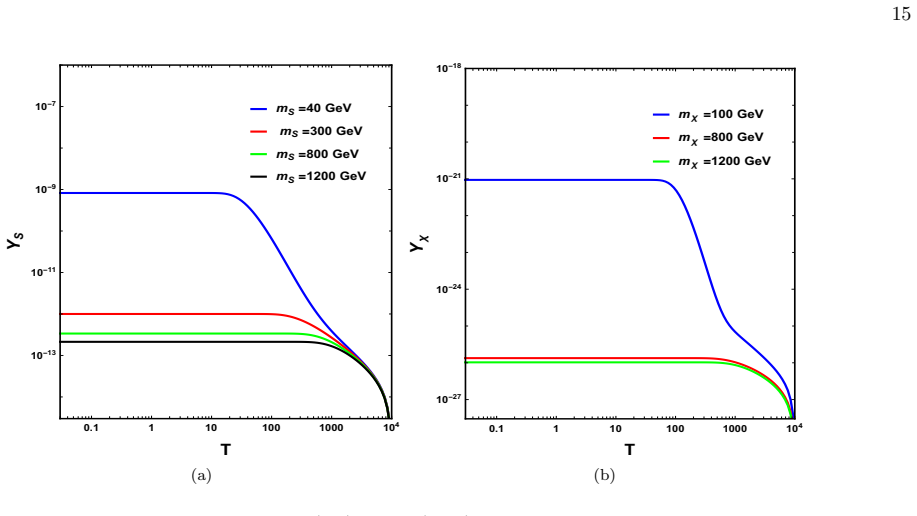
Extended reading notes
Core claim
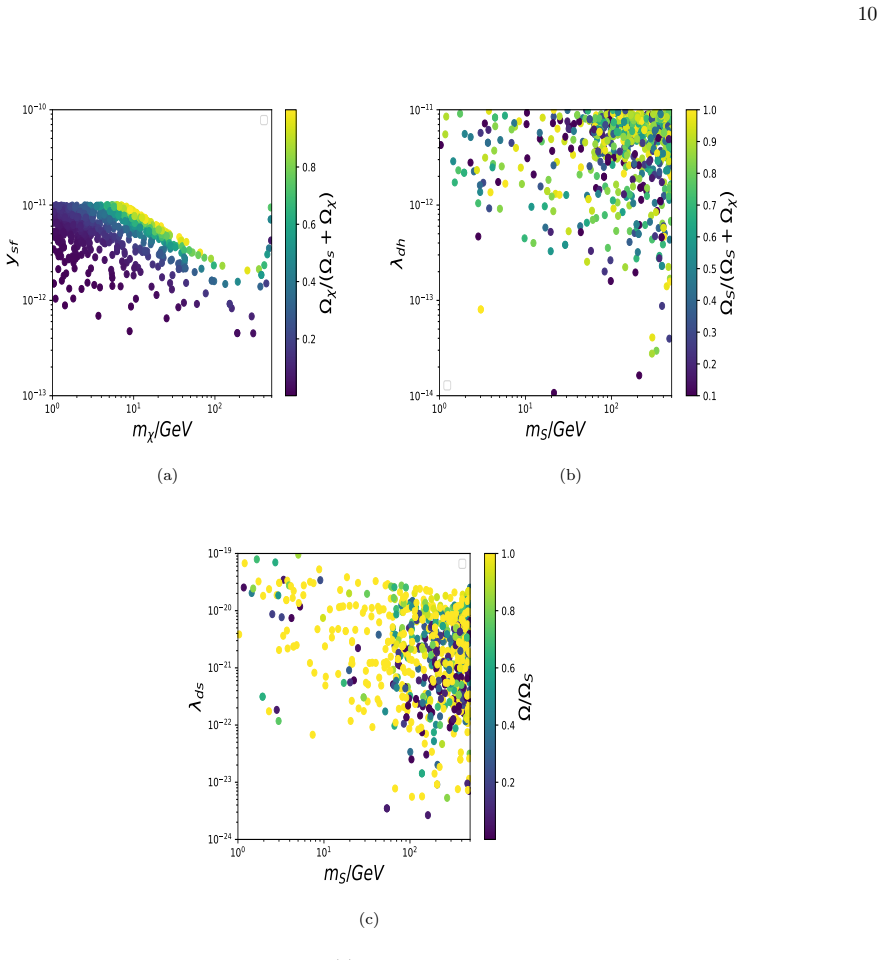
The paper's central claim is that in the FIMP-FIMP regime of the Z2×Z4 two-component dark matter model, the observed relic density Ωh² ≈ 0.12 can be reproduced for fermion and scalar masses in [1 GeV, 3 TeV] with m2 = 1 TeV, with portal couplings λ_ds spanning roughly 10^-25–10^-13. The mechanism is the v0 = mχ/y_sf relation: relic-density constraints force y_sf to be tiny (down to ~10^-13 or smaller when mχ < m2/2), making v0 enormous (10^9–10^15 GeV); since the new Higgs h2 couples to the scalar S through λ_ds v0² vertices, this large vev boosts h2-mediated S production, so λ_ds must be correspondingly suppressed to avoid overproduction. The paper verifies the consistency of this extreme r
Load-bearing premise
The load-bearing premise is that the ultra-small Yukawa and portal couplings are technically natural, i.e., quantum corrections do not lift them by order unity, and that the decoupling limit sinθ→0 is chosen so that SM-mediated production of the fermion is negligible.
Editorial extensions
If this is right
- Both dark matter candidates can be FIMPs in one model, with the observed relic density reproduced for DM masses from 1 GeV to 3 TeV when the new Higgs mass is 1 TeV.
- The portal coupling λ_ds can be as small as 10^-25, far below conventional FIMP values, because the large vev v0 = mχ/y_sf enhances h2-mediated production.
- The new Higgs h2 remains the dominant source of scalar dark matter for most of the viable parameter region, even at these ultra-small couplings.
- Depending on whether each DM mass is above or below m2/2, production is governed by different channels (h2 decays vs h2h2 annihilations), giving four distinct viable regions.
- The same Z2×Z4 Lagrangian can accommodate dark matter interaction strengths spanning over 25 orders of magnitude when combined with the previously studied WIMP and mixed regimes.
Reading between the lines
- The v0-driven suppression is generic: any model in which a FIMP mass comes from m = y v0 with tiny y inherits a large production cross section, so similarly small portal couplings should appear in other multi-component freeze-in constructions, not just this one.
- If h2 is light enough to be produced at colliders, the ultra-small λ_ds makes its decays to dark matter effectively invisible and may give displaced or long-lived signatures; searches for such signatures could probe the parameter region directly.
- The technical-naturalness claim is asserted rather than demonstrated; a one-loop computation of the radiative corrections to y_sf and λ_ds, or an explicit UV completion, would be the natural next check of whether the 10^-25 couplings are stable.
- The paper's scan assumes a specific decoupling limit; relaxing sinθ to small but nonzero values would open a SM-mediated production channel for χ and raise the allowed y_sf range, which is a testable extension of the parameter scan.
Editorial analysis
A structured set of objections, weighed in public.
Referee Report
Summary. The paper studies the FIMP-FIMP regime of a two-component dark matter model with a Z2×Z4 symmetry, containing a singlet scalar S and a Majorana fermion χ as DM candidates, plus a singlet S0 whose vev v0 generates mχ = y_sf v0. Working in the decoupling limit sinθ→0, the model has six free parameters. The authors use micrOMEGAs to solve the Boltzmann equations and identify viable parameter regions for four mass hierarchies relative to m2/2, reporting DM masses in [1 GeV, 3 TeV] for m2 = 1 TeV and portal couplings λ_ds as small as ~10^-24 because v0 = mχ/y_sf can be 10^9–10^15 GeV. The abstract further claims that these extreme couplings are theoretically consistent through technical naturalness, the gravitational freeze-in floor, and UV mechanisms such as Froggatt–Nielsen, but the body does not carry out these verifications.
Significance. If the advertised consistency claims hold, this would demonstrate a very broad FIMP-FIMP parameter region in a two-component DM model, with h2-mediated production dominating even for extraordinarily small couplings. The numerical analysis has real strengths: the analytic estimates in Eqs. (20)–(23) match the numerical curves, the channel decomposition is physically transparent, and the scan explicitly separates the four mass-hierarchy cases. However, the paper's headline novelty depends on ultra-small couplings being radiatively stable and on h2 being in thermal equilibrium in the decoupling limit; neither is established. The manuscript is therefore not yet ready in its present form.
major comments (3)
- [Abstract ¶3; Sec. III] The abstract asserts that 'we verify the theoretical consistency of these extreme values: the v0/v hierarchy is technically natural, λ_ds remains 15–20 orders of magnitude above the gravitational freeze-in floor, and the suppression can originate from higher-dimensional operators, radiative generation, or the Froggatt–Nielsen mechanism.' Sections II–IV contain none of this. Section III (Eqs. 9–11) imposes only perturbativity, unitarity, and vacuum stability. There is no RGE analysis, no symmetry-restoration argument for the limits y_sf→0 or λ_ds→0, no estimate of the gravitational freeze-in contribution, and no explicit UV operator or Froggatt–Nielsen charge assignment. Since the paper's central quantitative result is precisely the extreme smallness of these couplings, this missing verification is load-bearing. I request either adding the missing derivations or explicitly softening the a
- [Sec. II after Eq. (7); Eqs. (12)–(14)] In the decoupling limit sinθ→0, Eq. (8) gives λ_sh→0, so the h2 state has no coupling to the SM. Yet Eqs. (12)–(13) use the equilibrium abundance Ȳ_h2 (Eq. 14) as the source for S and χ production. If h2 is not in thermal contact with the SM bath, the freeze-in calculation is not self-consistent. The text says 'we fine-tune the value so that such a contribution can be negligible' (SM contribution to χ), but the scan has no sinθ parameter and the decoupling limit is treated as exact. Please specify the sinθ (or, equivalently, the λ_sh) value used in the micrOMEGAs runs, show that h2 remains in equilibrium down to T∼m2, and verify that the SM-mediated χ production is simultaneously negligible. Otherwise the central numerical results are not supported.
- [Abstract; Sec. IV C, Eq. (24), Figs. 6–9] The abstract's headline range 'λ_ds spans 10^-25 to 10^-13' does not match the scan. Equation (24) scans λ_ds ∈ [10^-24, 10^-10], and the smallest viable value shown is λ_ds ≈ 2×10^-24 (Fig. 6(c)); Sec. V summarizes the result as 'O(10^-20) level.' Either extend the scan to actually reach 10^-25 or correct the abstract and summary to state the range that is obtained. This is a central quantitative claim, not merely a typographical issue.
minor comments (3)
- [Sec. IV C, paragraph before Fig. 6] The sentence 'χ production is obtained via the decay process χ→h2h2' should read 'h2→χχ' in the case mχ < m2/2.
- [Appendix A, Eq. (A1)] The cross-section formula has unmatched parentheses and the logarithmic argument is difficult to parse. Please re-typeset and check the expression.
- [Sec. V vs Abstract] The abstract quotes a lower bound 10^-25 for λ_ds, while Sec. V states 'λ_ds can be as tiny as O(10^-20) level.' These should be made consistent.
Circularity Check
No circular derivation: the FIMP parameter regions are relic-density constraints, not predictions; the abstract's naturalness verification is asserted but missing.
full rationale
The paper's central derivation is self-contained. The Lagrangian (Eq. 1), mass relations (Eq. 3), and Boltzmann equations (Eqs. 12–13) are stated explicitly, and the viable regions in Figs. 6–9 are obtained by imposing the external Planck relic-density datum Ω_DM h² = 0.12, with micrOMEGAs as the numerical solver. The coupling ranges for y_sf and λ_ds are presented as constraints that reproduce the observed abundance, not as independent predictions, so this is standard constraint-satisfaction rather than fitted-input-called-prediction. The relation v0 = mχ/y_sf is used openly to interpret the smallness of λ_ds, and the analytical estimates (Eqs. 20–23) are explicitly described as checks, with micrOMEGAs providing the actual results. Self-citations to Refs. [9,20,22] define the parent model, but the model is restated in full in Section II, so no load-bearing result is imported from those papers; no uniqueness theorem or ansatz is smuggled in via citation. I therefore find no circular step. Two manuscript-internal weaknesses should be flagged, but they are not circularity: (i) Abstract ¶3 claims 'We verify the theoretical consistency of these extreme values: the v0/v hierarchy is technically natural, λds remains 15–20 orders of magnitude above the gravitational freeze-in floor, and the suppression can originate from higher-dimensional operators, radiative generation, or the Froggatt–Nielsen mechanism,' but Sections II–V contain no RGE, symmetry-protection, or UV-completion computation; Section III only imposes perturbativity, unitarity, and vacuum-stability inequalities. This is an omitted proof, not a circular derivation. (ii) Section II admits 'we fine-tune the value' for the decoupling limit sinθ→0, which sits uneasily with the naturalness claim; again this is a consistency gap, not a circular one. The score of 1 reflects only the minor, non-load-bearing self-citation of the parent model and the otherwise self-contained nature of the freeze-in calculation.
Assumptions & free parameters
free parameters (7)
- y_sf =
Allowed ranges: ~3e-13–1e-11 for mχ < m2/2; ~2e-8–2.5e-6 for mχ > m2/2 (m2 = 1 TeV)
- λ_ds =
Allowed ranges roughly 2e-24–5e-11 depending on mass case
- λ_dh =
1e-14–1e-11 (chosen scan range; allowed values)
- mχ =
1 GeV–3 TeV (chosen scan grid)
- mS =
1 GeV–3 TeV (chosen scan grid)
- m2 =
1 TeV (and 2 TeV for comparison) fixed
- sinθ =
0 (decoupling limit)
assumptions (5)
- domain assumption Initial DM abundance is negligible and χ/S never reach thermal equilibrium (freeze-in initial condition).
- domain assumption The observed DM relic density is entirely composed of χ and S.
- standard math Standard FRW cosmology with standard entropy and Hubble rates.
- ad hoc to paper Decoupling limit sinθ→0 suppresses SM-Higgs production of χ.
- ad hoc to paper The extremely small y_sf and λ_ds are radiatively stable / technically natural.
invented entities (4)
-
S (singlet scalar dark matter)
-
χ (Majorana fermion dark matter)
-
S0 (scalar with large vev v0 ~ 1e9–1e15 GeV)
-
h2 (second physical Higgs, mass m2 = 1–2 TeV)
Cite this review
Pith. "Pith review of FIMPs in a two-component dark matter model with $Z_2 \times Z_4$ symmetry." pith.science (2026). https://pith.science/paper/6FD6CBW5
@misc{pith2026260208359,
  author       = {Pith},
  title        = {Pith review of: FIMPs in a two-component dark matter model with $Z_2 \times Z_4$ symmetry},
  year         = {2026},
  howpublished = {\url{https://pith.science/paper/6FD6CBW5}},
  note         = {Machine review of arXiv:2602.08359}
}
abstract
We investigate the FIMP-FIMP regime in a two-component dark matter model with a $Z_2\times Z_4$ symmetry, where a singlet scalar $S$ and a Majorana fermion $\chi$ serve as the dark matter candidates. A singlet scalar $S_0$ with vacuum expectation value $v_0$ generates the fermion mass through the relation $m_\chi=y_{sf}v_0$. We show that the tiny Yukawa coupling $y_{sf}$ needed to reproduce the observed relic abundance naturally leads to a large symmetry-breaking scale $v_0$, which induces an ultra-feeble portal coupling $\lambda_{ds}$ responsible for the production of $S$. We find that $\lambda_{ds}$ can reach values of $10^{-25}\lesssim\lambda_{ds}\lesssim10^{-13}$, while gravitational freeze-in provides an irreducible contribution at extremely small couplings. Our results demonstrate that the relic abundance constraint, combined with symmetry breaking and freeze-in dynamics, naturally drives the portal interaction responsible for scalar dark matter production into the ultra-feeble regime.
Figures


Figures from the paper (7 more)




Reviewed August 4, 2026 · model on record in the stance chip above.
Discussion (0). Sign in to comment.