REVIEW 2 major objections 1 minor
Nuclear Charge Radii of Sr Isotopes: Reevaluation based on Transition Frequency Measurements in the $5s-5p-4d$ manifold in Sr$^+$
T0 review · 2 major / 1 minor · reviewed 2026-06-30 · grok-4.3
Pith's one-line read Charge radii of strontium isotopes above N=50 depend strongly on the method used to extract field-shift and mass-shift constants
desk verdict Improved isotope shift precision on Sr+ transitions is the real deliverable here; the claim that radii above N=50 depend strongly on extraction method needs a direct check that King-plot and ab initio constants differ only in their atomic factors. read the letter →
The pith
A machine-rendered reading of the paper's core claim, the machinery that carries it, and where it could break.
The reading
What carries the argument
King-plot analysis of isotope shifts measured in multiple transitions of the 5s-5p-4d manifold
What would settle it
An independent measurement of the charge radius for any Sr isotope with N>50 (for example by muonic-atom X-ray spectroscopy) that agrees with one extraction method but deviates from the other by more than the stated uncertainties.
Extended reading notes
Core claim
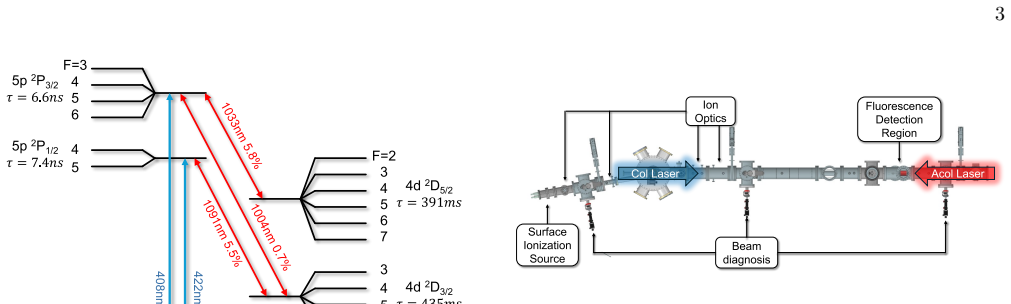
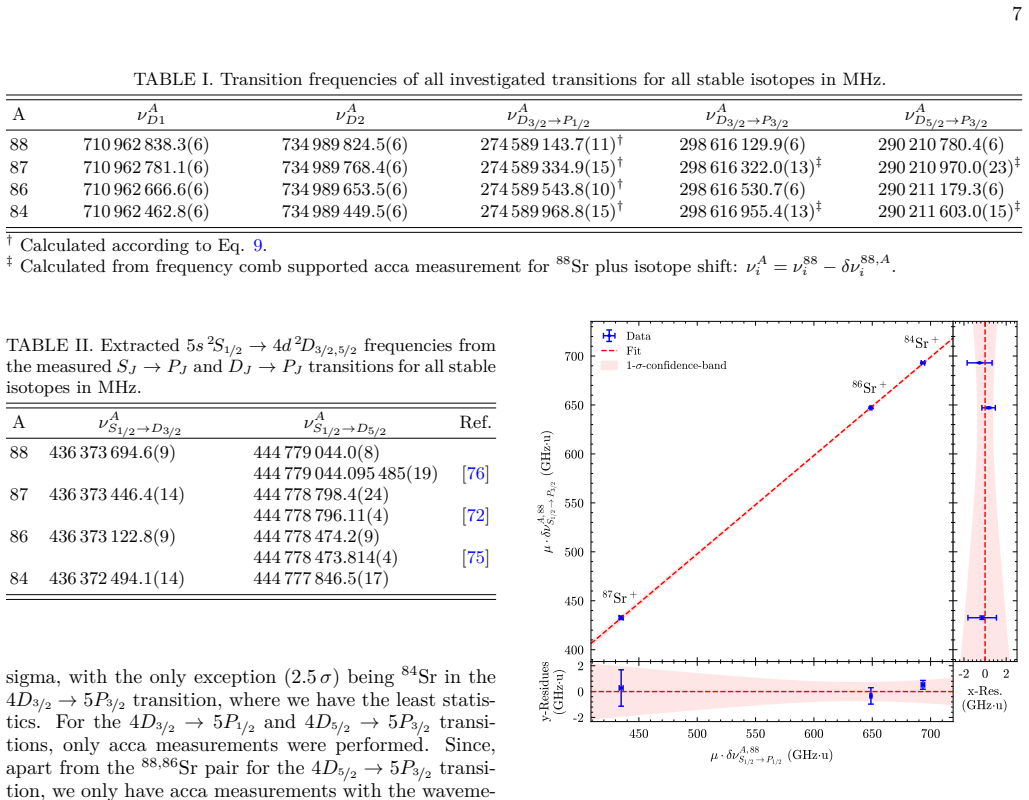
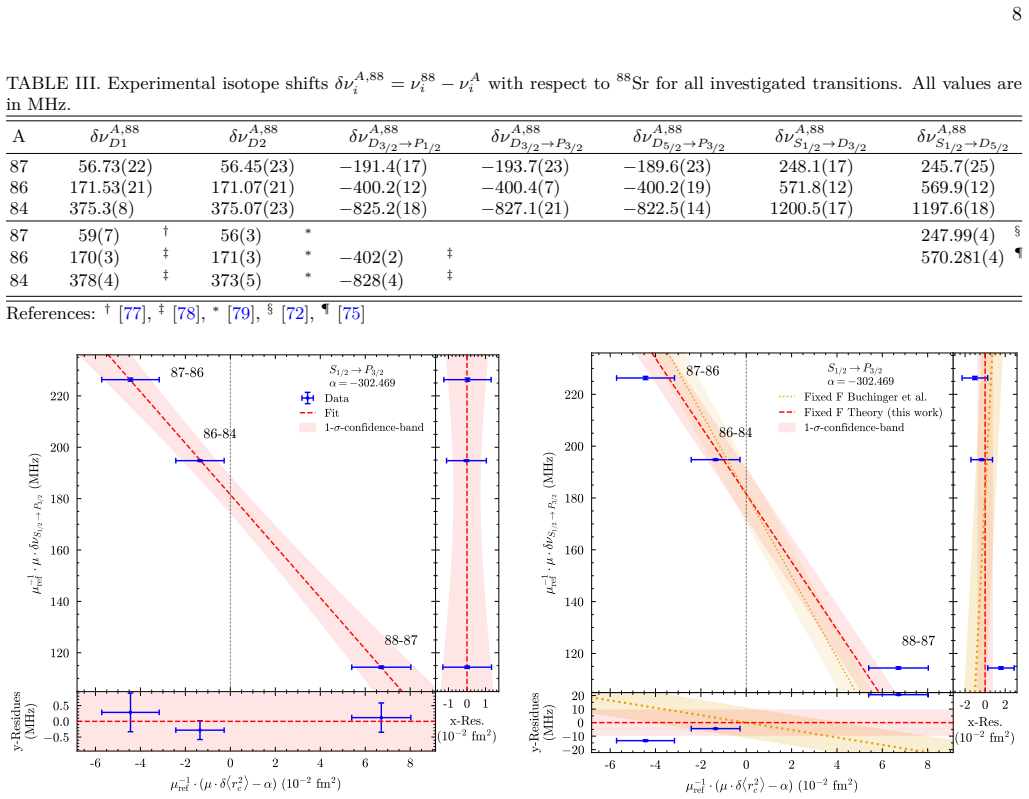
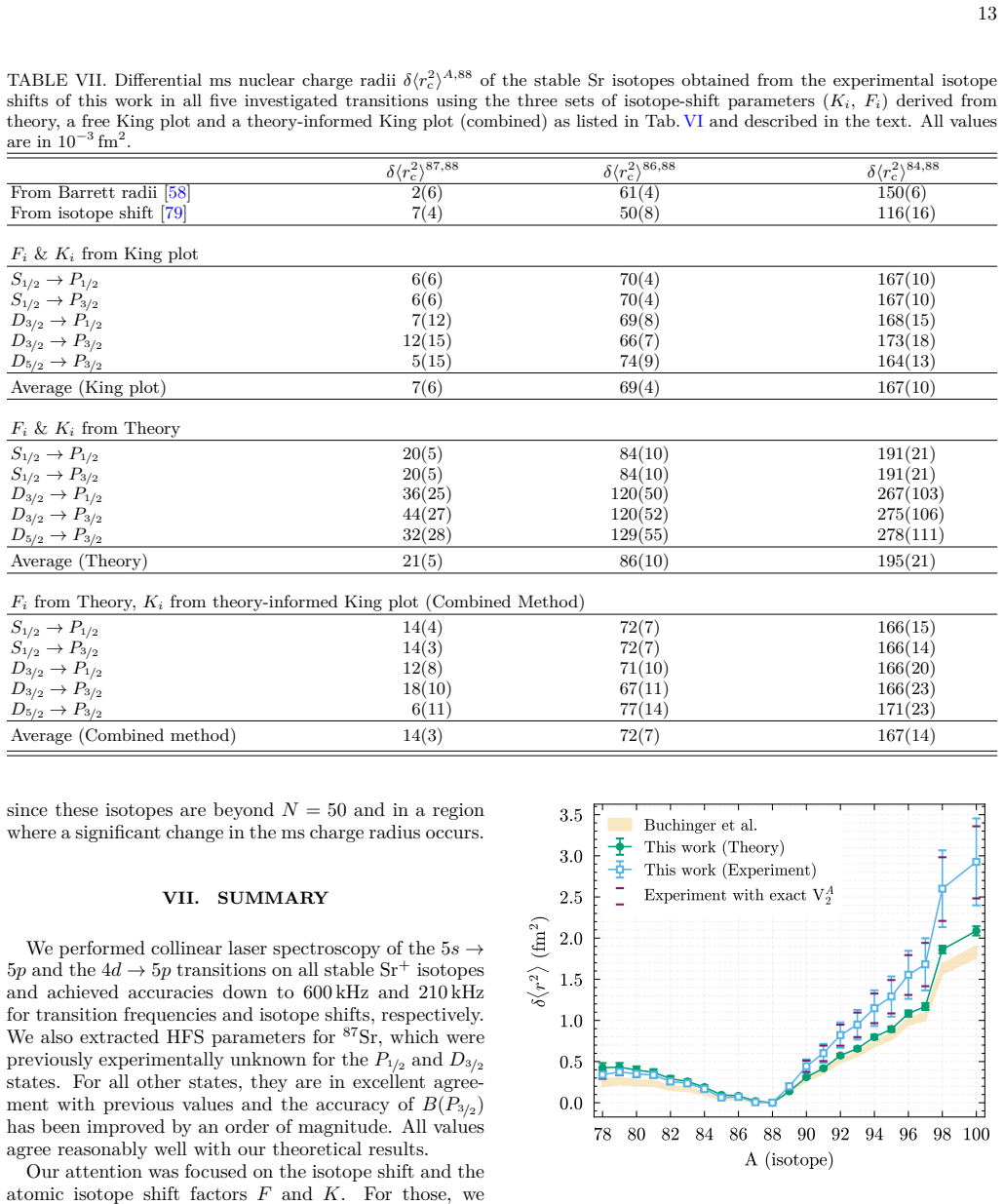
We performed quasi-simultaneous collinear and anticollinear laser spectroscopy on the D1, D2, and three 4d-to-5p transitions in naturally abundant Sr+ isotopes, reaching absolute frequency accuracies of 600 kHz and isotope-shift uncertainties of 200 kHz. King-plot analysis of the measured shifts gave a field-shift ratio F_D2/F_D1 = 1.004(5). When the same isotope-shift data were processed with field-shift and mass-shift constants taken either from experimental King plots or from state-of-the-art ab initio calculations, the extracted charge radii for isotopes above N=50 differed substantially depending on which set of constants was used.
Load-bearing premise
Field-shift and mass-shift constants extracted from purely experimental King plots can be compared directly with those from ab initio calculations without unaccounted systematic differences that would invalidate the observed dependence above N=50.
Editorial extensions
If this is right
- Charge radii above N=50 must be reported together with the specific method used to obtain the constants.
- The measured D2/D1 field-shift ratio supplies a direct benchmark for atomic-structure calculations.
- Hyperfine coefficients for the 5p and 4d states in 87Sr are improved by the new data.
- Literature values of Sr charge radii that rely on one or the other constant set may require reevaluation.
Reading between the lines
- The method dependence may signal that higher-order corrections or neglected effects differ between the experimental and theoretical routes.
- Similar comparisons performed on other isotopic chains near shell closures could expose comparable inconsistencies.
- Reducing the uncertainty in ab initio constants to the level of the experimental King-plot constants would remove the ambiguity in the radii.
Signed reviews
Editorial analysis
A structured set of objections, weighed in public.
Referee Report
Summary. The paper reports quasi-simultaneous collinear/anticollinear laser spectroscopy measurements of the D1, D2, and three 4d-5p transitions in stable Sr+ isotopes, achieving absolute frequencies to 600 kHz and isotope shifts to 200 kHz. A King-plot analysis of the D1/D2 lines yields F_D2/F_D1 = 1.004(5). The authors compare field-shift and mass-shift constants extracted via purely experimental King plots versus ab initio atomic calculations and conclude that nuclear charge radii for isotopes with N>50 depend strongly on the extraction method used.
Significance. If the reported method dependence holds after accounting for possible systematics, the result would be significant for nuclear-structure studies of neutron-rich Sr isotopes, as it quantifies how atomic-factor choices propagate into extracted radii beyond the N=50 shell closure. The sub-MHz isotope-shift precision and the benchmark field-shift ratio (lying inside the theoretically allowed range) are clear strengths that could serve as tests for atomic theory.
major comments (2)
- [Abstract] Abstract and § on King-plot vs. ab initio comparison: the central claim that charge radii above N=50 'are strongly dependent on the approach being used' is load-bearing, yet the manuscript provides no explicit quantitative test (e.g., variation of reference-isotope sets or inclusion of higher-order field-shift terms) showing that method-specific biases are smaller than the observed radius differences. This directly addresses the skeptic concern that King-plot and ab initio constants may differ by unaccounted systematics when applied to N>50 isotopes.
- The reevaluation rests on external ab initio inputs for one set of constants; without a self-contained error budget or cross-check that isolates the atomic-factor difference from experimental or theoretical systematics, the dependence claim cannot be verified from the data alone.
minor comments (1)
- [Abstract] The abstract states specific accuracy numbers but does not reference the sections or tables containing the full isotope-shift data tables and complete error budgets; adding explicit cross-references would improve traceability.
Simulated Author's Rebuttal
We thank the referee for the positive assessment of our work's significance and for the constructive comments. We address the major points below and have revised the manuscript to incorporate additional quantitative tests and an expanded error budget.
read point-by-point responses
-
Referee: [Abstract] Abstract and § on King-plot vs. ab initio comparison: the central claim that charge radii above N=50 'are strongly dependent on the approach being used' is load-bearing, yet the manuscript provides no explicit quantitative test (e.g., variation of reference-isotope sets or inclusion of higher-order field-shift terms) showing that method-specific biases are smaller than the observed radius differences. This directly addresses the skeptic concern that King-plot and ab initio constants may differ by unaccounted systematics when applied to N>50 isotopes.
Authors: We agree that explicit tests strengthen the claim. In the revised manuscript we have added King-plot analyses using multiple reference-isotope combinations and estimates of higher-order field-shift contributions. These show that the radius differences for N>50 isotopes remain larger than the variations arising from reference-set choice or higher-order terms, supporting that the method dependence is not an artifact of unaccounted systematics. revision: yes
-
Referee: The reevaluation rests on external ab initio inputs for one set of constants; without a self-contained error budget or cross-check that isolates the atomic-factor difference from experimental or theoretical systematics, the dependence claim cannot be verified from the data alone.
Authors: Our comparison already includes purely experimental King-plot results derived from the new data. We have now added a dedicated error-budget section that propagates both experimental and ab initio uncertainties and includes cross-checks applying each constant set to independent isotope pairs. This isolates the atomic-factor contribution and allows the method dependence to be verified directly from the measurements. revision: yes
Circularity Check
No circularity; radii dependence shown by applying independent extraction methods to new data
full rationale
The paper reports new experimental isotope-shift measurements on stable Sr isotopes (N≤50), performs a King-plot analysis to obtain an experimental field-shift ratio, and then applies two distinct sets of F and M constants—one from King plots on the measured data and one from external ab initio calculations—to extract radii for N>50 isotopes. This comparison does not reduce any claimed result to a fitted parameter or self-citation by construction; the ab initio constants are external inputs, and the observed dependence is a direct numerical consequence of inserting different constants into the isotope-shift equation. No load-bearing self-citation, self-definitional step, or fitted-input-renamed-as-prediction is present in the derivation chain.
Assumptions & free parameters
free parameters (1)
- F_D2/F_D1 field-shift ratio =
1.004(5)
assumptions (2)
- domain assumption King-plot linearity holds and allows reliable separation of field and mass shifts for the studied transitions.
- domain assumption Ab initio atomic structure calculations provide independent field- and mass-shift constants that can be directly compared to experimental King-plot results.
Cite this review
Pith. "Pith review of Nuclear Charge Radii of Sr Isotopes: Reevaluation based on Transition Frequency Measurements in the $5s-5p-4d$ manifold in Sr$^+$." pith.science (2026). https://pith.science/paper/BMIWD2P5
@misc{pith2026260504281,
  author       = {Pith},
  title        = {Pith review of: Nuclear Charge Radii of Sr Isotopes: Reevaluation based on Transition Frequency Measurements in the $5s-5p-4d$ manifold in Sr$^+$},
  year         = {2026},
  howpublished = {\url{https://pith.science/paper/BMIWD2P5}},
  note         = {Machine review of arXiv:2605.04281}
}
abstract
High-precision quasi-simultaneous collinear and anticollinear laser spectroscopy was performed on the $5s\,^2S_{1/2}\rightarrow 5p\,^2P_{1/2}$ (D1), $5s\,^2S_{1/2}\rightarrow 5p\,^2P_{3/2}$ (D2), and three $4d\rightarrow 5p$ transitions in the naturally abundant Sr$^+$ isotopes. Absolute transition frequencies were determined with uncertainties as low as $600$ kHz, while common-mode rejection enabled the extraction of isotope shifts with uncertainties down to $200$ kHz, one order of magnitude smaller than previously achieved. The uncertainties of the hyperfine-structure constants of the $5p$ states and the $4d\,^2D_{3/2}$ state in $^{87}$Sr were also improved. A King-plot analysis yielded a field-shift ratio of the D2 and D1 lines of $F_{\mathrm{D2}}/F_{\mathrm{D1}}=1.004(5)$, which lies within the theoretically allowed region and provides a benchmark for atomic-structure calculations. Using data from all stable isotopes and investigated transitions, we compare field- and mass-shift constants obtained using several established approaches, ranging from King plots based entirely on experimental input to state-of-the-art \textit{ab initio} atomic-structure calculations. We show that, above $N=50$, the extracted charge radii depend strongly on the approach used.
Figures


Figures from the paper (11 more)




Reviewed June 30, 2026 · model on record in the stance chip above.
Discussion (0). Continue with ORCID to comment.