REVIEW 2 minor 39 references
From EEG Cleaning to Decoding: The Role of Artifact Rejection in MI-based BCIs
T0 review · 0 major / 2 minor · reviewed 2026-05-25 · grok-4.3
Pith's one-line read Automated artifact rejection improves motor imagery BCI decoding most for low-baseline subjects and reduces performance spread across users.
desk verdict FAAR gives a practical, low-overhead way to do adaptive artifact rejection in MI-BCIs and the 13-dataset results back the claim that gains are biggest where baseline SNR is poor. read the letter →
The pith
A machine-rendered reading of the paper's core claim, the machinery that carries it, and where it could break.
The reading
What carries the argument
Fast Automatic Artifact Rejection (FAAR), a method that builds an epoch-level Signal Quality Index from artifact-sensitive features and applies adaptive thresholding to identify and reject contaminated epochs.
What would settle it
A new MI dataset in which applying FAAR to low-baseline subjects produces no accuracy gain or increases the spread of performance across subjects.
Extended reading notes
Core claim
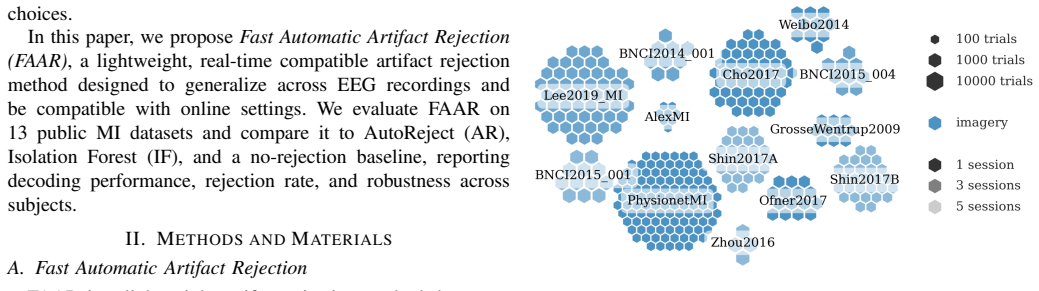
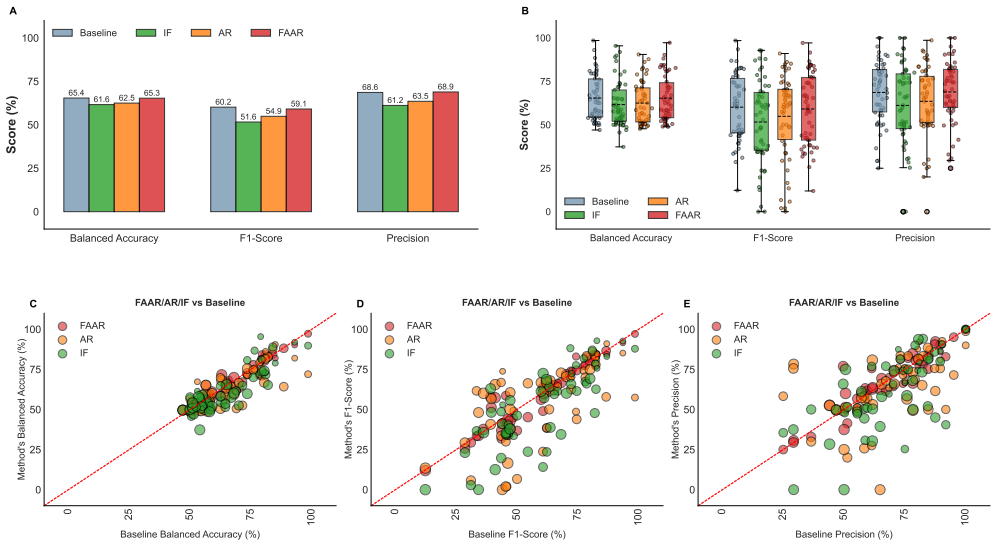
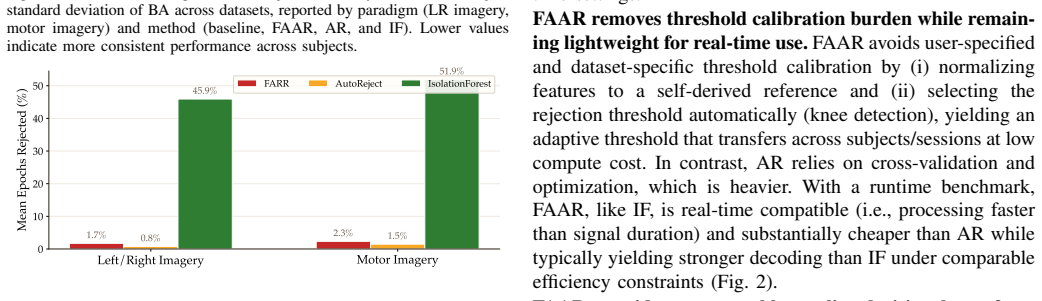
FAAR computes a compact set of artifact-sensitive features, derives an epoch-level Signal Quality Index, and adaptively selects rejection thresholds to remove contaminated epochs without prior knowledge of artifact types or manual tuning. Evaluated on 13 MI datasets against a no-rejection baseline, AutoReject, and Isolation Forest, the method produces subject- and regime-dependent effects on decoding accuracy, with the largest improvements in low-baseline or low-SNR conditions, while reducing inter-subject performance variability without aggressive data removal and maintaining consistent behavior across offline, training, and online settings.
Load-bearing premise
A compact set of artifact-sensitive features and the derived Signal Quality Index, together with adaptive threshold selection, can reliably flag contaminated epochs across many different MI datasets without knowing the artifact types ahead of time or needing manual tuning.
Signed reviews
Editorial analysis
A structured set of objections, weighed in public.
Referee Report
Summary. The paper introduces Fast Automatic Artifact Rejection (FAAR), a lightweight automated method for EEG artifact rejection in motor imagery (MI) BCIs. FAAR extracts a compact set of artifact-sensitive features, computes an epoch-level Signal Quality Index, and applies adaptive threshold selection to reject contaminated epochs without prior artifact knowledge or manual tuning. It evaluates the approach on 13 public MI datasets, comparing against a no-rejection baseline, AutoReject, and Isolation Forest, and reports that rejection effects are strongly subject- and regime-dependent (largest gains in low-baseline/low-SNR conditions), that FAAR reduces inter-subject performance variability without aggressive data removal, and that the method is consistent across offline, training, and online regimes while satisfying real-time constraints.
Significance. If the multi-dataset empirical results hold, the work provides concrete evidence that automated artifact rejection should be treated as an adaptive, regime-dependent component of MI-BCI pipelines rather than a fixed preprocessing step. The finding that gains are largest under low-SNR conditions and that inter-subject variability is reduced without heavy data loss directly addresses BCI illiteracy and reliability issues; the lightweight, fully automated design also supports deployment under real-time constraints.
minor comments (2)
- [Abstract] Abstract: states that evaluation results and comparisons were performed but supplies no quantitative performance numbers, statistical tests, or subject-exclusion criteria, which weakens the reader's ability to gauge the magnitude of the reported subject-dependent gains and variability reduction from the abstract alone.
- [Methods] The description of the compact artifact-sensitive feature set and the derived Signal Quality Index would benefit from an explicit enumeration or pseudocode in the methods section to allow exact reproduction.
Simulated Author's Rebuttal
We thank the referee for their positive summary and recommendation of minor revision. The assessment correctly captures the core contributions of FAAR as a lightweight, adaptive artifact rejection method whose benefits are regime- and subject-dependent, and we appreciate the recognition that these results speak to BCI reliability and illiteracy issues.
Circularity Check
No significant circularity; empirical evaluation on public datasets
full rationale
The paper proposes FAAR as a lightweight automated rejection method and evaluates its impact via direct comparison to baselines (no-rejection, AutoReject, Isolation Forest) across 13 public MI datasets. No mathematical derivations, parameter fits presented as predictions, or self-citation chains appear in the abstract or described methodology. Claims about subject- and regime-dependent effects rest on the multi-dataset empirical results rather than reducing to inputs by construction. The work is self-contained as an empirical comparison.
Assumptions & free parameters
Cite this review
Pith. "Pith review of From EEG Cleaning to Decoding: The Role of Artifact Rejection in MI-based BCIs." pith.science (2026). https://pith.science/paper/V2K2SURN
@misc{pith2026260512408,
  author       = {Pith},
  title        = {Pith review of: From EEG Cleaning to Decoding: The Role of Artifact Rejection in MI-based BCIs},
  year         = {2026},
  howpublished = {\url{https://pith.science/paper/V2K2SURN}},
  note         = {Machine review of arXiv:2605.12408}
}
read the original abstract
Motor imagery (MI) BCIs are sensitive to EEG artifacts, yet the practical impact of automated artifact rejection on downstream MI decoding performance remains unclear. While most work focuses on decoder design, the contribution of data curation, particularly automated rejection policies, has received comparatively less attention, despite its importance for robust machine learning pipelines. Here, we propose Fast Automatic Artifact Rejection (FAAR), a lightweight method that computes a compact set of artifact-sensitive features, derives an epoch-level Signal Quality Index, adaptively selects rejection thresholds, and automatically rejects contaminated epochs without requiring prior knowledge of artifact types or manual threshold tuning. We evaluate FAAR on 13 publicly available MI datasets and compare it to a no-rejection baseline, AutoReject, and Isolation Forest. We show rejection effects are strongly subject- and regime-dependent, with the largest gains in low-baseline/low-SNR conditions, so it should be used adaptively. FAAR reduces inter-subject performance variability, an important property for MI-BCI reliability and BCI-illiteracy, without aggressive data removal. Finally, FAAR's lightweight and fully automated thresholding yields consistent rejection behavior across offline curation, training, and online filtering, and supports real-time BCI constraints.
Figures

Figures from the paper (2 more)

Reference graph
Works this paper leans on
-
[1]
An EEG- based brain-computer interface for cursor control,
J. R. Wolpaw, D. J. McFarland, G. W. Neat, and C. A. Forneris, “An EEG- based brain-computer interface for cursor control,”Electroencephalogra- phy and Clinical Neurophysiology, 1991
work page 1991
-
[2]
M. A. Khan, R. Das, H. K. Iversen, and S. Puthusserypady, “Review on motor imagery based BCI systems for upper limb post-stroke neurore- habilitation: From designing to application,”Computers in Biology and Medicine, 2020
work page 2020
-
[3]
Five-class motor imagery BCI classification and its application to brain-controlled wheelchairs,
H. Pan, B. Teng, Z. Liu, S. Tong, X. Yu, and Z. Li, “Five-class motor imagery BCI classification and its application to brain-controlled wheelchairs,”Cognitive Neurodynamics, 2026
work page 2026
-
[4]
Adaptable Neuro- physiological Biometric Authentication System and Method,
A. H. Caillet, A. Shtarbanov, and T. Semah, “Adaptable Neuro- physiological Biometric Authentication System and Method,” Patent WO2025219294, published Oct. 22, 2025; filing no. WO2025EP60157 (Apr. 11, 2025)
work page 2025
-
[5]
A comprehen- sive review of EEG-based brain-computer interface paradigms,
R. Abiri, S. Borhani, E. W. Sellers, Y . Jiang, and X. Zhao, “A comprehen- sive review of EEG-based brain-computer interface paradigms,”J. Neural Eng., 2019
work page 2019
-
[6]
A. Bashashati, M. Fatourechi, R. K. Ward, and G. E. Birch, “A survey of signal processing algorithms in brain-computer interfaces based on electrical brain signals,”J. Neural Eng., 2007
work page 2007
-
[7]
Review of challenges associated with the EEG artifact removal methods,
W. Mumtaz, S. Rasheed, and A. Irfan, “Review of challenges associated with the EEG artifact removal methods,”Biomedical Signal Processing and Control, 2021
work page 2021
-
[8]
Improved Riemannian potato field: An automatic artifact rejection method for EEG,
D. Hajhassani, Q. Barth ´elemy, J. Mattout, and M. Congedo, “Improved Riemannian potato field: An automatic artifact rejection method for EEG,” Biomedical Signal Processing and Control, 2026
work page 2026
Show all 39 references
-
[9]
Methods for artifact detection and removal from scalp EEG: A review,
M. K. Islam, A. Rastegarnia, and Z. Yang, “Methods for artifact detection and removal from scalp EEG: A review,”Neurophysiologie Clinique/Clinical Neurophysiology, 2016
2016
-
[10]
Removal of artifacts from EEG signals: a review,
X. Jiang, B. G. Bin, and Z. Tian, “Removal of artifacts from EEG signals: a review,”Sensors (Basel), 2019
2019
-
[11]
Investigating effects of different artefact types on motor imagery BCI,
L. Frølich, I. Winkler, K.-R. M ¨uller, and W. Samek, “Investigating effects of different artefact types on motor imagery BCI,” inProc. 2015 37th Annu. Int. Conf. IEEE Eng. Med. Biol. Soc. (EMBC), 2015
2015
-
[12]
The effect of processing techniques on the classification accuracy of brain-computer interface systems,
A. Adolf, C. M. K ¨oll˝od, G. M ´arton, W. Fadel, and I. Ulbert, “The effect of processing techniques on the classification accuracy of brain-computer interface systems,”Brain Sciences, 2024
2024
-
[13]
An improved feature extraction algorithms of EEG signals based on motor imagery brain-computer interface,
X. Geng, D. Li, H. Chen, P. Yu, H. Yan, and M. Yue, “An improved feature extraction algorithms of EEG signals based on motor imagery brain-computer interface,”Alexandria Engineering Journal, 2022
2022
-
[14]
Comparison of two methods of removing EOG artifacts for use in a motor imagery-based brain computer interface,
M. Mohammadi and M. R. Mosavi, “Comparison of two methods of removing EOG artifacts for use in a motor imagery-based brain computer interface,”Evolving Systems, 2021
2021
-
[15]
Subject-dependent artifact removal for enhancing motor imagery classi- fier performance under poor skills,
M. Tob ´on-Henao, A. ´Alvarez-Meza, and G. Castellanos-Dom ´ınguez, “Subject-dependent artifact removal for enhancing motor imagery classi- fier performance under poor skills,”Sensors, 2022
2022
-
[16]
Removing electroencephalographic ar- tifacts by blind source separation,
T.-P. Jung, S. Makeig, C. Humphries, T.-W. Lee, M. J. McKeown, V . Iragui, and T. J. Sejnowski, “Removing electroencephalographic ar- tifacts by blind source separation,”Psychophysiology, 2000
2000
-
[17]
EEG is better left alone,
A. Delorme, “EEG is better left alone,”Sci. Rep., 2023
2023
-
[18]
EEGLAB: an open source toolbox for analysis of single-trial EEG dynamics including independent component analysis,
A. Delorme and S. Makeig, “EEGLAB: an open source toolbox for analysis of single-trial EEG dynamics including independent component analysis,”J. Neurosci. Methods, 2004
2004
-
[19]
Real-time neuroimaging and cognitive monitoring using wearable dry EEG,
T. R. Mullen, C. A. Kothe, Y . M. Chi, A. Ojeda, T. Kerth, S. Makeig, T.-P. Jung, and G. Cauwenberghs, “Real-time neuroimaging and cognitive monitoring using wearable dry EEG,”IEEE Transactions on Biomedical Engineering, vol. 62, no. 11, pp. 2553–2567, 2015
2015
-
[20]
MEG and EEG data analysis with MNE-Python,
A. Gramfort, M. Luessi, E. Larson, D. A. Engemann, D. Strohmeier, C. Brodbeck,et al., “MEG and EEG data analysis with MNE-Python,” Front. Neurosci., 2013
2013
-
[21]
FASTER: fully automated statistical thresholding for EEG artifact rejection,
H. Nolan, R. Whelan, and R. B. Reilly, “FASTER: fully automated statistical thresholding for EEG artifact rejection,”J. Neurosci. Methods, 2010
2010
-
[22]
Autoreject: automated artifact rejection for MEG and EEG data,
M. Jas, D. A. Engemann, Y . Bekhti, F. Raimondo, and A. Gramfort, “Autoreject: automated artifact rejection for MEG and EEG data,”Neu- roImage, 2017
2017
-
[23]
Reliable and fast automatic artifact rejection of long-term EEG recordings based on Isolation Forest,
R. Zhang, R. Rong, J. Q. Gan, Y . Xu, H. Wang, and X. Wang, “Reliable and fast automatic artifact rejection of long-term EEG recordings based on Isolation Forest,”Med. Biol. Eng. Comput., 2024
2024
-
[24]
The Riemannian Potato: an automatic and adaptive artifact detection method for online experiments using Riemannian geometry,
A. Barachant, A. Andreev, and M. Congedo, “The Riemannian Potato: an automatic and adaptive artifact detection method for online experiments using Riemannian geometry,” inProc. TOBI Workshop IV, 2013
2013
-
[25]
The Rieman- nian potato field: a tool for online signal quality index of EEG,
Q. Barth ´elemy, L. Mayaud, D. Ojeda, and M. Congedo, “The Rieman- nian potato field: a tool for online signal quality index of EEG,”IEEE Trans. Neural Syst. Rehabil. Eng., 2019
2019
-
[26]
An automatic Riemannian artifact rejection method for P300-based BCIs,
D. Hajhassani, J. Mattout, and M. Congedo, “An automatic Riemannian artifact rejection method for P300-based BCIs,” inProc. 2024 32nd Eur . Signal Process. Conf. (EUSIPCO), 2024
2024
-
[27]
Good data? The EEG Quality Index for automated assessment of signal quality,
S. D. Fickling, C. C. Liu, R. C. N. D’Arcy, S. Ghosh Hajra, and X. Song, “Good data? The EEG Quality Index for automated assessment of signal quality,” inProc. 2019 IEEE 10th Annu. Inf. Technol., Electron. Mobile Commun. Conf. (IEMCON), 2019
2019
-
[28]
The effects of electrode impedance on data quality and statistical significance in ERP recordings,
E. S. Kappenman and S. J. Luck, “The effects of electrode impedance on data quality and statistical significance in ERP recordings,”Psychophys- iology, 2010
2010
-
[29]
Complexity analysis of EEG, MEG, and fMRI in mild cognitive impairment and Alzheimer’s disease: A review,
J. Sun, B. Wang, Y . Niu, Y . Tan, C. Fan, N. Zhang, J. Xue, J. Wei, J. Xiang, “Complexity analysis of EEG, MEG, and fMRI in mild cognitive impairment and Alzheimer’s disease: A review,”Entropy (Basel), 2020
2020
-
[30]
Najimet al.,Stochastic Processes: Estimation, Optimisation and Analysis
K. Najimet al.,Stochastic Processes: Estimation, Optimisation and Analysis. Elsevier Ltd., 2004
2004
-
[31]
Enhanced detection of arti- facts in EEG data using higher-order statistics and independent component analysis,
A. Delorme, T. Sejnowski, and S. Makeig, “Enhanced detection of arti- facts in EEG data using higher-order statistics and independent component analysis,”NeuroImage, 2007
2007
-
[32]
Evaluation of artifact subspace reconstruction for automatic artifact components removal in multi-channel EEG recordings,
C.-Y . Chang, S.-H. Hsu, L. Pion-Tonachini, and T.-P. Jung, “Evaluation of artifact subspace reconstruction for automatic artifact components removal in multi-channel EEG recordings,”IEEE Trans. Biomed. Eng., 2020
2020
-
[33]
Developing brain vital signs: Initial framework for monitoring brain function changes over time,
S. Ghosh Hajraet al., “Developing brain vital signs: Initial framework for monitoring brain function changes over time,”Front. Neurosci., 2016
2016
-
[34]
Finding a ‘Kneedle’ in a haystack: Detecting knee points in system behavior,
V . Satopaa, J. Albrecht, D. Irwin, and B. Raghavan, “Finding a ‘Kneedle’ in a haystack: Detecting knee points in system behavior,” inProc. 2011 31st Int. Conf. ICDCSW, 2011
2011
-
[35]
Kneeliverse: A universal knee- detection library for performance curves,
M. Antunes, T. Estro, P. Bhandari, A. Gandhi, G. Kuenning, Y . Liu, C. Waldspurger, A. Wildani, and E. Zadok, “Kneeliverse: A universal knee- detection library for performance curves,” SoftwareX, vol. 30, Art. no. 102161, 2025
2025
-
[36]
Aristimunhaet al.,Mother of All BCI Benchmarks (MOABB), ver
B. Aristimunhaet al.,Mother of All BCI Benchmarks (MOABB), ver. 1.4.3. Zenodo, 2025
2025
-
[37]
Multiclass brain- computer interface classification by Riemannian geometry,
A. Barachant, S. Bonnet, M. Congedo, and C. Jutten, “Multiclass brain- computer interface classification by Riemannian geometry,”IEEE Trans. Biomed. Eng., 2012
2012
-
[38]
The largest EEG-based BCI reproducibility study for open science: the MOABB benchmark,
S. Chevallieret al., “The largest EEG-based BCI reproducibility study for open science: the MOABB benchmark,”HAL, working paper, hal- 04537061, 2024
2024
-
[39]
Return of the GEDAI: Unsupervised EEG denoising based on leadfield filtering,
T. Ros, V . F ´erat, Y . Huang, C. Colangelo, S. M. Kia, T. Wolfers, S. Vulliemoz, and M. Abele, “Return of the GEDAI: Unsupervised EEG denoising based on leadfield filtering,” bioRxiv, 2025
2025
Reviewed May 25, 2026 · model on record in the stance chip above.
Discussion (0). Continue with ORCID to comment.