REVIEW 2 major objections 6 minor 46 references
Borrowed Identities: Malleable Distillation Factories and a Unified Numerical Search
T0 review · 2 major / 6 minor · reviewed 2026-07-14 · grok-4.5
Pith's one-line read A weaker identity condition unifies magic-state distillation factories across Clifford levels and output types, so one parent circuit can produce T, CS, or CCZ states by gate removal.
desk verdict Clean Schrödinger-picture unification of d=2 magic factories that actually recovers the known catalogue in one linear search and makes output type a compile-time choice. read the letter →
The pith
A machine-rendered reading of the paper's core claim, the machinery that carries it, and where it could break.
The reading
What carries the argument
The borrowed-identity condition: a circuit C of weight-w phase rotations at angle θ=π/2^l satisfies C |+ angle^⊗n = e^{iφ} |+ angle^⊗n. Under two-group symmetry the condition becomes a linear master equation over Z_{2^{l+1}} (Theorem 5) that can be verified in polynomial time and yields every distance-2 factory recovered by the search.
What would settle it
Widen the two-group parameter sweep (or run the symmetry-free targeted solver) and check whether any previously known distance-2 factory, or any new smaller multi-output factory at distance greater than 2, fails the borrowed-identity phase conditions of Theorems 3 and 5.
Extended reading notes
Core claim
A circuit of multi-qubit phase rotations is a valid distillation factory whenever it acts as the identity on the all-plus state; removing the gates that act only on designated output qubits then leaves those qubits in a distilled magic state while the remaining qubits detect errors. This borrowed-identity condition is linear, level-uniform, and weaker than full codespace transversality, so a single search recovers factories for different magic states and yields parent circuits that encode several factories at once.
Load-bearing premise
That every surviving gate still touches at least one check qubit is enough to guarantee distance 2; reaching higher distance with multiple outputs requires breaking the check-qubit symmetry that the current linear search relies on.
Editorial extensions
If this is right
- One parent circuit template can be specialized at compile time to T, CS, CCZ or higher magic states, removing the need for separate hard-coded factory designs per output type.
- The same linear algebra searches simultaneously for S-gate, T-gate and higher-level rotation factories without changing the equations.
- Synthillation and non-CSS catalytic factories fall under the same borrowed-identity picture once lower-level rotations or Clifford post-processing are allowed.
- Because runtime scales only polynomially in the circuit qubit count n and output count k, larger multi-output distance-2 catalogues become reachable by simply widening the sweep.
Reading between the lines
- If higher-distance multi-output factories can be reached by controlled breaking of check symmetry while keeping the linear phase conditions, the same search would become a practical generator of the smallest factories used in resource estimates.
- Compile-time malleability suggests that a fault-tolerant compiler could treat the parent circuit as a reusable template and defer the choice of magic-state type until the surrounding algorithm is known.
- The Schrödinger-picture formulation may admit a clean map back to Heisenberg-picture codes, placing many existing constructions inside one algebraic foundation.
Editorial analysis
A structured set of objections, weighed in public.
Referee Report
Summary. The paper introduces a borrowed-identity condition for magic-state distillation: a circuit of multi-qubit Z-rotations need only act as the identity on |+⟩^⊗n, not as a transversal gate on a full codespace. This Schrödinger-picture condition is level-uniform in the Clifford hierarchy (θ=π/2^l) and yields linear master equations over Z_{2^{l+1}} for fully symmetric circuits (Theorem 3) and two-group-symmetric circuits (Theorem 5). Removing pure-output gates extracts a factory whose residual phase polynomial classifies the output magic state (T, CS, CCZ, higher C^{l-1}Z). A polynomial-time two-group brute-force search recovers, inside a stated envelope, the known distance-2 catalogue (Bravyi–Haah, H-code/Iceberg, Nezami–Haah d=2 entries, hypercube [[2^l,l,2]], [[12,2,2]] CS, small AG codes), including entangled and multi-output factories. Sequential constructions produce malleable parent circuits that encode several factories by gate removal, and an extended (symmetry-free) formulation covers synthillation and non-CSS catalytic factories. Appendices supply inductive proofs, explicit phase tables for [[8,3,2]] and [[20,4,2]], residual-polynomial classification, catalogues, Quirk circuits, and released search code.
Significance. If the results hold—as the derivations and recovery checks indicate—the work supplies a single algebraic search space that previously required separate code-construction pipelines for T, CS, and CCZ factories and for different Clifford levels. The linear, level-uniform master conditions and the compile-time malleability of parent circuits are concrete practical gains for FTQC resource estimation and compilation. Strengths that raise confidence include inductive proofs of the Dicke-sector lemmas (Apps. B–C), explicit phase verification of canonical factories (App. E), residual-polynomial output classification (App. D), recovery of an independently known catalogue as a consistency check rather than a fit, concurrent-work acknowledgment, and released code plus interactive Quirk circuits. The framework’s honest scoping of higher-distance multi-output search as open work is appropriate and does not undercut the d=2 unification claim.
major comments (2)
- After Eq. (8) and in the Framework section, distance 2 is guaranteed by the claim that every surviving gate touches a check qubit, so single faults are detected by X measurements. This is the standard dual-CSS single-error-detection argument and is correctly scoped, but the manuscript should state more precisely what “distance” means for the extracted factory (circuit fault distance / spacetime dual code distance) and that the guarantee is for d=2 only under the two-group ansatz. A short formal sentence tying the check-support condition to the dual CSS distance would remove any ambiguity for readers coming from the Heisenberg-picture literature.
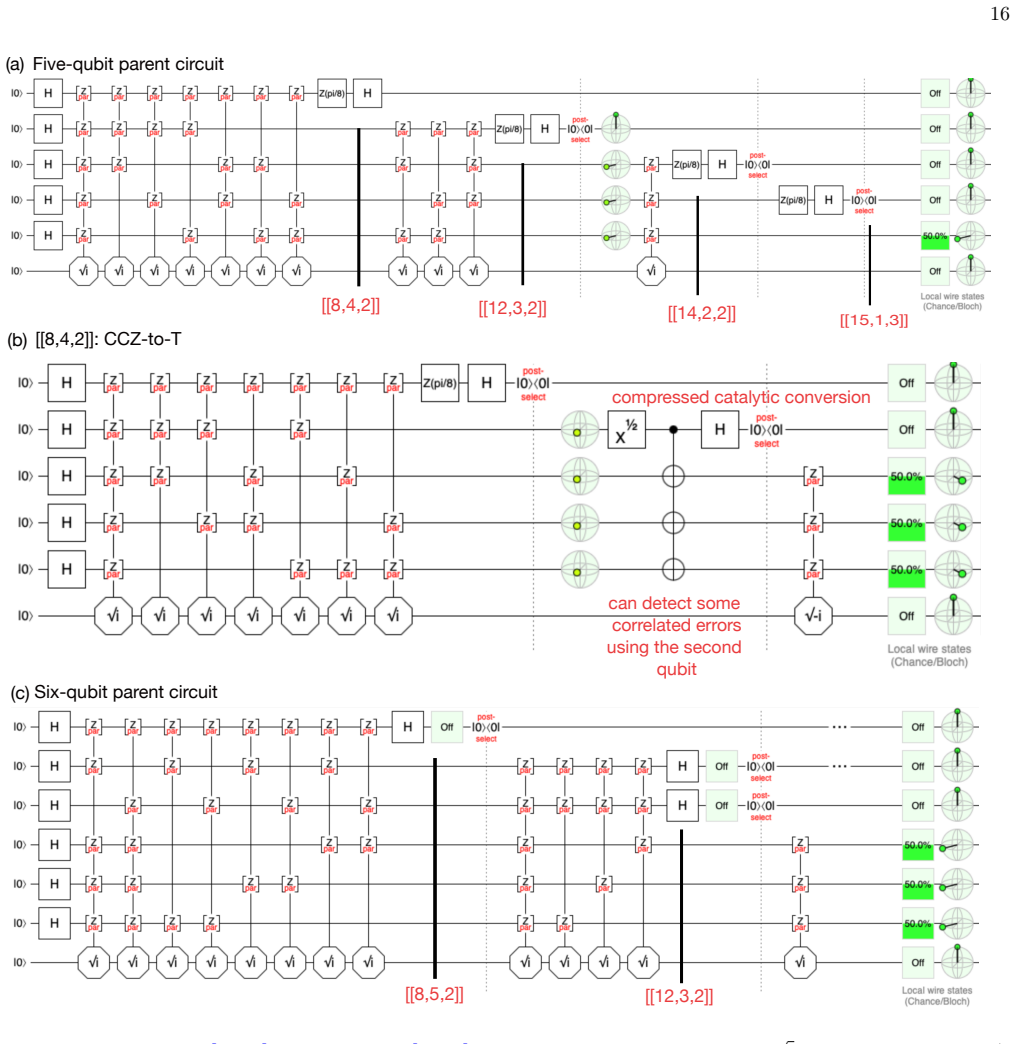
- The abstract and Discussion state that the framework unifies synthillation and non-CSS catalytic factories. The two-group search does not recover the Campbell–Howard synthillation families (they break output symmetry); those appear only via the symmetry-free targeted-output existence proof (App. H) and catalytic post-processing (Sec. 0c / App. I). The body already makes this distinction; the abstract should be tightened so that “unifies” is not read as “the main numerical search recovers,” e.g. by noting that synthillation/non-CSS sit under the extended borrowed-identity formalism rather than under the two-group catalogue of Fig. 1.
minor comments (6)
- Notation: the paper carefully notes that n is circuit qubits and N is gate count (dual to the usual literature swap). A single early display equation or table mapping (n,N,k,d) to the dual CSS parameters would help readers who jump between sections.
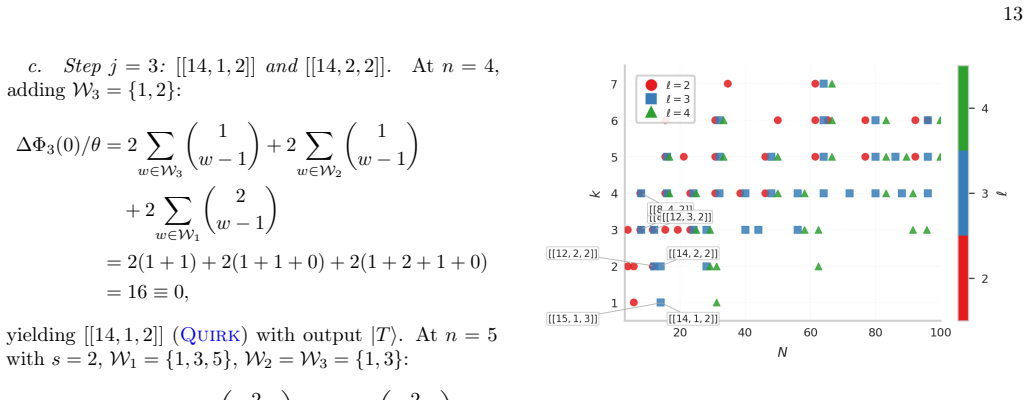
- Fig. 1 and Tables I–III: filled vs open markers and Clifford-equivalence classes are defined in App. D, but a one-line legend note in the main-text caption that “class” means residual-polynomial degree / Clifford orbit would make the figure self-contained.
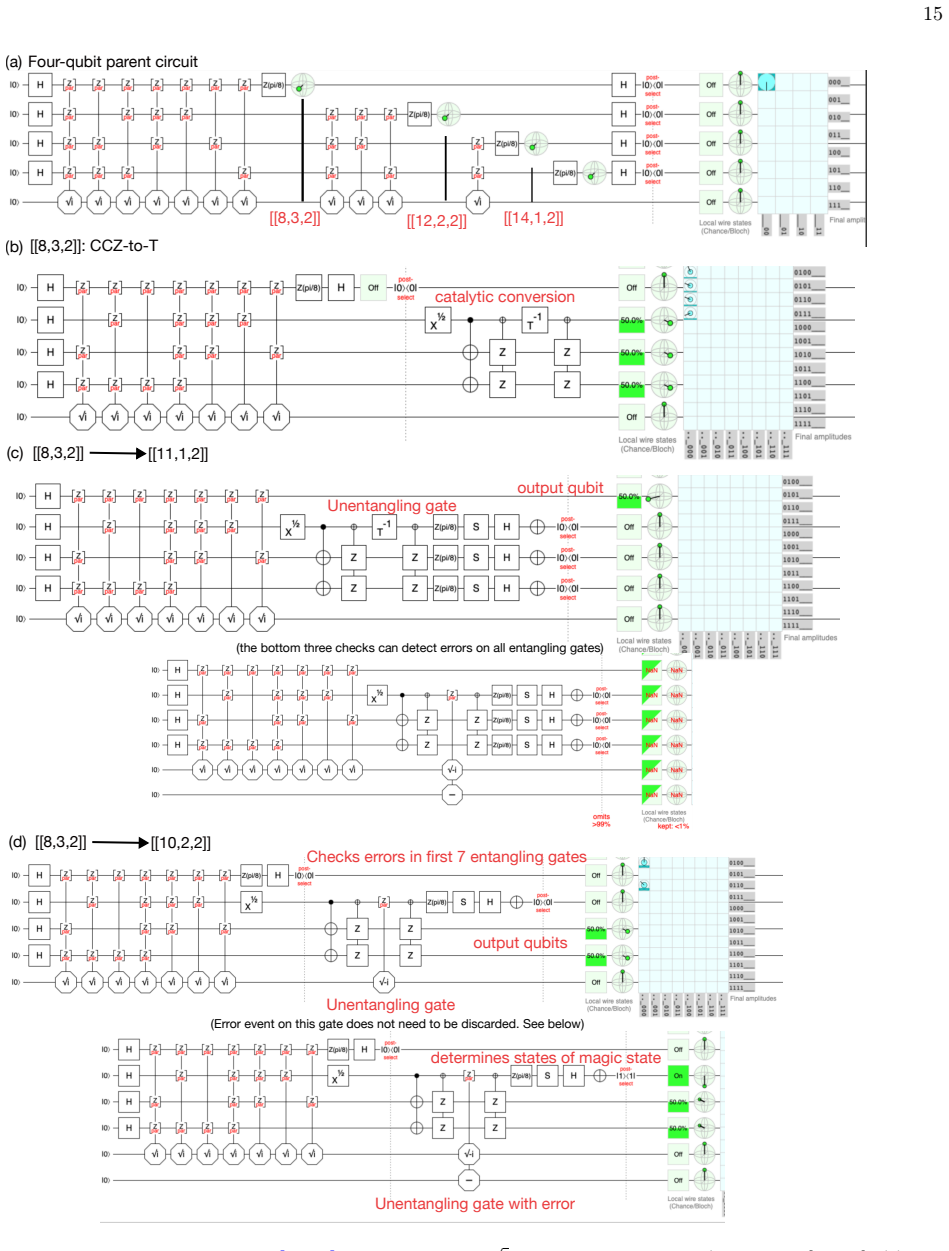
- Proposition 6 (malleability) is central to the compile-time claim; a brief forward pointer in the abstract or introduction to the four- and five-qubit parent examples (App. I, Figs. 5–6) would help readers locate the concrete evidence.
- App. F: the two-cell deterministic sign assignment is empirically sufficient for the recovered catalogue; a sentence on whether mixed signs could yield new (N,k) outside the two-group families (or only isomorphic circuits) would close a natural reader question.
- Typos / polish: “aborrowed” spacing in Definition 1; occasional missing spaces after periods in the abstract and early paragraphs; “theHeisenberg” / “theSchrödinger” compound-word spacing in the introduction.
- Note Added and Ref. [38]: the distinction (k=1 higher-distance SAT vs multi-output malleable search) is clear; ensuring the arXiv version cites the concurrent preprint consistently with the journal’s concurrent-work policy is the only remaining housekeeping item.
Circularity Check
No significant circularity: master conditions are derived from phase accumulation and validated by independent recovery of known factories.
full rationale
The paper's load-bearing claims rest on Definition 1 (borrowed identity C |+ angle⊗n = eiϕ |+ angle⊗n) and the subsequent closed-form phase conditions. Lemma 2 / Theorem 3 (symmetric) and Lemma 4 / Theorem 5 (two-group) are obtained by induction on Dicke-sector indices via Pascal's recurrence and odd-extraction identities; the resulting linear Diophantine constraints over Z2^{l+1} do not embed target factory parameters as free fits. Distance-2 is guaranteed by the explicit construction that every surviving gate after (wO,0) removal touches a check qubit (standard dual-CSS single-error detection, scoped after Eq. 8). Recovery of Bravyi–Haah, H-code, Nezami–Haah d=2 entries, hypercube [[2^l,l,2]], [[12,2,2]] CS, etc., is presented as an independent consistency check inside a stated polynomial-time sweep, not as a re-derivation. Malleability (Prop. 6) and sequential parents follow directly from successive gate removal on the same identity circuit. Prop. 7 correctly notes strict containment over CSS transversality; catalytic non-CSS examples are constructed explicitly rather than assumed. Concurrent SAT work [38] is distinguished by focus. No equation reduces a claimed result to its own input by construction, no fitted parameter is renamed a prediction, and no uniqueness theorem is imported via self-citation. The derivation is self-contained against the released search code, Quirk circuits, and residual-polynomial classification (Apps. D–I).
Assumptions & free parameters
free parameters (2)
- search envelope (k≤7, n≤11, s_total,s_O≤7, l∈{2,3,4})
- deterministic two-cell sign assignment
assumptions (4)
- domain assumption Diagonal gates of the Clifford hierarchy are closed under products and the phase they apply is completely determined by Hamming-weight overlap parity.
- ad hoc to paper A factory extracted by removing pure-output gates from a borrowed identity has distance at least 2 whenever every surviving gate touches a check qubit.
- domain assumption Spacetime duality maps an n-qubit borrowed identity of N multi-qubit Z-rotations to an N-qubit CSS code with n X-stabilizers on which T^⊗N acts as a logical Cl gate.
- domain assumption Output Clifford-equivalence class is completely classified by the highest non-vanishing finite difference of the residual phase polynomial (Proposition 8).
invented entities (2)
-
borrowed-identity condition
independent evidence
-
malleable parent circuit / sequential borrowed identity
independent evidence
Cite this review
Pith. "Pith review of Borrowed Identities: Malleable Distillation Factories and a Unified Numerical Search." pith.science (2026). https://pith.science/paper/54225QC4
@misc{pith2026260628518,
  author       = {Pith},
  title        = {Pith review of: Borrowed Identities: Malleable Distillation Factories and a Unified Numerical Search},
  year         = {2026},
  howpublished = {\url{https://pith.science/paper/54225QC4}},
  note         = {Machine review of arXiv:2606.28518}
}
abstract
Magic-state distillation is one of the leading overheads in fault-tolerant quantum computation. Existing methods for finding distillation factories require a transversal gate to act correctly on the entire codespace, a constraint that limits both generality and search efficiency. We introduce a strictly weaker borrowed-identity condition, requiring only that the distillation circuit act as the identity on a single input state. It applies uniformly across all levels of the Clifford hierarchy and unifies, within a single level, factories that distill different magic states -- for example, the $|T\rangle$, $|CS\rangle$, and $|CCZ\rangle$ factories. A brute-force search over borrowed-identity circuits with two-group symmetry recovers, within the search range, all distance-2 factories known from code-construction approaches, including entangled-output and multi-output factories previously outside the scope of any single numerical search. This unification yields parent circuits that encode multiple factories, so the output magic-state type can be chosen at compile time rather than fixed by a hard-coded design. The framework also extends beyond CSS codes, unifying constructions, including synthillation and non-CSS catalytic factories, previously obtained by disparate approaches.
Figures

Figures from the paper (3 more)
Reference graph
Works this paper leans on
-
[1]
Bravyi and A
S. Bravyi and A. Kitaev, Phys. Rev. A71, 022316 (2005), introducesmagic-statedistillationandthe[[15 , 1, 3]]Reed– Muller protocol; also the[[5, 1, 3]] |T⟩-distillation routine
2005
-
[2]
Eastin and E
B. Eastin and E. Knill, Physical review letters102, 110502 (2009)
2009
-
[3]
Gottesman and I
D. Gottesman and I. L. Chuang, Nature402, 390 (1999)
1999
-
[4]
Sales Rodriguez, J
P. Sales Rodriguez, J. M. Robinson, P. N. Jepsen, Z. He, C. Duckering, C. Zhao, K.-H. Wu, J. Campo, K. Bagnall, M. Kwon,et al., Nature645, 620 (2025)
2025
-
[5]
A. G. Fowler, M. Mariantoni, J. M. Martinis, and A. N. Cleland, Phys. Rev. A86, 032324 (2012)
2012
- [6]
-
[7]
H. Zhou, C. Duckering, C. Zhao, D. Bluvstein, M. Cain, A.Kubica, S.-T.Wang,andM.D.Lukin,inProceedings of the 52nd Annual International Symposium on Computer Architecture(2025) pp. 1432–1448
2025
-
[8]
S. Bravyi and J. Haah, Phys. Rev. A86, 052329 (2012), triorthogonal codes; introduces the[[3k + 8, k, 2]]family. The k = 2instance is[[14 , 2, 2]]and the k = 4instance is [[20,4,2]]., 1209.2426
arXiv 2012
Show all 46 references
-
[9]
Rengaswamy, R
N. Rengaswamy, R. Calderbank, M. Newman, and H. D. Pfister, IEEE J. Sel. Areas Inf. Theory1, 499 (2020), 1910.09333
2020 arXiv
-
[10]
Haah and M
J. Haah and M. B. Hastings, Quantum2, 71 (2018), gen- eralised triorthogonal codes forT,CS,CCZdistillation., 1709.02832
2018 arXiv
-
[11]
Bombín and M
H. Bombín and M. A. Martin-Delgado, Phys. Rev. B75, 075103 (2007), introduces the 3D color code; the smallest instance is the[[8, 3, 2]]code on the cube, with transversal Timplementing logicalCCZ., cond-mat/0607736
2007 arXiv
-
[12]
Eastin, Phys
B. Eastin, Phys. Rev. A87, 032321 (2013), first8T→ CCZ (Toffoli) distillation factory using the[[8, 3, 2]]code of Ref. [11]., 1212.4872
2013 arXiv
-
[13]
Krishna and J.-P
A. Krishna and J.-P. Tillich, Phys. Rev. Lett.123, 070507 (2019), 1811.08461
2019 arXiv
- [14]
-
[15]
E. T. Campbell and M. Howard, Phys. Rev. A95, 022316 (2017), 1606.01904
2017 arXiv
-
[16]
A. M. Meier, B. Eastin, and E. Knill, Quantum Inf. Com- put.13, 195 (2013), the original[[10, 2, 2]](10 → 2) pro- tocol using the[[4,2,2]]code as inner block., 1204.4221
2013 arXiv
-
[17]
Jones, Phys
C. Jones, Phys. Rev. A87, 042305 (2013), introduces the[[ n, n− 4, 2]]“H-code” family of which[[6, 2, 2]]is the smallest member., 1210.3388
2013 arXiv
-
[18]
D. Litinski, Quantum3, 205 (2019), space-time-optimised distillation circuits including explicit15 → 1,20 → 4, 14 → 2, and8 →CCZ realisations on the surface code; the[[14 , 2, 2]]entry in our table is the small-footprint variant introduced here., 1905.06903
2019 arXiv
-
[19]
Gottesman, Phys
D. Gottesman, Phys. Rev. A54, 1862 (1996)
1996
- [20]
-
[21]
A. Barg, N. J. Coble, D. Hangleiter, and C. Kang, IEEE Transactions on Information Theory72, 415 (2026)
2026
-
[22]
M. A. Webster, B. J. Brown, and S. D. Bartlett, Quantum 6, 815 (2022)
2022
-
[23]
M. A. Webster, A. O. Quintavalle, and S. D. Bartlett, New Journal of Physics25, 103018 (2023)
2023
-
[24]
Gong, Magic state distillation via codes over binary extension fields, Oral presentation at the Quantum Error Correction 2026 conference (2026)
A. Gong, Magic state distillation via codes over binary extension fields, Oral presentation at the Quantum Error Correction 2026 conference (2026)
2026
-
[25]
This is the number of valid borrowed-identity solutions found, i.e. admissible (parameter-tuple, sign) configura- tions; it includes solutions with trivial (stabilizer) output and counts the same factory once for each(n, s)tuple realizing it, so it exceeds the number of distin...
- [26]
-
[27]
S. X. Cui, D. Gottesman, and A. Krishna, Phys. Rev. A 95, 012329 (2017), 1608.06596. [28]S n acts by relabeling qubit registers, not by physically permuting hardware: qubits with identical circuit con- nectivity are interchangeable for the borrowed-identity condition
2017 arXiv
-
[28]
Even weights cannot yieldk= 1factories
-
[29]
A. M. Steane, Phys. Rev. A54, 4741 (1996)
1996
-
[30]
Steane, Proceedings of the Royal Society of London
A. Steane, Proceedings of the Royal Society of London. Se- ries A: Mathematical, Physical and Engineering Sciences 452, 2551 (1996)
1996
-
[31]
A.GongandJ.M.Renes,arXivpreprintarXiv:2410.23263 (2024)
2024 arXiv
-
[32]
L. Luo, Z. Ma, D. Lin, and H. Wang, Quantum Science & Technology5, 045022 (2020)
2020
-
[33]
Kubica and M
A. Kubica and M. E. Beverland, Physical Review A91, 032330 (2015)
2015
-
[34]
E.g.[[8 , 4, 2]]at l = 3is a Clifford-padded version of the cube[[8 , 3, 2]]; it is retained as a distinct CCZ-class factory, since the extra qubit yields additional correlated-error detection (Fig. 6(b)). 7
-
[35]
Gidney, Quirk: A drag-and-drop quantum circuit sim- ulator
C. Gidney, Quirk: A drag-and-drop quantum circuit sim- ulator. (2016)
2016
-
[36]
Jones, Phys
C. Jones, Phys. Rev. A87, 052334 (2013), indepen- dent and concurrent8T→CCZ construction using the [[8, 3, 2]]code of Ref. [11]; refined two-round error detec- tion., 1303.6971
2013 arXiv
-
[37]
Jacinto, X
H. Jacinto, X. Valcarce, V. Barizien, É. Gouzien, and N. Sangouard, arXiv preprint arXiv:2606.07734 (2026)
2026 arXiv
-
[38]
mO + mS odd with mO ≤ 1, mS ≤0
S. Singh, Algebraic magic state factory search [GitHub] (2026). Appendix A: Schrödinger vs. Heisenberg picture: specialization to triorthogonality Proposition 7.Every transversal- T distillation cir- cuit on a CSS code is, under spacetime duality, a bor- rowed identity. The co...
2026
-
[39]
The[[8,3,2]]factory (n= 4,k= 3,l= 3) The[[8 , 3, 2]]factory (Quirk) arises from the sequential construction at j = 1with W1 = {1, 2, 3, 4}, n = 4, θ=π/8. a. Borrowed-identity check.The Dicke-sector con- dition (Lemma 2) at i = 1requires P w∈W 3 w−1 ∈ 2l−i+1Z= 8Z: 3 0 + 3 1 + 3...
-
[40]
The[[20,4,2]]factory (n= 7,k= 4,l= 3) We verify the asymmetric borrowed-identity condition at(l, n, k) = (3,7,4),θ=π/8,(s total, sO, sS) = (2,3,1). a. Gate set. Wtotal = {1, 3, 5, 7}, WO = {0, 1, 4}, WS = {0, 1, 2, 3}. The allowed pairs are W = {(0, 1), (0, 3), (1, 0), (1, 2),...
-
[41]
For each parameter tuple( l, n, k, stotal, sO), the gate set W is determined by the three weight-separation setsWtotal, WO, WS as 10 described for asymmetric circuits
Search procedure The asymmetric search enumerates over the skip param- eters( stotal, sO)with sS = 1fixed. For each parameter tuple( l, n, k, stotal, sO), the gate set W is determined by the three weight-separation setsWtotal, WO, WS as 10 described for asymmetric circuits. Va...
-
[42]
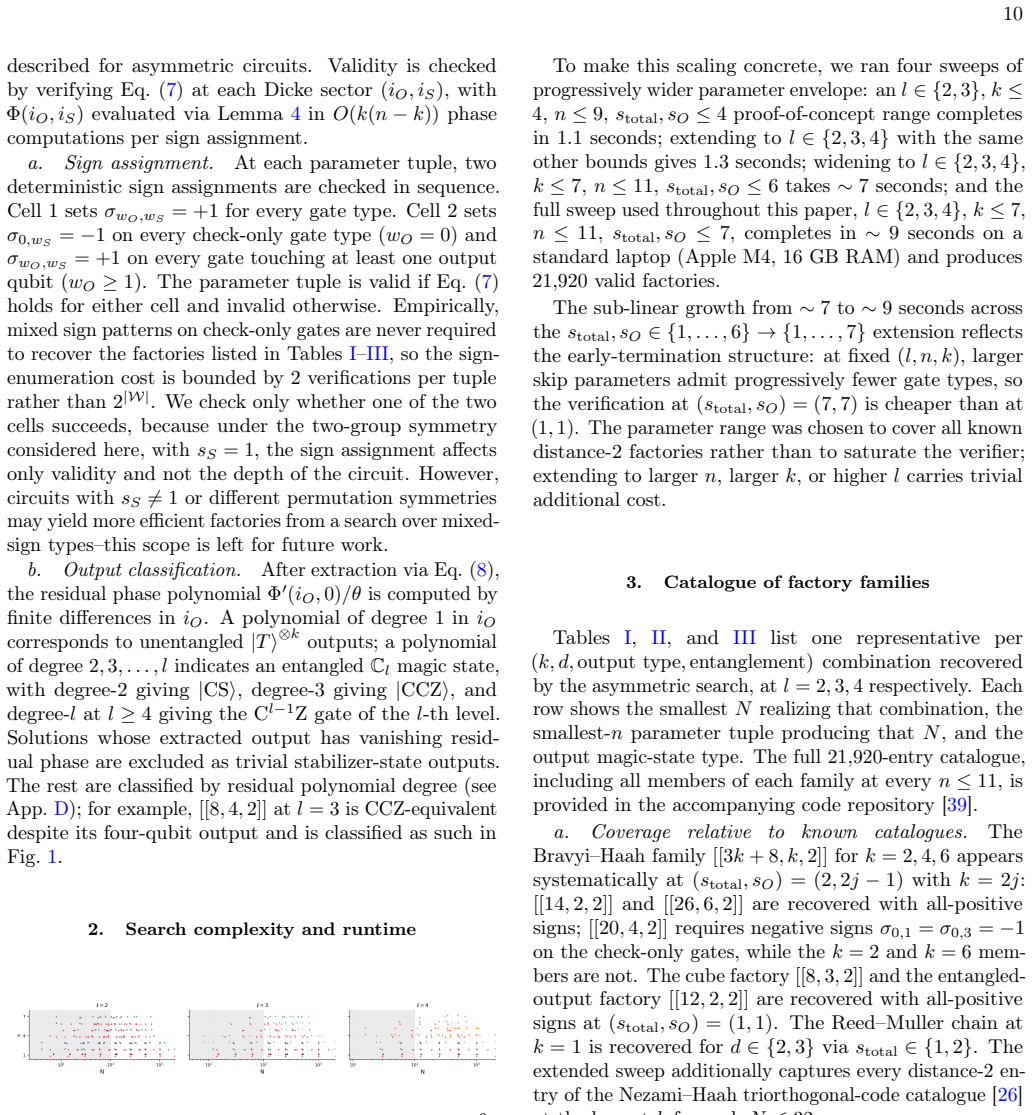
Search complexity and runtime FIG. 2. Full extent of the two-group catalogue (N up to∼103); the shaded band marks theN≤100region shown in Fig. 1. For each( l, n, k)triple, the number of( stotal, sO)pa- rameter tuples is|Stotal| × |SO|; per tuple, the determin- istic two-cell c...
-
[43]
Each row shows the smallestN realizing that combination, the smallest-n parameter tuple producing thatN, and the output magic-state type
Catalogue of factory families Tables I, II, and III list one representative per (k, d,output type,entanglement)combination recovered by the asymmetric search, atl = 2, 3, 4respectively. Each row shows the smallestN realizing that combination, the smallest-n parameter tuple pro...
-
[44]
, qn−k} and output qubitsO = {qn−k+1,
Construction and phase condition Definition 9(Sequential borrowed identity).Let θ = π/2l and partition n qubits into check qubits S = {q1, . . . , qn−k} and output qubitsO = {qn−k+1, . . . , qn}. Asequential borrowed identityis constructed by fixing each qj in turn and applyin...
-
[45]
The four-qubit parent (n = 4, Wj = {1,
Worked examples We verify Eq.(G2) explicitly for the four- and five- qubit malleable parent circuits discussed in the main text, working atl = 3( θ = π/8,2 π/θ = 16) with skip parameter s = 1unless otherwise stated. The four-qubit parent (n = 4, Wj = {1, . . . , n−j + 1}) prod...
-
[46]
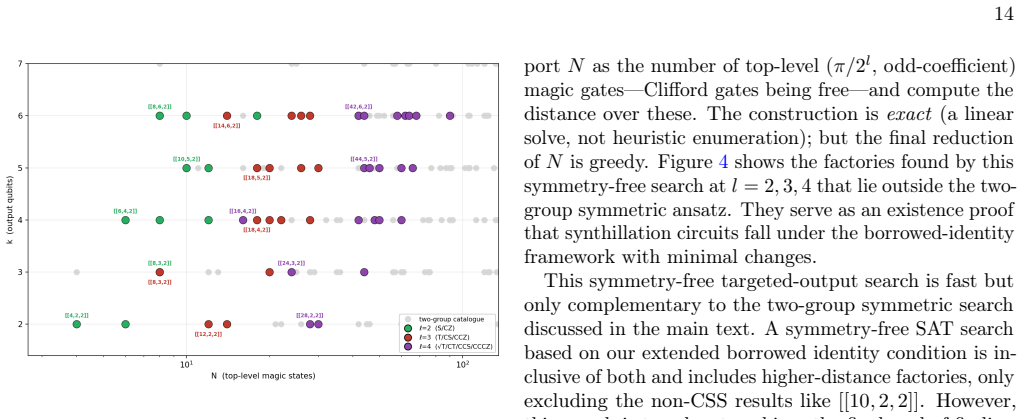
Results and qualitative features The sequential search results are shown in Fig. 3. For each( l, n)with l∈ { 2, 3, 4} and n≤ 6, we enumerate sequences( W1, . . . ,WJ)with J = n−k and each Wj = {w≡ 1 mods j : w≤n−j +1 } for sj ∈ {1, 2, 3, 4}, giving 4J candidate tuples per(n, J...
Reviewed July 14, 2026 · model on record in the stance chip above.
Discussion (0). Sign in to comment.