REVIEW 2 major objections 4 minor 42 references
Random Label Prediction Heads for Studying Memorization in Deep Neural Networks
T0 review · 2 major / 4 minor · reviewed 2026-07-14 · grok-4.5
Pith's one-line read Reducing memorization with random-label heads can either help or hurt generalization, depending on how densely the training data samples the true distribution.
desk verdict Clean operational probe for layer-wise memorization plus a regularizer that actually flips the sign of the generalization effect with sampling density; the Rademacher framing is loose but not load-bearing. read the letter →
The pith
A machine-rendered reading of the paper's core claim, the machinery that carries it, and where it could break.
The reading
What carries the argument
The random label prediction head (RLP-head): a shallow classifier attached in parallel to any chosen layer that is trained solely to predict fixed per-sample random labels from that layer’s activations. Its accuracy estimates memorization; a reverse-cross-entropy loss computed from its outputs regularizes the feature extractor against sample-specific features.
What would settle it
Train the identical architecture on a fully synthetic classification problem whose true decision boundary is known and densely sampled, apply RLP-regularization at increasing strengths, and check whether test error rises exactly when random-label accuracy falls to chance; if test error continues to fall while memorization is driven to zero, the sampling-density claim is falsified.
Extended reading notes
Core claim
Random-label prediction heads give a direct, layer-wise empirical measure of memorization capacity. When their success is actively suppressed by a reverse cross-entropy regularizer, memorization falls, but test performance rises on sufficiently sampled datasets and falls on undersampled ones. Memorization is therefore not equivalent to overfitting; it can be either detrimental or beneficial according to the sampling density of the training distribution.
Load-bearing premise
That the accuracy of a simple linear head at recovering fixed random labels from a layer’s activations faithfully measures how much sample-specific information that layer has memorized, rather than being limited by the head’s own capacity or by accidental structure in the random labels.
Editorial extensions
If this is right
- Memorization can be monitored layer-by-layer during ordinary supervised training without altering the main task loss.
- Explicit anti-memorization regularization can raise test accuracy and shrink the train–test gap on large, well-sampled vision datasets.
- On undersampled or long-tailed data the same regularizer can destroy accuracy on rare classes that require sample-specific features.
- Regularizing only the final layer shifts both class abstraction and residual memorization into earlier layers, sometimes improving early-exit accuracy.
- Classical complexity bounds that treat lower Rademacher complexity as strictly better do not capture the dual role of memorization observed here.
Reading between the lines
- The same RLP probe could be attached to intermediate activations of large language models to separate rare-document memorization from shared linguistic structure.
- If sampling density decides whether memorization helps, deliberate densification of long-tail regions may be a more effective alternative to anti-memorization regularizers.
- Layer-wise RLP accuracy curves offer a cheap diagnostic for deciding when a network is oversized relative to a given dataset.
- Multi-head random partitions give stronger regularization, suggesting residual shared structure still leaks into the single-head metric and could be refined.
Editorial analysis
A structured set of objections, weighed in public.
Referee Report
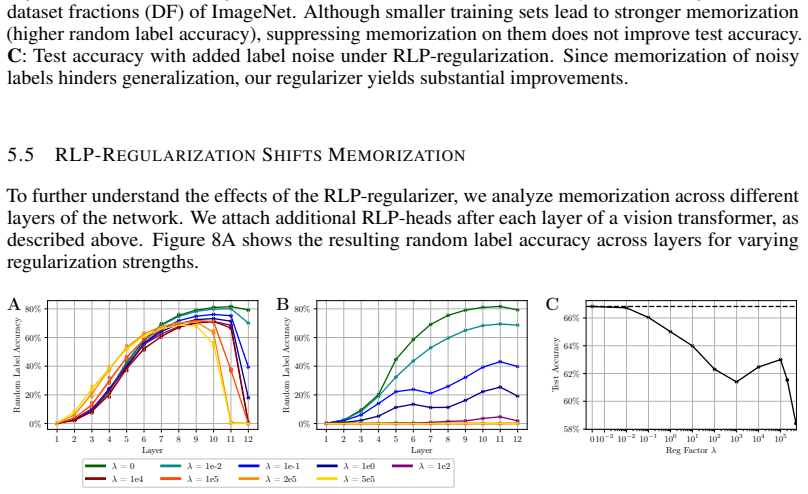
Summary. The paper introduces Random Label Prediction Heads (RLP-heads): auxiliary linear (or shallow) heads attached to intermediate activations that are trained to predict fixed random labels assigned to each training sample. Random-label accuracy is treated as an operational proxy for memorization capacity (motivated by Rademacher complexity). The same head yields a regularizer L_reg that penalizes confident random-label predictions and is applied only to the feature extractor. Extensive experiments on ViT-B/32–ImageNet and WideResNet-16-4–CIFAR-100 (plus ablations on head capacity, multi-head variants, frozen extractors, dataset fractions, label noise, ImageNet-LT, mixup, adversarial robustness and membership inference) show that RLP accuracy tracks known regularizers and capacity, that L_reg can drive it to chance, and that suppressing memorization improves test accuracy on sufficiently sampled data while degrading it on undersampled data. The authors hypothesize that the dual role is driven by sampling density and long-tail structure.
Significance. If the dual-role pattern holds, the work supplies both a practical, non-intrusive probe of layer-wise memorization and a controllable regularizer that can be used to test when memorization helps or hurts. The released code, the multi-control experimental design (dataset-fraction, noise, long-tail, de-duplication, multi-head, frozen re-probes), and the explicit separation of the metric from any theoretical generalization bound are genuine strengths. The result challenges the still-common identification of overfitting with memorization and offers a concrete experimental handle for studying long-tail effects (Feldman-style) without requiring leave-one-out retraining.
major comments (2)
- The dual-role claim (ImageNet improves, CIFAR-100 degrades under RLP-regularization) is the central empirical result, yet most main-text figures (Figs. 4–5, 7–9) report single-run curves without error bars or multi-seed statistics. Appendix A.17–A.18 give means±std only for the adversarial and membership-inference side experiments. Because the claimed effect sizes are modest (≈1.5 % on ImageNet, several points on CIFAR), at least three independent seeds for the key λ-sweeps on both datasets are needed to establish that the sign difference is robust rather than run-to-run variation.
- Section 3–4 present random-label accuracy as “an empirical estimate of Rademacher complexity.” The formal Rademacher definition (Eq. 1) involves a supremum over the hypothesis class and an expectation over random signs; the paper’s operational proxy is the accuracy of a single linear head trained by SGD on a fixed multi-class random labeling. While the proxy is later validated empirically (capacity sweeps, full-network random training in A.15, noisy-label correlation), the theoretical language should be softened to “operational proxy motivated by Rademacher complexity” so that readers do not treat the PAC bound of Theorem 1 as directly applicable to the reported numbers.
minor comments (4)
- Figure 2C and the layer-wise plots in Fig. 8 would benefit from a brief note on whether the RLP-heads share parameters or are independently initialized; the text is currently silent.
- Appendix A.12 reports Pearson r = 0.08 between RLP accuracy and Feldman scores; a short discussion of why the two measures diverge (generalization vs pure memorization) is already present but could be moved or cross-referenced more prominently in the main text.
- Typographical inconsistencies appear in the arXiv rendering (“RANDOMLABELPREDICTIONHEADS”, missing spaces after periods in several appendix headings). A light copy-edit pass would improve readability.
- The choice n = 100 000 for ImageNet (≈12 samples per random label) is justified in A.4–A.5, but a one-sentence reminder in the main experimental section would help readers who skip the appendix.
Circularity Check
No significant circularity: RLP accuracy is an operational proxy validated against independent controls; dual-role generalization effects are empirical observations, not forced by construction or self-citation.
full rationale
The paper's central chain is definitional only in the weak, non-circular sense that Rademacher complexity is classically the capacity to fit random labels (Sec. 3, Eq. 1), so measuring accuracy of an auxiliary linear head on fixed random labels is a natural empirical proxy (Sec. 4). This is not self-definitional circularity: the authors never claim a mathematical derivation that recovers a bound or uniqueness theorem from the metric itself; they treat random-label accuracy solely as a probe, then validate it against independent quantities (capacity sweeps A.9, full-network random-label training A.15 with Pearson r=0.93, noisy-label accuracy A.13–A.14, Feldman scores A.12, known regularizers Fig. 3). The regularizer L_reg (Eq. 4) is an explicit adversarial penalty on that probe; its effects on train/test accuracy are measured experimentally across datasets, fractions, noise levels, and long-tail classes (Figs. 4–7, A.2, A.19, A.21). No free parameter is fitted to a subset and then re-presented as a prediction; λ is swept and results reported for all values. No load-bearing self-citation, uniqueness import, or ansatz smuggling appears. The dual-role claim (memorization helps or hurts depending on sampling) is therefore an empirical pattern corroborated by multiple orthogonal ablations, not a result that reduces to its inputs by construction. Score 0 is the correct honest finding.
Assumptions & free parameters
free parameters (3)
- regularization strength λ
- number of random labels n
- RLP-head architecture (linear vs two-layer, hidden size)
assumptions (3)
- domain assumption Empirical Rademacher complexity can be approximated by the accuracy of a linear head trained on fixed random labels while the feature extractor is trained on true labels.
- ad hoc to paper Only the RLP-head receives gradients from L_rnd; the feature extractor receives gradients from L_reg but not from the classification head of the RLP path.
- domain assumption Random labels are drawn once and held fixed across epochs.
invented entities (1)
-
Random Label Prediction Head (RLP-head)
Cite this review
Pith. "Pith review of Random Label Prediction Heads for Studying Memorization in Deep Neural Networks." pith.science (2026). https://pith.science/paper/R2LAAYKL
@misc{pith2026260711541,
  author       = {Pith},
  title        = {Pith review of: Random Label Prediction Heads for Studying Memorization in Deep Neural Networks},
  year         = {2026},
  howpublished = {\url{https://pith.science/paper/R2LAAYKL}},
  note         = {Machine review of arXiv:2607.11541}
}
read the original abstract
We introduce a straightforward yet effective method to empirically study memorization in deep neural networks for classification tasks. Our approach augments each training sample with auxiliary random labels, which are then predicted by a random label prediction head (RLP-head). RLP-heads can be attached at arbitrary depths of a network, predicting random labels from the corresponding intermediate representation and thereby enabling analysis of how memorization capacity evolves across layers. By interpreting the RLP-head performance as an empirical estimate of Rademacher complexity, we obtain a direct measure of both sample-level memorization and model capacity. We leverage this random label accuracy metric to analyze generalization and overfitting in different models and datasets. Building on this approach, we further propose a novel regularization technique based on the output of the RLP-head, which demonstrably reduces memorization. Interestingly, our experiments reveal that reducing memorization can either improve or impair generalization, depending on the dataset and training setup. These findings challenge the traditional assumption that overfitting is equivalent to memorization and suggest new hypotheses to reconcile these seemingly contradictory results. The source code is available at https://github.com/MarlonBecker/RandomLabelHeads
Figures


Figures from the paper (6 more)



Reference graph
Works this paper leans on
-
[1]
Conference on Computer Vision and Pattern Recognition , year =
Christian Szegedy and Vincent Vanhoucke and Sergey Ioffe and Jonathon Shlens and Zbigniew Wojna , title =. Conference on Computer Vision and Pattern Recognition , year =
-
[2]
International Conference on Learning Representations , year=
Decoupled Weight Decay Regularization , author=. International Conference on Learning Representations , year=
-
[3]
ImageNet:
Jia Deng and Wei Dong and Richard Socher and Li. ImageNet:. Conference on Computer Vision and Pattern Recognition , year =
-
[4]
International Conference on Learning Representations , year =
Alexey Dosovitskiy and Lucas Beyer and Alexander Kolesnikov and Dirk Weissenborn and Xiaohua Zhai and Thomas Unterthiner and Mostafa Dehghani and Matthias Minderer and Georg Heigold and Sylvain Gelly and Jakob Uszkoreit and Neil Houlsby , title =. International Conference on Learning Representations , year =
-
[5]
Entropy and mutual information in models of deep neural networks , journal =
Marylou Gabri. Entropy and mutual information in models of deep neural networks , journal =
-
[6]
British Machine Vision Conference , year =
Sergey Zagoruyko and Nikos Komodakis , title =. British Machine Vision Conference , year =
-
[7]
Learning Multiple Layers of Features from Tiny Images , year =
Krizhevsky, Alex and Hinton, Geoffrey , institution =. Learning Multiple Layers of Features from Tiny Images , year =
-
[8]
ACM Comput
Mehrabi, Ninareh and Morstatter, Fred and Saxena, Nripsuta and Lerman, Kristina and Galstyan, Aram , title =. ACM Comput. Surv. , pages =. 2021 , volume =
2021
Show all 42 references
-
[9]
Journal of Machine Learning Research , year =
Nitish Srivastava and Geoffrey Hinton and Alex Krizhevsky and Ilya Sutskever and Ruslan Salakhutdinov , title =. Journal of Machine Learning Research , year =
-
[10]
Neural Networks Learning and Memorization with (almost) no Over-Parameterization , year =
Daniely, Amit , journal =. Neural Networks Learning and Memorization with (almost) no Over-Parameterization , year =
-
[11]
Foundations of machine learning
Mohri, Mehryar and Rostamizadeh, Afshin and Talwalkar, Ameet. Foundations of machine learning
-
[12]
Zhang, Chiyuan and Bengio, Samy and Hardt, Moritz and Recht, Benjamin and Vinyals, Oriol , title =. Commun. ACM , pages =. 2021 , volume =
2021
-
[13]
International Conference on Learning Representations , year=
Identity Crisis: Memorization and Generalization Under Extreme Overparameterization , author=. International Conference on Learning Representations , year=
-
[14]
What Neural Networks Memorize and Why: Discovering the Long Tail via Influence Estimation , year =
Feldman, Vitaly and Zhang, Chiyuan , journal =. What Neural Networks Memorize and Why: Discovering the Long Tail via Influence Estimation , year =
-
[15]
International Conference on Machine Learning , author =
A. International Conference on Machine Learning , author =
-
[16]
2021 , volume =
Preetum Nakkiran and Gal Kaplun and Yamini Bansal and Tristan Yang and Boaz Barak and Ilya Sutskever , title =. 2021 , volume =
2021
-
[17]
Mitigating Unwanted Biases with Adversarial Learning , booktitle =
Zhang, Brian Hu and Lemoine, Blake and Mitchell, Margaret , year =. Mitigating Unwanted Biases with Adversarial Learning , booktitle =
-
[18]
Wang, Zeyu and Qinami, Klint and Karakozis, Ioannis Christos and Genova, Kyle and Nair, Prem and Hata, Kenji and Russakovsky, Olga , year =. Towards
-
[19]
2019 , volume =
Xue Ying , title =. 2019 , volume =
2019
-
[20]
The secret sharer: evaluating and testing unintended memorization in neural networks , year =
Carlini, Nicholas and Liu, Chang and Erlingsson, \'. The secret sharer: evaluating and testing unintended memorization in neural networks , year =. USENIX Conference on Security Symposium , pages =
-
[21]
Small ReLU networks are powerful memorizers: a tight analysis of memorization capacity , year =
Yun, Chulhee and Sra, Suvrit and Jadbabaie, Ali , journal =. Small ReLU networks are powerful memorizers: a tight analysis of memorization capacity , year =
-
[22]
Image fairness in deep learning: problems, models, and challenges , journal =
Tian, Huan and Zhu, Tianqing and Liu, Wei and Zhou, Wanlei , year =. Image fairness in deep learning: problems, models, and challenges , journal =
-
[23]
Memorization Without Overfitting: Analyzing the Training Dynamics of Large Language Models , year =
Tirumala, Kushal and Markosyan, Aram and Zettlemoyer, Luke and Aghajanyan, Armen , journal =. Memorization Without Overfitting: Analyzing the Training Dynamics of Large Language Models , year =
-
[24]
Extracting Training Data from Large Language Models , booktitle =
Nicholas Carlini and Florian Tram. Extracting Training Data from Large Language Models , booktitle =. 2021 , pages =
2021
-
[25]
Proceedings of the 52nd Annual ACM SIGACT Symposium on Theory of Computing , volume =
Vitaly Feldman , title =. Proceedings of the 52nd Annual ACM SIGACT Symposium on Theory of Computing , volume =
-
[26]
Mozer and Hanie Sedghi and Zachary C
Pratyush Maini and Michael C. Mozer and Hanie Sedghi and Zachary C. Lipton and J. Zico Kolter and Chiyuan Zhang , year=. Can Neural Network Memorization Be Localized? , journal=
-
[27]
Deep Learning , author=
-
[28]
2024 , journal =
The Pitfalls of Memorization: When Memorization Hurts Generalization , author=. 2024 , journal =
2024
-
[29]
2021 , journal =
Deep Learning Through the Lens of Example Difficulty , author=. 2021 , journal =
2021
-
[30]
A Simple Weight Decay Can Improve Generalization , year =
Krogh, Anders and Hertz, John , journal =. A Simple Weight Decay Can Improve Generalization , year =
-
[31]
Journal of Imaging , VOLUME =
Barz, Björn and Denzler, Joachim , TITLE =. Journal of Imaging , VOLUME =. 2020 , NUMBER =
2020
-
[32]
International Conference on Learning Representations , year=
Towards Deep Learning Models Resistant to Adversarial Attacks , author=. International Conference on Learning Representations , year=
-
[33]
International Conference on Learning Representations , year=
Explaining and Harnessing Adversarial Examples , author=. International Conference on Learning Representations , year=
-
[34]
Proceedings of the 37th International Conference on Machine Learning , year=
Reliable evaluation of adversarial robustness with an ensemble of diverse parameter-free attacks , author=. Proceedings of the 37th International Conference on Machine Learning , year=
-
[35]
Proceedings of the IEEE/CVF conference on computer vision and pattern recognition , year=
Large-scale long-tailed recognition in an open world , author=. Proceedings of the IEEE/CVF conference on computer vision and pattern recognition , year=
-
[36]
International Conference on Learning Representations , year=
mixup: Beyond Empirical Risk Minimization , author=. International Conference on Learning Representations , year=
-
[37]
Early-Learning Regularization Prevents Memorization of Noisy Labels , year =
Liu, Sheng and Niles-Weed, Jonathan and Razavian, Narges and Fernandez-Granda, Carlos , journal =. Early-Learning Regularization Prevents Memorization of Noisy Labels , year =
-
[38]
2016 , journal =
Text Understanding from Scratch , author=. 2016 , journal =
2016
-
[39]
RoBERTa:
Yinhan Liu and Myle Ott and Naman Goyal and Jingfei Du and Mandar Joshi and Danqi Chen and Omer Levy and Mike Lewis and Luke Zettlemoyer and Veselin Stoyanov , year =. RoBERTa:
-
[40]
Scaling Learning Algorithms Towards
Bengio, Yoshua and LeCun, Yann , booktitle =. Scaling Learning Algorithms Towards
-
[41]
and Osindero, Simon and Teh, Yee Whye , journal =
Hinton, Geoffrey E. and Osindero, Simon and Teh, Yee Whye , journal =. A Fast Learning Algorithm for Deep Belief Nets , volume =
-
[42]
2016 , publisher=
Deep learning , author=. 2016 , publisher=
2016
Reviewed July 14, 2026 · model on record in the stance chip above.
Discussion (0). Continue with ORCID to comment.