REVIEW 3 major objections 5 minor 35 references
Demonstration of a cryogenic, switchable electron source for low-temperature detector calibration
T0 review · 3 major / 5 minor · reviewed 2026-08-01 · deepseek-v4-flash
Pith's one-line read A LED-illuminated aluminum foil produces switchable cryogenic electrons at rates above one per second.
desk verdict A worthwhile prototype demonstration whose qualitative electron-production case is solid, but the headline rate/efficiency numbers rest on a one-row Gaussian extrapolation and should not be taken at face value. read the letter →
The pith
A machine-rendered reading of the paper's core claim, the machinery that carries it, and where it could break.
The reading
What carries the argument
The mechanism is photoelectric emission from a double layer of 400 nm aluminum foils, illuminated by a 280 nm LED through an optical fiber. The electrons are accelerated by a negative voltage applied to the foils and travel 2.5 cm to a grounded array of microwave-multiplexed transition-edge sensors. The double foil serves as both a photocathode and a light-tight barrier against pinholes. A simple polarity test—signals seen only with negative bias—is the key identity that identifies the particles as electrons, and the count-rate scaling with LED current ties the process to photoemission.
What would settle it
Measure the full two-dimensional beam profile by reading all rows with uniform trigger thresholds or by inserting a collimator, and compare the integrated rate with the Gaussian-extrapolated value; an order-of-magnitude discrepancy would invalidate the claimed >=1 Hz rate and >=10^-14 efficiency.
Extended reading notes
Core claim
The central claim is that photoelectric emission from commercial aluminum foils, driven by a fiber-coupled UV LED, is a viable electron production mechanism inside a cryostat at 100 mK. With the foils biased negatively at 100–300 V relative to the grounded detector, single electrons are recorded by transition-edge sensor microcalorimeters; signals appear only under negative bias, confirming they are electrons. The measured rate scales with LED current and the pulse amplitude scales with accelerating voltage, and the inferred source rate and efficiency are >=1 Hz and >=10^-14 electrons per photon. The same setup also demonstrates that TES microcalorimeters can detect directly incident electro
Load-bearing premise
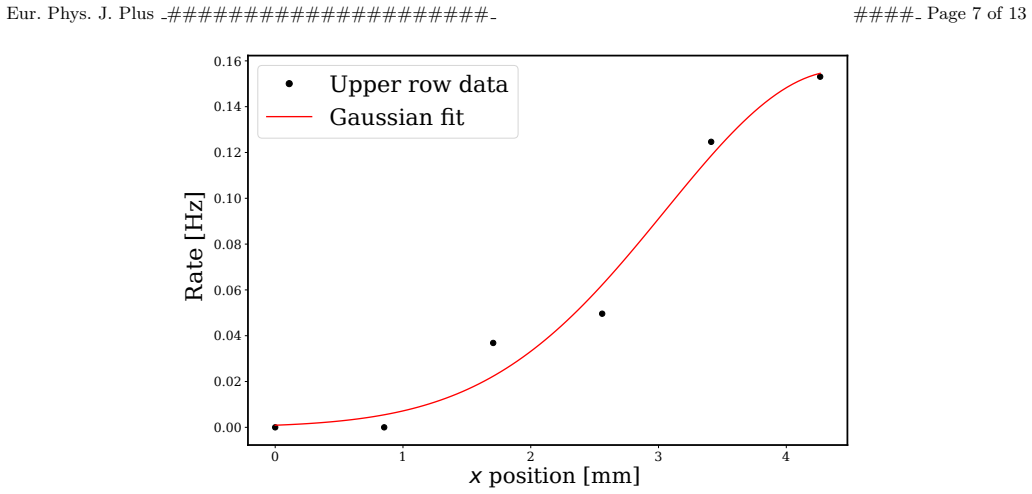
The headline rate and efficiency rest on assuming a 2D Gaussian beam shape fitted only to the upper row of the array; if the real beam is wider or asymmetric, those numbers could be off substantially.
Editorial extensions
If this is right
- The source can be built from inexpensive, commercially available aluminum and a standard LED, and it operates at the base temperature of a dilution refrigerator without an ultra-high vacuum.
- Electron yield is set independently of electron energy: LED current controls the rate, and acceleration voltage controls the energy.
- TES microcalorimeters can act as single-electron detectors in the 100–300 eV range, providing a low-energy testbed for these sensors.
- By adding an electron multiplier and a conversion target, the source could be developed into a switchable X-ray calibration line above the endpoint of a neutrino-mass spectrum.
- Because the LED can be pulsed, calibration data can be collected during short intervals interleaved with physics data, without moving parts.
Reading between the lines
- The quoted efficiency is per-photon at the photocathode; if the LED-to-foil photon flux is overestimated or the beam profile is broader than the single-row Gaussian fit implies, the true yield could easily be an order of magnitude lower, which would set a demanding requirement on the future electron-multiplier gain.
- If yield really is energy-independent, the same device could serve as a tunable monoenergetic electron source for mapping the energy response and nonlinearity of microcalorimeters across the full range of interest.
- A direct test would be to replace the current two-foil photocathode with foils of different thickness or different number of layers and observe whether the rate changes; the paper notes this dependence is still unknown.
- The surprising escape of electrons from superconducting aluminum suggests the photoemission at mK temperatures may proceed through a mechanism not described by standard mean-free-path arguments; understanding that mechanism could open a route to much higher efficiency.
Signed reviews
Editorial analysis
A structured set of objections, weighed in public.
Referee Report
Summary. The paper reports a prototype cryogenic electron source based on photoelectric emission from two 400-nm aluminum layers illuminated by a 280-nm LED, with electrons accelerated by up to 300 V and detected by a TES microcalorimeter array. The authors present three validation tests: signal appears only for negative bias, rate scales quadratically with LED current, and pulse amplitude increases with acceleration voltage. They characterize the beam profile by fitting a 1D Gaussian to the upper row of the array and, assuming a 2D Gaussian, infer a source rate of ≳1 Hz and an efficiency of ≳10^-14 e−/γ. They also analyze TES pulse energies using the Joule estimator, fit a phenomenological spectral model, and compare with Nebula simulations, reporting a measured energy resolution of about 40 eV for 100–300 eV electrons. The paper positions this as the first stage of a switchable calibration source for HOLMES and similar experiments.
Significance. If the quantitative claims are trustworthy, this is a valuable step toward a compact, switchable, cryogenic calibration source whose electron yield is independent of the acceleration energy—an improvement over CNT field-emission sources. The polarity, rate-scaling, and energy-scaling tests are clean and make the qualitative observation of cryogenic photoelectrons convincing. The demonstration of TES sensitivity to 100–300 eV electrons is also useful, as few such measurements exist. However, the headline rate and efficiency numbers rest on a fragile beam-profile extrapolation, and the physical mechanism of electron escape from 400-nm aluminum is explicitly acknowledged as unexplained. These issues do not undermine the qualitative demonstration but do require a more careful quantitative treatment before the specific numbers can be accepted.
major comments (3)
- [Section 4, Figure 7 and Abstract] The abstract's headline claims (rate ≳1 Hz, efficiency ≳10^-14 e−/γ) are derived from a 2D Gaussian integral whose width is obtained from a 1D Gaussian fit to the upper row only; the lower row was excluded. This leaves the y-profile and the beam-center y-position unconstrained. The measured per-channel rates in Fig. 6 are only 25–160 mHz, so the integrated rate depends heavily on the assumed Gaussian tail and symmetry. No systematic uncertainty is propagated from the profile assumption, and the photon-flux estimate Φ∼10^14 γ/s also lacks an uncertainty. If the beam is narrower or off-center in y, the inferred rate could be substantially lower; if it is wider or has non-Gaussian tails, higher. Please either provide a more robust rate estimate (e.g., a 2D fit using all available channels with a common threshold, or a conservative geometric-acceptance bound) or soften the abstract to qualit
- [Section 6, Conclusions] The paper states: 'Given the photon mean free path in aluminum and the short electron range, electrons should not be able to escape the material—contrary to our observations.' This is a serious physical gap in the central source-interpretation claim. If the standard photoemission picture cannot explain escape from 400-nm Al, then the observed electrons might originate from a different mechanism (e.g., pinholes, surface oxides, field-assisted emission, or photoemission from other surfaces). The polarity and intensity tests show that the carriers are electrons originating under negative bias, but they do not identify the emission site. Please add a discussion of possible escape mechanisms or a control measurement (e.g., varying the Al thickness or number of layers) that could distinguish the proposed interpretation. At minimum, the paper should not present the photoelectric-from-Al interpr
- [Section 5, Eqs. 2–3 and Fig. 9] The spectral model is motivated by Nebula simulations, then used to fit the data with E_J0 as a free parameter that sets the energy scale, and the same simulated curves are overlaid for comparison. This is a mild self-benchmarking loop: the simulated shape is not an independent prediction after E_J0 is fit. The 40 eV resolution is also model-dependent and the authors correctly note it is not the intrinsic TES resolution. Please clarify what E_J0 actually calibrates (e.g., whether it is tied to the known acceleration voltage) and show the sensitivity of the energy scale to the chosen functional form or to the fitted resolution. If the energy axis is not independently calibrated, this should be stated explicitly in the text.
minor comments (5)
- [Section 2, Figure 2 caption] The text 'Figure 2 shows a 4×16 detector array; however, the bottom two 2×16 TES arrays on the chip were not wire-bonded' is unclear. A 4×16 array is a single array; 'bottom two 2×16' suggests the chip actually contains multiple sub-arrays. Please clarify the geometry of the chip and exactly which pixels were read out.
- [Section 4] The description of the 5σ amplitude cut should specify how the noise-event distribution was defined, whether it was per channel or global, and how the threshold was applied. This is important because the rate depends on the cut.
- [References] Reference [12] (Alpert et al., Phys. Rev. Lett.) has an incomplete DOI: '10.1103/s9vl-7n24'. Please correct it.
- [General] The notation 'e−/γ' in the abstract and Section 6 is nonstandard; 'e−/photon' would be clearer. Also, the efficiency is defined relative to the nominal photon flux, but the actual flux reaching the photocathode (after fiber losses and reflection) is not quantified.
- [Figure 9] The caption states that a portion of the 100 eV spectrum has been truncated 'to maintain signal visibility'. Please specify exactly which range was truncated and how this affects the fit or the visual comparison with the simulation.
Circularity Check
No significant circularity: central electron-production claim rests on independent control tests; flagged model and rate issues are not circular reductions.
full rationale
The paper's core claim—that the observed TES signals are photoelectrons—is supported by control measurements that do not depend on any fitted model: signals appear only with negative bias, the rate scales with LED current, and the pulse amplitude scales with acceleration voltage. The rate and efficiency estimates in Section 4 are an extrapolation of a 1D Gaussian fit to the upper row, with an assumed 2D profile; this is a systematic/statistical weakness in the quantitative claim, not a circular reduction. The spectral model of Eqs. 2–3 is motivated by the Nebula Monte Carlo and then used to fit the data; the overlay of the same simulation is a consistency check, but the fit is to data and the simulation is an independent external code, so the comparison is not equal by construction. EJ0 is a fitted calibration parameter, but the electron energy is set externally by the applied acceleration voltage. Self-citations to HOLMES work supply context and standard analysis methods and are not load-bearing to the demonstration. The paper also honestly acknowledges unresolved physics (electron escape from superconducting aluminum), which is an open question but not evidence of circularity. The flagged issues are correctness risks, not circular derivation steps.
Assumptions & free parameters
free parameters (4)
- Gaussian beam-profile width =
1.38 ± 0.33 mm
- 5σ amplitude cut threshold =
5σ above noise
- EJ0 (spectrum endpoint) =
~100, ~200, ~300 eV (fit-extracted)
- Gaussian detector-response FWHM =
~40 eV (from fits)
assumptions (4)
- domain assumption Photoelectric emission from Al with 280 nm photons (4.4 eV) produces electrons that can escape despite the ~4 eV work function and unknown low-temperature escape depth
- domain assumption Photon flux at the photocathode is ~10^14 γ/s at 180 mA LED current
- ad hoc to paper The electron beam transverse profile is a 2D Gaussian
- domain assumption Nebula Monte Carlo correctly models electron transport and backscattering in the detector
Cite this review
Pith. "Pith review of Demonstration of a cryogenic, switchable electron source for low-temperature detector calibration." pith.science (2026). https://pith.science/paper/OY4UYADR
@misc{pith2026260720324,
  author       = {Pith},
  title        = {Pith review of: Demonstration of a cryogenic, switchable electron source for low-temperature detector calibration},
  year         = {2026},
  howpublished = {\url{https://pith.science/paper/OY4UYADR}},
  note         = {Machine review of arXiv:2607.20324}
}
abstract
We present the realization of a prototype of a compact, switchable electron source operating at cryogenic temperatures, demonstrated at energies ranging from 100 eV to 300 eV, and conceptually extendable to an arbitrary energy range. The electrons are produced via photoelectric emission, induced by a LED illuminating two 400~nm-thick commercial aluminum layers inside a cryostat, and are subsequently accelerated by a voltage of up to 300~V. Detection is carried out with an array of transition-edge sensor (TES) microcalorimeters designed for X-ray detectors, where we successfully observe signals consistent with electrons produced at the source at rates of $\gtrsim$1~Hz and with an efficiency of $\gtrsim 10^{-14}\ e^-/\gamma$. One of the potential applications of this prototype is the development of a calibration method for cryogenic detectors, based on the generation, acceleration, and multiplication of electrons, followed by their conversion into high-energy photons.
Figures


Figures from the paper (6 more)




Reference graph
Works this paper leans on
-
[2]
Alkhatib, D
I. Alkhatib, D. W. P. Amaral, T. Aralis, T. Aramaki, I. J. Arnquist, I. Ataee Langroudy, E. Azadbakht, S. Banik, D. Barker, C. Bathurst, D. A. Bauer, L. V. S. Bezerra, R. Bhattacharyya, T. Binder, M. A. Bowles, P. L. Brink, R. Bunker, B. Cabrera, R. Calkins, R. A. Cameron, C. Cartaro, D. G. Cerde˜ no, Y.-Y. Chang, M. Chaudhuri, R. Chen, N. Chott, J. Coole...
2021
-
[4]
Abele, G
H. Abele, G. Angloher, B. Arnold, M. Atzori Corona, A. Bento, E. Bossio, J. Burkhart, F. Cappella, M. Cappelli, N. Casali, R. Cerulli, A. Cruciani, G. Del Castello, M. del Gallo Roccagiovine, S. Dorer, A. Erhart, M. Friedl, S. Fichtinger, V. M. Ghete, M. Giammei, C. Goupy, D. Hauff, F. Jeanneau, E. Jericha, M. Kaznacheeva, A. Kinast, H. Kluck, A. Langenk¨...
2025
-
[5]
Sisti, C
M. Sisti, C. Arnaboldi, C. Brofferio, G. Ceruti, O. Cremonesi, E. Fiorini, A. Giuliani, B. Margesin, L. Martensson, A. Nuc- ciotti, M. Pavan, G. Pessina, S. Pirro, E. Previtali, L. Soma, M. Zen, New limits from the milano neutrino mass experiment with thermal microcalorimeters, Nuclear Instruments and Methods in Physics Research Section A: Accelerators, S...
2004
-
[6]
C. Pepe, B. Corcione, F. Pandolfi, H. Garrone, E. Monticone, I. Rago, G. Cavoto, A. Apponi, A. Ruocco, F. Malnati, D. Serazio, M. Rajteri, Detection of low-energy electrons with transition-edge sensors, Phys. Rev. Appl. 22 (4) (2024) L041007, publisher: American Physical Society.doi:10.1103/PhysRevApplied.22.L041007. URLhttps://link.aps.org/doi/10.1103/Ph...
-
[7]
O. Gr¨ oning, R. Clergereaux, L.-O. Nilsson, P. Ruffieux, P. Gr¨ oning, L. Schlapbach, Prospects and limitations of carbon nanotube field emission electron sources, CHIMIA 56 (10) (2002) 553.doi:10.2533/000942902777680081. URLhttps://www.chimia.ch/chimia/article/view/2002_553
-
[8]
C. P. de Vries, J. W. den Herder, E. Costantini, H. Aarts, P. Lowes, J. S. Kaastra, R. Kelley, K. Gendreau, Z. Arzoumanian, R. Koenecke, D. Haas, S. Paltani, K. Mitsuda, N. Y. Yamasaki, Filters and calibration sources for the soft x-ray spectrometer (SXS) instrument on ASTRO-H, in: M. Arnaud, S. S. Murray, T. Takahashi (Eds.), Space Telescopes and Instrum...
-
[9]
C. P. de Vries, P. Lowes, J. W. den Herder, H. Aarts, D. Haas, K. Mitsuda, N. Y. Yamasaki, R. Kelley, C. Kilbourne, K. Gendreau, Calibration sources for the soft x-ray spectrometer instrument on ASTRO-H, in: T. Takahashi, S. S. Murray, J.-W. A. den Herder (Eds.), Space Telescopes and Instrumentation 2012: Ultraviolet to Gamma Ray, Vol. 8443, International...
-
[10]
Alpert, M
B. Alpert, M. Balata, D. Bennett, M. Biasotti, C. Boragno, C. Brofferio, V. Ceriale, D. Corsini, P. K. Day, M. De Gerone, R. Dressler, M. Faverzani, E. Ferri, J. Fowler, F. Gatti, A. Giachero, J. Hays-Wehle, S. Heinitz, G. Hilton, U. K¨ oster, M. Lusignoli, M. Maino, J. Mates, S. Nisi, R. Nizzolo, A. Nucciotti, G. Pessina, G. Pizzigoni, A. Puiu, S. Ragazz...
2015
Show all 35 references
-
[11]
Becker, D
D. Becker, D. Bennett, M. Biasotti, M. Borghesi, V. Ceriale, M. D. Gerone, M. Faverzani, E. Ferri, J. Fowler, G. Gallucci, J. Gard, A. Giachero, J. Hays-Wehle, G. Hilton, J. Mates, A. Nucciotti, A. Orlando, G. Pessina, A. Puiu, C. Reintsema, D. Schmidt, D. Swetz, J. Ullom, L. ...
2019 doi
-
[12]
B. K. Alpert, M. Balata, D. T. Becker, D. A. Bennett, M. Borghesi, P. Campana, R. Carobene, M. De Gerone, W. B. Doriese, M. Faverzani, L. Ferrari Barusso, E. Ferri, J. W. Fowler, G. Gallucci, S. Gamba, J. D. Gard, F. Gatti, A. Giachero, M. Gobbo, U. K¨ oster, D. Labranca, M. L...
2025
-
[13]
Ahrens, B
F. Ahrens, B. K. Alpert, D. T. Becker, D. A. Bennett, E. Bogoni, M. Borghesi, P. Campana, R. Carobene, A. Cattaneo, A. Cian, H. A. Corti, N. Crescini, M. De Gerone, W. B. Doriese, M. Faverzani, L. Ferrari Barusso, E. Ferri, J. Fowler, G. Gallucci, S. Gamba, J. D. Gard, H. Garr...
2026
-
[14]
Bennett, M
D. Bennett, M. Borghesi, P. Campana, R. Carobene, G. Ceruti, M. De Gerone, M. Faverzani, L. Ferrari Barusso, E. Ferri, J. Fowler, S. Gamba, F. Gatti, A. Giachero, M. Gobbo, D. Labranca, R. Moretti, A. Nucciotti, L. Origo, S. Ragazzi, D. Schmidt, D. Swetz, J. Ullom, Impact of e...
2025 doi
-
[15]
Schweiger, M
C. Schweiger, M. Braß, V. Debierre, M. Door, H. Dorrer, C. E. D¨ ullmann, C. Enss, P. Filianin, L. Gastaldo, Z. Harman, M. W. Haverkort, J. Herkenhoff, P. Indelicato, C. H. Keitel, K. Kromer, D. Lange, Y. N. Novikov, D. Renisch, A. Rischka, R. X. Sch¨ ussler, S. Eliseev, K. Bl...
2024 doi
-
[16]
Alpert, D
B. Alpert, D. Becker, D. Bennet, M. Biasotti, M. Borghesi, G. Gallucci, M. De Gerone, M. Faverzani, E. Ferri, J. Fowler, J. Gard, A. Giachero, J. Hays–Wehle, G. Hilton, J. Mates, A. Nucciotti, A. Orlando, G. Pessina, A. Puiu, C. Reintsema, D. Schmidt, D. Swetz, J. Ullom, L. Va...
2019 doi
-
[17]
Irwin, G
K. Irwin, G. Hilton, Transition-Edge Sensors, Springer Berlin Heidelberg, Berlin, Heidelberg, 2005, pp. 63–150.doi: 10.1007/10933596_3. URLhttps://doi.org/10.1007/10933596_3
2005 doi
-
[19]
J. N. Ullom, D. A. Bennett, Review of superconducting transition-edge sensors for x-ray and gamma-ray spectroscopy, Superconductor Science and Technology 28 (8) (2015) 084003.doi:10.1088/0953-2048/28/8/084003. URLhttps://dx.doi.org/10.1088/0953-2048/28/8/084003
2015 doi
-
[20]
K. M. Patel, S. Withington, C. N. Thomas, D. J. Goldie, A. G. Shard, Simulation method for investigating the use of transition-edge sensors as spectroscopic electron detectors, Superconductor Science and Technology 34 (12) (2021) 125007. doi:10.1088/1361-6668/ac30d0. URLhttps:...
2021 doi
- [21]
-
[22]
Chevallay, J
E. Chevallay, J. Durand, S. Hutchins, G. Suberlucq, M. Wurgel, Photocathodes tested in the dc gun of the CERN photoemis- sion laboratory, Nuclear Instruments and Methods in Physics Research Section A: Accelerators, Spectrometers, Detectors and Associated Equipment 340 (1) (199...
1994
-
[23]
Rahemi, D
R. Rahemi, D. Li, Variation in electron work function with temperature and its effect on the Young’s modulus of metals, Scripta Materialia 99 (2015) 41–44.doi:https://doi.org/10.1016/j.scriptamat.2014.11.022. URLhttps://www.sciencedirect.com/science/article/pii/S135964621400493X
2015 doi
-
[24]
van Kessel, C
L. van Kessel, C. Hagen, Nebula: Monte Carlo simulator of electron–matter interaction, SoftwareX 12 (2020) 100605. doi:https://doi.org/10.1016/j.softx.2020.100605. URLhttps://www.sciencedirect.com/science/article/pii/S2352711020303186 Eur. Phys. J. Plus ##################### #...
2020
-
[25]
Borghesi, M
M. Borghesi, M. Faverzani, C. Ferrari, E. Ferri, A. Giachero, A. Nucciotti, L. Origo, The matrix optimum filter for low temperature detectors dead-time reduction, Eur. Phys. J. C 82 (5) (2022) 421.arXiv:2201.05549,doi:10.1140/epjc/ s10052-022-10379-w
2022 arXiv
-
[26]
Gatti, P
E. Gatti, P. F. Manfredi, Processing the signals from solid-state detectors in elementary-particle physics, La Rivista del Nuovo Cimento 9 (1) (1986) 1–146.doi:10.1007/BF02822156. URLhttps://doi.org/10.1007/BF02822156
1986 doi
-
[27]
Borghesi, Toward the First Neutrino Mass Measurement of Holmes, Ph.D
M. Borghesi, Toward the First Neutrino Mass Measurement of Holmes, Ph.D. thesis, University of Milano-Bicocca, Milano, Italy (Apr. 2022)
2022
-
[28]
Cimino, M
R. Cimino, M. Angelucci, L. Gonzalez, R. Larciprete, Sey and low-energy sey of conductive surfaces, Journal of Electron Spectroscopy and Related Phenomena 241 (2020) 146876, sources, Interaction with Matter, Detection and Analysis of Low Energy Electrons (SIMDALEE2).doi:https:...
2020 doi
-
[29]
J. W. Fowler, C. G. Pappas, B. K. Alpert, W. B. Doriese, G. C. O’Neil, J. N. Ullom, D. S. Swetz, Approaches to the optimal nonlinear analysis of microcalorimeter pulses, Journal of Low Temperature Physics 193 (3) (2018) 539–546.doi: 10.1007/s10909-018-1892-5. URLhttps://doi.or...
2018 doi
-
[30]
C. Bland, Choosing fitting functions to describe peak tails in alpha-particle spectrometry, Applied Radiation and Isotopes 49 (9) (1998) 1225–1229.doi:https://doi.org/10.1016/S0969-8043(97)10050-1. URLhttps://www.sciencedirect.com/science/article/pii/S0969804397100501
1998 doi
-
[31]
S. D. Team, Stan reference manual version 2.34.1 (2024).doi:https://mc-stan.org
2024
-
[32]
Verduin, Quantum Noise Effects in e-Beam Lithography and Metrology, Ph.D
T. Verduin, Quantum Noise Effects in e-Beam Lithography and Metrology, Ph.D. thesis, Technische Universiteit Delft (2017).doi:http://dx.doi.org/10.4233/uuid:f214f594-a21f-4318-9f29-9776d60ab06c
2017 doi
-
[33]
El-Gomati, C
M. El-Gomati, C. Walker, A. Assa’d, M. Zadrazil, Theory Experiment Comparison of the Electron Backscattering Factor from Solids at Low Electron Energy (250–5,000 eV), Scanning 30 (2008) 2–15.doi:10.1002/sca.20091
2008 doi
-
[34]
Z. J. Ding, H. M. Li, K. Goto, Y. Z. Jiang, R. Shimizu, Energy spectra of backscattered electrons in Auger electron spectroscopy: comparison of Monte Carlo simulations with experiment, Journal of Applied Physics 96 (8) (2004) 4598– 4606.arXiv:https://pubs.aip.org/aip/jap/artic...
2004 doi
-
[35]
O. Y. Ridzel, V. Astaˇ sauskas, W. S. Werner, Low energy (1–100 eV) electron inelastic mean free path (IMFP) values determined from analysis of secondary electron yields (SEY) in the incident energy range of 0.1–10 keV, Journal of Electron Spectroscopy and Related Phenomena 24...
2020 doi
-
[36]
Walker, M
C. Walker, M. El-Gomati, A. Assa’d, M. Zadraˇ zil, The secondary electron emission yield for 24 solid elements excited by primary electrons in the range 250–5000 eV: a theory/experiment comparison, Scanning 30 (5) (2008) 365–380.arXiv: https://onlinelibrary.wiley.com/doi/pdf/1...
2008 doi
-
[37]
M. S. Chung, T. E. Everhart, Simple calculation of energy distribution of low-energy secondary electrons emitted from metals under electron bombardment, Journal of Applied Physics 45 (2) (1974) 707–709.arXiv:https://pubs.aip.org/ aip/jap/article-pdf/45/2/707/18366951/707\_1\_o...
1974 doi
-
[38]
Patel, Transition-Edge Sensors for Electron Spectroscopy, Ph.D
K. Patel, Transition-Edge Sensors for Electron Spectroscopy, Ph.D. thesis, Apollo - University of Cambridge Repository (2023).doi:10.17863/CAM.104850. URLhttps://www.repository.cam.ac.uk/handle/1810/362956
2023 doi
Reviewed August 1, 2026 · model on record in the stance chip above.
Discussion (0). Continue with ORCID to comment.