REVIEW 4 major objections 5 minor 26 references
RFCheck: Synthetic RF Sensing Data Can Fail Measurement Consistency
T0 review · 4 major / 5 minor · reviewed 2026-08-11 · deepseek-v4-flash
Pith's one-line read A calibrated audit catches synthetic RF data that pass task checks but violate real measurement structure.
desk verdict A useful, honestly-scoped audit for synthetic RF data, with a real failure mode demonstrated on CSI, held back by construct-validity and reproducibility gaps. read the letter →
The pith
A machine-rendered reading of the paper's core claim, the machinery that carries it, and where it could break.
The reading
What carries the argument
The central object is the measurement-consistency score $S_m(x)=\max_j M_{m,j}(x)/\gamma_{m,j}^{(\alpha_j)}$, where $M_{m,j}$ is the $j$-th representation-specific measurement test for representation $m$ and $\gamma_{m,j}^{(\alpha_j)}$ is the empirical $(1-\alpha_j)$ quantile of test scores computed on held-out real calibration samples from the same pipeline. The max aggregation ensures that a strong abnormality in one test is not averaged away by the others. A finite-sample result (Theorem 1) bounds the probability that a future real sample exceeds the order-statistic threshold by $(n+1-k)/(n+1)\le \alpha$ under exchangeability, and the joint score is controlled by a union bound. For CSI the tests are time-domain precursor leakage and local frequency-domain continuation; for FMCW radar they are range leakage, range-Doppler continuation, and receive-chain temporal residual. This score is what carries the argument: it turns 'measurement consistency' into a calibrated, sample-level decision that can be used to rank, retain, repair, and correct synthetic candidates.
What would settle it
Compute the RFCheck score on a large held-out set of real samples that were not used for calibration; if the flagged ratio substantially exceeds the nominal level (for example, far above 5 percent at $\alpha=0.05$), the finite-sample calibration claim would be violated. A second, more semantic test: take a synthetic pool whose samples all pass RFCheck, train on it, and check whether the trained model relies on features absent from real measurements; if such a model performs as well on real test data as a model trained on real data alone, the claim that measurement consistency is a necessary precondition for useful augmentation would be weakened.
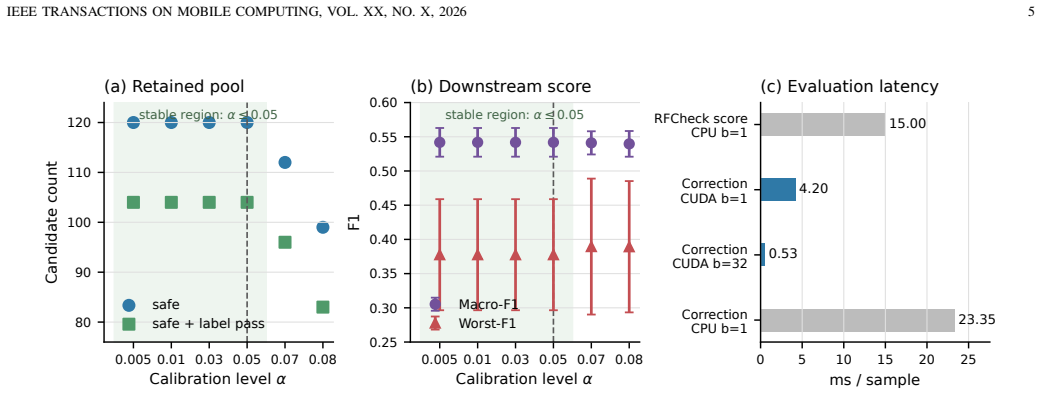
Extended reading notes
Core claim
On its own terms, the paper claims that measurement consistency is an independent validation axis for synthetic RF sensing data, distinct from label correctness and task accuracy. Concretely, a synthetic sample may pass common task-facing checks—selected summary distances and label-consistency acceptance—while deviating in localized ways from the empirical measurement behavior of real samples collected and processed by the same sensing pipeline. The paper instantiates RFCheck to make this deviation measurable: it defines measurement tests tied to the representation (precursor-like leakage in the delay domain and local continuation in the frequency domain for CSI; range leakage, range-Doppler continuation, and receive-chain temporal residuals for FMCW), calibrates each test threshold as an empirical quantile on held-out real samples, and flags any sample whose max-normalized joint score exceeds 1. In the reported experiments, label-consistent low-score and high-score candidates behave differently downstream, a repair reference lowers the flagged ratio to 10.83 percent while preserving mean task performance, and correction on a held-out proposal pool yields a class-balanced set with no flagged samples under a fixed training budget. The paper interprets the threshold as a benchmark-specific empirical reference, not a universal measurement boundary.
Load-bearing premise
The audit's thresholds are empirical quantiles computed on held-out real calibration samples from the same pipeline, so the whole argument assumes those calibration samples are representative enough that exceeding the threshold means true measurement inconsistency rather than calibration noise or benign distribution shift.
Editorial extensions
If this is right
- Aggregate summary distances (such as RBF-MMD on magnitude and phase-difference summaries) do not provide sample-level measurement localization, so they can leave localized violations undetected.
- Under the same label-consistency acceptance rule and class-balanced budget, low-risk synthetic candidates improve worst-class F1 over high-risk candidates by about 0.063, showing that measurement risk is an independent selection axis beyond label correctness.
- A score-guided repair reference lowers the flagged ratio to 10.83 percent while preserving mean task performance, so the detected failure is reducible, not just observable.
- Correction of refined proposals reduces measurement risk consistently across five runs, and on a held-out pool of 1140 candidates the calibrated selection produces a class-balanced, label-consistent set of 120 with no flagged samples.
- The same calibration principle transfers from CSI to FMCW millimeter-wave gesture sensing by replacing the measurement tests, indicating the failure mode is not specific to one RF representation.
Reading between the lines
- A straightforward extension would apply the same calibration workflow to other RF representations (ultra-wideband, mmWave MIMO channel tensors, or radar point clouds) by defining tests that match their measurement chains; the paper does not test these.
- The union-bound interpretation suggests that if a user wants a joint false-alarm rate near $\alpha$, the per-branch levels can be set to $\alpha/J$, but the paper deliberately keeps per-branch calibration as a conservative empirical reference and does not tune the joint level.
- If measurement consistency is a distinct axis, then synthetic-data releases could be accompanied by calibrated consistency certificates computed against a stated pipeline, which would make shortcuts harder to hide; the paper does not propose such a certification protocol.
- A testable extension would check whether selecting on the calibrated score before augmentation reduces shortcut reliance in safety-oriented tasks, where worst-class behavior matters; the paper's worst-class results are suggestive but seed-level intervals are wide.
Signed reviews
Editorial analysis
A structured set of objections, weighed in public.
Referee Report
Summary. The paper identifies a failure mode in synthetic RF sensing data: a synthetic sample may pass common task-facing checks (selected summary statistics, label consistency) while deviating from the measurement behavior of real samples produced by the same acquisition and preprocessing pipeline. The authors propose RFCheck, a calibrated audit that computes representation-specific measurement tests (time-domain precursor leakage and frequency-domain local continuation for CSI; range leakage, range-Doppler continuity, and receive-chain temporal residual for FMCW), calibrates per-test thresholds on held-out real data, and flags samples whose joint score exceeds the calibrated range. They then use the audit for retention (low-risk vs. high-risk candidate selection), repair (direct score-guided optimization), and correction (a learned module mapping proposals toward repair-reference targets). Experiments on Widar, ARIL, WiMANS, and M-Gesture show that aggregate summaries and label filters can miss the detected failures, that measurement risk separates downstream behavior under a fixed label-consistency budget, and that correction can produce low-flagged, class-balanced candidate sets in some settings while remaining ineffective for weak proposals and for preserving FMCW motion structure.
Significance. If the central claim holds, RFCheck is a useful complement to existing synthetic-data validation: it provides sample-level, representation-specific, calibration-based audit scores rather than aggregate distribution distances, and it is instantiated in two different RF sensing modalities. The paper is careful to hedge several claims: thresholds are benchmark-specific, the joint score is a conservative union-style detector rather than an exact alpha-level test, and correction is proposal-dependent. The controlled perturbation experiments, label-fixed retention study, and five-seed correction runs are valuable evidence. The main weakness is that the construct validity of the measurement tests is established only against perturbations built from the same physical intuitions encoded in the tests, and the correction experiments are partly circular if the repair-reference targets overlap with the calibration set. These issues are load-bearing for the central claim and need to be addressed with additional experiments and explicit split guarantees.
major comments (4)
- [Section III.A and Section V.A] The paper's central claim that synthetic samples 'fail measurement consistency' rests on the construct validity of the TD/FD (and FMCW range-Doppler) tests. As presented, the tests are validated mainly by showing that they respond to controlled perturbations (TD-canonical, FD-canonical, Local break) and that correction reduces the same scores that appear in the training objectives (Eqs. 12, 13, 17, 18). Both validations are partially circular: the perturbations are designed from the same finite-bandwidth/phase-continuity intuitions encoded in the tests, and the reduction metrics are the losses being optimized. I ask for an independent, physically grounded check of measurement inconsistency, for example energy in unoccupied subcarriers or phase discontinuity across the occupied-tone embedding in Eq. (5), and for a demonstration that the tests reject perturbations designed from a different physical mechanism. The subject-disjoint FMCW observation that real held-out samples are also flagged at elevated rates further suggests that the score may respond to generic distribution shift; the paper should provide a criterion that separates 'measurement inconsistency' from 'domain shift'.
- [Section III.A, Eqs. (1)-(4)] The finite-sample false-exceedance theorem (Theorem 1) applies to a future real sample exchangeable with the calibration samples. Synthetic samples are not exchangeable with real calibration samples, so the calibrated threshold is not a controlled probability statement for synthetic data; exceedance is only a descriptive benchmark. The paper acknowledges this in the text ('benchmark-specific empirical reference'), but the central claim requires showing that threshold exceedance is a meaningful signal of a pipeline violation rather than an artifact of limited calibration sample size or non-representative calibration. Please report the calibration set size, bootstrap confidence intervals for the thresholds, and the held-out real exceedance rate under the same split used for synthetic evaluation. If held-out real exceedance is much larger than alpha under subject-disjoint folds (as in FMCW), the paper should state explicitly where the benchmark-specific reference ends and the measurement-consistency claim begins.
- [Section IV.C, Eqs. (15)-(16), and Table I] The correction module is trained to map proposals toward repair-reference targets x_ref, and the repair reference is described as an 'offline intervention' using real data. It is not stated whether the real samples used as x_ref are disjoint from the calibration set D_m^cal, from the real samples used to construct controlled perturbations, and from the real training/test splits used for task evaluation. If x_ref samples overlap with the calibration set, then the reduction in RFCheck score after correction is partly by construction, because the target is in-distribution for the very thresholds being audited. Please state the exact split relationships, and if overlap exists, rerun the correction experiment with x_ref drawn from a separate real partition that is disjoint from calibration and task evaluation. This is necessary to interpret the 'full direct repair' and 'held-out correction selected' rows in Table I.
- [Table II and Section V.E] The FMCW correction-selection row reports a trajectory gap of 0.9475 and a fallback ratio of 0.7238, which the paper interprets as 'correction cannot recover coherent range-Doppler motion.' This is an honest limitation, but it undercuts the general claim stated in the abstract and conclusion that correction 'reduces measurement violations while preserving task behavior.' The FMCW evidence supports measurement-risk reduction only, not task-preserving correction. Please either temper the cross-representation wording to reflect that task-preserving correction is demonstrated only for CSI, or provide an FMCW configuration where task behavior is preserved without a large fallback ratio.
minor comments (5)
- [Section III.A, Eq. (4)] The union bound in Eq. (4) is correct but loose; since the paper already interprets the joint score conservatively, a sentence noting that the bound is not tight and that exact joint control is not claimed would be helpful.
- [Section IV.C and Table I] The held-out correction row reports 'no selected sample is flagged' after selecting by the RFCheck score; this is expected by the selection rule. Please clarify that the row supports feasibility of the screening workflow rather than serving as an independent test of the audit.
- [Section V.A, Fig. 3 caption] The caption says 'bars report flagged ratios' but the bar panel is small; consider reporting the numeric flagged ratios in the text or a table so the reader can verify the claim that tails are captured.
- [Section V.C, Fig. 6] The figure legend uses 'JPI' while the text and Table I use 'joint score'; unify the terminology to avoid confusion.
- [General] The paper does not mention code or data release. Given the reproducibility value of the calibration workflow and the controlled perturbation constructions, a statement about availability would be appropriate.
Circularity Check
Repair and correction 'failure-reduction' results are partly their own optimization/selection objectives, while the audit's real-data calibration is an external benchmark; no load-bearing self-citation or uniqueness-theorem circularity found.
-
fitted input called prediction
[Section III.B, Eqs. (12)-(13); Section V.C, Table I]
"min δ λmeasLmeas(ˆx+δ)+λsmall∥δ∥22+λlabLlab(ˆx+δ,y), (12) where the measurement hinge penalty is Lmeas(ˆx+δ) = Σ_j ( M_j(ˆx+δ)/γ_j −1 )_+. (13) ... Full direct repair ... reduces joint score to0.8523, lowers flagged ratio to0.1083."
The flagged state is defined by the normalized measurement score exceeding one, i.e. any M_j/γ_j above 1, and Eq. (13) is the hinge of exactly those same normalized responses. Minimizing Eq. (12) therefore pushes down the very quantities that define the flagged ratio, so reporting that direct repair reduced the flagged ratio to 0.1083 is reporting the optimizer's own objective evaluated at its solution, not an independent outcome. The only non-circular residue is the empirical preservation of macro-F1 and worst-class F1, which is not contained in Lmeas.
-
fitted input called prediction
[Section III.C, Eq. (18); Section V.D, held-out correction row]
"The tail term focuses on near-threshold samples: Ltail = 1/|BK| Σ_{i∈BK} Σ_j ( M_j(xprop,i+δθ,i)/γ_j −τ )_+, where B_K is the highest-score subset within a minibatch ... Under the fixed 40-per-class budget, RFCheck selects 120 candidates with a balanced 40/40/40 class histogram. No selected sample is flagged."
Correction is trained with Ltail, a hinge penalty on the same normalized scores M_j/γ_j whose exceedance defines a flagged sample, so the later report of near-zero flagged ratios is a consequence of the training loss. The held-out selection additionally hard-filters by the audit score, since the ranking includes −w1S(x) and the text states 'RFCheck selects'; hence 'no selected sample is flagged' is an inclusion constraint rather than a discovered property. The preserved task performance is again the independent residue, but the headline no-flagged outcome is definitional.
full rationale
The audit's calibration is genuinely external: thresholds are empirical (1−α) quantiles of held-out real scores, and Theorem 1's exchangeability argument does not depend on synthetic data. The central detection claim, that synthetic samples can exceed the calibrated real-data range, is therefore not circular. However, the paper's reduction claims are partly circular in the two ways quoted above: the repair objective and the correction tail loss minimize the same normalized measurement scores that are later reported as reduced, and the held-out selection enforces the zero-flag outcome by construction. The controlled-perturbation validation and the choice of TD/FD/RD tests raise construct-validity questions about whether 'measurement inconsistency' means anything beyond the hand-picked statistics, but that is a correctness or validity limitation rather than a circularity reducible from the paper's equations. Self-citations in the references are related work and are not load-bearing for the derivation. Overall, partial circularity in the intervention arms, with the diagnostic core remaining externally calibrated; score 5.
Assumptions & free parameters
free parameters (4)
- alpha_j (calibration level per test) =
0.05 (default in experiments, swept from 0.005 to 0.08)
- Weights in the ranking score (FMCW and CSI selection) =
w1...w6 (not all given numerically)
- Repair and correction loss weights (lambda_meas, lambda_small, lambda_lab, lambda_tail, lambda_traj) =
not specified numerically
- Margin tau in the tail term =
not specified
assumptions (3)
- domain assumption Exchangeability of calibration and future real samples (Theorem 1)
- domain assumption The chosen measurement tests (TD precursor leakage, FD continuation, range-Doppler continuation) are sufficient to capture measurement inconsistency
- ad hoc to paper The synthetic proposals are constructed as anchor + residual (Eq. 10)
Cite this review
Pith. "Pith review of RFCheck: Synthetic RF Sensing Data Can Fail Measurement Consistency." pith.science (2026). https://pith.science/paper/EQ4CODTY
@misc{pith2026260809676,
  author       = {Pith},
  title        = {Pith review of: RFCheck: Synthetic RF Sensing Data Can Fail Measurement Consistency},
  year         = {2026},
  howpublished = {\url{https://pith.science/paper/EQ4CODTY}},
  note         = {Machine review of arXiv:2608.09676}
}
read the original abstract
Synthetic radio-frequency (RF) sensing data are widely used to augment wireless sensing tasks, yet their measurement consistency with real data is rarely evaluated under matched acquisition conditions. This paper identifies a measurement-consistency failure mode: synthetic samples may pass task-facing checks while deviating from the measurement behavior of real samples collected and processed by the same sensing pipeline, potentially introducing synthetic shortcuts and biasing downstream model selection. We propose RFCheck, a calibrated measurement audit that uses held-out real data from the same acquisition and preprocessing pipeline as the reference. RFCheck calibrates representation-specific tests on real samples and flags synthetic samples whose responses exceed the calibrated real-data range. We use the audit for candidate screening and residual repair. We validate RFCheck primarily on Wi-Fi channel state information (CSI), where the audit examines delay-domain and local frequency-domain structures. Experiments show that aggregate statistics and label-based screening can miss measurement failures detected by RFCheck. Under the same label acceptance rule, low-risk and high-risk synthetic candidates exhibit different downstream behavior. A repair reference reduces the flagged ratio to 10.83% while preserving mean task performance. In a held-out proposal study, correction followed by calibrated selection produces a class-balanced set with no flagged samples under a fixed training budget. We further apply the same calibration principle to frequency-modulated continuous-wave (FMCW) millimeter-wave radar gesture sensing. The results show that synthetic RF sensing data can violate measurement consistency even when conventional task checks are satisfied, motivating measurement-aware diagnosis and mitigation before augmentation.
Figures


Figures from the paper (4 more)


Reference graph
Works this paper leans on
-
[1]
Integrated sensing and communications: Toward dual-functional wire- less networks for 6g and beyond,
F. Liu, Y . Cui, C. Masouros, J. Xu, T. X. Han, Y . C. Eldar, and S. Buzzi, “Integrated sensing and communications: Toward dual-functional wire- less networks for 6g and beyond,”IEEE J. Sel. Areas Commun., vol. 40, no. 6, pp. 1728–1767, 2022
2022
-
[2]
Integrated sensing and communications over the years: An evolution perspective,
D. Zhang, Y . Cui, X. Cao, N. Su, Y . Gong, F. Liu, W. Yuan, X. Jing, J. A. Zhang, J. Xu, C. Masouros, D. Niyato, and M. Di Renzo, “Integrated sensing and communications over the years: An evolution perspective,” IEEE Communications Surveys & Tutorials, pp. 1–1, 2026
work page 2026
-
[3]
Understanding and modeling of wifi signal based human activity recognition,
W. Wang, A. X. Liu, M. Shahzad, K. Ling, and S. Lu, “Understanding and modeling of wifi signal based human activity recognition,” in Proceedings of the 21st annual international conference on mobile computing and networking, 2015, pp. 65–76
work page 2015
-
[4]
Gen- erative diffusion models for radio wireless channel modelling and sampling,
U. Sengupta, C. Jao, A. Bernacchia, S. Vakili, and D.-s. Shiu, “Gen- erative diffusion models for radio wireless channel modelling and sampling,” inGLOBECOM 2023 - 2023 IEEE Global Communications Conference, 2023, pp. 4779–4784
work page 2023
-
[5]
Generative AI for data augmentation in wireless networks: Analysis, applications, and case study,
J. Wen, J. Kang, D. Niyato, Y . Zhang, J. Wang, B. Sikdar, and P. Zhang, “Generative AI for data augmentation in wireless networks: Analysis, applications, and case study,”IEEE Wireless Communications, pp. 1–10, 2025
work page 2025
-
[6]
Generative ai for physical layer communications: A survey,
N. Van Huynh, J. Wang, H. Du, D. T. Hoang, D. Niyato, D. N. Nguyen, D. I. Kim, and K. B. Letaief, “Generative ai for physical layer communications: A survey,”IEEE Transactions on Cognitive Communications and Networking, vol. 10, no. 3, pp. 706–728, 2024
work page 2024
-
[7]
RFBoost: Understanding and boosting deep WiFi sensing via physical data augmentation,
W. Hou and C. Wu, “RFBoost: Understanding and boosting deep WiFi sensing via physical data augmentation,”Proceedings of the ACM on Interactive, Mobile, Wearable and Ubiquitous Technologies, vol. 8, no. 2, pp. 1–26, 2024
work page 2024
-
[8]
RF- Diffusion: Radio signal generation via time-frequency diffusion,
G. Chi, Z. Yang, C. Wu, J. Xu, Y . Gao, Y . Liu, and T. X. Han, “RF- Diffusion: Radio signal generation via time-frequency diffusion,” in Proceedings of the 30th Annual International Conference on Mobile Computing and Networking, 2024, pp. 77–92
work page 2024
Show all 26 references
-
[9]
Diffusion models for wireless communications,
M. Letafati, S. Ali, and M. Latva-aho, “Diffusion models for wireless communications,”arXiv preprint arXiv:2310.07312, 2023
2023
-
[10]
Commodity WiFi sensing in ten years: Status, challenges, and opportunities,
S. Tan, Y . Ren, J. Yang, and Y . Chen, “Commodity WiFi sensing in ten years: Status, challenges, and opportunities,”IEEE Internet of Things Journal, vol. 9, no. 18, pp. 17 832–17 843, 2022
2022
-
[11]
Cross-domain WiFi sensing with channel state information: A survey,
C. Chen, G. Zhou, and Y . Lin, “Cross-domain WiFi sensing with channel state information: A survey,”ACM Computing Surveys, vol. 55, no. 11, pp. 1–37, 2023
2023
-
[12]
A survey on integrated sensing, communication, and computation,
D. Wen, Y . Zhou, X. Li, Y . Shi, K. Huang, and K. B. Letaief, “A survey on integrated sensing, communication, and computation,”IEEE Communications Surveys & Tutorials, 2024
2024
-
[13]
CSI- bench: A large-scale in-the-wild dataset for multi-task WiFi sensing,
G. Zhu, Y . Hu, W. Gao, W.-H. Wang, B. Wang, and K. Liu, “CSI- bench: A large-scale in-the-wild dataset for multi-task WiFi sensing,” arXiv preprint arXiv:2505.21866, 2025
2025
-
[14]
XRF55: A radio frequency dataset for human indoor action analysis,
F. Wang, Y . Lv, M. Zhu, H. Ding, and J. Han, “XRF55: A radio frequency dataset for human indoor action analysis,”Proceedings of the ACM on Interactive, Mobile, Wearable and Ubiquitous Technologies, vol. 8, no. 1, pp. 1–34, 2024
2024
-
[15]
Bullydetect: Detecting school physical bullying with wi-fi and deep wavelet transformer,
B. Lan, F. Wang, L. Xia, F. Nai, S. Nie, H. Ding, and J. Han, “Bullydetect: Detecting school physical bullying with wi-fi and deep wavelet transformer,”IEEE Internet of Things Journal, 2024
2024
-
[16]
DeepMIMO: A generic deep learning dataset for millimeter wave and massive MIMO applications,
A. Alkhateeb, “DeepMIMO: A generic deep learning dataset for millimeter wave and massive MIMO applications,”arXiv preprint arXiv:1902.06435, 2019
1902 arXiv
-
[17]
Physics-informed generative modeling of wireless channels,
B. B ¨ock, A. Oeldemann, T. Mayer, F. Rossetto, and W. Utschick, “Physics-informed generative modeling of wireless channels,”Proceed- ings of Machine Learning Research, vol. 267, pp. 4602–4626, 2025
2025
-
[18]
A kernel two-sample test,
A. Gretton, K. M. Borgwardt, M. J. Rasch, B. Sch ¨olkopf, and A. Smola, “A kernel two-sample test,”The journal of machine learning research, vol. 13, no. 1, pp. 723–773, 2012
2012
-
[19]
Data can speak for itself: Quality-guided utilization of wireless synthetic data,
C. Gong, B. Liang, W. Gao, and C. Xu, “Data can speak for itself: Quality-guided utilization of wireless synthetic data,” inProceedings of the 23rd Annual International Conference on Mobile Systems, Applica- tions and Services, 2025, pp. 209–222
2025
-
[20]
M-gesture: Person-independent real-time in-air gesture recognition using commodity millimeter wave radar,
H. Liu, A. Zhou, Z. Dong, Y . Sun, J. Zhang, L. Liu, H. Ma, J. Liu, and N. Yang, “M-gesture: Person-independent real-time in-air gesture recognition using commodity millimeter wave radar,”IEEE Internet Things J., vol. 9, no. 5, pp. 3397–3415, 2021
2021
-
[21]
Radarnet: Efficient gesture recognition technique utilizing a miniature radar sensor,
E. Hayashi, J. Lien, N. Gillian, L. Giusti, D. Weber, J. Yamanaka, L. Bedal, and I. Poupyrev, “Radarnet: Efficient gesture recognition technique utilizing a miniature radar sensor,” inProceedings of the 2021 CHI Conference on Human Factors in Computing Systems, 2021, pp. 1–14
2021
-
[22]
Mm-wave radar-based recognition of multiple hand gestures using long short-term memory (lstm) neural network,
P. Grobelny and A. Narbudowicz, “Mm-wave radar-based recognition of multiple hand gestures using long short-term memory (lstm) neural network,”Electronics, vol. 11, no. 5, p. 787, 2022
2022
-
[23]
Spotfi: Decimeter level localization using wifi,
M. Kotaru, K. Joshi, D. Bharadia, and S. Katti, “Spotfi: Decimeter level localization using wifi,” inProceedings of the 2015 ACM conference on special interest group on data communication, 2015, pp. 269–282
2015
-
[24]
Widar3.0: Zero-effort cross-domain gesture recognition with Wi-Fi,
Y . Zhang, Y . Zheng, K. Qian, G. Zhang, Y . Liu, C. Wu, and Z. Yang, “Widar3.0: Zero-effort cross-domain gesture recognition with Wi-Fi,” IEEE Transactions on Pattern Analysis and Machine Intelligence, vol. 44, no. 11, pp. 8671–8688, 2022
2022
-
[25]
Joint activity recognition and indoor localization with WiFi fingerprints,
F. Wang, J. Feng, Y . Zhao, X. Zhang, S. Zhang, and J. Han, “Joint activity recognition and indoor localization with WiFi fingerprints,” IEEE Access, vol. 7, pp. 80 058–80 068, 2019
2019
-
[26]
WiMANS: A benchmark dataset for WiFi-based multi-user activity sensing,
S. Huang, K. Li, D. You, Y . Chen, A. Lin, S. Liu, X. Li, and J. A. McCann, “WiMANS: A benchmark dataset for WiFi-based multi-user activity sensing,” inComputer Vision – ECCV 2024. Springer, 2024, pp. 72–91
2024
Reviewed August 11, 2026 · model on record in the stance chip above.
Discussion (0). Continue with ORCID to comment.