REVIEW 3 major objections 4 minor 55 references
Observation of Shock-Front Separation in Multi-Ion-Species Collisional Plasma Shocks
T0 review · 3 major / 4 minor · reviewed 2026-08-14 · deepseek-v4-flash
Pith's one-line read In colliding He/Ar plasma jets, the helium shock front separates from and extends ahead of the argon front by about 0.68 cm, matching multi-fluid simulations and diffusion theory.
desk verdict The paper's central observation may be compromised by Ar-II filter crosstalk with He-I 501.6 nm, but the theory and simulation context are solid. read the letter →
The pith
A machine-rendered reading of the paper's core claim, the machinery that carries it, and where it could break.
The reading
They saw that the place where helium emission changes is not exactly the place where argon emission changes. The helium front is about 0.68 cm closer to the incoming, undisturbed plasma than the argon front. The shock itself is narrow, about half a centimeter wide, which is only about 50 times the average distance a heated ion travels between collisions. That is a short distance, so the separation is small but real.
The same configuration was simulated with a 1D multi-fluid code. The simulation produced a similar separation, about 0.50 cm, and similar per-species widths. The authors argue that the effect is caused mostly by barodiffusion: inside the steep pressure jump of the shock, the pressure gradient pushes the lighter helium ions forward relative to the heavier argon ions. A theory-based estimate using the measured conditions gives a concentration change consistent with the simulation. One caveat: the images show light emission, not the actual number of helium and argon atoms at each location, and the post-shock emission intensities do not match the simulation.
Extended reading notes
Core claim
The central claim, in the paper's own conclusion, is that 'we experimentally observe shock-front separation and species-dependent shock widths' in a collisional He/Ar plasma shock, with 'the lighter He ions diffusing farther ahead within the overall shock front than the heavier Ar ions.' Quantitatively, the paper reports a measured separation of 0.68 +/- 0.17 cm between He and Ar emission features, He and Ar widths of 0.36 +/- 0.09 cm and 0.52 +/- 0.11 cm, and a width ratio of 1.52 +/- 0.34, with 1D multi-fluid simulations giving 0.50 +/- 0.12 cm, 0.44 +/- 0.12 cm, 0.57 +/- 0.12 cm, and 1.29 +/- 0.45.
Load-bearing premise
The load-bearing premise is that the He-I and Ar-II emission lineouts track the spatial locations of the He and Ar ion populations, so that the separation between the He-I minimum and the Ar-II peak is a separation of species. The paper itself notes that emission intensity does not map one-to-one onto plasma parameters across the shock, and that the species concentration was not directly measured, only inferred from simulations. If the neutral helium dip ahead of the shock is caused by ionization changes rather than by helium atoms having moved farther forward, the main observational claim would be weakened. See Sec IV, paragraph on intensity gradients, and Sec VII, where the authors state 'we did not directly measure the species concentration along the shock profile.'
Signed reviews
Editorial analysis
A structured set of objections, weighed in public.
Referee Report
Summary. The paper reports the experimental observation of shock-front separation in collisional multi-ion-species plasma shocks produced by obliquely merging He/Ar plasma jets. Using narrow-bandpass filtered fast-framing cameras, the authors measure the spatial profiles of He-I and Ar-II emission through the shock front and infer a He/Ar separation of 0.68 +/- 0.17 cm and species-dependent shock widths (He: 0.36 +/- 0.09 cm, Ar: 0.52 +/- 0.11 cm). These results are compared with 1D multi-fluid chicago simulations and with Kagan-Tang ion diffusion theory, including a quantitative estimate that barodiffusion is the dominant mechanism. The central claim is that lighter He ions diffuse farther ahead within the shock front than heavier Ar ions, and that the observed length scales agree with simulations and theory.
Significance. If the observational inference is sound, this would be a valuable direct measurement of species separation in a collisional multi-ion plasma shock in a regime relevant to HED and MIF plasmas. The paper is commendable for combining multiple independent approaches (two-color filtered imaging, 1D multi-fluid simulations, analytic diffusion estimates) and for presenting quantitative uncertainty bars. It also honestly reports the disagreement between experimental and synthetic emission intensities in the post-shock region and explicitly notes that species concentration was not directly measured. These strengths make the paper a useful benchmark data point even if the central inference needs additional support.
major comments (3)
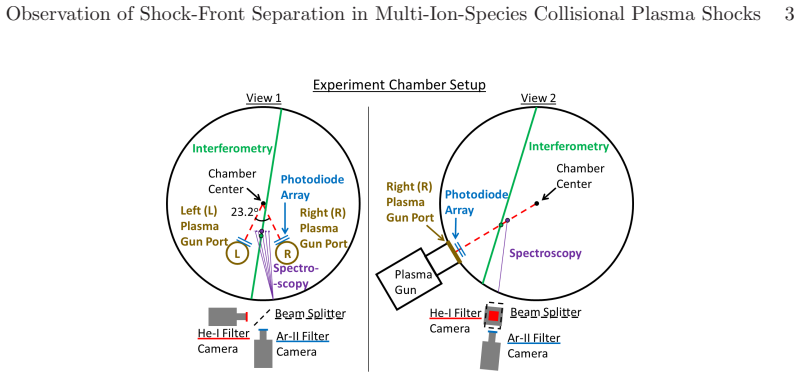
- [Sec. III, filter description; Fig. 3] The 500 +/- 25 nm Ar-II filter passband also transmits the He-I 501.6 nm line. Given that the plasma is 97% He by number, a small fractional He-I contribution could dominate the signal in the 'Ar-II' channel. The reference images in Fig. 3 demonstrate each filter's response for single-species plasmas, but they do not include the crucial control of imaging a pure-He shock through the Ar-II filter. Without this control, the 'Ar-II peak' in Fig. 4 may be partly or largely He-I emission, which would undermine the attribution of the measured separation to He/Ar species separation.
- [Sec. IV, lineout interpretation and Sec. VI.B, synthetic lineouts] The load-bearing premise is that the He-I and Ar-II intensity lineouts track the spatial locations of the He and Ar ion populations. The paper itself notes in Sec. IV that 'the intensity gradient does not map one-to-one with each parameter across the shock' and in Sec. VII that 'we did not directly measure the species concentration along the shock profile.' The synthetic lineouts in Fig. 6 do not reproduce the experimentally observed double-peaked structure or the intensity extrema used to define the separation (Sec. VI.B). This means the association between the measured emission features and the simulated density extrema is not validated; the observed 0.68 cm separation and 1.52 width ratio could reflect ionization-dependent emissivity structure rather than actual ion number-density separation.
- [Sec. IV and Sec. VI.A, peak-position distances] The simulation distances between the density peaks and the zero position (1.51 +/- 0.06 cm for He, 1.01 +/- 0.06 cm for Ar) do not agree with the experimental distances (2.01 +/- 0.33 cm for He, 1.33 +/- 0.17 cm for Ar) within uncertainty bars, as the paper acknowledges. This discrepancy is in the same observable (peak positions) used to infer the separation and suggests a systematic offset between experiment and simulation in the absolute shock location. The authors should discuss whether this offset affects the robustness of the separation measurement or whether it is a consequence of the different quantities being compared (emission peaks vs. density peaks).
minor comments (4)
- [Title and Sec. I] The title contains 'Collisio nal' with a space; this appears to be a typographical artifact and should be corrected.
- [Sec. VI.A] 'propaceos' appears to be a typographical rendering of 'PrismSPECT'; please correct the name for consistency with Sec. IV.
- [Sec. IV, shock width definition] The shock width is defined as the distance between 50% and 90% intensity values, but the physical motivation for these specific thresholds and the sensitivity of the resulting widths to the choice is not discussed; a brief justification or sensitivity check would help.
- [Fig. 4 caption and Sec. IV] The caption refers to 'peak He-II intensity is at intensity of 0' while the text describes the He-I lineout; clarifying that the He-I minimum is interpreted as a proxy for He-II would avoid confusion.
Circularity Check
No significant circularity: the experimental shock-front separation is compared against independent simulation and theory rather than being fitted or defined into existence.
full rationale
The derivation is not circular. The central quantitative claim, a 0.68 +/- 0.17 cm He/Ar separation inferred from filtered-emission lineouts, is not an input to the theory or simulation with which it is compared. The Chicago simulations are initialized from independently measured pre-shock parameters ('the two jets are given an initial density profile, temperature, and velocity based on input from experimental measurements'), and the simulated separation (0.50 +/- 0.12 cm) is an output, not a fit to the 0.68 cm measurement. The Sec. VII barodiffusion consistency estimate similarly uses measured plasma parameters and an approximate shock width (LSW approximately 0.4 cm) to estimate a concentration change; it does not feed the measured 0.68 cm separation back into itself. The paper even reports real disagreements with the simulation, including the missing double-peaked intensity structure and post-shock emission-intensity differences, which is the opposite of a forced agreement. Self-citations to the Chicago code and prior Plasma Liner Experiment work are not load-bearing circularity: the code is independently published and is not tuned in this paper to reproduce the target observable. The limitations the authors state ('we did not directly measure the species concentration along the shock profile' and 'the intensity gradient does not map one-to-one with each parameter across the shock') are epistemic caveats about inferring species positions from emission, not circular reductions. Even the possible Ar-II filter crosstalk from He-I 501.6 nm would be a measurement-validity concern, not a circularity of derivation. No fitted parameter is renamed as a prediction, and no result is defined in terms of itself.
Assumptions & free parameters
free parameters (3)
- Shock width definition thresholds =
50% and 90% of peak intensity
- Lineout width =
20 pixels, about 1 cm
- Analysis time =
2 microseconds after merging begins
assumptions (4)
- domain assumption Emission intensity gradients represent the spatial structure of the shock and the relative positions of He and Ar populations.
- domain assumption Pre-shock He and Ar behave as a single fluid with common temperatures because the interspecies mean free path is much smaller than the jet size.
- domain assumption Kagan-Tang diffusion theory and the Chicago multi-fluid collision model correctly describe momentum exchange between ion species in this regime.
- domain assumption The 34 shot-to-shot profiles at 2 microseconds are statistically representative despite shot-to-shot timing variations below 0.5 microseconds.
Cite this review
Pith. "Pith review of Observation of Shock-Front Separation in Multi-Ion-Species Collisional Plasma Shocks." pith.science (2026). https://pith.science/paper/YB5JBBSU
@misc{pith2026190800454,
  author       = {Pith},
  title        = {Pith review of: Observation of Shock-Front Separation in Multi-Ion-Species Collisional Plasma Shocks},
  year         = {2026},
  howpublished = {\url{https://pith.science/paper/YB5JBBSU}},
  note         = {Machine review of arXiv:1908.00454}
}
read the original abstract
We observe shock-front separation and species-dependent shock widths in multi-ion-species collisional plasma shocks, which are produced by obliquely merging plasma jets of a He/Ar mixture (97% He and 3% Ar by initial number density) on the Plasma Liner Experiment [S. C. Hsu et al., IEEE Trans. Plasma Sci. 46, 1951 (2018)]. Visible plasma emission near the He-I 587.6 nm and Ar-II 476.5-514.5 nm lines are simultaneously recorded by splitting a single visible image of the shock into two different fast-framing cameras with different narrow bandpass filters (589 +/- 5 nm for observing the He-I line and 500 +/- 25 nm for the Ar-II lines). For conditions in these experiments (pre-shock ion and electron densities ~5*10^14 cm^-3, ion and electron temperatures of ~2.2 eV, and relative plasma-merging speed of 22 km/s), the observationally inferred magnitude of He/Ar shock-front separation and the shock widths themselves are < 1 cm, which correspond to ~50 post-shock thermal ion-ion mean free paths. These experimental lengths scales are in reasonable qualitative and quantitative agreement with results from 1D multi-fluid simulations using the Chicago code. However, there are differences between the experimentally-inferred and simulation-predicted ionization states and line emission intensities, particularly in the post-shock region. Overall, the experimental and simulation results are consistent with theoretical predictions that the lighter He ions diffuse farther ahead within the overall shock front than the heavier Ar ions.
Figures


Figures from the paper (3 more)


Reference graph
Works this paper leans on
-
[1]
author author T. Cowling ,\ title title VI. The influence of diffusion on the propagation of shock waves , \ 10.1080/14786444208521339 journal journal The London, Edinburgh, and Dublin Philosophical Magazine and Journal of Science \ volume 33 ,\ pages 61--67 ( year 1942 ) NoStop
-
[2]
author author J. D. \ Jukes ,\ title title The structure of a shock wave in a fully ionized gas , \ 10.1017/S0022112057000646 journal journal Journal of Fluid Mechanics \ volume 3 ,\ pages 275--285 ( year 1957 ) NoStop
-
[3]
author author M. Y. \ Jaffrin \ and\ author R. F. \ Probstein ,\ title title Structure of a Plasma Shock Wave , \ 10.1063/1.1711072 journal journal Physics of Fluids \ volume 7 ,\ pages 1658 ( year 1964 ) NoStop
-
[4]
author author R. E. \ Center ,\ title title Measurement of Shock-Wave Structure in Helium-Argon Mixtures , \ 10.1063/1.1762357 journal journal Physics of Fluids \ volume 10 ,\ pages 1777 ( year 1967 ) NoStop
-
[5]
author author J. R. \ Rygg , author J. A. \ Frenje , author C. K. \ Li , author F. H. \ S \' e guin , author R. D. \ Petrasso , author J. A. \ Delettrez , author V. Y. \ Glebov , author V. N. \ Goncharov , author D. D. \ Meyerhofer , author S. P. \ Regan , author T. C. \ Sangster , \ and\ author C. Stoeckl ,\ title title Tests of the hydrodynamic equivale...
-
[6]
author author H. W. \ Herrmann , author J. R. \ Langenbrunner , author J. M. \ Mack , author J. H. \ Cooley , author D. C. \ Wilson , author S. C. \ Evans , author T. J. \ Sedillo , author G. A. \ Kyrala , author S. E. \ Caldwell , author C. S. \ Young , author A. Nobile , author J. Wermer , author S. Paglieri , author A. M. \ McEvoy , author Y. Kim , aut...
-
[7]
author author D. T. \ Casey , author J. A. \ Frenje , author M. Gatu Johnson , author M. J.-E. \ Manuel , author H. G. \ Rinderknecht , author N. Sinenian , author F. H. \ S \' e guin , author C. K. \ Li , author R. D. \ Petrasso , author P. B. \ Radha , author J. A. \ Delettrez , author V. Y. \ Glebov , author D. D. \ Meyerhofer , author T. C. \ Sangster...
-
[8]
author author H. G. \ Rinderknecht , author M. J. \ Rosenberg , author C. K. \ Li , author N. M. \ Hoffman , author G. Kagan , author A. B. \ Zylstra , author H. Sio , author J. A. \ Frenje , author M. Gatu Johnson , author F. H. \ S \' e guin , author R. D. \ Petrasso , author P. Amendt , author C. Bellei , author S. Wilks , author J. Delettrez , author ...
Show all 55 references
-
[9]
author author D. P. \ Higginson , author J. S. \ Ross , author D. D. \ Ryutov , author F. Fiuza , author S. C. \ Wilks , author E. P. \ Hartouni , author R. Hatarik , author C. M. \ Huntington , author J. Kilkenny , author B. Lahmann , author C. K. \ Li , author A. Link , auth...
-
[10]
Sio , author J
author author H. Sio , author J. A. \ Frenje , author A. Le , author S. Atzeni , author T. J. T. \ Kwan , author M. Gatu Johnson , author G. Kagan , author C. Stoeckl , author C. K. \ Li , author C. E. \ Parker , author C. J. \ Forrest , author V. Glebov , author N. V. \ Kabad...
-
[11]
author author O. Larroche ,\ title title Ion Fokker-Planck simulation of D- 3 He gas target implosions , \ 10.1063/1.4771880 journal journal Physics of Plasmas \ volume 19 ,\ pages 122706 ( year 2012 ) NoStop
2012 doi
-
[12]
Bellei , author P
author author C. Bellei , author P. A. \ Amendt , author S. C. \ Wilks , author M. G. \ Haines , author D. T. \ Casey , author C. K. \ Li , author R. Petrasso , \ and\ author D. R. \ Welch ,\ title title Species separation in inertial confinement fusion fuels , \ 10.1063/1.477...
-
[13]
Bellei , author H
author author C. Bellei , author H. Rinderknecht , author A. Zylstra , author M. Rosenberg , author H. Sio , author C. K. \ Li , author R. Petrasso , author S. C. \ Wilks , \ and\ author P. A. \ Amendt ,\ title title Species separation and kinetic effects in collisional plasma...
-
[14]
Inglebert , author B
author author A. Inglebert , author B. Canaud , \ and\ author O. Larroche ,\ title title Species separation and modification of neutron diagnostics in inertial-confinement fusion , \ 10.1209/0295-5075/107/65003 journal journal EPL (Europhysics Letters) \ volume 107 ,\ pages 65...
-
[15]
Vold , author R
author author E. Vold , author R. Rauenzahn , \ and\ author A. N. \ Simakov ,\ title title Multi-species plasma transport in 1D direct-drive ICF simulations , \ 10.1063/1.5083157 journal journal Physics of Plasmas \ volume 26 ,\ pages 032706 ( year 2019 ) NoStop
-
[16]
Amendt , author O
author author P. Amendt , author O. L. \ Landen , author H. F. \ Robey , author C. K. \ Li , \ and\ author R. D. \ Petrasso ,\ title title Plasma Barodiffusion in Inertial-Confinement-Fusion Implosions: Application to Observed Yield Anomalies in Thermonuclear Fuel Mixtures , \...
-
[17]
Amendt , author S
author author P. Amendt , author S. C. \ Wilks , author C. Bellei , author C. K. \ Li , \ and\ author R. D. \ Petrasso ,\ title title The potential role of electric fields and plasma barodiffusion on the inertial confinement fusion database , \ 10.1063/1.3577577 journal journa...
-
[18]
Kagan \ and\ author X.-Z
author author G. Kagan \ and\ author X.-Z. \ Tang ,\ title title Thermo-diffusion in inertially confined plasmas , \ 10.1016/j.physleta.2014.04.005 journal journal Physics Letters A \ volume 378 ,\ pages 1531--1535 ( year 2014 ) NoStop
2014 doi
-
[19]
author author S. C. \ Hsu , author T. R. \ Joshi , author P. Hakel , author E. L. \ Vold , author M. J. \ Schmitt , author N. M. \ Hoffman , author R. M. \ Rauenzahn , author G. Kagan , author X.-Z. \ Tang , author R. C. \ Mancini , author Y. Kim , \ and\ author H. W. \ Herrma...
-
[20]
author author T. R. \ Joshi , author P. Hakel , author S. C. \ Hsu , author E. L. \ Vold , author M. J. \ Schmitt , author N. M. \ Hoffman , author R. M. \ Rauenzahn , author G. Kagan , author X.-Z. \ Tang , author R. C. \ Mancini , author Y. Kim , \ and\ author H. W. \ Herrma...
-
[21]
author author H. G. \ Rinderknecht , author H.-S. \ Park , author J. S. \ Ross , author P. A. \ Amendt , author S. C. \ Wilks , author J. Katz , author N. M. \ Hoffman , author G. Kagan , author E. L. \ Vold , author B. D. \ Keenan , author A. N. \ Simakov , \ and\ author L. C...
-
[22]
author author H. G. \ Rinderknecht , author H.-S. \ Park , author J. S. \ Ross , author P. A. \ Amendt , author D. P. \ Higginson , author S. C. \ Wilks , author D. Haberberger , author J. Katz , author D. H. \ Froula , author N. M. \ Hoffman , author G. Kagan , author B. D. \...
-
[23]
author author T. R. \ Joshi , author S. C. \ Hsu , author P. Hakel , author N. M. \ Hoffman , author H. Sio , \ and\ author R. C. \ Mancini ,\ title title Progress on observations of interspecies ion separation in inertial-confinement-fusion implosions via imaging x-ray spectr...
2019
-
[24]
Kagan \ and\ author X.-Z
author author G. Kagan \ and\ author X.-Z. \ Tang ,\ title title Electro-diffusion in a plasma with two ion species , \ 10.1063/1.4745869 journal journal Physics of Plasmas \ volume 19 ,\ pages 082709 ( year 2012 ) NoStop
2012 doi
-
[25]
Bellei \ and\ author P
author author C. Bellei \ and\ author P. A. \ Amendt ,\ title title Asymptotic separation in multispecies collisional plasma shocks , \ 10.1103/PhysRevE.90.013101 journal journal Physical Review E \ volume 90 ,\ pages 013101 ( year 2014 ) NoStop
-
[26]
author author A. N. \ Simakov \ and\ author K. Molvig ,\ title title Hydrodynamic description of an unmagnetized plasma with multiple ion species. I. General formulation , \ 10.1063/1.4943894 journal journal Physics of Plasmas \ volume 23 ,\ pages 032115 ( year 2016 ) NoStop
-
[27]
author author S. I. \ Glazyrin , author A. S. \ Kuratov , \ and\ author V. Y. \ Bychenkov ,\ title title Separation of ions on the front of a shock wave in a multicomponent plasma , \ 10.1134/S0021364016040068 journal journal JETP Letters \ volume 103 ,\ pages 238--243 ( year ...
-
[28]
author author A. N. \ Simakov , author B. D. \ Keenan , author W. T. \ Taitano , \ and\ author L. Chac \' o n ,\ title title Plasma ion stratification by weak planar shocks , \ 10.1063/1.4995427 journal journal Physics of Plasmas \ volume 24 ,\ pages 092702 ( year 2017 ) NoStop
-
[29]
author author B. D. \ Keenan , author A. N. \ Simakov , author L. Chac \' o n , \ and\ author W. T. \ Taitano ,\ title title Deciphering the kinetic structure of multi-ion plasma shocks , \ 10.1103/PhysRevE.96.053203 journal journal Physical Review E \ volume 96 ,\ pages 05320...
-
[30]
author author B. D. \ Keenan , author A. N. \ Simakov , author W. T. \ Taitano , \ and\ author L. Chac \' o n ,\ title title Ion species stratification within strong shocks in two-ion plasmas , \ 10.1063/1.5020156 journal journal Physics of Plasmas \ volume 25 ,\ pages 032103 ...
-
[31]
Thoma , author D
author author C. Thoma , author D. R. \ Welch , author R. E. \ Clark , author N. Bruner , author J. J. \ MacFarlane , \ and\ author I. E. \ Golovkin ,\ title title Two-fluid electromagnetic simulations of plasma-jet acceleration with detailed equation-of-state , \ 10.1063/1.36...
-
[32]
Thoma , author D
author author C. Thoma , author D. R. \ Welch , \ and\ author S. C. \ Hsu ,\ title title Particle-in-cell simulations of collisionless shock formation via head-on merging of two laboratory supersonic plasma jets , \ 10.1063/1.4819063 journal journal Physics of Plasmas \ volume...
-
[33]
Thoma , author D
author author C. Thoma , author D. R. \ Welch , author R. E. \ Clark , author D. V. \ Rose , \ and\ author I. E. \ Golovkin ,\ title title Hybrid-PIC modeling of laser-plasma interactions and hot electron generation in gold hohlraum walls , \ 10.1063/1.4985314 journal journal ...
-
[34]
author author S. C. \ Hsu , author E. C. \ Merritt , author A. L. \ Moser , author T. J. \ Awe , author S. J. E. \ Brockington , author J. S. \ Davis , author C. S. \ Adams , author A. Case , author J. T. \ Cassibry , author J. P. \ Dunn , author M. A. \ Gilmore , author A. G....
-
[35]
author author E. C. \ Merritt , author A. L. \ Moser , author S. C. \ Hsu , author J. Loverich , \ and\ author M. Gilmore ,\ title title Experimental Characterization of the Stagnation Layer between Two Obliquely Merging Supersonic Plasma Jets , \ 10.1103/PhysRevLett.111.08500...
-
[36]
author author E. C. \ Merritt , author A. L. \ Moser , author S. C. \ Hsu , author C. S. \ Adams , author J. P. \ Dunn , author A. Miguel Holgado , \ and\ author M. A. \ Gilmore ,\ title title Experimental evidence for collisional shock formation via two obliquely merging supe...
2014
-
[37]
author author A. L. \ Moser \ and\ author S. C. \ Hsu ,\ title title Experimental characterization of a transition from collisionless to collisional interaction between head-on-merging supersonic plasma jetsa) , \ 10.1063/1.4920955 journal journal Physics of Plasmas \ volume 2...
-
[38]
author author S. C. \ Hsu , author S. J. \ Langendorf , author K. C. \ Yates , author J. P. \ Dunn , author S. Brockington , author A. Case , author E. Cruz , author F. D. \ Witherspoon , author M. A. \ Gilmore , author J. T. \ Cassibry , author R. Samulyak , author P. Stoltz ...
-
[39]
author author S. J. \ Langendorf , author K. C. \ Yates , author S. C. \ Hsu , author C. Thoma , \ and\ author M. Gilmore ,\ title title Experimental Measurements of Ion Heating in Collisional Plasma Shocks and Interpenetrating Supersonic Plasma Flows , \ 10.1103/PhysRevLett.1...
-
[40]
author author S. J. \ Langendorf , author K. C. \ Yates , author S. C. \ Hsu , author C. Thoma , \ and\ author M. Gilmore ,\ title title Experimental study of ion heating in obliquely merging hypersonic plasma jets , \ 10.1063/1.5108727 journal journal Physics of Plasmas \ vol...
-
[41]
author author E. C. \ Merritt , author A. G. \ Lynn , author M. A. \ Gilmore , \ and\ author S. C. \ Hsu ,\ title title Multi-chord fiber-coupled interferometer with a long coherence length laser , \ 10.1063/1.3697731 journal journal Review of Scientific Instruments \ volume 8...
-
[42]
author author E. C. \ Merritt , author A. G. \ Lynn , author M. A. \ Gilmore , author C. Thoma , author J. Loverich , \ and\ author S. C. \ Hsu ,\ title title Multi-chord fiber-coupled interferometry of supersonic plasma jets (invited) , \ 10.1063/1.4734496 journal journal Rev...
-
[43]
author author Prism Computational Sciences ,\ http://www.prism-cs.com/ title http://www.prism-cs.com , \ NoStop
-
[44]
author author E. V. \ Stenson \ and\ author P. M. \ Bellan ,\ title title Dual-Species Plasmas Illustrate MHD Flows , \ 10.1109/TPS.2008.927095 journal journal IEEE Transactions on Plasma Science \ volume 36 ,\ pages 1206--1207 ( year 2008 ) NoStop
2008
-
[45]
author author E. V. \ Stenson \ and\ author P. M. \ Bellan ,\ title title Magnetically Driven Flows in Arched Plasma Structures , \ 10.1103/PhysRevLett.109.075001 journal journal Physical Review Letters \ volume 109 ,\ pages 075001 ( year 2012 ) NoStop
-
[46]
author author National Institute of Standards and Technology Atomic Spectra Database ,\ 10.18434/T4W30F title https://www.nist.gov/pml/atomic-spectra-database , \ ( year 2019 ) NoStop
2019 doi
-
[47]
Huba ,\ https://www.nrl.navy.mil/ppd/content/nrl-plasma-formulary title NRL Plasma Formulary \ ( publisher Naval Research Laboratory ,\ address Washington, DC ,\ year 2016 )\ p
author author J. Huba ,\ https://www.nrl.navy.mil/ppd/content/nrl-plasma-formulary title NRL Plasma Formulary \ ( publisher Naval Research Laboratory ,\ address Washington, DC ,\ year 2016 )\ p. pages 31 NoStop
2016
-
[48]
author author B. A. \ Trubnikov ,\ title title Particle Interactions in a Fully Ionized Plasma , \ @noop journal journal Reviews of Plasma Physics \ volume 1 ,\ pages 105 ( year 1965 ) NoStop
1965
-
[49]
author author H. Helm ,\ title title The cross section for symmetric charge exchange of He + in He at energies between 0.3 and 8 eV , \ 10.1088/0022-3700/10/18/025 journal journal Journal of Physics B: Atomic and Molecular Physics \ volume 10 ,\ pages 3683--3697 ( year 1977 ) NoStop
-
[50]
author author B. M. \ Smirnov ,\ title title Tables for Cross Sections of the Resonant Charge Exchange Process , \ 10.1238/Physica.Regular.061a00595 journal journal Physica Scripta \ volume 61 ,\ pages 595--602 ( year 2000 ) NoStop
-
[51]
Messer , author A
author author S. Messer , author A. Case , author L. Wu , author S. Brockington , \ and\ author F. D. \ Witherspoon ,\ title title Nonlinear compressions in merging plasma jets , \ 10.1063/1.4795304 journal journal Physics of Plasmas \ volume 20 ,\ pages 032306 ( year 2013 ) NoStop
-
[52]
Kagan \ and\ author X.-Z
author author G. Kagan \ and\ author X.-Z. \ Tang ,\ @noop title Mathematica Code to Calculate Diffusion Ratios , \ ( year 2019 ) NoStop
2019
-
[53]
author author V. M. \ Zhdanov ,\ title title Transport Processes in Multicomponent Plasma , \ 10.1088/0741-3335/44/10/701 journal journal Plasma Physics and Controlled Fusion \ volume 44 ,\ pages 2283--2283 ( year 2002 ) NoStop
2002 doi
-
[54]
author author P. A. \ Amendt , author J. L. \ Milovich , author S. C. \ Wilks , author C. K. \ Li , author R. D. \ Petrasso , \ and\ author F. H. \ S \' e guin ,\ title title Electric field and ionization-gradient effects on inertial-confinement-fusion implosions , \ 10.1088/0...
-
[55]
\ Tang , author H
author author X.-Z. \ Tang , author H. L. \ Berk , author Z. Guo , \ and\ author C. J. \ McDevitt ,\ title title Reduced Fokker-Planck models for fast particle distribution across a transition layer of disparate plasma temperatures , \ 10.1063/1.4868731 journal journal Physics...
Reviewed August 14, 2026 · model on record in the stance chip above.
Discussion (0). Continue with ORCID to comment.