REVIEW 3 major objections 4 minor 3 cited by
The Topologically Twisted Index in the 't Hooft Limit and the Dual AdS$_4$ Black Hole Entropy
T0 review · 3 major / 4 minor · reviewed 2026-08-14 · deepseek-v4-flash
Pith's one-line read In the 't Hooft limit of ABJM theory, the topologically twisted index's leading term matches, after a Legendre transformation, the Bekenstein-Hawking entropy of magnetically charged AdS4 black holes in type IIA supergravity.
desk verdict The leading-order 't Hooft-limit result is new and credible, but the log-lambda prediction is an estimate, not an exact extraction, and the paper's 'precisely reproduces' overstates the evidence. read the letter →
The pith
A machine-rendered reading of the paper's core claim, the machinery that carries it, and where it could break.
The reading
What carries the argument
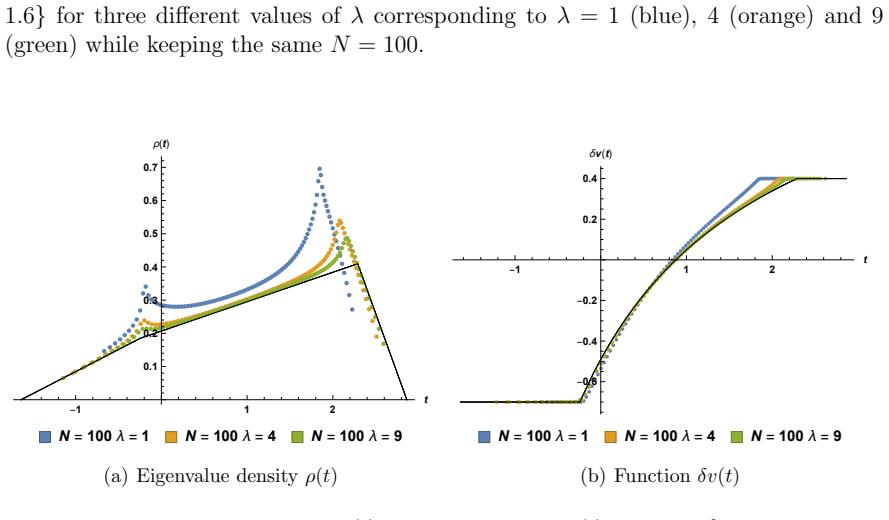
The load-bearing object is the Bethe potential $V$ (Eq. 3.2) whose critical points give the Bethe Ansatz equations (Eqs. 2.6--2.7) that fix the poles of the index integral. In the 't Hooft limit the eigenvalues are assumed to scale as $u_i=i\sqrt{\lambda}\,t_i+\pi\lambda/N-\tfrac12\delta v(t_i)$ (Eq. 3.4), and the paper introduces continuous densities $\rho(t)$ and $\delta v(t)$. A large-$\lambda$ Taylor expansion of the polylogarithm integrals (Eqs. 3.9--3.11) reduces the Bethe potential to the same form as in the M-theory limit, with prefactor $N^2/\sqrt{\lambda}$, so that the extremization procedure of [11] carries over and produces Eq. (1.1). The free energy of ABJM on $S^3$ in the 't Hooft limit is used as a template for the subleading genus expansion.
What would settle it
A one-loop IIA supergravity computation of the quantum effective action on the magnetically charged AdS$_4\times\mathbb{CP}^3$ background that yields a coefficient different from $-7/6$ for the $\log\lambda$ term would disprove the paper's prediction; alternatively, an analytic solution of the Bethe equations at fixed finite $\lambda$ showing that the densities $\rho(t)$, $\delta v(t)$ acquire $N$-dependent corrections would invalidate the scaling ansatz (Eq. 3.4) and hence the leading-order result.
Extended reading notes
Core claim
The central discovery is that the 't Hooft limit of the topologically twisted index of ABJM theory, combined with a large-$\lambda$ expansion of the Bethe potential, yields $\operatorname{Re}\log Z=-\frac{1}{3}\frac{N^2}{\sqrt{\lambda}}\sqrt{2\Delta_1\Delta_2\Delta_3\Delta_4}\sum_a \frac{n_a}{\Delta_a}$ as the leading term in $N$, with $N^2$ growth characteristic of the IIA regime. The paper shows that the eigenvalue densities $\rho(t)$ and $\delta v(t)$ depend only on $\lambda$ in this limit and match the analytic scaling $u_i=i\sqrt{\lambda}\,t_i+\pi\lambda/N-\tfrac12\delta v(t_i)$ numerically up to $N\sim 300$--$400$. Subleading in $N$, at genus one, the index contains a term $\frac{2\pi}{3}\sqrt{2\lambda}$ for equal fugacities and a $\log\lambda$ term with numerical coefficient $-7/6$, mirroring the structure of the ABJM free energy on $S^3$ and giving a concrete target for a one-loop IIA supergravity computation.
Load-bearing premise
The load-bearing premise is that in the 't Hooft limit the Bethe eigenvalues obey the scaling ansatz $u_i=i\sqrt{\lambda}\,t_i+\pi\lambda/N-\tfrac12\delta v(t_i)$ with $N$-independent densities $\rho(t)$ and $\delta v(t)$; this is verified numerically for $N$ up to about 300--400 but not proven analytically, and the subsequent large-$\lambda$ truncation of the polylog integrals is likewise assumed.
Editorial extensions
If this is right
- If the leading-order match is correct, the topologically twisted index in the 't Hooft limit provides a microscopic count of the microstates of magnetically charged asymptotically AdS$_4$ black holes in type IIA string theory, at leading order in $N$.
- The $-\frac{7}{6}\log\lambda$ term becomes a specific, quantitative prediction: a one-loop computation on the IIA supergravity side on the magnetically charged AdS$_4\times\mathbb{CP}^3$ background should reproduce this coefficient.
- The presence of the $\frac{2\pi}{3}\sqrt{2\lambda}$ genus-one term, analogous to the instanton-induced term in the $S^3$ free energy, suggests that similar nonperturbative effects appear in the twisted index.
- The numerical absence of a $N^2/\lambda$ correction to the leading term mirrors the absence of an $O(N)$ term in the M-theory limit under the map $k\to N/\lambda$, indicating a systematic correspondence between the two expansions.
- The observed dependence of subleading terms on $\lambda$ but not on $N$ supports the planar (genus) structure of the index expansion, paralleling the free energy on $S^3$.
Reading between the lines
- The same eigenvalue-scaling technique could be applied to other Chern-Simons matter theories with AdS$_4$ duals, such as massive IIA models, where a similar logarithmic-in-$\lambda$ coefficient might appear; verifying it would test whether the logarithmic term is universal.
- The logarithmic coefficient $-\frac{7}{6}$ is likely connected to the one-loop determinant of massless fields on the black hole background; a direct supergravity computation could identify which fields contribute each fraction.
- If the cancellation of the $N^2/\lambda$ correction can be proven analytically, it would reveal a hidden polylogarithm identity in ABJM theory that might generalize to other quiver theories.
- The large-$\lambda$ expansion appears to be an asymptotic series in $1/\sqrt{\lambda}$; resumming it, for instance through the $\kappa$ variable of the free energy, might connect the genus-one terms to modular forms, as speculated for the $S^3$ free energy.
Editorial analysis
A structured set of objections, weighed in public.
Referee Report
Summary. The manuscript studies the topologically twisted index of ABJM theory in the 't Hooft limit N,k → ∞ with λ=N/k fixed and large. Starting from the localization expression for the index and the Bethe ansatz equations, the authors propose an eigenvalue ansatz with density ρ(t) and function δv(t), evaluate the Bethe potential in the large-λ limit, and obtain the leading term Re log Z = -(1/3) N^2/√λ √(2 Δ1Δ2Δ3Δ4) Σ n_a/Δ_a (Eq. (1.1)). They claim this reproduces, after Legendre transformation, the Bekenstein-Hawking entropy of magnetically charged asymptotically AdS4 black holes in IIA on AdS4×CP3. They also numerically study subleading terms: a log N coefficient 2/3, a √λ N^0 term 2π/3 √(2λ) in the equal-fugacity case, and a log λ coefficient -7/6, which they propose as a prediction for the one-loop IIA effective action. Numerics are based on solving the BAE for N up to about 300–400 and multi-stage least-squares fits.
Significance. If correct, Eq. (1.1) provides a microscopic derivation of the entropy of magnetically charged AdS4 black holes in the IIA 't Hooft regime, extending previous M-theory-limit results and exhibiting the expected N^2 growth. The computation starts from the localization expression for the index and the Bethe potential, so the leading-order result is not circular with respect to the gravity entropy. Strengths include an exact starting point, a transparent numerical algorithm, cross-checks with the M-theory limit via k→N/λ, and agreement with the free-energy structure, including the -1/24 shift and the genus-one √λ term. The paper also makes a falsifiable prediction in the -7/6 log λ coefficient, which is a concrete target for a one-loop IIA supergravity computation. The main weakness is that the eigenvalue ansatz is not proven analytically and the cancellation of N^2/λ corrections is observed only numerically; these caveats should be reflected in the strength of the claims.
major comments (3)
- [Section 3, Eqs. (3.4), (3.10), (3.17)] The derivation of Eq. (1.1) relies on the eigenvalue ansatz u_i = i√λ t_i + πλ/N - (1/2)δv(t_i) and on truncating the polylog expansion at the N^2/√λ order. The paper gives numerical evidence that the density is N-independent for N=100,300 at λ=10 and that the large-λ tail is controlled by 1/√λ, but it does not prove that the O(N^2/λ) terms cancel. Section 3.2.1 explicitly reports g2 ~ 10^-8 and defers an analytic proof to future work. If g2 were non-zero, the fitted g1 in Table 3 would be contaminated at relative order 1/λ, which is precisely the size of the 0.53% discrepancy at λ=10 in Table 2. The wording 'precisely reproduces' is therefore stronger than what is established; either supply an analytic argument for the cancellation or soften the claim and frame the numerical check as compelling but non-exact evidence.
- [Section 3.2.4, Table 4] The advertised prediction of a -(7/6) log λ term is extracted from a multi-stage fit without reported error bars. The values of f3 in Table 4 come from the earlier fits in Table 1, so uncertainties propagate but are not quantified. The fit function (3.40) includes h1√λ + h2 log λ + h3 and drops non-perturbative O(e^{-√λ}) terms, but the sensitivity of h2 to the fitting window, to the inclusion of additional λ^{-1/2} or λ^{-1} terms, and to the choice of replacing λ by λ-1/24 is not discussed. Since this logarithmic term constitutes the paper's main prediction for the gravity side, the numerical evidence should be presented with error estimates and stability checks, or the prediction should be described as tentative.
- [Section 4, Eq. (4.6)] The gravity-side matching is sketched rather than demonstrated. Equation (4.6) states the relation 2g^2/G_4D = (2√2/3) N^2/√λ by reading off from the vacuum background (4.1), and the entropy formula (4.5) is quoted from prior work. The paper does not explicitly show the Legendre transformation that converts Eq. (1.1) into the Bekenstein-Hawking entropy for the magnetically charged black holes, nor does it display the intermediate steps that fix the numerical factors involving the flux sum Σ n_a/Δ_a. Making this derivation explicit, even in an appendix, would remove ambiguity and substantiate the central claim that the index 'precisely reproduces' the black hole entropy.
minor comments (4)
- [Abstract] There are typos in the abstract: 'supergrvity' should be 'supergravity' and 'twisteed' should be 'twisted'.
- [Eq. (2.7)] Equation (2.7) appears to use the same index j in the product over j as in the external label ilde B_j; the product index should likely be i to mirror Eq. (2.6).
- [Tables 1–4] The fitting tables report many digits with no uncertainties. Adding error bars or a statement of the expected numerical precision would make the comparisons more informative, especially for quantities claimed to match analytic values such as g3 = π/(24√2).
- [Section 3.1.2] The text says the conclusions are the same as those 'drown in the special case'; this should be 'drawn'.
Circularity Check
The central entropy match is non-circular, but the advertised log-lambda prediction is a re-expression of the authors' prior M-theory log N result in 't Hooft variables.
-
renaming known result
[Section 3.2.4, sanity check after Eq. (3.44), Eq. (3.45)]
"It turns our that adding a term of the form (7 /6) logk, yields the two coefficients that we have established in the ’t Hooft limit: (2 /3) logN and−(7/6) logλ. In fact all of the numerical results in the ’t Hooft limit shown above correspond to the results in the M-theory limit through change of variables k→ N/λ."
The abstract advertises the -(7/6) log lambda term as a new field-theory prediction for the IIA one-loop effective action. However, Eq. (3.45) shows this coefficient is obtained by taking the M-theory result from the authors' prior work [19] in the form -(1/2) log N + (7/6) log k and substituting k = N/lambda. Thus the 'prediction' is a re-labeling of an already-known same-group result in new variables, not an independent derivation in the 't Hooft limit. This does not affect the leading-order match, which is genuinely computed from localization, but it weakens the status of the log-lambda term as a new prediction.
full rationale
The central claim, Eq. (1.1), is not circular. The paper starts from the exact Bethe Ansatz equations (2.6)-(2.7) and the Bethe potential (3.2), introduces the eigenvalue ansatz (3.4) in the 't Hooft limit, and evaluates the leading large-lambda contribution to the Bethe potential, arriving at Re log Z0 in Eq. (3.14). The matching to the Bekenstein-Hawking entropy uses the 4D gauged supergravity entropy formula from the independent reference [11] together with the IIA dictionary relation (4.6). The field-theory result is not fitted to the black hole entropy; it is computed from localization data. The eigenvalue ansatz itself is verified numerically up to N = 300, and any unproven aspects of the ansatz or of the truncation at order N^2/sqrt(lambda) are rigor gaps, not circularity. The paper even flags these explicitly in Section 3.2.1, noting that an analytic proof of the N^2/lambda cancellation is left to future work. The only mild circularity is the log-lambda term: Eq. (3.45) reveals that the advertised -(7/6) log lambda prediction is the M-theory log N coefficient from the same research group, translated by k = N/lambda, rather than a fresh independent computation. This is a secondary claim and is disclosed by the authors, so the overall circularity score is low.
Assumptions & free parameters
free parameters (5)
- h2 (coefficient of log lambda in the N^0 term) =
-1.164 to -1.143 in fits; claimed -7/6
- h1 (coefficient of sqrt(lambda) in the N^0 term) =
2.96129
- f2 (coefficient of log N) =
0.66667
- g1 (coefficient of N^2 / sqrt(lambda)) =
-1.48096
- g3 (coefficient of N^2 / lambda^{3/2}) =
0.09256
assumptions (6)
- domain assumption Eigenvalue scaling ansatz in the 't Hooft limit: ui = i sqrt(lambda) ti + pi lambda / N - one half delta-v(ti), with N-independent densities rho(t) and delta-v(t).
- domain assumption Continuum limit: sums over eigenvalues can be replaced by integrals over a continuous density rho(t).
- domain assumption The leading Re log Z is obtained by extremizing the Bethe potential (3.12), following prior work.
- domain assumption Large-lambda expansion: terms of order 1/lambda in the Bethe potential are sub-leading and the N^2/lambda correction cancels.
- domain assumption AdS/CFT dictionary: 2 g^2 / G_4D = (2 sqrt(2)/3) N^2 / sqrt(lambda) for IIA on AdS4 times CP3.
- domain assumption The M-theory limit result -1/2 log N + 7/6 log k maps to the 't Hooft limit via k = N/lambda.
Cite this review
Pith. "Pith review of The Topologically Twisted Index in the 't Hooft Limit and the Dual AdS$_4$ Black Hole Entropy." pith.science (2026). https://pith.science/paper/5EZ2PH3J
@misc{pith2026190801194,
  author       = {Pith},
  title        = {Pith review of: The Topologically Twisted Index in the 't Hooft Limit and the Dual AdS$_4$ Black Hole Entropy},
  year         = {2026},
  howpublished = {\url{https://pith.science/paper/5EZ2PH3J}},
  note         = {Machine review of arXiv:1908.01194}
}
abstract
We study the topologically twisted index of $\mathcal{N}=6$ supersymmetric Chern-Simons matter theory with $U(N)_k \times U(N)_{-k}$ gauge group in the 't Hooft limit, that is, for $N, k \, \to \infty$ with $\lambda=N/k$ fixed. In the regime where $\lambda$ is fixed and large we find an analytical expression for the leading order term of the index. The leading term of the index matches precisely the Bekenstein-Hawking entropy of the dual asymptotically AdS$_4$ magnetically charged black holes embedded in IIA supergrvity on AdS$_4\times \mathbb{CP}^3$, after a standard Legendre transformation. We numerically explore the genus expansion of the topologically twisteed index beyond the leading order, focusing on the genus one contribution, that is, $N^0$. We find qualitative agreement with the topological expansion of the free energy on $S^3$ at genus one. Our logarithmic in $\lambda$ term constitutes a prediction for the one-loop effective action on the IIA supergravity side.
Figures


Figures from the paper (5 more)


Forward citations
Cited by 3 Pith papers
-
One-loop corrections to near extremal Kerr thermodynamics from semiclassical Virasoro blocks
Near-extremal Kerr black holes get a universal (s-1/2) log T_H entropy correction from long-lived modes, derived exactly from Virasoro blocks.
-
One loop corrections to the thermodynamics of near-extremal Kerr-(A)dS black holes from Heun equation
Cold near-extremal Kerr-de Sitter black holes carry universal log(T) entropy corrections while rotating Nariai geometries do not, as derived from Teukolsky/Heun connection coefficients.
-
One-loop determinants for black holes in 4d gauged supergravity
The one-loop determinants for vector multiplets scale as (v1 chi_V)^{1/4} per multiplet, physical hypermultiplets give the inverse, and these combine into logarithmic corrections to AdS4 black hole entropy with an und...
Reference graph
Works this paper leans on
-
[1]
O. Aharony, O. Bergman, D. L. Jafferis and J. Maldacena, N = 6 superconformal Chern-Simons-matter theories, M2-branes and their gravity duals, JHEP 10 (2008) 091, [ 0806.1218]. 27
arXiv 2008
-
[2]
N. Drukker, M. Marino and P. Putrov, From weak to strong coupling in ABJM theory, Commun.Math.Phys. 306 (2011) 511–563, [ 1007.3837]
arXiv 2011
-
[3]
N. Drukker, M. Marino and P. Putrov, Nonperturbative aspects of ABJM theory , JHEP 11 (2011) 141, [ 1103.4844]
arXiv 2011
-
[4]
F. Benini and A. Zaffaroni, A topologically twisted index for three-dimensional supersymmetric theories, JHEP 07 (2015) 127, [ 1504.03698]
arXiv 2015
-
[5]
Supersymmetric index on T^2 x S^2 and elliptic genus
M. Honda and Y. Yoshida, Supersymmetric index on T 2×S2 and elliptic genus , 1504.04355
-
[6]
C. Closset, S. Cremonesi and D. S. Park, The equivariant A-twist and gauged linear sigma models on the two-sphere , JHEP 06 (2015) 076, [ 1504.06308]
arXiv 2015
-
[7]
F. Benini and A. Zaffaroni, Supersymmetric partition functions on Riemann surfaces, 1605.06120
-
[8]
C. Closset and H. Kim, Comments on twisted indices in 3d supersymmetric gauge theories, 1605.06531
Show all 47 references
-
[9]
Closset, H
C. Closset, H. Kim and B. Willett, Supersymmetric partition functions and the three-dimensional A-twist, JHEP 03 (2017) 74, [ 1701.03171]
2017 arXiv
-
[10]
Closset, H
C. Closset, H. Kim and B. Willett, Seifert fibering operators in 3d N = 2 theories, 1807.02328
-
[11]
Benini, K
F. Benini, K. Hristov and A. Zaffaroni, Black hole microstates in AdS 4 from supersymmetric localization, JHEP 05 (2016) 054, [ 1511.04085]
2016 arXiv
-
[12]
Benini, K
F. Benini, K. Hristov and A. Zaffaroni, Exact microstate counting for dyonic black holes in AdS 4, Phys. Lett. B771 (2017) 462–466, [ 1608.07294]
2017 arXiv
-
[13]
Cabo-Bizet, V
A. Cabo-Bizet, V. I. Giraldo-Rivera and L. A. Pando Zayas, Microstate counting of AdS4 hyperbolic black hole entropy via the topologically twisted index , JHEP 08 (2017) 023, [ 1701.07893]
2017 arXiv
-
[14]
Azzurli, N
F. Azzurli, N. Bobev, P. M. Crichigno, V. S. Min and A. Zaffaroni, A universal counting of black hole microstates in AdS 4, JHEP 02 (2018) 054, [ 1707.04257]
2018 arXiv
-
[15]
S. M. Hosseini, K. Hristov and A. Passias, Holographic microstate counting for AdS4 black holes in massive IIA supergravity , JHEP 10 (2017) 190, [1707.06884]
2017 arXiv
-
[16]
Benini, H
F. Benini, H. Khachatryan and P. Milan, Black hole entropy in massive Type IIA, Class. Quant. Grav. 35 (2018) 035004, [ 1707.06886]
2018 arXiv
-
[17]
S. M. Hosseini, Black hole microstates and supersymmetric localization , Ph.D. thesis, Milan Bicocca U., 2018-02. 1803.01863. 28
2018 arXiv
-
[18]
Zaffaroni, Lectures on AdS Black Holes, Holography and Localization , 2019, 1902.07176
A. Zaffaroni, Lectures on AdS Black Holes, Holography and Localization , 2019, 1902.07176
2019 arXiv
-
[19]
J. T. Liu, L. A. Pando Zayas, V. Rathee and W. Zhao, Toward Microstate Counting Beyond Large N in Localization and the Dual One-loop Quantum Supergravity, JHEP 01 (2018) 026, [ 1707.04197]
2018 arXiv
-
[20]
J. T. Liu, L. A. Pando Zayas and S. Zhou, Subleading Microstate Counting in the Dual to Massive Type IIA , 1808.10445
-
[21]
J. T. Liu, L. A. Pando Zayas, V. Rathee and W. Zhao, One-Loop Test of Quantum Black Holes in anti–de Sitter Space , Phys. Rev. Lett. 120 (2018) 221602, [1711.01076]
2018 arXiv
-
[22]
Jeon and S
I. Jeon and S. Lal, Logarithmic Corrections to Entropy of Magnetically Charged AdS4 Black Holes, Phys. Lett. B774 (2017) 41–45, [ 1707.04208]
2017 arXiv
-
[23]
Hristov, I
K. Hristov, I. Lodato and V. Reys, On the quantum entropy function in 4d gauged supergravity, JHEP 07 (2018) 072, [ 1803.05920]
2018 arXiv
-
[24]
Gang and N
D. Gang and N. Kim, LargeN twisted partition functions in 3d-3d correspondence and Holography, Phys. Rev. D99 (2019) 021901, [ 1808.02797]
2019 arXiv
-
[25]
D. Gang, N. Kim and L. A. Pando Zayas, Precision Microstate Counting for the Entropy of Wrapped M5-branes, 1905.01559
1905 arXiv
-
[26]
C. P. Herzog, I. R. Klebanov, S. S. Pufu and T. Tesileanu, Multi-Matrix Models and Tri-Sasaki Einstein Spaces, Phys. Rev. D83 (2011) 046001, [ 1011.5487]
2011 arXiv
-
[27]
S. M. Hosseini and A. Zaffaroni, LargeN matrix models for 3d N = 2 theories: twisted index, free energy and black holes , JHEP 08 (2016) 064, [ 1604.03122]
2016 arXiv
-
[28]
S. M. Hosseini and N. Mekareeya, LargeN topologically twisted index: necklace quivers, dualities, and Sasaki-Einstein spaces , JHEP 08 (2016) 089, [1604.03397]
2016 arXiv
-
[29]
Marino and P
M. Marino and P. Putrov, Exact Results in ABJM Theory from Topological Strings, JHEP 06 (2010) 011, [ 0912.3074]
2010 arXiv
-
[30]
Ooguri and C
H. Ooguri and C. Vafa, World sheet derivation of a large N duality , Nucl. Phys. B641 (2002) 3–34, [ hep-th/0205297]
2002 arXiv
-
[31]
Okuyama, Instanton Corrections of 1/6 BPS Wilson Loops in ABJM Theory , JHEP 09 (2016) 125, [ 1607.06157]
K. Okuyama, Instanton Corrections of 1/6 BPS Wilson Loops in ABJM Theory , JHEP 09 (2016) 125, [ 1607.06157]
2016 arXiv
-
[32]
J. T. Liu and R. Minasian, Computing 1/N2 corrections in AdS/CFT, 1010.6074
-
[33]
Sen, Logarithmic Corrections toN = 2 Black Hole Entropy: An Infrared Window into the Microstates , Gen
A. Sen, Logarithmic Corrections toN = 2 Black Hole Entropy: An Infrared Window into the Microstates , Gen. Rel. Grav. 44 (2012) 1207–1266, [1108.3842]. 29
2012 arXiv
-
[34]
Sen, Logarithmic Corrections to Rotating Extremal Black Hole Entropy in Four and Five Dimensions , Gen
A. Sen, Logarithmic Corrections to Rotating Extremal Black Hole Entropy in Four and Five Dimensions , Gen. Rel. Grav. 44 (2012) 1947–1991, [ 1109.3706]
2012 arXiv
-
[35]
Sen, Microscopic and Macroscopic Entropy of Extremal Black Holes in String Theory, Gen
A. Sen, Microscopic and Macroscopic Entropy of Extremal Black Holes in String Theory, Gen. Rel. Grav. 46 (2014) 1711, [ 1402.0109]
2014 arXiv
-
[36]
Bhattacharyya, A
S. Bhattacharyya, A. Grassi, M. Marino and A. Sen, A One-Loop Test of Quantum Supergravity, Class. Quant. Grav. 31 (2014) 015012, [ 1210.6057]
2014 arXiv
-
[37]
Cvetic, M
M. Cvetic, M. J. Duff, P. Hoxha, J. T. Liu, H. Lu, J. X. Lu et al., Embedding AdS black holes in ten-dimensions and eleven-dimensions , Nucl. Phys. B558 (1999) 96–126, [ hep-th/9903214]
1999 arXiv
-
[38]
Halmagyi and S
N. Halmagyi and S. Lal, On the on-shell: the action of AdS 4 black holes, JHEP 03 (2018) 146, [ 1710.09580]
2018 arXiv
-
[39]
Cabo-Bizet, U
A. Cabo-Bizet, U. Kol, L. A. Pando Zayas, I. Papadimitriou and V. Rathee, Entropy functional and the holographic attractor mechanism , JHEP 05 (2018) 155, [1712.01849]
2018 arXiv
-
[40]
Benetti Genolini, J
P. Benetti Genolini, J. M. P´ erez Ipi˜ na and J. Sparks,Localization of the action in AdS/CFT, 1906.11249
1906 arXiv
-
[41]
Guarino and J
A. Guarino and J. Tarrio, BPS black holes from massive IIA on S 6, JHEP 09 (2017) 141, [ 1703.10833]
2017 arXiv
-
[42]
Guarino, D
A. Guarino, D. L. Jafferis and O. Varela, String Theory Origin of Dyonic N = 8 Supergravity and Its Chern-Simons Duals , Phys. Rev. Lett. 115 (2015) 091601, [1504.08009]
2015 arXiv
-
[43]
Varela, AdS4 solutions of massive IIA from dyonic ISO(7) supergravity , JHEP 03 (2016) 071, [ 1509.07117]
O. Varela, AdS4 solutions of massive IIA from dyonic ISO(7) supergravity , JHEP 03 (2016) 071, [ 1509.07117]
2016 arXiv
-
[44]
Marino and P
M. Marino and P. Putrov, ABJM theory as a Fermi gas , J. Stat. Mech. 1203 (2012) P03001, [ 1110.4066]
2012 arXiv
-
[45]
H. Fuji, S. Hirano and S. Moriyama, Summing Up All Genus Free Energy of ABJM Matrix Model , JHEP 08 (2011) 001, [ 1106.4631]
2011 arXiv
-
[46]
S. L. Cacciatori and D. Klemm, Supersymmetric AdS4 black holes and attractors , JHEP 01 (2010) 085, [ 0911.4926]
2010 arXiv
-
[47]
Cvetic, H
M. Cvetic, H. Lu and C. N. Pope, Consistent warped space Kaluza-Klein reductions, half maximal gauged supergravities and CPn constructions, Nucl. Phys. B597 (2001) 172–196, [ hep-th/0007109]. 30
2001 arXiv
Reviewed August 14, 2026 · model on record in the stance chip above.
Discussion (0). Continue with ORCID to comment.