REVIEW 3 major objections 5 minor 61 references
Non-Hermitian Boundary State Engineering in Anomalous Floquet Topological Insulators
T0 review · 3 major / 5 minor · reviewed 2026-08-14 · deepseek-v4-flash
Pith's one-line read Boundary states in anomalous Floquet topological insulators can be detached from the bulk bands and repositioned by losses without losing topological protection.
desk verdict Genuinely new boundary-state engineering in non-Hermitian Floquet insulators, with clean analytics and convincing numerics; the topological-protection claim is undertheorized but not fatal. read the letter →
The pith
A machine-rendered reading of the paper's core claim, the machinery that carries it, and where it could break.
The reading
What carries the argument
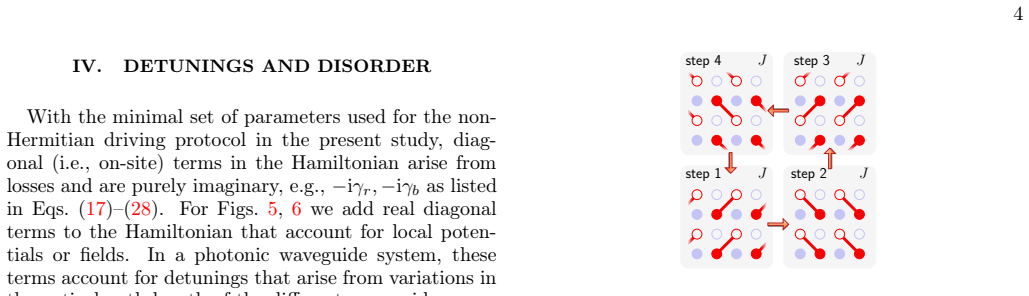
The load-bearing object is the one-period Floquet propagator $U(T)$, whose eigenvalues $e^{-i\varepsilon}$ lie on the unit circle in the Hermitian case and move off it once losses are added. An anomalous Floquet boundary state is one whose dispersion winds around the unit circle; because $U$ is invertible its spectrum cannot cross the origin, so the winding number survives non-Hermitian deformation and keeps the detached boundary states protected. Boundary state engineering is implemented by assigning independent loss rates $\gamma_r,\gamma_b$ to the two sublattices in the bulk and $\breve{\gamma}_r,\breve{\gamma}_b$ to isolated boundary sites, constrained by the non-Hermitian time-reversal conditions TRS* ($\gamma_r+\gamma_b=\breve{\gamma}_b+\breve{\gamma}_r$) or TRSt ($\gamma_r=\gamma_b$, $\breve{\gamma}_b=\breve{\gamma}_r$). These losses shift the imaginary parts of the quasienergies, letting boundary states detach from the bulk bands while the preserved winding number maintains their topological character.
What would settle it
Diagonalize the full open-boundary Floquet propagator for a finite strip with loss rates as in Eq. (7) and track the complex quasienergies of the two counterpropagating edge states as $\gamma_*$ or $\gamma_t$ is varied; if their imaginary parts do not follow the predicted values (for example $-2\gamma_*$ and $-6\gamma_*$ on opposite boundaries) with the winding number unchanged, or if a TRS*-separated channel shows backscattering under TRS-breaking disorder comparable to the TRSt case, the central claim of independent boundary-state engineering is falsified.
Extended reading notes
Core claim
The central discovery is that an anomalous Floquet topological phase combined with non-Hermiticity breaks the usual bulk-boundary lockstep. Because the Floquet propagator $U(T)$ is invertible, its spectrum cannot pass through the origin, so a boundary state that winds around the origin keeps its winding number even when losses pull its quasienergy off the unit circle; the boundary state can therefore detach from the bulk bands and be repositioned independently. In the $Z_2$-protected six-step protocol, choosing different loss rates on the two sublattices and on the two boundaries detaches the counterpropagating boundary states from the bulk, either with equal damping on both channels (the TRSt case, which preserves true bidirectional transport) or with separated imaginary parts (the TRS* case, which suppresses one direction). The result is boundary transport that is enhanced relative to bulk motion, helical transport with a preferred direction, and chiral transport in the same direction on opposite boundaries, with the TRS*-separated channel surviving symmetry-breaking disorder.
Load-bearing premise
The load-bearing premise is that the winding number of the one-period time-evolution operator remains a valid topological invariant in a non-Hermitian system with boundaries, so that boundary states moved off the bulk bands are still protected.
Editorial extensions
If this is right
- Boundary transport in an anomalous Floquet insulator can be enhanced relative to bulk motion by choosing bulk losses larger than the boundary losses.
- With TRS* symmetry, one of the two counterpropagating boundary states can be damped more strongly, producing helical transport with a preferred direction that no longer needs time-reversal symmetry for protection.
- Choosing different boundary losses on opposite boundaries makes chiral transport flow in the same direction on both edges, a configuration forbidden in Hermitian systems by the bulk-boundary correspondence.
- Because the winding number of the invertible Floquet propagator is preserved, these modifications remain topologically protected even when the boundary is imperfect or disorder is present.
- The same loss engineering transfers directly to photonic waveguide lattices, where gain and loss are intrinsic and can be implemented by bent waveguides.
Reading between the lines
- A natural testable extension is to check whether the detachment persists when nonreciprocal hopping (a non-Hermitian skin effect) is added; those systems can invalidate conventional bulk-boundary arguments, and the paper does not analyze them.
- The same mechanism could be used as a reconfigurable topological switch: changing the boundary loss parameters during operation would reroute boundary current without altering the bulk phase, something the paper does not discuss.
- In a balanced gain/loss (PT-type) setting, the relative-shift interpretation means the suppressed channel could become lasing or amplifying; exploring that regime goes beyond the paper's loss-only examples.
- The argument based on invertibility and winding is not specific to fermionic TRS, so it may extend to other non-Hermitian Floquet phases with different symmetries, though the paper only classifies TRS* and TRSt in its example.
Signed reviews
Editorial analysis
A structured set of objections, weighed in public.
Referee Report
Summary. This paper introduces the concept of 'boundary state engineering' (BSE) for non-Hermitian Floquet topological insulators. The authors argue that in an anomalous Floquet phase, boundary-state quasienergies can be moved in the complex plane by adding losses/gains, thereby detaching boundary states from bulk bands while retaining their winding around the origin. They analyze a six-step Floquet protocol with fermionic time-reversal symmetry, derive an analytic loss budget at perfect coupling (Eqs. (2)-(3)), and identify two non-Hermitian TRS variants (TRS* and TRSt) with distinct constraints on bulk and boundary loss parameters (Eqs. (4)-(6)). Numerical quasienergy spectra and real-space propagation are used to demonstrate enhanced boundary transport, transport with a preferred direction, and same-direction chiral transport on opposite boundaries, including robustness against disorder. The supplemental material provides additional examples and a driven Kane-Mele model.
Significance. If the claims hold, BSE would be a new design principle for topological photonics: boundary transport is no longer fixed by bulk topology, enabling transport scenarios impossible in Hermitian systems. The paper's strengths are the clean analytic loss accounting at perfect coupling, the explicit enumeration of non-Hermitian TRS constraints, and the direct real-space simulations showing the predicted transport phenomena. The experimental relevance to photonic waveguide lattices is well argued, and the supplemental material generalizes the construction to several other protocols. However, the central topological-protection claim is only supported by a short winding-number argument and by disorder numerics; the bulk-boundary correspondence for the open non-Hermitian system is not established, which is a significant gap.
major comments (3)
- [Conceptual argument after Fig. 1] The central claim that the boundary states remain 'topologically protected' rests on the sentence 'Since the propagator U is invertible, its spectrum cannot move through the origin, and the winding number is preserved.' This argument is not sufficient for open-boundary non-Hermitian systems. In such systems, the open-boundary spectrum and eigenstates can differ dramatically from the periodic-boundary Bloch spectrum due to the non-Hermitian skin effect, and point-gap winding numbers of U(k) do not by themselves guarantee the existence or protection of detached boundary states. The manuscript never computes the periodic-boundary spectrum U(k_x,k_y), never examines the generalized Brillouin zone, and never checks whether the bulk eigenstates of the strip are extended. The conclusion itself acknowledges that further theoretical research on invariants and bulk-boundary correspondence is needed. Since the abstract's claim 'without sacrificing their topological nature' is load-bearing, the authors should either (i) provide a rigorous justification for the absence of skin effect in this reciprocal protocol, or (ii) qualify the protection claim as a numerically supported robustness statement for the specific model. This is a required revision.
- [Fig. 6 (E,F)] The disorder robustness central to the protection claim is shown for a single disorder configuration (δ=0.2). Topological protection is a property of phases and should be demonstrated over an ensemble of disorder realizations; a single snapshot cannot rule out a rare backscattering event. The authors should show ensemble-averaged observables, such as the average intensity transmitted along the boundary or the mean backscattered fraction, over many realizations and for a range of disorder strengths. This would substantially strengthen the claim that the boundary states remain topologically protected.
- [Fig. 1 and surrounding text] The statement that 'Regular boundary states have to remain attached to the bulk bands, since otherwise the continuous dependence on momentum would be violated' is not self-evident for complex spectra. In a non-Hermitian system, a boundary-state dispersion over a periodic momentum variable is a closed loop in the complex plane, and closed loops can detach from bulk bands without violating continuity. Since the distinction between regular and anomalous phases is the conceptual basis of BSE, the authors should provide a proof or a reference establishing this dichotomy, or at least clarify the precise sense in which 'attachment' is required in the non-Hermitian setting.
minor comments (5)
- [Supplemental Material, Eq. (36b)] In the TRS* constraint for the horizontal couplings, 'B*_f6' appears to be a typo for 'B*_f5'; only parameters with subscript f5 are defined for step 5.
- [Shift σ(t) and normalized intensities] The statement that normalized intensities I(r)=|ψ(r)|^2/max_r' |ψ(r')|^2 cancel the factor Γ is only valid for a global maximum at a fixed time; this should be stated more precisely, since the maximum can change in time and the cancellation is not a full gauge invariance.
- [Fig. 6] Because the color scale is normalized to the maximum intensity at each time, the absolute decay of the signal is not visible. A color scale tied to absolute intensity, or a separate panel showing the total norm, would help the reader assess the claimed enhancement of boundary transport relative to bulk motion.
- [Eq. (8)] The combined notation '(TRS∗,t)' in Eq. (8) is compact but may confuse readers; writing the two cases explicitly would improve readability.
- [Conclusion] The final suggestion that experiments should investigate robustness is vague; the authors could list a specific measurable signature, such as the ratio of boundary to bulk intensity as a function of the loss parameter γ, to make the experimental proposal more concrete.
Circularity Check
No significant circularity: the central boundary-state manipulations are derived from explicit loss counting and symmetry algebra; self-citations to the driving protocol are not load-bearing.
full rationale
Eqs. (2) and (3) for bulk and boundary imaginary quasienergies are derived by explicit cycle counting at perfect coupling ('Working out the respective patterns for all four states depicted in the top row of Fig. 4'), not by fitting any quantity to the target claim. The loss parameters (γ_r, γ_b, ...) are freely chosen engineering inputs, and the boundary-state placements are linear consequences, so there is no fitted-input-called-prediction step. The TRS constraints in Eqs. (4)-(6) are obtained from the symmetry algebra and derived in the Supplemental Material, not imported as an unverified premise. The only load-bearing topological assertion, 'Since the propagator U is invertible, its spectrum cannot move through the origin, and the winding number is preserved,' is a point-gap winding argument rather than a restatement of the conclusion; whether it survives in open non-Hermitian systems is flagged by the authors themselves in the final sentence ('further theoretical research regarding the status of topological invariants and the bulk-boundary correspondence in non-Hermitian Floquet systems'), which is an admitted open point, not circularity. The driving protocol is taken from prior work including the authors' Ref. [25], but the new effects are demonstrated by explicit real-space simulations (Fig. 6) and additional examples in the Supplemental Material, so the self-citations are not load-bearing reductions. Overall, the derivation chain is self-contained; no step reduces to its own input.
Assumptions & free parameters
free parameters (5)
- J (diagonal coupling) =
1.5 in general simulations; pi/2 in analytic limit
- J' (horizontal coupling) =
0.4 in general simulations; 0 in analytic limit
- Bulk loss rates gamma_r, gamma_b =
gamma_r=gamma_b=gamma_t or gamma_* with values 1.2 (Fig. 5), 0.1 (Fig. 6), -1.25 (Kane-Mele)
- Boundary loss rates gamma_check_r, gamma_check_b per boundary =
Values as in Eq. (7), e.g. -2gamma_*, -6gamma_*
- Kane-Mele model parameters =
J1=J2=1, lambda_nu=0.3, lambda_SO,1=0.25, lambda_SO,2=0.5, T=1.5
assumptions (5)
- domain assumption Floquet propagator U(T) defines the topological phase via its spectrum on the unit circle for Hermitian and away from it for non-Hermitian systems.
- domain assumption An anomalous Floquet phase is one where boundary states wind around the unit circle and connect the same bulk band at quasienergies separated by 2pi.
- domain assumption The winding number of the invertible propagator is preserved under non-Hermitian perturbations because the spectrum cannot cross the origin.
- domain assumption Fermionic time-reversal symmetry with S = sigma_y tensor sigma_y applies to the six-step protocol and imposes the constraints in Eq. (5).
- domain assumption The open-boundary spectrum is well described by the local loss model without non-Hermitian skin effects.
Cite this review
Pith. "Pith review of Non-Hermitian Boundary State Engineering in Anomalous Floquet Topological Insulators." pith.science (2026). https://pith.science/paper/3PVNZTXO
@misc{pith2026190801372,
  author       = {Pith},
  title        = {Pith review of: Non-Hermitian Boundary State Engineering in Anomalous Floquet Topological Insulators},
  year         = {2026},
  howpublished = {\url{https://pith.science/paper/3PVNZTXO}},
  note         = {Machine review of arXiv:1908.01372}
}
read the original abstract
In Hermitian topological systems, the bulk-boundary correspondence strictly constraints boundary transport to values determined by the topological properties of the bulk. We demonstrate that this constraint can be lifted in non-Hermitian Floquet insulators. Provided that the insulator supports an anomalous topological phase, non-Hermiticity allows us to modify the boundary states independently of the bulk, without sacrificing their topological nature. We explore the ensuing possibilities for a Floquet topological insulator with non-Hermitian time-reversal symmetry, where the helical transport via counterpropagating boundary states can be tailored in ways that overcome the constraints imposed by Hermiticity. Non-Hermitian boundary state engineering specifically enables the enhancement of boundary transport relative to bulk motion, helical transport with a preferred direction, and chiral transport in the same direction on opposite boundaries. We explain the experimental relevance of our findings for the example of photonic waveguide lattices.
Figures


Figures from the paper (8 more)




Reference graph
Works this paper leans on
-
[1]
M. Z. Hasan and C. L. Kane, Rev. Mod. Phys.82, 3045 (2010)
2010
-
[2]
Qi and S.-C
X.-L. Qi and S.-C. Zhang, Rev. Mod. Phys. 83, 1057 (2011)
2011
-
[3]
Ozawa, H
T. Ozawa, H. M. Price, A. Amo, N. Goldman, M. Hafezi, L. Lu, M. C. Rechtsman, D. Schuster, J. Simon, O. Zil- berberg, and I. Carusotto, Rev. Mod. Phys.91, 015006 (2019)
2019
-
[4]
K. v. Klitzing, G. Dorda, and M. Pepper, Phys. Rev. Lett. 45, 494 (1980)
1980
-
[5]
D. J. Thouless, M. Kohmoto, M. P. Nightingale, and M. den Nijs, Phys. Rev. Lett.49, 405 (1982)
1982
-
[6]
König, S
M. König, S. Wiedmann, C. Brüne, A. Roth, H. Buh- mann, L. W. Molenkamp, X.-L. Qi, and S.-C. Zhang, Science 318, 766 (2007)
2007
-
[7]
Z.Wang, Y.Chong, J.D.Joannopoulos, andM.Soljacic, Nature 461, 772 (2009)
work page 2009
-
[8]
S. Stützer, Y. Plotnik, Y. Lumer, P. Titum, N. H. Lind- ner, M.Segev, M.C.Rechtsman, andA.Szameit,Nature 560, 461 (2018)
work page 2018
Show all 61 references
-
[9]
C.-K. Chiu, J. C. Y. Teo, A. P. Schnyder, and S. Ryu, Rev. Mod. Phys.88, 035005 (2016)
2016
-
[10]
A. P. Schnyder, S. Ryu, A. Furusaki, and A. W. W. Ludwig, Phys. Rev. B78, 195125 (2008)
2008
-
[11]
Roy and F
R. Roy and F. Harper, Phys. Rev. B96, 155118 (2017)
2017
-
[12]
S. Yao, Z. Yan, and Z. Wang, Phys. Rev. B96, 195303 (2017)
2017
-
[14]
Fu and C
L. Fu and C. L. Kane, Phys. Rev. B74, 195312 (2006)
2006
-
[15]
L. J. Maczewsky, B. Höckendorf, M. Kremer, T. Biesen- thal, M. Heinrich, A. Alvermann, H. Fehske, and A. Sza- meit, arXiv:1812.07930 (2018)
2018 arXiv
-
[16]
F. D. M. Haldane and S. Raghu, Phys. Rev. Lett.100, 013904 (2008)
2008
-
[17]
Jotzu, M
G. Jotzu, M. Messer, R. Desbuquois, M. Lebrat, T. Uehlinger, D. Greif, and T. Esslinger, Nature 515, 237 (2014)
2014
-
[18]
A. P. Slobozhanyuk, A. B. Khanikaev, D. S. Filonov, D. A. Smirnova, A. E. Miroshnichenko, and Y. S. Kivshar, Sci. Rep.6, 22270 (2016)
2016
-
[19]
Ningyuan, C
J. Ningyuan, C. Owens, A. Sommer, D. Schuster, and J. Simon, Phys. Rev. X5, 021031 (2015)
2015
-
[20]
Z. Yang, F. Gao, X. Shi, X. Lin, Z. Gao, Y. Chong, and B. Zhang, Phys. Rev. Lett.114, 114301 (2015)
2015
-
[22]
C. H. Lee, S. Imhof, C. Berger, F. Bayer, J. Brehm, L. W. Molenkamp, T. Kiessling, and R. Thomale, Comm. Phys. 1, 39 (2018)
2018
-
[23]
Klembt, T
S. Klembt, T. H. Harder, O. A. Egorov, K. Winkler, R. Ge, M. A. Bandres, M. Emmerling, L. Worschech, T. C. H. Liew, M. Segev, C. Schneider, and S. Höfling, Nature 562, 552 (2018)
2018
-
[24]
B 97, 045140 (2018)
B.Höckendorf, A.Alvermann, andH.Fehske,Phys.Rev. B 97, 045140 (2018)
2018
-
[25]
B 99, 245102 (2019)
B.Höckendorf, A.Alvermann, andH.Fehske,Phys.Rev. B 99, 245102 (2019)
2019
-
[26]
Hsieh, D
D. Hsieh, D. Qian, L. Wray, Y. Xia, Y. S. Hor, R. J. Cava, and M. Z. Hasan, Nature452, 970 (2008)
2008
-
[27]
Zhang, C.-X
H. Zhang, C.-X. Liu, X.-L. Qi, X. Dai, Z. Fang, and S.-C. Zhang, Nat. Phys.5, 438 (2009)
2009
-
[28]
M. C. Rechtsman, J. M. Zeuner, Y. Plotnik, Y. Lumer, D. Podolsky, F. Dreisow, S. Nolte, M. Segev, and A. Sza- meit, Nature 496, 196 (2013)
2013
-
[29]
J. M. Zeuner, M. C. Rechtsman, Y. Plotnik, Y. Lumer, S. Nolte, M. S. Rudner, M. Segev, and A. Szameit, Phys. Rev. Lett. 115, 040402 (2015)
2015
-
[30]
Lustig, S
E. Lustig, S. Weimann, Y. Plotnik, Y. Lumer, M. A. Bandres, A. Szameit, and M. Segev, Nature 567, 356 (2019)
2019
-
[33]
Nathan and M
F. Nathan and M. S. Rudner, New J. Phys.17, 125014 (2015)
2015
-
[34]
L. J. Maczewsky, J. M. Zeuner, S. Nolte, and A. Szameit, Nat. Comm. 8, 13756 (2017)
2017
-
[35]
Mukherjee, A
S. Mukherjee, A. Spracklen, M. Valiente, E. Andersson, P. Öhberg, N. Goldman, and R. R. Thomson, Nat. Comm. 8, 13918 (2017)
2017
-
[36]
Höckendorf, A
B. Höckendorf, A. Alvermann, and H. Fehske, J. Phys. A 50, 295301 (2017)
2017
-
[37]
Z. Gong, Y. Ashida, K. Kawabata, K. Takasan, S. Hi- gashikawa, and M. Ueda, Phys. Rev. X8, 031079 (2018)
2018
-
[38]
Zhou and J
H. Zhou and J. Y. Lee, Phys. Rev. B99, 235112 (2019)
2019
-
[40]
H. Shen, B. Zhen, and L. Fu, Phys. Rev. Lett. 120, 146402 (2018)
2018
-
[41]
121,086803(2018)
S.YaoandZ.Wang,Phys.Rev.Lett. 121,086803(2018)
2018
-
[42]
S. Yao, F. Song, and Z. Wang, Phys. Rev. Lett.121, 136802 (2018)
2018
-
[43]
F. K. Kunst, E. Edvardsson, J. C. Budich, and E. J. Bergholtz, Phys. Rev. Lett.121, 026808 (2018)
2018
-
[44]
C. H. Lee and R. Thomale, Phys. Rev. B 99, 201103 (2019)
2019
-
[45]
Harari, M
G. Harari, M. A. Bandres, Y. Lumer, M. C. Rechtsman, Y. D. Chong, M. Khajavikhan, D. N. Christodoulides, and M. Segev, Science359, eaar4003 (2018)
2018
-
[46]
W. B. Rui, Y. X. Zhao, and A. P. Schnyder, Phys. Rev. 6 B 99, 241110 (2019)
2019
-
[47]
J. Y. Lee, J. Ahn, H. Zhou, and A. Vishwanath, arXiv:1906.08782 (2019)
2019 arXiv
-
[48]
Ghatak and T
A. Ghatak and T. Das, J. Phys. Cond. Mat.31, 263001 (2019)
2019
-
[49]
D. S. Borgnia, A. Jura Kruchkov, and R.-J. Slager, arXiv:1902.07217 (2019)
2019 arXiv
-
[50]
Yoshida, R
T. Yoshida, R. Peters, N. Kawakami, and Y. Hatsugai, Phys. Rev. B99, 121101 (2019)
2019
-
[51]
M. A. Bandres, S. Wittek, G. Harari, M. Parto, J. Ren, M. Segev, D. N. Christodoulides, and M. Khajavikhan, Science 359, eaar4005 (2018)
2018
-
[52]
Weimann, M
S. Weimann, M. Kremer, Y. Plotnik, Y. Lumer, S. Nolte, K. G. Makris, M. Segev, M. C. Rechtsman, and A. Sza- meit, Nat. Mat.16, 433 (2016)
2016
-
[53]
Helbig, T
T. Helbig, T. Hofmann, S. Imhof, M. Abdelghany, T. Kiessling, L. W. Molenkamp, C. H. Lee, A. Szameit, M. Greiter, and R. Thomale, arXiv:1907.11562 (2019)
2019 arXiv
-
[54]
S. Lin, L. Jin, and Z. Song, Phys. Rev. B 99, 165148 (2019)
2019
-
[55]
Zhou and J
L. Zhou and J. Gong, Phys. Rev. B98, 205417 (2018)
2018
- [56]
-
[57]
Note that we measure quasienergies normalized to time step unity
-
[58]
See the supplemental material for a detailed derivation
-
[59]
For details on TRS breaking and preserving detunings, see the supplemental material
-
[60]
gain” and “loss
Disorder is both spatial and temporal, the exact form is specified in the supplemental material. The disorder strength amounts to0.2, or≈ 13% of the couplingJ. Supplemental material for: Non-Hermitian Boundary State Engineering in Anomalous Floquet Topological Insulators Bastia...
1908 arXiv
-
[61]
Kawabata, K
K. Kawabata, K. Shiozaki, M. Ueda, and M. Sato, Phys. Rev. X 9, 041015 (2019)
2019
-
[62]
Höckendorf, A
B. Höckendorf, A. Alvermann, and H. Fehske, Phys. Rev. B 99, 245102 (2019)
2019
-
[63]
M. S. Rudner, N. H. Lindner, E. Berg, and M. Levin, Phys. Rev. X3, 031005 (2013)
2013
-
[64]
Kitagawa, E
T. Kitagawa, E. Berg, M. Rudner, and E. Demler, Phys. Rev. B 82, 235114 (2010)
2010
-
[65]
Z. Yan, B. Li, X. Yang, and S. Wan, Sci. Rep.5, 16197 (2015)
2015
-
[66]
C. L. Kane and E. J. Mele, Phys. Rev. Lett.95, 146802 (2005)
2005
Reviewed August 14, 2026 · model on record in the stance chip above.
Discussion (0). Continue with ORCID to comment.