REVIEW 4 major objections 5 minor 46 references
Heavy baryon production with an instanton interaction
T0 review · 4 major / 5 minor · reviewed 2026-08-14 · deepseek-v4-flash
Pith's one-line read A two-quark reaction mechanism excites both internal modes of heavy baryons, and the relative production rates reveal baryon structure.
desk verdict A new two-quark mechanism for heavy-baryon production; the λ/ρ excitation pattern is likely robust, but the numerical rates rest on a simplified interaction. read the letter →
The pith
A machine-rendered reading of the paper's core claim, the machinery that carries it, and where it could break.
The reading
What carries the argument
The engine of the calculation is the 't Hooft-like three-flavor determinant interaction, rewritten via Fierz rearrangement so that one current (\(\bar u s\)) dresses the pion-to-meson transition and a two-quark operator \(O_B=(d^\dagger u)(s^\dagger d)-(d^\dagger d)(s^\dagger u)\) acts on the baryon. In the nonrelativistic limit and for forward scattering the operator becomes spin-independent, so it is the orbital and flavor structure of the harmonic-oscillator wave functions, separated into rho and $\lambda$ coordinates, that controls the rates. The identity that carries the result is the Gaussian overlap integral: ground states give a form factor \($e^{{-q_{\rm eff}}$^2/($4B^{2}$)}\), while l = 1 excited states multiply it by factors linear in \(|\vec q_{\rm eff}|\), making charmed-baryon production (large momentum transfer) favor excited states relative to strange-baryon production.
What would settle it
Measure the relative production rates of $\lambda$-mode and rho-mode Lambda and Sigma baryons, and of states like \(\Sigma(3/2^+)\) and \(\Lambda(5/2^-)\) that the spin-independent vertex forbids, in \(\pi^- p \to K \, \text{or} \, D + Y\) at J-PARC; if the predicted ratios, especially the 1:2:1:5:0 pattern or the vanishing of spin-flip states, are not seen, the simplified instanton mechanism is not the dominant two-quark process.
Extended reading notes
Core claim
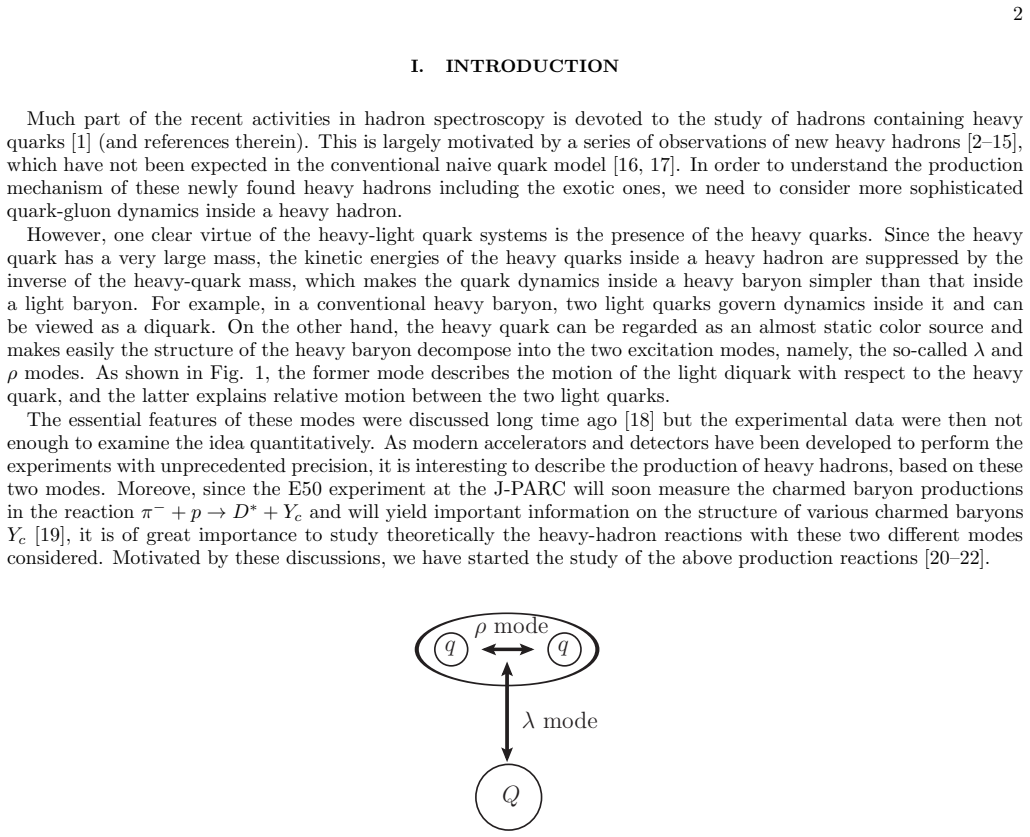
The central claim is that the 't Hooft-like six-quark interaction, reduced to a local, spin-independent two-quark operator, produces strange and charmed baryons from a proton target, and that this two-quark process excites both the lambda mode (the light-diquark motion relative to the heavy quark) and the rho mode (the relative motion of the two light quarks), whereas the one-quark process excites only the lambda mode. The computed relative production rates R(Y), normalized to the ground-state Lambda(1/2+), show that charmed excited states are produced almost as readily as the charmed ground state, while strange excited states are suppressed relative to the hyperon ground states; that the rate ratios within groups sharing the same spin content follow the pattern 1:2:1:5:0; and that ground-state Sigma baryons are produced about three times more often than ground-state Lambda baryons, opposite to the one-quark process and consistent with the need for both mechanisms.
Load-bearing premise
The calculation assumes that the simplified local 't Hooft-like interaction, derived for light flavors and taken as spin-independent, remains a valid description of the heavy-quark (strange or charm) production vertex, and that the meson-side matrix element cancels in the ratios.
Editorial extensions
If this is right
- Charmed excited baryons should be produced at rates comparable to the charmed ground state, while strange excited baryons remain suppressed relative to the hyperon ground states.
- States requiring quark spin flips, such as \(\Sigma(3/2^+)\), \(\Sigma(5/2^-)\), and \(\Lambda(5/2^-)\), are predicted to have zero production rate in this mechanism, so observing them would signal vector or tensor interactions beyond the leading scalar vertex.
- The rate ratios within each spin-content group (1:2:1:5:0) give a fingerprint for classifying a newly found baryon as lambda-mode or rho-mode, since lambda-mode Lambdas match rho-mode Sigmas and vice versa.
- At large momentum transfer the two-quark process dominates over the one-quark process because the Gaussian falloff is slower (\(B \simeq 2A\)), making the two-quark mechanism the relevant one for high-energy charmed-baryon production.
- The ground-state Sigma/Lambda production ratio of about three in the two-quark process, opposite to the one-quark result, implies both mechanisms must be combined to reproduce the observed ratio near 3/2.
Reading between the lines
- A direct test would be to compare the forward-angle rates of \(\Lambda(1405)\) (lambda-mode) and \(\Lambda(1670)\) (rho-mode) at fixed beam momentum; the paper's numbers imply the rho-mode state should be produced several times more often, which could distinguish quark-model assignments that otherwise agree in mass.
- The same ratio-symmetry argument should extend to the bottom sector: replacing charm by bottom moves the typical \(q_{\rm eff}\) even higher, so excited lambda- and rho-mode bottom baryons should be produced even more prominently relative to their ground states.
- Since the mechanism is spin-independent, adding the 1/Nc vector and tensor corrections would populate the currently vanishing states; the pattern of which forbidden states appear first would measure the size of those corrections.
- The meson-side matrix element \(\langle M | O_M | \pi \rangle\) was dropped; if it is not mild, the ratio predictions for kaon versus D-meson channels could shift, so measuring both channels at the same \(q_{\rm eff}\) would bound this assumption.
Editorial analysis
A structured set of objections, weighed in public.
Referee Report
Summary. The paper proposes a new microscopic mechanism for heavy baryon production in the reaction π^- p → M Y, where M is K or D and Y is a strange or charmed baryon. The mechanism is a two-quark process driven by a simplified, local version of the 't Hooft instanton-induced six-quark interaction. The authors factorize the amplitude into a meson transition and a baryon transition, use nonrelativistic harmonic-oscillator quark-model wave functions in the heavy-quark basis, and derive analytic Gaussian expressions for the transition amplitudes to ground, λ-excited, and ρ-excited baryons. Relative production rates are computed at forward angles and tabulated for strange and charmed baryons. The central claims are that the two-quark process excites both λ and ρ modes, in contrast to the one-quark process, and that the relative rates reflect the spin-orbital structure of the baryon wave functions, making the reactions useful for identifying λ-mode versus ρ-mode baryons at J-PARC.
Significance. If the central mechanism is correct, the paper provides a concrete, falsifiable set of relative-rate predictions that could be used at J-PARC to distinguish λ-mode and ρ-mode excited baryons. The analytic derivation from the harmonic-oscillator wave functions to the Gaussian amplitudes in Eqs. (25)-(33) is transparent, and the interaction strength c cancels in the normalized rates, so the predictions are parameter-free at the level of the model. The paper is also honest in flagging several of its own limitations. However, the quantitative predictions are conditional on an operator reduction and on neglecting meson matrix elements and finite-size effects; these assumptions are load-bearing rather than peripheral, and the paper does not currently supply enough derivation or sensitivity analysis to establish the claimed model-independence of the rate patterns.
major comments (4)
- [Section II.A, Eq. (4)] The reduction of the six-fermion 't Hooft interaction to the local, spin-independent two-quark operator O_B = (d†u)(s†d) - (d†d)(s†u), and its extension from strange to charm quarks, is asserted rather than derived. The text states that the (ūs) term reduces to the identity after neglecting Fermi motion and considering forward-angle scattering, but no calculation is shown, and the size of the neglected 1/N_c spin-dependent and tensor terms is not estimated. Since every entry in Table I is computed from this operator, the central quantitative claim depends on this unvalidated simplification. The authors' own disclaimer in the Introduction that the applicability of the interaction 'to production reactions in all details is not clear' underscores that this is a major assumption, not a minor technical step.
- [Section II.B-II.C, Table I] The spin-isospin coefficients |C_Y|² are not derived or even explicitly defined in a closed form, yet they control the relative rates and the selection-rule zeros in Table I. The reader cannot verify the values 1, 3, 0, 1/3, 2/3, 5/3, etc., from the quoted wave functions in Eqs. (13)-(19) and the operator in Eq. (4). Because the main physical claims—such as the 1:2:1:5:0 systematics in Table II and the identification of λ versus ρ modes—rest on these coefficients, the authors should provide the explicit angular-momentum and flavor recoupling calculation that produces each |C_Y|² value.
- [Section II.C, Eqs. (20), (35)] The meson matrix element ⟨M|O_M|π⟩ is dropped for all ratios. This cancellation is legitimate when comparing final baryons produced with the same meson M, but it is not legitimate when comparing the strange sector (M = K) with the charmed sector (M = D). The abstract and Section III.B claim large charmed-baryon production rates in comparison with strange baryons, yet the R(Ys) and R(Yc) entries in Table I are separately normalized to their respective ground states, and the different meson transition matrix elements are omitted. The comparison across the strange and charmed sectors is therefore not supported by the presented calculation.
- [Section II.A, Eq. (23)] The local contact form δ(x1-x3) ignores the finite instanton size and the known nonlocality of the instanton-induced interaction. This is particularly consequential for charm quarks, for which the instanton size is not negligible relative to the relevant baryon length scales. The selection rules and the Gaussian momentum dependence in Eqs. (27)-(33) follow directly from the delta-function locality; a finite-size form factor would modify the I_l integrals and hence the ratios in Tables I and II. The paper should either justify the local approximation quantitatively or show that the predicted pattern is robust under a finite-size smearing.
minor comments (5)
- [Eq. (7)] The center-of-mass coordinate is written as X = (mq(x1+x3)+mQ x3)/(2mq+mQ), which is missing the light-quark coordinate x2 and gives x3 twice; it should be mq(x1+x2)+mQ x3. This is likely a typographical error but should be corrected.
- [Section II.C, text after Eq. (36)] There are several typographical errors: 't Hoot-liked' should be 't Hooft-like'; in the Introduction, 'virture' should be 'virtue' and 'Moreove' should be 'Moreover'.
- [Section II.C, paragraph before Eq. (34)] The statement that 'the meson states in both the initial and final states are the same' is misleading, since the initial state is π and the final state is K or D. The intended meaning is presumably that the meson matrix element is common to all baryon final states within one sector; the wording should be clarified.
- [Table II] The row labeled 'Ratio' lists 1:2:1:2:1:5:0, which matches the ratios of the |C_Y|² values rather than the exact ratios of the computed R(Y) values. The caption should state that these are approximate ratios of the spin-isospin coefficients, not exact ratios of the differential cross sections.
- [Section II.B, Eq. (5)] The statement that the baryon wavefunction 'should be taken to be totally symmetric' is imprecise for a baryon with one heavy quark; the required symmetry is under exchange of the two identical light quarks, not full permutation symmetry among all three quarks.
Circularity Check
No circularity: the production rates are derived from the assumed interaction and quark-model wave functions, with no experimental rate used as input.
full rationale
The derivation chain is self-contained: the rates are computed, not fitted. Starting from Eq. (1), the 't Hooft six-quark interaction is Fierz-rearranged in Eq. (2) and reduced to Eqs. (3)-(4), where the baryon-side operator is O_B = (d†u)(s†d) - (d†d)(s†u). The baryon transition matrix element is written in Eq. (25) as an integral over the rho and lambda harmonic-oscillator wave functions, and the integrals are evaluated in Eqs. (28), (32), and (33). The differential rates R(Y) in Eq. (36) are proportional to |C_Y|^2 |I_l|^2 times phase space. The spin-isospin coefficients C_Y are Clebsch-Gordan coefficients of the quark-model wave functions; the interaction strength c cancels in the ratios; and the meson matrix element is dropped only for the study of relative rates. No measured production rate is used as an input to determine any parameter. The Lambda/Sigma data in Ref. [46] is invoked only after the computation, to argue that one-quark and two-quark mechanisms should coexist, not to fit the model. The paper's own caveats that the simplified 't Hooft-like interaction is not fully justified and that 1/N_c and finite-size corrections are neglected are model-validity limitations, not circular reductions. The self-citations [20-22, 23, 30] provide context, comparison, and wave-function conventions, but none of them is used to define the two-quark operator or to force the predicted pattern.
Assumptions & free parameters
free parameters (4)
- c (interaction strength) =
not fitted
- k (oscillator spring constant)
- m_q (light quark mass)
- m_s / m_c (heavy quark masses for strange and charm)
assumptions (6)
- domain assumption The instanton vacuum induces the 't Hooft six-quark interaction with the determinant structure of Eq. (1)
- domain assumption Baryon wave functions are nonrelativistic harmonic oscillator quark model states with heavy-quark spin symmetry
- domain assumption The strange quark can be treated as effectively heavy so that the heavy-quark basis applies to hyperons
- ad hoc to paper The meson transition matrix element ⟨M|O_M|π⟩ can be ignored when computing ratios
- ad hoc to paper Neglecting quark Fermi motion and restricting to forward-angle scattering reduces the baryon operator to the identity in spin space
- ad hoc to paper The interaction is local, approximated by a delta function δ(x1-x3)
Cite this review
Pith. "Pith review of Heavy baryon production with an instanton interaction." pith.science (2026). https://pith.science/paper/7YCFJH3L
@misc{pith2026190802966,
  author       = {Pith},
  title        = {Pith review of: Heavy baryon production with an instanton interaction},
  year         = {2026},
  howpublished = {\url{https://pith.science/paper/7YCFJH3L}},
  note         = {Machine review of arXiv:1908.02966}
}
abstract
We propose a new reaction mechanism for the study of strange and charmed baryon productions. In this mechanism we consider the correlation of two quarks in baryons, so it can be called the two-quark process. As in the previously studied one-quark process, we find large production rates for charmed baryons in comparison with strange baryons. Moreover, the new mechanism causes the excitation of both the $\rho$ mode and the $\lambda$ mode. Using the wave functions for baryons from a quark model, we compute the production rates of various baryon states. We find that the production rates reflect the structure of the wave functions that imply the usefulness of the reactions for the study of baryon structures.
Figures


Figures from the paper (1 more)

Reference graph
Works this paper leans on
- [1]
-
[2]
S. K. Choi et al. [Belle Collaboration], Phys. Rev. Lett. 91, 262001 (2003) [hep-ex/0309032]
arXiv 2003
-
[3]
D. Acosta et al. [CDF Collaboration], Phys. Rev. Lett. 93, 072001 (2004) [hep-ex/0312021]
arXiv 2004
-
[4]
B. Aubert et al. [BaBar Collaboration], Phys. Rev. D 71, 071103 (2005) [hep-ex/0406022]
arXiv 2005
-
[5]
V. M. Abazov et al. [D0 Collaboration], Phys. Rev. Lett. 101, 232002 (2008)
work page 2008
-
[6]
S. Chatrchyan et al. [CMS Collaboration], Phys. Rev. Lett. 108, 252002 (2012)
work page 2012
- [7]
-
[8]
M. Ablikim et al. [BESIII Collaboration], Phys. Rev. Lett. 110, 252001 (2013) [arXiv:1303.5949 [hep-ex]]
arXiv 2013
Show all 46 references
-
[9]
Aaij et al
R. Aaij et al. [LHCb Collaboration], Phys. Rev. Lett. 115, 072001 (2015) [arXiv:1507.03414 [hep-ex]]
2015 arXiv
-
[10]
Aaij et al
R. Aaij et al. [LHCb Collaboration], Phys. Rev. Lett. 117, no. 8, 082002 (2016) [arXiv:1604.05708 [hep-ex]]
2016 arXiv
-
[11]
Aaij et al
R. Aaij et al. [LHCb Collaboration], Phys. Rev. Lett. 117, no. 8, 082003 (2016) Addendum: [Phys. Rev. Lett. 117, no. 10, 109902 (2016)] Addendum: [Phys. Rev. Lett. 118, 119901 (2017)] [arXiv:1606.06999 [hep-ex]]
2016 arXiv
-
[12]
Aaij et al
R. Aaij et al. [LHCb Collaboration], Phys. Rev. Lett. 118, no. 2, 022003 (2017) [arXiv:1606.07895 [hep-ex]]
2017 arXiv
-
[13]
Aaij et al
R. Aaij et al. [LHCb Collaboration], Phys. Rev. Lett. 118, no. 18, 182001 (2017)
2017
-
[14]
Yelton et al
J. Yelton et al. [Belle Collaboration], Phys. Rev. D 97, no. 5, 051102 (2018) [arXiv:1711.07927 [hep-ex]]
2018 arXiv
-
[15]
Aaij et al
R. Aaij et al. [LHCb Collaboration], Phys. Rev. Lett. 122, no. 22, 222001 (2019) [arXiv:1904.03947 [hep-ex]]
2019 arXiv
-
[16]
Gell-Mann, Phys
M. Gell-Mann, Phys. Lett. 8, 214 (1964)
1964
-
[17]
Zweig, Developments in the Quark Theory of Hadrons, V olume 1
G. Zweig, Developments in the Quark Theory of Hadrons, V olume 1. Edited by D. Lichtenberg and S. Rosen. pp. 22-101
-
[18]
L. A. Copley, N. Isgur and G. Karl, Phys. Rev. D 20, 768 (1979) [Erratum-ibid. D 23, 817 (1981)]
1979
-
[19]
J-PARC P50 Proposal, ”Charmed Baryon Spectroscopy via the ( π−, D∗−) reaction”, Jan, 2012: *+\protect\vrule width0pt\protect\href{http://www.j- parc.jp/researcher/Hadron/en/Proposal_e.html#1301}{http://www.j-parc.jp/researcher/Hadron/en/Proposal_e.html#1301}+
2012
-
[20]
S. H. Kim, A. Hosaka, H.-Ch. Kim, H. Noumi and K. Shirotor i, PTEP 2014, no. 10, 103D01 (2014) [arXiv:1405.3445 [hep-ph]]
2014 arXiv
-
[21]
S. H. Kim, H.-Ch. Kim and A. Hosaka, Phys. Lett. B 763, 358 (2016) doi:10.1016/j.physletb.2016.10.061 [arXiv: 1605.02919 [hep-ph]]
2016 arXiv
-
[22]
S. H. Kim, H.-Ch. Kim and A. Hosaka, Phys. Rev. D 94, no. 9, 094025 (2016) doi:10.1103/PhysRevD.94.094025 [arXiv:1608.06394 [hep-ph]]
2016 arXiv
-
[23]
Yoshida, E
T. Yoshida, E. Hiyama, A. Hosaka, M. Oka and K. Sadato, Ph ys. Rev. D 92, no. 11, 114029 (2015) [arXiv:1510.01067 [hep-ph]]
2015 arXiv
-
[24]
Ezoe and A
T. Ezoe and A. Hosaka, Phys. Rev. D 94, no. 3, 034022 (2016) [arXiv:1605.01203 [nucl-th]]
2016 arXiv
-
[25]
Ezoe and A
T. Ezoe and A. Hosaka, Phys. Rev. D 96, no. 5, 054002 (2017) [arXiv:1703.01004 [hep-ph]]
2017 arXiv
-
[26]
C. G. Callan, Jr. and I. R. Klebanov, Nucl. Phys. B 262, 365 (1985)
1985
-
[27]
C. G. Callan, Jr., K. Hornbostel and I. R. Klebanov, Phys . Lett. B 202, 269 (1988)
1988
-
[28]
Weigel, Lect
H. Weigel, Lect. Notes Phys. 743, 1 (2008)
2008
-
[29]
Yamagata-Sekihara, T
J. Yamagata-Sekihara, T. Sekihara and D. Jido, PTEP 2013, 043D02 (2013) [arXiv:1210.6108 [nucl-th]]
2013 arXiv
-
[30]
Nagahiro, S
H. Nagahiro, S. Yasui, A. Hosaka, M. Oka and H. Noumi, Phy s. Rev. D 95, no. 1, 014023 (2017) [arXiv:1609.01085 [hep-ph]]
2017 arXiv
-
[31]
’t Hooft, Phys
G. ’t Hooft, Phys. Rev. Lett. 37, 8 (1976). Phys. Rev. D 14, 3432 (1976) Erratum: [Phys. Rev. D 18, 2199 (1978)]
1976
-
[32]
Diakonov and V
D. Diakonov and V. Y. Petrov, Nucl. Phys. B 272, 457 (1986)
1986
-
[33]
Sch¨ afer and E
T. Sch¨ afer and E. V. Shuryak, Rev. Mod. Phys. 70, 323 (1998) [hep-ph/9610451]
1998 arXiv
- [34]
-
[35]
S. i. Nam and H.-Ch. Kim, Phys. Rev. D 74 (2006) 076005 [hep-ph/0609267]; Phys. Rev. D 75 (2007) 094011 [hep-ph/0703089 [HEP-PH]]; Phys. Rev. D 77 (2008) 094014 [arXiv:0709.1745 [hep-ph]]
2006 arXiv
-
[36]
Shim and H.-Ch
S.-I. Shim and H.-Ch. Kim, Phys. Lett. B 772 (2017) 687 [arXiv:1704.03263 [hep-ph]]
2017 arXiv
-
[37]
S. I. Shim, A. Hosaka and H.-Ch. Kim, Phys. Lett. B 795, 438 (2019) [arXiv:1810.06815 [hep-ph]]
2019 arXiv
-
[38]
Takeuchi and M
S. Takeuchi and M. Oka, Phys. Rev. Lett. 66, 1271 (1991). doi:10.1103/PhysRevLett.66.1271
1991 doi
-
[39]
Takeuchi, Phys
S. Takeuchi, Phys. Rev. Lett. 73, 2173 (1994). doi:10.1103/PhysRevLett.73.2173; Phys. Re v. D 53, 6619 (1996) doi:10.1103/PhysRevD.53.6619 [nucl-th/9509046]; Nucl. Phys. A 642, 543 (1998) doi:10.1016/S0375-9474(98)00539-9 [hep-ph/9807240]
1994 arXiv
-
[40]
Takeuchi, O
S. Takeuchi, O. Morimatsu, Y. Tani and M. Oka, Prog. Theo r. Phys. Suppl. 137, 83 (2000). doi:10.1143/PTPS.137.83
2000 doi
-
[41]
Takeuchi, Y
S. Takeuchi, Y. Tani and M. Oka, Nucl. Phys. A 684, 403 (2001) doi:10.1016/S0375-9474(01)00434-1 [hep-ph/ 0008178]
2001 doi
-
[42]
Chernyshev, M
S. Chernyshev, M. A. Nowak and I. Zahed, Phys. Rev. D 53, 5176 (1996) [hep-ph/9510326]; S. Chernyshev, M. A. Nowak and I. Zahed, Phys. Lett. B 350, 238 (1995) [hep-ph/9409207]
1996 arXiv
-
[43]
Musakhanov, EPJ Web Conf
M. Musakhanov, EPJ Web Conf. 137, 03013 (2017) [arXiv:1703.07825 [hep-ph]]
2017 arXiv
-
[44]
M. V. Polyakov and M. Shmatikov, Phys. Atom. Nucl. 59, 1650 (1996) [Yad. Fiz. 59N9, 1705 (1996)] [hep-ph/9412371]
1996 arXiv
-
[45]
Patrignani et al
C. Patrignani et al. [Particle Data Group], Chin. Phys. C 40, no. 10, 100001 (2016)
2016
-
[46]
D. J. Crennell, H. A. Gordon, K. W. Lai and J. M. Scarr, Phy s. Rev. D 6, 1220 (1972)
1972
Reviewed August 14, 2026 · model on record in the stance chip above.
Discussion (0). Continue with ORCID to comment.