REVIEW 3 major objections 4 minor 2 cited by
Black hole collisions, instabilities, and cosmic censorship violation at large D
T0 review · 3 major / 4 minor · reviewed 2026-08-14 · deepseek-v4-flash
Pith's one-line read Colliding black holes in higher dimensions may end in a naked singularity.
desk verdict New angular-momentum radiation formula and quantitative black-bar/black-string match are solid, but the finite-D cosmic censorship claim is weaker than the paper's own 'no plausible alternative' rhetoric. read the letter →
The pith
A machine-rendered reading of the paper's core claim, the machinery that carries it, and where it could break.
The reading
What carries the argument
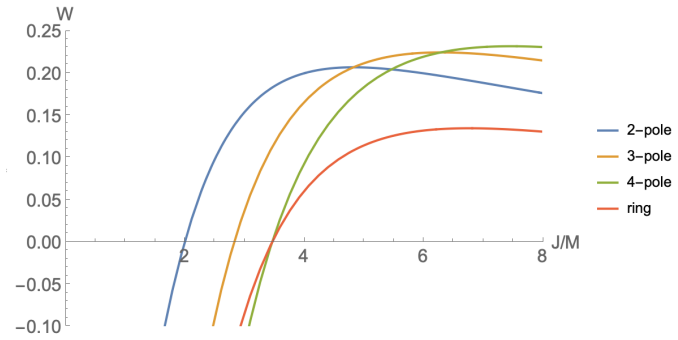
The engine of the argument is the large-D effective theory, in which a black hole is a gaussian blob of mass density m(t,x) and momentum p_i(t,x) living on a black brane and obeying simple diffusion-like equations. Within that theory, the black bar is the explicit stationary solution (2.21)-(2.22): a rigidly rotating, oblong gaussian whose longitudinal length grows as 1/$\Omega$, so longer bars rotate more slowly. Its leading instability is shown to have a growth rate matching the black-string formula W approximately (($\sqrt$(3))/4)(J/M) - 1. For the finite-D radiation estimate, the load-bearing identity is dE/dt = $\Omega$ dJ/dt, derived from a new D-dimensional quadrupole formula for angular momentum; together with the factorial suppression of the energy rate, it yields a radiative spin-down time of order D^D in units of the instability time, which is order one.
What would settle it
Run a full numerical relativity simulation of a head-on, high-spin black hole collision in D=8, and in D=6 and 7, with total J/M above the bar-instability threshold. The paper predicts the bar pinches to a naked singularity; observing instead that the bar radiates angular momentum and settles to a stable Myers-Perry black hole would falsify the central claim. More narrowly, measuring the angular-momentum radiation of a rotating black bar at D=6 and checking the new quadrupole formula (B.45) would test the key input.
Extended reading notes
Core claim
The central claim is that a collision of two spinning black holes with sufficient total angular momentum does not simply merge and settle into a stationary black hole. Instead, the merged horizon spends many rotation cycles as a nearly stationary, elongated bar, whose deformation grows at a rate that matches the Gregory-Laflamme instability of black strings. Because the bar can be arbitrarily long and the space has no compact direction to confine it, the pinch at the center is not halted, and the horizon reaches a singularity in finite time. The authors compute gravitational radiation from the bar in any D using a quadrupole formula, prove the general relation dE/dt = $\Omega$ dJ/dt, and find the spin-down time grows factorially with D while the instability time is order one; therefore, for large enough D (most likely D greater than or similar to 8), the bar fragments before radiation can save cosmic censorship. They also show that unstable ultraspinning Myers-Perry black holes generically evolve by breaking off smaller black holes, with transient black rings for axisymmetric perturbations and multi-pronged arms for higher non-axisymmetric modes.
Load-bearing premise
Everything at finite D rests on the assumption that the quadrupole radiation formula for a slowly moving, weakly gravitating ellipsoid correctly describes the spin-down of a strong-field black-hole horizon, including the relation dE/dt = $\Omega$ dJ/dt and the unspecified order-one factor c; if radiation is faster than estimated, the pinch may be quenched, especially near D=6.
Editorial extensions
If this is right
- For any D greater than or similar to 8 with enough total angular momentum, the endpoint of a two-black-hole merger is a naked singularity, so cosmic censorship fails in higher-dimensional general relativity.
- Just before the singularity, the horizon forms a Planck-scale neck; if quantum gravity evaporates it like a hot droplet, the long-term outcome is two outgoing black holes whose momenta differ from the initial ones only by Planck-suppressed uncertainties.
- Ultraspinning black holes at large D die by fragmentation: they shed excess spin by breaking off smaller black holes, rather than by radiating it away.
- The radiative relation dE/dt = Omega dJ/dt holds for rigidly rotating emitters in all dimensions, so the spin-down of any such bar is fixed once its energy radiation is known.
- The black-bar instability is quantitatively the Gregory-Laflamme instability of a black string segment, which lets one predict bar break-up times from string data.
Reading between the lines
- The paper does not commit to a precise lower critical dimension; if the order-one coefficient c in its radiation estimate is favorable, the same violation could occur down to D=6, a claim that existing finite-dimension numerical codes can test directly.
- The same bar-pinch mechanism may apply to other high-energy processes, such as black hole formation from grazing ultrarelativistic particle collisions, whenever the merged horizon is sufficiently elongated and rapidly spinning.
- The new D-dimensional angular-momentum quadrupole formula provides a benchmark: full nonlinear simulations of bar-mode instabilities at D=6 and D=7 could measure dJ/dt and compare with the formula, sharpening the estimate of the critical dimension for cosmic censorship violation.
Editorial analysis
A structured set of objections, weighed in public.
Referee Report
Summary. The manuscript uses the large-D effective theory of black holes to simulate, in 2+1 effective dimensions, collisions of spinning black holes and the non-linear evolution of ultraspinning Myers-Perry black holes. It identifies rotating black bars as long-lived intermediate states in mergers with sufficiently high angular momentum per unit mass, shows that the instability of these bars tracks the Gregory-Laflamme instability of black strings (Section 5.2), and uses this to argue for pinch-off towards a naked singularity. To connect to finite D, the authors compute the quadrupolar gravitational-radiation spin-down of a rotating bar (Section 6 and Appendix B), including a new derivation of the angular-momentum radiation formula in even D, and compare the radiative time scale with the Gregory-Laflamme instability time. They conclude that for sufficiently large D, and 'very likely for D ≳ 8', radiation is too slow to quench the instability, so cosmic censorship is violated; additional simulations show transient black rings and multi-pronged horizons in ultraspinning black hole evolutions. The paper is clearly written and the numerical evidence is presented carefully.
Significance. The large-D effective approach converts a hard time-dependent problem into tractable partial differential equations, and the paper substantially strengthens the case that higher-dimensional black hole collisions and instabilities can have cosmic-censorship-violating endpoints. The quantitative match between measured bar growth rates and the black-string formula (Figure 15), the demonstration of intermediate bar formation with excellent agreement to analytic profiles (Figure 8), and the first derivation of the quadrupolar angular-momentum emission formula in D dimensions (Appendix B.3) are valuable contributions. The work also makes falsifiable predictions for finite-D numerical relativity, in particular a critical spin above which fragmentation beats radiation and a critical dimension above which the bar instability dominates. However, the finite-D extrapolation is the weakest link; the paper itself acknowledges several hurdles, and the D ≈ 8 claim is not yet established by the presented estimates.
major comments (3)
- [Sec. 6.2–6.3, Eqs. (6.21), (6.29)] The comparison of time scales uses the linear Gregory-Laflamme growth time τ_inst, but Section 6.2 states that in black-string simulations the time to form a large pinch can be 'significantly larger than τ_inst, possibly even two orders of magnitude larger'. This matters numerically: from (6.21) and (6.29), with the common factor (8GM/Ω^{D−4})^{1/(D−3)} cancelled, τ_rad/τ_inst = D Γ((D−1)/2)^2/(2π c), which at D=8 is about 14/c. A nonlinear pinch delay of even 10 τ_inst, or c of order a few, therefore reverses the race at D=8, allowing spin-down to quench the instability. The statement in Section 3.4.1 that centrifugal repulsion 'will accelerate the pinching faster' is not quantified, and the observed faster pinch in the effective-theory simulations cannot by itself settle the finite-D competition because those simulations contain no gravitational radiation. The finite-D conclusion for D ≈ 8 should be softened to an extrapolation unless a quantitative bound on the nonlinear pinch time for black bars is provided.
- [App. B.3, Eq. (B.19), Sec. 6.3] The angular-momentum radiation rate (B.45) is derived using the retarded Green's function (B.19), which the authors state holds 'as long as D is even'. Nevertheless, the spin-down time (6.21) is used for all D ≳ 8 and in the 'possibly down to D=6' discussion, including odd D=7. No odd-D derivation or interpolation argument is given. The finite-D comparison should be explicitly restricted to even D, or an odd-D treatment should be supplied, before the D=7 statement can be made.
- [Sec. 6.1, Eq. (6.11), Sec. 6.3] The central spin-down estimate contains an undetermined O(1) coefficient c from Eq. (6.11), and Section 6.3 acknowledges that the exponent in 2^D may easily be modified. With the printed formulas, at D=8 one has τ_rad > τ_inst only for c ≲ 14, and at D=7 only for c ≲ 4.5, so the abstract's 'very likely for D ≳ 8' requires c to be near the lower end of O(1) and also requires the nonlinear pinch delay to be absent. The sentence in Section 6.3 claiming that the prefactor comparison holds 'unless c>9' appears inconsistent with the ratio following from (6.21) and (6.29) and should be rechecked. A sensitivity analysis over c and over the nonlinear-delay factor is needed; absent that, the robust statement is only 'for sufficiently large D'.
minor comments (4)
- [Fig. 6 caption] The caption says 'The dashed and continuous lines correspond to stationary MP black holes and black bars' but does not identify which line type refers to which solution; please make this explicit.
- [Fig. 8 caption] The word 'analityc' should be 'analytic'.
- [Section 6, first paragraph] The terms 'death by fragmentation' and 'death by radiation' are used without definition; please define them at first use, since they carry the interpretation of the two competing channels.
- [Appendix B.1 and B.2] The quadrupole calculation models the black bar as a rigidly rotating ellipsoid with constant mass density, but the conditions under which this weak-field, slow-motion approximation applies to a strong-field black hole horizon are never stated; a sentence making this limitation explicit would help readers calibrate the estimate.
Circularity Check
No significant circularity: the finite-D race between radiative spin-down and GL-type pinch is a genuine comparison with external benchmarks, not a quantity put in by construction.
full rationale
The central derivation chain is not circular. The collision and bar evolutions are solutions of the large-D effective equations previously derived in [2,12] by the same group, but the paper does not ask the reader to accept the CC-violation claim on the strength of that citation alone: the bar's GL-type instability is cross-checked against the known Gregory-Laflamme instability and its blackfold description [7,15], and against external finite-D numerical simulations [8,26,27]. The spin-down estimate in Sec. 6 and App. B is an actual calculation: the energy loss uses the D-dimensional quadrupole formula of [9], and the angular-momentum rate is derived from first principles in App. B.3, leading to dE/dt = Omega dJ/dt (Eq. 6.13). Applying it to black bars is an explicitly stated model (rotating ellipsoid, App. B.1), not a renamed input. The only unknown coefficient c in Eq. (6.21) is openly identified as an O(1) uncertainty, including possible corrections to the 2^D exponent, and is not fitted from the claimed outcome. The conclusion tau_inst << tau_rad for large D follows from comparing Eq. (6.21) with Eq. (6.29), two independent estimates, and the paper explicitly flags the weak links: the large-D theory cannot itself exhibit a naked pinch (Sec. 3.4.1), the nonlinear pinch time may be up to two orders of magnitude larger than tau_inst (Sec. 6.2), and the minimum dimension D~6-8 is uncertain (Secs. 6.3, 7). These are correctness limitations, not circular reductions. Self-citations to [2,12,14,15] supply the framework and benchmark formulas, but the load-bearing comparisons also involve external results, so no step reduces to its own input by construction.
Assumptions & free parameters
free parameters (1)
- c =
Undetermined order-one constant; must be small enough (roughly below 9 to 30 depending on D) for the D around 8…
assumptions (6)
- domain assumption The large-D effective equations (2.1)-(2.2) capture the dynamics of localized black holes over long times.
- domain assumption The post-merger elongated horizon behaves as a stationary black bar, so its instability rate follows from the black-string analogy (5.5).
- domain assumption The D-dimensional quadrupole formula applies to a black bar modeled as a rigidly rotating ellipsoid.
- domain assumption Black string and black bar Gregory-Laflamme instabilities end in a naked singularity rather than settling to a stable non-uniform configuration.
- domain assumption Radiative spin-down proceeds quasistatically, so the first law and dE/dt = Omega dJ/dt hold during emission.
- standard math The angular momentum radiation formula in Appendix B.3 follows from standard transverse-traceless decomposition and stress-energy conservation.
Cite this review
Pith. "Pith review of Black hole collisions, instabilities, and cosmic censorship violation at large D." pith.science (2026). https://pith.science/paper/4CYDKUEK
@misc{pith2026190803424,
  author       = {Pith},
  title        = {Pith review of: Black hole collisions, instabilities, and cosmic censorship violation at large D},
  year         = {2026},
  howpublished = {\url{https://pith.science/paper/4CYDKUEK}},
  note         = {Machine review of arXiv:1908.03424}
}
abstract
We study the evolution of black hole collisions and ultraspinning black hole instabilities in higher dimensions. These processes can be efficiently solved numerically in an effective theory in the limit of large number of dimensions D. We present evidence that they lead to violations of cosmic censorship. The post-merger evolution of the collision of two black holes with total angular momentum above a certain value is governed by the properties of a resonance-like intermediate state: a long-lived, rotating black bar, which pinches off towards a naked singularity due to an instability akin to that of black strings. We compute the radiative loss of spin for a rotating bar using the quadrupole formula at finite D, and argue that at large enough D ---very likely for $D\gtrsim 8$, but possibly down to D=6--- the spin-down is too inefficient to quench this instability. We also study the instabilities of ultraspinning black holes by solving numerically the time evolution of axisymmetric and non-axisymmetric perturbations. We demonstrate the development of transient black rings in the former case, and of multi-pronged horizons in the latter, which then proceed to pinch and, arguably, fragment into smaller black holes.
Figures


Figures from the paper (14 more)


Forward citations
Cited by 2 Pith papers
-
Cosmic censorship in a (dual) collider
In holographic models with a good-singularity ground state, a boost-invariant expanding fluid drives the dual horizon curvature to diverge in classical gravity.
-
The Fate of Instability of de Sitter Black Holes at Large $D$
At large D, RN-dS and GB-dS black holes evolve to stationary lumpy solutions on the instability threshold, and in the unstable region their mass localizes into spot-like or ring-like configurations.
Reference graph
Works this paper leans on
-
[1]
Cosmic censorship viola- tion in black hole collisions in higher dimensions,
T. Andrade, R. Emparan, D. Licht and R. Luna, “Cosmic censorship viola- tion in black hole collisions in higher dimensions,” JHEP 1904 (2019) 121 doi:10.1007/JHEP04(2019)121 [arXiv:1812.05017 [hep-th]]
arXiv 2019
-
[2]
Rotating black holes and black bars at large D,
T. Andrade, R. Emparan and D. Licht, “Rotating black holes and black bars at large D,” JHEP 1809 (2018) 107 doi:10.1007/JHEP09(2018)107 [arXiv:1807.01131 [hep-th]]
arXiv 2018
-
[3]
Gravitational collapse: The role of general relativity,
R. Penrose, “Gravitational collapse: The role of general relativity,” Riv. Nuovo Cim. 1 (1969) 252 [Gen. Rel. Grav. 34 (2002) 1141]
work page 1969
-
[4]
Black Holes in Higher Dimensional Space-Times,
R. C. Myers and M. J. Perry, “Black Holes in Higher Dimensional Space-Times,” Annals Phys. 172 (1986) 304. doi:10.1016/0003-4916(86)90186-7
-
[5]
Instability of ultra-spinning black holes,
R. Emparan and R. C. Myers, “Instability of ultra-spinning black holes,” JHEP 0309 (2003) 025 doi:10.1088/1126-6708/2003/09/025 [hep-th/0308056]
arXiv 2003
-
[6]
M. Shibata and H. Yoshino, “Bar-mode instability of rapidly spinning black hole in higher dimensions: Numerical simulation in general relativity,” Phys. Rev. D 81 (2010) 104035 doi:10.1103/PhysRevD.81.104035 [arXiv:1004.4970 [gr-qc]]
arXiv 2010
-
[7]
Black strings and p-branes are unstable,
R. Gregory and R. Laflamme, “Black strings and p-branes are unstable,” Phys. Rev. Lett. 70 (1993) 2837 doi:10.1103/PhysRevLett.70.2837 [hep-th/9301052]
arXiv 1993
-
[8]
Black Strings, Low Viscosity Fluids, and Violation of Cosmic Censorship,
L. Lehner and F. Pretorius, “Black Strings, Low Viscosity Fluids, and Violation of Cosmic Censorship,” Phys. Rev. Lett. 105 (2010) 101102 doi:10.1103/PhysRevLett.105.101102 [arXiv:1006.5960 [hep-th]]
arXiv 2010
Show all 37 references
-
[9]
Gravitational ra- diation in D-dimensional space-times,
V. Cardoso, O. J. C. Dias and J. P. S. Lemos, “Gravitational ra- diation in D-dimensional space-times,” Phys. Rev. D 67 (2003) 064026 doi:10.1103/PhysRevD.67.064026 [hep-th/0212168]
2003 arXiv
-
[10]
The End Point of Nonaxisymmetric Black Hole Instabilities in Higher Dimensions,
H. Bantilan, P. Figueras, M. Kunesch and R. Panosso Macedo, “The End Point of Nonaxisymmetric Black Hole Instabilities in Higher Dimensions,” arXiv:1906.10696 [hep-th]
1906 arXiv
-
[11]
Charged rotating black holes in higher di- mensions,
T. Andrade, R. Emparan and D. Licht, “Charged rotating black holes in higher di- mensions,” JHEP 1902 (2019) 076 doi:10.1007/JHEP02(2019)076 [arXiv:1810.06993 [hep-th]]
2019 arXiv
-
[12]
Evolution and End Point of the Black String Instability: Large D Solution,
R. Emparan, R. Suzuki and K. Tanabe, “Evolution and End Point of the Black String Instability: Large D Solution,” Phys. Rev. Lett. 115 (2015) no.9, 091102 doi:10.1103/PhysRevLett.115.091102 [arXiv:1506.06772 [hep-th]]. 40
2015 arXiv
-
[13]
Hydro- elastic Complementarity in Black Branes at large D,
R. Emparan, K. Izumi, R. Luna, R. Suzuki and K. Tanabe, “Hydro- elastic Complementarity in Black Branes at large D,” JHEP 1606 (2016) 117 doi:10.1007/JHEP06(2016)117 [arXiv:1602.05752 [hep-th]]
2016 arXiv
-
[14]
The large D limit of General Relativity,
R. Emparan, R. Suzuki and K. Tanabe, “The large D limit of General Relativity,” JHEP 1306 (2013) 009 doi:10.1007/JHEP06(2013)009 [arXiv:1302.6382 [hep-th]]
2013 arXiv
-
[15]
Black Brane Viscosity and the Gregory- Laflamme Instability,
J. Camps, R. Emparan and N. Haddad, “Black Brane Viscosity and the Gregory- Laflamme Instability,” JHEP 1005 (2010) 042 doi:10.1007/JHEP05(2010)042 [arXiv:1003.3636 [hep-th]]
2010 arXiv
-
[16]
AdS/Ricci-flat cor- respondence and the Gregory-Laflamme instability,
M. M. Caldarelli, J. Camps, B. Gout´ eraux and K. Skenderis, “AdS/Ricci-flat cor- respondence and the Gregory-Laflamme instability,” Phys. Rev. D 87 (2013) no.6, 061502 doi:10.1103/PhysRevD.87.061502 [arXiv:1211.2815 [hep-th]]
2013 arXiv
-
[17]
The holographic dual of a Rie- mann problem in a large number of dimensions,
C. P. Herzog, M. Spillane and A. Yarom, “The holographic dual of a Rie- mann problem in a large number of dimensions,” JHEP 1608 (2016) 120 doi:10.1007/JHEP08(2016)120 [arXiv:1605.01404 [hep-th]]
2016 arXiv
-
[18]
The large D black hole Membrane Paradigm at first subleading order,
Y. Dandekar, A. De, S. Mazumdar, S. Minwalla and A. Saha, “The large D black hole Membrane Paradigm at first subleading order,” JHEP 1612 (2016) 113 doi:10.1007/JHEP12(2016)113 [arXiv:1607.06475 [hep-th]]
2016 arXiv
-
[19]
Currents and Radiation from the large D Black Hole Membrane,
S. Bhattacharyya, A. K. Mandal, M. Mandlik, U. Mehta, S. Minwalla, U. Sharma and S. Thakur, “Currents and Radiation from the large D Black Hole Membrane,” JHEP 1705 (2017) 098 doi:10.1007/JHEP05(2017)098 [arXiv:1611.09310 [hep-th]]
2017 arXiv
-
[20]
Instability and new phases of higher-dimensional rotating black holes,
O. J. C. Dias, P. Figueras, R. Monteiro, J. E. Santos and R. Emparan, “Instability and new phases of higher-dimensional rotating black holes,” Phys. Rev. D 80 (2009) 111701 doi:10.1103/PhysRevD.80.111701 [arXiv:0907.2248 [hep-th]]
2009 arXiv
-
[21]
Stationary black holes: Large D analysis,
R. Suzuki and K. Tanabe, “Stationary black holes: Large D analysis,” JHEP 1509 (2015) 193 doi:10.1007/JHEP09(2015)193 [arXiv:1505.01282 [hep-th]]
2015 arXiv
-
[22]
Rings, Ripples, and Rotation: Connecting Black Holes to Black Rings,
´O. J. C. Dias, J. E. Santos and B. Way, “Rings, Ripples, and Rotation: Connecting Black Holes to Black Rings,” JHEP 1407 (2014) 045 doi:10.1007/JHEP07(2014)045 [arXiv:1402.6345 [hep-th]]
2014 arXiv
-
[23]
Bumpy black holes,
R. Emparan, P. Figueras and M. Martinez, “Bumpy black holes,” JHEP 1412 (2014) 072 doi:10.1007/JHEP12(2014)072 [arXiv:1410.4764 [hep-th]]
2014 arXiv
-
[24]
Topology-changing horizons at large D as Ricci flows,
R. Emparan and R. Suzuki, “Topology-changing horizons at large D as Ricci flows,” JHEP 1907 (2019) 094 doi:10.1007/JHEP07(2019)094 [arXiv:1905.01062 [hep-th]]
2019 arXiv
-
[25]
Horizon formation and far-from-equilibrium isotropization in supersymmetric Yang-Mills plasma,
P. M. Chesler and L. G. Yaffe, “Horizon formation and far-from-equilibrium isotropization in supersymmetric Yang-Mills plasma,” Phys. Rev. Lett. 102 (2009) 211601 doi:10.1103/PhysRevLett.102.211601 [arXiv:0812.2053 [hep-th]]. 41
2009 arXiv
-
[26]
End Point of the Ultraspinning Instability and Violation of Cosmic Censorship,
P. Figueras, M. Kunesch, L. Lehner and S. Tunyasuvunakool, “End Point of the Ultraspinning Instability and Violation of Cosmic Censorship,” Phys. Rev. Lett. 118 (2017) no.15, 151103 doi:10.1103/PhysRevLett.118.151103 [arXiv:1702.01755 [hep- th]]
2017 arXiv
-
[27]
End Point of Black Ring Insta- bilities and the Weak Cosmic Censorship Conjecture,
P. Figueras, M. Kunesch and S. Tunyasuvunakool, “End Point of Black Ring Insta- bilities and the Weak Cosmic Censorship Conjecture,” Phys. Rev. Lett. 116 (2016) no.7, 071102 doi:10.1103/PhysRevLett.116.071102 [arXiv:1512.04532 [hep-th]]
2016 arXiv
-
[28]
A Critical dimension in the black string phase transition,
E. Sorkin, “A Critical dimension in the black string phase transition,” Phys. Rev. Lett. 93 (2004) 031601 doi:10.1103/PhysRevLett.93.031601 [hep-th/0402216]
2004 arXiv
-
[29]
Phases and Stability of Non-Uniform Black Strings,
R. Emparan, R. Luna, M. Mart´ ınez, R. Suzuki and K. Tanabe, “Phases and Stability of Non-Uniform Black Strings,” JHEP 1805 (2018) 104 doi:10.1007/JHEP05(2018)104 [arXiv:1802.08191 [hep-th]]
2018 arXiv
-
[30]
Black hole formation in the grazing collision of high- energy particles,
H. Yoshino and Y. Nambu, “Black hole formation in the grazing collision of high- energy particles,” Phys. Rev. D 67 (2003) 024009 doi:10.1103/PhysRevD.67.024009 [gr-qc/0209003]
2003 arXiv
-
[31]
Improved analysis of black hole formation in high- energy particle collisions,
H. Yoshino and V. S. Rychkov, “Improved analysis of black hole formation in high- energy particle collisions,” Phys. Rev. D 71 (2005) 104028 Erratum: [Phys. Rev. D 77 (2008) 089905] doi:10.1103/PhysRevD.71.104028, 10.1103/PhysRevD.77.089905 [hep-th/0503171]
2005 arXiv
-
[32]
High-velocity collision of two black holes,
M. Shibata, H. Okawa and T. Yamamoto, “High-velocity collision of two black holes,” Phys. Rev. D 78 (2008) 101501 doi:10.1103/PhysRevD.78.101501 [arXiv:0810.4735 [gr-qc]]
2008 arXiv
-
[33]
The High-energy collision of two black holes,
U. Sperhake, V. Cardoso, F. Pretorius, E. Berti and J. A. Gonzalez, “The High-energy collision of two black holes,” Phys. Rev. Lett. 101 (2008) 161101 doi:10.1103/PhysRevLett.101.161101 [arXiv:0806.1738 [gr-qc]]
2008 arXiv
-
[34]
Radiation from a D-dimensional collision of shock waves: a remarkably simple fit formula,
F. S. Coelho, C. Herdeiro and M. O. P. Sampaio, “Radiation from a D-dimensional collision of shock waves: a remarkably simple fit formula,” Phys. Rev. Lett. 108 (2012) 181102 doi:10.1103/PhysRevLett.108.181102 [arXiv:1203.5355 [hep-th]]
2012 arXiv
-
[35]
Ultrarelativistic black hole formation,
W. E. East and F. Pretorius, “Ultrarelativistic black hole formation,” Phys. Rev. Lett. 110 (2013) no.10, 101101 doi:10.1103/PhysRevLett.110.101101 [arXiv:1210.0443 [gr- qc]]
2013 arXiv
-
[36]
Julia - A Fresh Approach to Numerical Computing,
J. Bezanson, A. Edelman, S. Karpinski, and V. B. Shah, “Julia - A Fresh Approach to Numerical Computing,” SIAM review 59, 65 (2017). https://docs.julialang.org/ 42
2017
-
[37]
DifferentialEquations.jl - A Performant and Feature- Rich Ecosystem for Solving Differential Equations in Julia,
C. Rackauckas and Q. Nie, “DifferentialEquations.jl - A Performant and Feature- Rich Ecosystem for Solving Differential Equations in Julia,” JORS 5(1), 15 (2017), doi:10.5334/jors.151 43
2017 doi
Reviewed August 14, 2026 · model on record in the stance chip above.
Discussion (0). Continue with ORCID to comment.