REVIEW 2 major objections 4 minor 50 references
Compton-like scattering of a scalar particle with N photons and one graviton
T0 review · 2 major / 4 minor · reviewed 2026-08-14 · deepseek-v4-flash
Pith's one-line read One master formula computes tree amplitudes for a scalar coupled to N photons and one graviton.
desk verdict A compact all-N tree-level master formula for scalar QED plus one graviton, with honest low-N checks; the main residual risk is the coincidence-limit regularization in Section 3.1, which I judge manageable but worth an independent Feynman cross-check. read the letter →
The pith
A machine-rendered reading of the paper's core claim, the machinery that carries it, and where it could break.
The reading
What carries the argument
The machinery is the worldline path-integral representation of the dressed scalar propagator, in which external fields appear as vertex operators integrated along the particle's line. Three pieces carry the argument: the graviton-polarization parametrization $\epsilon_{\mu\nu}=\lambda_\mu\rho_\nu$, $\varepsilon_0=\lambda+\rho$, which makes the graviton vertex photon-like; the master formula Eq. (20), whose delta-function terms encode seagull and quartic vertices; and the replacement rule Eq. (34)-(35), which maps the photon-graviton vertex to the vector $\upsilon^\mu_l$ and shifts $k_l\to k_l+k_0$. The transversality proof depends on two facts: the effective vector vanishes when a photon polarization is replaced by its momentum, and the diffeomorphism variation of $\upsilon_l$ splits into a term that cancels the irreducible contribution plus a term that dies by photon transversality.
What would settle it
Evaluate Eq. (37) at $N=3$ with explicit on-shell momenta and polarizations, contract the graviton leg with $k_0\xi$, and simplify; the claim predicts the result is zero. Computing the same amplitude directly from the perturbative expansion of scalar QED coupled to linearized gravity at the same kinematic point gives an independent number, and any nonzero contraction or mismatch with the formula would falsify the arbitrary-$N$ claim.
Extended reading notes
Core claim
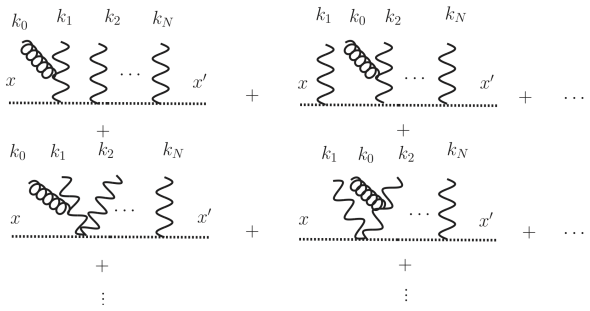
The central claim is Eq. (37): for arbitrary $N$, the full two-scalar $N$-photon one-graviton amplitude equals the irreducible worldline amplitude plus a sum of $N$-photon amplitudes in which one line is replaced by the effective polarization vector $\upsilon_l$ at shifted momentum $k_l+k_0$. The irreducible part is generated by a graviton vertex operator that, after the parametrization $\epsilon_{\mu\nu}=\lambda_\mu\rho_\nu$ with $\varepsilon_{0\mu}=\lambda_\mu+\rho_\mu$, takes exactly the form of a photon vertex operator; auxiliary ghost fields cancel the singular coincidence limit of the velocity correlator, leaving $\langle \dot q^\mu(\tau_0)\dot q^\nu(\tau_0)\rangle=-2\delta^{\mu\nu}/T$. The reducible part is not obtained by sewing diagrams but by a replacement rule acting on the known $N$-photon amplitude. On-shell, the construction yields transversality $M^{(N,1)}(\ldots;k_0\xi,k_0)=0$ on the graviton leg and the analogous condition on every photon leg.
Load-bearing premise
The construction assumes that the singular self-correlation of the particle's velocity at the graviton insertion point is cancelled exactly by the auxiliary ghost fields, leaving the finite replacement $\langle \dot q^\mu(\tau_0)\dot q^\nu(\tau_0)\rangle=-2\delta^{\mu\nu}/T$; if another valid regularization shifts that finite remainder, the master formula and the transversality results no longer follow.
Editorial extensions
If this is right
- With Eq. (37), the full amplitude for any $N$ is available without enumerating the separate seagull, quartic, and single-emission diagrams: compute the irreducible worldline correlator and apply the replacement rule to the known $N$-photon formula.
- Photon transversality holds separately for the irreducible and reducible sectors, so each part can be checked independently before they are summed.
- The graviton transversality condition requires a precise cancellation between the reducible and irreducible parts; the paper displays this cancellation explicitly for $N=0,1,2$ and asserts it for arbitrary $N$.
- For $N=1$ the formula reproduces the previously known factorization of gravitational photoproduction, where the mixed amplitude reduces to the scalar QED photon-photon amplitude times a simple spin-independent factor.
- Because the underlying worldline expressions hold off-shell, the master formula can be applied before scalar on-shell conditions are imposed, which makes it a candidate input for off-shell or recursion-based amplitude constructions.
Reading between the lines
- The replacement rule looks naturally iterative: applying it to two different photon lines in a pure $N$-photon amplitude would build the two-graviton reducible sector, although the paper notes that chains of ghost contractions need extra care before that step is rigorous.
- The photon-like form of the graviton vertex suggests that soft-graviton limits might be re-expressed as double-soft photon limits inside the worldline correlator; the paper lists soft-graviton theorems as a future direction without developing that identification.
- The explicit cancellations in the appendix are shown for $N\le 2$, so a symbolic check at $N=3$ would give a concrete stress test of the arbitrary-$N$ transversality statement without requiring new ideas.
- If a different regularization of the curved-space path integral shifted the finite remainder of the velocity self-correlation, the master formula would need scheme-dependent counterterms; comparing Eq. (37) with direct perturbative evaluation at one fixed $N$ would pin down the convention.
Editorial analysis
A structured set of objections, weighed in public.
Referee Report
Summary. The paper computes tree-level scattering amplitudes for a massive scalar coupled to an arbitrary number N of photons and a single graviton, using the worldline formalism. The main result is Eq. (37): the full amplitude is written as the sum of an irreducible worldline contribution (Eq. (20)) and a reducible part constructed by a new 'tree replacement' rule (Eq. (36)), in which one photon polarization/momentum is replaced by the graviton-emission vertex. The authors verify the construction by checking on-shell transversality of the photon legs and of the graviton leg, giving explicit results for N=0,1,2 in the main text and appendices, and a general argument for arbitrary N.
Significance. If correct, the paper provides a compact all-N master formula for a mixed QED-gravity tree amplitude and a replacement rule that generalizes Bern-Kosower-type constructions to graviton emission from photon lines. The explicit N=0,1,2 amplitudes, the recovery of the known photoproduction factorization for N=1, and the detailed Ward-identity checks in Appendices A and B are concrete and useful. The derivation introduces no free parameters and is self-contained except for the regularization assumption discussed below. The worldline approach here is a reasonable and novel route to these amplitudes, and the paper is a solid contribution to the literature.
major comments (2)
- [Section 3.1, Eq. (19)] The central step is the replacement of the curved-space graviton vertex (13) by the photon-like vertex (19), which relies on the assertion that after ghost cancellation one may set ⟨qdot^μ(τ0) qdot^ν(τ0)⟩ = -2/T δ^{μν}. This coincidence-limit prescription is stated without derivation, and it is load-bearing: Eqs. (20), (37), and the graviton transversality argument in Section 4 all depend on it. Since the paper checks amplitudes computed with this prescription against Ward identities that assume the same prescription, the N≤2 checks do not independently validate the regularization. Please provide a derivation or a precise citation showing that this replacement is exact in the presence of the photon insertions, and discuss whether point-splitting or worldline dimensional regularization could generate additional finite contact terms.
- [Section 4, Eq. (54)] The all-N proof of the graviton Ward identity (53) is only sketched: after the shift ϵ→k0ξ, the transformed υ_i is claimed to consist of -tilde ε_i plus a term proportional to (k0+k_i)^μ that drops out by photon transversality, leaving a cancellation with the right-hand side of Eq. (36). This is plausible, but for N>2 the cancellations are not shown explicitly, and the appendix only treats N≤2. Please expand the argument to a full proof for arbitrary N, or provide an explicit check for N=3, so that the 'arbitrary N' claim is fully supported.
minor comments (4)
- [Appendix B, below Eq. (64)] The phrase 'vanishes on-sell' should read 'vanishes on-shell'.
- [Acknowledgments] The word 'Ackowledgments' is misspelled; it should be 'Acknowledgments'.
- [Eq. (20)] The notation 'with ¨Δ_{0−0′}=0' is unclear; please specify the convention used for the second derivative of the worldline Green function at coincident points, and how the δ-function contact terms are defined in the master formula.
- [References] Reference [35] is listed as 'in preparation'; if it remains unpublished, consider citing a more permanent source or removing the reference.
Circularity Check
No significant circularity: Eq. (37) is assembled from independent worldline and field-theory inputs, and the Ward-identity checks are consistency tests rather than fitted predictions.
full rationale
The derivation chain is self-contained and non-circular. The pure N-photon master formula (Eq. (8)/(10)) is taken from earlier independent work (Daikouji et al. and Ahmadiniaz-Bashir-Schubert), and the curved-space worldline measure with Lee-Yang ghosts (Eqs. (11)-(15)) is imported from published work by Bastianelli, Corradini and van Nieuwenhuizen. Section 3.1 reduces the graviton vertex to photon-like form (Eq. (19)) by an explicit regularization statement: the ghost correlators are asserted to cancel the singular part of <qdot^mu qdot^nu>, leaving <qdot^mu qdot^nu> = -2/T delta^{munu}. Whether that coincidence-limit prescription is correct is a substantive physics assumption and a correctness risk, but it is an input to the computation, not the target result; Eqs. (19)-(20) follow algebraically from that stated assumption rather than presupposing the final amplitude. The reducible part is derived from the standard two-photon-one-graviton vertex (Eqs. (28)-(29)) combined with the Feynman-gauge photon propagator replacement (Eq. (31)), not chosen to enforce the Ward identity. Equation (37) is therefore a constructed formula, and the transversality checks in Section 4 and Appendix B evaluate that formula under k0 -> k0 xi. No parameter is fitted to those identities, and no cited result is used to forbid alternative constructions. Self-citations appear in background material and in the closed-loop analogue of Eq. (51), but the open-line identity is derived in the text and that citation is not load-bearing. Consequently there is no circular step.
Assumptions & free parameters
assumptions (5)
- domain assumption The worldline path integral with Lee-Yang ghosts, Eq. (11), correctly represents the scalar propagator in a curved spacetime background.
- domain assumption Coincidence-limit prescription <qdot^mu(tau0) qdot^nu(tau0)> = -2/T delta^munu, with ghost contributions cancelling, gives the correct effective graviton vertex operator.
- domain assumption On-shell graviton polarization is transverse and traceless, with k0 . xi = 0 and k0^2 = 0 as used in Eq. (52).
- domain assumption Reducible diagrams are obtained by inserting the two-photon-one-graviton vertex, Eq. (29), into a photon line and sewing with the Feynman-gauge photon propagator, Eq. (31).
- domain assumption The N-photon two-scalar amplitude D^(N) satisfies on-shell photon transversality in every external photon leg.
Cite this review
Pith. "Pith review of Compton-like scattering of a scalar particle with N photons and one graviton." pith.science (2026). https://pith.science/paper/GPN2BFX3
@misc{pith2026190803425,
  author       = {Pith},
  title        = {Pith review of: Compton-like scattering of a scalar particle with N photons and one graviton},
  year         = {2026},
  howpublished = {\url{https://pith.science/paper/GPN2BFX3}},
  note         = {Machine review of arXiv:1908.03425}
}
read the original abstract
Tree-level scattering amplitudes for a scalar particle coupled to an arbitrary number N of photons and a single graviton are computed. We employ the worldline formalism as the main tool to compute the irreducible part of the amplitude, where all the photons and the graviton are directly attached to the scalar line, then derive a tree replacement rule to construct the reducible parts of the amplitude which involve irreducible pure N-photon two-scalar amplitudes where one photon line emits the graviton. We test our construction by verifying the on-shell gauge and diffeomorphism Ward identities, at arbitrary N.
Figures


Reference graph
Works this paper leans on
-
[1]
Scattering Amplitudes in Gauge Theory and Gravity,
H. Elvang and Y. t. Huang, “Scattering Amplitudes in Gauge Theory and Gravity,” Cam- bridge University Press (2015)
work page 2015
-
[2]
An Operator calculus having applications in quantum electrodynamics,
R. P. Feynman, “An Operator calculus having applications in quantum electrodynamics,” Phys. Rev. 84 (1951) 108
work page 1951
-
[3]
Efficient calculation of one loop QCD amplitudes,
Z. Bern and D. A. Kosower, “Efficient calculation of one loop QCD amplitudes,” Phys. Rev. Lett. 66 (1991) 1669
work page 1991
-
[4]
The computation of loop amplitudes in gauge theories,
Z. Bern and D. A. Kosower, “The computation of loop amplitudes in gauge theories,” Nucl. Phys. B 379 (1992) 451
work page 1992
-
[5]
String-based methods in perturbative gravity
Z. Bern, D. C. Dunbar and T. Shimada, “String-based methods in perturbative gravity”, Phys. Lett. B 312, 277 (1993) [hep-th/9307001]
arXiv 1993
-
[6]
Field theory without Feynman diagrams: one loop effective actions,
M. J. Strassler, “Field theory without Feynman diagrams: one loop effective actions,” Nucl. Phys. B385 (1992) 145 [hep-ph/9205205]
arXiv 1992
-
[7]
Perturbative quantum field theory in the string inspired formalism,
C. Schubert, “Perturbative quantum field theory in the string inspired formalism,” Phys. Rept. 355 (2001) 73 [hep-th/0101036]
arXiv 2001
-
[8]
Worldline Green Functions for Multiloop Diagrams
M. G. Schmidt and C. Schubert, “Worldline Green Functions for Multiloop Diagrams”, Phys. Lett. B331 69 (1994) [hep-th/9403158]
work page Pith review arXiv 1994
Show all 50 references
-
[9]
Multiloop calculations in the string inspired formalism: The Single spinor loop in QED,
M. G. Schmidt and C. Schubert, “Multiloop calculations in the string inspired formalism: The Single spinor loop in QED,” Phys. Rev. D53 (1996) 2150 [hep-th/9410100]
1996 arXiv
-
[10]
Photon splitting in a strong magnetic field: Recalculation and comparison with previous calculations
S.L. Adler and C. Schubert, “Photon splitting in a strong magnetic field: Recalculation and comparison with previous calculations”, Phys. Rev. Lett.77 (1996) 1695 [hep-th/9605035]. 18
1996 arXiv
-
[11]
Constant external fields in gauge theory and the spin 0, 1/2, 1 path integrals,
M. Reuter, M. G. Schmidt and C. Schubert, “Constant external fields in gauge theory and the spin 0, 1/2, 1 path integrals,” Annals Phys.259 (1997) 313 [hep-th/9610191]
1997 arXiv
-
[12]
Quantum effective actions from nonper- turbative worldline dynamics,
H. Gies, J. Sanchez-Guillen and R. A. Vazquez, “Quantum effective actions from nonper- turbative worldline dynamics,” JHEP0508 (2005) 067 [hep-th/0505275]
2005 arXiv
-
[13]
Worldline instantons and pair production in inhomoge- neous fields,
G. V. Dunne and C. Schubert, “Worldline instantons and pair production in inhomoge- neous fields,” Phys. Rev. D72 (2005) 105004 [hep-th/0507174]
2005 arXiv
-
[14]
Worldline formalism in a gravitational background,
F. Bastianelli and A. Zirotti, “Worldline formalism in a gravitational background,” Nucl. Phys. B 642 (2002) 372 [hep-th/0205182]
2002 arXiv
-
[15]
One-loop quantum gravity from a worldline viewpoint,
F. Bastianelli and R. Bonezzi, “One-loop quantum gravity from a worldline viewpoint,” JHEP 1307 (2013) 016 [arXiv:1304.7135 [hep-th]]
2013 arXiv
-
[16]
One-loop quantum gravity from the N = 4 spinning particle,
F. Bastianelli, R. Bonezzi, O. Corradini and E. Latini, “One-loop quantum gravity from the N = 4 spinning particle,” JHEP1911 (2019) 124 doi:10.1007/JHEP11(2019)124 [arXiv:1909.05750 [hep-th]]
2019 arXiv
-
[17]
One loop photon-graviton mixing in an electromagnetic field: Part 1,
F. Bastianelli and C. Schubert, “One loop photon-graviton mixing in an electromagnetic field: Part 1,” JHEP0502 (2005) 069 [gr-qc/0412095]
2005 arXiv
-
[18]
Casimir effect on the worldline,
H. Gies, K. Langfeld and L. Moyaerts, “Casimir effect on the worldline,” JHEP0306 (2003) 018 [hep-th/0303264]
2003 arXiv
-
[19]
Higherspinfieldsfromaworldlineperspective,
F.Bastianelli, O.CorradiniandE.Latini, “Higherspinfieldsfromaworldlineperspective,” JHEP 0702 (2007) 072 [hep-th/0701055]
2007 arXiv
-
[20]
Effective action for higher spin fields on (A)dS backgrounds,
F. Bastianelli, R. Bonezzi, O. Corradini and E. Latini, “Effective action for higher spin fields on (A)dS backgrounds,” JHEP1212 (2012) 113 [arXiv:1210.4649 [hep-th]]
2012 arXiv
-
[21]
Worldline approach to quantum field theories on flat manifolds with boundaries,
F. Bastianelli, O. Corradini and P. A. G. Pisani, “Worldline approach to quantum field theories on flat manifolds with boundaries,” JHEP0702 (2007) 059 [hep-th/0612236]
2007 arXiv
-
[22]
Worldline formalism for a confined scalar field,
O. Corradini, J. P. Edwards, I. Huet, L. Manzo and P. Pisani, “Worldline formalism for a confined scalar field,” JHEP1908 (2019) 037 [arXiv:1905.00945 [hep-th]]
2019 arXiv
-
[23]
Worldline approach to noncommutative field theory,
R. Bonezzi, O. Corradini, S. A. Franchino Vinas and P. A. G. Pisani, “Worldline approach to noncommutative field theory,” J. Phys. A45 (2012) 405401 [arXiv:1204.1013 [hep-th]]
2012 arXiv
-
[24]
A covariant representation of the Ball-Chiu vertex,
N. Ahmadiniaz and C. Schubert, “A covariant representation of the Ball-Chiu vertex,” Nucl. Phys. B869 (2013) 417 [arXiv:1210.2331[hep-ph]]
2013 arXiv
-
[25]
QCD gluon vertices from the string-inspired formalism
N. Ahmadiniaz and C. Schubert, “ QCD gluon vertices from the string-inspired formalism" Int. J. Mod. Phys. E25 (2016) 1642004 [arXiv:1811.10780[hep-th]]
2016 arXiv
-
[26]
Bern-Kosower rule for scalar QED,
K. Daikouji, M. Shino and Y. Sumino, “Bern-Kosower rule for scalar QED,” Phys. Rev. D 53 (1996) 4598 [hep-ph/9508377]
1996 arXiv
-
[27]
Multiphoton amplitudes and generalized Landau-Khalatnikov-Fradkin transformation in scalar QED
N. Ahmadiniaz, A. Bashir and C. Schubert, “Multiphoton amplitudes and generalized Landau-Khalatnikov-Fradkin transformation in scalar QED”, Phys. Rev. D93 (2016) 045023 [arXiv:1511.05087 [hep-ph]]. 19
2016 arXiv
-
[28]
Master formu- las for the dressed scalar propagator in a constant field,
A. Ahmad, N. Ahmadiniaz, O. Corradini, S. P. Kim and C. Schubert, “Master formu- las for the dressed scalar propagator in a constant field,” Nucl. Phys. B919 (2017) 9 [arXiv:1612.02944 [hep-ph]]
2017 arXiv
-
[29]
Dressed scalar propagator in a non- Abelian background from the worldline formalism,
N. Ahmadiniaz, F. Bastianelli and O. Corradini, “Dressed scalar propagator in a non- Abelian background from the worldline formalism,” Phys. Rev. D93 (2016) no.2, 025035 Addendum: [Phys. Rev. D93 (2016) no.4, 049904] [arXiv:1508.05144 [hep-th]]
2016 arXiv
-
[30]
Classical And Quantum Dynamics Of Particles With Arbitrary Spin,
V. D. Gershun and V. I. Tkach, “Classical And Quantum Dynamics Of Particles With Arbitrary Spin,” JETP Lett.29 (1979) 288 [Pisma Zh. Eksp. Teor. Fiz.29 (1979) 320]
1979
-
[31]
Einstein gravity from theN = 4 spinning particle,
R. Bonezzi, A. Meyer and I. Sachs, “Einstein gravity from theN = 4 spinning particle,” JHEP 1810 (2018) 025 doi:10.1007/JHEP10(2018)025 [arXiv:1807.07989 [hep-th]]
2018 arXiv
-
[32]
Particle spin dynamics as the Grassmann variant of classical mechanics
F. A. Berezin and M. S. Marinov, “Particle spin dynamics as the Grassmann variant of classical mechanics”, Ann. Phys. (N.Y)104 (1977) 336
1977
-
[33]
Path integral representation for the relativistic particle propagators and BFV quantization,
E. S. Fradkin and D. M. Gitman, “Path integral representation for the relativistic particle propagators and BFV quantization,” Phys. Rev. D44 (1991) 3230
1991
-
[34]
One-particle reducible contribution to the one-loop spinor propagator in a constant field,
N. Ahmadiniaz, F. Bastianelli, O. Corradini, J. P. Edwards and C. Schubert, “One-particle reducible contribution to the one-loop spinor propagator in a constant field,” Nucl. Phys. B 924 (2017) 377 [arXiv:1704.05040 [hep-th]]
2017 arXiv
-
[35]
Ahmadiniaz, V
N. Ahmadiniaz, V. M. Banda, F. Bastianelli, O. Corradini, J. P. Edwards and C. Schubert, in preparation
-
[36]
Angular zeros of Brown, Mikaelian, Sahdev, and Samuel and the factorization of tree amplitudes in gauge theories,
C. J. Goebel and F. Halzen and J. P. Leveille, “Angular zeros of Brown, Mikaelian, Sahdev, and Samuel and the factorization of tree amplitudes in gauge theories,” Phys. Rev. D23 (1981) no. 11, 2682
1981
-
[37]
Factorizationandpolarizationinlinearizedgravity,
S.Y.Choi, J.S.ShimandH.S.Song, “Factorizationandpolarizationinlinearizedgravity,” Phys. Rev. D51 (1995) 2751 [hep-th/9411092]
1995 arXiv
-
[38]
Factorization in graviton scattering and the ’natural’ value of the g factor,
B. R. Holstein, “Factorization in graviton scattering and the ’natural’ value of the g factor,” Phys. Rev. D74 (2006) 085002
2006
-
[39]
On the low-energy limit of one-loop photon-graviton amplitudes,
F. Bastianelli, O. Corradini, J. M. Dávila and C. Schubert, “On the low-energy limit of one-loop photon-graviton amplitudes,” Phys. Lett. B716 (2012) 345 [arXiv:1202.4502 [hep-th]]
2012 arXiv
-
[40]
Graviton-Photon Scattering,
N. E. J. Bjerrum-Bohr, B. R. Holstein, L. PlantÃľ and P. Vanhove, “Graviton-Photon Scattering,” Phys. Rev. D91 (2015) no.6, 064008 [arXiv:1410.4148 [gr-qc]]
2015 arXiv
-
[41]
GravitationalComptonScat- tering from the Worldline Formalism,
N.Ahmadiniaz, O.Corradini, J.M.DávilaandC.Schubert, “GravitationalComptonScat- tering from the Worldline Formalism,” Int. J. Mod. Phys. Conf. Ser.43 (2016) 1660201
2016
-
[42]
Path integrals and anomalies in curved space,
F. Bastianelli and P. van Nieuwenhuizen, “Path integrals and anomalies in curved space,” Cambridge University Press, Cambridge, U.K. (2006)
2006
-
[43]
Worldgraph Approach to Yang-Mills Amplitudes from N=2 Spinning Particle,
P. Dai, Y. t. Huang and W. Siegel, “Worldgraph Approach to Yang-Mills Amplitudes from N=2 Spinning Particle,” JHEP0810 (2008) 027 [arXiv:0807.0391 [hep-th]]. 20
2008 arXiv
-
[44]
Wordline Computation of Tree-level QED and QCD Amplitudes and Transversality,
F. M. Balli, “Wordline Computation of Tree-level QED and QCD Amplitudes and Transversality,” unpublished M.Sc. thesis
-
[45]
Dimensional regularization of nonlinear sigma models on a finite time interval,
F. Bastianelli, O. Corradini and P. van Nieuwenhuizen, “Dimensional regularization of nonlinear sigma models on a finite time interval,” Phys. Lett. B494 (2000) 161 [hep- th/0008045]
2000
-
[46]
The Path integral for a particle in curved spaces and Weyl anomalies,
F. Bastianelli, “The Path integral for a particle in curved spaces and Weyl anomalies,” Nucl. Phys. B376 (1992) 113 doi:10.1016/0550-3213(92)90070-R [hep-th/9112035]
1992 arXiv
-
[47]
Trace anomalies from quantum mechanics,
F. Bastianelli and P. van Nieuwenhuizen, “Trace anomalies from quantum mechanics,” Nucl. Phys. B389 (1993) 53 doi:10.1016/0550-3213(93)90285-W [hep-th/9208059]
1993 arXiv
-
[48]
Photons and Gravitons in S - Matrix Theory: Derivation of Charge Conser- vation and Equality of Gravitational and Inertial Mass,
S. Weinberg, “Photons and Gravitons in S - Matrix Theory: Derivation of Charge Conser- vation and Equality of Gravitational and Inertial Mass,” Phys. Rev.135 (1964) B1049
1964
-
[49]
Evidence for a New Soft Graviton Theorem,
F. Cachazo and A. Strominger, “Evidence for a New Soft Graviton Theorem,” arXiv:1404.4091 [hep-th]
-
[50]
Lectures on the Infrared Structure of Gravity and Gauge Theory,
A. Strominger, “Lectures on the Infrared Structure of Gravity and Gauge Theory,” arXiv:1703.05448 [hep-th]. 21
Reviewed August 14, 2026 · model on record in the stance chip above.
Discussion (0). Continue with ORCID to comment.