REVIEW 1 major objections 6 minor 28 references
First direct detection constraint on mirror dark matter kinetic mixing using LUX 2013 data
T0 review · 1 major / 6 minor · reviewed 2026-08-14 · deepseek-v4-flash
Pith's one-line read The first dedicated direct-detection search for mirror dark matter finds no signal and sets the strongest limit yet on the kinetic-mixing coupling, excluding mirror electron temperatures above 0.3 keV at 90% confidence.
desk verdict First direct-detection limit on mirror dark matter from LUX; the statistical analysis is solid but the headline T>0.3 keV exclusion leans on unvalidated Earth-shielding inputs. read the letter →
The pith
A machine-rendered reading of the paper's core claim, the machinery that carries it, and where it could break.
The reading
What carries the argument
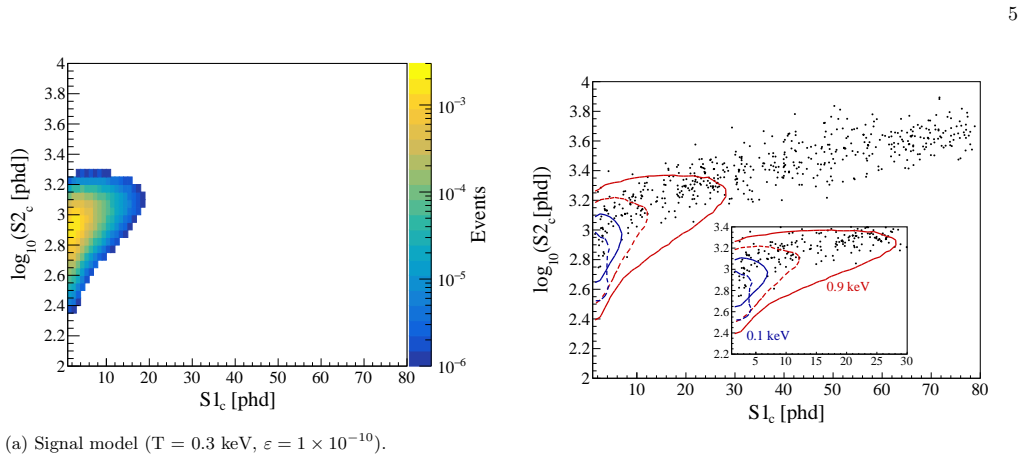
The central object is the differential electron-recoil rate dR/dE_R for mirror electrons scattering off atomic xenon electrons, built on the Coulomb-like cross-section dσ/dE_R = 2π $ε^{2}$ $α^{2}$ / (m_e $E_R^{2}$ $v^{2}$). The paper's main modeling contribution is the shielded velocity distribution: a Gaussian halo distribution clipped to velocities above a cutoff set by the column density of captured mirror helium nuclei, integrated over arrival directions to give the modified velocity parameter v_0^c(E_R). That function, together with the effective number of free electrons per xenon atom, converts a kinetic-mixing parameter into a predicted S1c/S2c distribution, which is compared with the data through a profile-likelihood test.
What would settle it
Recompute the 90% confidence limit with the captured mirror-helium density set to zero (no shielding): if the exclusion of T > 0.3 keV survives, the result does not depend on the shielding model; if it disappears, the central claim rests on unvalidated Earth-capture inputs and would need a dedicated measurement of the captured halo density.
Extended reading notes
Core claim
The paper's central claim is that the LUX 2013 electron-recoil data are consistent with background alone, so mirror dark matter, if it exists, must have a kinetic-mixing parameter ε below the 90% confidence limit shown for each local mirror electron temperature between 0.1 and 0.9 keV. In particular, the limit is about three orders of magnitude below the existing orthopositronium bound near the theoretically expected temperature of 0.3 keV, and the region T > 0.3 keV is excluded at 90% confidence. The analysis improves on previous constraints not only by using a large exposure, but by including, for the first time for xenon, the shielding of the incoming mirror-electron flux by mirror dark matter captured around the Earth, along with annual and diurnal modulation and atomic-shell effects.
Load-bearing premise
The limit depends on the adopted model of mirror matter captured around the Earth: the calculation assumes specific values for the amount of mirror helium captured near Earth and how it screens incoming mirror electrons, and it neglects deflection by the dark ionosphere; if those assumptions are wrong, the quoted limit on the mixing parameter shifts.
Editorial extensions
If this is right
- Mirror dark matter with a local mirror electron temperature above 0.3 keV is excluded at 90% confidence by LUX 2013 data alone, regardless of the exact kinetic-mixing parameter within the model.
- For temperatures between 0.1 and 0.9 keV, the allowed kinetic-mixing parameter is reduced by orders of magnitude compared with the orthopositronium bound, confining the model to the lower end of the theoretically allowed range.
- The Earth-shielding treatment materially changes the predicted recoil spectrum, so future direct searches for mirror dark matter must include capture and shielding effects rather than assuming a simple Maxwellian halo.
- The background-only best fit for all temperatures implies that any mirror dark matter signal in LUX 2013 is below 11 events at 90% confidence, making this a benchmark for hidden-sector electron-scattering searches.
- This analysis demonstrates that direct detection can constrain hidden-sector dark matter even when the portal coupling is tiny, complementing collider and positronium searches.
Reading between the lines
- If the shielding model is roughly right, a larger xenon exposure with the same analysis would push the kinetic-mixing limit below 10^-11 at the theoretically preferred temperature, either finding a signal or closing the remaining window.
- Because the signal is strongly peaked at low recoil energy, a detector with a lower energy threshold than LUX would test the same model more sensitively; the paper's spectra suggest the reach is threshold-limited, not just exposure-limited.
- A clean test of the model would compare event rates in detectors at different elevations: if the captured mirror halo is spherically symmetric, the shielding column changes with elevation, so the paper's caveat implies a measurable rate difference between a deep underground detector and a shallower one.
- The temperature dependence of the limit could be used to infer the local mirror electron temperature if a future experiment sees a signal, since the spectral shape and modulation phase carry that information.
Signed reviews
Editorial analysis
A structured set of objections, weighed in public.
Referee Report
Summary. This paper presents a search for mirror dark matter electron scattering in 95 live-days x 118 kg of LUX 2013 data. The signal model includes Earth shielding of the mirror dark matter flux, annual and diurnal modulation, and xenon atomic shell effects. No signal is found; the background-only model describes the data (506±32 expected vs 516 observed, KS p-values 0.27–0.71). The authors set a 90% CL upper limit on the kinetic mixing parameter epsilon for local mirror electron temperatures T in 0.1–0.9 keV, improve on the orthopositronium bound, and exclude T > 0.3 keV at 90% CL for the adopted mirror dark matter model.
Significance. If the shielding model is accepted, the result is a significant first dedicated direct detection constraint on mirror dark matter kinetic mixing, improving over the orthopositronium limit by orders of magnitude and severely restricting the allowed parameter space. The statistical analysis is careful: a four-observable profile likelihood with nuisance parameters, a validated background model, and goodness-of-fit tests. The main limitation is the dependence of the signal normalization on theoretically estimated mirror-plasma densities and Earth-capture parameters, which are not assigned uncertainties, and the acknowledged omission of dark-ionosphere deflection. The result is thus a conditional bound rather than a model-independent constraint.
major comments (1)
- [Signal Model (Eqs. 5–10) and Conclusion] The signal rate in Eq. (5) is proportional to n0_e' = N nfar_e', with nfar_e' = 0.2 cm^-3 from Ref. [18], and N is determined by the cutoff velocity vcut through Eqs. (6)–(9), which depend on the captured mirror helium column density (n_He'(R_E) = 5.8e-11 cm^-3) and on log Lambda ~ 20 from Refs. [15,17]. These inputs are imported from NaI-based calculations and are not independently validated for the LUX site, and the Conclusion explicitly states that deflection by the captured dark ionosphere is not included and could significantly alter the signal model. Because the 90% CL limit on epsilon scales as (signal event count)^-1/2 via Eq. (12), a factor-of-two change in the incoming flux or shielding cutoff shifts the limit by about 40%; the headline exclusion of T > 0.3 keV, which follows from comparing this model-dependent limit with the theoretical lower bound epsilon >= 1e-11, is correspondingly fragile. I request a quantitative sensitivity study (e.g., a band in Fig. 5 from varying nfar_e' and n_He'(R_E) over plausible ranges) or a clear statement in the abstract that the T > 0.3 keV exclusion is conditional on the adopted Earth-shielding and density model.
minor comments (6)
- [Abstract / Results] The arXiv abstract states that the limit is set for mirror electron temperatures between 0.1 and 0.6 keV, while the full-text abstract and the Results section state the range 0.1–0.9 keV; this inconsistency should be corrected.
- [Eq. (1)] In Eq. (1), 'Langrangians' is a typo for 'Lagrangians'.
- [Results] In the Results section, 'electron reocil data' should be 'electron recoil data'.
- [References] Reference [27] lists the collaboration name incorrectly as 'E. Aprile et al. (Collaboration, The XENON)'; the standard format 'The XENON100 Collaboration' should be used.
- [Fig. 5] In Fig. 5, the y-axis label appears garbled ('ε 9 −10^6 −10^3 −10^1'); the authors should verify the rendered axis label.
- [Signal Model] In the Signal Model section, the symbol v0_c is introduced without an explicit definition of the subscript; a brief parenthetical definition would improve readability.
Circularity Check
No circularity: the LUX epsilon limit is a genuine null-result constraint; model inputs are conditional assumptions, not fitted or predicted quantities.
full rationale
The derivation of the 90% confidence limit on the kinetic mixing parameter is not circular. No value of epsilon is fitted to LUX data; the paper states that 'The best fit model covers zero signal model contribution for all mirror electron temperatures,' and the limit is obtained by rescaling an externally chosen epsilon(0) by the observed-count 90% CL upper limit via Eq. (12). The signal normalization uses the shielding formalism of Refs. [15,17,18] with fixed inputs (n_far^{e'} = 0.2 cm^-3, n_He' = 5.8e-11 cm^-3, log Lambda ~ 20), but these are imported model assumptions with stated sources, not outputs of the LUX analysis, and the cited works are not by the present LUX authors. The paper also validates its implementation by reproducing Fig. 4(a) of Ref. [17] for NaI before applying the same calculation to xenon. The 'exclude mirror electron temperatures above 0.3 keV' statement is a model-dependent combined result: it compares the LUX upper limit with the theoretical band 10^-11 <= epsilon <= 4e-10 adopted from Ref. [2]. That band is an input assumption, not a consequence of the LUX fit, so the statement is conditional rather than circular. The Conclusion explicitly acknowledges that 'the effect of deflection by the captured dark ionosphere is not included and this could significantly alter the signal model'; this is an honest systematic limitation affecting the model normalization, not a self-referential derivation. No fitted parameter is renamed as a prediction, no uniqueness theorem is imported from the authors' prior work, and no defined quantity reduces by construction to another quantity being predicted. The central claim therefore has independent experimental content.
Assumptions & free parameters
free parameters (4)
- Local mirror electron temperature T =
0.1-0.9 keV scan; expectation 0.3 keV from Eq. 3
- Local mirror electron number density far from Earth, n_far^{e'} =
0.2 cm^-3
- Captured mirror helium density at Earth's surface, n_He'(R_E) =
5.8e-11 cm^-3
- Coulomb logarithm in cutoff-velocity estimate, log Lambda =
~20 (Lambda ~ T/E_min)
assumptions (8)
- domain assumption The hidden sector is an exact mirror copy of the SM with a discrete Z2 symmetry and kinetic mixing (Eqs. 1-2).
- domain assumption The mirror DM halo is in hydrostatic equilibrium and fully ionized, with local temperature T = m v_rot^2/2 and mirror helium mass fraction 90%.
- domain assumption The electron-mirror electron scattering cross section is Eq. 4, with atomic binding accounted for only by a step-function g_T.
- domain assumption The Earth-capture and shielding formalism (v_cut, column density, Eq. 8) is correct and dark ionosphere deflection is negligible.
- domain assumption The local mirror electron density far from Earth is 0.2 cm^-3.
- domain assumption The theoretical allowed range 10^-11 <= epsilon <= 4e-10 and the supernova-heating lower bound used for the T>0.3 keV exclusion are correct.
- domain assumption NEST v2.0 accurately simulates LUX low-energy electron recoil response.
- domain assumption The background model components and their rates are correct and complete.
Cite this review
Pith. "Pith review of First direct detection constraint on mirror dark matter kinetic mixing using LUX 2013 data." pith.science (2026). https://pith.science/paper/I4RUAAIW
@misc{pith2026190803479,
  author       = {Pith},
  title        = {Pith review of: First direct detection constraint on mirror dark matter kinetic mixing using LUX 2013 data},
  year         = {2026},
  howpublished = {\url{https://pith.science/paper/I4RUAAIW}},
  note         = {Machine review of arXiv:1908.03479}
}
abstract
We present the results of a direct detection search for mirror dark matter interactions, using data collected from the Large Underground Xenon experiment during 2013, with an exposure of 95 live-days $\times$ 118 kg. Here, the calculations of the mirror electron scattering rate in liquid xenon take into account the shielding effects from mirror dark matter captured within the Earth. Annual and diurnal modulation of the dark matter flux and atomic shell effects in xenon are also accounted for. Having found no evidence for an electron recoil signal induced by mirror dark matter interactions we place an upper limit on the kinetic mixing parameter over a range of local mirror electron temperatures between 0.1 and 0.6 keV. This limit shows significant improvement over the previous experimental constraint from orthopositronium decays and significantly reduces the allowed parameter space for the model. We exclude mirror electron temperatures above 0.3 keV at a 90% confidence level, for this model, and constrain the kinetic mixing below this temperature.
Figures


Figures from the paper (2 more)


Reference graph
Works this paper leans on
-
[18]
Mirror dark matter will be confirmed or excluded by XENON1T
J. Clarke and R. Foot, Phys. Lett. B 766, 29 (2017), arXiv:1606.09063v1
work page Pith review arXiv 2017
-
[1]
J. Feng, H. Tu, and H. Yu, J. Cosmol. and Astropart. Phys. 2008, 1 (2008), arXiv:0808.2318
arXiv 2008
-
[2]
Mirror dark matter: Cosmology, galaxy structure and direct detection
R. Foot, Int. J. Mod. Phys. A 29 (2014), 10.1142/S0217751X14300130, arXiv:1401.3965
work page Pith review arXiv 2014
-
[3]
R. Foot, H. Lew, and R. Volkas, Phys. Lett. B 272, 67 (1991)
work page 1991
-
[4]
Holdom, Phys
B. Holdom, Phys. Lett. B 166, 196 (1986)
1986
- [5]
-
[6]
R. Foot and S. Vagnozzi, J. Cosmol. and Astropart. Phys. 2016 (2016), 10.1088/1475-7516/2016/07/013, arXiv:1602.02467
arXiv 2016
-
[7]
D. S. Akerib et al. (LUX), Phys. Rev. Lett. 112 (2014), 10.1103/PhysRevLett.112.091303, arXiv:1310.8214
arXiv 2014
Show all 28 references
-
[8]
D. S. Akerib et al. (LUX), Phys. Rev. Lett. 116, 1 (2016), arXiv:1512.03506
2016 arXiv
-
[9]
D. S. Akerib et al. (LUX), Phys. Rev. Lett. 118, 251302 (2017)
2017
-
[10]
D. S. Akerib et al. (LUX), Phys. Rev. Lett. 118, 261301 (2017)
2017
-
[11]
D. S. Akerib et al. (LUX), Phys. Rev. Lett. 122, 131301 (2019), arXiv:1811.11241
2019 arXiv
-
[12]
D. S. Akerib et al. (LUX), Nucl. Instrum. Methods Phys. Res. A 704, 111 (2013), arXiv:1211.3788
2013 arXiv
-
[13]
D. S. Akerib et al. (LUX), Phys. Rev. D 97, 1 (2018), arXiv:1712.05696
2018 arXiv
-
[14]
D. S. Akerib et al. (LUX), J. Instrum. 13, P02001 (2018)
2018
-
[15]
Clarke and R
J. Clarke and R. Foot, J. Cosmol. and Astropart. Phys. 2016 (2016), 10.1088/1475-7516/2016/01/029, arXiv:1512.06471v1
2016 arXiv
-
[16]
Ciarcelluti and R
P. Ciarcelluti and R. Foot, Phys. Lett. B690, 462 (2010), arXiv:0809.4438
2010 arXiv
- [17]
-
[19]
Bernabei et al
R. Bernabei et al. , Nucl. Instrum. Methods Phys. Res. 592, 297 (2008)
2008
-
[20]
D. S. Akerib et al. (LUX), Phys. Rev. D 93, 1 (2016)
2016
-
[21]
Szydagis et al., (2018), 10.5281/zenodo.1314669
M. Szydagis et al., (2018), 10.5281/zenodo.1314669
2018 doi
-
[22]
D. S. Akerib et al. (LUX), Astropart. Phys. 62, 33 (2015), arXiv:1403.1299
2015 arXiv
-
[23]
Aprile and T
E. Aprile and T. Doke, Rev. Mod. Phys. 82, 2053 (2010)
2010
-
[24]
D. S. Akerib et al. (LUX), Phys. Rev. D 97, 1 (2017), arXiv:1709.00800
2017 arXiv
-
[25]
Cowan, K
G. Cowan, K. Cranmer, E. Gross, and O. Vitells, Eur. Phys. J. C 71 (2011), 10.1140/epjc/s10052-011-1554-0, arXiv:1007.1727
2011 arXiv
- [26]
-
[27]
Aprile et al
E. Aprile et al. (Collaboration, The XENON), Science 349, 851 (2015), https://science.sciencemag.org/content/349/6250/851.full.pdf
2015
-
[28]
Bernabei et al., The European Physical Journal C 73, 2648 (2013)
R. Bernabei et al., The European Physical Journal C 73, 2648 (2013)
2013
Reviewed August 14, 2026 · model on record in the stance chip above.
Discussion (0). Continue with ORCID to comment.