REVIEW 3 major objections 6 minor 48 references
Timing and resource-aware mapping of quantum circuits to superconducting processors
T0 review · 3 major / 6 minor · reviewed 2026-08-14 · deepseek-v4-flash
Pith's one-line read Qmap maps quantum circuits onto the Surface-17 processor with timing and resource awareness, reducing latency overhead by up to 47.3% and operation overhead by up to 28.6% compared with an operation-count-minimizing mapper.
desk verdict Useful and practical NISQ compilation paper with a real contribution, but the MOVE precondition is unaddressed in the writeup and the evaluation is not yet independently reproducible. read the letter →
The pith
A machine-rendered reading of the paper's core claim, the machinery that carries it, and where it could break.
The reading
What carries the argument
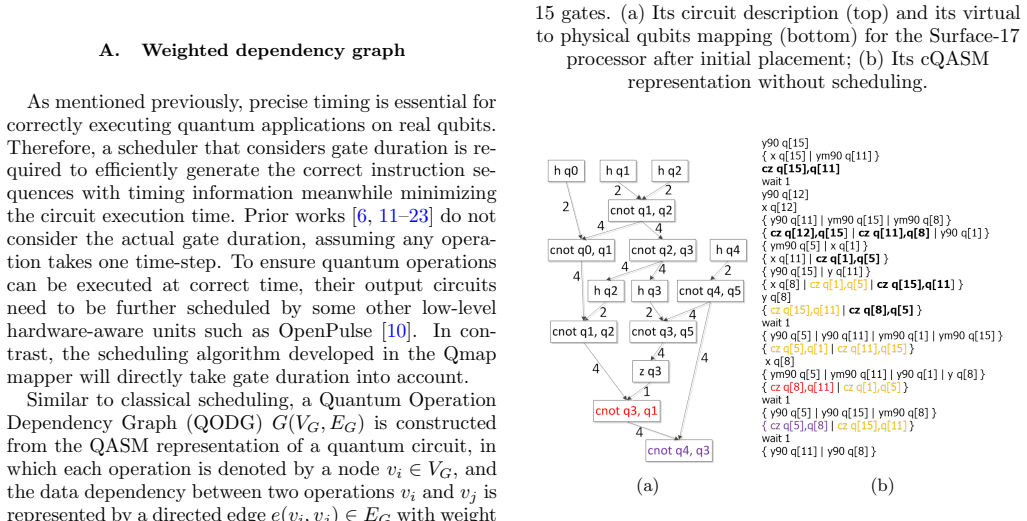
The central mechanism is a resource-constrained list scheduler built on a weighted Quantum Operation Dependency Graph (QODG), in which every gate is a node and every dependency edge carries the duration of the preceding gate. A machine state S records, for each resource in four configuration tables—Tg1 for single-qubit drive sources, Tgm for measurement feedlines, Tg2f for CZ-versus-CZ concurrency, and Tg2d for qubits that must be detuned during a CZ—the occupying operation and the half-open cycle interval [t0, t1) during which it is busy. A gate can be issued at cycle t only if all its resources are free for its full duration; among available gates the scheduler picks the one with the longest remaining path to the sink. The router reuses this scheduler in a look-back mode, generating all shortest-path movement sets, scheduling each against the already mapped prefix, and keeping the set that minimally extends latency.
What would settle it
Execute a Qmap-generated schedule for a benchmark such as decod24bdd on an actual Surface-17 device and compare the measured output distribution with the ideal simulated one; a missed control constraint—for example, two same-frequency single-qubit gates issued in the same cycle or a CZ executed while a qubit that should be parked is busy—would produce a characteristic error signature on the affected qubits.
Extended reading notes
Core claim
The paper's central claim is that classical control restrictions—shared microwave sources for single-qubit gates, shared measurement feedlines, and frequency-detuning exclusions during two-qubit gates—can be encoded as resource occupations in a conventional list scheduler, making timing- and resource-aware mapping practical at polynomial scheduling cost. Qmap schedules gates using real durations (single-qubit rotations and measurement take 1 and 15 cycles, CZ gates take 2 cycles) and its router evaluates all shortest-path movement sets for each non-nearest-neighbor gate, interleaves each candidate set with already mapped gates using the same scheduler, and selects the set that minimally extends total latency. Against a MinPath mapper that randomly picks a minimum-operation movement set and only applies timing and control constraints in a later scheduling pass, Qmap achieves lower or equal latency overhead for 96.4% of benchmarks and lower or equal gate overhead for 87.5%, with the largest latency improvement at 47.3% and the largest gate-count improvement at 28.6%. The paper also shows that using MOVE operations (two CNOTs, requiring a destination qubit in |0⟩) instead of SWAPs (three CNOTs) cuts gate overhead by up to 38.9% and latency by up to 29%.
Load-bearing premise
The load-bearing premise is that the configuration tables for Surface-17's classical control—shared single-qubit drive sources, measurement feedlines, and two-qubit detuning exclusions—completely capture the hardware's real restrictions; if a real constraint is missing, the scheduled circuits may not execute correctly.
Editorial extensions
If this is right
- Qmap's output circuits carry precise per-cycle timing and already respect classical-control restrictions, so the separate pulse-level scheduling pass that earlier mappers require can be reduced or eliminated.
- Optimizing for gate count alone leaves substantial execution time on the table: Qmap matched or beat the operation-count-minimizing mapper on latency for 96.4% of the benchmarks, and the largest gap was 47.3%.
- MOVE operations are preferable to SWAPs whenever a qubit known to be in |0⟩ is available, reducing the number of gates by up to 38.9% and latency by up to 29% in the paper's tests.
- The scheduler's worst-case complexity is polynomial—O(min(g, n)·(n+|R|)·g) in the number of gates, qubits, and resources—so timing-aware mapping is feasible for large gate counts, even though the routing heuristic still scales sub-exponentially with qubit count.
- Because all hardware characteristics are read from a configuration file, the same mapper can be retargeted to other processors by replacing the topology, duration, and resource tables.
Reading between the lines
- The same resource-table formulation could absorb noise information, such as gate error rates and decoherence decay, as additional costs; if it did, latency-minimizing schedules might also become success-probability-minimizing schedules, which the paper did not test.
- The 47.3% latency gap was measured on a 17-qubit processor; as processors grow, shared-control constraints become denser, so timing-aware routing is likely to matter even more relative to operation-count minimization.
- A natural stress test is to map the same benchmarks onto other processors with different shared-control arrangements, using only the configuration file, to see whether the resource-table model transfers and how much latency it recovers.
- The MOVE-versus-SWAP savings suggest a hardware-design consequence the paper leaves implicit: placing dedicated |0⟩ ancilla storage near frequently interacting qubits could reduce mapping overhead further.
Signed reviews
Editorial analysis
A structured set of objections, weighed in public.
Referee Report
Summary. This paper presents Qmap, a mapping/compilation framework that transforms hardware-agnostic quantum circuits into executable circuits for the 17-qubit Surface-17 superconducting processor, respecting the primitive gate set, gate durations, qubit connectivity, and restrictions from shared classical control electronics (AWGs for single-qubit gates, feedlines for measurement, and frequency-detuning rules for CZ gates). The mapper combines an ILP-based initial placement, a resource-constrained list scheduler (Algorithm 1) that models classical-control limits as resource conflicts, a routing heuristic (Algorithms 2-3) that evaluates multiple shortest-path SWAP/MOVE movement sets and selects the one that minimally extends an ASAP partial schedule, and a global ALAP rescheduling pass. Using 56 benchmarks from RevLib and QLib, the authors compare Qmap with two self-implemented baselines, Trivial and MinPath, and report that Qmap reduces latency overhead by up to 47.3% and gate-count overhead by up to 28.6% relative to MinPath, with average reductions of 22% and 3.0%, at the cost of substantially longer compilation times.
Significance. Assuming the reported results hold, this is a useful contribution to the quantum-compilation literature: it is among the first mappers to fold classical control-electronics restrictions (shared AWGs, shared feedlines, CZ detuning rules) directly into a polynomial-complexity list scheduler, and the latency-aware movement-set selection is a clean, well-motivated improvement over operation-count-only routing. The evaluation uses external benchmark circuits (RevLib and QLib), and no parameters are fitted to the reported outcomes, so the comparison is not circular; the pseudocode for the three algorithms is clear, and the authors are honest about limitations (sub-exponential routing complexity, qubit counts below 20, deferred external comparison). The strength of the central latency-improvement claim, however, is conditional on the two load-bearing points in the major comments: the |0>-precondition for MOVE must be demonstrably enforced, and the randomized self-implemented baseline must be reported with variance and, ideally, anchored by an external comparison.
major comments (3)
- [§II.A, §III.B, §IV.C] Section II.A states that a MOVE operation 'requires that the destination qubit where the quantum state needs to be moved to, is in the |0⟩ state.' This precondition is a quantum-state condition, yet none of the three algorithms in Sections III-IV tracks it: the machine state S in Algorithm 1 (Section III.B) covers only the classical resources in Tg1, Tgm, Tg2f, and Tg2d, and the routing state in Algorithms 2-3 (Section IV.C) is the VP-map plus the QODG, with no predicate recording which physical qubits are currently in |0>. The manuscript also states no invariant of the form 'MOVE destinations are chosen only among physical qubits not currently holding a computational state.' Because Table IV reports large MOVE counts for both MinPath and Qmap (e.g., hundreds of MOVEs for several benchmarks), the reader has no basis to conclude that the generated eQASM circuits are equivalent to the input circuits: a MOVE into a data qubit, or into an ancilla that is not guaranteed to be |0>, entangles rather than transfers the state. Since the claimed gate-overhead reductions rely in part on MOVE usage (Sections I and V.E), this is load-bearing for the central claim. I ask the authors to (i) state the precise invariant under which MOVE destinations are known to be |0>, (ii) show where and how Algorithms 2 and 3 enforce it during movement-set enumeration, scheduling, and VP-map updates, and (iii) verify, preferably by instrumenting the compiler or checking the output eQASM for the 56 benchmarks, that every MOVE reported in Table IV satisfies the precondition.
- [§V.B, §V.C] Section V.C reports only the minimum of five mapping runs for each benchmark, and Section V.B describes the MinPath router as randomly selecting one movement set along a shortest path; since MinPath is therefore a random baseline, the reported 47.3% (latency) and 28.6% (gates) reductions are comparisons against the best-of-five outcome of a randomized procedure, with no measure of spread, so the reader cannot tell whether these reductions exceed run-to-run variation of the baseline. The paper should report the mean and standard deviation (or all five runs) per benchmark and per mapper, and should state the direction of the bias: because Qmap selects the latency-minimal movement set (Algorithm 3) and is only randomized on ties, reporting the minimum plausibly favors the random MinPath baseline, making the comparison conservative. Furthermore, MinPath is an author-constructed representative rather than a published prior mapper: Section VII concedes that comparison with prior works is future work, so the abstract's phrase 'a prior mapping strategy' overstates the external validity of the comparison. I recommend either benchmarking against at least one published mapper (e.g., a Qiskit/OpenPulse-style flow or the mapper of Ref. [17]) on the same benchmark set, or explicitly presenting MinPath as an ablation baseline and adjusting the claims and abstract accordingly.
- [§II.D, §III.B] Sections II.D and III.B define the scheduler's resource model entirely through the configuration tables Tg1, Tgm, Tg2f, and Tg2d, but the paper lists only their sizes (|Tg1|=3, |Tgm|=3, |Tg2f|=48, |Tg2d|=48) and neither includes the tables nor states where the configuration file can be obtained. Because the validity of the scheduled circuits on actual Surface-17 hardware — and hence the correctness of the comparison in Table IV — depends on these tables faithfully capturing the classical-control restrictions (e.g., the detuning rules from Ref. [27]), the omission makes the central modeling contribution unverifiable and the experiments non-reproducible. Please include the full configuration file as supplementary material (or specify all 48-entry tables in the paper) and indicate where the Qmap implementation can be obtained.
minor comments (6)
- [§I] In Section I, final bullet, 'respectivel' should read 'respectively'.
- [§V.C] Benchmark names are used inconsistently ('gray6 47', 'decod24 b', 'bestein vazirani') relative to the names in Table II ('graycode647', 'decod24bdd', 'bensteinvazirani16'); please use consistent labels throughout.
- [§V.D] Section V.D states 'the two-qubit gate number from 5 to 62483', but Table II's largest two-qubit-gate count is 28084 and its largest total gate count is 64283; 62483 matches neither and appears to be a typo.
- [Tables II and IV] In the version of the manuscript I reviewed, the table columns run together (e.g., 'alu bdd 288 7 84 38 48 169' and entries such as '0.06365286'), making several rows unreadable; please ensure the published tables have clearly separated columns and unambiguous cell boundaries.
- [§IV.C, §V.B] The notation 'O(g√n4√n)' is ambiguous; it should be typeset as O(g·√n·4^√n) (or equivalent) to make the sub-exponential dependence on the qubit count clear.
- [§V.C] The statement that MinPath 'can reduce the latency overhead and gate overhead up to 140% and 360%' is ambiguous, since an overhead reduction is itself a percentage; the authors should define whether this is a relative reduction of the overhead values or a percentage-point difference, and give the corresponding formula.
Circularity Check
No circularity found: Qmap's reported reductions are measured on external benchmarks against a stated baseline, with no fitted parameter renamed as a prediction.
full rationale
Qmap is evaluated by compiling 56 benchmarks from RevLib and QLib onto a fixed hardware model and comparing latency and gate overheads against two baselines (Trivial and MinPath) described and implemented in the paper itself. The reported reductions (up to 47.3% latency and 28.6% gates) are measurements on external circuits, not values fitted into the mapper. The scheduler (Algorithm 1) and router (Algorithms 2 and 3) are constructive heuristics whose objective of minimizing latency is stated before the experiments rather than derived from the experimental outcomes. MinPath is defined as a baseline that minimizes operation counts and selects a random shortest movement set (Section V.B), while Qmap is defined to evaluate multiple movement sets with a resource-constrained lookback (Algorithms 2 and 3); the comparison therefore tests a design choice rather than reducing one quantity to another by construction. The paper's self-citations, such as the OpenQL compiler [28] and the ILP placement method [38], are instrumental, and the shared ILP-based placement between Qmap and MinPath isolates the router contribution. The MOVE precondition that destinations must be in the |0> state (Section II.A) is a possible correctness gap if the resource model does not track that condition, but a correctness risk is not a circular-definition risk. No fitted parameter is renamed as a prediction, and no uniqueness theorem or ansatz is imported from the authors' prior work to force the result. The central claim is self-contained against the external benchmarks and the stated configuration model, so no significant circularity is present.
Assumptions & free parameters
assumptions (4)
- domain assumption Gate durations and primitive gate set for Surface-17 (Table I: single-qubit gates 1 cycle, CZ 2 cycles, measurement 15 cycles).
- domain assumption Same-frequency qubits are operated by the same microwave source or AWG, so different single-qubit gates on same-frequency qubits cannot run concurrently; measurement on the same feedline serializes; CZ gates have the detuning rules described in Section II.C.
- domain assumption A MOVE operation requires the destination qubit to be in state |0>, and ancilla qubits are available for current benchmarks.
- ad hoc to paper The MinPath mapper is a fair representative of prior operation-count-minimizing mappers.
Cite this review
Pith. "Pith review of Timing and resource-aware mapping of quantum circuits to superconducting processors." pith.science (2026). https://pith.science/paper/QQCMKY5T
@misc{pith2026190804226,
  author       = {Pith},
  title        = {Pith review of: Timing and resource-aware mapping of quantum circuits to superconducting processors},
  year         = {2026},
  howpublished = {\url{https://pith.science/paper/QQCMKY5T}},
  note         = {Machine review of arXiv:1908.04226}
}
read the original abstract
Quantum algorithms need to be compiled to respect the constraints imposed by quantum processors, which is known as the mapping problem. The mapping procedure will result in an increase of the number of gates and of the circuit latency, decreasing the algorithm's success rate. It is crucial to minimize mapping overhead, especially for Noisy Intermediate-Scale Quantum (NISQ) processors that have relatively short qubit coherence times and high gate error rates. Most of prior mapping algorithms have only considered constraints such as the primitive gate set and qubit connectivity, but the actual gate duration and the restrictions imposed by the use of shared classical control electronics have not been taken into account. In this paper, we present a timing and resource-aware mapper called Qmap to make quantum circuits executable on a scalable superconducting processor named Surface-17 with the objective of achieving the shortest circuit latency. In particular, we propose an approach to formulate the classical control restrictions as resource constraints in a conventional list scheduler with polynomial complexity. Furthermore, we implement a routing heuristic to cope with the connectivity limitation. This router finds a set of movement operations that minimally extends circuit latency. To analyze the mapping overhead and evaluate the performance of different mappers, we map 56 quantum benchmarks onto Surface-17. Compared to a prior mapping strategy that minimizes the number of operations, Qmap can reduce the latency overhead up to 47.3% and operation overhead up to 28.6%, respectively.
Figures


Figures from the paper (3 more)


Reference graph
Works this paper leans on
-
[17]
A. Farghadan and N. Mohammadzadeh, International Journal of Circuit Theory and Applications 45, 989 (2017)
work page 2017
-
[27]
D. Venturelli, M. Do, E. Rieffel, and J. Frank, Quantum Science and Technology 3, 025004 (2018)
work page 2018
-
[1]
It is a scheduler-based heuristic of which the objective is to minimize overall circuit latency
Routing heuristic In this work, after the ILP-based initial placement, a heuristic algorithm is used to perform this routing task. It is a scheduler-based heuristic of which the objective is to minimize overall circuit latency. Algorithm 2 shows the pseudo code of the proposed routing algorithm, which finds all two-qubit gates in which qubits are not neare...
-
[2]
During Qmap initialization time, the distance (i.e
Movement set selection For finding a set of movement operations for a non- NN two-qubit gate, all shortest paths between these two qubits are considered. During Qmap initialization time, the distance (i.e. the length of the shortest path) between each pair of qubits has been computed using the Floyd- Warshall algorithm. Finding all shortest paths between q...
work page 1914
-
[3]
M. Kjaergaard, M. E. Schwartz, J. Braum¨ uller, P. Krantz, J. I.-J. Wang, S. Gustavsson, and W. D. Oliver, arXiv:1905.13641 (2019)
arXiv 2019
-
[4]
Preskill, Quantum 2, 79 (2018)
J. Preskill, Quantum 2, 79 (2018)
2018
-
[5]
R. P. Feynman, International Journal of Theoretical Physics 21, 467 (1982)
1982
- [6]
Show all 48 references
-
[7]
Quantum experience,
IBM, “Quantum experience,” https://www.research. ibm.com/ibm-q/ (2017)
2017
-
[8]
Boixo, S
S. Boixo, S. V. Isakov, V. N. Smelyanskiy, R. Babbush, N. Ding, Z. Jiang, M. J. Bremner, J. M. Martinis, and H. Neven, Nature Physics 14, 595 (2018)
2018
-
[9]
Asaad, C
S. Asaad, C. Dickel, N. K. Langford, S. Poletto, A. Bruno, M. A. Rol, D. Deurloo, and L. DiCarlo, npj Quantum Information 2, 16029 (2016)
2016
-
[10]
and finds a set of movement operations to bring these two qubits to adjacent positions. After the movement set selection, the router schedules the SWAP/MOVE opera- tions into the circuit (line 11), updates the VP-map (line 12), recomputes the set of available gates (line 15), a...
-
[11]
C. D. Hill, E. Peretz, S. J. Hile, M. G. House, M. Fuech- sle, S. Rogge, M. Y. Simmons, and L. C. Hollenberg, Science advances 1, e1500707 (2015)
2015
-
[12]
R. Li, L. Petit, D. P. Franke, J. P. Dehollain, J. Helsen, M. Steudtner, N. K. Thomas, Z. R. Yoscovits, K. J. Singh, S. Wehner, et al. , Science advances 4, eaar3960 (2018)
2018
-
[13]
D. C. McKay, T. Alexander, L. Bello, M. J. Biercuk, L. Bishop, J. Chen, J. M. Chow, A. D. C´ orcoles, D. Eg- ger, S. Filipp, et al., arXiv:1809.03452 (2018)
2018 arXiv
-
[14]
Yazdani, M
M. Yazdani, M. S. Zamani, and M. Sedighi, Quantum information processing 12, 3239 (2013)
2013
-
[15]
A. Lye, R. Wille, and R. Drechsler, in The 20th Asia and South Pacific Design Automation Conference (ASP- DAC) (IEEE, 2015) pp. 178–183
2015
-
[16]
Wille, O
R. Wille, O. Keszocze, M. Walter, P. Rohrs, A. Chat- topadhyay, and R. Drechsler, in 2016 21st Asia and South Pacific Design Automation Conference (ASP- DAC) (IEEE, 2016) pp. 292–297
2016
- [18]
-
[19]
Qiskit: An open-source framework for quantum computing,
H. Abraham, AduOffei, I. Y. Akhalwaya, G. Alek- sandrowicz, et al. , “Qiskit: An open-source framework for quantum computing,” (2019)
2019
-
[20]
Zulehner, A
A. Zulehner, A. Paler, and R. Wille, IEEE Transactions on Computer-Aided Design of Integrated Circuits and Systems (2018)
2018
-
[21]
M. Y. Siraichi, V. F. d. Santos, S. Collange, and F. M. Q. Pereira, in Proceedings of the 2018 International Sympo- sium on Code Generation and Optimization (ACM, 2018) pp. 113–125
2018
-
[22]
Finigan, M
W. Finigan, M. Cubeddu, T. Lively, J. Flick, and P. Narang, arXiv:1810.08291 (2018)
2018 arXiv
-
[23]
G. Li, Y. Ding, and Y. Xie, in Proceedings of the Twenty- Fourth International Conference on Architectural Sup- port for Programming Languages and Operating Systems (ACM, 2019) pp. 1001–1014
2019
-
[24]
S. S. Tannu and M. K. Qureshi, in Proceedings of the Twenty-Fourth International Conference on Architec- tural Support for Programming Languages and Operating Systems (ACM, 2019) pp. 987–999
2019
-
[25]
Nishio, Y
S. Nishio, Y. Pan, T. Satoh, H. Amano, and R. Van Me- ter, arXiv:1903.10963 (2019)
2019 arXiv
-
[26]
Cowtan, S
A. Cowtan, S. Dilkes, R. Duncan, A. Krajenbrink, W. Simmons, and S. Sivarajah, arXiv:1902.08091 (2019)
2019 arXiv
-
[28]
K. E. Booth, M. Do, J. C. Beck, E. Rieffel, D. Venturelli, and J. Frank, in Twenty-Eighth International Conference on Automated Planning and Scheduling (2018)
2018
-
[29]
Venturelli, M
D. Venturelli, M. Do, B. O’Gorman, J. Frank, E. Rieffel, K. E. Booth, T. Nguyen, P. Narayan, and S. Nanda, (2019)
2019
-
[30]
Versluis, S
R. Versluis, S. Poletto, N. Khammassi, B. Tarasinski, N. Haider, D. J. Michalak, A. Bruno, K. Bertels, and L. DiCarlo, Phys. Rev. Applied 8, 034021 (2017)
2017
-
[31]
Khammassi, I
N. Khammassi, I. Ashraf, J. v. Someren, R. Nane, A. Krol, M. A. Rol, L. Lao, K. Bertels, and C. G. Al- mudever, arXiv:2005.13283 (2020)
2020 arXiv
-
[32]
Wille, D
R. Wille, D. Große, L. Teuber, G. W. Dueck, and R. Drechsler, in 38th International Symposium on Multi- ple Valued Logic (ismvl 2008) (IEEE, 2008) pp. 220–225
2008
-
[33]
C. C. Lin, A. Chakrabarti, and N. K. Jha, ACM Journal on Emerging Technologies in Computing Systems 11, 7 (2014)
2014
-
[34]
T. E. OBrien, B. Tarasinski, and L. DiCarlo, npj Quan- tum Information 3, 39 (2017)
2017
-
[35]
J. E. Kelley Jr and M. R. Walker, in Papers presented at the December 1-3, 1959, eastern joint IRE-AIEE-ACM computer conference (ACM, 1959) pp. 160–173
1959
-
[36]
Blazewicz, J
J. Blazewicz, J. K. Lenstra, and A. R. Kan, Discrete applied mathematics 5, 11 (1983)
1983
-
[37]
Khammassi, G
N. Khammassi, G. G. Guerreschi, I. Ashraf, J. W. Hogaboam, C. G. Almudever, and K. Bertels, arXiv:1805.09607 (2018)
2018 arXiv
-
[38]
Khammassi, I
N. Khammassi, I. Ashraf, X. Fu, C. G. Almud´ ever, and K. Bertels, in Design, Automation & Test in Europe Con- ference & Exhibition (DATE), 2017 (IEEE, 2017) pp. 464–469
2017
-
[39]
X. Fu, L. Riesebos, M. A. rOL, J. van Straten, J. van Someren, N. Khammassi, I. Ashraf, R. Vermeulen, V. Newsum, K. Loh, et al. , in 2019 IEEE International Symposium on High Performance Computer Architecture (HPCA) (IEEE, 2019) pp. 224–237
2019
-
[40]
M. J. Dousti, A. Shafaei, and M. Pedram, in Proceedings of the 24th edition of the great lakes symposium on VLSI (ACM, 2014) pp. 117–122
2014
-
[41]
L. Lao, B. van Wee, I. Ashraf, J. van Someren, N. Kham- massi, K. Bertels, and C. G. Almudever, Quantum Sci- ence and Technology 4, 015005 (2019)
2019
-
[42]
M. J. Dousti and M. Pedram, in Proceedings of the 50th 14 Annual Design Automation Conference (DAC)) (ACM,
-
[43]
Murali, N
P. Murali, N. M. Linke, M. Martonosi, A. J. Abhari, N. H. Nguyen, and C. H. Alderete, in Proceedings of the 46th International Symposium on Computer Architecture (2019) pp. 527–540
2019
-
[44]
Murali, J
P. Murali, J. M. Baker, A. Javadi-Abhari, F. T. Chong, and M. Martonosi, in Proceedings of the Twenty-Fourth International Conference on Architectural Support for Programming Languages and Operating Systems (2019) pp. 1015–1029
2019
-
[45]
X. Fu, M. A. Rol, C. C. Bultink, J. van Someren, N. Khammassi, I. Ashraf, R. F. L. Vermeulen, J. C. de Sterke, W. J. Vlothuizen, R. N. Schouten, C. G. Al- mudever, L. DiCarlo, and K. Bertels, in Proceedings of the 50th Annual IEEE/ACM International Symposium on Microarchitectu...
2017
-
[46]
Intel newsroom,
Intel, “Intel newsroom,” https://newsroom.intel. com/press-kits/quantum-computing/#intel-qutech (2019)
2019
-
[47]
N. M. Linke, D. Maslov, M. Roetteler, S. Debnath, C. Figgatt, K. A. Landsman, K. Wright, and C. Mon- roe, Proceedings of the National Academy of Sciences 114, 3305 (2017)
2017
-
[48]
Y. Shi, N. Leung, P. Gokhale, Z. Rossi, D. I. Schus- ter, H. Hoffmann, and F. T. Chong, in Proceedings of the Twenty-Fourth International Conference on Architec- tural Support for Programming Languages and Operating Systems (ACM, 2019) pp. 1031–1044. 15 TABLE IV: The results of...
2019
Reviewed August 14, 2026 · model on record in the stance chip above.
Discussion (0). Continue with ORCID to comment.