REVIEW 2 major objections 4 minor 41 references
Quasi-cosmological Traversable Wormholes in $f(R)$ Gravity
T0 review · 2 major / 4 minor · reviewed 2026-08-14 · deepseek-v4-flash
Pith's one-line read This paper constructs exact traversable wormhole solutions in $f(R)$ gravity and claims that, unlike in general relativity, they can satisfy the null energy condition at the throat.
desk verdict The paper's density and pressure formulas drop the nonzero H term from its own field equations, so the NEC/WEC claims are not statements about the stated f(R) theory. read the letter →
The pith
A machine-rendered reading of the paper's core claim, the machinery that carries it, and where it could break.
The reading
What carries the argument
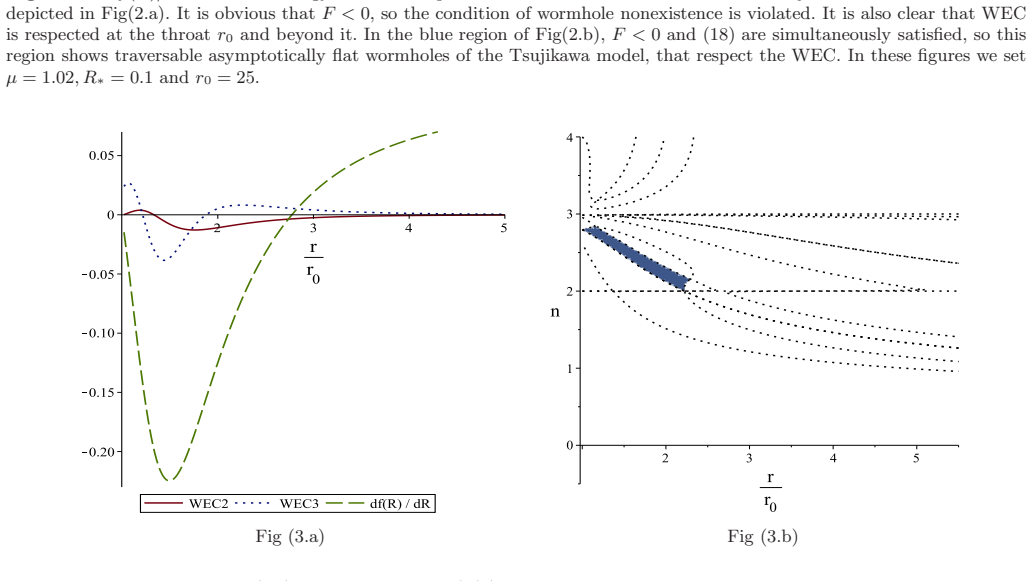
The argument runs on three pieces. First, the $f(R)$ field equations are rewritten as $G_{\mu\nu}=T^c_{\mu\nu}+\tilde T^m_{\mu\nu}$, placing all curvature corrections into an effective stress tensor, and the matter is taken as an anisotropic fluid with density $\rho$, radial pressure $p_r$, and transverse pressure $p_t$. Second, the nonconstant Ricci scalar ansatz $R=6c_1+6c_2 r^{-n}$ fixes the shape function $b(r)$ and makes the wormhole asymptotically match cosmological backgrounds. Third, the paper uses a known no-go result stating that static wormholes cannot satisfy the null energy condition when $F=df/dR>0$ and its second derivative is nonzero, so it searches parameter regions with $F<0$; there the effective gravitational constant is negative. The energy-condition inequalities are then evaluated for six viable $f(R)$ models, with $n$, $r_0$, and the model parameters scanned to identify allowed regions.
What would settle it
Compute $H(r)=\frac{1}{4}(FR+\Box F+T)$ along the claimed solutions, evaluating $F$, $\Box F$, and the matter trace $T$ from the paper's shape function and a concrete model such as $f(R)=R-\mu R_* \tanh(R/R_*)$. If $H$ does not vanish identically, the density and pressure formulas used in the energy-condition plots are not the solutions of the full field equations, and the central claim is not established.
Extended reading notes
Core claim
On its own terms, the paper establishes a family of exact, static, spherically symmetric wormhole metrics in $f(R)$ gravity, with shape function $b(r)=(-r_0^n c_1+r_0^{n-2})r^{3-n}+c_1 r^3$, where $c_1=-1,0,1$ selects hyperbolic, flat, or spherical asymptotics. The Ricci scalar is nonconstant, $R=6c_1+6c_2 r^{-n}$, which is the feature that distinguishes these solutions from earlier constant-$R$ wormhole constructions. Testing the energy conditions using the density and pressures obtained from the field equations, the authors find that, when $F=df/dR$ is negative, the null energy condition can hold at the throat and near it for asymptotically flat and hyperbolic wormholes in most of the models considered, and the weak energy condition can hold through the whole exterior for some flat and hyperbolic solutions. Asymptotically spherical wormholes satisfy the null energy condition only in two of the six models. The paper reads this as evidence that $f(R)$ gravity can replace exotic matter with anti-gravitational regions as the physical support for traversable wormholes.
Load-bearing premise
The energy-condition results rest on the assumption that $H=\frac{1}{4}(FR+\Box F+T)$ is zero for the nonconstant-Ricci-scalar solutions, because the density and pressure formulas used to evaluate the energy conditions are only the solutions of the field equations in that case; the paper does not impose or verify $H=0$.
Editorial extensions
If this is right
- If the central claim is right, the standard obstruction to traversable wormholes—exotic matter near the throat—does not apply in $f(R)$ gravity; the throat can sit in a region with $F<0$ and still satisfy the null energy condition.
- For some asymptotically flat and hyperbolic solutions the weak energy condition holds everywhere outside the throat, so these spacetimes pass the stricter energy conditions, not only the null one.
- Asymptotically spherical wormholes are far more constrained: only two of the six models admit them with the null energy condition satisfied near the throat, so spherical asymptotics are not generically supported.
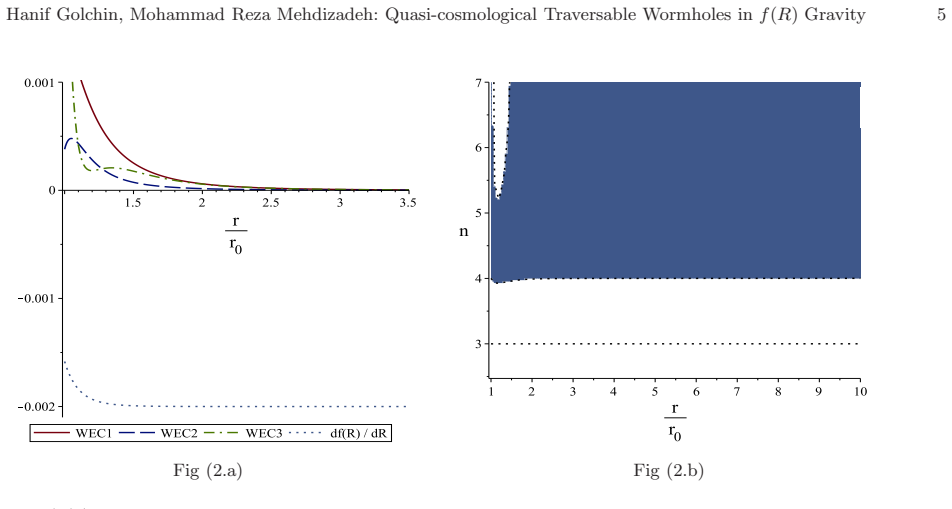
- The parameter $n$ in the Ricci scalar acts as a tuning dial: the paper identifies intervals, for example $4<n<5.2$ for the flat case of the hyperbolic-tangent model, where the energy conditions hold, making the existence of such wormholes a parameter-selection question.
- The same ansatz and energy-condition inequalities can be applied to other viable $f(R)$ models, so the paper provides a template for scanning model space rather than a single isolated solution.
Reading between the lines
- A direct test of the central claim is to evaluate $H=\frac{1}{4}(FR+\Box F+T)$ for the ansatz; if it does not vanish, the simplified density and pressure formulas used in the energy-condition plots do not solve the full field equations, and the results would need to be re-derived.
- Because the solutions require $F<0$, the matter that formally satisfies the energy conditions lives in a region where the effective gravitational constant is negative; whether that counts as ordinary matter depends on the physical interpretation of the modified-gravity frame, which the paper does not settle.
- The asymptotic Ricci scalar is a constant $6c_1$, so these wormholes sit in a cosmological background; one natural extension is to promote $c_1$ to a function of time and look for dynamical wormholes that evolve with the expansion of the universe.
- The paper tests six models, but the method is a scan over parameter space; a more systematic search over broader $f(R)$ families could map out which functional forms support energy-condition-respecting wormholes, and would likely find both survivors and exclusions.
Editorial analysis
A structured set of objections, weighed in public.
Referee Report
Summary. The manuscript studies traversable wormholes with the static spherically symmetric metric (6) in f(R) gravity, imposing the nonconstant Ricci scalar R=6c1+6c2/r^n (Eq. 13) and deriving the shape function b(r) in Eq. (16). After imposing the throat conditions, the authors set c1=0,±1 to describe asymptotically flat, hyperbolic, and spherical wormholes. Using the matter density and pressures quoted in Eqs. (10)-(12), they derive the WEC/NEC inequalities (18) and scan the parameter space of six f(R) models, searching for regions with F<0 so as to evade the Bronnikov-Starobinsky no-go theorem. They conclude that, unlike in Einstein gravity, NEC holds at the throat and near it for several models, and WEC holds through the whole space for some asymptotically flat and hyperbolic solutions.
Significance. If the equations were correct, the paper would provide a potentially important counterexample to the usual expectation that traversable wormholes require exotic matter, within observationally motivated f(R) models. The authors deserve credit for being explicit, for treating six viable models, and for correctly recognizing that the F<0 anti-gravitational regime is the only region in which the cited no-go theorem can be evaded; their parameter scan is not circular. However, the central result is not supported because the matter variables used in the energy conditions do not follow from the stated field equations. The stress-test concern is confirmed, and the conclusion as stated is therefore not established by the manuscript.
major comments (2)
- [§2, Eqs. (9)-(12)] Equations (10)-(12) do not solve the paper's own field equations. Equation (9) gives b'/r^2=(ρ+H)/F, with analogous H terms in the radial and tangential equations, where H=(FR+□F+T)/4. Solving for the matter variables gives ρ=F b'/r^2−H, not Eq. (10), and the corresponding H terms are missing from Eqs. (11) and (12). The paper never imposes H=0. For the nonconstant Ricci scalar (13) and the nonlinear f(R) models considered, H is generically nonzero; using the trace (3), H=(FR−f)/2+□F, which does not vanish for these models. Equivalently, the exact density from Eq. (2) is ρ=f/2−□F, whereas Eq. (10) gives F R/2; the difference is exactly H. Since every WEC/NEC inequality in Eq. (18) and all figures are built from (10)-(12), the main claim that ordinary matter can support these wormholes is not a statement about the theory defined by Eq. (2). Working in the F<0 regime does not repair this omission.
- [§3, Eq. (18)] For c1=±1, Eq. (18) contains algebraic errors that are independent of the H issue. Substituting b(r)=c1 r^3 + A r^{3−n} with A=r0^{n−2}−c1 r0^n into (10)-(12) gives ρ+p_t = F[2c1+(4−n)A r^{−n}/2] + (F'/r)(c1r^2−1+A r^{2−n}) and ρ+p_r = F[2c1+(2−n)A r^{−n}] + F'[c1r+(2−n)A r^{1−n}/2] − F''(1−c1r^2−A r^{2−n}). Equation (18) instead has 24c1r where 4c1r should appear, 12c1 where 2c1 should appear, 6c1r^2 where c1r^2 should appear, and r0^{n−2}−6c1r0^n in place of A throughout. Consequently, the c1=±1 WEC/NEC plots in Figs. 8-13 are not produced by the stated matter expressions (10)-(12), even before the H-term problem is addressed.
minor comments (4)
- [§3, energy-condition definitions] The text writes 'the null energy condition WEC2: ρ+pt>0, WEC3: ρ+pr>0' immediately after defining WEC1, WEC2, and WEC3; this is confusing because the same labels are reused for NEC, and the definitions should be clearly separated.
- [Eq. (18) and surrounding text] The primes on F in Eq. (18) are never defined; since F=df/dR, the manuscript should state explicitly that F'=dF/dr=f''(R)R'(r), so that F'' is also unambiguous.
- [Figure captions] Several captions contain typos such as 'asymptoticly' in Figs. 5, 6, 8, 9, and 11-13, and 'Fig10' without a space; a careful proofreading pass is needed.
- [§2, text before Eq. (10)] The phrase 'By solving the above system' is misleading, because Eqs. (10)-(12) are not the general solution of Eq. (9); they are obtained only after dropping the H terms, as noted in the first major comment.
Circularity Check
No circularity; Eqs. (10)-(12) silently drop the H term of Eq. (9), a correctness gap, not a circular reduction.
full rationale
The paper's central chain is: field equations (2)/(4) -> (9) with H defined -> (10)-(12) -> (18) -> parameter scans. I find no circular reduction in the rubric's sense. The self-citations (refs [5], [9], [14]) are background references in the introduction and are not load-bearing. The Bronnikov-Starobinsky theorem [29,30] is external, not this group's own theorem, and the paper's anti-gravitational F<0 search is a legitimate use of that theorem. The serious defect is that (10)-(12) do not solve (9); they are what remains after deleting every H term, and H=1/4(FR+boxF+T) is generically nonzero for the nonconstant Ricci scalar (13). Thus the energy-condition plots are not statements about the theory defined by (2). But deleting a term is not the same as assuming the conclusion: the omitted H does not encode the NEC/WEC result, and the paper does not fit data or rename its inputs. Accordingly the circularity score is low (2), while the correctness risk from the dropped H term is high.
Assumptions & free parameters
free parameters (5)
- c1 =
0, -1, +1 (chosen by hand)
- c2 =
eliminated by throat condition b(r0)=r0
- n =
varied, e.g., 2.02 to 5
- r0 =
1, 15, 25, etc.
- f(R) model parameters =
e.g., mu=1.02, 5; lambda=0.98, 1; R*=0.001 to 1; a,b,c=2,20,20
assumptions (4)
- domain assumption The metric f(R) field equations (2) with matter minimally coupled describe the theory.
- domain assumption The Morris-Thorne wormhole metric (6) with zero redshift function is traversable and static.
- ad hoc to paper The Ricci scalar can be imposed as R=6c1+6c2/r^n.
- domain assumption The Bronnikov-Starobinsky nonexistence theorem (20) applies, and F<0 evades it.
Cite this review
Pith. "Pith review of Quasi-cosmological Traversable Wormholes in $f(R)$ Gravity." pith.science (2026). https://pith.science/paper/6MLVO3XG
@misc{pith2026190804378,
  author       = {Pith},
  title        = {Pith review of: Quasi-cosmological Traversable Wormholes in $f(R)$ Gravity},
  year         = {2026},
  howpublished = {\url{https://pith.science/paper/6MLVO3XG}},
  note         = {Machine review of arXiv:1908.04378}
}
abstract
In this paper we study traversable wormholes in the context of $f(R)$ gravity. Exact solutions of traversable wormholes are found by imposing the nonconstant Ricci scalar. These solutions asymptotically match spherical, flat and hyperbolic FRW metric. By choosing some static $f(R)$ gravity models, we verify the standard energy conditions for the asymptotically spherical, flat and hyperbolic wormhole solutions. Unlike the Einstein gravity, we find that in the context of $f(R)$ modified gravity, the asymptotically spherical, flat and hyperbolic wormhole solutions can respect the null energy condition (NEC) at the wormhole throat and near that. We find that in some static $f(R)$ models, asymptotically flat and hyperbolic wormholes respect the weak energy condition (WEC) through the whole space.
Figures


Figures from the paper (11 more)


Reference graph
Works this paper leans on
-
[28]
Marco Calz, Massimiliano Rinaldi, Lorenzo Sebastiani, Eur.Phys.J. C78, 178 (2018)
work page 2018
- [1]
-
[2]
Einstein and N
A. Einstein and N. Rosen, Phys. Rev. 48, 73 (1935)
1935
-
[3]
M. S. Morris and K. S. Thorne, Am. J. Phys. 56, 395 (1988); M. S. Morris, K. S. Thorne, and U. Yurtsever, Phys. Rev. Lett. 61, 1446 (1988)
work page 1988
- [4]
-
[5]
M. R. Mehdizadeh, M. Kord Zangeneh and F. S. N. Lobo, Phys. Rev. D 92, no. 4, 044022 (2015) [arXiv:1506.03427 [gr-qc]]
arXiv 2015
-
[6]
S. H. Mazharimousavi, M. Halilsoy, and Z. Amirabi, Phys. Rev. D 81, 104002 (2010); Classical Quantum Gravity 28, 025004 (2011); M. R. Mehdizadeh, M. K. Zangeneh, and F. S. N. Lobo, Phys. Rev. D 92, 044022 (2015)
work page 2010
-
[7]
A. G. Agnese and M. La Camera, Phys. Rev. D 51, 2011 (1995); K. K. Nandi, A. Islam, and J. Evans, Phys. Rev. D 55, 2497 (1997); F. S. N. Lobo and M. A. Oliveira, Phys. Rev. D 81, 067501 (2010); S. V. Sushkov and S. M. Kozyrev, Phys. Rev. D 84, 124026 (2011)
work page 1995
Show all 41 references
-
[8]
E. F. Eiroa and G. F. Aguirre, Eur. Phys. J. C 72, 2240 (2012); M. Richarte and C. Simeone, Phys. Rev. D 80, 104033 (2009)
2012
-
[9]
M. R. Mehdizadeh, M. K. Zangeneh, and F. S. N. Lobo, Phys. Rev. D 91, 084004 (2015); M. K. Zangeneh, F. S. N. Lobo, and M. H. Dehghani, Phys. Rev. D 92, 124049 (2015). 10 Hanif Golchin, Mohammad Reza Mehdizadeh: Quasi-cosmolo gical Traversable Wormholes in f (R) Gravity Fig (9...
2015
-
[10]
V. D. Dzhunushaliev and D. Singleton, Phys. Rev. D 59, 064018 (1999); J. P. de Leon, J. Cosmol. Astropart. Phys. 11 (2009) 013
1999
-
[11]
Shaikh and S
R. Shaikh and S. Kar, Phys. Rev. D 94, 024011 (2016)
2016
-
[12]
K. A. Bronnikov and A. M. Galiakhmetov, Grav. Cosmol. 21, no. 4, 283 (2015)
2015
-
[13]
K. A. Bronnikov and A. M. Galiakhmetov, Phys. Rev. D 94, no. 12, 124006 (2016)
2016
-
[14]
M. R. Mehdizadeh and A. H. Ziaie, Phys. Rev. D 95, 064049 (2017)
2017
-
[15]
Deffayet, G
C. Deffayet, G. R. Dvali, and G. Gabadadze, Phys. Rev. D65, 044023 (2002); S. M. Carroll, V. Duvvuri, M. Trod- den, and M. S. Turner, Phys. Rev. D70, 043528 (2004); S. Nojiri and S. D. Odintsov, Phys. Rev. D68, 123512 (2003)
2002
-
[16]
A. A. Starobinsky, Phys. Lett. B 91, 99 (1980)
1980
-
[17]
Faraoni, Phys
V. Faraoni, Phys. Rev. D72, 124005 (2005); A. de la Cruz- Dombriz and A. Dobado, Phys. Rev. D74, 087501 (2006); N. J. Poplawski, Phys. Rev. D74, 084032 (2006); T. Clifton and J. D. Barrow, Phys. Rev. D72, 103005 (2005); S. No- jiri and S. D. Odintsov, Phys. Rev. D74, 086005 (2...
2005
-
[18]
Harko, F
T. Harko, F. S. N. Lobo, M. K. Mak, S. V. Sushkov, Phys. Rev. D 87, 067504 (2013); F.S.N. Lobo, AIP Conf. Proc. 1458, 447 (2011); F.S.N. Lobo, M. A. Oliveira, Phys. Rev. D 80, 104012 (2009)
2013
-
[19]
Furey, A
N. Furey, A. De Benedictis, Class. Quant. Grav. 22, 313 (2005); A. De Benedictis, D. Horvat, Gen. Rel. Grav. 44, 2711 (2012)
2005
-
[20]
Rahaman, A
F. Rahaman, A. Banerjee, M. Jamil, A. K. Yadav, H. Idris, Int. J. Theor. Phys. 53, 1910 (2014); M. Jamil, F. Ra- haman, R. Myrzakulov, P.K.F. Kuhfittig, N. Ahmed, U.F. Mondal, J. Korean Phys. Soc. 65, 917 (2014)
2014
-
[21]
Bhattacharya, S
S. Bhattacharya, S. Chakraborty, Eur. Phys. J. C 77:558 (2017);S. Bahamonde, M. Jamil, P. Pavlovic, and M. Sos- sich, Phys. Rev. D 94 044041 (2016):
2017
-
[22]
Eiroa and G
E.F. Eiroa and G. Figueroa Aguirre, Eur. Phys. J. C 78, 54 (2018); E.F. Eiroa and G. Figueroa Aguirre, Eur. Phys. J. C 76, 132 (2016); E.F. Eiroa and G. Figueroa Aguirre, Phys. Rev. D 94, 044016 (2016); Hanif Golchin, Mohammad Reza Mehdizadeh: Quasi-cosmologi cal Traversable W...
2018
-
[23]
Eiroa, G
E.F. Eiroa, G. Figueroa Aguirre, and J.M.M. Senovilla, Phys. Rev. D 95, 124021 (2017)
2017
-
[24]
Azizi, Int
T. Azizi, Int. J. Theo. Phys. 52, 3486 (2013); N.M. Garcia , F. S. N. Lobo, Phys. Rev. D 82, 104018 (2010)
2013
-
[25]
Pavlovic, M
P. Pavlovic, M. Sossich, Eur.Phys.J. C75 117 (2015)
2015
-
[26]
Bertolami and J
O. Bertolami and J. Paramos, Class. Quant. Grav. 25 (2008) 245017; O. Bertolami and J. Paramos, Phys. Rev. D 77 (2008) ; T. Multamaki and I. Vilja, Phys. Rev. D73, 024018 (2006);G. J. Olmo, Phys. Rev. D75, 023511 (2007);J. A. R. Cembranos, Phys. Rev. D73, 064029 (2006); W. Hu ...
2008
-
[27]
D 97, 044009 (2018)
Lorenzo Sebastiani, Luciano Vanzo, Sergio Zerbini, Phys.Rev. D 97, 044009 (2018)
2018
-
[29]
K. A. Bronnikov and A. A. Starobinsky, JETP Lett. 85, 1 (2007) [Pisma Zh. Eksp. Teor. Fiz. 85, 3 (2007)]
2007
-
[30]
K. A. Bronnikov, M. V. Skvortsova and A. A. Starobinsky, Grav. Cosmol. 16, 216 (2010)
2010
-
[31]
Wormhole geometries in f(R) modified theories of gravity,
F. S. N. Lobo and M. A. Oliveira, “Wormhole geometries in f(R) modified theories of gravity,” Phys. Rev. D 80, 104012 (2009) [arXiv:0909.5539 [gr-qc]]. 12 Hanif Golchin, Mohammad Reza Mehdizadeh: Quasi-cosmolo gical Traversable Wormholes in f (R) Gravity Fig (12.a) Fig (12.b) F...
2009 arXiv
-
[32]
Tsujikawa, Phys
S. Tsujikawa, Phys. Rev. D 77, 023507 (2008) [arXiv:0709.1391 [astro-ph]]
2008 arXiv
-
[33]
f(R) theories,
A. De Felice and S. Tsujikawa, “f(R) theories,” Living Re v. Rel. 13, 3 (2010) [arXiv:1002.4928 [gr-qc]]
2010 arXiv
-
[34]
DARK ENERGY Theory and Observations
L. Amendola and S. Tsujikawa 2010 “DARK ENERGY Theory and Observations”, Cambridge University Press, 2010
2010
-
[35]
Disappearing cosmological constan t in f(R) gravity,
A. A. Starobinsky, “Disappearing cosmological constan t in f(R) gravity,” JETP Lett. 86, 157 (2007) [arXiv:0706.2041 [astro-ph]]
2007 arXiv
-
[36]
Are f(R) dark energy models cosmologically viable ?,
L. Amendola, D. Polarski and S. Tsujikawa, “Are f(R) dark energy models cosmologically viable ?,” Phys. Rev. Lett. 98, 131302 (2007) [astro-ph/0603703]
2007 arXiv
-
[37]
Models of f(R) Cosmic Acceleration that Evade Solar-System Tests,
W. Hu and I. Sawicki, “Models of f(R) Cosmic Acceleration that Evade Solar-System Tests,” Phys. Rev. D 76, 064004 (2007) [arXiv:0705.1158 [astro-ph]]
2007 arXiv
-
[38]
Modified f(R) gravity unify - ing R**m inflation with Lambda CDM epoch,
S. Nojiri and S. D. Odintsov, “Modified f(R) gravity unify - ing R**m inflation with Lambda CDM epoch,” Phys. Rev. D 77, 026007 (2008) [arXiv:0710.1738 [hep-th]]
2008 arXiv
-
[39]
Conditions for the cosmological viability of f(R) Hanif Golchin, Mohammad Reza Mehdizadeh: Quasi-cosmologi cal Traversable Wormholes in f (R) Gravity 13 dark energy models,
L. Amendola, R. Gannouji, D. Polarski and S. Tsu- jikawa, “Conditions for the cosmological viability of f(R) Hanif Golchin, Mohammad Reza Mehdizadeh: Quasi-cosmologi cal Traversable Wormholes in f (R) Gravity 13 dark energy models,” Phys. Rev. D 75, 083504 (2007) [gr-qc/0612180]
2007 arXiv
-
[40]
A Class of viable modified f(R) gravities describing inflation and the onset of ac- celerated expansion,
G. Cognola, E. Elizalde, S. Nojiri, S. D. Odintsov, L. Se- bastiani and S. Zerbini, “A Class of viable modified f(R) gravities describing inflation and the onset of ac- celerated expansion,” Phys. Rev. D 77, 046009 (2008) [arXiv:0712.4017 [hep-th]]
2008 arXiv
-
[41]
Non-singular exponential gravity: a simple th e- ory for early- and late-time accelerated expansion,
E. Elizalde, S. Nojiri, S. D. Odintsov, L. Sebastiani and S. Zerbini, “Non-singular exponential gravity: a simple th e- ory for early- and late-time accelerated expansion,” Phys. Rev. D 83, 086006 (2011) [arXiv:1012.2280 [hep-th]]
2011 arXiv
Reviewed August 14, 2026 · model on record in the stance chip above.
Discussion (0). Continue with ORCID to comment.