REVIEW 2 major objections 6 minor 57 references
A combined on-the-fly/interpolation procedure for evaluating energy values needed in molecular simulations
T0 review · 2 major / 6 minor · reviewed 2026-08-14 · deepseek-v4-flash
Pith's one-line read A simple mesh interpolation can replace almost all exact energy evaluations in molecular simulations.
desk verdict Solid, honest algorithmic contribution with real speedups in low-dimensional simulations; the reported results stand, but the error gate is a heuristic in D>1 and the accuracy guarantee is empirical, not formal. read the letter →
The pith
A machine-rendered reading of the paper's core claim, the machinery that carries it, and where it could break.
The reading
What carries the argument
The central object is the interpolant of Eq. (5), a symmetric combination of partial interpolants (Eq. (2)) that are exact for quadratic potentials and are defined via barycentric coordinates on a simplex. Each partial interpolant uses the energy and gradient at one vertex plus the average gradient over all vertices, so the maximum pairwise deviation among them, δV (Eq. (6)), serves as the local reliability estimate that controls mesh refinement. For anharmonic systems, the paper introduces an anisotropic triangulation whose cost function (Eq. (12)) estimates the interpolation error in a simplex from energy and gradient data alone, producing elongated simplices along directions where the potential is nearly harmonic.
What would settle it
Run a Monte Carlo simulation in two or three dimensions on a potential with a known closed form, compare δV with the true interpolation error |V~ - V| at every accepted point, and check whether any accepted point has a true error that substantially exceeds the preset δVmax. A concrete construction would be a potential whose third derivatives are concentrated inside a simplex while vanishing at all of its vertices and edge midpoints, which would make all partial interpolants agree but the true error large.
Extended reading notes
Core claim
The paper claims that the interpolation procedure of Eq. (5), built from partial interpolants that are exact for quadratic potentials, combined with the reliability estimate δV of Eq. (6) and an on-the-fly mesh update (using either Delaunay or a new anisotropic triangulation), can replace exact potential energy evaluations in Monte Carlo and path integral Monte Carlo simulations. The mesh is refined only where δV exceeds a threshold δVmax, and energy and gradient data at the vertices guarantee an exact result for harmonic potentials. For the HCN/DCN equilibrium isotope effect in three internal coordinates, the interpolation reproduces benchmark path integral values to within about 1% while using around $10^{4}$ times fewer exact potential evaluations, and the interpolation RMSE comes out consistently below δVmax.
Load-bearing premise
The whole mesh-refinement decision rests on the assumption that the maximum pairwise deviation among partial interpolants, δV, tracks the true interpolation error in more than one dimension, even though it is proven to be a bound only in one dimension; if this proportionality fails for some potential, the algorithm would either over-refine or, worse, silently accept inaccurate energies.
Editorial extensions
If this is right
- Path integral Monte Carlo calculations of isotope effects and other equilibrium properties can be run with a few thousand ab initio points instead of hundreds of millions of direct evaluations, a speedup of about four orders of magnitude.
- Because the interpolation cost scales logarithmically with the number of mesh points, the method remains cheap as the mesh grows, unlike Shepard interpolation or Gaussian process regression.
- The mesh built during a low-temperature path integral simulation can be reused at higher temperatures with only a small number of added points, allowing multi-temperature studies at little extra cost.
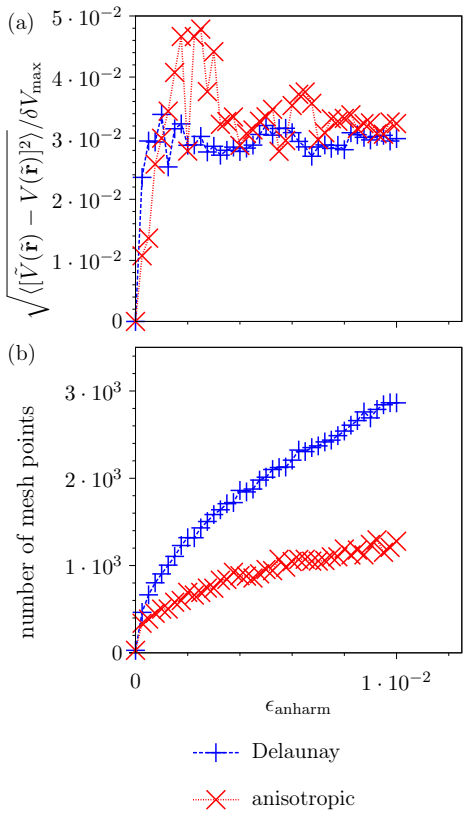
- For anharmonic systems, the anisotropic triangulation reaches the same interpolation accuracy as Delaunay with fewer than half the mesh points, so it should be considered whenever the potential is strongly anisotropic.
Reading between the lines
- The δV criterion is validated only empirically beyond one dimension; a rigorous bound could be obtained by estimating the third-derivative tensor inside each simplex, which would turn the heuristic into a provable guarantee.
- The same anisotropic cost function could be attached to other local interpolants, such as modified Shepard or moving least squares, to build problem-adapted meshes for those methods.
- Because the mesh stores energy and gradient data, it is a reusable surrogate for the potential energy surface; one could test whether a mesh trained on one isotopologue transfers to another with minimal additional exact evaluations.
- A potential failure mode is silent under-refinement: if δV underestimates the true error in some region of configuration space, the algorithm would accept inaccurate energies without warning. A targeted test with a crafted potential having large third derivatives inside a simplex but nearly zero at its vertices would reveal whether this can happen.
Editorial analysis
A structured set of objections, weighed in public.
Referee Report
Summary. The manuscript presents an on-the-fly interpolation method for potential energies in Monte Carlo and path integral Monte Carlo simulations. The algorithm maintains a simplicial mesh of points at which the potential and its gradient have been computed exactly; for a query point, it locates the containing simplex, evaluates the interpolant of Eq. (5) (a barycentric-weighted combination of vertex-based partial interpolants, exact for quadratic potentials), and accepts the value when the reliability indicator δV of Eq. (6) is below a user-set threshold δVmax. If the point lies outside the convex hull or δV is too large, a new mesh point is added and the triangulation is updated by Lawson flips, using either the Delaunay cost (Eq. 11) or a proposed anisotropic cost (Eq. 12). The method is tested on two-dimensional quartic oscillators and on the path integral Monte Carlo evaluation of the HCN/DCN equilibrium isotope effect, reporting interpolation RMSEs well below δVmax and a reduction of exact potential evaluations by roughly four orders of magnitude in the HCN/DCN test.
Significance. If the reliability of the interpolation can be established, this is a useful and practical contribution. The interpolant is simple, exact for harmonic potentials, and the mesh-based search scales logarithmically with the number of stored points; the numerical tests are carefully executed, using block-averaged error bars and benchmark comparisons, and the reported isotope effects agree with the exact PIMC benchmarks to better than 1%. The reduction in the number of exact potential evaluations (from about 10^8–10^9 to about 10^4 in the HCN/DCN test) is impressive. The principal weakness is that the error-control mechanism, Eq. (6), is only a rigorous bound in one dimension; in higher dimensions it is a heuristic whose failure modes are not analyzed. This limits the generality of the central claim but does not invalidate the empirical demonstration.
major comments (2)
- [II A, Eq. (6)] For D>1, the indicator δV(r) defined in Eq. (6) is not a bound on the true interpolation error and can be exactly zero while the error is nonzero. For a fixed simplex and query point, the quantities V~j(r) are linear functionals of the cubic part of V; in D=2, the four independent cubic coefficients are constrained by only two independent conditions when all three pairwise differences V~j−V~k vanish (the third is redundant). Hence there exist nonzero cubic potentials for which δV(r)=0 but V~(r)≠V(r). Since the interpolant is exact for quadratics, the error is dominated by such cubic terms, and scaling the cubic component makes the accepted error arbitrarily large while the gate remains closed. The authors acknowledge in Sec. II A that the estimate only 'seems to perform qualitatively correctly' in higher dimensions, but this assertion is load-bearing: δVmax controls mesh density and the decision to accept interpolation. The random exact evaluations used for calibration estimate only an average RMSE and cannot detect rare, spatially localized high-error points; evidence of such rare events is visible in Table III, where the 500 K anisotropic-triangulation RMSE has a block-averaged error of 0.8×10^-6 (relative to a mean of 5.7×10^-6). I recommend adding either a rigorous error bound under explicit assumptions on the third derivatives and simplex geometry, a conservative fallback that exact-evaluates when the simplex is large or δV is ambiguous, or a systematic numerical study with potentials designed to hit the kernel of the gate.
- [III B, Table III] The paper claims that the method 'can replace exact potential energy evaluations' while maintaining a preset accuracy, but the evidence for this is empirical and limited to two systems. The HCN potential is nearly harmonic, where the interpolant is almost exact by construction, and the quartic oscillator is two-dimensional. The large block-averaged uncertainties in some RMSE entries (e.g., 500 K anisotropic row in Table III) indicate that rare large interpolation errors do occur and are not captured by the small number of random exact checks (about 100 per simulation). To support the central claim, the authors should either provide a rigorous accuracy guarantee for D>1 or explicitly reframe the method as a heuristic with empirical calibration, and add a test case specifically designed to challenge the reliability gate (e.g., a potential with a strong cubic component in a direction that makes δV small).
minor comments (6)
- [Abstract] There is a missing space in 'HCN/DCNequilibrium isotope effect' in the abstract; the same ligature-related spacing issue appears in the conclusion ('anisotropictriangulationachievessimilarinterpolationerrors').
- [II A] The phrase 'yields an exact estimate' for the one-dimensional case would be clearer as 'yields an exact upper bound', since Eq. (6) with D=1 provides |V~−V|≤δV rather than an equality.
- [II B, Eq. (12)] The sentence describing g_anisotr as 'a qualitative estimate of the upper bound for interpolation error' is misleading, because no upper bound is proven; suggest rewording to 'a qualitative indicator of the interpolation error within a simplex'.
- [II C] The search procedure uses 'k-trees', which is usually written 'kd-trees'; the claim that the cost of selecting the initial simplex is 'approximately constant' is not demonstrated and may depend on the triangulation quality.
- [III B 1] The number of replicas P is assigned by linear interpolation in 1/T, but the paper does not specify how P is rounded or whether the values at intermediate temperatures are integer; this should be clarified for reproducibility.
- [Appendix A] The pseudo-code does not include the constraint-handling modifications described in the text (e.g., the checks for faces lying in constraining planes and the treatment of zero-volume simplices); making the pseudo-code self-contained would improve reproducibility.
Circularity Check
No significant circularity: interpolation accuracy and isotope effects are benchmarked against exact evaluations, and no target quantity is used to set method parameters.
full rationale
The paper's central claim is that its on-the-fly simplicial-mesh interpolation, using the Eq. (5) interpolant with either Delaunay or anisotropic triangulation, can replace exact potential energy evaluations in Monte Carlo and path integral Monte Carlo simulations while keeping interpolation error below a preset threshold. Tracing the derivation chain shows no load-bearing step that reduces to its own inputs. The interpolant is constructed to be exact for quadratic potentials, and this property is verified in a harmonic test, but that is a mathematical design property, not a prediction extracted from the test. The mesh-adaptation gate uses the error proxy δV of Eq. (6); the paper explicitly states that the exact bound holds in one dimension and that for higher dimensions the estimate only 'seems to perform qualitatively correctly.' This is a heuristic validity assumption, and therefore a correctness risk, but it is not circular: δV is computed from the same interpolants, not fitted to any target observable, and δVmax is a user-chosen accuracy tolerance. The paper independently calibrates the adequacy of δVmax by performing a small number of extra exact potential evaluations and computing the actual interpolation RMSE; this is a verification step, not parameter fitting to a desired result. The HCN/DCN isotope effect is compared with benchmark path integral calculations using the original force field, with agreement within about 1%; no constant in the interpolation algorithm was tuned to reproduce these isotope effects. The mesh parameters (δVmax, cpush, δGmin) are robustness settings, while the reported RMSEs and isotope-effect values are outputs, not fitting targets. Self-citations in the paper are limited to prior method developments, and none is invoked as a unique theorem to forbid alternatives. The strongest concern raised by the skeptical reading is that the δV gate may be blind to some errors in more than one dimension, but that is an empirical and mathematical robustness issue, not a circularity of the derivation. Consequently, the paper's central results are self-contained against external benchmarks, and no circular step can be exhibited.
Assumptions & free parameters
free parameters (4)
- deltaVmax (interpolation reliability threshold) =
3.125e-2 for the oscillator; 1e-4 a.u. for HCN
- deltaGmin (Lawson flip tolerance) =
not specified numerically
- cpush (outward push distance) =
not specified numerically
- probability of exact recalibration =
10^-5 per interpolation
assumptions (4)
- standard math Convex hull and triangulation update algorithms (Lawson flips, conflict zone) correctly maintain a triangulation of the mesh.
- ad hoc to paper deltaV(r) from Eq. (6) is a qualitative proxy for interpolation error in D>1.
- domain assumption Interpolation error and deltaV are both proportional to the magnitude of third derivatives in a small simplex, so halving deltaVmax approximately halves the RMSE.
- ad hoc to paper Anisotropic Lawson flips with g_anisotr terminate at a useful triangulation.
Cite this review
Pith. "Pith review of A combined on-the-fly/interpolation procedure for evaluating energy values needed in molecular simulations." pith.science (2026). https://pith.science/paper/H57OP5Z3
@misc{pith2026190806960,
  author       = {Pith},
  title        = {Pith review of: A combined on-the-fly/interpolation procedure for evaluating energy values needed in molecular simulations},
  year         = {2026},
  howpublished = {\url{https://pith.science/paper/H57OP5Z3}},
  note         = {Machine review of arXiv:1908.06960}
}
read the original abstract
We propose an algorithm for molecular dynamics or Monte Carlo simulations that uses an interpolation procedure to estimate potential energy values from energies and gradients evaluated previously at points of a simplicial mesh. We chose an interpolation procedure which is exact for harmonic systems and considered two possible mesh types: Delaunay triangulation and an alternative anisotropic triangulation designed to improve performance in anharmonic systems. The mesh is generated and updated on the fly during the simulation. The procedure is tested on two-dimensional quartic oscillators and on the path integral Monte Carlo evaluation of HCN/DCN equilibrium isotope effect.
Figures


Reference graph
Works this paper leans on
-
[1]
author author C. Song \ and\ author T. J. \ Mart\' i nez ,\ https://doi.org/10.1063/1.4948438 journal journal J. Chem. Phys. \ volume 144 ,\ eid 174111 ( year 2016 ) NoStop
-
[2]
author author G. Jeanmairet , author S. Sharma , \ and\ author A. Alavi ,\ https://doi.org/10.1063/1.4974177 journal journal J. Chem. Phys. \ volume 146 ,\ eid 044107 ( year 2017 ) NoStop
-
[3]
author author A. P\' e rez , author M. E. \ Tuckerman , author H. P. \ Hjalmarson , \ and\ author O. A. \ von Lilienfeld ,\ https://doi.org/10.1021/ja102004b journal journal J. Am. Chem. Soc. \ volume 132 ,\ eid 11510 ( year 2010 ) NoStop
-
[4]
author author P. Gasparotto , author A. A. \ Hassanali , \ and\ author M. Ceriotti ,\ https://doi.org/10.1021/acs.jctc.5b01138 journal journal J. Chem. Theory Comput. \ volume 12 ,\ eid 1953 ( year 2016 ) NoStop
-
[5]
author author R. P. \ de Tudela \ and\ author D. Marx ,\ https://doi.org/10.1103/PhysRevLett.119.223001 journal journal Phys. Rev. Lett. \ volume 119 ,\ eid 223001 ( year 2017 ) NoStop
-
[6]
author author G. A. \ Worth , author M. A. \ Robb , \ and\ author I. Burghardt ,\ https://doi.org/10.1039/B314253A journal journal Faraday Discuss. \ volume 127 ,\ eid 307 ( year 2004 ) NoStop
doi:10.1039/b314253a 2004
-
[7]
author author R. Ianconescu , author J. Tatchen , \ and\ author E. Pollak ,\ https://doi.org/10.1063/1.4825040 journal journal J. Chem. Phys. \ volume 139 ,\ eid 154311 ( year 2013 ) NoStop
-
[8]
author author B. F. E. \ Curchod \ and\ author T. J. \ Mart\' i nez ,\ https://doi.org/10.1021/acs.chemrev.7b00423 journal journal Chem. Rev. \ volume 118 ,\ eid 3305 ( year 2018 ) NoStop
Show all 57 references
-
[9]
author author K. E. \ Spinlove , author G. W. \ Richings , author M. A. \ Robb , \ and\ author G. A. \ Worth ,\ https://doi.org/10.1039/C8FD00090E journal journal Faraday Discuss. \ volume 212 ,\ eid 191 ( year 2018 ) NoStop
2018 doi
-
[10]
Patoz , author T
author author A. Patoz , author T. Begu s i\' c , \ and\ author J. Van\' i c ek ,\ https://doi.org/10.1021/acs.jpclett.8b00827 journal journal J. Phys. Chem. Lett. \ volume 9 ,\ eid 2367 ( year 2018 ) NoStop
2018 doi
-
[11]
Micciarelli , author F
author author M. Micciarelli , author F. Gabas , author R. Conte , \ and\ author M. Ceotto ,\ https://doi.org/10.1063/1.5096968 journal journal J. Chem. Phys. \ volume 150 ,\ eid 184113 ( year 2019 ) NoStop
2019 doi
-
[12]
Laude , author D
author author G. Laude , author D. Calderini , author D. P. \ Tew , \ and\ author J. O. \ Richardson ,\ https://doi.org/10.1039/C8FD00085A journal journal Faraday Discuss. \ volume 212 ,\ eid 237 ( year 2018 ) NoStop
2018 doi
-
[13]
Conte , author F
author author R. Conte , author F. Gabas , author G. Botti , author Y. Zhuang , \ and\ author M. Ceotto ,\ https://doi.org/10.1063/1.5109086 journal journal J. Chem. Phys. \ volume 150 ,\ eid 244118 ( year 2019 ) NoStop
2019 doi
-
[14]
Ischtwan \ and\ author M
author author J. Ischtwan \ and\ author M. A. \ Collins ,\ https://doi.org/10.1063/1.466801 journal journal J. Chem. Phys. \ volume 100 ,\ eid 8080 ( year 1994 ) NoStop
1994 doi
-
[15]
author author T. J. \ Frankcombe , author M. A. \ Collins , \ and\ author G. A. \ Worth ,\ https://doi.org/10.1016/j.cplett.2010.02.068 journal journal Chem. Phys. Lett. \ volume 489 ,\ eid 242 ( year 2010 ) NoStop
2010 doi
-
[16]
Evenhuis \ and\ author T
author author C. Evenhuis \ and\ author T. J. \ Mart \'i nez ,\ https://doi.org/10.1063/1.3660686 journal journal J. Chem. Phys. \ volume 135 ,\ eid 224110 ( year 2011 ) NoStop
2011 doi
-
[17]
author author C. W. \ Kim \ and\ author Y. M. \ Rhee ,\ https://doi.org/10.1021/acs.jctc.6b00647 journal journal J. Chem. Theory Comput. \ volume 12 ,\ eid 5235 ( year 2016 ) NoStop
2016 doi
-
[18]
Huang , author B
author author X. Huang , author B. J. \ Braams , \ and\ author J. M. \ Bowman ,\ https://doi.org/10.1063/1.1834500 journal journal J. Chem. Phys. \ volume 122 ,\ eid 044308 ( year 2005 ) NoStop
2005 doi
-
[19]
Guo , author A
author author Y. Guo , author A. Kawano , author D. L. \ Thompson , author A. F. \ Wagner , \ and\ author M. Minkoff ,\ https://doi.org/10.1063/1.1777572 journal journal J. Chem. Phys. \ volume 121 ,\ eid 5091 ( year 2004 ) NoStop
2004 doi
-
[20]
Dawes , author X.-G
author author R. Dawes , author X.-G. \ Wang , author A. W. \ Jasper , \ and\ author T. Carrington Jr. ,\ https://doi.org/10.1063/1.3494542 journal journal J. Chem. Phys. \ volume 133 ,\ eid 134304 ( year 2010 ) NoStop
2010 doi
-
[21]
author author J. P. \ Alborzpour , author D. P. \ Tew , \ and\ author S. Habershon ,\ https://doi.org/10.1063/1.4964902 journal journal J. Chem. Phys. \ volume 145 ,\ eid 174112 ( year 2016 ) NoStop
2016 doi
-
[22]
author author G. W. \ Richings \ and\ author S. Habershon ,\ https://doi.org/10.1016/j.cplett.2017.01.063 journal journal Chem. Phys. Lett. \ volume 683 ,\ eid 228 ( year 2017 ) NoStop
2017 doi
-
[23]
author author T. B. \ Blank , author S. D. \ Brown , author A. W. \ Calhoun , \ and\ author D. J. \ Doren ,\ https://doi.org/10.1063/1.469597 journal journal J. Chem. Phys. \ volume 103 ,\ eid 4129 ( year 1995 ) NoStop
1995 doi
-
[24]
Manzhos , author X
author author S. Manzhos , author X. Wang , author R. Dawes , \ and\ author T. Carrington Jr. ,\ https://doi.org/10.1021/jp055253z journal journal J. Phys. Chem. A \ volume 110 ,\ eid 5295 ( year 2006 ) NoStop
2006 doi
-
[25]
Malshe , author L
author author M. Malshe , author L. M. \ Raff , author M. Hagan , author S. Bukkapatnam , \ and\ author R. Komanduri ,\ https://doi.org/10.1063/1.3431624 journal journal J. Chem. Phys. \ volume 132 ,\ eid 204103 ( year 2010 ) NoStop
2010 doi
-
[26]
Gastegger , author J
author author M. Gastegger , author J. Behler , \ and\ author P. Marquetand ,\ https://doi.org/10.1039/C7SC02267K journal journal Chem. Sci. \ volume 8 ,\ eid 6924 ( year 2017 ) NoStop
2017 doi
-
[27]
author author M. R. \ Salazar \ and\ author R. L. \ Bell ,\ https://doi.org/10.1002/(SICI)1096-987X(199810)19:13<1431::AID-JCC1>3.0.CO;2-R journal journal J. Comput. Chem. \ volume 19 ,\ eid 1431 ( year 1998 ) NoStop
1998 doi
-
[28]
author author M. R. \ Salazar ,\ https://doi.org/10.1016/S0009-2614(02)00744-3 journal journal Chem. Phys. Lett. \ volume 359 ,\ eid 460 ( year 2002 ) NoStop
2002 doi
-
[29]
Hornus \ and\ author J
author author S. Hornus \ and\ author J. D. \ Boissonnat ,\ https://hal.inria.fr/inria-00343188 title An efficient implementation of Delaunay triangulations in medium dimensions , \ ( year 2008 ),\ note [Research Report] RR-6743, INRIA. Stop
2008
-
[30]
author author R. W. \ Clough \ and\ author J. L. \ Tocher ,\ in\ http://contrails.iit.edu/items/show/8574 booktitle Proceedings of the Conference on Matrix Methods in Structural Mechanics \ ( year 1966 )\ pp.\ pages 515--545 NoStop
1966
-
[31]
Alfeld ,\ https://doi.org/10.1016/0167-8396(84)90029-3 journal journal Comput
author author P. Alfeld ,\ https://doi.org/10.1016/0167-8396(84)90029-3 journal journal Comput. Aided Geom. Des. \ volume 1 ,\ eid 169 ( year 1984 ) NoStop
1984 doi
-
[32]
Alfeld ,\ https://doi.org/10.1137/0722006 journal journal SIAM J
author author P. Alfeld ,\ https://doi.org/10.1137/0722006 journal journal SIAM J. Numer. Anal. \ volume 22 ,\ eid 95 ( year 1985 ) NoStop
1985 doi
-
[33]
Dell'Accio , author F
author author F. Dell'Accio , author F. Di Tommaso , author O. Nouisser , \ and\ author B. Zerroudi ,\ https://doi.org/10.1016/j.apnum.2017.12.006 journal journal Appl. Numer. Math. \ volume 126 ,\ eid 78 ( year 2018 ) NoStop
2017 doi
-
[34]
Xuli ,\ https://doi.org/10.1016/j.jat.2003.08.001 journal journal J
author author H. Xuli ,\ https://doi.org/10.1016/j.jat.2003.08.001 journal journal J. Approx. Theory \ volume 124 ,\ eid 242 ( year 2003 ) NoStop
2003 doi
-
[35]
Guessab , author O
author author A. Guessab , author O. Nouisser , \ and\ author G. Schmeisser ,\ https://doi.org/10.1016/j.cam.2005.08.015 journal journal J. Comput. Appl. Math. \ volume 196 ,\ eid 162 ( year 2006 ) NoStop
2005 doi
-
[36]
author author R. P. A. \ Bettens \ and\ author M. A. \ Collins ,\ https://doi.org/10.1063/1.479368 journal journal J. Chem. Phys. \ volume 111 ,\ eid 816 ( year 1999 ) NoStop
1999 doi
-
[37]
author author C. L. \ Lawson ,\ https://doi.org/10.1016/0167-8396(86)90001-4 journal journal Comput. Aided Geom. Des. \ volume 3 ,\ eid 231 ( year 1986 ) NoStop
1986 doi
-
[38]
Edelsbrunner ,\ https://doi.org/10.1017/S0962492900001331 journal journal Acta Numer
author author H. Edelsbrunner ,\ https://doi.org/10.1017/S0962492900001331 journal journal Acta Numer. \ volume 9 ,\ eid 133 ( year 2000 ) NoStop
-
[39]
author author J. M. \ Mirebeau ,\ https://doi.org/10.1007/s00365-010-9090-y journal journal Constr. Approx. \ volume 32 ,\ eid 339 ( year 2010 ) NoStop
2010 doi
-
[40]
Bossen \ and\ author P
author author F. Bossen \ and\ author P. S. \ Heckbert ,\ in\ https://www.semanticscholar.org/paper/A-Pliant-Method-for-Anisotropic-Mesh-Generation-Bossen-Heckbert/12318fc5882e328a330640bf38f79da5c523e1a6 booktitle 5th International Meshing Roundtable \ ( year 1996 )\ pp.\ pag...
1996
-
[41]
Shimada , author A
author author K. Shimada , author A. Yamada , \ and\ author T. Itoh ,\ https://doi.org/10.1142/S0218195900000243 journal journal Int. J. Comput. Geom. Appl. \ volume 10 ,\ eid 417 ( year 2000 ) NoStop
-
[42]
author author J. D. \ Boissonnat , author M. Rouxel-Labb \'e , \ and\ author M. Wintraecken ,\ in\ http://doi.org/10.4230/LIPIcs.SoCG.2017.19 booktitle 33rd International Symposium on Computational Geometry (SoCG 2017) ,\ series Leibniz International Proceedings in Informatics...
2017 doi
-
[43]
Devillers , author S
author author O. Devillers , author S. Pion , \ and\ author M. Teillaud ,\ https://doi.org/10.1142/S0129054102001047 journal journal Int. J. Found. Comput. S. \ volume 13 ,\ eid 181 ( year 2002 ) NoStop
2002 doi
-
[44]
author author J. L. \ Bentley ,\ http://doi.org/10.1145/361002.361007 journal journal Commun. ACM \ volume 18 ,\ eid 509 ( year 1975 ) NoStop
1975
-
[45]
Flyvbjerg \ and\ author H
author author H. Flyvbjerg \ and\ author H. G. \ Petersen ,\ https://doi.org/10.1063/1.457480 journal journal J. Chem. Phys. \ volume 91 ,\ eid 461 ( year 1989 ) NoStop
1989 doi
-
[46]
author author M. F. \ Herman , author E. J. \ Bruskin , \ and\ author B. J. \ Berne ,\ https://doi.org/10.1063/1.442815 journal journal J. Chem. Phys. \ volume 76 ,\ eid 5150 ( year 1982 ) NoStop
1982 doi
-
[47]
author author M. E. \ Tuckerman , author B. J. \ Berne , author G. J. \ Martyna , \ and\ author M. L. \ Klein ,\ https://doi.org/10.1063/1.465188 journal journal J. Chem. Phys. \ volume 99 ,\ eid 2796 ( year 1993 ) NoStop
1993 doi
-
[48]
author author R. P. \ Feynman \ and\ author A. R. \ Hibbs ,\ @noop title Quantum mechanics and path integrals \ ( publisher McGraw-Hill ,\ year 1965 ) NoStop
1965
-
[49]
P\' e rez \ and\ author O
author author A. P\' e rez \ and\ author O. A. \ von Lilienfeld ,\ https://doi.org/10.1021/ct2000556 journal journal J. Chem. Theory Comput. \ volume 7 ,\ eid 2358 ( year 2011 ) NoStop
2011 doi
-
[50]
Cheng \ and\ author M
author author B. Cheng \ and\ author M. Ceriotti ,\ https://doi.org/10.1063/1.4904293 journal journal J. Chem. Phys. \ volume 141 ,\ eid 244112 ( year 2014 ) NoStop
2014 doi
-
[51]
author author V. Y. \ Makhnev , author A. A. \ Kyuberis , author O. L. \ Polyansky , author I. I. \ Mizus , author J. Tennyson , \ and\ author N. F. \ Zobov ,\ https://doi.org/10.1016/j.jms.2018.09.002 journal journal J. Mol. Spectrosc. \ volume 353 ,\ eid 40 ( year 2018 ) NoStop
2018 doi
-
[52]
Sprik , author M
author author M. Sprik , author M. L. \ Klein , \ and\ author D. Chandler ,\ https://doi.org/10.1103/physrevb.31.4234 journal journal Phys. Rev. B \ volume 31 ,\ eid 4234 ( year 1985 a ) NoStop
1985 doi
-
[53]
Sprik , author M
author author M. Sprik , author M. L. \ Klein , \ and\ author D. Chandler ,\ https://doi.org/10.1103/PhysRevB.32.545 journal journal Phys. Rev. B \ volume 32 ,\ eid 545 ( year 1985 b ) NoStop
1985 doi
-
[54]
author author H. C. \ Urey ,\ https://doi.org/10.1039/JR9470000562 journal journal J. Chem. Soc. \ volume 1947 ,\ eid 562 ( year 1947 ) NoStop
1947 doi
-
[55]
Wolfsberg , author W
author author M. Wolfsberg , author W. A. V. \ Hook , author P. Paneth , \ and\ author L. P. N. \ Rebelo ,\ https://doi.org/10.1007/978-90-481-2265-3 title Isotope Effects in the Chemical, Geological and Bio Sciences \ ( publisher McGraw-Hill ,\ year 2010 ) NoStop
-
[56]
author author M. A. \ Webb \ and\ author T. F. Miller III ,\ https://doi.org/10.1021/jp411134v journal journal J. Phys. Chem. A \ volume 118 ,\ eid 467 ( year 2014 ) NoStop
2014 doi
-
[57]
note Table tab:HCN_IE_errs shows that the largest number of mesh points was generated during the lowest temperature simulation. Because the spacing of mesh points does not depend on temperature, this suggests that the mesh generated at the lowest temperature covered the larges...
2014
Reviewed August 14, 2026 · model on record in the stance chip above.
Discussion (0). Continue with ORCID to comment.