REVIEW 3 major objections 5 minor 71 references
Typical and extreme entropies of long-lived isolated quantum systems
T0 review · 3 major / 5 minor · reviewed 2026-08-14 · deepseek-v4-flash
Pith's one-line read Observational entropy behaves like classical Boltzmann entropy even at its extreme values, while bipartite entanglement entropy does not.
desk verdict Solid numerical case that observational entropy, unlike entanglement entropy, behaves Boltzmann-like at its extremes, though the quantitative lower bound leans on a same-group analytic result that is only extrapolated to the thermodynamic limit. read the letter →
The pith
A machine-rendered reading of the paper's core claim, the machinery that carries it, and where it could break.
The reading
What carries the argument
The load-bearing object is the maximum localization probability $P_{\mathrm{max}}$: the largest probability, reachable by evolving a random pure thermal state unitarily, that all particles are found in a chosen spatial region of size $\Delta x$. A prior analytical result [47] bounds $P_{\mathrm{max}}\le 1/2$ for real initial states and $P_{\mathrm{max}}\le \pi^2/16$ for complex ones, provided the localized subspace is much smaller than the full Hilbert space, the region is larger than the thermal wavelength, and the interactions are local; the paper checks these conditions numerically on its fermionic lattice. Through the identity $S_{xE}(\mathrm{loc}) \ge (1-P_{\mathrm{max}})S_{\mathrm{th}}$, this bound turns the physical impossibility of concentrating all particles into a small region into a universal floor on observational entropy. The contrasting object for entanglement entropy is the upper bound in Eq. (5), derived in [59], which depends only on particle number and partition sizes and explains why the maximal entanglement entropy stays constant as the bath grows.
What would settle it
Directly maximize $P_{\mathrm{max}}$ over unitary evolution for many complex random pure thermal states in the same fermionic lattice with $N_p=3$, $L=30$ or larger, and a localized region satisfying the three stated conditions; if the mean maximum localization probability clearly exceeds $\pi^2/16$, the localization bound that produces the floor in Eq. (9) is false. Alternatively, prepare a cold-atom lattice in a thermal pure state, reconstruct $S_{xE}$ by coarse-grained counting, and look for a measured value below $(1-P_{\mathrm{max}})S_{\mathrm{th}}$.
Extended reading notes
Core claim
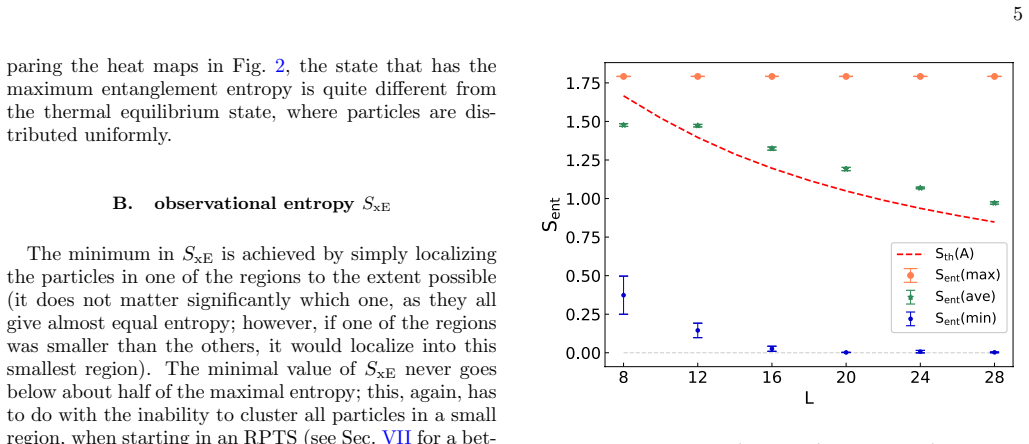
Using exact diagonalization of a one-dimensional fermionic lattice with $N_p=2$ or $3$ particles, the paper shows that over infinite-time unitary evolution starting from a random pure thermal state, the maximum and minimum of $S_{xE}$ are both close to its typical value and to the thermodynamic entropy $S_{\mathrm{th}}$, while the minimum of the bipartite entanglement entropy $S_{\mathrm{ent}}$ approaches zero and its maximum approaches a constant, $\ln 6$ for the parameters studied, that is independent of the bath size and much larger than the average. The quantitative anchor is the maximum localization probability $P_{\mathrm{max}}$: for initial real random pure thermal states $P_{\mathrm{max}}\le 1/2$, and for complex ones $P_{\mathrm{max}}\le \pi^2/16$, so a localized state obeys $S_{xE}(\mathrm{loc})\ge (1-P_{\mathrm{max}})S_{\mathrm{th}}$ and the minimum observational entropy stays at a fixed fraction of the thermodynamic entropy. The paper verifies the localization bound numerically for its interacting lattice, identifies the localized state as the one minimizing $S_{xE}$ (but not $S_{\mathrm{ent}}$), and concludes that observational entropy tracks Boltzmann entropy through the correspondence between macrostate size $\Omega$ and entropy, whereas entanglement entropy does not.
Load-bearing premise
The argument assumes that the localization bounds on $P_{\mathrm{max}}$, proved for random-vector and weakly-interacting-gas eigenstates, transfer to the physical non-random eigenstates of the interacting fermionic lattice and to the thermodynamic limit, with the constants $1/2$ and $\pi^2/16$ approached quickly enough.
Editorial extensions
If this is right
- If $S_{xE}$ is Boltzmann-like, then a single coarse-grained measurement protocol gives a practical measure of how far an isolated system is from thermal equilibrium, including during rare large fluctuations.
- Starting from a random pure thermal state, observational entropy cannot fluctuate below about half of the thermodynamic entropy, so spontaneous concentration of particles into a small region is limited in entropy cost; entanglement entropy has no such floor and can vanish.
- The maximal entanglement entropy is not a symptom of a large macrostate: it is achieved by non-typical configurations with balanced particle numbers in the two partitions, and it stays constant as the bath size grows.
- The gap between maximal and typical entanglement entropy grows with system size, so any claim that uses extreme entanglement values as a thermodynamic entropy proxy becomes worse for larger systems.
Reading between the lines
- If the localization bound is the true origin of the $S_{xE}$ floor, then the same floor should appear for other spatial coarse-grainings finer than the thermal wavelength; varying $\Delta x$ and comparing measured minima with Eq. (9) would test this directly.
- The dip in $S_{xE}(\mathrm{min})$ near $\beta\approx 0.5$ suggests a temperature-controlled crossover in the ability to localize particles at the coarse-graining scale, which might be observable in cold-atom experiments as a change in the rarity of low-entropy configurations.
- A closely related question not settled here is whether the sum of local von Neumann entropies, a multipartite entanglement measure, also obeys a $(1-P_{\mathrm{max}})$-type floor; this is a direct extension of the paper's closing observation.
- For cosmological questions such as the arrow of time, the relevant entropy should be one that is bounded below even under extreme fluctuations and remains defined for a closed system; observational entropy is a concrete candidate if its localization floor survives in a gravitational state space.
Editorial analysis
A structured set of objections, weighed in public.
Referee Report
Summary. This paper compares two entropy measures for isolated quantum systems out of equilibrium: bipartite entanglement entropy and observational entropy with position-and-energy coarse graining. Using exact diagonalization of a one-dimensional lattice of interacting spinless fermions (N_p = 2 or 3, L up to 30, starting from random pure thermal states), the authors characterize the typical, maximal, and minimal values reached under unitary evolution. They report that observational entropy behaves qualitatively like classical Boltzmann entropy even at its extremes: the maximum is close to the uniform thermal state, and the minimum is bounded below at roughly half the thermodynamic entropy, achieved by localizing particles as much as possible. In contrast, entanglement entropy is minimized by emptying the subsystem and maximized by splitting particles between the two partitions, and neither extreme is typical. The quantitative anchor is Eq. (9), S_xE(loc) ≥ (1 - P_max) S_th, where P_max ≤ 1/2 (real pure thermal states) or π²/16 (complex pure thermal states) comes from the authors' earlier work [47].
Significance. If established, the paper's central distinction is significant: observational entropy would be a Boltzmann-like entropy that remains physically meaningful far from equilibrium and at extreme fluctuations, whereas bipartite entanglement entropy would not. This matters for discussions of thermalization, entropy production, and arrow-of-time questions in closed systems. The manuscript is transparent about its numerical setup, uses exact diagonalization with explicitly stated parameters, reports error bars from six initial states, and connects its results to analytic bounds. It does not, however, ship code or data, and its quantitative claims rely on a transfer of results from a companion paper [47] that is tested here only on very small systems.
major comments (3)
- [Sec. VI, Eqs. (8)-(9)] The lower bound S_xE(loc) ≥ (1 - P_max) S_th is load-bearing for the paper's central claim that observational entropy cannot fall below about half its maximum, but the constants 1/2 and π²/16 are proved in Ref. [47] for random energy eigenvectors and a weakly interacting gas, not for the interacting fermionic lattice used here. The numerical transfer test in Fig. 8 uses N_p = 3 and L ≤ 30, where N/M² ≈ 40.6 at L = 30 (N = C(30,3) = 4060, M = C(5,3) = 10); this is a modest ratio, and the paper itself notes that 'the presence of some fluctuations is expected since our model is a real system with non-random energy eigenvectors.' Since a larger P_max in the thermodynamic limit would weaken or erase the lower bound, please add a finite-size scaling analysis of P_max as a function of N/M² at fixed β and Δx, and investigate the sensitivity of the limiting P_max to the interaction strengths V, V′ and to N_p. Without this, the claim that S_xE(min) cannot fall below roughly half of S_th is an extrapolation rather than an established result.
- [Sec. III (simplex search algorithm)] The reported global minima and maxima of Sent and SxE are obtained with a local simplex search over phases φ_E = Et, with no demonstration that the search is globally convergent. For nonconvex entropy landscapes this is a real risk: the values labeled 'Sent(min)', 'Sent(max)', and 'SxE(min)' could be local extrema, and the quantitative statements such as 'Sent(min) ≈ 0.05' or 'SxE(min) ≈ 63% of the maximum' could be artifacts of the starting point. Because the paper's central claims concern extreme values, please establish robustness of the extrema, for example by repeated optimization from many random phase initializations, or by an exhaustive phase grid for small L where the Hilbert-space dimension is small enough, and report the spread of the resulting extrema.
- [Sec. VII, Eq. (8)] Equation (8) is stated without derivation and is attributed to Ref. [47], which shares three authors with this paper. Since Eq. (9) is the quantitative anchor for the main conclusion, the manuscript should either reproduce the derivation in an appendix or state precisely which conditions from Ref. [47] guarantee the formula, including the large-L assumption and the treatment of finite-size corrections. Note also that Eq. (8) is then plotted in Fig. 9 for system sizes as small as L = 8, even though it is introduced as a large-L expression; the expected finite-size error at these small L should be quantified or the plot restricted to the regime of validity.
minor comments (5)
- [Sec. I and Sec. III] The word 'compliment' appears where 'complement' is meant (e.g., 'between a subsystem and its compliment').
- [Sec. VI] The condition on the Hilbert-space dimensions appears to be typeset as 'N ≥ M²'; it should be 'N ≫ M²' to match the condition required by the argument in Ref. [47].
- [Sec. II] The paper takes t = t′ = 1.9 and V = V′ = 0.5 for all simulations, but does not discuss whether this parameter set is in the non-integrable regime or how the qualitative conclusions depend on the choice of couplings; a brief justification or a test with different couplings would make the numerics more convincing.
- [Sec. III] The description of the histogram construction says the system is evolved 'for a long time' and sampled 'at each small fixed time step,' but the actual time step and total duration are not stated; these details matter for assessing whether the sampled distribution is representative of the long-time behavior.
- [Fig. 10 and associated text] The presentation of macrostate sizes and the percentages in Fig. 10 is hard to follow; please clarify the definitions of Ω and the percentages in the caption or in the main text so that the claimed correspondence between macrostate size and observational entropy can be checked directly.
Circularity Check
No significant circularity: Eqs. (8)/(9) rest on an independent parameter-free bound (Ref. [47]) with numerical transfer checks in Sec. VI, and no fitted input is relabeled as a prediction.
full rationale
The central quantitative claim, SxE(loc) >= (1 - Pmax) Sth, is not produced by fitting the present data. It is taken from Ref. [47], a separate parameter-free derivation for random energy eigenvectors and a weakly interacting gas, and the paper then independently tests the relevant bound Pmax <= 1/2 (real) or pi^2/16 (complex) on the interacting fermionic lattice in Sec. VI (Fig. 8). Section VII compares the resulting Eq. (8) with numerically minimized SxE, so the comparison is evidence, not an input. The qualitative statement that SxE is Boltzmann-like is indeed partly built into the definition of observational entropy as a coarse-grained Shannon entropy over macrostate volumes (Appendix A): this is a design feature of the quantity rather than a hidden derivation step, and the paper's nontrivial content lies in the extreme-value characterization and the contrast with entanglement entropy, which are computed independently. The remaining concerns about finite-size extrapolation from L <= 30 are correctness risks, not circularity.
Assumptions & free parameters
free parameters (4)
- Hamiltonian couplings t=t'=1.9, V=V'=0.5
- Inverse temperature beta=0.01 for most runs
- Subsystem and partition size Delta x=4, or 5 in Sec. VI
- Number of particles Np=2 or 3
assumptions (5)
- domain assumption The energy eigenstates of the fermionic lattice are sufficiently ETH-like that the Pmax bounds of Ref. [47] apply.
- domain assumption The Nelder-Mead simplex search over phases phi_E attains the global entropy extrema.
- standard math Maximizing over phases phi_E = E t is equivalent to maximizing over all times because energy spacings are effectively irrational.
- domain assumption Finite-size results with Np <= 3 and L <= 30 represent the thermodynamic limit trends.
- domain assumption A random pure thermal state is a valid stand-in for the canonical thermal state at the chosen beta.
Cite this review
Pith. "Pith review of Typical and extreme entropies of long-lived isolated quantum systems." pith.science (2026). https://pith.science/paper/K7M5P2NK
@misc{pith2026190807083,
  author       = {Pith},
  title        = {Pith review of: Typical and extreme entropies of long-lived isolated quantum systems},
  year         = {2026},
  howpublished = {\url{https://pith.science/paper/K7M5P2NK}},
  note         = {Machine review of arXiv:1908.07083}
}
read the original abstract
In this paper, we investigate and compare two well-developed definitions of entropy relevant for describing the dynamics of isolated quantum systems: bipartite entanglement entropy and observational entropy. In a model system of interacting particles in a one-dimensional lattice, we numerically solve for the full quantum behavior of the system. We characterize the fluctuations, and find the maximal, minimal, and typical entropy of each type that the system can eventually attain through its evolution. While both entropies are low for some "special" configurations and high for more "generic" ones, there are several fundamental differences in their behavior. Observational entropy behaves in accord with classical Boltzmann entropy (e.g. equilibrium is a condition of near-maximal entropy and uniformly distributed particles, and minimal entropy is a very compact configuration). Entanglement entropy is rather different: minimal entropy "empties out" one partition while maximal entropy apportions the particles between the partitions, and neither is typical. Beyond these qualitative results, we characterize both entropies and their fluctuations in some detail as they depend on temperature, particle number, and box size.
Figures


Figures from the paper (6 more)


Reference graph
Works this paper leans on
- [59]
-
[47]
J. M. Deutsch, D. ˇSafr´ anek, and A. Aguirre, Phys. Rev. E 101, 032112 (2020)
work page 2020
-
[1]
D. N. Page, Phys. Rev. Lett. 71, 1291 (1993)
1993
-
[2]
Grasselli, Master’s thesis, Universit` a degli Studi di Perugia (2014)
F. Grasselli, Master’s thesis, Universit` a degli Studi di Perugia (2014)
work page 2014
- [3]
- [4]
-
[5]
J. M. Deutsch, H. Li, and A. Sharma, Phys. Rev. E 87, 042135 (2013)
work page 2013
- [6]
Show all 71 references
-
[7]
A. M. Kaufman, M. E. Tai, A. Lukin, M. Rispoli, R. Schittko, P. M. Preiss, and M. Greiner, Science 353, 794 (2016)
2016
-
[8]
T. J. Osborne and M. A. Nielsen, Phys. Rev. A 66, 032110 (2002)
2002
-
[9]
J. I. Latorre, E. Rico, and G. Vidal, Quant. Inf. Comput. 4, 48 (2003)
2003
-
[10]
Vidal, J
G. Vidal, J. I. Latorre, E. Rico, and A. Kitaev, Phys. Rev. Lett. 90, 227902 (2003)
2003
-
[11]
Emparan, J
R. Emparan, J. High Energy Phys. 2006, 012 (2006)
2006
-
[12]
Nishioka, Rev
T. Nishioka, Rev. Mod. Phys. 90, 035007 (2018)
2018
-
[13]
Mukohyama, Phys
S. Mukohyama, Phys. Rev. D 58, 104023 (1998)
1998
-
[14]
R. G. Unanyan and M. Fleischhauer, Phys. Rev. Lett. 95, 260604 (2005)
2005
-
[15]
Cho, Phys
J. Cho, Phys. Rev. X 8, 031009 (2018)
2018
-
[16]
ˇSafr´ anek, J
D. ˇSafr´ anek, J. M. Deutsch, and A. Aguirre, Phys. Rev. A 99, 010101(R) (2019)
2019
-
[17]
ˇSafr´ anek, J
D. ˇSafr´ anek, J. M. Deutsch, and A. Aguirre, Phys. Rev. A 99, 012103 (2019)
2019
-
[18]
ˇSafr´ anek, A
D. ˇSafr´ anek, A. Aguirre, and J. M. Deutsch, arXiv:1905.03841 [cond-mat.stat-mech] (2019)
2019 arXiv
-
[19]
von Neumann, Eur
J. von Neumann, Eur. Phys. J. H 35, 201 (2010). 4 Note that switching the order of coarse-graining, leads to an entropy SEx that is always lower than the thermodynamic en- tropy in both high and low-temperature limit as per Eq. (A4), SEx ≤SE (ˆρ)≤Sth, but comes with its own se...
2010
-
[20]
von Neumann, Mathematical foundations of quantum mechanics (Princeton university press, Princeton, 1955), pp
J. von Neumann, Mathematical foundations of quantum mechanics (Princeton university press, Princeton, 1955), pp. 410–416
1955
-
[21]
Wehrl, Rev
A. Wehrl, Rev. Mod. Phys 50, 221 (1978)
1978
-
[22]
C. S. Lent, Phys. Rev. E 100, 012101 (2019)
2019
-
[23]
Goldstein, J
S. Goldstein, J. L. Lebowitz, Tumulka, and N. Zanghi, arXiv:1903.11870 [cond-mat.stat-mech] (2019)
2019 arXiv
-
[24]
Gemmer and R
J. Gemmer and R. Steinigeweg, Phys. Rev. E 89, 042113 (2014)
2014
-
[25]
Strasberg, arXiv:1906.09933 [cond-mat.stat-mech] (2019)
P. Strasberg, arXiv:1906.09933 [cond-mat.stat-mech] (2019)
2019 arXiv
-
[26]
Boltzmann, in The kinetic theory of gases: an anthol- ogy of classic papers with historical commentary (World Scientific, Hackensack, 2003), pp
L. Boltzmann, in The kinetic theory of gases: an anthol- ogy of classic papers with historical commentary (World Scientific, Hackensack, 2003), pp. 262–349
2003
-
[27]
Dunkel and S
J. Dunkel and S. Hilbert, Nat. Phys. 10, 67 (2014)
2014
-
[28]
Hilbert, P
S. Hilbert, P. H¨ anggi, and J. Dunkel, Phys. Rev. E 90, 062116 (2014)
2014
-
[29]
Schneider, S
U. Schneider, S. Mandt, A. Rapp, S. Braun, H. Weimer, I. Bloch, and A. Rosch, arXiv:1407.4127 [cond- mat.quant-gas] (2014)
2014 arXiv
-
[30]
Buonsante, R
P. Buonsante, R. Franzosi, and A. Smerzi, Ann. Physics 375, 414 (2016)
2016
-
[31]
Goldstein and J
S. Goldstein and J. L. Lebowitz, Physica D 193, 53 (2004)
2004
-
[32]
S. G. Brush, History of the Kinetic Theory of Gases (Is- tituto della Enciclopedia Italiana, 2004), vol. 7, chap. 44
2004
-
[33]
D. J. Evans, E. G. D. Cohen, and G. P. Morriss, Phys. Rev. Lett. 71, 2401 (1993)
1993
-
[34]
Jarzynski, Phys
C. Jarzynski, Phys. Rev. Lett. 78, 2690 (1997)
1997
-
[35]
G. E. Crooks, Phys. Rev. E 60, 2721 (1999)
1999
-
[36]
Seifert, Rep
U. Seifert, Rep. Prog. Phys. 75, 126001 (2012)
2012
-
[37]
Luposchainsky, A
D. Luposchainsky, A. C. Barato, and H. Hinrichsen, Phys. Rev. E 87, 042108 (2013)
2013
-
[38]
Talkner, P
P. Talkner, P. H¨ anggi, and M. Morillo, Phys. Rev. E77, 051131 (2008)
2008
-
[39]
Esposito, U
M. Esposito, U. Harbola, and S. Mukamel, Rev. Mod. Phys. 81, 1665 (2009)
2009
-
[40]
S. Rana, S. Lahiri, and A. Jayannavar, Pramana J. Phys. 80, 207 (2013)
2013
-
[41]
Esposito and S
M. Esposito and S. Mukamel, Phys. Rev. E 73, 046129 (2006)
2006
-
[42]
Brunelli, L
M. Brunelli, L. Fusco, R. Landig, W. Wieczorek, J. Hoelscher-Obermaier, G. Landi, F. L. Semi˜ ao, A. Fer- raro, N. Kiesel, T. Donner, et al., Phys. Rev. Lett. 121, 160604 (2018)
2018
-
[43]
Manzano, J
G. Manzano, J. M. Horowitz, and J. M. R. Parrondo, Phys. Rev. X 8, 031037 (2018)
2018
-
[44]
Popescu, A
S. Popescu, A. J. Short, and A. Winter, Nat. Phys. 2, 754 (2006)
2006
-
[45]
J. M. Deutsch, New J. Phys. 12, 075021 (2010)
2010
-
[46]
L. F. Santos, A. Polkovnikov, and M. Rigol, Phys. Rev. E 86, 010102(R) (2012)
2012
-
[48]
Coffman, J
V. Coffman, J. Kundu, and W. K. Wootters, Phys. Rev. A 61, 052306 (2000). 14
2000
-
[49]
Rigolin, T
G. Rigolin, T. R. de Oliveira, and M. C. de Oliveira, Phys. Rev. A 74, 022314 (2006)
2006
-
[50]
S. Das, S. Shankaranarayanan, and S. Sur, arXiv preprint arXiv:0806.0402 [gr-qc] (2008)
2008 arXiv
-
[51]
C. H. Bennett, G. Brassard, C. Cr´ epeau, R. Jozsa, A. Peres, and W. K. Wootters, Phys. Rev. Lett. 70, 1895 (1993)
1993
-
[52]
Helwig, W
W. Helwig, W. Cui, J. I. Latorre, A. Riera, and H.-K. Lo, Phys. Rev. A 86, 052335 (2012)
2012
-
[53]
Zhang, T
Y. Zhang, T. Grover, and A. Vishwanath, Phys. Rev. Lett. 107, 067202 (2011)
2011
-
[54]
Jiang, Z
H.-C. Jiang, Z. Wang, and L. Balents, Nat. Phys. 8, 902 (2012)
2012
-
[55]
Sugiura and A
S. Sugiura and A. Shimizu, Phys. Rev. Lett. 108, 240401 (2012)
2012
-
[56]
Sugiura and A
S. Sugiura and A. Shimizu, Phys. Rev. Lett. 111, 010401 (2013)
2013
-
[57]
Y. O. Nakagawa, M. Watanabe, H. Fujita, and S. Sug- iura, Nat. Comm. 9, 1635 (2018)
2018
-
[58]
J. A. Nelder and R. Mead, Comput. J. 7, 308 (1965)
1965
-
[60]
Yamaguchi, J
K. Yamaguchi, J. Phys. Soc. Jpn. 88, 064002 (2019)
2019
-
[61]
E. S. Sørensen, M.-S. Chang, N. Laflorencie, and I. Af- fleck, J. Stat. Mech. 2007, P08003 (2007)
2007
-
[62]
H¨ anggi, G.-L
P. H¨ anggi, G.-L. Ingold, and P. Talkner, New J. Phys. 10, 115008 (2008)
2008
-
[63]
H¨ orhammer and H
C. H¨ orhammer and H. B¨ uttner, J. Stat. Phys.133, 1161 (2008)
2008
-
[64]
Eisert, M
J. Eisert, M. Cramer, and M. B. Plenio, Rev. Mod. Phys. 82, 277 (2010)
2010
-
[65]
Laflorencie, Phys
N. Laflorencie, Phys. Rep. 646, 1 (2016)
2016
-
[66]
P. C. W. Davies, The Physics of Time Asymmetry (Uni- versity of California Press, Oakland, 1977)
1977
-
[67]
Aguirre and S
A. Aguirre and S. Gratton, Phys. Rev. D 67, 083515 (2003)
2003
-
[68]
Albrecht and L
A. Albrecht and L. Sorbo, Phys. Rev. D 70, 063528 (2004)
2004
-
[69]
Penrose, The Road to Reality
R. Penrose, The Road to Reality. A Complete Guide to the Laws of the Universe, Joanthan Cape (Random House, London, 2004)
2004
-
[70]
S. M. Carroll and J. Chen, arXiv:hep-th/0410270 [hep- th] (2004)
2004 arXiv
-
[71]
Aguirre, S
A. Aguirre, S. M. Carroll, and M. C. Johnson, J. Cosmol. Astropart. Phys. 2012, 024 (2012)
2012
Reviewed August 14, 2026 · model on record in the stance chip above.
Discussion (0). Continue with ORCID to comment.