REVIEW 3 major objections 7 minor 1 cited by
Reconstructing simulated CMB polarization power spectra with the Analytical Blind Separation method
T0 review · 3 major / 7 minor · reviewed 2026-08-14 · deepseek-v4-flash
Pith's one-line read The Analytical Blind Separation method recovers simulated CMB B-mode power spectra with relative errors below 20 percent over the full multipole range in every tested case, and below 5 percent for multipoles above 150, while recovering…
desk verdict Solid, honest simulation study: first polarization test of ABS, with real caveats; headline accuracy is conditional on foreground low-rankness, which the paper discloses but could foreground more. read the letter →
The pith
A machine-rendered reading of the paper's core claim, the machinery that carries it, and where it could break.
The reading
What carries the argument
The load-bearing object is the empirical multivariate power spectrum matrix $D_{ij}(\ell)$ of the ten frequency channels. ABS diagonalizes this matrix after subtracting the known noise covariance, discards eigenvectors whose eigenvalues fall below a threshold ($\lambda_{\mathrm{cut}} = 0.5$), and estimates the CMB spectrum from the remaining modes using $\hat{D}_{\mathrm{cmb}} = (\sum_{\lambda_\mu \ge \lambda_{\mathrm{cut}}} G_\mu^2 \lambda_\mu^{-1})^{-1}$, where $G$ is the projection of the CMB mixing vector onto the eigenbasis. A shift parameter $S$ is added to the CMB covariance before diagonalization so that the faint B-mode signal stays in the subspace that survives thresholding, and is subtracted at the end. For partial sky, the pipeline first computes pure pseudo-multipoles with the E/B separation method to suppress E-to-B leakage.
What would settle it
Compute the eigenvalues of the foreground-only covariance matrix $D_{\mathrm{fore}}(\ell)$ for a foreground model with strongly varying spectral indices, such as a two-component dust model or a spatially varying index beyond the d1s1 scaling; if more than $N_f - 1$ eigenvalues lie above the noise threshold at any multipole, the ABS estimator cannot separate CMB from foregrounds without positive bias, and the claimed sub-20-percent accuracies would fail.
Extended reading notes
Core claim
The central discovery is that ABS, previously demonstrated on temperature maps, also works for polarization: the estimator built from the noise-debiased covariance of ten frequency channels yields E- and B-mode power spectra whose band powers agree with the true simulated spectra within the claimed tolerances across most scales. The agreement holds for full-sky maps despite foregrounds that exceed the CMB by orders of magnitude, and holds in partial sky when the pure pseudo-multipole E/B separation method is used to suppress E-to-B leakage. The main caveat the paper demonstrates is at the largest angular scales: null tests with only foregrounds and noise show a systematic underestimation below multipole 150, and the low-multipole B-mode errors are too large to detect a primordial tensor signal with these settings.
Load-bearing premise
The accuracy claims rest on the assumption that, after noise de-biasing, the foreground emission occupies a low-rank subspace of the multi-frequency covariance matrix, so the CMB direction can be isolated by eigenvalue thresholding; if foreground spectral indices vary enough to make the foreground covariance effectively full rank, the paper states it is impossible to get a CMB spectrum without positive foreground bias.
Editorial extensions
If this is right
- In a full-sky analysis, ABS recovers the lensing B-mode signal with relative error below 5 percent for multipoles above 150, for $r = 0$, $0.01$, and $0.05$, meaning the method is accurate enough for lensing B-mode science at intermediate and small scales.
- The E-mode spectrum, which carries standard cosmological information, is recovered within 20 percent above multipole 30 in the full-sky case, so parameter estimation from E-modes is feasible with this pipeline.
- Masking the Galactic plane and applying an E/B separation correction keeps partial-sky relative errors below 21 percent for multipoles 30 to 1050, showing that foreground masking can be combined with ABS without destroying its accuracy.
- At the largest scales, the recovered B-mode has large error bars and a systematic low-multipole bias, confirmed by null tests with foregrounds and noise only, so primordial gravitational-wave detection with $r$ below about 0.05 is not yet within reach for this configuration.
Reading between the lines
- Because ABS bypasses map reconstruction, its accuracy is set by the eigenvalue gap between foregrounds and noise; a testable extension is to run the same pipeline with binning in $\ell$ before eigendecomposition, which the paper leaves to future work and which should reduce the finite-sample bias at low multipoles.
- The positive foreground bias that appears when the foreground subspace becomes full rank suggests that the quoted accuracies may degrade for real skies with strongly varying dust spectral indices; the paper's appendix with an extra polarized AME component already shows low-multipole errors growing to 50 percent, so a full-rank foreground model would be a sharper stress test.
- The systematic underestimate in the null tests matches the analytic toy model in the appendix, where empirical CMB-noise correlation produces a negative bias; this suggests that a larger shift parameter $S$ at low multipoles could trade that negative bias for a controllable positive one, a direct and testable prediction of the paper's own formalism.
Editorial analysis
A structured set of objections, weighed in public.
Referee Report
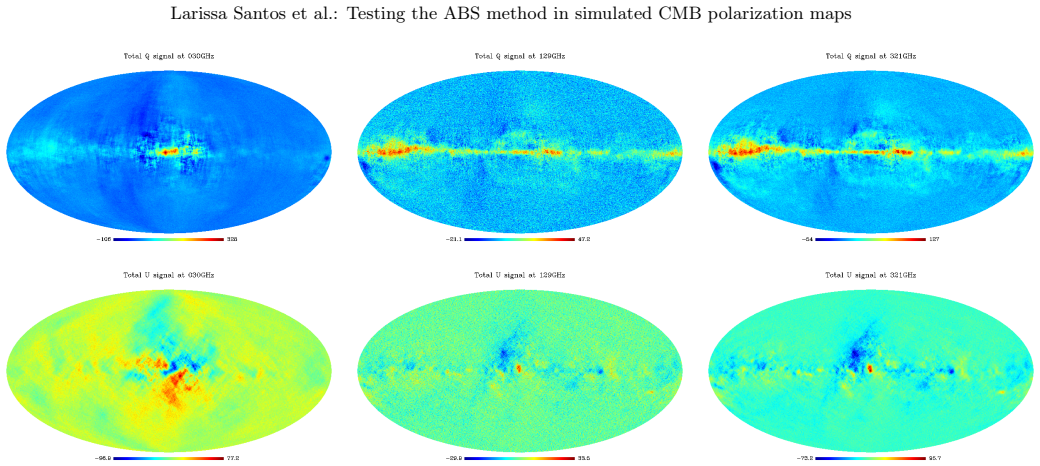
Summary. This paper presents an end-to-end simulation test of the Analytical Blind Separation (ABS) method of Zhang et al. (2016) for estimating CMB E- and B-mode polarization power spectra. The authors generate ten-band (30-321 GHz) full-sky polarization maps with CMB from CAMB/LensPix, foregrounds from the PySM d1s1 model (synchrotron plus thermal dust with spatially varying spectral indices), and white noise at a PICO-like sensitivity. ABS is applied either on the full sky or after a partial-sky mask with Smith-Zaldarriaga pure E/B estimators, using 50 noise realizations. The paper reports full-sky E-mode recovery within 20% for ell>30 and B-mode recovery within 20% over the full multipole range (and below 5% for ell>150) for r=0, 0.01, and 0.05; partial-sky recovery within 21% for 30<=ell<=1050. Low-multipole biases are documented through null tests, Appendix B isolates the E/B separation contribution, and Appendix A examines a foreground model with polarized AME.
Significance. If the reported accuracies hold, ABS offers a computationally light, blind route to E/B power spectra at intermediate and small angular scales for future space missions, with only a small number of tunable parameters (the shift parameter S, the eigenvalue threshold lambda_cut, and mask apodization). The paper's strengths are its use of standardized public simulation tools, the comparison against the realized CMB spectrum rather than the ensemble mean, the explicit null tests, and the analytic toy model in Appendix C that clarifies the finite-sample and thresholding biases. The main limitation is that the headline percentages are tied to the particular foreground model tested; the paper's own AME test shows that a third foreground component degrades low-multipole B-mode recovery markedly.
major comments (3)
- [Section 5.1, Figure 5] The text says the simulation contains two foreground components and one CMB, but Figure 5 shows more than M+1=3 significant eigenvalues above the threshold at low multipoles, meaning the effective foreground rank already exceeds the rank assumed in Eqs. (6)-(7). Since the method's separation relies on the CMB direction lying outside the foreground subspace spanned by the retained eigenvalues, this rank violation is a load-bearing condition for the quoted 20%/5% accuracies. The paper should quantify the positive foreground bias caused by this rank violation or explicitly scope the claims to the empirical foreground model.
- [Appendix A, Figure A.1] When polarized AME is added as a third foreground component, the full-sky B-mode relative error reaches about 50% for ell<170, with the <5% accuracy holding only for ell>170. The abstract and conclusions do not mention this degradation; they state only that the method "performs quite well" and recovers spectra within the quoted percentages. The central claim is therefore conditional on foreground complexity and should be tempered or supplemented by a systematic foreground-model scan.
- [Section 3.1] The paper states that for real observations D_fore has rank N_f and that "it is impossible to get a CMB spectrum which would not contain at least a bit of positive bias." This admission, combined with the PySM d1s1 results, means the demonstrated accuracy is not a generic property of ABS. The paper should state in the abstract and conclusions that the quoted errors are upper limits for a two-component foreground model, not universal guarantees.
minor comments (7)
- [Title] The arXiv title "Reconstructing simulated CMB polarization power spectra with the Analytical Blind Separation method" differs from the manuscript title "Testing the Analytical Blind Separation method in simulated CMB polarization maps"; the journal should standardize one title.
- [Section 2.2] The phrase "it's connection" should be "its connection".
- [Conclusions] The word "perfomance" should be "performance".
- [Section 4.1] In the text before Table 1, "T able 1" should read "Table 1".
- [Equation (13)] The definition of the apodization coordinate used in the window function W(delta) should be stated explicitly, and the sign of the step should be checked against the description of the mask.
- [Figure 5 caption] The caption says eigenvalues are shown in absolute value, and the text says negative eigenvalues are red dots; please make the red-dot convention explicit in the caption itself.
- [Section 5.1] The sentence "At the very lowest ells, however, the errors and biases become too large for a successful estimate of the B-mode power spectrum" is in tension with the preceding claim of "below 20% for the full multipole range"; please clarify whether the 20% claim applies to the binned range shown and what "full range" means.
Circularity Check
No significant circularity: the ABS recovery claims are empirical simulation tests against external ground truth, not a reduction of outputs to inputs.
full rationale
The core claims are that ABS recovers simulated CMB E/B power spectra to the stated accuracy. The estimator (Eqs. 6-7) is an algebraic function of the observed multi-frequency covariance after noise de-biasing, with inputs being the known CMB mixing vector f, a threshold lambda_cut, and a shift parameter S. The recovered spectra are compared with CAMB/LensPix input CMB power spectra, which are not used in the estimator, so the comparison is external to the method. The low-rank foreground assumption is an explicitly stated ansatz rather than an output of the derivation, and Section 3.1 plus Appendix A quantify its failure modes; this is a robustness limitation, not circularity. Self-citations (Zhang et al. 2016 for the estimator; Yao et al. 2018 for threshold insensitivity) introduce the method and hyperparameter guidance, but the simulated ground truth is independent of those citations, and the paper openly reports low-multipole biases and degraded AME recovery. No equation or fitted parameter is identified that is equivalent by construction to the claimed prediction, so the derivation chain is self-contained.
Assumptions & free parameters
free parameters (3)
- Shift parameter S =
S = 1000 sigma_noise (full-sky baseline); S = 100 sigma_noise in AME case
- Eigenvalue threshold lambda_cut =
0.5
- Mask apodization parameters =
delta_c = 1 degree, sigma set by beta = 1e-4
assumptions (5)
- domain assumption The CMB signal is uncorrelated with foreground emission and instrumental noise in the ensemble average, and empirical correlations are negligible at high multipoles.
- domain assumption Foreground emission lies in a low-dimensional subspace of rank M < N_f, with the CMB mixing vector not in that subspace.
- domain assumption The noise covariance is known well enough to be subtracted without error.
- domain assumption The data model d_obs = f d_cmb + d_fore + d_noise holds for each polarization field independently, with rigid CMB scaling across frequencies.
- standard math The ABS estimator in Eqs. 6-7 from Zhang et al. (2016) is correct.
Cite this review
Pith. "Pith review of Reconstructing simulated CMB polarization power spectra with the Analytical Blind Separation method." pith.science (2026). https://pith.science/paper/S4HDSU2I
@misc{pith2026190807862,
  author       = {Pith},
  title        = {Pith review of: Reconstructing simulated CMB polarization power spectra with the Analytical Blind Separation method},
  year         = {2026},
  howpublished = {\url{https://pith.science/paper/S4HDSU2I}},
  note         = {Machine review of arXiv:1908.07862}
}
abstract
Multi-frequency observations are needed to separate the CMB from foregrounds and accurately extract cosmological information from the data. The Analytical Blind Separation (ABS) method is dedicated to extracting the CMB power spectrum from multi-frequency observations in the presence of contamination from astrophysical foreground emission and instrumental noise. In this study, we apply the ABS method to simulated sky maps as could be observed with a future space-borne survey, in order to test the method's capability for determining the CMB polarization $E$- and $B$-mode power spectra. We present the ABS method performance on simulations for both a full-sky analysis and for an analysis concentrating on sky regions less impacted by Galactic foreground emission. We discuss the origin and minimization of biases in the estimated CMB polarization angular power spectra. We find that the ABS method performs quite well for the analysis of full-sky observations at intermediate and small angular scales, in spite of strong foreground contamination. On the largest scales, extra work is still required to reduce biases of various origins and the impact of confusion between CMB $E$ and $B$ polarization for partial-sky analyses.
Figures


Figures from the paper (9 more)


Forward citations
Cited by 1 Pith paper
-
Fast End-to-End Framework for Cosmological Parameter Inference from CMB Data Using Machine Learning
An ABS+neural-network pipeline recovers τ and r from simulated CMB maps for LiteBIRD/PICO with reported 1-σ errors of 0.0030–0.0035 (τ) and 0.0014–0.0056 (r), using held-out cosmologies sampled inside the training range.
Reference graph
Works this paper leans on
-
[1]
N., Adshead, P., Ahmed, Z., et al.\ 2016, arXiv e-prints, arXiv:1610.02743
Abazajian, K. N., Adshead, P., Ahmed, Z., et al.\ 2016, arXiv e-prints, arXiv:1610.02743
arXiv 2016
-
[2]
Ade, P., Aguirre, J., Ahmed, Z., et al.\ 2019, Journal of Cosmology and Astro-Particle Physics, 2019, 56
2019
-
[3]
M., & Dickinson, C.\ 2009, , 395, 1055
Ali-Ha \"i moud, Y., Hirata, C. M., & Dickinson, C.\ 2009, , 395, 1055
2009
-
[4]
Andr \'e , P., Baccigalupi, C., Banday, A., et al.\ 2014, JCAP, 2, 006
2014
-
[5]
F.\ 2007, , 376, 739
Aumont, J., & Mac \' as-P \'e rez, J. F.\ 2007, , 376, 739
2007
-
[6]
Baccigalupi, C., Perrotta, F., de Zotti, G., et al.\ 2004, , 354, 55
2004
-
[7]
Banerji R., Patanchon G., Delabrouille J., Hazumi M., Thuong Hoang D., Ishino H., Matsumura T., 2019, JCAP, 2019, 043
2019
-
[8]
Basak S., Delabrouille J., 2012, MNRAS, 419, 1163
2012
Show all 144 references
-
[9]
Basak S., Delabrouille J., 2013, MNRAS, 435, 18
2013
-
[10]
Basu, K., et al.\ 2019, arXiv, arXiv:1909.01592
2019
-
[11]
2011, Astroparticle Physics, 34, 705
Battistelli , E., et al. 2011, Astroparticle Physics, 34, 705
2011
-
[12]
L., Halpern, M., Hinshaw, G., et al.\ 2003, , 148, 1
Bennett, C. L., Halpern, M., Hinshaw, G., et al.\ 2003, , 148, 1
2003
-
[13]
L., Hill, R
Bennett, C. L., Hill, R. S., Hinshaw, G., et al.\ 2003, , 148, 97
2003
-
[14]
Beno \^ t A., et al., 2003, A&A, 399, L19
2003
-
[15]
Betoule M., Pierpaoli E., Delabrouille J., Le Jeune M., Cardoso J.-F., 2009, A&A, 503, 691
2009
-
[16]
Bicep2 Collaboration, et al., 2015, ApJ, 814, 110
2015
-
[17]
Bobin J., Starck J.-L., Fadili J., Moudden Y., 2007, ITIP, 16, 2662
2007
-
[18]
L., Larson, D., Weiland, J
Bennett, C. L., Larson, D., Weiland, J. L., et al.\ 2013, , 208, 20
2013
-
[19]
BICEP2 Collaboration, Ade, P. A. R., Aikin, R. W., et al.\ 2014, Physical Review Letters, 112, 241101
2014
-
[20]
Bock, J., Aljabri, A., Amblard, A., et al.\ 2009, arXiv:0906.1188
2009 arXiv
-
[21]
Bonaldi, A., Bedini, L., Salerno, E., Baccigalupi, C., & de Zotti, G.\ 2006, , 373, 271
2006
-
[22]
R., Prunet, S., & Sethi, S
Bouchet, F. R., Prunet, S., & Sethi, S. K.\ 1999, , 302, 663
1999
-
[23]
F., Fisher, K
Bunn, E. F., Fisher, K. B., Hoffman, Y., et al.\ 1994, , 432, L75
1994
-
[24]
F., Zaldarriaga, M., Tegmark, M., & de Oliveira-Costa, A.,\ 2003, , 67, 023501
Bunn, E. F., Zaldarriaga, M., Tegmark, M., & de Oliveira-Costa, A.,\ 2003, , 67, 023501
2003
-
[25]
F.,\ 2011, , 83, 083003
Bunn, E. F.,\ 2011, , 83, 083003
2011
-
[26]
& Fang, L
Cao, L. & Fang, L. Z. ,\ 2009, , 706, 1545
2009
-
[27]
Cardoso, J.-F., Martin, M., Delabrouille, J., Betoule, M., & Patanchon, G.\ 2008, arXiv:0803.1814
2008 arXiv
-
[28]
& Chon, G.\ 2005, , 360, 509
Challinor, A. & Chon, G.\ 2005, , 360, 509
2005
-
[29]
Chluba, J., et al.\ 2019, arXiv, arXiv:1909.01593
2019 arXiv
-
[30]
Di Valentino, E.; Melchiorri, A.; Silk, J.\ 2019, Nature Astronomy
2019
-
[31]
R., et al.\ 2014, JCAP, 4, 014
Das, S., Louis, T., Nolta, M. R., et al.\ 2014, JCAP, 4, 014
2014
-
[32]
de Bernardis, P., Ade, P. A. R., Bock, J. J., et al.\ 2000, , 404, 955
2000
-
[33]
M., et al.\ 2008, , 388, 247
de Oliveira-Costa, A., Tegmark, M., Gaensler, B. M., et al.\ 2008, , 388, 247
2008
-
[34]
Delabrouille, J., Cardoso, J.-F., & Patanchon, G.\ 2003, , 346, 1089
2003
-
[35]
Delabrouille J., Cardoso J.-F., 2009, LNP, 665, 159, LNP...665
2009
-
[36]
Delabrouille, J., Cardoso, J.-F., Le Jeune, M., et al.\ 2009, , 493, 835
2009
-
[37]
Delabrouille, J., Betoule, M., Melin, J.-B., et al.\ 2013, , 553, A96
2013
-
[38]
Delabrouille J., et al., 2018, JCAP, 2018, 014
2018
-
[39]
Delabrouille J., et al., 2019, arXiv, arXiv:1909.01591
2019 arXiv
-
[40]
T.\ 2011, Physics of the Interstellar and Intergalactic Medium by Bruce T
Draine, B. T.\ 2011, Physics of the Interstellar and Intergalactic Medium by Bruce T. Draine. Princeton University Press, 2011. ISBN: 978-0-691-12214-4
2011
-
[41]
Dunkley, J., 2009, , 1141, 222
2009
-
[42]
, 2004, , 349, 603
Efstathiou, G. , 2004, , 349, 603
2004
-
[43]
K., O'Dwyer, I
Eriksen, H. K., O'Dwyer, I. J., Jewell, J. B., et al.\ 2004, , 155, 227
2004
-
[44]
K., Banday A
Eriksen H. K., Banday A. J., G \'o rski K. M., Lilje P. B., 2004, ApJ, 612, 633
2004
-
[45]
K., Jewell J
Eriksen H. K., Jewell J. B., Dickinson C., Banday A. J., G \'o rski K. M., Lawrence C. R., 2008, ApJ, 676, 10
2008
-
[46]
et al., Millimeter, Submillimeter, and Far-Infrared Detectors and Instrumentation for Astronomy VII, 2014, 9153, 91531I
Essinger-Hileman , T. et al., Millimeter, Submillimeter, and Far-Infrared Detectors and Instrumentation for Astronomy VII, 2014, 9153, 91531I
2014
-
[47]
B., & Mart \' nez-Gonz \'a lez, E.\ 2012, , 420, 2162
Fern \'a ndez-Cobos, R., Vielva, P., Barreiro, R. B., & Mart \' nez-Gonz \'a lez, E.\ 2012, , 420, 2162
2012
-
[48]
, Grain J., Tristram, M
Ferte, A. , Grain J., Tristram, M. , Stompor, R.\ 2013, , 88, 023524
2013
-
[49]
Ghosh, S., Delabrouille, J., Zhao, W, & Santos, L., JCAP (in press), arXiv:2007.09928
2007 arXiv
-
[50]
M., Hivon, E., Banday, A
G \'o rski, K. M., Hivon, E., Banday, A. J., et al.\ 2005, , 622, 759
2005
-
[51]
L., Hill, R
Gold, B., Bennett, C. L., Hill, R. S., et al.\ 2009, , 180, 265
2009
-
[52]
& Stompor, R., , \ 2009, 79, 123515
Grain, J., Tristram, M. & Stompor, R., , \ 2009, 79, 123515
2009
-
[53]
P.\ 1975 , Sov
Grishchuk, L. P.\ 1975 , Sov. Phys. JETP, 40, 409; Grishchuk, L. P.\ 1976, JETP Lett.,23, 293 ; Grishchuk, L. P.\ 1977 Ann. N. Y. Acad. Sci., 302, 439
1975
-
[54]
W., Leitch, E
Halverson, N. W., Leitch, E. M., Pryke, C., et al.\ 2002, , 568, 38
2002
-
[55]
Hanany, S., Alvarez, M., Artis, E., et al \ 2019, arXiv:1902.10541
2019 arXiv
-
[56]
Hanany, S., Ade, P., Balbi, A., et al.\ 2000, , 545, L5
2000
-
[57]
Haslam, C. G. T., Klein, U., Salter, C. J., et al.\ 1981, , 100, 209
1981
-
[58]
Haslam, C. G. T., Salter, C. J., Stoffel, H., & Wilson, W. E.\ 1982, , 47, 1
1982
-
[59]
Hinshaw, G., Larson, D., Komatsu, E., et al.\ 2013, , 208, 19
2013
-
[60]
P., Jones, A
Hobson, M. P., Jones, A. W., Lasenby, A. N., & Bouchet, F. R.\ 1998, , 300, 1
1998
-
[61]
& Dodelson, S.\ 2002, , 40, 171
Hu, W. & Dodelson, S.\ 2002, , 40, 171
2002
-
[62]
Hu, W.\ 2002 , , 65, 023003
2002
-
[63]
M., Zaldarriaga M., 2003, PhRvD, 67, 043004
Hu W., Hedman M. M., Zaldarriaga M., 2003, PhRvD, 67, 043004
2003
-
[64]
H.\ 2004, , 609, 1
Jewell, J., Levin, S., & Anderson, C. H.\ 2004, , 609, 1
2004
-
[65]
Kamionkowski, M., Kosowsky, S., & Stebbins , A.\ 1997, , 78, 2058
1997
-
[66]
Kamionkowski, M., Kosowsky, S., & Stebbins , A.\ 1997, , 55, 7368
1997
-
[67]
Kang , J. H. et al. 2018 , Millimeter, Submillimeter, and Far-Infrared Detectors and Instrumentation for Astronomy IX, 10708, 107082N
2018
-
[68]
Kaplan J., Delabrouille J., 2002, AIPC, 609, 209, AIPC..609
2002
-
[69]
G., Shimon M., Yadav A
Keating B. G., Shimon M., Yadav A. P. S., 2013, ApJL, 762, L23
2013
-
[70]
Keisler, R., Hoover, S., Harrington, N., et al.\ 2015, , 807, 151
2015
-
[71]
Kim, J.\ 2011 , 531, A32
2011
-
[72]
& Naselsky, P.,\ 2010, , 519, A104
Kim, J. & Naselsky, P.,\ 2010, , 519, A104
2010
-
[73]
J., Chuss, D
Kogut, A., Fixsen, D. J., Chuss, D. T., et al.\ 2011, JCAP, 7, 025
2011
-
[74]
L., Ade, P
Kuo, C. L., Ade, P. A. R., Bock, J. J., et al.\ 2004, , 600, 32
2004
-
[75]
L., Eriksen, H
Larson, D. L., Eriksen, H. K., Wandelt, B. D., et al.\ 2007, , 656, 653
2007
-
[76]
M., Cardoso, J.-F., Baccigalupi, C., et al.\ 2008, , 491, 597
Leach, S. M., Cardoso, J.-F., Baccigalupi, C., et al.\ 2008, , 491, 597
2008
-
[77]
R.; Leonardi, R.; Ansmann, M., et al.\ 2008, APJS, 177, 419-430
Levy, A. R.; Leonardi, R.; Ansmann, M., et al.\ 2008, APJS, 177, 419-430
2008
-
[78]
Lewis, A., \ 2003, , 68, 083509
2003
-
[79]
Lewis, A., Challinor, A., & Lasenby, A.\ 2000, , 538, 473
2000
-
[80]
and Challinor, A.\ 2006, Phys
Lewis, A. and Challinor, A.\ 2006, Phys. Rept. 429, 1
2006
-
[81]
Lewis, A.,\ 2005, , 71, 083008
2005
-
[82]
& Hanson, D.\ 2011 , JCAP, 03, 018
Lewis, A., Challinor, A. & Hanson, D.\ 2011 , JCAP, 03, 018
2011
- [83]
-
[84]
Liu, H., Creswell , J., Naselsky, P., \ 2018, JCAP, 5, 059
2018
-
[85]
Liu, H., \ 2018, , 617, A90
2018
-
[86]
\ 2019, , 100, 023538
Liu, H., Creswell , J., von Hausegger, S., Naselsky, P. \ 2019, , 100, 023538
2019
-
[87]
Liu, H., Creswell , J., Dachlythra, K., \ 2019, JCAP, 4, 046
2019
-
[88]
Liu, H., \ 2019, arXiv:1906.10381
2019 arXiv
-
[89]
, Das, S., Dunkley, J
Louis, T., N ss, S. , Das, S., Dunkley, J. & Sherwin, B. , ,\ 2013, 435, 2040
2013
-
[90]
Lyth, D. H. & Riotto, A.\ 1999 , Phys. Rept. 314, 1
1999
-
[91]
J., et al., 2008, ApJ, 689, 655
MacTavish C. J., et al., 2008, ApJ, 689, 655
2008
-
[92]
M., Vielva, P., & Silk, J.\ 2003, , 345, 1101
Mart \' nez-Gonz \'a lez, E., Diego, J. M., Vielva, P., & Silk, J.\ 2003, , 345, 1101
2003
-
[93]
S., Pearson, T
Mason, B. S., Pearson, T. J., Readhead, A. C. S., et al.\ 2003, , 591
2003
-
[94]
Mather, J. C. et al. 1994, , 420, 439
1994
-
[95]
Matsumura, T., Akiba, Y., Borrill, J., et al.\ 2014, Journal of Low Temperature Physics, 176, 733
2014
-
[96]
R., Bersanelli, M., Childers,J., et al.\ 2005, APJS, 158, 101-108
Meinhold, P. R., Bersanelli, M., Childers,J., et al.\ 2005, APJS, 158, 101-108
2005
-
[97]
Moudden Y., Cardoso J.-F., Starck J.-L., Delabrouille J., 2005, EJASP, 2005, 484606
2005
-
[98]
Natoli P., et al., 2018, JCAP, 2018, 022
2018
-
[99]
J., Bersanelli, M., Childers,J., et al.\ 2005, APJS, 158, 93-100
O'Dwyer, I. J., Bersanelli, M., Childers,J., et al.\ 2005, APJS, 158, 93-100
2005
-
[100]
L., & Safdi, B
Mishra-Sharma, S., Rodd, N. L., & Safdi, B. R.\ 2017, , 153, 253
2017
-
[101]
Miville-Desch \^e nes, M.-A., Ysard, N., Lavabre, A., et al.\ 2008, , 490, 1093
2008
-
[102]
Mukhanov, V. F. , Feldman, H. A., and Brandenberger, R. H. , Phys. Rept.\ 1992, 215, 203
1992
-
[103]
Patanchon G., Cardoso J.-F., Delabrouille J., Vielva P., 2005, MNRAS, 364, 1185
2005
-
[104]
Planck Collaboration, Ade, P. A. R., Aghanim, N., et al.\ 2014, , 571, A16
2014
-
[105]
Planck Collaboration, Adam, R., Ade, P. A. R., et al.\ 2016, , 594, A10
2016
-
[106]
Planck Collaboration, Ade, P. A. R., Aghanim, N., et al.\ 2016, , 594, A13
2016
-
[107]
et al.\ 2016, , 594, A1
Planck Collaboration, Adam, R. et al.\ 2016, , 594, A1
2016
-
[108]
et al.\ 2016, , 594, A11
Planck Collaboration, Aghanim, N. et al.\ 2016, , 594, A11
2016
-
[109]
et al.\ 2016, , 586, A133
Planck Collaboration, Adam, R. et al.\ 2016, , 586, A133
2016
-
[110]
Planck Collaboration, Akrami, Y., Ashdown, M., et al.\ 2018, arXiv e-prints , arXiv:1801.04945
2018 arXiv
-
[111]
Planck Collaboration, et al., 2019, arXiv, arXiv:1907.12875
2019 arXiv
-
[112]
Planck Collaboration, et al., 2018, arXiv, arXiv:1807.06209
2018 arXiv
-
[113]
Polarbear Collaboration, P. A. R. Ade, Akiba, Y., et al.\ 2014, , 794, 171
2014
-
[114]
Remazeilles M., Delabrouille J., Cardoso J.-F., 2011, MNRAS, 410, 2481
2011
-
[115]
Remazeilles, M., Delabrouille, J., & Cardoso, J.-F., 2011, MNRAS, 418, 467
2011
-
[116]
J., Bigot-Sazy, M.-A., & Ghosh, T.\ 2015, , 451, 4311
Remazeilles, M., Dickinson, C., Banday, A. J., Bigot-Sazy, M.-A., & Ghosh, T.\ 2015, , 451, 4311
2015
-
[117]
Remazeilles, M., Dickinson, C., Eriksen, H. K. K. & Wehus, I. K.\ 2016 , 458, 2032-2050
2016
-
[118]
B., Delabrouille J., Kaplan J., Giraud-H \'e raud Y., Lamarre J.-M., Murphy J
Rosset C., Yurchenko V. B., Delabrouille J., Kaplan J., Giraud-H \'e raud Y., Lamarre J.-M., Murphy J. A., 2007, A&A, 464, 405
2007
-
[119]
Saha, R., Jain, P., & Souradeep, T.\ 2006, , 645, L89
2006
-
[120]
& Zhao, W.,\ 2017, JCAP, 1, 043
Santos, L., Wang, K., Hu, Y., Fang, W. & Zhao, W.,\ 2017, JCAP, 1, 043
2017
-
[121]
Shimon M., Keating B., Ponthieu N., Hivon E., 2008, PhRvD, 77, 083003
2008
-
[122]
M.\ 2006 ,74, 083002
Smith, K. M.\ 2006 ,74, 083002
2006
-
[123]
Smith, K. M. & Zaldarriaga, M.,\ 2007, , 76, 043001
2007
-
[124]
F., Bennett, C
Smoot, G. F., Bennett, C. L., Kogut, A. et al., \ 1992, , 396, L1-L5
1992
-
[125]
and Zaldarriaga, M.\ 1996, 469, 437
Seljak, U. and Zaldarriaga, M.\ 1996, 469, 437
1996
-
[126]
and Zaldarriaga, M.\ 1997, 78, 2054
Seljak, U. and Zaldarriaga, M.\ 1997, 78, 2054
1997
-
[127]
L., Hlozek, R
Sievers, J. L., Hlozek, R. A., Nolta, M. R., et al.\ 2013, JCAP, 10, 060
2013
-
[128]
M.\ 2011, , 411, 2750
Silsbee, K., Ali-Ha \"i moud, Y., & Hirata, C. M.\ 2011, , 411, 2750
2011
-
[129]
A.\ 1979, JETP Lett
Starobinsky, A. A.\ 1979, JETP Lett. 30, 682; Starobinsky, A. A.\ 1980, Phys. Lett. B, 91, 99S
1979
-
[130]
A., Brukhanov A
Strukov, I. A., Brukhanov A. A., Skulachev, D. P., Sazhin, M. V., \ 1992, Soviet Astronomy Letters, 18, 153
1992
-
[131]
Tegmark, M., & Efstathiou, G.\ 1996, , 281, 1297
1996
-
[132]
Tegmark, M., & de Oliveira-Costa, A.\ 2001, , 64, 63001
2001
-
[133]
J.\ 2003, , 68, 123523
Tegmark, M., de Oliveira-Costa, A., & Hamilton, A. J.\ 2003, , 68, 123523
2003
-
[134]
Thorne, B., Dunkley, J., Alonso, D., & N ss, S.\ 2017, , 469, 2821
2017
-
[135]
Thuong Hoang D., et al., 2017, JCAP, 2017, 015
2017
-
[136]
D., Larson, D
Wandelt, B. D., Larson, D. L., & Lakshminarayanan, A.\ 2004, , 70, 083511
2004
-
[137]
Wang, Y. F. , Wang, K. and Zhao, W.\ 2016, Research in Astronomy and Astrophysics,16, 059
2016
-
[138]
A., Carreira, P., Cleary, K., et al.\ 2003, , 341, 1057
Watson, R. A., Carreira, P., Cleary, K., et al.\ 2003, , 341, 1057
2003
-
[139]
& Zhang, J
Yao, J., Zhang, L., Zhao, Y., Zhang, P., Santos, L. & Zhang, J. \ 2018, , 239,36
2018
-
[140]
& Seljak , U.\ 1997, , 55, 1830
Zaldarriaga , M. & Seljak , U.\ 1997, , 55, 1830
1997
-
[141]
& Seljak, U.\ 1998 58, 023003
Zaldarriaga, M. & Seljak, U.\ 1998 58, 023003
1998
-
[142]
Zhang, P., Zhang, J., & Zhang, L.\ 2019, , 484, 1616
2019
-
[143]
& Baskaran, D.\ 2010 , , 82, 023001
Zhao, W. & Baskaran, D.\ 2010 , , 82, 023001
2010
-
[144]
Planck Collaboration, Ade, P. A. R., Aghanim, N., et al.\ 2014, , 571, A13
2014
Reviewed August 14, 2026 · model on record in the stance chip above.
Discussion (0). Continue with ORCID to comment.