REVIEW 3 major objections 3 minor 17 references
Flavour-Exotic Tetraquarks in Large-$N_{\rm c}$ QCD: Do They Exist?
T0 review · 3 major / 3 minor · reviewed 2026-08-14 · deepseek-v4-flash
Pith's one-line read This paper argues that QCD's large-Nc limit forbids narrow tetraquarks whose four quark flavours are all distinct.
desk verdict Clear short summary of a plausible large-Nc argument against narrow flavour-exotic tetraquarks, but the no-go conclusion overreaches because a compact-plus-molecular pair is not excluded. read the letter →
The pith
A machine-rendered reading of the paper's core claim, the machinery that carries it, and where it could break.
The reading
What carries the argument
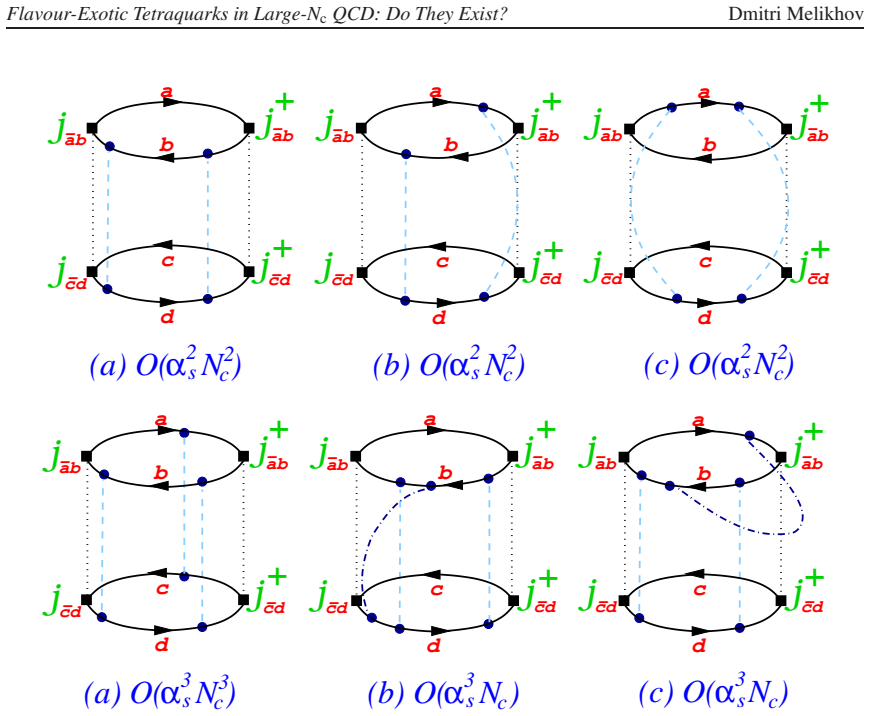
The load-bearing tool is the "tetraquark-phile Feynman diagram": a diagram in two-meson scattering that depends non-polynomially on $s=(p_1+p_2)^2$ and has a four-quark branch cut starting at $\hat s=(m_a+m_b+m_c+m_d)^2$, identified via the Landau equations. Counting such diagrams in the $1/N_c$ expansion leads to the two-tetraquark requirement, while the second ingredient is the group-theoretic decomposition of the four-quark colour state, which yields only one compact singlet (diquark–antidiquark) and one molecular singlet. The mismatch of these two structures is the entire argument.
What would settle it
Find a single narrow compact resonance with four distinct quark flavours — e.g. $\bar u d \bar s c$ — whose couplings to two-meson channels fit one pole rather than two. Concretely, a lattice or experimental measurement showing one pole reproducing both the flavour-preserving and flavour-reordering correlators at their respective $N_c$ orders would refute the paper's central claim.
Extended reading notes
Core claim
On its own terms, the paper's discovery is a consistency obstruction. In large-$N_c$ QCD, the $N_c$-leading tetraquark-phile contributions to flavour-preserving correlators are of order $O(N_c^0)$, while those to flavour-reordering correlators are of order $O(N_c^{-1})$; a single tetraquark pole cannot reproduce both behaviours, so any flavour-exotic quark content must be carried by at least two states, $T_A$ and $T_B$, whose couplings to the two meson-pair channels scale as $O(N_c^{-1})$ and $O(N_c^{-2})$ in opposite order. But the colour decomposition of two quarks and two antiquarks supplies only one compact colour singlet built from a diquark–antidiquark pair; the other singlet is a loosely bound meson–meson molecule. From this mismatch the authors draw the conclusion stated as their title: large-$N_c$ QCD does not support the existence of any narrow flavour-exotic tetraquarks.
Load-bearing premise
The load-bearing premise is that the two states required by large-$N_c$ consistency must both be compact diquark–antidiquark tetraquarks; if one is a loosely bound meson–meson molecule instead, the argument against a compact flavour-exotic tetraquark collapses.
Editorial extensions
If this is right
- No narrow, compact bound state with four mutually different quark flavours should appear in experiment; this explains the absence of reliable flavour-exotic tetraquark candidates.
- The same large-$N_c$ reasoning predicts that if a flavour-exotic state is ever seen, it must be either a loosely bound meson–meson molecule or broad enough that its compact description fails.
- The no-go argument does not apply to tetraquarks with identical flavour pairs, such as $[q_a q_b \bar q_c \bar q_b]$, so hidden-charm and doubly-heavy exotics remain viable and are what recent lattice studies find.
- In the hypothetical two-state picture, both tetraquarks would have total widths of order $O(N_c^{-2})$, i.e. parametrically narrow; the contradiction is not that such states are wide but that only one compact colour singlet is available.
- Large-$N_c$ consistency requires at least two states with the same flavour content coupling at different orders in $1/N_c$ to the two meson-pair channels.
Reading between the lines
- Beyond the paper's explicit claim, the argument leaves open a mixed resolution: one compact diquark–antidiquark state plus one molecular meson–meson state would satisfy large-$N_c$ consistency while still allowing a narrow compact flavour-exotic tetraquark to exist.
- The same two-singlet-versus-two-pole mismatch may apply to other exotics whose constituents are all flavour-distinct, so the no-go logic could be adapted to pentaquarks or hexaquarks with fully exotic flavour content.
- A concrete lattice test would be to look for flavour-exotic poles in two-meson scattering at large $N_c$; finding exactly one compact pole with the $N_c$ order of a single tetraquark would falsify the paper's conclusion.
Signed reviews
Editorial analysis
A structured set of objections, weighed in public.
Referee Report
Summary. The paper argues that narrow flavour-exotic tetraquarks — bound states of two quarks and two antiquarks with four mutually different flavours — cannot exist in large-N_c QCD. The argument combines two ingredients. First, from the large-N_c counting of four-quark correlators (citing the authors' earlier work, Refs [1-4]), the paper claims that internal consistency at leading order requires at least two tetraquark states with the same flavour content, coupling with complementary N_c^{-1} and N_c^{-2} strengths to the two possible meson-meson channels. Second, from the SU(3) colour decomposition 3⊗3⊗3⊗3 = 1⊕1⊕8⊕8⊕8⊕8⊕10⊕10⊕27, the paper notes that there is only one compact diquark-antidiquark singlet for fixed Lorentz quantum numbers. The conclusion is that large-N_c QCD does not support the existence of any narrow flavour-exotic tetraquark.
Significance. The question addressed is well posed and timely, and the paper's large-N_c counting is parameter-free and potentially falsifiable. If the no-go conclusion could be rigorously established, it would be a strong model-independent statement relevant to the interpretation of exotic-hadron candidates. The paper also clearly explains why the argument does not apply to tetraquarks with identical quark or antiquark flavours, which is useful context. The main weakness is that the no-go statement is stronger than the derivation: the paper's own Section 3 admits two colour-singlet four-quark routes, one compact and one molecular, and the logical gap between 'at least two poles' and 'two compact tetraquarks' is not closed.
major comments (3)
- [Section 4 (with Section 3)] The central conclusion — 'Large-N_c QCD does not support the existence of any narrow flavour-exotic tetraquarks' — does not follow from the stated premises. Section 3 explicitly identifies two colour-singlet routes for a four-quark state: the compact diquark-antidiquark singlet and a colour-singlet meson-meson molecular configuration. Section 2 requires at least two poles with identical flavour content in the three correlators, but the paper never rules out the possibility that one pole is the compact state and the other is the molecular state. A molecular pole could in principle carry the complementary N_c^{-1} and N_c^{-2} couplings needed to satisfy the leading-order equations. The authors must either show that a molecular companion cannot satisfy the large-N_c constraints or weaken the conclusion to the claim that the compact interpretation alone is inconsistent.
- [Section 2 (unnumbered correlator equations)] The pairwise requirement is the load-bearing premise of the argument, yet the derivation is not included in this paper; it is quoted from Refs [1-4]. The displayed equations show that a single pole with equal couplings to the two meson-meson channels is inconsistent with the different N_c orders of the flavour-preserving and flavour-reordering correlators, and they exhibit one two-pole pattern that works. However, the text says only that this is 'one solution', not that the complementary-coupling pattern is the unique leading-order solution, nor that the two required poles must both be compact. Please state the precise theorem from the cited papers and explain why alternative solutions, including a compact-plus-molecular combination, are excluded.
- [Section 2, amplitude pattern after the correlator displays] The argument's logical structure needs the 'necessity' side of the pairwise condition to be made explicit. As written, the paper proves that two poles with complementary couplings can satisfy the large-N_c constraints, but it does not prove that such a pair is the only possible leading-order realisation. If additional solutions exist — for instance, one compact pole plus one molecular pole, or more than two poles with different N_c assignments — then the claimed contradiction with the uniqueness of the compact colour singlet is not established. The authors should either provide the uniqueness proof or carefully state the assumptions under which the pairwise condition is necessary.
minor comments (3)
- [Section 2] Since this is a proceedings contribution, the authors should make the paper more self-contained by stating explicitly which result is proven in Refs [1-4] and which part is new in this paper; currently the reader must consult the cited literature to verify the central counting claim.
- [Figures 3 and 4] The captions of Figures 3 and 4 contain typesetting artifacts (for example, stray spaces and incomplete order symbols like 'O( N )'), which should be corrected in the final version.
- [Abstract and Section 4] The abstract says the analysis 'suggests the nonexistence' of compact flavour-exotic tetraquarks, while Section 4 states categorically that large-N_c QCD 'does not support the existence of any narrow flavour-exotic tetraquarks'. These formulations are not equivalent; aligning them would clarify the strength of the claim.
Circularity Check
No circular derivation: the two-state large-Nc requirement is re-derived from the pole equations, the group-theoretic count is standard, and the conclusion is a logical inference rather than an input by construction.
full rationale
The paper's central claim, that large-Nc QCD does not support narrow flavour-exotic tetraquarks, is assembled from two premises. The first premise, that at least two tetraquark states are needed for flavour-exotic content, is not merely imported by citation: Section 2 explicitly exhibits the two categories of correlators, assigns their leading Nc orders, writes the single- and two-pole decompositions, and shows that a single pole cannot simultaneously reproduce the O(Nc^-2) flavour-preserving and O(Nc^-3) flavour-reordering behaviours while two poles with complementary couplings can. The Nc counting is attributed to the authors' earlier work, but the present text restates the operative equations, so the derivation is not replaced by a self-citation. The second premise, that the colour decomposition of q q qbar qbar contains only one compact diquark-antidiquark singlet, is a standard group-theoretic statement explicitly written out in Section 3. Section 4 then draws the negative conclusion from the mismatch. No fitted parameter is renamed as a prediction, no quantity is defined in terms of the target conclusion, and no external uniqueness theorem is invoked. The identified weakness is a logical gap rather than circularity: Section 3 itself notes that SU(3) singlets arise along a second, meson-meson molecular route, so the 'at least two' states required by large-Nc consistency could in principle be one compact tetraquark and one molecular state; the paper does not exclude that scenario before declaring nonexistence. That gap affects the validity of the no-go inference, but it is not a reduction of the conclusion to its inputs. Accordingly, the circularity score is 0.
Assumptions & free parameters
assumptions (4)
- domain assumption Large-Nc limit of QCD with α_s = O(1/N_c) and meson decay constants f_M = O(sqrt(N_c))
- domain assumption Tetraquark-phile diagram criterion: only diagrams with non-polynomial s-dependence and branch cut above four-particle threshold can contribute tetraquark poles
- standard math Colour-singlet decomposition of 3⊗3⊗3⊗3 admits exactly one compact diquark-antidiquark singlet and one color-singlet meson-meson singlet
- domain assumption The two tetraquark states required by large-Nc consistency have finite masses as N_c→∞ and couple to the two meson pairs with amplitudes of different N_c orders
Cite this review
Pith. "Pith review of Flavour-Exotic Tetraquarks in Large-$N_{\rm c}$ QCD: Do They Exist?." pith.science (2026). https://pith.science/paper/4IGCHBYY
@misc{pith2026190808802,
  author       = {Pith},
  title        = {Pith review of: Flavour-Exotic Tetraquarks in Large-$N_\rm c$ QCD: Do They Exist?},
  year         = {2026},
  howpublished = {\url{https://pith.science/paper/4IGCHBYY}},
  note         = {Machine review of arXiv:1908.08802}
}
read the original abstract
Flavour-exotic tetraquark mesons, by definition bound states of two quarks and two antiquarks of four mutually different quark flavours, are, for given Lorentz features, subject to two incompatible constraints: On the one hand, within quantum chromodynamics a formation of compact tetraquark states is most easily envisaged by merging two colour-antisymmetric two-quark clusters, a diquark and an antidiquark. This path, however, leads to merely a single tetraquark state of chosen Lorentz characteristics. On the other hand, in the limit of the number of colour degrees of freedom growing beyond bounds, internal consistency at leading order calls for the presence of (at least) two of such tetraquark states of identical quark-flavour composition. The failure of attempts to reconcile these two contradictory insights suggests the nonexistence of compact flavour-exotic tetraquark mesons.
Figures


Figures from the paper (1 more)

Reference graph
Works this paper leans on
- [1]
-
[2]
Exotic states and their properties from large-$N_{\rm c}$ QCD
W . Lucha, D. Melikhov, and H. Sazdjian, PoS (EPS-HEP 2017 ) 390, arXiv:1709.02132 [hep-ph]
work page Pith review arXiv 2017
- [3]
-
[4]
Exotic Tetraquark Mesons in Large-$N_c$ Limit: an Unexpected Great Surprise
W . Lucha, D. Melikhov, and H. Sazdjian, EPJ Web Conf. 192 (2018) 00044, arXiv:1808.05519 [hep-ph]
work page Pith review arXiv 2018
- [5]
-
[6]
Tetraquark-adequate formulation of QCD sum rules
W . Lucha, D. Melikhov, and H. Sazdjian, Phys. Rev. D 100 (2019) 014010, arXiv:1901.03881 [hep-ph]
work page Pith review arXiv 2019
-
[7]
L. D. Landau, Nucl. Phys. 13 (1959) 181
work page 1959
-
[8]
’t Hooft, Nucl
G. ’t Hooft, Nucl. Phys. B 72 (1974) 461
1974
Show all 17 references
-
[9]
Witten, Nucl
E. Witten, Nucl. Phys. B 160 (1979) 57
1979
- [10]
-
[11]
Knecht and S
M. Knecht and S. Peris, Phys. Rev. D 88 (2013) 036016, arXiv:1307.1273 [hep-ph]
2013 arXiv
-
[12]
T. D. Cohen and R. F. Lebed, Phys. Rev. D 90 (2014) 016001, arXiv:1403.8090 [hep-ph]
2014 arXiv
-
[13]
Maiani, A
L. Maiani, A. D. Polosa, and V . Riquer, J. High Energy Phy s. 06 (2016) 160, arXiv:1605.04839 [hep-ph]
2016 arXiv
-
[14]
Maiani, A
L. Maiani, A. D. Polosa, and V . Riquer, Phys. Rev. D 98 (2018) 054023, arXiv:1803.06883 [hep-ph]
2018 arXiv
-
[15]
Francis, R
A. Francis, R. J. Hudspith, R. Lewis, and K. Maltman, Phy s. Rev. Lett. 118 (2017) 142001, arXiv:1607.05214 [hep-lat]
2017 arXiv
-
[16]
Bicudo, J
P . Bicudo, J. Scheunert, and M. Wagner, Phys. Rev. D 95 (2017) 034502, arXiv:1612.02758 [hep-lat]
2017 arXiv
-
[17]
Junnarkar, N
P . Junnarkar, N. Mathur, and M. Padmanath, Phys. Rev. D 99 (2019) 034507, arXiv:1810.12285 [hep-lat]. 6
2019 arXiv
Reviewed August 14, 2026 · model on record in the stance chip above.
Discussion (0). Continue with ORCID to comment.