REVIEW 3 major objections 4 minor 1 cited by
Variational-State Quantum Metrology
T0 review · 3 major / 4 minor · reviewed 2026-08-14 · deepseek-v4-flash
Pith's one-line read Variational metrology finds asymmetric entangled probe states that outperform every symmetric state under noise by up to a factor of 2.
desk verdict Solid variational metrology paper with a real finding—symmetry-broken states beat symmetric ones under amplitude damping—but the headline claim rests on a non-global optimizer for the symmetric baseline. read the letter →
The pith
A machine-rendered reading of the paper's core claim, the machinery that carries it, and where it could break.
The reading
What carries the argument
The central object is a shallow variational encoder circuit $U_E(\theta)$ with a linear number of rotation parameters, together with a cost function built from the quantum Fisher information via the fidelity formula $F_Q = 8\lim_{\delta\omega\to 0}[1 - \mathrm{Fid}(\rho_0, \rho_1)]/(\delta\omega)^2$. The optimizer maximizes the dimensionless precision $\gamma/T\,(\Delta\omega)^{-2}$ over both circuit parameters and sensing time $t$. The load-bearing mechanism is the symmetry-breaking component $|D\rangle$ in Eq. (19): unlike the symmetric Dicke state $|J,J-2\rangle$, $|D\rangle$ contains only paired excitations on specific qubit pairs, so after amplitude damping the optimal measurement includes $N$ distinguishable bases $|A_j\rangle = T_+^{(j)}(b_1|11\cdots 1\rangle \pm b_2\sqrt{N/2}|D\rangle)$. Each such basis carries a first-order relaxation event, giving a sum of $N$ comparable Fisher-information contributions instead of one, which is the analytical reason for the superior performance.
What would settle it
Run a certified global search over the permutation-symmetric subspace, i.e., Dicke-state superpositions, for $N = 6$ and $N = 8$ under amplitude damping with $p(t) = 1 - e^{-\gamma t}$, optimizing $\gamma/T\,(\Delta\omega)^{-2}$ over $t$ and the coefficients $c_m$, and compare with the best symmetry-broken ansatz state reported. If any symmetric state reaches or exceeds the ansatz value, the claimed symmetry-breaking advantage is refuted for that $N$; equivalently, the explicit state $|\psi_a\rangle$ in Eq. (19) can be tested against the best symmetric state through the classical-Fisher decomposition in Appendix C.
Extended reading notes
Core claim
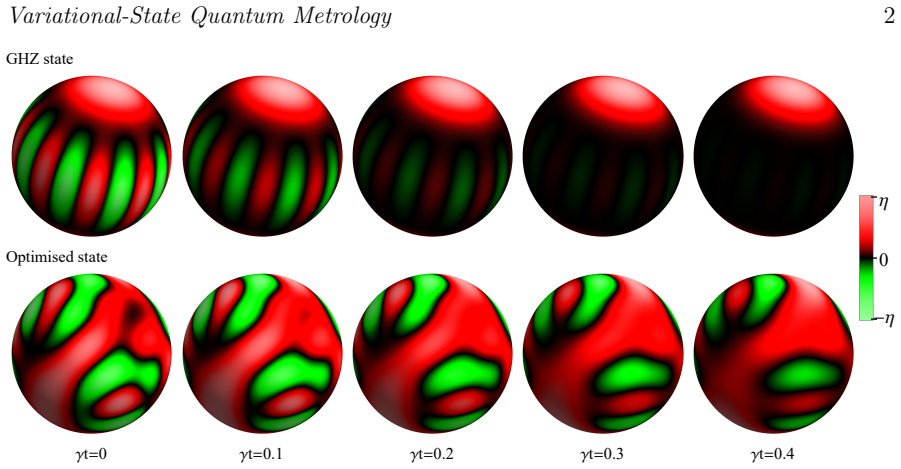
The paper claims that under amplitude damping and inhomogeneous Pauli errors, optimal metrological probe states for 3 to 9 qubits are not symmetric under permutations, and that these symmetry-broken states achieve up to twice the precision of the best permutation-symmetric states, including GHZ states, one-axis twisted squeezed states, and general symmetric Dicke superpositions. The advantage comes from an additional component $|D\rangle = \sqrt{2/N}(|1100\cdots 000\rangle + |0011\cdots 000\rangle + \cdots + |0000\cdots 011\rangle)$ added to a superposition of $|00\cdots 0\rangle$ and $|11\cdots 1\rangle$, which allows first-order $T_1$ decay events on individual qubits to be resolved in $2N$ separate measurement bases rather than one collective basis. The paper also confirms in the dephasing and Ornstein-Uhlenbeck cases that its variational search reproduces known optimal states, so the non-symmetric finding is presented as a genuine exception to the usual symmetric ansatz rather than a failure of the optimizer.
Load-bearing premise
The load-bearing premise is that the randomized coordinate-descent search reached the true global optimum within both the shallow ansatz family and the symmetric subspace for $N$ up to 9 under amplitude damping and Pauli errors, and that the shallow ansatz is expressive enough to contain the optimal state; the paper explicitly states it cannot guarantee global optimality.
Editorial extensions
If this is right
- A near-term quantum device can run the variational loop directly with encoder and decoder circuits, and the resulting probe state is tailored to the device's own dominant noise without separate process tomography.
- For amplitude damping the symmetry-breaking advantage appears for $N \geq 5$ and persists when preparation circuits are subject to depolarizing gate noise at realistic rates, so it is compatible with imperfect hardware.
- Under dephasing and Ornstein-Uhlenbeck noise the same ansatz reproduces known optimal behavior, squeezed-like states and GHZ states respectively, showing the method recovers established results where symmetry is not broken.
- The gain over symmetric states is a constant factor, not a new scaling: the precision remains linear in $N$ under Markovian noise, consistent with asymptotic no-go bounds.
Reading between the lines
- If the Appendix C mechanism, $N$ distinguishable first-order error-resolving measurement bases, persists for larger $N$, the constant-factor advantage may grow with qubit number even though the asymptotic scaling stays linear; the paper only claims the advantage for $N \leq 9$.
- A testable heuristic follows: any noise model with a non-rotationally-symmetric error axis and distinguishable single-qubit decay sectors should show a similar symmetry-breaking benefit, while rotationally symmetric dephasing should not.
- The same cost function could be extended to include active error correction or pulse-control parameters, potentially combining passive first-order correction with active protection; this extends the paper's variational scheme beyond passive probe states.
Editorial analysis
A structured set of objections, weighed in public.
Referee Report
Summary. The paper proposes a variational quantum algorithm for finding near-optimal probe states for quantum metrology in the presence of noise. The probe state is prepared by a parameterized shallow circuit, allowed to evolve under a field Hamiltonian together with a continuous noisy channel, and the precision is quantified by the quantum Fisher information computed via a fidelity-based finite-difference approximation. The authors simulate systems of up to 9 qubits exactly with QuEST for dephasing, amplitude damping, inhomogeneous Pauli errors, and Ornstein-Uhlenbeck noise, optimizing both the circuit parameters and the sensing time. Their central numerical finding is that, for amplitude damping and inhomogeneous Pauli errors, permutation-non-symmetric ansatz states outperform the permutation-symmetric states they optimized (GHZ, squeezed, and general symmetric Dicke mixtures) by up to a constant factor of about 2. For amplitude damping, they provide an analytical model in which a broken-symmetry component permits first-order T1 decay events to be individually resolved, yielding additional Fisher information. They also outline an experimental implementation with encoder and decoder circuits and analyze the effect of imperfect preparation gates in an appendix.
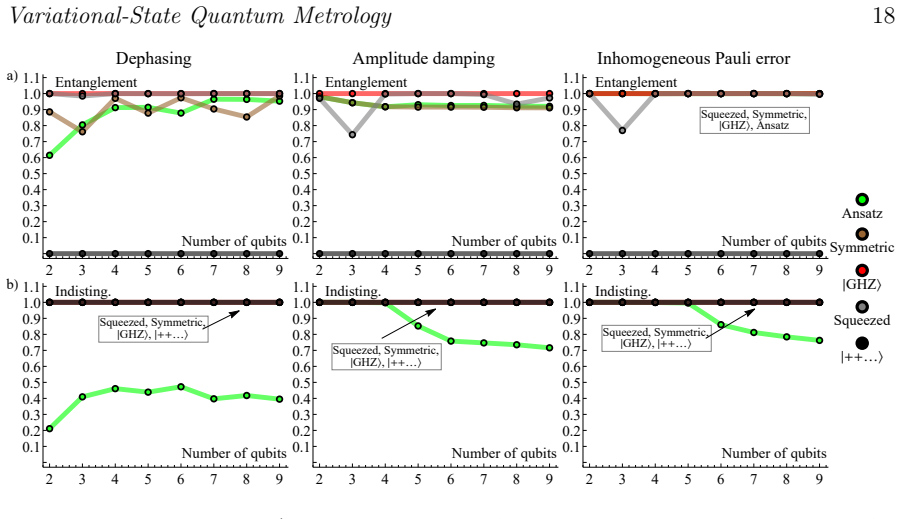
Significance. If the central numerical claim holds, the paper makes a useful and somewhat counterintuitive contribution to noisy quantum metrology: it shows, for small numbers of qubits, that relaxing permutation symmetry can yield a constant-factor advantage over the symmetric states that have dominated the literature, and it gives an intuitive analytical explanation for the amplitude-damping case. The work is strengthened by exact numerical simulations using QuEST, by validation against known analytic optima for dephasing and Ornstein-Uhlenbeck noise, and by the public release of the simulation code. The analytical model in Appendix C, while heuristic, is a concrete falsifiable description of the mechanism. The main weakness is that the 'outperforms any symmetric state' claim depends on the completeness of a randomized optimization over the symmetric subspace, which the authors explicitly do not guarantee; this tempers the strength of the headline claim but does not undermine the existence of the explicit ansatz states themselves.
major comments (3)
- [Sec. 5.2, Sec. 7, Fig. 4(a)(mid/right)] The central claim that the ansatz states 'outperform any symmetric state' is not established by the reported numerics, because the symmetric baseline is produced by the same randomized adaptive coordinate descent routine whose global optimality the authors explicitly disclaim ('we cannot guarantee global optimality in general', Sec. 5.2; 'verifying global optimality of the symmetry-breaking states is beyond the scope of the current work', Sec. 7). Since the symmetric subspace has dimension N+1, for N up to 9 a substantially more exhaustive search (dense grid plus local refinement, or a certified global optimizer) is feasible and would make the comparison conclusive; alternatively, the claim should be weakened to 'outperform all symmetric states found by our optimizer and all previously known explicit state families'.
- [Sec. 5.3 and Fig. 4] The optimizer is validated only for dephasing and Ornstein-Uhlenbeck noise, where analytic optima are known and the ansatz, symmetric, and squeezed curves essentially coincide. No independent validation is supplied for amplitude damping or inhomogeneous Pauli errors, which are precisely the two channels where the symmetry-breaking advantage is claimed. A concrete test would be to compare the optimized symmetric curve against known asymptotic upper bounds for these channels, or to repeat the symmetric-subspace optimization for N up to 9 with a qualitatively different global search method, to confirm that the brown curve in Fig. 4 is not a local optimum.
- [Appendix C, Eqs. (C.1)–(C.5)] The analytical argument that the non-symmetric scheme gains a factor proportional to N relies on the ratios in Eqs. (C.4) and (C.5) being O(N^0) for every j, but the derivation only states this asymptotic order without showing the constants or the range of N for which the individual contributions remain comparable to the symmetric single-basis contribution. Since the claimed advantage is a constant factor at finite N (not an asymptotic scaling), the argument would be more convincing if the authors provided the explicit expressions for prob(Aj) and its derivative, or a plot of the ratio F_a/F_s versus N for the optimized coefficients.
minor comments (4)
- [Throughout] There are several typos and OCR artifacts, including 'Winger' in the Fig. 1 caption, 'follwing' in the introduction, 'its its' in the Fig. 7 caption, and garbled author names in Ref. [40]; these should be corrected.
- [Sec. 5.1] The squeezed-state definition contains an extraneous time variable t in the exponents e^{-iθ3 t Jz}, e^{-iθ2 t Jx}, and e^{-iθ1 t Jz^2}; since t is the sensing time and is optimized separately, the formula should use the rotation angles θ_i alone or define the effective angles explicitly to avoid confusion.
- [Appendix C] The text refers both to 'all 2N bases' and to 'N distinguishable measurement bases'; because each j contributes two bases (the ± signs), the counting in Eqs. (C.1)–(C.3) should be clarified, and the sum index should be explicit.
- [Sec. 5.4] The phrase 'passively correct first-order decay events' may overstate the mechanism; the analysis in Appendix C describes extracting additional Fisher information from first-order decay outcomes, not correcting the state, so consider rewording to 'extract additional Fisher information from first-order decay events'.
Circularity Check
No circularity: the metrological state search is a numerical optimization over a physically defined objective, with self-citations only contextual and non-load-bearing.
full rationale
The paper's central claim is the output of a numerical optimization of the quantum Fisher information for an explicit variational ansatz under explicit noise models. The objective function is the physically defined estimation precision, and the baselines (GHZ, product, squeezed, general symmetric states) are independently parameterized and externally known; nothing in the cost function is defined in terms of the target result. The non-symmetric advantage is therefore an optimization finding, not an assumption containing the conclusion. The paper explicitly disclaims global optimality in Sec. 5.2 ('we cannot guarantee global optimality in general') and Sec. 7 ('verifying global optimality of the symmetry-breaking states is beyond the scope of the current work'), which is an honest completeness caveat about the search rather than a circular reduction. Appendix C is a post hoc explanatory model: the coefficients c1, c2, c3 are read off the optimized states, and the manuscript presents it as an analysis of why the found states perform well, not as an independent prediction. The self-citations are not load-bearing: [26] supplies a previously known asymptotic scaling expectation for the Ornstein-Uhlenbeck case, which the paper independently reproduces numerically, and [61] is mentioned only as a possible future optimization technique. No equation or fitted parameter is renamed as a prediction, and no claimed result reduces by construction to its input.
Assumptions & free parameters
free parameters (1)
- c1, c2, c3 (coefficients of |ψ_a>) =
c1≈0.77, c2≈0.55, c3≈0.33 for N=8
assumptions (5)
- domain assumption The sensing-and-noise process is an infinitesimal divisible CPTP map with generator -iωJ_z + γL acting as Φ_ωt = e^{-iωtJ_z + γtL} (Eq. 8).
- standard math The quantum Fisher information is computed via the fidelity limit F_Q[ρ(ω)] = 8 lim_{δω→0} [1-Fid(ρ(ω),ρ(ω+δω))]/δω^2 (Eq. 6) and the finite-difference approximation Eq. (9) with δωt much less than 1.
- domain assumption The encoder and analysis stages are perfect and take negligible time compared with the sensing time t (Sec. 4), so the only error during preparation is neglected except in Appendix D.
- domain assumption For dephasing, amplitude damping, and Pauli error models, the noise acts independently and identically on each qubit with the Kraus maps in Eqs. (14)-(16).
- ad hoc to paper The fixed ansatz circuit B2B2B1B2B2B1 (Fig. 3) is expressive enough to approximate the metrologically optimal states for N up to 9.
Cite this review
Pith. "Pith review of Variational-State Quantum Metrology." pith.science (2026). https://pith.science/paper/ROHVA6GX
@misc{pith2026190808904,
  author       = {Pith},
  title        = {Pith review of: Variational-State Quantum Metrology},
  year         = {2026},
  howpublished = {\url{https://pith.science/paper/ROHVA6GX}},
  note         = {Machine review of arXiv:1908.08904}
}
read the original abstract
Quantum technologies exploit entanglement to enhance various tasks beyond their classical limits including computation, communication and measurements. Quantum metrology aims to increase the precision of a measured quantity that is estimated in the presence of statistical errors using entangled quantum states. We present a novel approach for finding (near) optimal states for metrology in the presence of noise, using variational techniques as a tool for efficiently searching the classically intractable high-dimensional space of quantum states. We comprehensively explore systems consisting of up to 9 qubits and find new highly entangled states that are not symmetric under permutations and non-trivially outperform previously known states up to a constant factor 2. We consider a range of environmental noise models; while passive quantum states cannot achieve a fundamentally superior scaling (as established by prior asymptotic results) we do observe a significant absolute quantum advantage. We finally outline a possible experimental setup for variational quantum metrology which can be implemented in near-term hardware.
Figures


Figures from the paper (5 more)




Forward citations
Cited by 1 Pith paper
-
An atomic array optical clock with single-atom readout
An optical clock made from a 40-atom strontium tweezer array with single-atom readout reaches 2.5×10^-15/√τ stability and agrees with a detailed Monte Carlo simulation.
Reference graph
Works this paper leans on
-
[1]
A variational eigenvalue solver on a photonic quantum processor
Alberto Peruzzo, Jarrod McClean, Peter Shadbolt, Man-Hong Yung, Xiao-Qi Zhou, Peter J Love, Al´ an Aspuru-Guzik, and Jeremy L Obrien. A variational eigenvalue solver on a photonic quantum processor. Nat. Comm., 5:4213, 2014
2014
-
[2]
Hardware-efficient variational quantum eigensolver for small molecules and quantum magnets
Abhinav Kandala, Antonio Mezzacapo, Kristan Temme, Maika Takita, Markus Brink, Jerry M Chow, and Jay M Gambetta. Hardware-efficient variational quantum eigensolver for small molecules and quantum magnets. Nature, 549(7671):242, 2017
2017
-
[3]
Quantum optimization using variational algorithms on near-term quantum devices
Nikolaj Moll, Panagiotis Barkoutsos, Lev S Bishop, Jerry M Chow, Andrew Cross, Daniel J Egger, Stefan Filipp, Andreas Fuhrer, Jay M Gambetta, Marc Ganzhorn, et al. Quantum optimization using variational algorithms on near-term quantum devices. Quantum Sci. Technol., 3(3):030503, 2018
2018
-
[4]
The theory of variational hybrid quantum-classical algorithms
Jarrod R McClean, Jonathan Romero, Ryan Babbush, and Al´ an Aspuru-Guzik. The theory of variational hybrid quantum-classical algorithms. New J. Phys. , 18(2):023023, 2016
2016
-
[5]
A quantum approximate optimization algorithm
Edward Farhi, Jeffrey Goldstone, and Sam Gutmann. A quantum approximate optimization algorithm. arXiv preprint arXiv:1411.4028 , 2014
arXiv 2014
-
[6]
Efficient variational quantum simulator incorporating active error minimization
Ying Li and Simon C Benjamin. Efficient variational quantum simulator incorporating active error minimization. Phys. Rev. X , 7(2):021050, 2017
2017
-
[7]
Kosuke Mitarai, Makoto Negoro, Masahiro Kitagawa, and Keisuke Fujii. Quantum circuit learning. Phys. Rev. A , 98(3):032309, 2018
work page 2018
-
[8]
Physical-Layer Supervised Learning Assisted by an Entangled Sensor Network
Quntao Zhuang and Zheshen Zhang. Supervised Learning Enhanced by an Entangled Sensor Network. arXiv preprint arXiv:1901.09566 , 2019
work page Pith review arXiv 1901
Show all 85 references
-
[9]
Quantum compilation and circuit optimisation via energy dissipation
Tyson Jones and Simon C Benjamin. Quantum compilation and circuit optimisation via energy dissipation. arXiv preprint arXiv:1811.03147 , 2018. Variational-State Quantum Metrology 28
2018 arXiv
-
[10]
Variational Quantum Gate Optimization
Kentaro Heya, Yasunari Suzuki, Yasunobu Nakamura, and Keisuke Fujii. Variational Quantum Gate Optimization. arXiv preprint arXiv:1810.12745 , 2018
2018 arXiv
-
[11]
Quantum-enhanced measurements: beating the standard quantum limit
Vittorio Giovannetti, Seth Lloyd, and Lorenzo Maccone. Quantum-enhanced measurements: beating the standard quantum limit. Science, 306(5700):1330–1336, 2004
2004
-
[12]
Oberthaler, Roman Schmied, and Philipp Treutlein
Luca Pezz` e, Augusto Smerzi, Markus K. Oberthaler, Roman Schmied, and Philipp Treutlein. Quantum metrology with nonclassical states of atomic ensembles. Rev. Mod. Phys., 90:035005, Sep 2018
2018
-
[13]
Advances in quantum metrology
Vittorio Giovannetti, Seth Lloyd, and Lorenzo Maccone. Advances in quantum metrology. Nat. Phot., 5(4):222, 2011
2011
-
[14]
Quantum metrology from a quantum information science perspective
G´ eza T´ oth and Iagoba Apellaniz. Quantum metrology from a quantum information science perspective. J. Phys. A: Math. Theor. , 47(42):424006, oct 2014
2014
-
[15]
Spin dynamics: basics of nuclear magnetic resonance
Malcolm H Levitt. Spin dynamics: basics of nuclear magnetic resonance . John Wiley & Sons, Chichester, 2001
2001
-
[16]
Optical magnetic imaging of living cells
David Le Sage, Koji Arai, David R Glenn, Stephen J DeVience, Linh M Pham, Lilah Rahn-Lee, Mikhail D Lukin, Amir Yacoby, Arash Komeili, and Ronald L Walsworth. Optical magnetic imaging of living cells. Nature, 496(7446):486, 2013
2013
-
[17]
Hall-effect sensors: theory and application
Edward Ramsden. Hall-effect sensors: theory and application . Elsevier, 2011
2011
-
[18]
Gradiometric micro-SQUID susceptometer for scanning measurements of mesoscopic samples
Martin E Huber, Nicholas C Koshnick, Hendrik Bluhm, Leonard J Archuleta, Tommy Azua, Per G Bj¨ ornsson, Brian W Gardner, Sean T Halloran, Erik A Lucero, and Kathryn A Moler. Gradiometric micro-SQUID susceptometer for scanning measurements of mesoscopic samples. Rev. Sci. Instr...
2008
-
[19]
Force-detected nuclear magnetic resonance: recent advances and future challenges
Martino Poggio and Christian L Degen. Force-detected nuclear magnetic resonance: recent advances and future challenges. Nanotech., 21(34):342001, 2010
2010
-
[20]
Ultrasensitive magnetic field detection using a single artificial atom
Mustafa Bal, Chunqing Deng, Jean-Luc Orgiazzi, FR Ong, and Adrian Lupascu. Ultrasensitive magnetic field detection using a single artificial atom. Nat. Comm., 3:1324, 2012
2012
-
[21]
Subpicotesla diamond magnetometry
Thomas Wolf, Philipp Neumann, Kazuo Nakamura, Hitoshi Sumiya, Takeshi Ohshima, Junichi Isoya, and J¨ org Wrachtrup. Subpicotesla diamond magnetometry. Phys. Rev. X , 5(4):041001, 2015
2015
-
[22]
Optical and spin coherence properties of nitrogen-vacancy centers placed in a 100 nm thick isotopically purified diamond layer
Toyofumi Ishikawa, Kai-Mei C Fu, Charles Santori, Victor M Acosta, Raymond G Beausoleil, Hideyuki Watanabe, Shinichi Shikata, and Kohei M Itoh. Optical and spin coherence properties of nitrogen-vacancy centers placed in a 100 nm thick isotopically purified diamond layer. Nano L...
2012
-
[23]
S. F. Huelga, C. Macchiavello, T. Pellizzari, A. K. Ekert, M. B. Plenio, and J. I. Cirac. Improvement of Frequency Standards with Quantum Entanglement. Phys. Rev. Lett., 79:3865– 3868, Nov 1997
1997
-
[24]
Efficient tools for quantum metrology with uncorrelated noise
Jan Ko lody´ nski and Rafa l Demkowicz-Dobrza´ nski. Efficient tools for quantum metrology with uncorrelated noise. New J. Phys. , 15(7):073043, jul 2013
2013
-
[25]
The elusive Heisenberg limit in quantum-enhanced metrology
Rafa l Demkowicz-Dobrza´ nski, Jan Ko lody´ nski, and M˘ ad˘ alin Gut ¸˘ a. The elusive Heisenberg limit in quantum-enhanced metrology. Nat. Comm., 3:1063, 2012
2012
-
[26]
Benjamin, and Joseph Fitzsimons
Yuichiro Matsuzaki, Simon C. Benjamin, and Joseph Fitzsimons. Magnetic field sensing beyond the standard quantum limit under the effect of decoherence. Phys. Rev. A, 84:012103, Jul 2011
2011
-
[27]
Chin, Susana F
Alex W. Chin, Susana F. Huelga, and Martin B. Plenio. Quantum Metrology in Non-Markovian Environments. Phys. Rev. Lett., 109:233601, Dec 2012
2012
-
[28]
Heisenberg limited metrology using quantum error-correction codes
Roee Ozeri. Heisenberg limited metrology using quantum error-correction codes. arXiv preprint arXiv:1310.3432, 2013
2013 arXiv
-
[29]
Arrad, Y
G. Arrad, Y. Vinkler, D. Aharonov, and A. Retzker. Increasing Sensing Resolution with Error Correction. Phys. Rev. Lett., 112:150801, Apr 2014
2014
-
[30]
D¨ ur, M
W. D¨ ur, M. Skotiniotis, F. Fr¨ owis, and B. Kraus. Improved Quantum Metrology Using Quantum Error Correction. Phys. Rev. Lett., 112:080801, Feb 2014
2014
-
[31]
E. M. Kessler, I. Lovchinsky, A. O. Sushkov, and M. D. Lukin. Quantum Error Correction for Metrology. Phys. Rev. Lett., 112:150802, Apr 2014. Variational-State Quantum Metrology 29
2014
-
[32]
Herrera-Mart´ ı, Tuvia Gefen, Dorit Aharonov, Nadav Katz, and Alex Retzker
David A. Herrera-Mart´ ı, Tuvia Gefen, Dorit Aharonov, Nadav Katz, and Alex Retzker. Quantum Error-Correction-Enhanced Magnetometer Overcoming the Limit Imposed by Relaxation. Phys. Rev. Lett., 115:200501, Nov 2015
2015
-
[33]
Plenio and Susana F
Martin B. Plenio and Susana F. Huelga. Sensing in the presence of an observed environment. Phys. Rev. A , 93:032123, Mar 2016
2016
-
[34]
Leung, M
Debbie W. Leung, M. A. Nielsen, Isaac L. Chuang, and Yoshihisa Yamamoto. Approximate quantum error correction can lead to better codes. Phys. Rev. A , 56:2567–2573, Oct 1997
1997
-
[35]
Taghavi, R
S. Taghavi, R. L. Kosut, and D. A. Lidar. Channel-Optimized Quantum Error Correction. IEEE Transactions on Information Theory , 56(3):1461–1473, March 2010
2010
-
[36]
QVECTOR: an algorithm for device-tailored quantum error correction
Peter D Johnson, Jonathan Romero, Jonathan Olson, Yudong Cao, and Al´ an Aspuru-Guzik. QVECTOR: an algorithm for device-tailored quantum error correction. arXiv preprint arXiv:1711.02249, 2017
2017 arXiv
-
[37]
Anil Shaji and Carlton M. Caves. Qubit metrology and decoherence. Phys. Rev. A , 76:032111, Sep 2007
2007
-
[38]
Spin squeezing and decoherence limit in Ramsey spectroscopy
Duger Ulam-Orgikh and Masahiro Kitagawa. Spin squeezing and decoherence limit in Ramsey spectroscopy. Phys. Rev. A , 64:052106, Oct 2001
2001
-
[39]
General framework for estimating the ultimate precision limit in noisy quantum-enhanced metrology
BM Escher, RL de Matos Filho, and L Davidovich. General framework for estimating the ultimate precision limit in noisy quantum-enhanced metrology. Nat. Phys., 7(5):406, 2011
2011
-
[40]
Optimal quantum states for frequency estimation
F Frwis and M Skotiniotis and B Kraus and W Dr. Optimal quantum states for frequency estimation. New J. Phys. , 16(8):083010, aug 2014
2014
-
[41]
Matrix Product States for Quantum Metrology
Marcin Jarzyna and Rafa l Demkowicz-Dobrza´ nski. Matrix Product States for Quantum Metrology. Phys. Rev. Lett., 110:240405, Jun 2013
2013
-
[42]
Oszmaniec, R
M. Oszmaniec, R. Augusiak, C. Gogolin, J. Ko lody´ nski, A. Ac´ ın, and M. Lewenstein. Random Bosonic States for Robust Quantum Metrology. Phys. Rev. X , 6:041044, Dec 2016
2016
-
[44]
Nielsen and Isaac L
Michael A. Nielsen and Isaac L. Chuang. Quantum Computation and Quantum Information: 10th Anniversary Edition. Cambridge University Press, New York, NY, USA, 10th edition, 2011
2011
-
[45]
Braunstein and Carlton M
Samuel L. Braunstein and Carlton M. Caves. Statistical distance and the geometry of quantum states. Phys. Rev. Lett., 72:3439–3443, May 1994
1994
-
[46]
Helstrom
C.W. Helstrom. Minimum mean-squared error of estimates in quantum statistics. Phys. Lett. A, 25(2):101 – 102, 1967
1967
-
[47]
Quantum Fisher information matrix and multiparameter estimation
Jing Liu, Haidong Yuan, Xiao-Ming Lu, and Xiaoguang Wang. Quantum Fisher information matrix and multiparameter estimation. J. Phys. A: Math. Theo. , 2019
2019
-
[48]
Quantum Fisher Information for Density Matrices with Arbitrary Ranks
Jing Liu, Xiao-Xing Jing, Wei Zhong, and Xiao-Guang Wang. Quantum Fisher Information for Density Matrices with Arbitrary Ranks. Comm. Theor. Phys. , 61(1):45–50, jan 2014
2014
-
[49]
Wolf and J
Michael M. Wolf and J. Ignacio Cirac. Dividing Quantum Channels. Comm. Math. Phys. , 279(1):147–168, Apr 2008
2008
-
[50]
Infinitely divisible markov mappings in quantum probability theory
LV Denisov. Infinitely divisible markov mappings in quantum probability theory. Theory of Probability & Its Applications , 33(2):392–395, 1989
1989
-
[51]
QuEST and high performance simulation of quantum computers
Tyson Jones, Anna Brown, Ian Bush, and Simon C Benjamin. QuEST and high performance simulation of quantum computers. Sci. Rep., 9(1):10736, 2019
2019
-
[52]
Sun, and Franco Nori
Jian Ma, Xiaoguang Wang, C.P. Sun, and Franco Nori. Quantum spin squeezing. Phys. Rep., 509(2):89 – 165, 2011
2011
-
[53]
Robust quantum metrology with explicit symmetric states
Yingkai Ouyang, Nathan Shettell, and Damian Markham. Robust quantum metrology with explicit symmetric states. arXiv preprint arXiv:1908.02378 , 2019
1908 arXiv
-
[54]
John K Stockton, J. M. Geremia, Andrew C Doherty, and Hideo Mabuchi. Characterizing the entanglement of symmetric many-particle spin-1/2 systems. Phys. Rev. A , 67(2):022112, 2003
2003
-
[55]
Jun J. Sakurai. Modern Quantum Mechanics. Addison-Wesley, Reading, rev. edition, 1994
1994
-
[56]
On Angular Momentum,
Julian Schwinger. On Angular Momentum,. In L. C. Biedenharn and H. Van Dam, editors, Quantum Theory of Angular Momentum , pages 229–279. Academic Press, New York, 1965. Variational-State Quantum Metrology 30
1965
-
[57]
P. J. J. O’Malley, R. Babbush, I. D. Kivlichan, J. Romero, J. R. McClean, R. Barends, J. Kelly, P. Roushan, A. Tranter, N. Ding, B. Campbell, Y. Chen, Z. Chen, B. Chiaro, A. Dunsworth, A. G. Fowler, E. Jeffrey, E. Lucero, A. Megrant, J. Y. Mutus, M. Neeley, C. Neill, C. Quintan...
2016
-
[58]
Quantum gradient descent and Newton’s method for constrained polynomial optimization
Patrick Rebentrost, Maria Schuld, Leonard Wossnig, Francesco Petruccione, and Seth Lloyd. Quantum gradient descent and Newton’s method for constrained polynomial optimization. New J. Phys., 21(7):073023, jul 2019
2019
-
[59]
Stochastic gradient descent for hybrid quantum-classical optimization
Ryan Sweke, Frederik Wilde, Johannes Meyer, Maria Schuld, Paul K F¨ ahrmann, Barth´ el´ emy Meynard-Piganeau, and Jens Eisert. Stochastic gradient descent for hybrid quantum-classical optimization. arXiv preprint arXiv:1910.01155 , 2019
1910 arXiv
-
[60]
An adaptive optimizer for measurement-frugal variational algorithms
Jonas M K¨ ubler, Andrew Arrasmith, Lukasz Cincio, and Patrick J Coles. An adaptive optimizer for measurement-frugal variational algorithms. arXiv preprint arXiv:1909.09083 , 2019
1909 arXiv
-
[61]
Quantum natural gradient generalised to non-unitary circuits
B´ alint Koczor and Simon C Benjamin. Quantum natural gradient generalised to non-unitary circuits. arXiv preprint arXiv:1912.08660 , 2019
1912 arXiv
-
[62]
Adaptive coordinate descent
Ilya Loshchilov, Marc Schoenauer, and Mich` ele Sebag. Adaptive coordinate descent. In Proceedings of the 13th annual conference on Genetic and evolutionary computation , pages 885– 892, 2011
2011
-
[63]
Variational-State-Quantum-Metrology, 2019
GitHub repository. Variational-State-Quantum-Metrology, 2019. https://github.com/ QTechTheory/Variational-State-Quantum-Metrology
2019
-
[64]
A fibre bundle over manifolds of quantum channels and its application to quantum statistics
Akio Fujiwara and Hiroshi Imai. A fibre bundle over manifolds of quantum channels and its application to quantum statistics. J. Phys. A: Math. Theor. , 41(25):255304, may 2008
2008
-
[65]
Timothy F. Havel. Robust procedures for converting among Lindblad, Kraus and matrix representations of quantum dynamical semigroups. J. Math. Phys. , 44(2):534–557, 2003
2003
-
[66]
G. E. Uhlenbeck and L. S. Ornstein. On the Theory of the Brownian Motion. Phys. Rev., 36:823– 841, Sep 1930
1930
-
[67]
Ting Yu and J.H. Eberly. Entanglement evolution in a non-Markovian environment. Optics Comm., 283(5):676 – 680, 2010
2010
-
[68]
Meyer and Nolan R
David A. Meyer and Nolan R. Wallach. Global entanglement in multiparticle systems. J. Math. Phys., 43(9):4273–4278, 2002
2002
-
[69]
An observable measure of entanglement for pure states of multi-qubit systems
Gavin K Brennen. An observable measure of entanglement for pure states of multi-qubit systems. arXiv preprint quant-ph/0305094 , 2003
2003 arXiv
-
[70]
Maximally entangled multipartite states: a brief survey
M Enr´ ıquez, I Wintrowicz, and Karol ˙Zyczkowski. Maximally entangled multipartite states: a brief survey. In J. Phys.: Conf. Ser. , volume 698, page 012003. IOP Publishing, 2016
2016
-
[71]
G. S. Agarwal. Relation between atomic coherent-state representation, state multipoles, and generalized phase-space distributions. Phys. Rev. A , 24:2889–2896, 1981
1981
-
[72]
Brif and A
C. Brif and A. Mann. Phase-space formulation of quantum mechanics and quantum-state reconstruction for physical systems with Lie-group symmetries. Phys. Rev. A , 59(2):971–987, 1999
1999
-
[73]
B´ alint Koczor, Robert Zeier, and Steffen J. Glaser. Continuous phase-space representations for finite-dimensional quantum states and their tomography. Phys. Rev. A , 101:022318, Feb 2020
2020
-
[74]
B´ alint Koczor, Robert Zeier, and Steffen J. Glaser. Continuous phase spaces and the time evolution of spins: star products and spin-weighted spherical harmonics. J. Phys. A. , 52(5):055302, 2019. (Preprint arXiv:1808.02697)
2019 arXiv
-
[75]
B´ alint Koczor, Robert Zeier, and Steffen J. Glaser. Time evolution of coupled spin systems in a generalized Wigner representation. Ann. Phys., 408(September):1–50, 2019
2019
-
[76]
On phase-space representations of spin systems and their relations to infinite- dimensional quantum states
B´ alint Koczor. On phase-space representations of spin systems and their relations to infinite- dimensional quantum states . Dissertation, Technische Universitat Munchen, Munich, 2019
2019
-
[77]
Grossmann
A. Grossmann. Parity operator and quantization of δ-functions. Comm. Math. Phys. , 48(3):191– 194, 1976. Variational-State Quantum Metrology 31
1976
-
[78]
de Gosson, Steffen J Glaser, and Robert Zeier
B´ alint Koczor, Frederik vom Ende, Maurice A. de Gosson, Steffen J Glaser, and Robert Zeier. Phase Spaces, Parity Operators, and the Born-Jordan Distribution, 2018. ( Preprint arXiv:1811.05872)
2018 arXiv
-
[79]
Wigner Functions for Arbitrary Quantum Systems
Todd Tilma, Mark J Everitt, John H Samson, William J Munro, and Kae Nemoto. Wigner Functions for Arbitrary Quantum Systems. Phys. Rev. Lett., 117(18):180401, 2016
2016
-
[80]
Superconducting quantum circuits at the surface code threshold for fault tolerance
Rami Barends, Julian Kelly, Anthony Megrant, Andrzej Veitia, Daniel Sank, Evan Jeffrey, Ted C White, Josh Mutus, Austin G Fowler, Brooks Campbell, et al. Superconducting quantum circuits at the surface code threshold for fault tolerance. Nature, 508(7497):500, 2014
2014
-
[81]
Realization of three-qubit quantum error correction with superconducting circuits
Matthew D Reed, Leonardo DiCarlo, Simon E Nigg, Luyan Sun, Luigi Frunzio, Steven M Girvin, and Robert J Schoelkopf. Realization of three-qubit quantum error correction with superconducting circuits. Nature, 482(7385):382, 2012
2012
-
[82]
State preservation by repetitive error detection in a superconducting quantum circuit
Julian Kelly, Rami Barends, Austin G Fowler, Anthony Megrant, Evan Jeffrey, Theodore C White, Daniel Sank, Josh Y Mutus, Brooks Campbell, Yu Chen, et al. State preservation by repetitive error detection in a superconducting quantum circuit. Nature, 519(7541):66, 2015
2015
-
[83]
Superconducting quantum bits
John Clarke and Frank K Wilhelm. Superconducting quantum bits. Nature, 453(7198):1031, 2008
2008
-
[84]
Electron paramagnetic resonance spectroscopy using a single artificial atom
Hiraku Toida, Yuichiro Matsuzaki, Kosuke Kakuyanagi, Xiaobo Zhu, William J Munro, Hiroshi Yamaguchi, and Shiro Saito. Electron paramagnetic resonance spectroscopy using a single artificial atom. Comm. Phys., 2(1):33, 2019
2019
-
[85]
A search algorithm for quantum state engineering and metrology
PA Knott. A search algorithm for quantum state engineering and metrology. New J. Phys. , 18(7):073033, 2016
2016
-
[86]
C. J. Ballance, T. P. Harty, N. M. Linke, M. A. Sepiol, and D. M. Lucas. High-Fidelity Quantum Logic Gates Using Trapped-Ion Hyperfine Qubits. Phys. Rev. Lett., 117:060504, Aug 2016
2016
Reviewed August 14, 2026 · model on record in the stance chip above.
Discussion (0). Continue with ORCID to comment.