REVIEW 4 major objections 4 minor 2 cited by
Multi-messenger tests of gravity with weakly lensed gravitational waves
T0 review · 4 major / 4 minor · reviewed 2026-08-14 · deepseek-v4-flash
Pith's one-line read Cross-correlating GW with CMB lensing can test whether gravity bends light and gravitational waves alike
desk verdict A solid proposal for a GW-CMB lensing cross-correlation test, but the claim that a nonzero correlation manifestly verifies GR is too strong and the distance-error correlation assumption needs work. read the letter →
The pith
A machine-rendered reading of the paper's core claim, the machinery that carries it, and where it could break.
The reading
What carries the argument
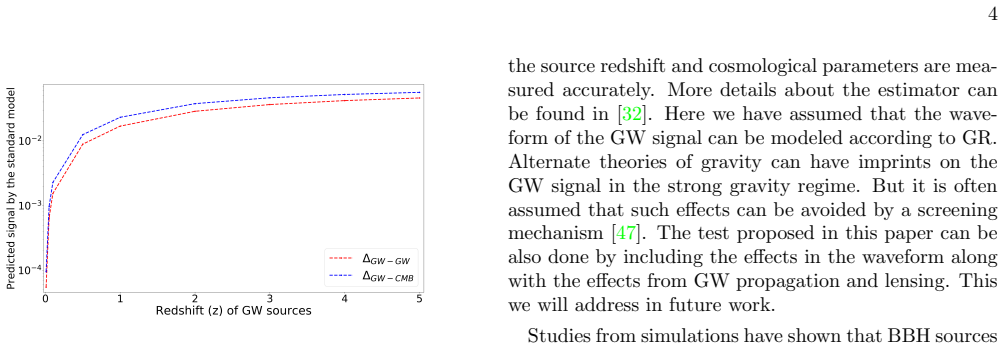
The load-bearing object is the GW luminosity-distance convergence estimator $\hat{D}_L(\hat{n}) = 1 - d_L(\hat{n})/d_L^{\rm est}(\hat{n})$, which equals the lensing convergence $\kappa_{\rm gw}$ plus a distance-error term $\epsilon$. Cross-correlating this estimator with a CMB lensing convergence map yields Eq. (18); because the error term is assumed uncorrelated with the CMB lensing field, the measured correlation isolates the common-lensing signal. The theoretical signal is the cross-spectrum $C_l^{\kappa_{\rm gw}\kappa_{\rm cmb}}$ of Eq. (15), built from the GW kernel $W_{\rm gw}$ and CMB kernel $W_{\rm cmb}$ and the nonlinear matter power spectrum $P_\delta((l+1/2)/\chi)$ in the Limber approximation.
What would settle it
If a future GW sample with the source counts, redshifts, and sky-localization errors assumed in the forecasts yields a cross-spectrum between the $\hat{D}_L$ field and CMB lensing maps that is consistent with zero at cumulative SNR above 3, the paper's central prediction would be falsified; repeating the analysis with galaxy-lensing maps would provide a systematics check on the result.
Extended reading notes
Core claim
The central claim is that the lensing convergence field $\kappa_{\rm gw}$ imprinted on gravitational-wave luminosity distances by intervening matter can be estimated from the waveform alone, using the chirp-mass-independent luminosity distance estimator and an external redshift, and that this field has a predictable cross-power spectrum $C_l^{\kappa_{\rm gw}\kappa_{\rm cmb}}$ with CMB lensing. Because both photons and GWs propagate through the same gravitational potentials, GR predicts a nonzero correlation; the paper computes this signal in the Limber approximation from the product of the GW and CMB lensing kernels times the nonlinear matter power spectrum. The forecasts show LISA's massive black hole binaries with electromagnetic counterparts and Cosmic Explorer's stellar-mass binaries can detect the correlation with SNR above 3 for plausible source counts and sky localizations. A measured nonzero correlation verifies that GWs and photons follow identical geodesics, and a measured amplitude that deviates from the GR+LCDM prediction would probe modified gravity, graviton mass, extra dimensions, and differences between the scalar potentials $\Phi$ and $\Psi$.
Load-bearing premise
The scheme assumes that errors in the estimated luminosity distance—from redshift uncertainties, distance measurement noise, and cosmological parameter errors—are completely uncorrelated with the CMB lensing convergence field, and that the GW sources used have reliable redshifts; if those errors correlate with the intervening matter distribution, the measured cross-correlation would be biased.
Editorial extensions
If this is right
- A nonzero GW-CMB lensing cross-correlation measured at SNR above 3 would directly verify general relativity's prediction that photons and gravitational waves travel on identical geodesics.
- The measured amplitude of the cross-spectrum as a function of source redshift can constrain modified-gravity parameters and the relation between the scalar potentials $\Phi$ and $\Psi$.
- The cross-correlation between GW strain and CMB lensing is effectively a three-point function of two CMB fields and the GW strain, going beyond the standard luminosity-distance-redshift test of background cosmology.
- The same estimator can be applied to neutron star binaries, black hole-neutron star binaries, and to galaxy-survey lensing maps, widening the test to other GW sources and density tracers.
- Removing the weak-lensing contribution from GW signals (delensing) reduces the uncertainty in GW source parameters and sharpens gravitational-wave tests of modified gravity.
Reading between the lines
- If redshift errors or electromagnetic-counterpart selection effects correlate with the intervening matter distribution, the estimator would be biased; injecting such correlated errors into simulations would quantify how much bias can masquerade as a GR-violating signal.
- The same convergence estimator could be cross-correlated with galaxy lensing or 21-cm lensing maps rather than CMB lensing, potentially providing higher-redshift overlap and independent systematics checks for stellar-mass GW sources without electromagnetic counterparts.
- A tomographic version using GW source redshift bins could measure the growth of the lensing kernels directly, effectively mapping the matter distribution with gravitational waves as a probe, which the paper leaves implicit.
- Because the GW-CMB cross-spectrum is sensitive to the same matter distribution as CMB lensing reconstruction, a discrepancy between the measured and predicted correlation could flag systematics in the CMB lensing maps themselves.
Editorial analysis
A structured set of objections, weighed in public.
Referee Report
Summary. The paper proposes a new multi-messenger test of general relativity: reconstruct a weak-lensing convergence field from the luminosity-distance residuals of gravitational-wave (GW) sources relative to their electromagnetic (EM) redshifts, and cross-correlate this field with the CMB lensing convergence. The authors compute the theoretical cross-spectrum C_l^{kappa_gw kappa_cmb} under LCDM+GR using the Limber approximation and a nonlinear matter power spectrum (Eq. 15), estimate the covariance including GW shot noise and CMB lensing reconstruction noise (Eq. 19), and forecast cumulative SNRs for LISA and Cosmic Explorer as functions of source redshift, source number, and angular resolution (Fig. 3). The central claim is that a non-zero GW-CMB lensing correlation would verify a fundamental GR prediction that photons and gravitational waves follow the same geodesics, and that deviations from the predicted signal would probe modified gravity.
Significance. If the proposed measurement works as described, it would open a genuinely new observational window: no current test directly cross-correlates GW strain with CMB lensing to probe the equality of photon and graviton geodesics in the weakly perturbed cosmological metric. The theoretical framework is largely standard: Eq. (15) is the usual Limber-approximated cross-spectrum of two convergence fields, and Eq. (19) is a plausible diagonal covariance model. The paper is also commendably explicit about the approximations used (inspiral-only waveform, diagonal covariance, Limber approximation) and about the fact that Ngw and theta_min are treated as free parameters. The forecast is falsifiable in principle and would be a valuable target for LISA and next-generation ground-based detectors. The main issues are in the estimator: the treatment of the error term epsilon in Eq. (18), the reliance on an unpublished companion paper for the estimator, the unverified assumption of EM counterparts with photometric redshifts for LISA massive black hole binaries, and the concluding claim that a detected non-zero correlation would by itself 'manifestly verify' GR.
major comments (4)
- [Estimator of the convergence field from GW strain, Eqs. (17)-(18)] The estimator in Eq. (17) is ˆD_L = κ_gw + ε − εκ_gw, but the cross-correlation in Eq. (18) is written as ∫(ε + ˆκ_gw)ˆκ_CMB, silently dropping the product term −εκ_gw. Even if ⟨ε κ_CMB⟩ vanishes, the contribution −⟨εκ_gw κ_CMB⟩ does not automatically vanish, since ε and κ_gw probe the same line of sight; this missing term biases the estimated cross-correlation. More importantly, the assertion after Eq. (18) that ‘the convergence field is uncorrelated with the error ε(n)’ is an assumption rather than a demonstrated property. Flux-limited EM-counterpart selection is affected by lensing magnification, and photometric-redshift errors are known to correlate with galaxy environment, so ε can be correlated with the matter distribution that lenses the CMB. Such a residual correlation contributes a term C_l^{εκ_cmb} that is degenerate with the GR signal in Eq. (15). This is load-bearing because the whole claim of a clean cross-correlation measurement rests on this step.
- [Conclusion] The conclusion states that ‘the existence of a non-zero correlation between these two signals will manifestly verify a fundamental prediction of general relativity.’ This overstates what the test can establish. First, the estimator in Eq. (17) uses the GR waveform relation of Eqs. (7)-(8) to convert measured strain into luminosity distance; any modified-gravity effect on wave propagation or on the distance–redshift relation would be absorbed into the reconstructed convergence field. Second, many modified-gravity theories predict a non-zero GW–CMB lensing correlation through altered lensing kernels, gravitational slip, or a modified growth rate, so a non-zero correlation is not by itself a GR discriminator. The paper should either weaken the claim to ‘consistent with the concordance GR prediction’ or specify how amplitude and redshift dependence would be compared with Eq. (15) to distinguish GR from alternatives.
- [Forecast for LISA and Cosmic Explorer, Fig. 3] The forecast treats Ngw and θ_min as free parameters and assumes that LISA massive black hole binaries have EM counterparts with σ_z/(1+z) = 0.03, while Cosmic Explorer sources have 100% redshift uncertainty. These assumptions are observationally unverified, and the projected SNR depends sensitively on them. The paper would be stronger if the source redshift distribution dngw/dz used in the forecasts were stated explicitly and if the SNR were presented as a function of the assumed counterpart fraction and redshift-error model. As it stands, the ‘large measurable window’ in Fig. 3 is a conditional forecast, not a prediction, and the reader cannot reproduce the cumulative SNR from the information given.
- [Eqs. (17) and (20), estimator and noise model] The core estimator of the convergence field and the detailed form of the luminosity-distance noise σ_dl are taken from Ref. [32], which is described as ‘Submitted to MNRAS (2019)’ and is not available to the reader of this manuscript. Given that the estimator is the central new element of the paper, the derivation of Eq. (17) and the mapping between σ_dl, σ_b, and the statistics of ε in Eq. (20) should either be provided in an appendix or the paper should cite a published, publicly available version of the companion work.
minor comments (4)
- [Conclusion] The conclusion refers to ‘the predicted signal ... shown in Fig. 1’, but the signal as a function of source redshift is shown in Fig. 2.
- [Eq. (20)] The localization suppression factor is typeset as ‘el2θ2min/8 ln 2’; this should presumably be exp(l^2 θ_min^2 / (8 ln 2)) or an equivalent explicitly written exponential.
- [Eq. (18)] The notation ˆκ_CMB is introduced without definition; it should be stated that this is the reconstructed CMB lensing convergence map with the associated reconstruction noise N_l^{κκ}.
- [General] The sentence ‘As the convergence field is uncorrelated with the error ε(n), the first term on the right hand side goes to zero’ would be clearer if it explicitly distinguished the statistical ensemble over noise and source properties from the ensemble over cosmic density fields.
Circularity Check
No significant circularity: the predicted cross-correlation is computed from LCDM+GR and standard lensing kernels, not fitted to data, and no central claim reduces to its own inputs.
full rationale
The central signal C_l^{kappa_gw kappa_cmb} (Eq. 15) is a standard Limber-approximation cross-spectrum between two lensing kernels, evaluated with CLASS using LCDM and GR; it is not fitted to any measurement and does not depend on the proposed estimator. The estimator in Eq. (17) is explicitly constructed from the standard strain-luminosity-distance relation (Eqs. 7-8), and the paper openly states: "Here we have assumed that the waveform of the GW signal can be modeled according to GR." That is a stated modeling assumption, not a prediction secretly defined by the target result. The self-citation to [32] (Mukherjee, Wandelt and Silk, submitted) only supplies "More details about the estimator," while Eqs. (17)-(20) are stated and used in the present paper, so the derivation does not reduce to that citation. The assumption that the error epsilon is uncorrelated with the CMB lensing field is a statistical independence assumption that could be violated by flux-limited selection or photo-z environment correlations, but a potentially biased estimator is a systematic-error concern, not a case of the derivation being equivalent to its inputs by construction. The conclusion's wording that a nonzero correlation will "manifestly verify" GR is stronger than the evidence supports because modified-gravity models can also produce nonzero correlation, but that is a logical overreach in interpretation, not circularity. No circular step was found.
Assumptions & free parameters
free parameters (4)
- Ngw =
varied (free)
- theta_min =
varied (free)
- sigma_z/(1+z) =
0.03 (photometric), ~0 (spectroscopic)
- merger rate for Cosmic Explorer =
24-112 Gpc^-3 yr^-1
assumptions (5)
- domain assumption Fiducial LCDM cosmology with nonlinear matter power spectrum from CLASS
- domain assumption Error epsilon in luminosity distance is uncorrelated with CMB lensing field
- domain assumption Newtonian inspiral waveform (Eq. 7) valid for SNR estimates
- standard math Limber approximation in evaluating the cross-power spectrum
- domain assumption Normalized GW source redshift distribution dn_gw/dz
Cite this review
Pith. "Pith review of Multi-messenger tests of gravity with weakly lensed gravitational waves." pith.science (2026). https://pith.science/paper/JJ27X7TB
@misc{pith2026190808950,
  author       = {Pith},
  title        = {Pith review of: Multi-messenger tests of gravity with weakly lensed gravitational waves},
  year         = {2026},
  howpublished = {\url{https://pith.science/paper/JJ27X7TB}},
  note         = {Machine review of arXiv:1908.08950}
}
read the original abstract
General relativity (GR) predicts concordant trajectories for photons and gravitational waves (GW). We propose a new multi-messenger avenue (GW-CMB-CMB) to prove this aspect of fundamental physics by cross-correlating the GW signal of astrophysical origin with the lensing field derived from the cosmic microwave background (CMB). This new window will allow robust measurement of the prediction from GR with high signal-to-noise and will be able to unveil the true nature of gravity using the GW sources detected by missions such as the Laser Interferometer Space Antenna (LISA), Einstein Telescope and Cosmic Explorer.
Figures


Forward citations
Cited by 2 Pith papers
-
Probing the theory of gravity with gravitational lensing of gravitational waves and galaxy surveys
Cross-correlating gravitational wave lensing with galaxy surveys is forecast to detect weak lensing of gravitational waves at z<0.5 within about 10 years, with black hole-neutron star mergers as the most promising source.
-
Prospect for Detection of Strongly Lensed Multi-messenger Signals of Binary Neutron Star Mergers
Future CE+ET detectors may detect lensed BNS kilonovae at ~0.5/yr via pointed follow-up of known galaxy lenses, while lensed sGRBs and afterglows remain rare or undetectable with current-generation facilities.
Reference graph
Works this paper leans on
- [32]
-
[1]
S. W. Hawking and W. Israel, Three hundred years of gravitation (Cambridge University Press, 1987)
work page 1987
-
[2]
I. D. Saltas, I. Sawicki, L. Amendola, and M. Kunz, Phys. Rev. Lett. 113, 191101 (2014), 1406.7139
arXiv 2014
- [3]
-
[4]
V. Cardoso, O. J. C. Dias, and J. P. S. Lemos, Phys. Rev. D67, 064026 (2003), hep-th/0212168
arXiv 2003
-
[5]
S. M. Carroll, I. Sawicki, A. Silvestri, and M. Trodden, New J. Phys. 8, 323 (2006), astro-ph/0607458
arXiv 2006
- [6]
- [7]
Show all 68 references
- [8]
-
[9]
Silvestri, L
A. Silvestri, L. Pogosian, and R. V. Buniy, Phys. Rev. D87, 104015 (2013), 1302.1193
2013 arXiv
- [10]
- [11]
- [12]
-
[13]
However, the other two parameters such as αM and Γij remain unconstrained
and constraining the termcT andµ which are related to the speed of GW and the graviton mass. However, the other two parameters such as αM and Γij remain unconstrained. Along with the effects on GW propaga- tion, alternate theories of gravity also affect the Poisson equation ∇2(Φ...
-
[14]
Belgacem, Y
E. Belgacem, Y. Dirian, S. Foffa, and M. Maggiore, Phys. Rev. D97, 104066 (2018), 1712.08108
2018 arXiv
-
[15]
P. A. R. Ade et al. (Planck), Astron. Astrophys. 594, A15 (2016), 1502.01591
2016 arXiv
-
[16]
Baker, E
T. Baker, E. Bellini, P. G. Ferreira, M. Lagos, J. Noller, and I. Sawicki, Phys. Rev. Lett. 119, 251301 (2017), URL https://link.aps.org/doi/10. 1103/PhysRevLett.119.251301
2017
- [17]
-
[18]
Millea, E
M. Millea, E. Anderes, B. D. Wandelt, and M. Millea, ArXiv e-prints (2017), 1708.06753
2017 arXiv
- [19]
- [20]
-
[21]
Maggiore and O
M. Maggiore and O. U. Press, Gravitational Waves: Vol- ume 1: Theory and Experiments , Gravitational Waves (OUP Oxford, 2008), ISBN 9780198570745, URL https: //books.google.com/books?id=AqVpQgAACAAJ
2008
- [22]
-
[23]
Nissanke, D
S. Nissanke, D. E. Holz, S. A. Hughes, N. Dalal, and J. L. Sievers, ApJ 725, 496 (2010), 0904.1017
2010 arXiv
-
[24]
E. E. Flanagan and S. A. Hughes, Phys. Rev. D57, 4535 (1998), gr-qc/9701039
1998 arXiv
-
[25]
B. F. Schutz, Nature 323, 310 (1986)
1986
- [26]
-
[27]
Takahashi, Astrophys
R. Takahashi, Astrophys. J. 644, 80 (2006), astro- ph/0511517
2006
-
[28]
Laguna, S
P. Laguna, S. L. Larson, D. Spergel, and N. Yunes, As- trophys. J. 715, L12 (2010), 0905.1908
2010 arXiv
-
[29]
Lesgourgues, ArXiv e-prints (2011), 1104.2932
J. Lesgourgues, ArXiv e-prints (2011), 1104.2932
2011 arXiv
- [30]
-
[31]
Bertacca, A
D. Bertacca, A. Raccanelli, N. Bartolo, and S. Matarrese, Phys. Dark Univ. 20, 32 (2018), 1702.01750
2018 arXiv
-
[33]
Giacomazzo, J
B. Giacomazzo, J. G. Baker, M. C. Miller, C. S. Reynolds, and J. R. van Meter, The Astrophysical Jour- nal Letters 752, L15 (2012), URL http://stacks.iop. org/2041-8205/752/i=1/a=L15
2012
-
[34]
D. Blas, J. Lesgourgues, and T. Tram, JCAP 7, 034 (2011), 1104.2933
2011 arXiv
-
[35]
Palenzuela, L
C. Palenzuela, L. Lehner, and S. L. Liebling, Science329, 927 (2010), 1005.1067
2010 arXiv
-
[36]
B. D. Farris, P. Duffell, A. I. MacFadyen, and Z. Haiman, 7 Mon. Not. Roy. Astron. Soc. 447, L80 (2015), 1409.5124
2015 arXiv
-
[37]
Haiman, Found
Z. Haiman, Found. Phys. 48, 1430 (2018)
2018
-
[38]
P. J. Armitage and P. Natarajan, Astrophys. J. 567, L9 (2002), astro-ph/0201318
2002 arXiv
-
[39]
For stellar ori- gin BBHs which can be probed from Cosmic Explorer, we may not have an electromagnetic counter-part and as a result, the redshift error will be large
and its redshift (z) using upcoming missions [40–43] or other dedicated spectroscopic surveys. For stellar ori- gin BBHs which can be probed from Cosmic Explorer, we may not have an electromagnetic counter-part and as a result, the redshift error will be large. So, by using th...
-
[40]
R. Gold, V. Paschalidis, M. Ruiz, S. L. Shapiro, Z. B. Eti- enne, and H. P. Pfeiffer, Phys. Rev. D90, 104030 (2014), 1410.1543
2014 arXiv
-
[41]
Padovani et al., ArXiv e-prints (2017), 1705.06064
P. Padovani et al., ArXiv e-prints (2017), 1705.06064
2017 arXiv
-
[42]
Petiteau, S
A. Petiteau, S. Babak, and A. Sesana, Astrophys. J. 732, 82 (2011), 1102.0769
2011 arXiv
-
[43]
LSST Science Collaboration, P. A. Abell, J. Allison, S. F. Anderson, J. R. Andrew, J. R. P. Angel, L. Armus, D. Ar- nett, S. J. Asztalos, T. S. Axelrod, et al., ArXiv e-prints (2009), 0912.0201
2009 arXiv
-
[44]
Refregier, A
A. Refregier, A. Amara, T. D. Kitching, A. Rassat, R. Scaramella, J. Weller, and f. t. Euclid Imaging Con- sortium, ArXiv e-prints (2010), 1001.0061
2010 arXiv
-
[45]
https://www.eso.org/sci/publications.html, https: //www.eso.org/sci/publications.html
-
[46]
Maartens, F
R. Maartens, F. B. Abdalla, M. Jarvis, and M. G. Santos (SKA Cosmology SWG), PoS AASKA14, 016 (2015), 1501.04076
2015 arXiv
-
[47]
B. P. Abbott et al. (LIGO Scientific, Virgo), Phys. Rev. D100, 104036 (2019), 1903.04467
2019 arXiv
- [48]
-
[49]
K. N. Abazajian et al. (CMB-S4), ArXiv e-prints (2016), 1610.02743
2016 arXiv
-
[50]
D. E. Holz and S. A. Hughes, Astrophys. J. 629, 15 (2005), astro-ph/0504616
2005 arXiv
-
[51]
Lewis, A
A. Lewis, A. Challinor, and D. Hanson, Journal of Cos- mology and Astro-Particle Physics 2011, 018 (2011), 1101.2234
2011 arXiv
-
[52]
Mangilli, B
A. Mangilli, B. Wandelt, F. Elsner, and M. Liguori, As- tron. Astrophys. 555, A82 (2013), 1303.1722
2013 arXiv
-
[53]
https://www.ligo.org, https://www.ligo.org
-
[54]
In this analysis, we treat the number of GW sourcesNgw and the smallest angular scale θmin as free parameters
then this signal is also accessible from advance-LIGO. In this analysis, we treat the number of GW sourcesNgw and the smallest angular scale θmin as free parameters. (a) (b) FIG. 3: We show the cumulative SNR as a function of the maximum cosmological redshift (z). We have cons...
-
[55]
Amaro-Seoane, H
P. Amaro-Seoane, H. Audley, S. Babak, J. Baker, E. Ba- rausse, P. Bender, E. Berti, P. Binetruy, M. Born, D. Bor- toluzzi, et al., ArXiv e-prints (2017), 1702.00786
2017 arXiv
-
[56]
B. P. Abbott et al. (LIGO Scientific), Class. Quant. Grav. 34, 044001 (2017), 1607.08697
2017 arXiv
-
[57]
B. P. Abbott et al. (LIGO Scientific, Virgo), Astrophys. J. 833, L1 (2016), 1602.03842
2016 arXiv
-
[58]
B. P. Abbott et al. (LIGO Scientific, Virgo), Astrophys. J. 882, L24 (2019), 1811.12940
2019 arXiv
-
[59]
Micic, K
M. Micic, K. Holley-Bockelmann, S. Sigurdsson, and T. Abel, MNRAS 380, 1533 (2007), astro-ph/0703540
2007 arXiv
-
[60]
Klein, E
A. Klein, E. Barausse, A. Sesana, A. Petiteau, E. Berti, S. Babak, J. Gair, S. Aoudia, I. Hinder, F. Ohme, et al., Phys. Rev. D 93, 024003 (2016), URL https://link. aps.org/doi/10.1103/PhysRevD.93.024003
2016 doi
-
[61]
Nissanke, J
S. Nissanke, J. Sievers, N. Dalal, and D. Holz, Astrophys. J. 739, 99 (2011), 1105.3184
2011 arXiv
- [62]
-
[63]
caltech.edu/~shane/sensitivity/MakeCurve.html
http://www.srl.caltech.edu/∼ shane/sensitivity/MakeCurve.html, http://www.srl. caltech.edu/~shane/sensitivity/MakeCurve.html
-
[64]
P´ erez and B
F. P´ erez and B. E. Granger, Computing in Science and Engineering 9, 21 (2007), ISSN 1521-9615, URL http: //ipython.org
2007
-
[65]
W. R. Inc., Mathematica, Version 12.0 , champaign, IL, 2019
2019
-
[66]
J. D. Hunter, Computing In Science & Engineering 9, 90 (2007)
2007
-
[67]
van der Walt, S
S. van der Walt, S. C. Colbert, and G. Varoquaux, Computing in Science and Engineering 13, 22 (2011), 1102.1523
2011 arXiv
-
[68]
Jones, T
E. Jones, T. Oliphant, P. Peterson, et al., SciPy: Open source scientific tools for Python (2001–), [Online; ac- cessed ¡today¿], URL http://www.scipy.org/
2001
Reviewed August 14, 2026 · model on record in the stance chip above.
Discussion (0). Continue with ORCID to comment.