REVIEW 4 major objections 4 minor 4 cited by
Coherent elastic neutrino-nucleus scattering on 40Ar from first principles
T0 review · 4 major / 4 minor · reviewed 2026-08-14 · deepseek-v4-flash
Pith's one-line read Coupled-cluster calculations from chiral Hamiltonians predict 40Ar's weak form factor and a neutron skin of 0.035–0.09 fm, with proton-scattering data as validation.
desk verdict Solid first-principles 40Ar weak form factor with honest caveats; the neutron radius range rests partly on an untested Rp-Rn correlation, but this is a credible, useful contribution. read the letter →
The pith
A machine-rendered reading of the paper's core claim, the machinery that carries it, and where it could break.
The reading
What carries the argument
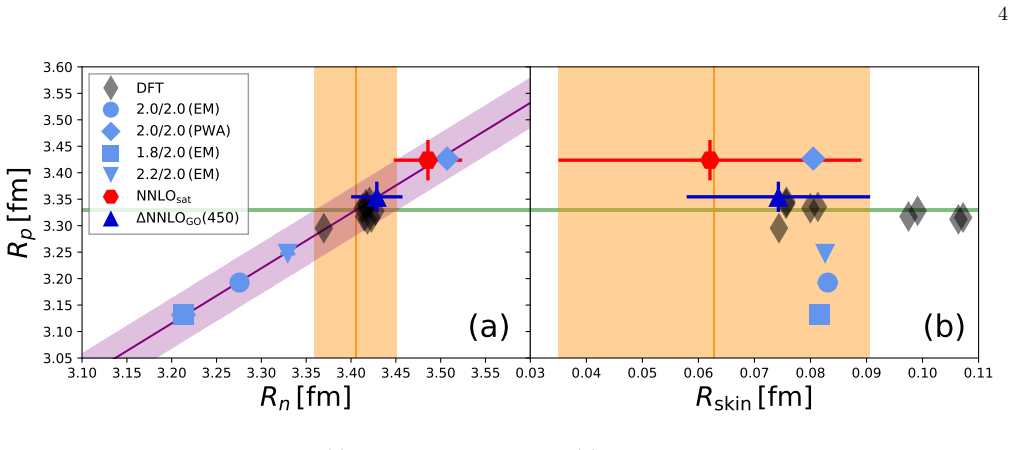
The load-bearing object is the weak form factor $$F_W($q^{2}$)=\frac{N F_n($q^{2}$)-(1-4\$sin^{2}$\theta_W)Z F_p($q^{2}$)}{Q_W},$$ which, because $1-4\sin^2\theta_W\simeq0.0457$, is almost exactly the neutron form factor $F_n(q^2)$ at the low momentum transfers relevant to coherent scattering. The wave functions come from coupled-cluster theory: a similarity transformation of the Hamiltonian, truncated at singles, doubles, and linearized triples, with a double-charge-exchange equation-of-motion operator that turns two protons of 40Ca into two neutrons and maps the closed-shell reference state onto open-shell 40Ar. The second mechanism is the strong $R_p$–$R_n$ correlation observed in the coupled-cluster results: intersecting the computed band with the known experimental proton radius narrows the neutron radius to 3.36–3.45 fm, while the correlated radii keep the skin thickness small.
What would settle it
Measure the 40Ar neutron radius directly, for example with parity-violating electron scattering at momentum transfers around 0.5–1.0 fm$^{-1}$, and compare with the predicted range $R_n = 3.36$–$3.45$ fm and $R_{\mathrm{skin}} = 0.035$–$0.09$ fm; a result outside this band while the charge form factor remains reproduced would refute the assumption.
Extended reading notes
Core claim
The paper's central claim is that coupled-cluster theory with Hamiltonians from chiral effective field theory can produce predictive weak form factors for 40Ar from first principles, without fitting anything to 40Ar neutron data. The validation is the charge form factor: the same wave functions reproduce electron-scattering measurements up to about $q=2$ fm$^{-1}$, and the electroweak operator is taken as the one-body current alone, with two-body currents argued to be negligible. Since the weak charge of the proton is suppressed, the predicted $F_W$ is essentially the neutron form factor, leading to $R_n=3.36$–$3.45$ fm and $R_{\mathrm{skin}}=0.035$–$0.09$ fm. The paper further shows that the coherent neutrino-scattering cross section on 40Ar is only mildly sensitive to the choice of Hamiltonian, varying by 2–6% over the relevant momentum range.
Load-bearing premise
The calculation assumes that matching the measured proton charge form factor, using only one-body electroweak currents, is enough to guarantee that the predicted neutron-dominated weak form factor—for which no direct 40Ar neutron-sensitive data exist—is correct.
Editorial extensions
If this is right
- The weak form factor $F_W(q^2)$ is essentially the neutron form factor, so the CEνNS rate on 40Ar scales with $N^2$ and is a neutron-distribution observable.
- The calculation constrains the 40Ar neutron radius to $R_n = 3.36$–$3.45$ fm and the neutron skin to $R_{\mathrm{skin}} = 0.035$–$0.09$ fm, consistent with density functional theory.
- The predicted CEνNS cross section varies only about 2% at $q = 50$ MeV and 6% at $q = 100$ MeV across the Hamiltonians, so existing-level experiments probably cannot distinguish the interactions.
- The first minimum of the weak form factor sits about $0.035$ fm$^{-1}$ below the charge form factor's minimum, showing that the neutron distribution extends beyond the proton distribution.
- Precision CEνNS measurements on argon could, in turn, discriminate among chiral effective field theory Hamiltonians.
Reading between the lines
- If the proton-validated wave functions transfer to the neutron channel, the same pipeline should give trustworthy weak form factors for other open-shell nuclei that have electron-scattering data, which could be checked against future CEνNS spectra.
- The tight $R_p$–$R_n$ covariance means one independent neutron-radius measurement on 40Ar would discriminate among the chiral Hamiltonians; the paper's own argument already shows most of the spread is a common shift in both radii.
- Since the low-$q$ cross section moves by only 2–6% across Hamiltonians, CEνNS at current precision is better suited to testing Standard Model parameters, while nuclear-structure extraction would require pushing measurements to higher momentum transfers.
- For argon-based dark matter detectors, the constrained weak form factor directly shrinks the uncertainty on the neutrino-floor background they must subtract.
Editorial analysis
A structured set of objections, weighed in public.
Referee Report
Summary. The manuscript presents coupled-cluster calculations of the coherent elastic neutrino-nucleus scattering (CEvNS) observables for 40Ar, using several chiral effective field theory Hamiltonians. The authors compute the charge form factor and compare it to electron scattering data from Ottermann et al., validate the many-body convergence between D and T-1 levels, and then predict the weak form factor, the CEvNS cross section, and the point-proton and point-neutron radii. By exploiting a strong correlation between Rp and Rn, and intersecting the computed band with the experimental Rp, they quote a neutron radius range 3.36-3.45 fm and a neutron skin thickness range 0.035-0.09 fm. The results are found to be consistent with density functional theory predictions.
Significance. If the predictions are reliable, this is a useful first-principles result for neutrino experiments using liquid argon (COHERENT, DUNE) and for constraining neutron distributions. The paper's strengths include the use of multiple chiral Hamiltonians calibrated to independent data, an explicit check of D vs T-1 convergence for the charge form factor, and a transparent presentation of the correlation between Rp and Rn. The consistency with density functional theory results adds confidence. However, the central validation argument rests on charge form factor data, which is proton-dominated, while the key predictions concern neutron-dominated observables; this transferability is the main correctness risk. The manuscript is honest about its reliance on one-body electroweak currents but does not quantify the associated uncertainty.
major comments (4)
- [Results, Fig. 1] The statement 'This comparison validates the theory' is too strong for the neutron observables that follow. The electron scattering data constrain the charge form factor, which is dominated by the proton distribution because the neutron charge form factor is suppressed. The subsequent predictions for Fn, Rn, and Rskin rely on an untested transferability of the proton-sensitive validation to neutron-dominated quantities. Please either provide a quantitative argument for why the agreement in Fch constrains Fn (e.g., using the measured 48Ca neutron skin or parity-violating electron scattering constraints) or explicitly state that the neutron predictions currently rest on the assumed reliability of the chiral Hamiltonians rather than on direct validation.
- [Interactions, 'For electroweak operators...'] The neglect of two-body electroweak currents is asserted with a reference to their expected smallness, but no estimate is given for 40Ar or for the momentum range relevant to CEvNS. At q=50-100 MeV, where the quoted spread among Hamiltonians is 2-6%, two-body currents could contribute at a comparable level. Please quantify the expected size of two-body current contributions to the weak form factor of a medium-mass nucleus, or provide a conservative uncertainty band that includes their possible effect.
- [Results, Fig. 3] The quoted constraint 3.36 <= Rn <= 3.45 fm is obtained by intersecting the correlation band with the experimental Rp, but the uncertainty on the experimental Rp from Ref. [46] is not propagated into the final range, and the construction of the 'symmetric spread' band is not fully specified. The figure also shows that the DFT points scatter vertically relative to the ab initio band, which indicates that the linear Rn-Rp correlation is not exact. Please propagate the experimental Rp uncertainty and define the band construction quantitatively, or weaken the quoted ranges accordingly.
- [Results, Fig. 2(a) and Fig. 3] The convergence between D and T-1 levels is demonstrated for the charge form factor, but the neutron density and weak form factor are the key outputs. No convergence check is shown for the neutron-dominated observables against any neutron-sensitive data or against higher-order coupled-cluster truncations. Please state whether the D/T-1 difference for Fn and Rn was computed (and if so, report it), or explicitly list this as a limitation of the systematic uncertainty estimate.
minor comments (4)
- [Results, CEνNS cross section section] The text 'via q2 = sqrt(2E_nu M T / (E_nu - T)) approx sqrt(2 M T)' appears to contain a typo: the expression with the square root should be for q, not q^2. Please correct this to avoid dimensional inconsistency.
- [Abstract] The phrase 'The neutron-skin thickness of 40Ar40' contains a duplicated isotope label; it should read '40Ar'.
- [References, Ref. [47]] The reference to 'N. Schunk, private communication' likely should be 'N. Schunck', consistent with Ref. [5].
- [Results, Fig. 2] The text states that the ab initio weak form factor agrees with density functional theory [5], but the corresponding DFT curve is not shown in Fig. 2. Please indicate where this agreement is visible or provide the comparison.
Circularity Check
No circularity: the 40Ar weak form factor and radii are computed from coupled-cluster solutions of chiral Hamiltonians anchored to independent data; the experimental Rp is used only as an external constraint, not as a fitted input.
full rationale
The derivation chain is self-contained. The chiral Hamiltonians (NNLOsat, ΔNNLOGO(450), and SRG-evolved EM potentials) are calibrated to nucleon-nucleon phase shifts, light-nucleus energies and radii, and nuclear-matter saturation, not to 40Ar observables. The validation step compares the computed charge form factor to Ottermann electron-scattering data, which is independent external input; the paper does not adjust any parameter to force agreement. The weak form factor and CEνNS cross section follow from the same one-body electroweak operators, and the neglect of two-body currents is supported by independent many-body citations [44,45], not by the present results. The final Rn and Rskin constraints do use the experimental Rp from [46], but this is not circular: the Rp-to-Rn correlation band is computed from the six ab initio Hamiltonians in this paper, and the experimental Rp is an external anchor, not a fitted target produced by the calculation. The self-citations (Refs. [29,30,48,50]) are methodological precedents for the coupled-cluster truncation labels and for the correlation-intersection technique; the present paper reproduces the correlation itself, so the load-bearing content does not rest on the self-citation. No equation reduces to its own input, no fitted parameter is renamed as a prediction, and no uniqueness claim is imported from the authors' prior work. A limitation remains that charge-form-factor validation is proton-dominated, but that is a correctness and validation-risk concern, not circularity.
Assumptions & free parameters
free parameters (3)
- Harmonic oscillator basis frequency hbar Omega =
16 MeV
- Triples energy truncation E3max =
18 oscillator spacings
- Model space size =
15 major oscillator shells (11 for the softest interaction)
assumptions (5)
- domain assumption Chiral EFT Hamiltonians at NNLO or higher describe nuclear interactions in 40Ar.
- domain assumption Coupled-cluster truncation at T1+T2 with linearized triples converges for 40Ar ground-state densities.
- domain assumption Double-charge-exchange equation-of-motion from 40Ca yields a valid 40Ar ground state.
- domain assumption One-body electroweak currents are sufficient; two-body currents are negligible.
- domain assumption Experimental proton radius Rp from Ref. [46] is accurate enough to constrain Rn.
Cite this review
Pith. "Pith review of Coherent elastic neutrino-nucleus scattering on 40Ar from first principles." pith.science (2026). https://pith.science/paper/I6J5L35J
@misc{pith2026190809739,
  author       = {Pith},
  title        = {Pith review of: Coherent elastic neutrino-nucleus scattering on 40Ar from first principles},
  year         = {2026},
  howpublished = {\url{https://pith.science/paper/I6J5L35J}},
  note         = {Machine review of arXiv:1908.09739}
}
read the original abstract
Coherent elastic neutrino scattering on the 40Ar nucleus is computed with coupled-cluster theory based on nuclear Hamiltonians inspired by effective field theories of quantum chromodynamics. Our approach is validated by calculating the charge form factor and comparing it to data from electron scattering. We make predictions for the weak form factor, the neutron radius, and the neutron skin, and estimate systematic uncertainties. The neutron-skin thickness of 40Ar40 is consistent with results from density functional theory. Precision measurements from coherent elastic neutrino-nucleus scattering could potentially be used to extract these observables and help to constrain nuclear models.
Figures


Forward citations
Cited by 4 Pith papers
-
Electroweak form factors of large nuclei as BPS skyrmions
With one fitted radial parameter, the BPS Skyrme model reproduces electromagnetic and weak form factors of heavy nuclei up to about 150 MeV, including PREX and CREX data.
-
Searching for neutrino polarizability at DUNE
DUNE's near detector could probe new parameter space for enhanced neutrino polarizability in light-scalar models, mainly through single-forward-shower events from coherent argon scattering.
-
Electroweak probes of ground state densities
Electroweak probes, anchored by upcoming PREX-II and CREX measurements, can tightly constrain neutron skins and low-momentum weak form factors of argon, xenon, and mirror nuclei within one model family.
-
Prospects for Exploring Non-Standard Neutrino Properties with Argon-Based CEvNS Experiments
Argon CEvNS detectors at stopped-pion sources project sin²θW precision near 1%, neutrino magnetic-moment limits near 10⁻⁹ μB, charge-radius limits near 10⁻³² cm², and vector NSI sensitivity at the 10⁻² level.
Reference graph
Works this paper leans on
-
[46]
Table of experimental nu- clear ground state charge radii: An update,
I. Angeli and K.P. Marinova, “Table of experimental nu- clear ground state charge radii: An update,” At. Data Nucl. Data Tables 99, 69 – 95 (2013)
work page 2013
-
[1]
Measurement of the neutron radius of 208Pb through parity violation in electron scattering,
S. Abrahamyan, Z. Ahmed, H. Albataineh, K. An- iol, D. S. Armstrong, W. Armstrong, T. Averett, B. Babineau, A. Barbieri, V. Bellini, R. Beminiwattha, J. Benesch, F. Benmokhtar, T. Bielarski, W. Boeglin, A. Camsonne, M. Canan, P. Carter, G. D. Cates, C. Chen, J.-P. Chen, O. Hen, F. Cusanno, M. M. Dal- ton, R. De Leo, K. de Jager, W. Deconinck, P. Decowski,...
work page 2012
-
[2]
Elec- troweak Measurements of Neutron Densities in CREX and PREX at JLab, USA,
C. J. Horowitz, K. S. Kumar, and R. Michaels, “Elec- troweak Measurements of Neutron Densities in CREX and PREX at JLab, USA,” Eur. Phys. J.A50, 48 (2014), arXiv:1307.3572 [nucl-ex]
arXiv 2014
-
[3]
Neutron skins of atomic nuclei: per aspera ad astra,
M. Thiel, C. Sfienti, J. Piekarewicz, C. J. Horowitz, and M. Vanderhaeghen, “Neutron skins of atomic nuclei: per aspera ad astra,” (2019), arXiv:1904.12269 [nucl-ex]
arXiv 2019
-
[4]
Nuclear neu- tron form factor from neutrino–nucleus coherent elastic scattering,
P. S. Amanik and G. C. McLaughlin, “Nuclear neu- tron form factor from neutrino–nucleus coherent elastic scattering,” Journal of Physics G: Nuclear and Particle Physics 36, 015105 (2008)
work page 2008
-
[5]
Neutrino-nucleus coherent scattering as a probe of neu- tron density distributions,
K. Patton, J. Engel, G. C. McLaughlin, and N. Schunck, “Neutrino-nucleus coherent scattering as a probe of neu- tron density distributions,” Phys. Rev. C 86, 024612 (2012)
work page 2012
-
[6]
Average csi neutron density distribution from coherent data,
M. Cadeddu, C. Giunti, Y. F. Li, and Y. Y. Zhang, “Average csi neutron density distribution from coherent data,” Phys. Rev. Lett. 120, 072501 (2018)
work page 2018
-
[7]
Observation of coherent elastic neutrino- nucleus scattering,
D. Akimov, J. B. Albert, P. An, C. Awe, P. S. Bar- beau, B. Becker, V. Belov, A. Brown, A. Bolozdynya, B. Cabrera-Palmer, M. Cervantes, J. I. Collar, R. J. Cooper, R. L. Cooper, C. Cuesta, D. J. Dean, J. A. De- twiler, A. Eberhardt, Y. Efremenko, S. R. Elliott, E. M. Erkela, L. Fabris, M. Febbraro, N. E. Fields, W. Fox, Z. Fu, A. Galindo-Uribarri, M. P. G...
work page 2017
Show all 50 references
-
[8]
Prospects for measuring coherent neutrino-nucleus elastic scattering at a stopped-pion neu- trino source,
K. Scholberg, “Prospects for measuring coherent neutrino-nucleus elastic scattering at a stopped-pion neu- trino source,” Phys. Rev. D 73, 033005 (2006)
2006
-
[9]
Deep underground neutrino experiment,
“Deep underground neutrino experiment,” http://www.dunescience.org
-
[10]
“Deap,” DEAP-3600: deap3600.ca
-
[11]
Darkside,
“Darkside,” http://darkside.lngs.infn.it/
-
[12]
“Ardm,” http://darkmatter.ethz.ch/
-
[13]
Miniclean,
“Miniclean,” Mini Clean : http://deapclean.org/
-
[14]
Electromagnetic reactions on light nuclei,
S. Bacca and S. Pastore, “Electromagnetic reactions on light nuclei,” Journal of Physics G: Nuclear and Particle Physics 41, 123002 (2014)
2014
-
[15]
Neutral weak current two-body contribu- 6 tions in inclusive scattering from 12C,
A. Lovato, S. Gandolfi, J. Carlson, Steven C. Pieper, and R. Schiavilla, “Neutral weak current two-body contribu- 6 tions in inclusive scattering from 12C,” Phys. Rev. Lett. 112, 182502 (2014)
2014
-
[16]
Quantum Monte Carlo calculations of weak transitions in A = 6 − 10 nuclei,
S. Pastore, A. Baroni, J. Carlson, S. Gandolfi, Steven C. Pieper, R. Schiavilla, and R. B. Wiringa, “Quantum Monte Carlo calculations of weak transitions in A = 6 − 10 nuclei,” Phys. Rev. C 97, 022501 (2018)
2018
-
[17]
Discrep- ancy between experimental and theoreticalβ-decay rates resolved from first principles,
P. Gysbers, G. Hagen, J. D. Holt, G. R. Jansen, T. D. Morris, P. Navr´ atil, T. Papenbrock, S. Quaglioni, A. Schwenk, S. R. Stroberg, and K. A. Wendt, “Discrep- ancy between experimental and theoreticalβ-decay rates resolved from first principles,” Nature Physics (2019), 10.103...
2019 arXiv
-
[18]
Lepton scatter- ing from 40Ar and Ti in the quasielastic peak region,
C. Barbieri, N. Rocco, and V. Som, “Lepton scatter- ing from 40Ar and Ti in the quasielastic peak region,” (2019), arXiv:1907.01122 [nucl-th]
2019 arXiv
-
[19]
The nuclear equation of state and neutron star masses,
J. M. Lattimer, “The nuclear equation of state and neutron star masses,” Annual Review of Nu- clear and Particle Science 62, 485–515 (2012), https://doi.org/10.1146/annurev-nucl-102711-095018
2012 doi
-
[20]
Re- view of particle physics,
M. Tanabashi, K. Hagiwara, K. Hikasa, K. Naka- mura, Y. Sumino, F. Takahashi, J. Tanaka, K. Agashe, G. Aielli, C. Amsler, M. Antonelli, D. M. Asner, H. Baer, Sw. Banerjee, R. M. Barnett, T. Basaglia, C. W. Bauer, J. J. Beatty, V. I. Belousov, J. Beringer, S. Bethke, A. Bettini...
2018
-
[21]
Bound states of a many-particle system,
F. Coester, “Bound states of a many-particle system,” Nuclear Physics 7, 421 – 424 (1958)
1958
-
[22]
Short-range correlations in nuclear wave functions,
F. Coester and H. K¨ ummel, “Short-range correlations in nuclear wave functions,” Nuclear Physics 17, 477 – 485 (1960)
1960
-
[23]
Many-fermion theory in expS- (or coupled cluster) form,
H. K¨ ummel, K. H. L¨ uhrmann, and J. G. Zabolitzky, “Many-fermion theory in expS- (or coupled cluster) form,” Physics Reports 36, 1 – 63 (1978)
1978
-
[24]
An overview of coupled cluster theory and its applications in physics,
R. F. Bishop, “An overview of coupled cluster theory and its applications in physics,” Theoretical Chemistry Accounts: Theory, Computation, and Modeling (Theo- retica Chimica Acta) 80, 95–148 (1991)
1991
-
[25]
Microscopic Calcula- tion of the Inclusive Electron Scattering Structure Func- tion in 16O,
B. Mihaila and J. H. Heisenberg, “Microscopic Calcula- tion of the Inclusive Electron Scattering Structure Func- tion in 16O,” Phys. Rev. Lett. 84, 1403–1406 (2000)
2000
-
[26]
Coupled-cluster ap- proach to nuclear physics,
D. J. Dean and M. Hjorth-Jensen, “Coupled-cluster ap- proach to nuclear physics,” Phys. Rev. C 69, 054320 (2004)
2004
-
[27]
Coupled cluster calculations of ground and excited states of nuclei,
K. Kowalski, D. J. Dean, M. Hjorth-Jensen, T. Papen- brock, and P. Piecuch, “Coupled cluster calculations of ground and excited states of nuclei,” Phys. Rev. Lett.92, 132501 (2004)
2004
-
[28]
Coupled-cluster theory in quantum chemistry,
R. J. Bartlett and M. Musia l, “Coupled-cluster theory in quantum chemistry,” Rev. Mod. Phys. 79, 291–352 (2007)
2007
-
[29]
Coupled-cluster computations of atomic nuclei,
G. Hagen, T. Papenbrock, M. Hjorth-Jensen, and D. J. Dean, “Coupled-cluster computations of atomic nuclei,” Rep. Prog. Phys. 77, 096302 (2014)
2014
-
[30]
Computing the dipole polarizability of 48Ca with in- creased precision,
M. Miorelli, S. Bacca, G. Hagen, and T. Papenbrock, “Computing the dipole polarizability of 48Ca with in- creased precision,” Phys. Rev. C 98, 014324 (2018)
2018
-
[31]
How robust is the n = 34 subshell closure? first spectroscopy of 52Ar,
H. N. Liu, A. Obertelli, P. Doornenbal, C. A. Bertulani, G. Hagen, J. D. Holt, G. R. Jansen, T. D. Morris, A. Schwenk, R. Stroberg, N. Achouri, H. Baba, F. Browne, D. Calvet, F. Chˆ ateau, S. Chen, N. Chiga, A. Corsi, M. L. Cort´ es, A. Delbart, J.-M. Gheller, A. Giganon, A. G...
2019
-
[32]
Effects of Three-Nucleon Forces and Two-Body Cur- rents on Gamow-Teller Strengths,
A. Ekstr¨ om, G. R. Jansen, K. A. Wendt, G. Hagen, T. Papenbrock, S. Bacca, B. Carlsson, and D. Gazit, “Effects of Three-Nucleon Forces and Two-Body Cur- rents on Gamow-Teller Strengths,” Phys. Rev. Lett.113, 262504 (2014)
2014
-
[33]
Elastic electron scattering from 40ar,
C.R. Ottermann, C.H. Schmitt, G.G. Simon, F. Borkowski, and V.H. Walther, “Elastic electron scattering from 40ar,” Nuclear Physics A 379, 396 – 406 (1982)
1982
-
[34]
Effective field theory of nuclear forces,
U. Van Kolck, “Effective field theory of nuclear forces,” Prog. Part. Nucl. Phys. 43, 337 – 418 (1999)
1999
-
[35]
Modern theory of nuclear forces,
E. Epelbaum, H.-W. Hammer, and Ulf-G. Meißner, “Modern theory of nuclear forces,” Rev. Mod. Phys. 81, 1773–1825 (2009)
2009
-
[36]
Chiral effective field the- ory and nuclear forces,
R. Machleidt and D.R. Entem, “Chiral effective field the- ory and nuclear forces,” Physics Reports 503, 1 – 75 (2011)
2011
-
[37]
Sta- tistical uncertainties of a chiral interaction at next-to- next-to leading order,
A. Ekstr¨ om, B. D. Carlsson, K. A. Wendt, C. Forss´ en, M. Hjorth Jensen, R. Machleidt, and S. M. Wild, “Sta- tistical uncertainties of a chiral interaction at next-to- next-to leading order,” J. Phys, G: Nucl. Part. Phys. 42, 034003 (2015)
2015
-
[38]
Jiang et al
W. Jiang et al. , in preparation
-
[39]
∆ isobars and nuclear saturation,
A. Ekstr¨ om, G. Hagen, T. D. Morris, T. Papenbrock, and P. D. Schwartz, “∆ isobars and nuclear saturation,” Phys. Rev. C 97, 024332 (2018)
2018
-
[40]
Simi- larity renormalization group for nucleon-nucleon interac- tions,
S. K. Bogner, R. J. Furnstahl, and R. J. Perry, “Simi- larity renormalization group for nucleon-nucleon interac- tions,” Phys. Rev. C 75, 061001 (2007)
2007
-
[41]
Accurate charge- dependent nucleon-nucleon potential at fourth order of chiral perturbation theory,
D. R. Entem and R. Machleidt, “Accurate charge- dependent nucleon-nucleon potential at fourth order of chiral perturbation theory,” Phys. Rev. C 68, 041001 (2003)
2003
-
[42]
Low- momentum interaction in few-nucleon systems,
A. Nogga, S. K. Bogner, and A. Schwenk, “Low- momentum interaction in few-nucleon systems,” Phys. Rev. C 70, 061002 (2004)
2004
-
[43]
Improved nuclear matter calculations from chiral low-momentum interactions,
K. Hebeler, S. K. Bogner, R. J. Furnstahl, A. Nogga, and A. Schwenk, “Improved nuclear matter calculations from chiral low-momentum interactions,” Phys. Rev. C 83, 031301 (2011)
2011
-
[44]
Charge form factor and sum rules of electromagnetic response functions in 12C,
A. Lovato, S. Gandolfi, Ralph Butler, J. Carlson, Ew- ing Lusk, Steven C. Pieper, and R. Schiavilla, “Charge form factor and sum rules of electromagnetic response functions in 12C,” Phys. Rev. Lett. 111, 092501 (2013)
2013
-
[45]
Electromagnetic struc- ture ofa = 2 and 3 nuclei in chiral effective field theory,
M. Piarulli, L. Girlanda, L. E. Marcucci, S. Pastore, R. Schiavilla, and M. Viviani, “Electromagnetic struc- ture ofa = 2 and 3 nuclei in chiral effective field theory,” Phys. Rev. C 87, 014006 (2013)
2013
-
[47]
Schunk, private communication
N. Schunk, private communication
-
[48]
First princi- ples electromagnetic responses in medium-mass nuclei,
J. Simonis, S. Bacca, and G. Hagen, “First princi- ples electromagnetic responses in medium-mass nuclei,” (2019), arXiv:1905.02055 [nucl-th]
2019 arXiv
-
[49]
Inelastic and elastic scattering of 187-mev electrons from selected even-even nuclei,
R. H. Helm, “Inelastic and elastic scattering of 187-mev electrons from selected even-even nuclei,” Phys. Rev. 104, 1466–1475 (1956)
1956
-
[50]
Neutron and weak-charge distributions of the 48Ca nucleus,
G. Hagen, A. Ekstr¨ om, C. Forss´ en, G. R. Jansen, W. Nazarewicz, T. Papenbrock, K. A. Wendt, S. Bacca, N. Barnea, B. Carlsson, C. Drischler, K. Hebeler, M. Hjorth-Jensen, M. Miorelli, G. Orlandini, A. Schwenk, and J. Simonis, “Neutron and weak-charge distributions of the 48C...
2016
Reviewed August 14, 2026 · model on record in the stance chip above.
Discussion (0). Continue with ORCID to comment.