REVIEW 3 major objections 5 minor 1 cited by
Exponentiating virtual imaginary contributions in a parton shower
T0 review · 3 major / 5 minor · reviewed 2026-08-14 · deepseek-v4-flash
Pith's one-line read A parton shower can include the imaginary part of virtual graphs in its Sudakov factor by exponentiating matrices of size at most 14-by-14.
desk verdict Finite-matrix exponentiation of Viπ is a solid, checkable technical result; the paper's only real soft spot is an unquantified Magnus truncation, which a careful referee should push on but which does not sink the method. read the letter →
The pith
A machine-rendered reading of the paper's core claim, the machinery that carries it, and where it could break.
The reading
What carries the argument
The central object is the no-splitting operator $N^e(t_2,t_1)=\mathcal{T}\exp[-\int_{t_1}^{t_2}d\tau\{V^{lc+}(\tau)+V_{i\pi}(\tau)\}]$, which factorizes as a product of an operator $n$ acting on ket color states and an operator $n^\dagger$ acting on bra color states. The operator $a$ in the exponent of $n$ decomposes as $a^{lc+}_{\mathrm{coll}}+a^{lc+}_{\mathrm{soft}}-4i\pi T_a\cdot T_b$; the collinear and soft pieces are diagonal in the chosen color basis, while $T_a\cdot T_b$ mixes only the small sets of color basis states constructed for each initial-state flavor combination. The two identities that make the computation finite are the Fierz identity for the color generators, which produces the small mixing matrices, and the Magnus expansion, which converts the time-ordered exponential into an ordinary exponential whose higher terms are argued to be suppressed by powers of $e^{-t}$.
What would settle it
A direct fine-grained numerical evaluation of the time-ordered exponential in Eq. (18) for a representative color state, especially with the shower-time integration extending down to the soft cutoff, would settle whether the ordinary exponential used in the paper is accurate; if the two disagree by an amount comparable to the reported $0.01$ shift in the gap fraction, the Magnus truncation is not justified.
Extended reading notes
Core claim
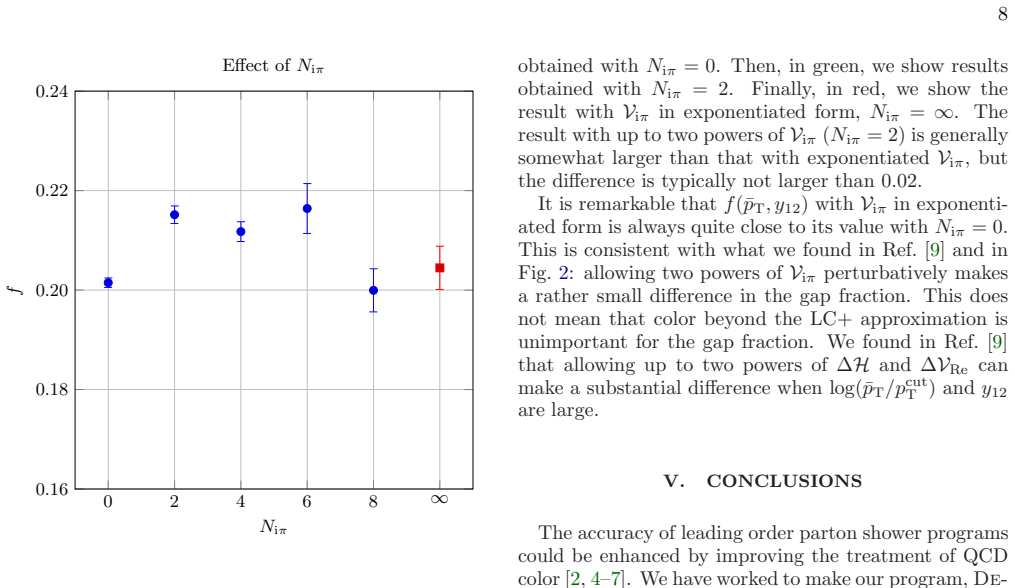
The paper establishes that the noncommuting color operator $T_a\cdot T_b$ underlying the imaginary part of virtual graphs mixes, for any fixed assignment of the other parton colors, only a small set of basis states: two for incoming $\bar q\bar q$, $qq$, or $q\bar q$; four for $\bar q g$ or $qg$; and fourteen for $gg$. The no-splitting operator therefore factors into a ket-space operator $n$ and a bra-space operator $n^\dagger$, each an ordinary exponential (after the Magnus expansion) of a matrix of dimension at most $14\times14$. Numerically, in the rapidity-gap fraction $f(\bar p_T,y_{12})$ at 13 TeV, the exponentiated result agrees with the perturbative sequence $N_{i\pi}=0,2,4,6,8$: the shift from the $N_{i\pi}=0$ result is about $0.003\pm0.004$ in the central bin, and at most about $0.02$ across the studied range of $\bar p_T$ and $y_{12}$. The paper concludes that $V_{i\pi}$ can be included in the Sudakov exponent, and that for this observable it makes little numerical difference whether one exponentiates or expands.
Load-bearing premise
The load-bearing premise is that the higher-order terms in the Magnus expansion can be neglected because each is suppressed by powers of $e^{-t}$; this is stated without a bound, and near the soft cutoff of the shower, where $t$ is small, the suppression is not reliable.
Editorial extensions
If this is right
- Any parton shower that wants to treat color beyond leading color can include the full imaginary part of virtual graphs in its Sudakov factor by exponentiating matrices of dimension at most $14\times14$, with the dimension fixed by the flavors of the two incoming partons.
- For the rapidity gap fraction, the all-orders exponentiated result lies within errors of the low-order perturbative results, so one does not need exponentiation for this observable and can continue to treat $V_{i\pi}$ perturbatively.
- The smallness of the net effect is explained by the opposite signs of $V_{i\pi}$ on ket and bra color states: for an observable that is not color-sensitive, the phase cancels, and the gap fraction is not sensitive enough to see the residual.
- The method can in principle be combined with a perturbative treatment of the operators $\Delta H$ and $\Delta V_{Re}$, as the paper outlines, to produce a more complete parton shower with $V_{i\pi}$ resummed to all orders.
- If a future observable is found in which $V_{i\pi}$ has a substantial numerical effect, the machinery of this paper provides a way to resum it rather than expanding in powers of the large phase operator.
Reading between the lines
- A natural test of the Magnus truncation would be to compute the second and third Magnus terms explicitly in the region near the soft cutoff of the shower, where $e^{-t}$ is not small; if those terms are not negligible there, the numerical agreement found for the gap fraction might be accidental rather than generic.
- Because the small color subspace is fixed by the flavor of the two incoming partons, the same closure property may hold for other color operators that appear in exact-color showers, potentially allowing exact color evolution without an expansion in powers of $1/N_c$.
- The near cancellation of the ket and bra phases suggests a practical heuristic: observables that mainly measure energy flow rather than color flow will not need $V_{i\pi}$ exponentiation, while color-correlation observables such as multi-jet color flow or non-global logarithms are the natural place to search for a large effect.
- The largest matrix being $14\times14$ for gluon-gluon initial states suggests that processes with more colored external partons could require larger but still finite matrices, so the method may extend beyond the two-incoming-parton case treated here.
Signed reviews
Editorial analysis
A structured set of objections, weighed in public.
Referee Report
Summary. The paper addresses the treatment of the operator Viπ, the imaginary part of one-loop virtual corrections, in the Nagy–Soper parton shower. Starting from the LC+ approximation, the authors ask whether Viπ can be exponentiated into the no-splitting Sudakov operator. They derive explicit finite-dimensional matrices for the action of Ta·Tb on the color ket space for all initial-state flavor combinations, with dimensions 2, 2, 2, 4, 4, and 14. They then use the Magnus expansion to replace the time-ordered exponential in Eq. (18) by an ordinary exponential, arguing that higher-order Magnus terms are suppressed by powers of e−t. The numerical implementation in Deductor computes the rapidity-gap fraction with Viπ treated perturbatively (Niπ = 0, 2, 4, 6, 8) and with Viπ exponentiated (Niπ = ∞). The results show a small net effect of Viπ, and the paper concludes that, for this observable, perturbative treatment is sufficient while the exponentiation method is available for future applications.
Significance. The finite-dimensional closure of Ta·Tb under the trace basis is a concrete and valuable technical result. The explicit matrices in Eqs. (32), (44), (49), (63), (68), and (73) are derived in detail and make the all-order inclusion of Viπ conceptually possible at modest computational cost. The paper is also honest about the scope of the numerical test, noting that the complete algorithm of Eq. (13) is not implemented and that NRe = 0. However, the paper's central validation claim rests on an uncontrolled approximation: the replacement of the time-ordered exponential by an ordinary exponential. If that step is not controlled, the numerical agreement with perturbative truncations does not validate exponentiation of the true no-splitting operator. The method would be genuinely useful for observables where Viπ has a large effect, but the evidence presented here is incomplete.
major comments (3)
- [II, Eqs. (34)–(39)] The replacement of the time-ordered exponential in Eq. (18) by an ordinary exponential is not controlled. The paper computes ω2 and shows that the commutator is proportional to (e−τ1 − e−τ2), then states that higher-order terms are “similarly suppressed” and “can reasonably be neglected.” No bound on the tail Σ_{k≥3} ωk is given. The suppression is not uniform over the integration region: when τ1 and τ2 are near the lower endpoint t1, e−τ is not small, and the operator [a_soft^(1), Ta·Tb] carries no additional α_s suppression beyond the explicit (α_s/2π)^2 prefactor. Consequently, the operator actually exponentiated in the numerical test is not the no-splitting operator defined in Eq. (11) unless the neglected Magnus terms are actually negligible, which is precisely the point requiring proof.
- [IV, Figs. 1 and 2] Because the exponentiated result is computed with the truncated Magnus approximation, the comparison with perturbative Niπ values tests the approximated operator, not the full time-ordered exponentiation claimed in the abstract and conclusions. The observed smallness of the Viπ effect could therefore be an artifact of the neglected higher-order Magnus terms rather than a property of the true no-splitting operator. This issue is directly testable: with matrices of dimension at most 14, one can evaluate the time-ordered exponential by slicing the shower-time interval and compare the result with the ordinary exponential. Such a numerical check, or an analytical bound on the neglected terms, is needed before the agreement in Figs. 1 and 2 can be interpreted as validation of the exponentiation procedure.
- [IV, Fig. 1 and surrounding text] The statistical precision of the exponentiated result is too limited to support the central numerical claim. The text quotes f = 0.204 ± 0.04 for Niπ = ∞; even if this is a misprint for 0.004, the error is comparable to the spread among the perturbative points and to the claimed net effect of order 0.01. Thus the statement that the perturbative and exponentiated results “agree that the effect is small” is weaker than it appears, and a more precise evaluation would be required to distinguish the two treatments decisively.
minor comments (5)
- [Title page] There is a typo in the arXiv header: “parto n shower” should read “parton shower,” and the corresponding line in the abstract should be checked for the same issue.
- [II, after Eq. (23)] The sentence defining Ta·Tb says “Ta inserts a color generator on line ‘a’ and Tb inserts a color generator on line ‘a’”; the second occurrence should clearly refer to line “b.”
- [II, Eq. (36)] The notation for the coupling factor is inconsistent: Eq. (35) writes α_s(τ)/(2π) while Eq. (36) writes α_s(τ1)/(2π) α_s(τ2)/(2π); the meaning is clear, but unifying the notation would improve readability.
- [V, paragraph on cancellation] The heuristic identity exp(a + iφ) exp(a − iφ) = exp(2a) is presented without explicitly noting that it is only a commutative proxy; the paper immediately explains that non-commutativity is responsible for the residual effect, so the heuristic should be labeled as illustrative rather than as an argument.
- [I, Eq. (19)] The decomposition of a(t) is taken from Ref. [8], but the paper does not define the normalization of Ta·Tb in that context. A reader who has not studied Ref. [8] would benefit from a sentence stating that the traces and basis conventions follow Ref. [1].
Circularity Check
No circularity: the 14x14 color closure and the exponentiation construction are derived in the paper; no fitted observable or load-bearing self-citation reduces the central claim to its input.
full rationale
The paper's central claim is that the imaginary-part operator Viπ can be exponentiated by exponentiating matrices of dimension at most 14x14. That construction is self-contained: starting from the definition N^e(t2,t1) = T exp[-∫{V_lc+ + Viπ}] in Eq. (11) and the color form of Viπ in Eq. (14), the paper derives, using Fierz identities, that Ta·Tb closes on small subspaces for each initial-state flavor combination (Eqs. 31-33, 43-44, 48-49, 62-63, 67-68, 72-73). No quantity is fitted to the gap-fraction data, and no parameter is tuned to make the exponentiated result agree with the perturbative result; the numerical test is an internal comparison between two treatments within the same program. The paper does cite the authors' earlier work for the LC+ formalism and for the color operator decomposition (Refs. [1,8,9]), but those citations supply the input operators and the definition of the test observable, not the paper's new conclusion that Viπ can be exponentiated in a finite-dimensional space. The Magnus truncation after Eq. (39), where higher-order terms are asserted to be 'similarly suppressed' and 'can reasonably be neglected' without a quantitative bound, is an uncontrolled approximation and a correctness risk near the lower integration limit, but it is not circular: the ordinary exponential is presented as an approximation to, not a restatement of, the time-ordered exponential. Thus there is no step in which a prediction reduces by construction to its input, and no load-bearing self-citation chain. The proper concern is the reliability of the e^{-t} suppression argument, not circularity.
Assumptions & free parameters
assumptions (4)
- domain assumption The form of Viπ, Eq. (14): Viπ(t) = -4iπ αs/(2π) ([Ta·Tb ⊗ 1] - [1⊗Ta·Tb]), taken from Eq. (10.14) of Ref. [1].
- domain assumption The LC+ approximation: V_lc+(τ) is diagonal in the trace basis, a_coll is proportional to the unit matrix, and a_soft is diagonal with eigenvalues determined by color-connected pairs.
- ad hoc to paper The Magnus expansion applies and can be truncated after the first term because higher-order terms are suppressed by powers of e^{-t}.
- standard math The Fierz identity for SU(3) generators, Eq. (29), and the trace-basis color decomposition.
Cite this review
Pith. "Pith review of Exponentiating virtual imaginary contributions in a parton shower." pith.science (2026). https://pith.science/paper/VKE2CNFZ
@misc{pith2026190811420,
  author       = {Pith},
  title        = {Pith review of: Exponentiating virtual imaginary contributions in a parton shower},
  year         = {2026},
  howpublished = {\url{https://pith.science/paper/VKE2CNFZ}},
  note         = {Machine review of arXiv:1908.11420}
}
abstract
The operator in a parton shower algorithm that represents the imaginary part of virtual Feynman graphs has a non-trivial color structure and is large because it is proportional to a factor of $4\pi$. In order to improve the treatment of color in a parton shower, it may help to exponentiate this phase operator. We show that it is possible to do so by exponentiating matrices that are no larger than $14\times14$. Using the example of the probability to have a gap in the rapidity interval between two high transverse momentum jets, we test this exponentiation algorithm by comparing to the result of treating the phase operator perturbatively. We find that the exponentiation works, but that the net effect of the exponentiated phase operator is quite small for this problem, so that one can as well use the perturbative approach.
Figures

Forward citations
Cited by 1 Pith paper
-
Recoil-Safe Subtraction, Matching and Merging in e+e- to hadrons
The Alaric shower is matched to NLO matrix elements and merged to five jets in e+e- to hadrons, with new analytic subtraction terms validated against Catani-Seymour subtraction.
Reference graph
Works this paper leans on
-
[1]
Z. Nagy and D. E. Soper, Parton shower evolution with subleading color, JHEP 1206, 044 (2012) [inSPIRE]
work page 2012
-
[2]
directly. There is an approximation, the LC+ approximation, that generalizes the leading color approximation [ 1]. In the LC+ approximation, we re- place HI (t) and V(t) by approximate operators Hlc+ (t) and V lc+ (t). Then we solve d dt U lc+ (t, t 0) = [ Hlc+ (t) − V lc+ (t)] U lc+ (t, t 0) . (3) The solution takes the form U lc+ (t, t 0) = N lc+ (t, t ...
-
[3]
Z. Nagy and D. E. Soper, Effects of subleading color in a parton shower , JHEP 1507, 119 (2015) [inSPIRE]
work page 2015
-
[4]
act on a color space that has a very large dimensionality. In fact, an n gluon statistical state vector is expanded in [( n − 1)!/ 2]2 basis vectors if we use the trace basis. For n = 10 this is 3 × 10¹⁰ basis vectors. However, let us look at this more closely. When the operator N e(t2, t 1) operates on a statistical space basis vector ⏐ ⏐{p, f, c ′, c }m...
-
[5]
S. Pl¨ atzer, M. Sj¨ odahl and J. Thor´ en, Color matrix element corrections for parton showers , JHEP 1811, 009 (2018) [inSPIRE]
work page 2018
-
[6]
J. Isaacson and S. Prestel, Stochastically sampling color configurations , Phys. Rev. D 99, 014021 (2019) [inSPIRE]
work page 2019
-
[7]
J. R. Forshaw, J. Holguin and S. Pl¨ atzer, Parton branching at amplitude level , arXiv:1905.08686 [hep-ph] [inSPIRE]
arXiv 1905
-
[8]
Z. Nagy and D. E. Soper, Parton showers with more exact color evolution , Phys. Rev. D 99, 054009 (2019) [inSPIRE]
work page 2019
Show all 40 references
-
[9]
a”, Tb represents the insertion of a color matrix T c on incoming parton line “b
and ( 10) give U(t, t 0) as series in powers of ∆ H(t), ∆ VRe(t), and Viπ (t). Then we can specify non-negative integers NRe and Niπ and retain contributions proportional to [∆ H]A[∆ VRe]B[Viπ ]C with A + B ≤ NRe, C ≤ Niπ and A + B + C ≤ max{NRe, N iπ }. In the present paper, ...
-
[10]
We have seen that the operator n, including its i π terms, can be written as an exponential of a finite di- mensional matrix in the case of an incoming ¯ q, ¯q state
as the ordinary exponential of a. We have seen that the operator n, including its i π terms, can be written as an exponential of a finite di- mensional matrix in the case of an incoming ¯ q, ¯q state. In the following subsections, we examine the other pos- sible choices for the...
-
[11]
Alioli, J
S. Alioli, J. R. Andersen, C. Oleari, E. Re and J. M. Smil- lie, Probing higher-order corrections in dijet production at the LHC , Phys. Rev. D 85, 114034 (2012) [inSPIRE]
2012
-
[12]
The first, in blue, is obtained with Niπ = 0
In each y12 bin, we show three curves. The first, in blue, is obtained with Niπ = 0. Then, in green, we show results obtained with Niπ = 2. Finally, in red, we show the result with Viπ in exponentiated form, Niπ = ∞ . The result with up to two powers of Viπ (Niπ = 2) is general...
-
[13]
Forshaw, J
J. Forshaw, J. Keates and S. Marzani, Jet vetoing at the LHC, JHEP 0907, 023 (2009) [inSPIRE]
2009
-
[14]
At first sight, the goal of exponentiating Viπ in a prac- tical algorithm seems unreachable because the color op- erators in Eq
have opposite signs. At first sight, the goal of exponentiating Viπ in a prac- tical algorithm seems unreachable because the color op- erators in Eq. (
-
[15]
Pl¨ atzer and M
S. Pl¨ atzer and M. Sj¨ odahl,Subleading Nc improved Par- ton Showers , JHEP 1207, 042 (2012) [inSPIRE]
2012
-
[16]
´Angeles Mart ´ ınez, M
R. ´Angeles Mart ´ ınez, M. De Angelis, J. R. Forshaw, S. Pl¨ atzer and M. H. Seymour, Soft gluon evolu- tion and non-global logarithms , JHEP 1805, 044 (2018) 10 [inSPIRE]
2018
-
[17]
Dasgupta and G
M. Dasgupta and G. P. Salam, Resummation of non- global QCD observables , Phys. Lett. B 512, 323 (2001) [inSPIRE]
2001
-
[18]
a” carries an outgoing quark color in- dex that we can call α and incoming parton “b
has the decomposition [ 8]: a(t, {p, f }m) = alc+ coll (t, {p, f }m) + alc+ soft(t, {p, f }m) − 4iπ Ta ·Tb . (19) First, there is alc+ coll . This operator comes from “direct” graphs, in which a parton is emitted from parton line l and absorbed on the same parton line, α s(t) ...
-
[19]
The operator alc+ coll (t, {p, f }m) contains the soft × collinear singularities of a
of a. The operator alc+ coll (t, {p, f }m) contains the soft × collinear singularities of a. Thus at fixed t, this operator contains a factor of t, which comes from integrating over the momentum frac- tion in a splitting. However, we saw in Eq. (
-
[20]
We also saw in Eq
that alc+ coll (t, {p, f }m) is proportional to the unit matrix, so that it commutes with the other terms in a. We also saw in Eq. ( 21) that the soft part of a is a diagonal op- erator. However, Ta ·Tb does not commute with alc+ soft. Thus the commutator is [ a(τ1, {p, f }m),...
-
[21]
Nagy and D
Z. Nagy and D. E. Soper, Effect of color on rapidity gap survival, arXiv:1905.07176 [hep-ph] [ inSPIRE]
1905 arXiv
-
[22]
Aad et al
G. Aad et al. [ATLAS Collaboration], Measurement of dijet production with a veto on additional central jet ac- tivity in pp collisions at √ s = 7 TeV using the ATLAS detector, JHEP 1109, 053 (2011) [inSPIRE]
2011
-
[23]
R. M. Duran Delgado, J. R. Forshaw, S. Marzani and M. H. Seymour, The dijet cross section with a jet veto JHEP 1108, 157 (2011) [inSPIRE]
2011
-
[24]
Hoeche and M
S. Hoeche and M. Schonherr, Uncertainties in next-to-leading order plus parton shower matched simulations of inclusive jet and dijet production , Phys. Rev. D 86, 094042 (2012) [inSPIRE]
2012
-
[25]
Nagy and D
Z. Nagy and D. E. Soper, What is a parton shower? , Phys. Rev. D 98, 014034 (2018) [inSPIRE]
2018
-
[26]
Kidonakis, G
N. Kidonakis, G. Oderda and G. F. Sterman, Evo- lution of color exchange in QCD hard scattering , Nucl. Phys. B 531, 365 (1998) [inSPIRE]
1998
-
[27]
Oderda and G
G. Oderda and G. F. Sterman, Energy and color flow in dijet rapidity gaps , Phys. Rev. Lett. 81, 3591 (1998) [inSPIRE]
1998
-
[28]
J. R. Forshaw, A. Kyrieleis and M. H. Sey- mour, Gaps between jets in the high energy limit , JHEP 0506, 034 (2005) [inSPIRE]
2005
-
[30]
C. F. Berger, T. Kucs and G. F. Sterman, Energy flow in interjet radiation , Phys. Rev. D 65, 094031 (2002) [inSPIRE]
2002
-
[31]
Dasgupta and G
M. Dasgupta and G. P. Salam, Accounting for coherence in interjet E(t) flow: A Case study , JHEP 0203, 017 (2002) [inSPIRE]
2002
-
[32]
R. B. Appleby and M. H. Seymour, Nonglobal logarithms in interjet energy flow with kt clustering requirement , JHEP 0212, 063 (2002) [inSPIRE]
2002
-
[33]
J. R. Forshaw, A. Kyrieleis and M. H. Seymour, Super- leading logarithms in non-global observables in QCD? , JHEP 0608, 059 (2006) [inSPIRE]
2006
-
[34]
Thus these contributions can reasonably be neglected and we simply write n in Eq
are similarly suppressed. Thus these contributions can reasonably be neglected and we simply write n in Eq. (
-
[35]
J. R. Forshaw, A. Kyrieleis and M. H. Sey- mour, Super-leading logarithms in non-global observ- ables in QCD: Colour basis independent calculation , JHEP 0809, 128 (2008) [inSPIRE]
2008
-
[36]
Nagy and D
Z. Nagy and D. E. Soper, Parton showers with quantum interference, JHEP 0709, 114 (2007) [inSPIRE]
2007
-
[37]
(39) We see that the second term of the exponent, ω 2, in Eq
is [ a(τ1, {p, f }m), a (τ2, {p, f }m) ] = − 4iπ (e−τ1 − e−τ2) [ alc+(1) soft ({p, f }m), T a ·Tb ] + · · ·. (39) We see that the second term of the exponent, ω 2, in Eq. ( 34) is not only second order in α s but is also sup- pressed by powers of e−t so that it does not contri...
-
[38]
Magnus, On the exponential solution of differential equations for a linear operator , Commun
W. Magnus, On the exponential solution of differential equations for a linear operator , Commun. Pure Appl. Math. 7, 649 (1954) [inSPIRE]
1954
-
[39]
Cacciari, G
M. Cacciari, G. P. Salam and G. Soyez, The Anti- k(t) jet clustering algorithm , JHEP 0804, 063 (2008) [inSPIRE]
2008
-
[40]
Nagy and D
Z. Nagy and D. E. Soper, Jets and threshold sum- mation in Deductor , Phys. Rev. D 98, 014035 (2018) [inSPIRE]
2018
-
[53]
and ( 29) gives us ˆC(n; a, α )α ′β β ′ = ∑ n′ Mn′nC(n′; a, α )α ′β β ′ , (67) where M = − 1 2 0 − 1 0 0 − 1 0 0 0 0 1 Nc 0 1 0 0 Nc . (68) E. Incoming g g In this case, we have two outgoing gluon indices a and b. We consider basis states of form G(n; a, b ; {r}) =...
Reviewed August 14, 2026 · model on record in the stance chip above.
Discussion (0). Continue with ORCID to comment.