REVIEW 3 major objections 4 minor 111 references
Spectroscopic characterization of aluminum monofluoride with relevance to laser cooling and trapping
T0 review · 3 major / 4 minor · reviewed 2026-08-14 · deepseek-v4-flash
Pith's one-line read AlF is a practical molecule for laser cooling: Q-lines closed, one repump gives about 10^4 photons
desk verdict Excellent, data-rich spectroscopy that makes a strong case for AlF as a laser-cooling candidate, but the flagship '10^4 photons with one repump' number rests on an unmeasured v''=2 branching ratio that the paper's own data suggest could be off by an order of magnitude. read the letter →
The pith
A machine-rendered reading of the paper's core claim, the machinery that carries it, and where it could break.
The reading
What carries the argument
The load-bearing object is the Q-line of a $^1\Pi \leftarrow {}^1\Sigma^+$ electronic transition. Angular-momentum selection rules make every Q-line rotationally closed, so a molecule excited on Q(1) cannot decay into other rotational levels of the ground state except through a hyperfine-mixing leak below $10^{-5}$. Around that closed line the paper assembles the quantities that fix the photon budget: the radiative lifetime, the off-diagonal vibrational branching ratio, the spin-forbidden electronic branching ratio, and the hyperfine-resolved level structure that tells which laser frequencies address which components. The measured electric dipole moments in the X, a, and A states let the same Hamiltonian describe behaviour in external electric fields up to 150 kV/cm.
What would settle it
Run a cycling test on a slow AlF beam: drive the Q(1) line with the main laser plus one 0-1 repump and count fluorescence photons per molecule until the signal drops. The paper's numbers predict about $10^4$ photons before $v''=2$ accumulation dominates; a measured photon budget an order of magnitude smaller would invalidate the single-repump scheme.
Extended reading notes
Core claim
On the paper's own terms, the central discovery is that the $A\,^1\Pi - X\,^1\Sigma^+$ transition of AlF meets the requirements for laser cooling: all Q-lines are rotationally closed, nearly all decay returns to the vibrational ground state, and the residual loss channels are small. Specifically, the A-state lifetime is measured as $1.90\pm0.03$ ns, the off-diagonal vibrational branching to $v''=1$ is $(5.60\pm0.02)\times10^{-3}$, the hyperfine-induced rotational leak is below $10^{-5}$, and the spin-forbidden decay into the metastable $a\,^3\Pi$ state is about $10^{-7}$ per cycle. With one repump laser on the 0-1 band, the molecule can scatter about $10^4$ photons before accumulating in $v''=2$, a velocity change of 382 m/s, enough to stop a buffer-gas or supersonic beam. The same closed-Q-line structure on the $a\,^3\Pi - X\,^1\Sigma^+$ band gives a route to narrow-line cooling toward sub-microkelvin temperatures.
Load-bearing premise
The single-repump cooling budget rests on the measured vibrational branching ratio $A_{01}/A_{11}=(5.59\pm0.02)\times10^{-3}$ being a true population ratio; if the two laser-induced-fluorescence signals used to extract it were not strictly linear in laser power or the two beams were not identically overlapping Gaussian modes, the ratio would be biased and the number of repump lasers required would change.
Editorial extensions
If this is right
- A single repump laser on the 0-1 band yields about $10^4$ scattered photons per molecule, a velocity change of 382 m/s, sufficient to slow a cryogenic buffer-gas beam or a supersonic beam to rest.
- With the measured A-state decay rate of $2\pi\times 83.8$ MHz, the stopping distance for a 150 m/s buffer-gas beam is about 2 cm and for a 300 m/s supersonic beam about 8 cm.
- Because the $a\,^3\Pi - X\,^1\Sigma^+$ Q-lines are also rotationally closed, a second-stage narrow-line cooling scheme on that band is feasible, with a natural final temperature in the microkelvin range.
- The Stark shift-to-mass ratio in the $a\,^3\Pi_1$, J=1 level is only about 20% below metastable CO, and AlF can additionally be manipulated by electric fields in its singlet ground state.
- The complete set of hyperfine, rotational, and dipole-moment parameters provides a benchmark for quantum-chemistry calculations of this molecule.
Reading between the lines
- Not drawn in the paper: if the $10^4$-photon budget survives a direct cycling test, AlF should reach magneto-optical trap densities far beyond those typical of association-based ultracold samples, because its bimolecular loss channel is strongly endothermic.
- A direct cycling measurement with one repump would separate the measured vibrational branching from any hidden loss and could be performed with present laser technology by observing fluorescence decay as a function of scattered photon number.
- The two nuclear spins ($I_{\rm Al}=5/2$, $I_{\rm F}=1/2$) in the most abundant isotopomer are fully resolved here; that combination may make AlF useful for quantum-state-controlled collisions or for precision tests needing a heavy molecule with strong internal interactions.
- The near-degeneracy of the F=2 and F=3 hyperfine components in the ground rotational level, split by less than 1 kHz, could serve as a sensitive magnetometer or a clock-like transition if coherence can be maintained.
Editorial analysis
A structured set of objections, weighed in public.
Referee Report
Summary. The paper reports a comprehensive spectroscopic characterization of aluminum monofluoride (AlF) with the explicit goal of assessing its suitability for laser cooling and trapping. Using a pulsed molecular beam with laser-radio-frequency/microwave multiple-resonance and laser-induced-fluorescence detection, the authors determine the hyperfine structure and rotational constants of the X1Σ+, a3Π, and A1Π states; measure the radiative lifetime of the A1Π state; measure the vibrational branching ratios from A1Π to X1Σ+ v''=1; observe for the first time the spin-forbidden A1Π→a3Π transition; and measure the electric dipole moments in all three states. The central conclusion is that AlF is an excellent candidate for laser cooling on any Q-line of the A1Π-X1Σ+ band and for trapping at high densities, with a quantitative projection that about 10^4 photons can be scattered with a single vibrational repump laser.
Significance. If the quantitative claims hold, this is a substantial and useful contribution to the molecular laser-cooling community. The paper provides a large amount of high-quality experimental data: 138 rf/microwave transition frequencies with loop-closure consistency checks, a measured A-state lifetime (1.90±0.03 ns) in agreement with theory (1.89 ns), two independent measurements of the vibrational branching ratio, the first measurement of the weak A1Π→a3Π loss channel at the 10^-7 level, and accurate electric dipole moments in three electronic states. These data constitute a solid foundation for designing laser-slowing and MOT schemes for AlF and serve as a benchmark for ab initio calculations. However, the quantitative laser-cooling projection depends on an unmeasured vibrational branching ratio to X1Σ+ v''=2 and on a measured A01 branching ratio that shows a sizable internal discrepancy; these issues need to be addressed before the central quantitative claims can be fully endorsed.
major comments (3)
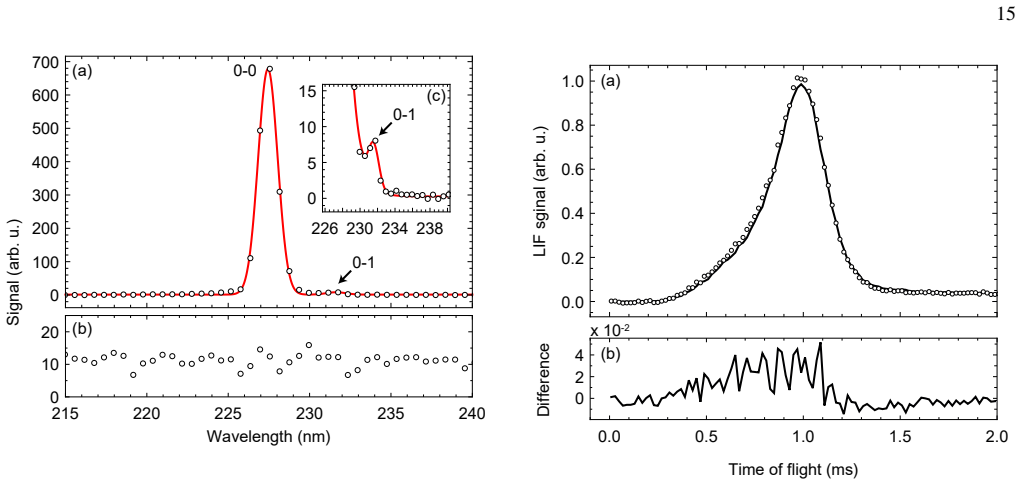
- [Section XI and Table VI] The statement that 'with one vibrational repump laser it is possible to scatter about 10^4 photons' is set by the branching ratio A02/A00, but A02/A00 is never measured; Table VI lists only the calculated value 0.1×10^-3. The same table shows that the calculated A01 values (4.7×10^-3 and 4.8×10^-3) underestimate the measured values (7.3±1×10^-3 and 5.59±0.02×10^-3), so the theoretical vibrational branching pattern is not validated at the factor-of-two level needed for this projection. If A02/A00 were 1×10^-3 rather than 0.1×10^-3, the single-repump photon number would be about 10^3, which would not slow a 300 m/s supersonic beam to rest. The qualitative 'excellent candidate' claim survives, but the quantitative photon budget should be explicitly tied to a measured or bounded A02/A00, or the text should state clearly that this number relies on an unverified calculation.
- [Section IX B and Table VI] The two experimental determinations of the A1Π→X1Σ+ vibrational branching ratio, A01/A00=(7.3±1)×10^-3 from dispersed fluorescence and A01/A11=(5.59±0.02)×10^-3 from the power-ratio method, differ by about 30%, which is much larger than the quoted uncertainty of the second method. The abstract and Section XI quote the latter value as being 'in good agreement with theoretical predictions,' but the former is about 55% above the calculated 4.7×10^-3. The paper does not discuss this internal discrepancy. Because this ratio directly sets the number of repump lasers required for the cooling scheme, the authors should either reconcile the two measurements or propagate the difference into a systematic uncertainty on the laser-cooling design.
- [Section IX B, second method] The power-ratio measurement of A01/A11 assumes that the laser-induced fluorescence signals are strictly proportional to laser power, that the two laser beams have identical Gaussian spatial profiles and overlap, and that the excitation is unsaturated. The paper reports that 16 power pairs and two rotational lines were used, but it does not show a linearity plot or a power-dependence residual. Given the 30% discrepancy with the dispersed-fluorescence method, this assumption is not adequately supported. The authors should provide the power-scaling data or add a systematic uncertainty that accounts for possible saturation and beam-mismatch effects.
minor comments (4)
- [Section IX B] The relation between the measured emission amplitude ratio ν01A01/(ν00A00)=(7±3)×10^-3 and the quoted A01/A00=(7.3±1)×10^-3 should be written out explicitly, since the conversion between detected amplitude and Einstein A coefficient is not shown.
- [Section VI and Table I] The new parameter eq0QLS(Al) is introduced to obtain a kHz-level fit, and the text notes that it has not been described in the literature before. A short operator definition and a comment on its correlation with the other quadrupole parameters would help readers reproduce the fit and assess its physical significance.
- [Figure 6 caption] The F-quantum-number assignments in the R2(0) spectrum are said to be based on Section VI, but the assignment logic is not summarized in the caption. A one-sentence explanation would improve readability.
- [Abstract and Section XI] The quoted vibrational branching ratio is given as (5.60±0.02)×10^-3 in the abstract and as (5.6±0.02)×10^-3 in Section XI, but Table VI lists both A01/A00 and A01/A11. Please ensure the text consistently states which ratio is being quoted when discussing the repump requirement.
Circularity Check
No significant circularity: all load-bearing quantities are measured directly, and derived cooling metrics are independent of those measurements.
full rationale
The paper's central claim that AlF is a good laser-cooling candidate rests on measured quantities: the A 1Pi, v=0 radiative lifetime (1.90 +/- 0.03 ns from a Voigt fit to LIF linewidths), the vibrational branching ratios (A01/A00 = (7.3 +/- 1)e-3 by dispersed LIF and A01/A11 = (5.59 +/- 0.02)e-3 by a two-laser power-ratio measurement), the spin-forbidden A-a branching ((1.0 +/- 0.1)e-7 from relative ToF amplitudes), and electric dipole moments from Stark-shift measurements. None of these is fitted to the cooling claim or derived from it. The hyperfine-mixing rotational loss below 1e-5 is computed from hyperfine parameters obtained from a Hamiltonian fit to line positions and line shapes; the loss itself is not a fitted parameter, so this is a genuine derived prediction rather than a self-defined one. The photon budget of ~1e4 photons with one repump uses the calculated A02/A00 = 0.1e-3 value listed in Table VI, which is admittedly not measured in this work; this is a validation gap or an unverified calculation, but not circularity, because the calculation is not tuned to reproduce the 1e4-photon claim. Self-citations to rate models and MOT proposals (e.g., Refs. [107-109]) are used only to translate the measured spontaneous decay rate into stopping distances and capture velocities; they do not determine any measured spectroscopic constant. The derivation chain is therefore self-contained: measurement inputs, fitted Hamiltonian parameters, and calculated cooling metrics are distinct, and no prediction reduces by construction to an input or to a self-citation chain.
Assumptions & free parameters
free parameters (4)
- a(Al) in A1Pi state =
113 +/- 5 MHz
- a(F) in A1Pi state =
181 +/- 5 MHz
- Gaussian FWHM in A-state Voigt fit =
10 MHz (from NO calibration)
- Polarizability anisotropy alpha2 in a3Pi state =
-1.25 Å^3
assumptions (5)
- domain assumption The effective Hamiltonian (Eqs. 2-6) with tensor-operator matrix elements correctly describes the rovibronic, fine, and hyperfine structure of AlF in the X, a, and A states.
- ad hoc to paper The hyperfine structure of the A1Pi J=1 level is assigned by resemblance to the a3Pi1 J=1 level.
- domain assumption The residual Doppler width of the AlF beam is bounded by the NO calibration (12 MHz FWHM), fixed as 10 MHz in the Voigt fit.
- domain assumption The photoionization cross-section from the A1Pi state equals the measured a3Pi value (3.6 +/- 0.5)x10^-17 cm^2.
- domain assumption LIF signals in the power-ratio measurement are proportional to laser power for both vibrational bands.
invented entities (2)
-
Spin-orbit correction to the Al quadrupole coupling, eq0QLS(Al)
-
Polarizability anisotropy alpha2 = -1.25 Å^3 for the a3Pi state
Cite this review
Pith. "Pith review of Spectroscopic characterization of aluminum monofluoride with relevance to laser cooling and trapping." pith.science (2026). https://pith.science/paper/GNCDJ2KY
@misc{pith2026190811774,
  author       = {Pith},
  title        = {Pith review of: Spectroscopic characterization of aluminum monofluoride with relevance to laser cooling and trapping},
  year         = {2026},
  howpublished = {\url{https://pith.science/paper/GNCDJ2KY}},
  note         = {Machine review of arXiv:1908.11774}
}
abstract
Here we report on spectroscopic measurements of the aluminum monofluoride molecule (AlF) that are relevant to laser cooling and trapping experiments. We measure the detailed energy level structure of AlF in the X$^1\Sigma^+$ electronic ground state, in the A$^1\Pi$ state, and in the metastable a$^3\Pi$ state. We determine the rotational, vibrational and electronic branching ratios from the A$^1\Pi$ state. We also study how the rotational levels split and shift in external electric and magnetic fields. We find that AlF is an excellent candidate for laser cooling on any Q-line of the A$^1\Pi$ - X$^1\Sigma^+$ transition and for trapping at high densities.
Figures


Figures from the paper (17 more)




Reference graph
Works this paper leans on
-
[1]
L. D. Carr, D. DeMille, R. V . Krems, and J. Ye, New Jour- nal of Physics 11 (2009), 10.1088/1367-2630/11/5/055049, arXiv:0904.3175
work page Pith review arXiv 2009
-
[2]
J. L. Bohn, A. M. Rey, and J. Ye, Science 357, 1002 (2017), arXiv:1708.02806
work page Pith review arXiv 2017
-
[3]
R. V . Krems, Physical Chemistry Chemical Physics 10, 4079 (2008)
2008
-
[4]
Balakrishnan, The Journal of Chemical Physics 145, 150901 (2016)
N. Balakrishnan, The Journal of Chemical Physics 145, 150901 (2016)
2016
-
[5]
D. DeMille, J. M. Doyle, and A. O. Sushkov, Science 357, 990 (2017), arXiv:1704.07928
arXiv 2017
-
[6]
M. S. Safronova, D. Budker, D. DeMille, D. F. J. Kimball, A. Derevianko, and C. W. Clark, Reviews of Modern Physics 90, 025008 (2018), arXiv:1710.01833
arXiv 2018
-
[7]
DeMille, Physical Review Letters 88, 067901 (2002), arXiv:0109083 [quant-ph]
D. DeMille, Physical Review Letters 88, 067901 (2002), arXiv:0109083 [quant-ph]
2002
-
[8]
S. A. Moses, J. P. Covey, M. T. Miecnikowski, D. S. Jin, and J. Ye, Nature Physics 13, 13 (2016), arXiv:1610.07711
work page Pith review arXiv 2016
Show all 111 references
-
[9]
J. A. Blackmore, L. Caldwell, P. D. Gregory, E. M. Bridge, R. Sawant, J. Aldegunde, J. Mur-Petit, D. Jaksch, J. M. Hut- son, B. E. Sauer, M. R. Tarbutt, and S. L. Cornish, Quantum Science and Technology4, 014010 (2018), arXiv:1804.02372
2018 arXiv
-
[10]
K.-K. Ni, T. Rosenband, and D. D. Grimes, Chemical Science 9, 6830 (2018)
2018
-
[11]
J. M. Sage, S. Sainis, T. Bergeman, and D. DeMille, Physical Review Letters 94, 203001 (2005), arXiv:0501008 [physics]
2005
-
[12]
K.-K. Ni, S. Ospelkaus, M. H. G. de Miranda, A. Pe’er, B. Neyenhuis, J. J. Zirbel, S. Kotochigova, P. S. Julienne, D. S. Jin, and J. Ye, Science 322, 231 (2008), arXiv:0808.2963
2008 arXiv
-
[13]
L. R. Liu, J. D. Hood, Y . Yu, J. T. Zhang, N. R. Hut- zler, T. Rosenband, and K.-K. Ni, Science 360, 900 (2018), arXiv:1804.04752
2018 arXiv
-
[14]
J. D. Weinstein, R. DeCarvalho, T. Guillet, B. Friedrich, and J. M. Doyle, Nature 395, 148 (1998), arXiv:9810036 [physics]
1998
-
[15]
H. L. Bethlem, G. Berden, and G. Meijer, Physical Review Letters 83, 1558 (1999)
1999
-
[16]
Vanhaecke, U
N. Vanhaecke, U. Meier, M. Andrist, B. H. Meier, and F. Merkt, Physical Review A75, 031402 (2007)
2007
-
[17]
Narevicius, A
E. Narevicius, A. Libson, C. G. Parthey, I. Chavez, J. Nare- vicius, U. Even, and M. G. Raizen, Physical Review A 77, 1 (2008), arXiv:0804.0219
2008 arXiv
-
[18]
Zeppenfeld, B
M. Zeppenfeld, B. G. U. Englert, R. Glöckner, A. Prehn, M. Mielenz, C. Sommer, L. D. van Buuren, M. Motsch, and G. Rempe, Nature 491, 570 (2012), arXiv:1208.0046 [physics.atom-ph]
2012 arXiv
-
[19]
E. S. Shuman, J. F. Barry, and D. DeMille, Nature 467, 820 (2010), arXiv:1103.6004. 23
2010 arXiv
-
[20]
M. T. Hummon, M. Yeo, B. K. Stuhl, A. L. Collopy, Y . Xia, and J. Ye, Physical Review Letters 110, 1 (2013), arXiv:1209.4069
2013 arXiv
-
[21]
Zhelyazkova, A
V . Zhelyazkova, A. Cournol, T. E. Wall, A. Matsushima, J. J. Hudson, E. A. Hinds, M. R. Tarbutt, and B. E. Sauer, Physical Review A 89, 053416 (2014), arXiv:1308.0421
2014 arXiv
-
[22]
J. Lim, J. R. Almond, M. A. Trigatzis, J. A. Devlin, N. J. Fitch, B. E. Sauer, M. R. Tarbutt, and E. A. Hinds, Physical Review Letters 120, 123201 (2018), arXiv:1712.02868
2018 arXiv
-
[23]
Kozyryev, L
I. Kozyryev, L. Baum, K. Matsuda, B. L. Augenbraun, L. An- deregg, A. P. Sedlack, and J. M. Doyle, Physical Review Let- ters 118, 173201 (2017), arXiv:1609.02254
2017 arXiv
-
[24]
J. F. Barry, D. J. McCarron, E. B. Norrgard, M. H. Steinecker, and D. DeMille, Nature 512, 286 (2014), arXiv:1404.5680
2014 arXiv
-
[25]
H. J. Williams, S. Truppe, M. Hambach, L. Caldwell, N. J. Fitch, E. A. Hinds, B. E. Sauer, and M. R. Tarbutt, New Jour- nal of Physics 19, 113035 (2017), arXiv:1706.07848
2017 arXiv
-
[26]
Anderegg, B
L. Anderegg, B. L. Augenbraun, E. Chae, B. Hemmerling, N. R. Hutzler, A. Ravi, A. Collopy, J. Ye, W. Ketterle, and J. M. Doyle, Physical Review Letters 119, 103201 (2017), arXiv:1705.10288
2017 arXiv
-
[27]
A. L. Collopy, S. Ding, Y . Wu, I. A. Finneran, L. Anderegg, B. L. Augenbraun, J. M. Doyle, and J. Ye, Physical Review Letters 121, 213201 (2018)
2018
-
[28]
Truppe, H
S. Truppe, H. J. Williams, M. Hambach, L. Caldwell, N. J. Fitch, E. A. Hinds, B. E. Sauer, and M. R. Tarbutt, Nature Physics 13, 1173 (2017), arXiv:1703.00580
2017 arXiv
-
[29]
T. Chen, W. Bu, and B. Yan, Physical Review A 96, 053401 (2017), arXiv:1709.07602
2017 arXiv
-
[30]
Aggarwal, H
The NL-eEDM collaboration, P. Aggarwal, H. L. Bethlem, A. Borschevsky, M. Denis, K. Esajas, P. A. B. Haase, Y . Hao, S. Hoekstra, K. Jungmann, T. B. Meijknecht, M. C. Mooij, R. G. E. Timmermans, W. Ubachs, L. Willmann, and A. Za- para, The European Physical Journal D 72, 197 (2018)
2018
-
[31]
Albrecht, M
R. Albrecht, M. Scharwaechter, T. Sixt, L. Hofer, and T. Lan- gen, (2019), arXiv:1906.08798
2019 arXiv
-
[32]
G. Z. Iwata, R. L. McNally, and T. Zelevinsky, Physical Re- view A 96, 022509 (2017), arXiv:1705.00113
2017 arXiv
-
[33]
E. B. Norrgard, E. R. Edwards, D. J. McCarron, M. H. Stei- necker, D. DeMille, S. S. Alam, S. K. Peck, N. S. Wadia, and L. R. Hunter, Physical Review A 95, 062506 (2017), arXiv:1702.02548
2017 arXiv
-
[34]
L. Xu, Y . Yin, B. Wei, Y . Xia, and J. Yin, Physical Review A 93, 013408 (2016)
2016
-
[35]
Kozyryev, T
I. Kozyryev, T. C. Steimle, P. Yu, D.-T. Nguyen, and J. M. Doyle, New Journal of Physics 21, 052002 (2019)
2019
-
[36]
Nakhate, T
S. Nakhate, T. C. Steimle, N. H. Pilgram, and N. R. Hutzler, Chemical Physics Letters 715, 105 (2019)
2019
-
[37]
H. J. Williams, L. Caldwell, N. J. Fitch, S. Truppe, J. Rode- wald, E. A. Hinds, B. E. Sauer, and M. R. Tarbutt, Physical Review Letters 120, 163201 (2018), arXiv:1711.07355
2018 arXiv
-
[38]
D. J. McCarron, M. H. Steinecker, Y . Zhu, and D. DeMille, Physical Review Letters 121, 013202 (2018), arXiv:1712.01462
2018 arXiv
-
[39]
Anderegg, B
L. Anderegg, B. L. Augenbraun, Y . Bao, S. Burchesky, L. W. Cheuk, W. Ketterle, and J. M. Doyle, Nature Physics 14, 890 (2018), arXiv:1803.04571
2018 arXiv
-
[40]
Anderegg, L
L. Anderegg, L. W. Cheuk, Y . Bao, S. Burchesky, W. Ketterle, K.-K. Ni, and J. M. Doyle, , 1 (2019), arXiv:1902.00497
2019 arXiv
-
[41]
J. Lim, M. D. Frye, J. M. Hutson, and M. R. Tarbutt, Physical Review A 92, 053419 (2015), arXiv:1508.03987
2015 arXiv
-
[42]
H. Son, J. J. Park, W. Ketterle, and A. O. Jamison, , 1 (2019), arXiv:1907.09630
2019 arXiv
-
[43]
B. K. Stuhl, M. T. Hummon, M. Yeo, G. Quéméner, J. L. Bohn, and J. Ye, Nature 492, 396 (2012), arXiv:1209.6343
2012 arXiv
-
[44]
De Marco, G
L. De Marco, G. Valtolina, K. Matsuda, W. G. Tobias, J. P. Covey, and J. Ye, Science 7230 (2019), 10.1126/sci- ence.aau7230
2019 doi
-
[45]
N. J. Fitch and M. R. Tarbutt, ChemPhysChem 17, 3609 (2016), arXiv:1609.05823
2016 arXiv
-
[46]
A. M. Jayich, X. Long, and W. C. Campbell, Physical Review X 6, 041004 (2016), arXiv:1603.08053
2016 arXiv
-
[47]
X. Wu, T. Gantner, M. Koller, M. Zeppenfeld, S. Chervenkov, and G. Rempe, Science 358, 645 (2017), arXiv:1710.05988
2017 arXiv
-
[48]
S. E. Galica, L. Aldridge, D. J. McCarron, E. E. Eyler, and P. L. Gould, Physical Review A 98, 023408 (2018), arXiv:1804.04184
2018 arXiv
-
[49]
Petzold, P
M. Petzold, P. Kaebert, P. Gersema, M. Siercke, and S. Os- pelkaus, New Journal of Physics 20 (2018), 10.1088/1367- 2630/aab9f5, arXiv:1712.05157
2018 arXiv
-
[50]
D. J. McCarron, Journal of Physics B: Atomic, Molecular and Optical Physics 51, 212001 (2018)
2018
-
[51]
B. K. Stuhl, B. C. Sawyer, D. Wang, and J. Ye, Physical Re- view Letters 101, 243002 (2008), arXiv:0808.2171
2008 arXiv
-
[52]
M. D. Di Rosa, The European Physical Journal D 31, 395 (2004)
2004
-
[53]
R. J. Hendricks, D. A. Holland, S. Truppe, B. E. Sauer, and M. R. Tarbutt, Frontiers in Physics 2, 1 (2014), arXiv:1404.6174v1
2014 arXiv
-
[54]
M. R. Tarbutt, Contemporary Physics 59, 356 (2018)
2018
-
[55]
Wells and I
N. Wells and I. C. Lane, Physical Chemistry Chemical Physics 13, 19018 (2011)
2011
-
[56]
S. R. Langhoff, C. W. Bauschlicher, and P. R. Taylor, The Journal of Chemical Physics 88, 5715 (1988)
1988
-
[57]
H. C. Ko, M. A. Greenbaum, J. A. Blauer, and M. Farber, The Journal of Physical Chemistry 69, 2311 (1965)
1965
-
[58]
R. F. Barrow, I. Kopp, and C. Malmberg, Physica Scripta 10, 86 (1974)
1974
-
[59]
J. M. Brown, I. Kopp, C. Malmberg, and B. Rydh, Physica Scripta 17, 55 (1978)
1978
-
[60]
D. R. Lide, The Journal of Chemical Physics 38, 2027 (1963)
1963
-
[61]
D. R. Lide, The Journal of Chemical Physics 42, 1013 (1965)
1965
-
[62]
F. C. Wyse, W. Gordy, and E. F. Pearson, The Journal of Chemical Physics 52, 3887 (1970)
1970
-
[63]
Hoeft, F
J. Hoeft, F. J. Lovas, E. Tiemann, and T. Törring, Zeitschrift für Naturforschung A 25, 1029 (1970)
1970
-
[64]
Honerjäger and R
R. Honerjäger and R. Tischer, Zeitschrift für Naturforschung A 29, 342 (1974)
1974
-
[65]
G. D. Rochester, Physical Review 56, 305 (1939)
1939
-
[66]
H. C. Rowlinson and R. F. Barrow, Proceedings of the Physical Society. Section A 66, 437 (1953)
1953
-
[67]
S. M. Naudé and T. J. Hugo, Physical Review 90, 318 (1953)
1953
-
[68]
S. M. Naudé and T. J. Hugo, Canadian Journal of Physics 31, 1106 (1953)
1953
-
[69]
S. M. Naudé and T. J. Hugo, Canadian Journal of Physics 32, 246 (1954)
1954
-
[70]
Rosenwaks, R
S. Rosenwaks, R. Steele, and H. Broida, Chemical Physics Letters 38, 121 (1976)
1976
-
[71]
I. Kopp, B. Lindgren, and C. Malmberg, Physica Scripta 14, 170 (1976)
1976
-
[72]
Gross, C
P. Gross, C. S. Campbell, P. J. C. Kent, and D. L. Levi, Dis- cussions of the Faraday Society 4, 206 (1948)
1948
-
[73]
Gross, C
P. Gross, C. Hayman, and D. L. Levi, Transactions of the Faraday Society 50, 477 (1954)
1954
-
[74]
R. F. Barrow, J. W. C. Johns, and F. J. Smith, Transactions of the Faraday Society 52, 913 (1956). 24
1956
-
[75]
Zhang, Infrared Spectroscopy of Molecules in the Gas Phase, Ph.D
K. Zhang, Infrared Spectroscopy of Molecules in the Gas Phase, Ph.D. thesis, Waterloo (1997)
1997
-
[76]
R. S. Freund and W. Klemperer, The Journal of Chemical Physics 43, 2422 (1965)
1965
-
[77]
R. A. Frosch and H. M. Foley, Physical Review 88, 1337 (1952)
1952
-
[78]
R. Zare, A. Schmeltekopf, W. Harrop, and D. Albritton, Jour- nal of Molecular Spectroscopy 46, 37 (1973)
1973
-
[79]
Brown, E
J. Brown, E. Colbourn, J. Watson, and F. Wayne, Journal of Molecular Spectroscopy 74, 294 (1979)
1979
-
[80]
Brown and A
J. Brown and A. Merer, Journal of Molecular Spectroscopy74, 488 (1979)
1979
-
[81]
Brazier, R
C. Brazier, R. Ram, and P. Bernath, Journal of Molecular Spectroscopy 120, 381 (1986)
1986
-
[82]
Gordy and R
W. Gordy and R. L. Cook, Microwave molecular spectra (Wi- ley, New York, 1984)
1984
-
[83]
Carrington and J
A. Carrington and J. A. Brown, Rotational spectroscopy of di- atomic molecules (Cambridge University Press, 2003)
2003
-
[84]
C. H. Townes and A. L. Schawlow, Microwave Spectroscopy (Dover publications, Inc., New York, 1975)
1975
-
[85]
Klaus, S
T. Klaus, S. Takano, and G. Winnewisser, Astronomy and Astrophysics 322, L1 (1997)
1997
-
[86]
J. P. Champion, M. Loete, and G. Pierre, Spectroscopy of the Earth’s atmosphere and interstellar medium , edited by K. N. Rao and A. Weber (Academic Press, Columbus, OH, 1992) pp. 339–422
1992
-
[87]
Veldhoven, J
J. Veldhoven, J. Küpper, H. L. Bethlem, B. Sartakov, A. J. A. Roij, and G. Meijer, The European Physical Journal D31, 337 (2004)
2004
-
[88]
D. V . Dearden, R. D. Johnson, and J. W. Hudgens, The Journal of Physical Chemistry 95, 4291 (1991)
1991
-
[89]
J. L. Kohl and W. H. Parkinson, The Astrophysical Journal 184, 641 (1973)
1973
-
[90]
J. J. Gilijamse, S. Hoekstra, S. A. Meek, M. Metsälä, S. Y . T. van de Meerakker, G. Meijer, and G. C. Groenen- boom, The Journal of Chemical Physics 127, 221102 (2007), arXiv:0710.2240
2007 arXiv
-
[91]
T. C. James, The Journal of Chemical Physics55, 4118 (1971)
1971
-
[92]
Brown, J
J. Brown, J. Hougen, K.-P. Huber, J. Johns, I. Kopp, H. Lefebvre-Brion, A. Merer, D. Ramsay, J. Rostas, and R. Zare, Journal of Molecular Spectroscopy 55, 500 (1975)
1975
-
[93]
J. K. Watson, Journal of Molecular Spectroscopy 66, 500 (1977)
1977
-
[94]
Veseth, Journal of Physics B: Atomic and Molecular Physics 3, 1677 (1970)
L. Veseth, Journal of Physics B: Atomic and Molecular Physics 3, 1677 (1970)
1970
-
[95]
L. G. Piper and L. M. Cowles, The Journal of Chemical Physics 85, 2419 (1986)
1986
-
[96]
S. E. Maxwell, N. Brahms, R. DeCarvalho, D. R. Glenn, J. S. Helton, S. V . Nguyen, D. Patterson, J. Petricka, D. DeMille, and J. M. Doyle, Physical Review Letters 95, 173201 (2005)
2005
-
[97]
N. R. Hutzler, H.-I. Lu, and J. M. Doyle, Chemical Reviews 112, 4803 (2012), arXiv:1111.2841
2012 arXiv
-
[98]
Truppe, M
S. Truppe, M. Hambach, S. M. Skoff, N. E. Bulleid, J. S. Bumby, R. J. Hendricks, E. A. Hinds, B. E. Sauer, and M. R. Tarbutt, Journal of Modern Optics 65, 648 (2018)
2018
-
[99]
R. J. Le Roy, Journal of Quantitative Spectroscopy and Radia- tive Transfer 186, 167 (2017)
2017
-
[100]
Yousefi and P
M. Yousefi and P. F. Bernath, The Astrophysical Journal Sup- plement Series 237, 7 (2018)
2018
-
[101]
N. L. Garland and D. R. Crosley, Journal of Quantitative Spec- troscopy and Radiative Transfer 33, 591 (1985)
1985
-
[102]
MOLPRO, version 2019.2, a package of ab initio programs,
H.-J. Werner, P. J. Knowles, G. Knizia, F. R. Manby, M. Schütz, P. Celani, W. Györffy, D. Kats, T. Korona, R. Lindh, A. Mitrushenkov, G. Rauhut, K. R. Shamasundar, T. B. Adler, R. D. Amos, S. J. Bennie, A. Bernhardsson, A. Berning, D. L. Cooper, M. J. O. Deegan, A. J. Dobbyn, ...
2019
-
[103]
The calculations employ the A V5Z [112] basis set for each atom
The MRCI calculations are fed with the natural orbitals from a Multi-Configuration Self-Consistent Field (MCSCF) calcu- lation with a complete active space (CAS) consisting of nine orbitals with A1 symmetry, three with B1 symmetry and three with B2 symmetry associated with the ...
-
[104]
D. E. Woon and E. Herbst, Astrophysical Journal, Supplement Series 185, 273 (2009)
2009
-
[105]
Kaneda, J
Y . Kaneda, J. M. Yarborough, Y . Merzlyak, A. Yamaguchi, K. Hayashida, N. Ohmae, and H. Katori, Optics Letters 41, 705 (2016)
2016
-
[106]
Burkley, A
Z. Burkley, A. D. Brandt, C. Rasor, S. F. Cooper, and D. C. Yost, 80523, 1 (2018), arXiv:1811.09874
2018 arXiv
-
[107]
M. R. Tarbutt, B. E. Sauer, J. J. Hudson, and E. A. Hinds, New Journal of Physics 15, 053034 (2013), arXiv:1302.2870
2013 arXiv
-
[108]
E. B. Norrgard, D. J. McCarron, M. H. Steinecker, M. R. Tar- butt, and D. DeMille, Physical Review Letters 116, 063004 (2016)
2016
-
[109]
M. R. Tarbutt, New Journal of Physics 17, 015007 (2015), arXiv:1409.0244
2015 arXiv
-
[111]
S. A. Meek, H. L. Bethlem, H. Conrad, and G. Meijer, Physi- cal Review Letters 100, 153003 (2008), arXiv:0801.2943
2008 arXiv
-
[112]
K. L. Schuchardt, B. T. Didier, T. Elsethagen, L. Sun, V . Guru- moorthi, J. Chase, J. Li, and T. L. Windus, Journal of Chemi- cal Information and Modeling 47, 1045 (2007)
2007
Reviewed August 14, 2026 · model on record in the stance chip above.
Discussion (0). Continue with ORCID to comment.