REVIEW 4 major objections 4 minor 39 references
Multiplicity fluctuations in the Glauber Monte Carlo approach
T0 review · 4 major / 4 minor · reviewed 2026-08-14 · deepseek-v4-flash
Pith's one-line read Shadowed quark sources reproduce Pb+Pb multiplicity fluctuations where wounded-nucleon models fail.
desk verdict Modest, honest application of wounded-quark+shadowing to NA49 scaled variance; the claim holds qualitatively but the poor pp fit and fitted lambda leave real slack. read the letter →
The pith
A machine-rendered reading of the paper's core claim, the machinery that carries it, and where it could break.
The reading
What carries the argument
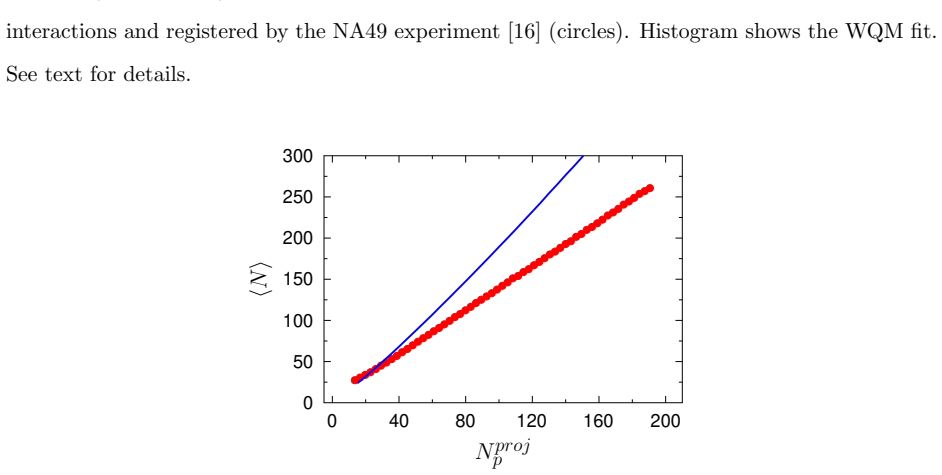
The load-bearing object is the compound (superposition) multiplicity distribution: $N=\sum_{i=1}^{N_p} n_i$, built from a Glauber Monte Carlo distribution of the number of sources $N_p$ and a per-source Negative Binomial distribution $P_H$ fixed by a fit to proton-proton data. The scaled variance splits as $\omega=\omega_s+\langle N_s\rangle\omega_k$ (Eq. 2), so fluctuations in the number of sources multiply the per-source contribution. For the Wounded Quark Model the relevant sources are wounded quarks, meaning quarks inside nucleons that have collided at least once; shadowing modifies each source's emission by the factor $\exp(-n\lambda)$, where $n$ counts quark sources ahead of it in the same nucleus and $\lambda=0.95$ is the fitted suppression parameter. This machinery converts a fixed participant number into a fluctuating source count and thereby generates the extra variance the data require.
What would settle it
Measure the scaled variance in Pb+Pb collisions at fixed numbers of both projectile and target participants, binning tightly in both, at the same acceptance. If the variance is largely reduced once target participants are fixed, the source-number fluctuation term $\omega_k$ is not the origin of the data; if it remains high, the quark-source fluctuation mechanism is supported.
Extended reading notes
Core claim
On the paper's own terms, the central discovery is that the centrality dependence of the scaled variance $\omega$ of the charged-particle multiplicity distribution in Pb+Pb collisions at fixed projectile participant number is controlled by the number and fluctuation of subnucleonic sources, not by nucleon woundedness. The paper constructs compound distributions $P(N)$ from a Negative Binomial source distribution $P_H$ and a Glauber-determined distribution of sources $P_S$, so that $\omega = \omega_s + \langle N_s\rangle \omega_k$. It finds that the Wounded Nucleon Model gives $\omega$ nearly independent of centrality, contradicting data, while the Wounded Quark Model's additional quark-source fluctuations raise $\omega$ at all centralities. The specific new result is that only after applying an exponential shadowing suppression $S(n,\lambda)=\exp(-n\lambda)$ to quark sources, with $\lambda=0.95$, does the model reproduce the measured centrality trend for $80 < N_{\rm proj}^p < 200$; the shortfall at more peripheral collisions is left as an open trigger-process.
Load-bearing premise
The claim rests on the assumption that each wounded quark emits particles independently according to the same probability law measured in proton-proton collisions, so that only the number of quark sources and their shadowing change with centrality; if sources are correlated, or if emission depends on local density, the predicted scaled variance can fail.
Editorial extensions
If this is right
- The failure of the Wounded Nucleon Model for the scaled variance is read as evidence that particle production sources are subnucleonic already at SPS energies, not as a signal from a new final-state mechanism.
- Fixing the per-source distribution from pp data, the model predicts both the average multiplicity and the scaled variance of Pb+Pb collisions in the range $80<N_{\rm proj}^p<200$ once $\lambda$ is set, with no additional centrality-dependent parameter needed there.
- Beyond $N_{\rm proj}^p<80$ the model systematically undershoots the data, so the paper points to an additional mechanism that increases the number of effective sources (sea quarks or gluons) only in the most peripheral range.
- The extra variance from fluctuations in the number of quark sources is the reason $\omega$ in the Wounded Quark Model exceeds the Wounded Nucleon Model value, as demonstrated by the paper's compound-distribution appendix.
Reading between the lines
- Inference: Because the formalism predicts the full shape of $P(N)$ rather than just its scaled variance, higher normalized moments such as skewness and kurtosis of the same data provide a sharper, currently unused test of the Negative Binomial per-source plus shadowing assumptions.
- Inference: The shadowing parameter $\lambda$ should be extractable from other observables, such as centrality-dependent mean transverse momentum or two-particle correlations; if different observables require different $\lambda$, the mechanism would need revision.
- Inference: The centrality window $80<N_{\rm proj}^p<200$ where the model works suggests a natural experiment: measure multiplicity fluctuations in smaller collision systems at the same energy, where quark-counting effects and the proposed trigger process should move the predicted breakpoint.
Editorial analysis
A structured set of objections, weighed in public.
Referee Report
Summary. The paper uses the Glauber Monte Carlo approach with wounded nucleon and wounded quark sources to describe the centrality dependence of the scaled variance of charged-particle multiplicity measured by NA49 in Pb+Pb collisions at sqrt(s_NN)=17.3 GeV. The authors first show that the Wounded Nucleon Model, with source parameters fitted to the pp multiplicity distribution, reproduces the average multiplicity but fails for the scaled variance. They then introduce a Wounded Quark Model in which each wounded quark emits particles according to a negative binomial distribution fitted to pp data, and implement a shadowing suppression factor S(n,lambda)=exp(-n*lambda) (Eq. 7) to reduce the overproduction of average multiplicity in Pb+Pb. With lambda=0.95, the model is reported to reproduce (in Sec. VI, 'partially reproduces') the centrality dependence of the scaled variance for 80 < N_proj^p < 200, while deviating for more peripheral collisions. The paper concludes that subnucleonic sources with shadowing provide a better description of the NA49 fluctuation data than the standard wounded nucleon picture.
Significance. If the central claim holds, the paper gives a simple, physically motivated explanation for a long-standing puzzle: the non-trivial centrality dependence of multiplicity fluctuations observed by NA49, which standard event generators and the wounded nucleon model fail to describe. The strength of the paper is its transparent use of the compound-distribution formalism, Eq. (2), and the explicit demonstration that fluctuations in the number of sources, rather than in the source strength, drive the rise of the scaled variance; the pedagogical appendix makes this point clearly. The use of pp and Pb+Pb data at the same experimental acceptance is a further advantage. However, because the WQM fit to pp data is poor and the shadowing parameter is adjusted to the Pb+Pb average multiplicity, the prediction is not as clean as the abstract suggests. The central claim is visually supported but lacks quantitative goodness-of-fit assessment, so the paper in its current form is a suggestive phenomenological study rather than a definitive demonstration.
major comments (4)
- [Sec. V, Fig. 6b] The central claim that the shadowed WQM 'reproduces' the centrality dependence of the scaled variance for 80 < N_proj^p < 200 is based on visual inspection of the right panel of Fig. 6. No chi-squared value, confidence band, or other quantitative measure is provided for this range, despite the fact that the model curve and data both have nontrivial structure. The authors should add a quantitative goodness-of-fit measure (e.g., chi^2/N_dof) for the quoted centrality range, or explicitly state that the agreement is only qualitative.
- [Sec. V, Fig. 3 and Eqs. (3)-(6)] The WQM fit to the pp multiplicity distribution is reported as 'rather poor' with chi^2/N_dof ~ 6. The per-source negative binomial parameters (langle N_NB rangle = 0.53, k = 14) obtained from this poor fit are then used unchanged as the source distribution P_H in Pb+Pb. Since the scaled variance of Eq. (2) depends directly on the source-level variance omega_s, and since the fitted omega_s is close to 1.04 (nearly Poissonian), the centrality rise of omega is generated almost entirely by the source-number fluctuation term, which is sensitive to the shape of P_H. Alternative source distributions compatible with the pp data could therefore change the predicted scaled variance materially. The authors should assess this sensitivity, for example by repeating the Pb+Pb calculation with other P_H parameter sets that still describe the pp data within uncertainties.
- [Sec. V, Eq. (7) and Fig. 6a] The shadowing parameter lambda = 0.95 is chosen to bring the model's average multiplicity into agreement with the Pb+Pb data (Fig. 6a). This means the model is not independent of the Pb+Pb data it describes; the scaled-variance prediction is conditional on a parameter tuned to the same dataset. The paper should show how the predicted scaled variance in Fig. 6b varies with lambda, or at least provide the range of lambda allowed by the average-multiplicity fit, so that the reader can judge whether the agreement in the range 80 < N_proj^p < 200 is robust or accidental.
- [Abstract and Sec. VI] The abstract states that the model 'reproduces the centrality dependence of scaled variance', while Sec. VI says the model 'partially reproduces' it and that 'the discrepancy between data and WQM predictions grows when going towards peripheral collisions'. Since the abstract is the central claim, it should carry the same qualification as the conclusions. The reader should not have to reach Sec. VI to discover that the claim is limited to 80 < N_proj^p < 200 and that the model fails for peripheral collisions.
minor comments (4)
- [Sec. VI] There is a typo in the first bullet: 'Wounded nuleons' should be 'Wounded nucleons'.
- [Sec. II] In the paragraph describing the NA49 measurement, 'multiplicity distributions of charged articles' should read 'charged particles'.
- [Sec. IV, Fig. 2] The text says the WNM scaled variance shows a 'small monotonic increase' with decreasing participant number, but Fig. 2b appears to show a very weak increase; please clarify whether this is a monotonic trend within statistical fluctuations.
- [Sec. V, Fig. 5] The vertical axis label 'QW' is not defined in the caption or text before the figure; define it as the average number of wounded quarks per nucleon in the caption.
Circularity Check
No significant circularity: the scaled variance is a genuine prediction, with only the average multiplicity used to set the shadowing strength.
full rationale
The central chain is: fit NB parameters to pp data (Fig. 3); feed them into a Glauber wounded-quark source distribution; observe that this overproduces the Pb+Pb mean; introduce a shadowing suppression S(n,λ)=exp(-nλ) and choose λ=0.95 to bring the mean into approximate agreement; then compute the scaled variance from the compound-distribution identity ω = ω_s + ⟨n⟩ ω_k. The target quantity, ω for 80<N_p^proj<200, is not used to fix any parameter: λ is selected using only the average multiplicity, and the source-number distribution and its variance come from the GLISSANDO geometry. The scaled variance is therefore a derived consequence of the model, not a renaming of the fit. Self-citations (Refs. [15,28,32-34]) are to prior code/model implementations used as tools, not as unverified uniqueness arguments, so they do not make the argument circular. The weak point is evidence quality, not circularity: the WQM pp fit has χ2/Ndof ≈ 6, the abstract's 'describe quite well' overstates this, and no uncertainties are given for the ω comparison in Fig. 6b, so the 'reproduces' claim is visually asserted. These are robustness and correctness concerns, not circularity.
Assumptions & free parameters
free parameters (5)
- lambda (shadowing suppression parameter) =
0.95
- WNM NB mean <<N_NB>> =
1.4
- WNM NB shape k =
9.8
- WQM per-quark NB mean <<N_NB>> =
0.53
- WQM per-quark NB shape k =
14
assumptions (4)
- domain assumption Independent source superposition: the final multiplicity is the sum of independent source emissions, Eqs. (3)-(4).
- domain assumption Per-wounded-quark emission is NB with parameters fixed from pp data and unchanged in Pb+Pb collisions.
- ad hoc to paper Shadowing suppression S(n,lambda)=exp(-n*lambda) from Chatterjee et al., Ref. [36].
- domain assumption Wounded quark geometry from GLISSANDO: nucleons are composed of quarks with specified quark-quark cross sections.
invented entities (1)
-
Triggering process increasing sea quark or gluon sources for N_proj^p < 80
Cite this review
Pith. "Pith review of Multiplicity fluctuations in the Glauber Monte Carlo approach." pith.science (2026). https://pith.science/paper/473TJ4QK
@misc{pith2026190900375,
  author       = {Pith},
  title        = {Pith review of: Multiplicity fluctuations in the Glauber Monte Carlo approach},
  year         = {2026},
  howpublished = {\url{https://pith.science/paper/473TJ4QK}},
  note         = {Machine review of arXiv:1909.00375}
}
read the original abstract
We discuss multiplicity fluctuations of charged particles produced in nuclear collisions measured event-by-event by the NA49 experiment at CERN SPS within the Glauber Monte Carlo approach. We use the concepts of wounded nucleons and wounded quarks in the mechanism of multiparticle production to characterize multiplicity fluctuations expressed by the scaled variance of multiplicity distribution. Although Wounded Nucleon Model correctly reproduce the centrality dependence of the average multiplicity in Pb+Pb collisions, it completely fails in description of corresponding centrality dependence of scaled variance of multiplicity distribution. Using subnucleonic degrees of freedom, i.e. wounded quarks within Wounded Quark Model, it is possible to describe quite well the multiplicity distribution of charged particles produced in proton+proton interactions. However, the Wounded Quark Model with parameters describing multiplicity distribution of particles produced in proton+proton interactions substantially exceeds the average multiplicity of charged particles produced in Pb+Pb collisions. To obtain values of average multiplicities close to those experimentally measured in Pb+Pb collisions, the concept of shadowed quark sources is implemented. Wounded Quark Model with implemented shadowing source scenario reproduces the centrality dependence of scaled variance of multiplicity distribution of charged particles produced in Pb+Pb collisions in the range from the most central to mid-peripheral interactions.
Figures


Figures from the paper (5 more)


Reference graph
Works this paper leans on
-
[1]
Final multiplicity distribution is the sum of constant number of P1 (N) distributions,
-
[2]
The multiplicityN of generated particles is given by Eq
Final multiplicity distribution is the sum of fluctuating number ofP1 (N) distributions. The multiplicityN of generated particles is given by Eq. (3). The average multiplicity is then: ⟨N⟩ =⟨Np⟩⟨n⟩, (A.1) where⟨n⟩ is the average multiplicity from single source. Variance of multiplicity distribution: Var (N) =⟨Np⟩Var (n) +Var (Np)⟨n⟩2, (A.2) where Var (n) m...
-
[3]
M. A. Stephanov, K. Rajagopal, E. V. Shuryak, Phys. Rev. D60, 114028 (1999) doi:10.1103/PhysRevD.60.114028 [hep-ph/9903292]
arXiv 1999
-
[4]
V. Koch, Relativistic Heavy Ion Physics, Chapter of the book ”Relativistic Heavy Ion Physics, Stock (Ed.), Springer, Heidelberg, 2010, p. 626-652. [nucl-th/0810.2520]
arXiv 2010
-
[5]
H. Heiselberg, Phys. Rept. 351, 161 (2001) doi:10.1016/S0370-1573(00)00140-X [nucl- th/0003046]
arXiv 2001
-
[6]
M. L. Miller, K. Reygers, S. J. Sanders and P. Steinberg, Ann. Rev. Nucl. Part. Sci. 57, 205 (2007) [nucl-ex/0701025]
arXiv 2007
-
[7]
D. Kharzeev, E. Levin and M. Nardi, Nucl. Phys. A 730, 448 (2004) Erratum: [Nucl. Phys. A 743, 329 (2004)] doi:10.1016/j.nuclphysa.2004.06.022, 10.1016/j.nuclphysa.2003.08.031 [hep- ph/0212316]
-
[8]
S. S. Adler et al. [PHENIX Collaboration], Phys. Rev. C 89, no. 4, 044905 (2014) doi:10.1103/PhysRevC.89.044905 [arXiv:1312.6676 [nucl-ex]]
arXiv 2014
Show all 39 references
-
[9]
Eremin and S
S. Eremin and S. Voloshin, Phys. Rev. C 67, 064905 (2003) doi:10.1103/PhysRevC.67.064905 [nucl-th/0302071]
2003 arXiv
-
[10]
Bialas, W
A. Bialas, W. Czyz and W. Furmanski, Acta Phys. Polon. B 8, 585 (1977)
1977
-
[11]
V. V. Anisovich, Y. M. Shabelski and V. M. Shekhter, Nucl. Phys. B 133, 477 (1978). doi:10.1016/0550-3213(78)90237-7
1978 doi
-
[12]
Bialas, M
A. Bialas, M. Bleszynski and W. Czyz, Nucl. Phys. B 111, 461 (1976). doi:10.1016/0550- 3213(76)90329-1
1976 doi
- [13]
-
[14]
Kumar Netrakanti and B
P. Kumar Netrakanti and B. Mohanty, Phys. Rev. C 70, 027901 (2004) doi:10.1103/PhysRevC.70.027901 [nucl-ex/0401036]
2004 arXiv
-
[15]
Kharzeev and M
D. Kharzeev and M. Nardi, Phys. Lett. B 507, 121 (2001) doi:10.1016/S0370-2693(01)00457-9 [nucl-th/0012025]
2001 arXiv
-
[16]
B. B. Back et al. [PHOBOS Collaboration], Phys. Rev. C 65, 031901 (2002) doi:10.1103/PhysRevC.65.031901 [nucl-ex/0105011]
2002 arXiv
-
[17]
P. Boek, W. Broniowski and M. Rybczyski, Phys. Rev. C 94, no. 1, 014902 (2016) 16 doi:10.1103/PhysRevC.94.014902 [arXiv:1604.07697 [nucl-th]]
2016 arXiv
-
[18]
Alt et al
C. Alt et al. [NA49 Collaboration], Phys. Rev. C 75, 064904 (2007) doi:10.1103/PhysRevC.75.064904 [nucl-ex/0612010]
2007 arXiv
-
[19]
Gyulassy and X
M. Gyulassy and X. N. Wang, Comput. Phys. Commun. 83, 307 (1994) doi:10.1016/0010- 4655(94)90057-4 [nucl-th/9502021]
1994 arXiv
-
[20]
B.B. Back, J. Phys. Conf. Ser. 5, 1-16 (2005) doi:10.1088/1742-6596/5/1/001 [nucl- ex/0411012]
2005
-
[21]
Cassing and E
W. Cassing and E. L. Bratkovskaya, Phys. Rept. 308, 65 (1999). doi:10.1016/S0370- 1573(98)00028-3
1999 doi
-
[22]
Bleicher et al
M. Bleicher et al. , J. Phys. G 25, 1859 (1999) doi:10.1088/0954-3899/25/9/308 [hep- ph/9909407]
1999
- [23]
-
[24]
V. P. Konchakovski, S. Haussler, M. I. Gorenstein, E. L. Bratkovskaya, M. Bleicher and H. Stoecker, Phys. Rev. C 73, 034902 (2006) doi:10.1103/PhysRevC.73.034902 [nucl- th/0511083]
2006
-
[25]
Rybczynski and Z
M. Rybczynski and Z. Wlodarczyk, J. Phys. Conf. Ser. 5, 238 (2005) doi:10.1088/1742- 6596/5/1/022 [nucl-th/0408023]
2005 arXiv
-
[26]
Cunqueiro, E
L. Cunqueiro, E. G. Ferreiro, F. del Moral and C. Pajares, Phys. Rev. C 72, 024907 (2005) doi:10.1103/PhysRevC.72.024907 [hep-ph/0505197]
2005 arXiv
-
[27]
Gazdzicki and M
M. Gazdzicki and M. I. Gorenstein, Phys. Lett. B 640, 155 (2006) doi:10.1016/j.physletb.2006.07.044 [hep-ph/0511058]
2006 arXiv
-
[28]
Benecke, T
J. Benecke, T. T. Chou, C. N. Yang and E. Yen, Phys. Rev. 188, 2159 (1969). doi:10.1103/PhysRev.188.2159
1969 doi
-
[29]
Bialas and W
A. Bialas and W. Czyz, Acta Phys. Polon. B 36, 905 (2005) [arXiv:hep-ph/0410265]
2005 arXiv
-
[30]
Rybczynski (for the NA49 Collaboration) in Proceedings of the 43
M. Rybczynski (for the NA49 Collaboration) in Proceedings of the 43. International Sympo- sium on Multiparticle Dynamics S. Chekanov and Z. Sullivan eds., (IIT Press, Chicago, 2013) p.265, ISBN 978-1-61597-002-5
2013
-
[31]
Glauber in Lectures in Theoretical Physics W
R.J. Glauber in Lectures in Theoretical Physics W. E. Brittin and L. G. Dunham eds., (Inter- science, New York, 1959) Vol. 1, p. 315
1959
-
[32]
Bialas, M
A. Bialas, M. Bleszynski and W. Czyz, Acta Phys. Polon. B 8, 389 (1977)
1977
-
[33]
Loizides, J
C. Loizides, J. Nagle and P. Steinberg, SoftwareX 1-2, 13 (2015) 17 doi:10.1016/j.softx.2015.05.001 [arXiv:1408.2549 [nucl-ex]]
2015 arXiv
-
[34]
Broniowski, M
W. Broniowski, M. Rybczynski and P. Bozek, Comput. Phys. Commun. 180, 69 (2009) doi:10.1016/j.cpc.2008.07.016 [arXiv:0710.5731 [nucl-th]]
2009 arXiv
-
[35]
Rybczynski, G
M. Rybczynski, G. Stefanek, W. Broniowski and P. Bozek, Comput. Phys. Commun. 185, 1759 (2014) doi:10.1016/j.cpc.2014.02.016 [arXiv:1310.5475 [nucl-th]]
2014 arXiv
-
[36]
Bozek, W
P. Bozek, W. Broniowski, M. Rybczynski and G. Stefanek, arXiv:1901.04484 [nucl-th]
1901 arXiv
-
[37]
Andrade, F
R. Andrade, F. Grassi, Y. Hama, T. Kodama and O. Socolowski, Jr., Phys. Rev. Lett. 97, 202302 (2006) doi:10.1103/PhysRevLett.97.202302 [nucl-th/0608067]
2006 arXiv
-
[38]
Chatterjee, S
S. Chatterjee, S. K. Singh, S. Ghosh, M. Hasanujjaman, J. Alam and S. Sarkar, Phys. Lett. B 758, 269 (2016) doi:10.1016/j.physletb.2016.05.022 [arXiv:1510.01311 [nucl-th]]
2016 arXiv
-
[39]
R. J. Glauber, Phys. Rev. 100, 242 (1955). doi:10.1103/PhysRev.100.242 18
1955 doi
Reviewed August 14, 2026 · model on record in the stance chip above.
Discussion (0). Continue with ORCID to comment.