REVIEW 2 major objections 4 minor 1 cited by
Exact results for 5d SCFTs of long quiver type
T0 review · 2 major / 4 minor · reviewed 2026-08-14 · deepseek-v4-flash
Pith's one-line read The paper derives exact large-N free energies for long linear quiver 5d SCFTs by solving the localization matrix model as a 2d electrostatics problem, producing closed-form results that match supergravity and prior numerics and imply a…
desk verdict A strong analytic saddle-point computation that delivers first field-theory free energies for several 5d SCFTs and a clean C_T–F_S5 relation; “exact” should be read as leading large-N instanton-suppressed, and the small-rank tail treatment is an unquantified approximation, but the cross-checks make it well worth refereeing. read the letter →
The pith
A machine-rendered reading of the paper's core claim, the machinery that carries it, and where it could break.
The reading
What carries the argument
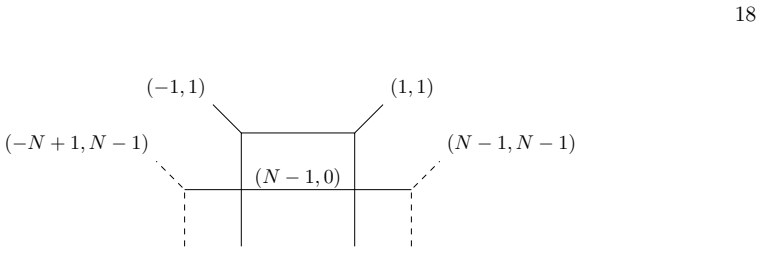
The load-bearing object is the rescaled eigenvalue density ϱ(z,x) = N(z)ρ(z,x), which satisfies the Poisson equation (1/4)∂$_x^{2}$ ϱ + ∂$_z^{2}$ ϱ + $L^{2}$ k(z)δ(x) = 0 on the strip z ∈ [0,1], with Dirichlet boundary conditions ϱ(0,x) = N(0)δ(x) and ϱ(1,x) = N(1)δ(x), and with interior nodes where N_f ≠ 2N acting as semi-infinite conducting plates. The strip is mapped to the upper half plane by u = $e^{{2πx + iπz}}$, and the saddle point solution is written as a superposition of contributions from boundary ranks and fundamental flavors. This turns a system of many coupled matrix integrals into a single solvable boundary-value problem.
What would settle it
Compute the leading instanton correction to the matrix model for the +_{N,M} or T_N theory and check whether it is exponentially suppressed relative to the saddle point value, or evaluate the full localized partition function numerically at moderate N with instantons included and compare the large-N coefficient with the analytic result.
Extended reading notes
Core claim
The central claim is that the large-N saddle point of the squashed S5 partition function for these long quiver theories is governed by a single electrostatic potential ϱ(z,x) = N(z)ρ(z,x) obeying a Poisson equation on a strip, and that this equation can be solved exactly by conformally mapping the strip to the upper half plane. For the +_{N,M} and T_N theories this yields exact free energies, for example F_{+_{N,M}} = -7/($16π^{2}$) ($ω_tot^{3}$/(ω_1ω_2ω_3)) ζ(3) $N^{2}$ $M^{2}$ and F_{T_N} = -1/($8π^{2}$) ($ω_tot^{3}$/(ω_1ω_2ω_3)) ζ(3) $N^{4}$. For theories with fundamental flavors at interior nodes, the free energies are expressed through polylogarithms D_4 and D_5 whose phases encode quiver parameters. The paper also establishes the universal relation C_T = -640/$π^{2}$ F_{S5} for all long quiver theories of the type considered.
Load-bearing premise
The calculation assumes that instanton contributions to the localized partition function are subleading in the large-N limit, so that the zero-instanton matrix model together with the saddle point approximation gives the exact leading free energy; it also approximates small-rank gauge nodes at quiver tails by smooth eigenvalue densities.
Editorial extensions
If this is right
- The exact free energies confirm the proposed AdS6/CFT5 dualities for Type IIB 5-brane webs, matching supergravity results for the +_{N,M}, T_N, Y_N, ⋔_N, T_{2K,K,2}, T_{N,K,j} and +_{N,M,j} theories.
- The universal relation C_T = -640/π^2 F_{S5} means a single round-sphere free energy computation determines the conformal central charge for all these theories at large N.
- The squashed-sphere free energy factorizes as F_ω = (ω_tot^3/(27 ω_1ω_2ω_3)) F_{S5}, independent of the detailed saddle point solution.
- Free energies of theories with internal fundamental flavors involve polylogarithms up to degree five, with quiver parameters appearing as phases of the polylogarithms rather than as simple powers.
- The explicit saddle point eigenvalue distributions provide a starting point for computing other BPS quantities, including Wilson loops, flavor central charges, and topologically twisted indices.
Reading between the lines
- The electrostatics reformulation is likely to extend to other long quiver SCFTs in lower dimensions, where similar large-N matrix models arise from localization.
- The appearance of ζ(5) instead of ζ(3) for theories with constrained 7-brane junctions suggests that the transcendental weight of the free energy could serve as a field-theoretic diagnostic for whether a supergravity solution contains 7-branes.
- A direct evaluation of the first instanton correction for moderate N could test whether instantons are truly subleading at large N; if they contribute at the same order, the closed-form results would receive corrections.
- The analytic saddle point distributions may allow the topologically twisted index to be evaluated in closed form, upgrading the numerical match to an exact statement.
Editorial analysis
A structured set of objections, weighed in public.
Referee Report
Summary. This paper develops an analytic saddle-point treatment of the squashed S^5 partition functions of 5d long linear quiver gauge theories that arise as relevant deformations of 5d SCFTs with Type IIB supergravity duals. The authors reformulate the localized matrix model in terms of continuous eigenvalue densities on a strip, derive a Poisson-type saddle-point equation with boundary and junction conditions, and solve the resulting electrostatics problem for quivers with N_f=2N at all interior nodes (including the T_N and +_{N,M} theories) and for a sample with N_f≠2N nodes and Chern-Simons terms (including the Y_N and ⋄_N theories). They obtain closed-form free energies, such as F_{+_{N,M}} = -7/(16π^2) (ω_tot^3/(ω_1ω_2ω_3)) ζ(3) N^2 M^2 and F_{T_N} = -1/(8π^2) (ω_tot^3/(ω_1ω_2ω_3)) ζ(3) N^4, and derive the universal relation C_T = -640/π^2 F_{S^5}. The results match supergravity predictions and prior numerical localization results on the round S^5.
Significance. If correct, these are the first analytic field-theory results for several of the 5d SCFTs considered, providing precision checks of AdS6/CFT5 and explicit expressions with nontrivial polylogarithmic dependence on the quiver parameters. The derivation is fully analytic and parameter-free: no fitting to supergravity is performed, and the matching with independent supergravity and numerical computations in [43,48,56] is a genuine post-hoc consistency check. The closed-form free energies and the universal C_T relation are strong, falsifiable predictions. The main caveat is the reliance on two acknowledged but unproven assumptions: suppression of instanton contributions and replacement of O(1)-rank tail nodes by smooth eigenvalue densities; these are the load-bearing gaps between the exact solution of the simplified saddle-point equations and exact results for the full SCFT partition function.
major comments (2)
- [Sec. II A, before Eq. (2.13); also Sec. I, paragraph on localization] The paper asserts that instanton contributions are suppressed in the large-N limit and that the saddle point of the zero-instanton matrix model captures the partition function exactly, but no estimate or proof is provided. Because the final free energies (4.5), (4.10), (4.28), (4.51), (4.56), (4.61) and (4.69) are presented as exact results, this is a load-bearing step. The manuscript should either supply a quantitative argument for the suppression in these specific quiver theories (for example, a lower bound on the instanton action that grows with N), or explicitly restate the results as the leading large-N values of the perturbative saddle point with instanton corrections left as an open problem. The agreement with supergravity and numerics in [43,48,56] is strong evidence but does not replace a field-theoretic justification.
- [Sec. IV B, T_N theory paragraph; analogous passages in Secs. IV C, IV E, IV F, IV G] For quiver nodes of O(1) rank, such as the SU(2) nodes at the tail of the T_N quiver and the corresponding tail nodes in the Y_N, T_{2K,K,2}, T_{N,K,j} and +_{N,M,j} theories, the paper replaces discrete eigenvalue sums by smooth densities ρ(z,x) with normalization ∫dx ρ(z,x)=1, although for finite-rank nodes the eigenvalue distribution is inherently discrete. The paper states that this 'will lead to consistent results' but does not estimate the error or show that the finite-rank corrections are subleading in the large-N limit. Since the claim is exactness of the free energies, the manuscript should either justify this approximation to the required order or explicitly state that the results hold up to corrections from the tail nodes, which is particularly relevant for the T_N result (4.10) and its relatives.
minor comments (4)
- [Sec. II A, paragraph before Eq. (2.13)] The word 'constributions' in 'instanton constributions' is a typo for 'contributions', and the same typo appears in the similar sentence in Sec. I.
- [Eqs. (2.24)–(2.27)] The symbol L is used both for the quiver length and for the Lagrangian density defined in Eq. (2.25); this notational clash makes the action formulas harder to read, and using a different symbol for one of the two would improve clarity.
- [Sec. II C, after Eq. (2.33)] The phrase 'integration by parts in the first term' would be clearer if it specified that the integration is with respect to y, since the stated fall-off condition on ϱ(z,y) for large y is what justifies the manipulation.
- [Eq. (4.61) and Eq. (4.69)] The displayed expressions for F_{T_{N,K,j}} and F_{+_{N,M,j}} contain a minor parenthesis mismatch in the term involving D_5(e^{2ikπ}); the closing bracket should be checked against the definitions in (5.2).
Circularity Check
No significant circularity: the large-N free energies are derived by solving the localization saddle-point equations, with supergravity and numerical comparisons entering only as post-hoc checks.
full rationale
The derivation chain is self-contained: it begins from the known localized matrix model (2.6), reduces it in the large-N limit to the action (2.27), derives the saddle-point equation (2.36) with boundary and junction conditions, solves the resulting 2d electrostatics problem in (3.13)-(3.14), and evaluates the free energy on-shell in (3.17). The quiver data N(z), k(z) and c(z) are the inputs, and no coefficient or integration constant in the final free energies (4.5), (4.10), (4.28), (4.51), (4.56), (4.61) or (4.69) is adjusted to match the supergravity or numerical results cited in the paper. The cited prior work, including papers with overlapping authorship, is used as benchmark comparisons such as 'agrees with the supergravity result of [43]' and 'matches the field theory numerics of [48]', or as definitions of brane constructions, not as load-bearing justification for the saddle-point computation. The paper's own stated limitations - that instanton contributions are 'expected to be suppressed' before (2.13), and that smooth eigenvalue densities at small-rank quiver tails 'will lead to consistent results' in Sec. IV B - are explicit approximations and are correctness risks if they fail, but they are not circular steps because the target free energies are not assumed or fitted through them. The universal relation (2.52) is derived in the paper from (2.49)-(2.51) using the same large-N framework, and the later supergravity agreements are consistency checks rather than inputs. No specific reduction of a prediction to its input by construction can be quoted from the paper, so no circularity is found.
Assumptions & free parameters
assumptions (5)
- domain assumption Supersymmetric localization reduces the squashed S5 partition function to the zero-instanton matrix model (2.6)/(2.9).
- domain assumption Instanton contributions are suppressed at large N, and the saddle point of the perturbative matrix model is exact.
- domain assumption The discrete quiver can be described by continuous functions N(z), k(z), c(z), and the eigenvalue densities are smooth distributions on [0,1] x R, including at small-rank tail nodes.
- domain assumption Leading large-argument asymptotics of the triple sine functions (2.21) capture the leading saddle point; subleading terms do not affect the leading free energy.
- domain assumption For Nf != 2N nodes, the support restrictions and Dirichlet/Neumann conditions (2.48) and (3.4) correctly account for Chern-Simons terms.
Cite this review
Pith. "Pith review of Exact results for 5d SCFTs of long quiver type." pith.science (2026). https://pith.science/paper/I33UBALT
@misc{pith2026190901369,
  author       = {Pith},
  title        = {Pith review of: Exact results for 5d SCFTs of long quiver type},
  year         = {2026},
  howpublished = {\url{https://pith.science/paper/I33UBALT}},
  note         = {Machine review of arXiv:1909.01369}
}
abstract
Exact results are derived for 5d SCFTs with holographic duals in Type IIB supergravity. These theories have relevant deformations that flow to linear quiver gauge theories, with the number of nodes large in the large-$N$ limits described by supergravity. Starting from a suitable formulation of the matrix models resulting from supersymmetric localization of the squashed $S^5$ partition functions, the saddle point equations are solved for generic quivers with $N_f=2N$ at all interior nodes, which includes the $T_N$ theories, and for a sample of theories with $N_f\neq 2N$ nodes including theories with Chern-Simons terms. The resulting exact expressions for the free energies and conformal central charges are consistent with supergravity predictions and, where available, with previous numerical field theory analyses.
Figures


Figures from the paper (1 more)

Forward citations
Cited by 1 Pith paper
-
Uplifting supersymmetric $AdS_6$ black holes to type II supergravity
The author uplifts supersymmetric AdS6 black holes from F(4) gauged supergravity into massive type IIA and type IIB supergravity, and verifies an entropy match in the IIA case.
Reference graph
Works this paper leans on
-
[1]
One therefore has to find a non-negative harmonic function ϱ(z,x ) on the strip (z,x )∈ [0, 1 2]×R, with, since N(z) vanishes at z = 0, ϱ(0,x ) = 0
Saddle point The quiver (4.11) is symmetric under z→ 1−z, as reflected in N(z) =N(1−z), and the same is expected for the saddle point configuration. One therefore has to find a non-negative harmonic function ϱ(z,x ) on the strip (z,x )∈ [0, 1 2]×R, with, since N(z) vanishes at z = 0, ϱ(0,x ) = 0 . (4.15) The boundary condition at z = 1 2 follows from the jun...
-
[2]
(4.12) Since µ(z) and τ(z) vanish along parts of the quiver where Nf = 2N, they take the form µ(z) = µ0 Lδ ( z− 1 2 ) , τ (z) = τ0 Lδ ( z− 1 2 ) . (4.13) In the expression for F in (2.27) the flavors at the boundary nodes drop out, and the boundary terms vanish, such that FYN = L2 ∫ 1 0 dz ∫ dxdyL + π 3cN−1L3N ∫ dx ˆρ( 1 2,x )x3 +L3N [ µ0 ∫ dxx ˆρ( 1 2,x )...
-
[3]
This shows that (4.16) is indeed satisfied with µ0 = ζ(3) 16π2 , τ 0 =−π 48cN−1 . (4.24)
-
[4]
The Lagrange multiplier terms do not contribute since they multiply the constraints, leaving FYN ⏐⏐ ˆρ=ˆρs = L2 ∫ 1 0 dz ∫ dxdyL ⏐⏐ ˆρ=ˆρs + π 3cN−1L3N ∫ dx ˆρs( 1 2,x )x3
Free energy To derive the free energy, the expression for FYN in (4.14) is evaluated on the saddle point configuration (4.21). The Lagrange multiplier terms do not contribute since they multiply the constraints, leaving FYN ⏐⏐ ˆρ=ˆρs = L2 ∫ 1 0 dz ∫ dxdyL ⏐⏐ ˆρ=ˆρs + π 3cN−1L3N ∫ dx ˆρs( 1 2,x )x3 . (4.25) Using integration by parts and that ϱs is harmonic...
-
[5]
− (2N− 2)− [2N] , (4.29) with all Chern-Simons levels zero and Nf = 2N at all nodes
S-dual quiver The quiver deformation arising after performing an S-duality on the brane web is given by (2)− (4)− (6)−... − (2N− 2)− [2N] , (4.29) with all Chern-Simons levels zero and Nf = 2N at all nodes. For N = 2 this is the rank-1 E5 theory. In the matrix model (2.16) this quiver corresponds to L =N− 1,Nt = 2t andkN−1 = 2N. The continuous version (2....
-
[6]
Saddle point To construct ϱ, the problem is mapped to the upper half plane with a following SL(2,R) transformation, u =e4πx+2πiz , v = ue4πx0 + 1 u +e4πx0 . (4.39) In the v coordinate we need a non-negative function satisfying Neumann boundary conditions for v in (−∞, 0)⊂R and Dirichlet boundary conditions for v∈R+, ϱ(v) ⏐⏐ v∈R+ =Nδ (v, 1) . (4.40) With t...
-
[7]
The condition that the quadratic term be zero leads to cosh(2πx0) = 2
The linear and cubic terms vanish by symmetry of ϱs underx→−x. The condition that the quadratic term be zero leads to cosh(2πx0) = 2 . (4.45) The resulting saddle point configuration for z∈ (0, 1) is given by ˆρs = N N(z) 1− 2 csch2(2πx +iπz)√ 3 + 2 coth(2πx +iπz) √√ 3 tanh(2πx +iπz) + 2√ 3 tanh(2πx +iπz)− 2 + c.c. (4.46) The junction condition (4.37) is s...
-
[8]
Holography, Generalized Geometry and Duality
Free energy The free energy is obtained by evaluating F in (4.35) on the saddle point configuration (4.46). With the boundary conditions atz = 0 andz = 1, the local saddle point equation and the symmetry under z→ 1−z this leads to F +N ⏐⏐ ϱ=ϱs =−4N 2 ∫ dxdy [ϱs(z,x )∂zϱs(z,y )] z= 1 2−ϵ z=0 FH(x−y) . (4.48) Using the boundary condition at z = 0 this furthe...
Show all 86 references
-
[9]
Five-dimensional SUSY field theories, nontrivial fixed points and string dynamics,
Nathan Seiberg, “Five-dimensional SUSY field theories, nontrivial fixed points and string dynamics,” Phys. Lett. B388, 753–760 (1996), arXiv:hep-th/9608111 [hep-th]
1996 arXiv
-
[10]
Five-dimensional supersymmetric gauge theories and degenerations of Calabi-Yau spaces,
Kenneth A. Intriligator, David R. Morrison, and Nathan Seiberg, “Five-dimensional supersymmetric gauge theories and degenerations of Calabi-Yau spaces,” Nucl. Phys. B497, 56–100 (1997), arXiv:hep- th/9702198 [hep-th]
1997
-
[11]
Branes, superpotentials and superconformal fixed points,
Ofer Aharony and Amihay Hanany, “Branes, superpotentials and superconformal fixed points,” Nucl. Phys. B504, 239–271 (1997), arXiv:hep-th/9704170 [hep-th]
1997 arXiv
-
[12]
5-D field theories and M theory,
Barak Kol, “5-D field theories and M theory,” JHEP 11, 026 (1999), arXiv:hep-th/9705031 [hep-th]
1999 arXiv
-
[13]
Webs of (p,q) five-branes, five-dimensional field theories and grid diagrams,
Ofer Aharony, Amihay Hanany, and Barak Kol, “Webs of (p,q) five-branes, five-dimensional field theories and grid diagrams,” JHEP 01, 002 (1998), arXiv:hep-th/9710116 [hep-th]
1998 arXiv
-
[14]
On the M theory ap- proach to (compactified) 5-D field theories,
A. Brandhuber, N. Itzhaki, J. Sonnenschein, S. Theisen, and S. Yankielowicz, “On the M theory ap- proach to (compactified) 5-D field theories,” Phys. Lett. B415, 127–134 (1997), arXiv:hep-th/9709010 [hep-th]
1997 arXiv
-
[15]
Towards Classification of 5d SCFTs: Single Gauge Node,
Patrick Jefferson, Hee-Cheol Kim, Cumrun Vafa, and Gabi Zafrir, “Towards Classification of 5d SCFTs: Single Gauge Node,” (2017), arXiv:1705.05836 [hep-th]
2017 arXiv
-
[16]
On Geometric Classification of 5d SCFTs,
Patrick Jefferson, Sheldon Katz, Hee-Cheol Kim, and Cumrun Vafa, “On Geometric Classification of 5d SCFTs,” JHEP 04, 103 (2018), arXiv:1801.04036 [hep-th]
2018 arXiv
-
[17]
Three dimensional canonical singularity and five dimensional N = 1 SCFT,
Dan Xie and Shing-Tung Yau, “Three dimensional canonical singularity and five dimensional N = 1 SCFT,” JHEP 06, 134 (2017), arXiv:1704.00799 [hep-th]
2017 arXiv
-
[18]
Phases of 5d SCFTs from M-/F-theory on Non- Flat Fibrations,
Fabio Apruzzi, Ling Lin, and Christoph Mayrhofer, “Phases of 5d SCFTs from M-/F-theory on Non- Flat Fibrations,” JHEP 05, 187 (2019), arXiv:1811.12400 [hep-th]
2019 arXiv
-
[19]
Five-dimensional SCFTs and gauge theory phases: an M-theory/type IIA perspective,
Cyril Closset, Michele Del Zotto, and Vivek Saxena, “Five-dimensional SCFTs and gauge theory phases: an M-theory/type IIA perspective,” SciPost Phys. 6, 052 (2019), arXiv:1812.10451 [hep-th]
2019 arXiv
-
[20]
Fibers add Flavor, Part I: Classification of 5d SCFTs, Flavor Symmetries and BPS States,
Fabio Apruzzi, Craig Lawrie, Ling Lin, Sakura Schfer-Nameki, and Yi-Nan Wang, “Fibers add Flavor, Part I: Classification of 5d SCFTs, Flavor Symmetries and BPS States,” (2019), arXiv:1907.05404 [hep-th]
2019 arXiv
-
[21]
The D-4 - D-8 brane system and five-dimensional fixed points,
Andreas Brandhuber and Yaron Oz, “The D-4 - D-8 brane system and five-dimensional fixed points,” Phys. Lett. B460, 307–312 (1999), arXiv:hep-th/9905148 [hep-th]
1999 arXiv
-
[22]
5d quivers and their AdS(6) duals,
Oren Bergman and Diego Rodriguez-Gomez, “5d quivers and their AdS(6) duals,” JHEP 07, 171 (2012), arXiv:1206.3503 [hep-th]
2012 arXiv
-
[23]
Exact results for five-dimensional superconformal field theories with gravity duals,
Daniel L. Jafferis and Silviu S. Pufu, “Exact results for five-dimensional superconformal field theories with gravity duals,” JHEP 05, 032 (2014), arXiv:1207.4359 [hep-th]
2014 arXiv
-
[24]
Probing the Higgs branch of 5d fixed point theories with dual giant gravitons in AdS(6),
Oren Bergman and Diego Rodriguez-Gomez, “Probing the Higgs branch of 5d fixed point theories with dual giant gravitons in AdS(6),” JHEP 12, 047 (2012), arXiv:1210.0589 [hep-th]
2012 arXiv
-
[25]
Wilson Loops in 5d N=1 SCFTs and AdS/CFT,
Benjamin Assel, John Estes, and Masahito Yamazaki, “Wilson Loops in 5d N=1 SCFTs and AdS/CFT,” Annales Henri Poincare 15, 589–632 (2014), arXiv:1212.1202 [hep-th]
2014 arXiv
-
[26]
5d superconformal indices at large N and holography,
Oren Bergman, Diego Rodrguez-Gmez, and Gabi Zafrir, “5d superconformal indices at large N and holography,” JHEP 08, 081 (2013), arXiv:1305.6870 [hep-th]
2013 arXiv
-
[27]
Super- symmetric gauge theories on five-manifolds,
Luis F. Alday, Pietro Benetti Genolini, Martin Fluder, Paul Richmond, and James Sparks, “Super- symmetric gauge theories on five-manifolds,” JHEP 08, 007 (2015), arXiv:1503.09090 [hep-th]
2015 arXiv
-
[28]
Janus solutions in six-dimensional gauged su- pergravity,
Michael Gutperle, Justin Kaidi, and Himanshu Raj, “Janus solutions in six-dimensional gauged su- pergravity,” JHEP 12, 018 (2017), arXiv:1709.09204 [hep-th]. 32
2017 arXiv
-
[29]
Mass deformations of 5d SCFTs via holography,
Michael Gutperle, Justin Kaidi, and Himanshu Raj, “Mass deformations of 5d SCFTs via holography,” JHEP 02, 165 (2018), arXiv:1801.00730 [hep-th]
2018 arXiv
-
[30]
Holographic duals of five-dimensional SCFTs on a Riemann surface,
Ibrahima Bah, Achilleas Passias, and Peter Weck, “Holographic duals of five-dimensional SCFTs on a Riemann surface,” JHEP 01, 058 (2019), arXiv:1807.06031 [hep-th]
2019 arXiv
-
[31]
Surface defects in the D4 − D8 brane system,
Giuseppe Dibitetto and Nicol Petri, “Surface defects in the D4 − D8 brane system,” JHEP 01, 193 (2019), arXiv:1807.07768 [hep-th]
2019 arXiv
-
[32]
Topologically twisted indices in five dimensions and holography,
Seyed Morteza Hosseini, Itamar Yaakov, and Alberto Zaffaroni, “Topologically twisted indices in five dimensions and holography,” JHEP 11, 119 (2018), arXiv:1808.06626 [hep-th]
2018 arXiv
-
[33]
5d Partition Functions with A Twist,
P. Marcos Crichigno, Dharmesh Jain, and Brian Willett, “5d Partition Functions with A Twist,” JHEP 11, 058 (2018), arXiv:1808.06744 [hep-th]
2018 arXiv
-
[34]
6D attractors and black hole microstates,
Seyed Morteza Hosseini, Kiril Hristov, Achilleas Passias, and Alberto Zaffaroni, “6D attractors and black hole microstates,” (2018), 10.1007/JHEP12(2018)001, [JHEP12,001(2018)], arXiv:1809.10685 [hep-th]
2018 arXiv
-
[35]
Large AdS 6 black holes from CFT 5,
Sunjin Choi and Seok Kim, “Large AdS 6 black holes from CFT 5,” (2019), arXiv:1904.01164 [hep-th]
2019 arXiv
-
[36]
Supersymmetric probes in warped AdS6,
Jose Manuel Penin, Alfonso V. Ramallo, and Diego Rodriguez-Gomez, “Supersymmetric probes in warped AdS6,” (2019), arXiv:1906.07732 [hep-th]
2019 arXiv
-
[37]
Five-branes, seven-branes and five-dimensional E(n) field theories,
Oliver DeWolfe, Amihay Hanany, Amer Iqbal, and Emanuel Katz, “Five-branes, seven-branes and five-dimensional E(n) field theories,” JHEP 03, 006 (1999), arXiv:hep-th/9902179 [hep-th]
1999 arXiv
-
[38]
5d fixed points from brane webs and O7-planes,
Oren Bergman and Gabi Zafrir, “5d fixed points from brane webs and O7-planes,” JHEP 12, 163 (2015), arXiv:1507.03860 [hep-th]
2015 arXiv
-
[39]
5-brane webs for 5d N = 1 G 2 gauge theories,
Hirotaka Hayashi, Sung-Soo Kim, Kimyeong Lee, and Futoshi Yagi, “5-brane webs for 5d N = 1 G 2 gauge theories,” JHEP 03, 125 (2018), arXiv:1801.03916 [hep-th]
2018 arXiv
-
[40]
Dualities and 5-brane webs for 5d rank 2 SCFTs,
Hirotaka Hayashi, Sung-Soo Kim, Kimyeong Lee, and Futoshi Yagi, “Dualities and 5-brane webs for 5d rank 2 SCFTs,” JHEP 12, 016 (2018), arXiv:1806.10569 [hep-th]
2018 arXiv
-
[41]
Rank-3 antisymmetric matter on 5-brane webs,
Hirotaka Hayashi, Sung-Soo Kim, Kimyeong Lee, and Futoshi Yagi, “Rank-3 antisymmetric matter on 5-brane webs,” JHEP 05, 133 (2019), arXiv:1902.04754 [hep-th]
2019 arXiv
-
[42]
Warped AdS6×S2 in Type IIB supergravity I: Local solutions,
Eric D’Hoker, Michael Gutperle, Andreas Karch, and Christoph F. Uhlemann, “Warped AdS6×S2 in Type IIB supergravity I: Local solutions,” JHEP 08, 046 (2016), arXiv:1606.01254 [hep-th]
2016 arXiv
-
[43]
Holographic duals for five-dimensional superconformal quantum field theories,
Eric D’Hoker, Michael Gutperle, and Christoph F. Uhlemann, “Holographic duals for five-dimensional superconformal quantum field theories,” Phys. Rev. Lett. 118, 101601 (2017), arXiv:1611.09411 [hep- th]
2017 arXiv
-
[44]
Warped AdS6× S2 in Type IIB supergravity II: Global solutions and five-brane webs,
Eric D’Hoker, Michael Gutperle, and Christoph F. Uhlemann, “Warped AdS6× S2 in Type IIB supergravity II: Global solutions and five-brane webs,” JHEP 05, 131 (2017), arXiv:1703.08186 [hep- th]
2017 arXiv
-
[45]
Warped AdS6× S2 in Type IIB supergravity III: Global solutions with seven-branes,
Eric D’Hoker, Michael Gutperle, and Christoph F. Uhlemann, “Warped AdS6× S2 in Type IIB supergravity III: Global solutions with seven-branes,” JHEP 11, 200 (2017), arXiv:1706.00433 [hep- th]
2017 arXiv
-
[46]
Supersymmetric AdS6 via T Duality,
Yolanda Lozano, Eoin Colgin, Diego Rodrguez-Gmez, and Konstadinos Sfetsos, “Supersymmetric AdS6 via T Duality,” Phys. Rev. Lett. 110, 231601 (2013), arXiv:1212.1043 [hep-th]
2013 arXiv
-
[47]
Hints of 5d Fixed Point Theories from Non-Abelian T-duality,
Yolanda Lozano, Eoin Colgin, and Diego Rodrguez-Gmez, “Hints of 5d Fixed Point Theories from Non-Abelian T-duality,” JHEP 05, 009 (2014), arXiv:1311.4842 [hep-th]
2014 arXiv
-
[48]
AdS6 solutions of type II supergravity,
Fabio Apruzzi, Marco Fazzi, Achilleas Passias, Dario Rosa, and Alessandro Tomasiello, “AdS6 solutions of type II supergravity,” JHEP 11, 099 (2014), [Erratum: JHEP05,012(2015)], arXiv:1406.0852 [hep- th]
2014 arXiv
-
[49]
Supersymmetric AdS 6 Solutions of Type IIB Super- gravity,
Hyojoong Kim, Nakwoo Kim, and Minwoo Suh, “Supersymmetric AdS 6 Solutions of Type IIB Super- gravity,” Eur. Phys. J. C75, 484 (2015), arXiv:1506.05480 [hep-th]
2015 arXiv
-
[50]
Comments on the symmetry of AdS 6 solutions in string/M-theory and Killing spinor equations,
Hyojoong Kim and Nakwoo Kim, “Comments on the symmetry of AdS 6 solutions in string/M-theory and Killing spinor equations,” Phys. Lett. B760, 780–787 (2016), arXiv:1604.07987 [hep-th]
2016 arXiv
-
[51]
En- tanglement entropy vs. free energy in IIB supergravity duals for 5d SCFTs,
Michael Gutperle, Chrysostomos Marasinou, Andrea Trivella, and Christoph F. Uhlemann, “En- tanglement entropy vs. free energy in IIB supergravity duals for 5d SCFTs,” JHEP 09, 125 (2017), arXiv:1705.01561 [hep-th]
2017 arXiv
-
[52]
(p,q)-strings probing five-brane webs,
Justin Kaidi, “(p,q)-strings probing five-brane webs,” JHEP 10, 087 (2017), arXiv:1708.03404 [hep-th]
2017 arXiv
-
[53]
Type IIB 7-branes in warped AdS 6: partition functions, brane webs and probe limit,
Michael Gutperle, Andrea Trivella, and Christoph F. Uhlemann, “Type IIB 7-branes in warped AdS 6: partition functions, brane webs and probe limit,” JHEP 04, 135 (2018), arXiv:1802.07274 [hep-th]
2018 arXiv
-
[54]
Massive spin 2 excitations in AdS6×S2 33 warped spacetimes,
Michael Gutperle, Christoph F. Uhlemann, and Oscar Varela, “Massive spin 2 excitations in AdS6×S2 33 warped spacetimes,” JHEP 07, 091 (2018), arXiv:1805.11914 [hep-th]
2018 arXiv
-
[55]
Testing AdS6/CFT5 in Type IIB with stringy operators,
Oren Bergman, Diego Rodr´ ıguez-G´ omez, and Christoph F. Uhlemann, “Testing AdS6/CFT5 in Type IIB with stringy operators,” JHEP 08, 127 (2018), arXiv:1806.07898 [hep-th]
2018 arXiv
-
[56]
Precision Test of AdS6/CFT5 in Type IIB String Theory,
Martin Fluder and Christoph F. Uhlemann, “Precision Test of AdS6/CFT5 in Type IIB String Theory,” Phys. Rev. Lett. 121, 171603 (2018), arXiv:1806.08374 [hep-th]
2018 arXiv
-
[57]
M-theory curves from warped AdS 6 in Type IIB,
Justin Kaidi and Christoph F. Uhlemann, “M-theory curves from warped AdS 6 in Type IIB,” JHEP 11, 175 (2018), arXiv:1809.10162 [hep-th]
2018 arXiv
-
[58]
Gauged Six-Dimensional Supergravity from Warped IIB Reductions,
Junho Hong, James T. Liu, and Daniel R. Mayerson, “Gauged Six-Dimensional Supergravity from Warped IIB Reductions,” JHEP 09, 140 (2018), arXiv:1808.04301 [hep-th]
2018 arXiv
-
[59]
Supersymmetric AdS 7 and AdS6 vacua and their minimal consistent truncations from exceptional field theory,
Emanuel Malek, Henning Samtleben, and Valent Vall Camell, “Supersymmetric AdS 7 and AdS6 vacua and their minimal consistent truncations from exceptional field theory,” Phys. Lett. B786, 171–179 (2018), arXiv:1808.05597 [hep-th]
2018 arXiv
-
[60]
AdS 6 T-duals and type IIB AdS 6× S2 geometries with 7-branes,
Yolanda Lozano, Niall T. Macpherson, and Jess Montero, “AdS 6 T-duals and type IIB AdS 6× S2 geometries with 7-branes,” JHEP 01, 116 (2019), arXiv:1810.08093 [hep-th]
2019 arXiv
-
[61]
On minimal Type IIB AdS 6 solutions with commuting 7-branes,
Andrea Chaney and Christoph F. Uhlemann, “On minimal Type IIB AdS 6 solutions with commuting 7-branes,” JHEP 12, 110 (2018), arXiv:1810.10592 [hep-th]
2018 arXiv
-
[62]
Supersymmetric AdS 7 and AdS6 vacua and their consistent truncations with vector multiplets,
Emanuel Malek, Henning Samtleben, and Valent Vall Camell, “Supersymmetric AdS 7 and AdS6 vacua and their consistent truncations with vector multiplets,” JHEP 04, 088 (2019), arXiv:1901.11039 [hep- th]
2019 arXiv
-
[63]
Relating AdS 6 solutions in type IIB supergravity,
Kevin Chen and Michael Gutperle, “Relating AdS 6 solutions in type IIB supergravity,” JHEP 04, 054 (2019), arXiv:1901.11126 [hep-th]
2019 arXiv
-
[64]
Black hole microstate counting in Type IIB from 5d SCFTs,
Martin Fluder, Seyed Morteza Hosseini, and Christoph F. Uhlemann, “Black hole microstate counting in Type IIB from 5d SCFTs,” (2019), arXiv:1902.05074 [hep-th]
2019 arXiv
-
[65]
The perturbative partition function of supersymmetric 5D Yang-Mills theory with matter on the five-sphere,
Johan Kll´ en, Jian Qiu, and Maxim Zabzine, “The perturbative partition function of supersymmetric 5D Yang-Mills theory with matter on the five-sphere,” JHEP 08, 157 (2012), arXiv:1206.6008 [hep-th]
2012 arXiv
-
[66]
M5-branes from gauge theories on the 5-sphere,
Hee-Cheol Kim and Seok Kim, “M5-branes from gauge theories on the 5-sphere,” JHEP 05, 144 (2013), arXiv:1206.6339 [hep-th]
2013 arXiv
-
[67]
Superconformal Partition Functions and Non-perturbative Topological Strings,
Guglielmo Lockhart and Cumrun Vafa, “Superconformal Partition Functions and Non-perturbative Topological Strings,” JHEP 10, 051 (2018), arXiv:1210.5909 [hep-th]
2018 arXiv
-
[68]
Supersymmetric theories on squashed five-sphere,
Yosuke Imamura, “Supersymmetric theories on squashed five-sphere,” PTEP 2013, 013B04 (2013), arXiv:1209.0561 [hep-th]
2013 arXiv
-
[69]
Perturbative partition function for squashed S5,
Yosuke Imamura, “Perturbative partition function for squashed S5,” PTEP 2013, 073B01 (2013), arXiv:1210.6308 [hep-th]
2013 arXiv
-
[70]
Spheres, Charges, Instantons, and Bootstrap: A Five-Dimensional Odyssey,
Chi-Ming Chang, Martin Fluder, Ying-Hsuan Lin, and Yifan Wang, “Spheres, Charges, Instantons, and Bootstrap: A Five-Dimensional Odyssey,” JHEP 03, 123 (2018), arXiv:1710.08418 [hep-th]
2018 arXiv
-
[71]
Romans Supergravity from Five-Dimensional Holograms,
Chi-Ming Chang, Martin Fluder, Ying-Hsuan Lin, and Yifan Wang, “Romans Supergravity from Five-Dimensional Holograms,” JHEP 05, 039 (2018), arXiv:1712.10313 [hep-th]
2018 arXiv
-
[72]
Comments on Squashed-sphere Partition Func- tions,
Nikolay Bobev, Pablo Bueno, and Yannick Vreys, “Comments on Squashed-sphere Partition Func- tions,” JHEP 07, 093 (2017), arXiv:1705.00292 [hep-th]
2017 arXiv
-
[73]
The Bloch-Wigner-Ramakrishnan polylogarithm function,
Don Zagier, “The Bloch-Wigner-Ramakrishnan polylogarithm function,” Mathematische Annalen 286, 613–624 (1990)
1990
-
[74]
Webs of five-branes and N=2 superconformal field theories,
Francesco Benini, Sergio Benvenuti, and Yuji Tachikawa, “Webs of five-branes and N=2 superconformal field theories,” JHEP 09, 052 (2009), arXiv:0906.0359 [hep-th]
2009 arXiv
-
[75]
Lifting 4d dualities to 5d,
Oren Bergman and Gabi Zafrir, “Lifting 4d dualities to 5d,” JHEP 04, 141 (2015), arXiv:1410.2806 [hep-th]
2015 arXiv
-
[76]
Mass-deformed T N as a linear quiver,
Hirotaka Hayashi, Yuji Tachikawa, and Kazuya Yonekura, “Mass-deformed T N as a linear quiver,” JHEP 02, 089 (2015), arXiv:1410.6868 [hep-th]
2015 arXiv
-
[77]
Classical Polylog- arithms for Amplitudes and Wilson Loops,
Alexander B. Goncharov, Marcus Spradlin, C. Vergu, and Anastasia Volovich, “Classical Polylog- arithms for Amplitudes and Wilson Loops,” Phys. Rev. Lett. 105, 151605 (2010), arXiv:1006.5703 [hep-th]
2010 arXiv
-
[78]
Tinkertoys for Gaiotto Duality,
Oscar Chacaltana and Jacques Distler, “Tinkertoys for Gaiotto Duality,” JHEP 11, 099 (2010), arXiv:1008.5203 [hep-th]
2010 arXiv
-
[79]
Exploring transcendentality in superstring amplitudes,
Eric D’Hoker and Michael B. Green, “Exploring transcendentality in superstring amplitudes,” (2019), arXiv:1906.01652 [hep-th]
2019 arXiv
-
[80]
Gravity Dual of Supersymmetric 34 Gauge Theories on a Squashed Five-Sphere,
Luis F. Alday, Martin Fluder, Paul Richmond, and James Sparks, “Gravity Dual of Supersymmetric 34 Gauge Theories on a Squashed Five-Sphere,” Phys. Rev. Lett. 113, 141601 (2014), arXiv:1404.1925 [hep-th]
2014 arXiv
-
[81]
Super- symmetric gauge theories on squashed five-spheres and their gravity duals,
Luis F. Alday, Martin Fluder, Carolina M. Gregory, Paul Richmond, and James Sparks, “Super- symmetric gauge theories on squashed five-spheres and their gravity duals,” JHEP 09, 067 (2014), arXiv:1405.7194 [hep-th]
2014 arXiv
-
[82]
Supersymmetric AdS 6 black holes from F(4) gauged supergravity,
Minwoo Suh, “Supersymmetric AdS 6 black holes from F(4) gauged supergravity,” JHEP01, 035 (2019), arXiv:1809.03517 [hep-th]
2019 arXiv
-
[83]
Supersymmetric AdS6 black holes from matter coupled F (4) gauged supergravity,
Minwoo Suh, “Supersymmetric AdS6 black holes from matter coupled F (4) gauged supergravity,” JHEP 02, 108 (2019), arXiv:1810.00675 [hep-th]
2019 arXiv
-
[84]
Uplifting supersymmetric AdS6 black holes to type II supergravity,
Minwoo Suh, “Uplifting supersymmetric AdS6 black holes to type II supergravity,” (2019), arXiv:1908.09846 [hep-th]
2019 arXiv
-
[85]
4d N=2 superconformal linear quivers with type IIA duals,
Ofer Aharony, Leon Berdichevsky, and Micha Berkooz, “4d N=2 superconformal linear quivers with type IIA duals,” JHEP 08, 131 (2012), arXiv:1206.5916 [hep-th]
2012 arXiv
-
[86]
I. S. Gradshteyn and I. M. Ryzhik, Table of Integrals, Series, and Products , seventh ed., edited by Daniel Zwillinger and Victor H. Moll (Academic Press, 2007)
2007
Reviewed August 14, 2026 · model on record in the stance chip above.
Discussion (0). Continue with ORCID to comment.