REVIEW 4 major objections 6 minor 64 references
Valley and Zeeman Splittings in Multilayer Epitaxial Graphene Revealed by Circular Polarization Resolved Magneto-infrared Spectroscopy
T0 review · 4 major / 6 minor · reviewed 2026-08-14 · deepseek-v4-flash
Pith's one-line read This paper reports a four-fold splitting of the n=0 to n=1 Landau-level transition in monolayer inclusions of multilayer epitaxial graphene, attributed to the lifting of valley and spin degeneracy of the zeroth Landau level combined with…
desk verdict A potentially important CP-resolved magneto-IR measurement of four-fold LL splitting in epitaxial graphene, but the interpretation hinges on an unverified single-layer assignment and the g-factors lack quantified uncertainty. read the letter →
The pith
A machine-rendered reading of the paper's core claim, the machinery that carries it, and where it could break.
The reading
What carries the argument
The load-bearing mechanism is the circular-polarization selection rule for inter-Landau-level transitions: $\sigma+$ light activates $LL_{-s}\rightarrow LL_{s+1}$ and $\sigma-$ light activates $LL_{-s-1}\rightarrow LL_s$, so the two polarizations isolate electron-like and hole-like transitions and expose electron-hole asymmetry. The quantitative analysis centers on a four-sub-LL model of the zeroth Landau level with energies $\pm(\Delta_> \pm \Delta_<)/2$ and the two extraction formulas $\Delta_< = [(T_A - T_B) + (T_C - T_D)]/2$ and $\Delta_{eh} = [(T_A + T_B) - (T_C + T_D)]/2$, where $T_A\ldots T_D$ are the measured transition fields interpolated by $T_i = a_i\sqrt{B} + b_iB$. This decomposition separates the Zeeman-like linear-in-$B$ part from the valley-splitting part and tests whether the valley splitting scales as $\sqrt{B}$ or $B$.
What would settle it
Take the four modes A-D at a series of photon energies and fit each one independently to $T_i = a_i\sqrt{B} + b_iB$; if they all yield the same Fermi velocity and extrapolate to a common zero-field crossing consistent with one monolayer, the four-fold-splitting interpretation is supported, whereas distinct Fermi velocities or field scalings would show that the modes originate from different layers. A complementary check is scanning tunneling spectroscopy on the same multilayer sample at high field, which would image four resolved sub-LL peaks in a single monolayer rather than peaks spread across multiple layers.
Extended reading notes
Core claim
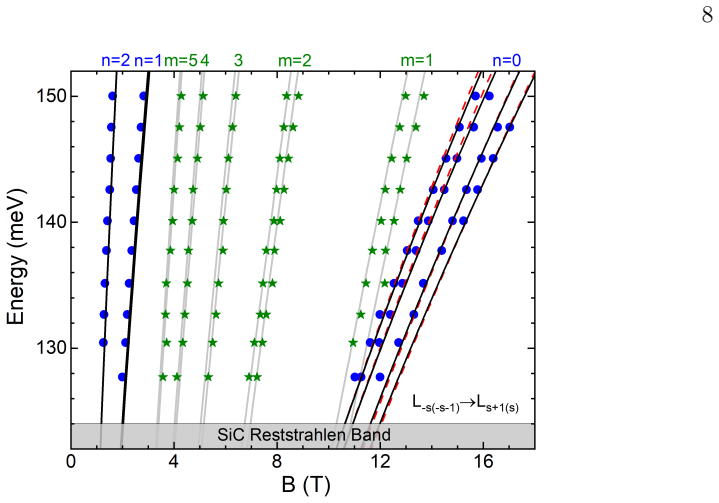
On its own terms, the paper's central claim is that the monolayer inclusions of multilayer epitaxial graphene host a four-fold splitting of the n=0 Landau-level transition: four modes labeled A, B, C, and D appear in the magneto-transmission around the n=0 to n=1 transition, with two electron-like ($\sigma+$) and two hole-like ($\sigma-$) transitions. The energies are modeled with sub-LLs at $\pm(\Delta_> \pm \Delta_<)/2$, where $\Delta_>$ and $\Delta_<$ are the larger and smaller of the valley and Zeeman splittings of the zeroth LL, and the electron and hole first Landau levels are offset by different Fermi velocities, $v^e_F = 1.025\times 10^6$ m/s and $v^h_F = 0.975\times 10^6$ m/s. The data give $\Delta_< = 0.16$ meV/T (linear in $B$), i.e. a Zeeman-like splitting with $g^*_{ZS}=4.8$ after including the bare electron g-factor of the first LL, and a remaining splitting $\Delta_>$ that is consistent with either $\sqrt{B}$ or $B$ dependence; under the linear-in-$B$ assumption the effective valley g-factor is $g^*_{VS}=6.7$, favoring an electron-phonon mechanism (Kekulé distortion or charge-density wave) over a spin-polarized ferromagnetic ground state.
Load-bearing premise
All four modes A, B, C, and D come from the same high-mobility monolayer graphene layer and represent sub-Landau-level structure; if they actually come from different layers with different Fermi velocities or carrier densities, the four-fold splitting attribution fails.
Editorial extensions
If this is right
- If the assignment holds, bulk circular-polarization magneto-IR becomes a direct probe of broken-symmetry Landau-level states in graphene, complementing transport and tunneling measurements that may be complicated by edge effects.
- The electron-hole asymmetry of the monolayer inclusions is quantified as about 2.5% in Fermi velocity, giving microscopic parameters for band-structure models of epitaxial graphene.
- The linear-in-$B$ splitting $\Delta_<$ rules out a spin-polarized ferromagnetic ground state of charge-neutral graphene in this system, consistent with prior transport and spectroscopy results.
- A linear-in-$B$ valley splitting, if confirmed, would point to electron-phonon-driven symmetry breaking rather than a purely Coulomb exchange mechanism.
- The opposite-sign electron-hole asymmetry in bilayer inclusions suggests that rotational stacking and neighboring layers can control the sign of band asymmetry, which could be used in band engineering.
Reading between the lines
- A sharper test of the same-layer assumption would be to extract each mode's $\sqrt{B}$ slope separately; identical Fermi velocities for A-D would support the four-fold splitting picture, while different slopes would indicate modes from distinct layers with different mobilities or densities.
- Extending the same CP-resolved magneto-IR technique to higher photon energies or higher magnetic fields could settle whether $\Delta_>$ scales as $\sqrt{B}$ or $B$, which the current data cannot distinguish.
- The reported effective g-factors are substantially larger than the bare electron value, so the implied interaction enhancement could be checked against transport measurements on the same MEG material in regimes where the Fermi level sits inside the split sub-LL gap.
- The sign reversal of electron-hole asymmetry in bilayer inclusions suggests a design rule: the local rotation angle of neighboring layers may tune the sign and magnitude of band asymmetry in epitaxial graphene stacks.
Signed reviews
Editorial analysis
A structured set of objections, weighed in public.
Referee Report
Summary. This paper reports circular-polarization-resolved magneto-infrared transmission measurements on multilayer epitaxial graphene (MEG) at 4.2 K in magnetic fields up to 17.5 T, using tunable quantum cascade lasers. For the monolayer graphene (MLG) inclusions, the n=0 to n=1 Landau-level transition is reported to resolve into four fine-structure modes, labeled A-D, attributed to the lifting of the valley and spin degeneracy of the zeroth Landau level together with electron-hole asymmetry. The transition energies are fit as T_i = a_i*sqrt(B) + b_i*B (Eq. 5), and the combinations Delta_< = [(T_A-T_B)+(T_C-T_D)]/2 and Delta_eh = [(T_A+T_B)-(T_C+T_D)]/2 are extracted (Eq. 4). A linear-in-B Delta_< is identified with an enhanced Zeeman splitting (g*_ZS = 4.8), while the larger splitting Delta_> is ascribed to a valley-symmetry-breaking state; the authors prefer a linear-in-B scenario (g*_VS = 6.7), while acknowledging that a sqrt(B) scenario fits equally well within their (unquantified) experimental uncertainty. For the bilayer graphene (BLG) inclusions, the paper reports electron-hole mass asymmetry of the opposite sign to exfoliated BLG, attributed to interlayer couplings in the MEG stack.
Significance. If established, the four-fold splitting of the zeroth-Landau-level transition in near-neutral monolayer graphene probed by bulk optical spectroscopy would be a significant result for the broken-symmetry phase diagram of graphene, complementing prior transport and scanning-probe studies. The manuscript has clear strengths: the algebraic extraction of Delta_< and Delta_eh from four transition energies is exact given the model of Eq. (3); the use of circular polarization to separate electron-like and hole-like transitions is appropriate; the internal consistency check on Delta_eh is reasonable; and the text is candid that the nature of Delta_> cannot be conclusively determined (Sec. 3.3). The reported effective g-factors are fit results rather than independent predictions, and the four-mode spectrum itself is a falsifiable observation that does not depend on the parameter values. The BLG sign anomaly is an interesting, independently testable claim. These strengths, however, are conditioned on the single-layer assignment of the A-D modes and on an error analysis that the manuscript does not currently provide.
major comments (4)
- [Sec. 3.2, Eqs. (4)-(5), Fig. 1(d)] The central claim rests on the assumption that modes A-D belong to a single high-mobility monolayer layer, but this is asserted ('one can attribute the A, B, C, and D modes to the four-fold splitting of the n = 0 transition in high mobility graphene layers') rather than demonstrated. The sample demonstrably contains multiple monolayer-like populations with different Fermi velocities: v_eF = 1.025x10^6 m/s, v_hF = 0.975x10^6 m/s (fitted in Sec. 3.3) and the ** mode at vF = 1.00x10^6 m/s. A 2.5% difference in vF between two layers would shift the n = 0 transition energy by about 3.5 meV at 14 T (where E is near 140 meV), the same order as the claimed splittings (Delta_< is about 2.2 meV and Delta_> about 5.4 meV at 14 T). The paper should therefore report the fitted a_i and b_i of Eq. (5) with their uncertainties and show explicitly that the sqrt(B) terms cancel in the combination Delta_< = [(T_A-T_B)+(T_C-T_D)]/2, i.e., that a_A - a_B + a_C - a_D is consistent with zero; otherwise the 'linear-in-B' identification of Delta_< and both quoted g-factors inherit an unconstrained systematic error. A quantitative argument excluding the possibility that A and B (or C and D) originate from different monolayer inclusions with slightly different vF or local doping is required.
- [Sec. 3.3 and Fig. 2(c)] No error bars, standard deviations, or confidence intervals are given anywhere in the paper, yet the central conclusions are quantitative: Delta_< = 0.16 meV/T, Delta_> = 1.44 meV/sqrt(T) or 0.39 meV/T, and the derived g-factors. The B-field range over which the n = 0 transition is observed is only 11-17 T, where sqrt(B) and B are strongly correlated, so distinguishing Delta_< proportional to B from Delta_< proportional to sqrt(B) requires quantitative uncertainties. The text states that the two Delta_> scenarios cannot be differentiated 'within the experimental uncertainty' without quantifying that uncertainty, and the abstract nevertheless presents g*_VS = 6.7 (one of the two equally good fits) as the result; the abstract should carry the caveat stated in Sec. 3.3, where the authors write that 'this work cannot give a conclusive answer to this question.' In addition, the claimed consistency check that Delta_eh is proportional to sqrt(B) is partially tautological, since the fit ansatz of Eq. (5) guarantees a sqrt(B) component; the paper should verify that the sqrt(B) coefficient of Delta_eh equals (v_eF + v_hF)*sqrt(2ehbar) using the velocities independently fitted to the n = 1 and n = 2 transitions in Fig. 3.
- [Sec. 3.2, Fig. 1(d)] The identification of the four modes A-D rests on correlating kinks with peaks in second derivatives of transmission spectra. No line-shape fits, no sample-to-sample reproducibility data, and no estimate of the peak-position uncertainty are provided, although subsequent analysis quotes transition energies to the precision needed for a 0.16 meV/T slope. The dismissal of the * mode as circular-polarization leakage is also unquantified; the degree of circular polarization of the setup is not reported. The authors should document how peak positions (and their uncertainties) were extracted, how many independent photon energies contributed to Fig. 2(b), and justify the leakage assignment quantitatively.
- [Sec. 3.3, g*_ZS derivation] The derivation of g*_ZS = 4.8 is not transparent as written: the text states that Delta_< = 0.16 meV/T corresponds to a g-factor of 2.8 and that adding the first Landau level's bare g-factor of 2 gives g*_ZS = 4.8. Since Eq. (3) neglects first-LL splittings, the measured Delta_< of Eq. (4) already contains both the zeroth-LL and first-LL Zeeman contributions; the sign convention connecting them (e.g., Delta_<,meas = |g_1 - g_0| mu_B B for spin-conserving transitions) must be specified to justify g_0 = 4.8 rather than g_0 = 0.8. This affects a headline number and should be clarified.
minor comments (6)
- [Eq. (4)] The typeset fractions are ambiguous; write Delta_< = [(T_A-T_B)+(T_C-T_D)]/2 and Delta_eh = [(T_A+T_B)-(T_C+T_D)]/2.
- [Fig. 2(c)] State how many independent photon energies and field points define Delta_< and Delta_eh, and add error bars or a bootstrap uncertainty band.
- [Sec. 3.3] The estimate e^2/4pi*epsilon*epsilon_0*l_B approximately equal to 11 meV/sqrt(T) assumes epsilon approximately equal to 5; the provenance of this dielectric constant and the sensitivity of the estimate to it should be stated.
- [Sec. 3.1] The equivalence of sweeping the field in positive versus negative directions with sigma+ and sigma- illumination deserves an explicit sentence, since the equivalence holds only if the sample response is isotropic under field reversal.
- [Sec. 3.4] The BLG band masses m*_e = 0.0376m_0 and m*_h = 0.0283m_0 and the +/-14% asymmetry are quoted without uncertainties, despite being the basis for the sign-anomaly claim.
- [Abstract] The phrase 'best fit yields effective g-factors' overstates the determination of Delta_>; wording such as 'consistent with' would better reflect the caveat stated in Sec. 3.3.
Circularity Check
No circularity: the g-factors are transparent fits to independently observed spectral modes, and the linear-in-B identification is an outcome of a two-term interpolation, not an input.
full rationale
The paper's central claim is the observation of four spectral modes A, B, C, and D within the n = 0 to n = 1 Landau-level transition of monolayer graphene inclusions in multilayer epitaxial graphene. These modes are identified directly from the measured magneto-transmission spectra and their second derivatives (Fig. 1(d)), so the existence of a four-fold splitting is raw experimental structure, not a quantity derived from the model. The effective g-factors g*_VS = 6.7 and g*_ZS = 4.8 are explicitly obtained as fitting parameters: the magnetic-field dependence of each mode is interpolated with Ti = ai sqrt(B) + bi B (Eq. 5), and the splitting quantities Delta< and Delta_eh are then computed from the definitions in Eq. (3) via Eq. (4). The linear-in-B behavior of Delta< is not imposed by construction, because Eq. (5) allows both sqrt(B) and B terms for every mode; the conclusion that Delta< is linear requires the sqrt(B) contributions to cancel after fitting. The paper does not disguise the fits as predictions, and it candidly states that Delta> cannot be uniquely determined from the experimental parameters alone. The assignment of the four modes to a single high-mobility monolayer layer rather than to different layers is a physical interpretation, but it is not a circular reduction: it is a testable assumption that could be falsified by alternative assignments. Prior magneto-optical and transport studies, including some from the same research groups, are cited for context and for possible symmetry-breaking mechanisms, but the central four-fold-splitting observation and the fitted g-factors do not depend on any self-citation chain. No equation is defined in terms of its own output, and no fitted parameter is relabeled as an independent prediction. The derivation chain is self-contained at the level of algebra and data analysis, so the circularity score is 0.
Assumptions & free parameters
free parameters (7)
- v_F^e (electron Fermi velocity, MLG) =
1.025 x 10^6 m/s
- v_F^h (hole Fermi velocity, MLG) =
0.975 x 10^6 m/s
- Delta_< slope (Zeeman-like splitting) =
0.16 meV/T
- Delta_> (valley splitting amplitude) =
1.44 meV/sqrt(T) [case i] or 0.39 meV/T [case ii]
- Interpolation coefficients a_i, b_i for modes A-D (Eq. 5) =
Not tabulated
- m*_e, m*_h (BLG electron/hole band mass) =
0.0376 m0, 0.0283 m0
- Delta (dimer/non-dimer site energy in BLG) =
-0.068 eV
assumptions (6)
- domain assumption LL energies for MLG and BLG follow Eqs. (1) and (2), with no interaction corrections beyond the added splittings.
- domain assumption Top MEG layers are quasi-neutral, rotationally decoupled from each other and from the SiC substrate, so their electronic structure matches isolated monolayer graphene.
- ad hoc to paper The four modes A-D observed within the n=0 transition all arise from high-mobility monolayer graphene layers, while the broad ** mode is from low-mobility layers.
- ad hoc to paper Electron-hole asymmetry is fully captured by separate electron and hole Fermi velocities, and the first electron/hole LL splittings are negligible.
- domain assumption Valley and Zeeman splittings are expected to scale either as sqrt(B) or linearly with B.
- standard math Circular polarization selection rule Delta s = +/-1 holds for these inter-LL transitions.
Cite this review
Pith. "Pith review of Valley and Zeeman Splittings in Multilayer Epitaxial Graphene Revealed by Circular Polarization Resolved Magneto-infrared Spectroscopy." pith.science (2026). https://pith.science/paper/CLW6GMKT
@misc{pith2026190901501,
  author       = {Pith},
  title        = {Pith review of: Valley and Zeeman Splittings in Multilayer Epitaxial Graphene Revealed by Circular Polarization Resolved Magneto-infrared Spectroscopy},
  year         = {2026},
  howpublished = {\url{https://pith.science/paper/CLW6GMKT}},
  note         = {Machine review of arXiv:1909.01501}
}
abstract
Circular polarization resolved magneto-infrared studies of multilayer epitaxial graphene (MEG) are performed using tunable quantum cascade lasers in high magnetic fields up to 17.5 T. Landau level (LL) transitions in the monolayer and bilayer graphene inclusions of MEG are resolved, and considerable electron-hole asymmetry is observed in the extracted electronic band structure. For monolayer graphene, a four-fold splitting of the $n=0$ to $n=1$ LL transition is evidenced and attributed to the lifting of the valley and spin degeneracy of the zeroth LL and the broken electron-hole symmetry. The magnetic field dependence of the splitting further reveals its possible mechanisms. The best fit to experimental data yields effective $g$-factors, $g^*_{VS}=6.7$ and $g^*_{ZS}=4.8$, for the valley and Zeeman splitting, respectively.
Figures


Figures from the paper (1 more)

Reference graph
Works this paper leans on
-
[1]
Introduction Graphene has attracted great interests in the past 15 years due to its spectacular physical properties [1, 2, 3, 4, 5, 6, 7]. The low-energy electronic structure of graphene features linearly dispersed conduction and valence bands, which touch at two inequivalent, charge-neutral points (namely K and K′ points) in the Brillouin zone [8]. There...
-
[2]
Method MEG samples were grown on the carbon-terminated face of SiC using the confinement controlled sublimation method [21, 22], followed by routine atomic force microscopy (Park System XE) and Raman spectroscopy characterizations. The high-quality samples were selected based on the surface morphology and the absence of the D peak in Raman spectra [40], an...
-
[3]
Results and discussions 3.1. Landau level spectra of multilayer epitaxial graphene Figure 1(a,b) show the typical magneto-transmission spectra of MEG, T (B)/T (B = 0 T), measured with incident IR light at the photon energy EIR = 145 meV and normalized to its zero field value. From the unpolarized (blue) spectra, one can identify a series of absorption dips...
-
[4]
Conclusion In conclusion, we have performed a magneto-IR spectroscopy study of high-quality MEG with tunable CP light. We find that the MLG inclusions in MEG feature a four-fold splitting of the n = 0 LL transition, resulting from the lifting of the valley and spin degeneracy of the zeroth LL and the broken electron-hole symmetry. By analyzing the magnetic...
-
[5]
C. W. J. Beenakker, Rev. Mod. Phys. 80, 1337 (2008)
2008
-
[6]
A. H. Castro Neto, F. Guinea, N. M. R. Peres, K. S. Novoselov, and A. K. Geim, Rev. Mod. Phys. 81, 109 (2009)
2009
-
[7]
N. M. R. Peres, Rev. Mod. Phys. 82, 2673 (2010)
work page 2010
-
[8]
S. Das Sarma, A. Shaffique, E. H. Hwang, and E. Rossi, Rev. Mod. Phys. 83, 407 (2011)
work page 2011
Show all 64 references
-
[9]
M. O. Goerbig, Rev. Mod. Phys. 83, 1193 (2011)
2011
-
[10]
V. N. Kotov, B. Uchoa, V. M. Pereira, F. Guinea, and A. H. Castro Neto, Rev. Mod. Phys. 84, 1067 (2012)
2012
-
[11]
D. N. Basov, M. M. Fogler, A. Lanzara, F. Wang, and Y. Zhang, Rev. Mod. Phys. 86, 959 (2014)
2014
-
[12]
P. R. Wallace, Phys. Rev. 71, 622 (1947)
1947
-
[13]
Zhang, Z
Y. Zhang, Z. Jiang, J. P. Small, M. S. Purewal, Y.-W. Tan, M. Fazlollahi, J. D. Chudow, J. A. Jaszczak, H. L. Stormer, and P. Kim, Phys. Rev. Lett. 96, 136806 (2006)
2006
-
[14]
Jiang, Y
Z. Jiang, Y. Zhang, H. L. Stormer, and P. Kim, Phys. Rev. Lett. 99, 106802 (2007)
2007
-
[15]
Y. Zhao, P. Cadden-Zimansky, F. Ghahari, and P. Kim, Phys. Rev. Lett. 108, 106804 (2012)
2012
-
[16]
A. F. Young, C. R. Dean, L. Wang, H. Ren, P. Cadden-Zimansky, K. Watanabe, T. Taniguchi, J. Hone, K. L. Shepard, and P. Kim, Nat. Phys. 8, 550 (2012)
2012
-
[17]
A. F. Young, J. D. Sanchez-Yamagishi, B. Hunt, S. H. Choi, K. Watanabe, T. Taniguchi, R. C. Ashoori, P. Jarillo-Herrero, Nature 505, 528 (2014)
2014
-
[18]
Y. J. Song, A. F. Otte, Y. Kuk, Y. Hu, D. B. Torrance, P. N. First, W. A. de Heer, H. Min, S. Adam, M. D. Stiles et al. , Nature 467, 185 (2010)
2010
-
[19]
Orlita, L
M. Orlita, L. Z. Tan, M. Potemski, M. Sprinkle, C. Berger, W. A. de Heer, S. G. Louie, and G. Martinez, Phys. Rev. Lett. 108, 247401 (2012)
2012
-
[20]
L. Z. Tan, M. Orlita, M. Potemski, J. Palmer, C. Berger, W. A. de Heer, S. G. Louie, and G. Martinez, Phys. Rev. B 91, 235122 (2015)
2015
-
[21]
B. M. Hunt, J. Li, A. A. Zibrov, L. Wang, T. Taniguchi, K. Watanabe, J. Hone, C. R. Dean, M. Zaletel, R. C. Ashoori, and A. F. Young, Nat. Commun. 8, 948 (2017)
2017
- [22]
-
[23]
S.-Y. Li, Y. Zhang, L.-J. Yin, and L. He, arXiv:1904.06902
1904 arXiv
-
[24]
Yang, Solid State Commun
For example, see an earlier review, K. Yang, Solid State Commun. 143, 27 (2007), and the references therein. 12
2007
-
[25]
W. A. de Heer, C. Berger, M. Ruan, M. Sprinkle, X. Li, Y. Hu, B. Zhang, J. Hankinson, and E. Conrad, Proc. Natl. Acad. Sci. 108, 16900 (2011)
2011
-
[26]
45, Physics of Solid Surfaces, Subvolume B-VIII, edited by G
Epigraphene: epitaxial graphene on silicon carbide, in Landolt-B¨ ornstein: Numerical Data and Functional Relationships in Science and Technology - New Series, Vol. 45, Physics of Solid Surfaces, Subvolume B-VIII, edited by G. Chiarotti and P. Chiaradia (Springer-Verlag Berlin...
2018
-
[27]
Varchon, R
F. Varchon, R. Feng, J. Hass, X. Li, B. Ngoc Nguyen, C. Naud, P. Mallet, J.-Y. Veuillen, C. Berger, E. H. Conrad, and L. Magaud, Phys. Rev. Lett. 99, 126805 (2007)
2007
-
[28]
D. L. Miller, K. D. Kubista, G. M. Rutter, M. Ruan, W. A. de Heer, P. N. First, and J. A. Stroscio, Science 324, 924 (2009)
2009
-
[29]
Sprinkle, D
M. Sprinkle, D. Siegel, Y. Hu, J. Hicks, A. Tejeda, A. Taleb-Ibrahimi, P. Le F` evre, F. Bertran, S. Vizzini, H. Enriquez et al. , Phys. Rev. Lett. 103, 226803 (2009)
2009
-
[30]
Orlita, C
M. Orlita, C. Faugeras, P. Plochocka, P. Neugebauer, G. Martinez, D. K. Maude, A.-L. Barra, M. Sprinkle, C. Berger, W. A. de Heer, and M. Potemski, Phys. Rev. Lett. 101, 267601 (2008)
2008
-
[31]
M. L. Sadowski, G. Martinez, M. Potemski, C. Berger, and W. A. de Heer, Phys. Rev. Lett. 97, 266405 (2006)
2006
-
[32]
J. Hass, F. Varchon, J. E. Mill´ an-Otoya, M. Sprinkle, N. Sharma, W. A. de Heer, C. Berger, P. N. First, L. Magaud, and E. H. Conrad, Phys. Rev. Lett. 100, 125504 (2008)
2008
-
[33]
E. A. Henriksen, P. Cadden-Zimansky, Z. Jiang, Z. Q. Li, L.-C. Tung, M. E. Schwartz, M. Takita, Y.-J. Wang, P. Kim, and H. L. Stormer, Phys. Rev. Lett. 104, 067404 (2010)
2010
-
[34]
Z.-G. Chen, Z. Shi, W. Yang, X. Lu, Y. Lai, H. Yan, F. Wang, G. Zhang, and Z. Q. Li, Nat. Commun. 5, 4461 (2014)
2014
-
[35]
Y.-T. Cui, B. Wen, E. Y. Ma, G. Diankov, Z. Han, F. Amet, T. Taniguchi, K. Watanabe, D. Goldhaber-Gordon, C. R. Dean, and Z.-X. Shen, Phys. Rev. Lett. 117, 186601 (2016)
2016
-
[36]
M. J. Zhu, A. V. Kretinin, M. D. Thompson, D. A. Bandurin, S. Hu, G. L. Yu, J. Birkbeck, A. Mishchenko, I. J. Vera-Marun, K. Watanabe et al. , Nat. Commun. 8, 14552 (2017)
2017
-
[37]
Y. Zeng, J. I. A. Li, S. A. Dietrich, O. M. Ghosh, K. Watanabe, T. Taniguchi, J. Hone, and C. R. Dean, Phys. Rev. Lett. 122, 137701 (2019)
2019
-
[38]
P. R. Schroeder, M. S. Dresselhaus, and A. Javan, Phys. Rev. Lett. 20, 1292 (1968)
1968
-
[39]
W. W. Toy, M. S. Dresselhaus, and G. Dresselhaus, Phys. Rev. B 15, 4077 (1977)
1977
-
[40]
R. E. Doezema, W. R. Datars, H. Schaber, and A. van Schyndel, Phys. Rev. B 19, 4224 (1979)
1979
-
[41]
Crassee, J
I. Crassee, J. Levallois, D. van der Marel, A. L. Walter, Th. Seyller, and A. B. Kuzmenko, Phys. Rev. B 84, 035103 (2011)
2011
-
[42]
L. G. Booshehri, C. H. Mielke, D. G. Rickel, S. A. Crooker, Q. Zhang, L. Ren, E. H. H´ aroz, A. Rustagi, C. J. Stanton, Z. Jin et al. , Phys. Rev. B 85, 205407 (2012)
2012
-
[43]
Kharitonov, Phys
M. Kharitonov, Phys. Rev. B 85, 155439 (2012)
2012
-
[44]
J. Kunc, Y. Hu, J. Palmer, C. Berger, W. A. de Heer, Appl. Phys. Lett. 103 201911 (2013)
2013
-
[45]
Jiang, Z
Y. Jiang, Z. L. Dun, H. D. Zhou, Z. Lu, K.-W. Chen, S. Moon, T. Besara, T. M. Siegrist, R. E. Baumbach, D. Smirnov, and Z. Jiang, Phys. Rev. B 96, 041101(R) (2017)
2017
-
[46]
Orlita, C
M. Orlita, C. Faugeras, J. Borysiuk, J. M. Baranowski, W. Strupi´ nski, M. Sprinkle, C. Berger, W. A. de Heer, D. M. Basko, G. Martinez, and M. Potemski, Phys. Rev. B 83, 125302 (2011)
2011
-
[47]
Faugeras, A
C. Faugeras, A. Nerri` ere, M. Potemski, A. Mahmood, E. Dujardin, C. Berger, and W. A. de Heer, Appl. Phys. Lett. 92, 011914 (2008)
2008
-
[48]
Sprinkle, J
M. Sprinkle, J. Hicks, A. Tejeda, A. Taleb-Ibrahimi, P. Le F` evre, F. Bertran, H. Tinkey, M. C. Clark, P. Soukiassian, D. Martinotti et al. , J. Phys. D: Appl. Phys. 43, 374006 (2010)
2010
-
[49]
D. A. Siegel, C. G. Hwang, A. V. Fedorov, and A. Lanzara, Phys. Rev. B 81, 241417 (2010)
2010
-
[50]
Jiang, E
Z. Jiang, E. A. Henriksen, L.-C. Tung, Y.-J. Wang, M. E. Schwartz, M. Y. Han, P. Kim, and H. L. Stormer, Phys. Rev. Lett. 98, 197403 (2007)
2007
-
[51]
E. A. Henriksen, Z. Jiang, L.-C. Tung, M. E. Schwartz, M. Takita, Y.-J. Wang, P. Kim, and H. L. Stormer, Phys. Rev. Lett. 100, 087403 (2008)
2008
-
[52]
E. V. Gorbar, V. P. Gusynin, V. A. Miransky, and I. A. Shovkovy, Phys. Rev. B66, 045108 (2002). 13
2002
-
[53]
R. S. Deacon, K.-C. Chuang, R. J. Nicholas, K. S. Novoselov, and A. K. Geim, Phys. Rev. B 76, 081406(R) (2007)
2007
-
[54]
Iyengar, J
A. Iyengar, J. Wang, H. A. Fertig, and L. Brey, Phys. Rev. B 75, 125430 (2007)
2007
-
[55]
Yu. A. Bychkov and G. Martinez, Phys. Rev. B 77, 125417 (2008)
2008
-
[56]
Fuchs and P
J.-N. Fuchs and P. Lederer, Phys. Rev. Lett. 98, 016803 (2007)
2007
-
[57]
Z. Q. Li, E. A. Henriksen, Z. Jiang, Z. Hao, M. C. Martin, P. Kim, H. L. Stormer, and D. N. Basov, Nat. Phys. 4, 532 (2008)
2008
-
[58]
J. M. Poumirol, W. Yu, X. Chen, C. Berger, W. A. de Heer, M. L. Smith, T. Ohta, W. Pan, M. O. Goerbig, D. Smirnov, and Z. Jiang, Phys. Rev. Lett. 110, 246803 (2013)
2013
-
[59]
L. M. Malard, J. Nilsson, D. C. Elias, J. C. Brant, F. Plentz, E. S. Alves, A. H. Castro Neto, and M. A. Pimenta, Phys. Rev. B 76, 201401(R) (2007)
2007
-
[60]
L. M. Zhang, Z. Q. Li, D. N. Basov, M. M. Fogler, Z. Hao, and M. C. Martin, Phys. Rev. B 78, 235408 (2008)
2008
-
[61]
Z. Q. Li, E. A. Henriksen, Z. Jiang, Z. Hao, M. C. Martin, P. Kim, H. L. Stormer, and D. N. Basov, Phys. Rev. Lett. 102, 037403 (2009)
2009
-
[62]
K. F. Mak, C. H. Lui, J. Shan, and T. F. Heinz, Phys. Rev. Lett. 102, 256405 (2009)
2009
-
[63]
McCann and M
E. McCann and M. Koshino, Rep. Prog. Phys. 76, 056503 (2013)
2013
-
[64]
Mucha-Kruczy´ nski, E
M. Mucha-Kruczy´ nski, E. McCann, and V. I. Fal’ko, Semicond. Sci. Technol. 25, 033001 (2010)
2010
Reviewed August 14, 2026 · model on record in the stance chip above.
Discussion (0). Continue with ORCID to comment.