REVIEW 2 major objections 5 minor 28 references
Distinguishing Dirac from Majorana neutrinos in a microwave cavity
T0 review · 2 major / 5 minor · reviewed 2026-08-14 · deepseek-v4-flash
Pith's one-line read The paper argues that a microwave cavity with a degenerate TE/TM mode pair can measure neutrino-induced photon polarization scattering, and that the factor-of-two difference between Majorana and Dirac couplings makes the neutrino's nature…
desk verdict The theory and cavity design are reasonable, but the central one-year feasibility claim is wrong: Eq. (36) gives g_min ~ 1-5 Hz^2, not the 10^-6 Hz^2 threshold used in the timelines. read the letter →
The pith
A machine-rendered reading of the paper's core claim, the machinery that carries it, and where it could break.
The reading
What carries the argument
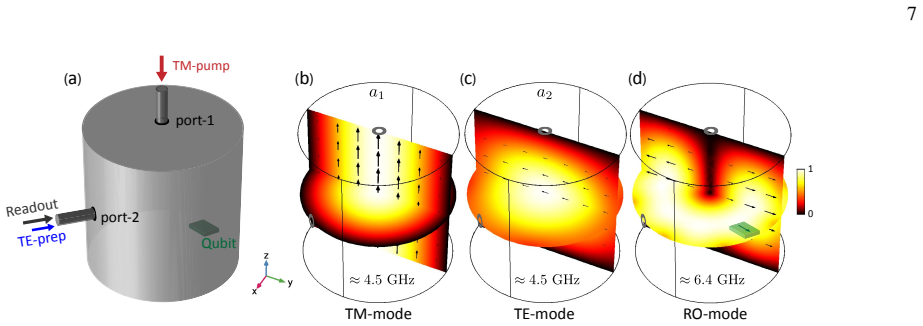
The load-bearing object is the effective Hamiltonian $H_{\nu\gamma}=\hbar\sum_{p,s,s'}(g_{\nu\gamma}/\omega_p)(\hat{q}\cdot\epsilon_s)(\hat{q}\cdot\epsilon_{s'})a^\dagger_s a_{s'}$, where $g_{\nu\gamma}=(\sqrt{2}/6\pi)\alpha G_F c\bar{F}_\nu$. It describes a neutrino beam acting as a birefringent medium that converts one photon polarization into the orthogonal one, with conversion rate $J=g_{\nu\gamma}/\tilde{\omega}_p$. The argument is carried by this Hamiltonian's proportionality to $(\hat{q}\cdot\epsilon)(\hat{q}\cdot\epsilon')$ and by the identity $H^M=2H^D$, which follows from the Majorana self-conjugacy condition and yields $\Delta V^M=2\Delta V^D$ in Stokes-parameter language. The experimental side is supported by the degenerate TE/TM mode pair in a cylindrical niobium cavity, the transmon qubit dispersively coupled to a readout mode, and the covariance-matrix solution of the two-mode Langevin equations that produces Eq. (36) for $g^{\min}_{\nu\gamma}$.
What would settle it
Directly evaluate Eq. (36) at $Q=10^{10}$, $P_1=1\,\mathrm{mW}$, and $\Omega/2\pi=4.5\,\mathrm{GHz}$, then compare the resulting $g_{\nu\gamma}^{\min}$ with the coupling $g_{\nu\gamma}\simeq10^{-5}\,\mathrm{Hz}^2$ that Eq. (28) gives for a $10^5\,\mathrm{GeV\,cm^{-2}s^{-1}}$ neutrino flux; if $g_{\nu\gamma}^{\min}$ is not near $10^{-6}\,\mathrm{Hz}^2$, the one-year resolution claim is falsified.
Extended reading notes
Core claim
The central discovery is a calculable, experiment-facing consequence of the Dirac/Majorana distinction: in forward photon-neutrino scattering, the one-loop effective interaction couples the two linear polarizations of a photon mode with coupling $g_{\nu\gamma}\simeq 10^{-11}\bar{F}_\nu$ (with $\bar{F}_\nu$ in GeV cm$^{-2}$ s$^{-1}$), and the Majorana Hamiltonian is exactly twice the Dirac Hamiltonian, $H^M_{\nu\gamma}=2H^D_{\nu\gamma}$. The paper argues that this factor of two survives in the rate at which microwave photons flip between orthogonal polarizations, so a measurement of the scattering rate is a direct inequality test. It then derives the minimum resolvable coupling $g^{\min}_{\nu\gamma}$ for a driven cavity and, taking state-of-the-art quality factors $Q=10^{10}$, a 1 mW pump at $\Omega/2\pi=4.5$ GHz, and existing neutrino fluxes, concludes that one year of integration reaches the factor-of-two threshold.
Load-bearing premise
The whole timeline rests on the assumption that a one-shot run can detect a coupling as small as $g_{\nu\gamma}^{\min}\simeq10^{-6}\,\mathrm{Hz}^2$ with a $Q=10^{10}$ cavity, a 1 mW pump, and a 4.5 GHz mode; if the real single-shot sensitivity is orders of magnitude worse, the claimed one-year and few-day timelines do not follow.
Editorial extensions
If this is right
- A null result at the predicted sensitivity would exclude the simple one-loop photon-neutrino forward-scattering Hamiltonian, or set bounds on the Dirac/Majorana coupling ratio.
- Working at lower microwave frequencies and higher cavity quality factors directly shortens the required integration time, since $g^{\min}_{\nu\gamma}$ scales with $\Omega$ and $1/\sqrt{Q}$.
- Because the observable is a factor-of-two ratio rather than an absolute rate, many systematic uncertainties common to the two polarization channels cancel.
- The same setup can be used as a neutrino detector: once calibrated, the polarization-scattering count measures the neutrino flux $\bar{F}_\nu$ entering the cavity.
Reading between the lines
- If the one-year estimate holds, this would be the first tabletop experiment that can constrain the neutrino's Dirac/Majorana nature, complementing neutrinoless double-beta decay searches without needing a tonne-scale detector.
- The factor of two is robust to many model details, so even a null result would give a quantitative limit on $g_{\nu\gamma}$ and on new neutrino electromagnetic couplings, not just on the Dirac/Majorana question.
- One immediate testable extension would be to repeat the same cavity measurement with different neutrino energies or different photon frequencies; if the effective coupling follows the $1/\omega$ and $\bar{F}_\nu$ scalings predicted here, the signal would move accordingly.
Editorial analysis
A structured set of objections, weighed in public.
Referee Report
Summary. This manuscript proposes a tabletop experiment to distinguish Dirac from Majorana neutrinos by measuring the polarization-flip rate of microwave photons in a high-Q cavity induced by forward scattering from a neutrino beam. The authors derive a one-loop effective Hamiltonian for photon-neutrino scattering, argue that the Majorana-induced scattering rate is twice the Dirac one, derive a single-shot sensitivity formula for the induced coupling, and support the design with finite-element simulations of cavity modes and a transmon readout. The central feasibility claim is that the factor-of-two difference can be resolved in about one year with current technology and in a few days with improved neutrino fluxes.
Significance. If the central claim were correct, the proposal would offer a genuinely new laboratory route to a longstanding question, complementing neutrinoless double-beta decay searches. The paper has real strengths: a concrete effective-Hamiltonian derivation, a specific cavity design with FEM mode profiles, use of a transmon for single-photon detection, and quantitative parameter estimates that are falsifiable. The factor-of-two amplitude relation also has independent support in the literature. Unfortunately, the feasibility estimate does not survive arithmetic checks against the paper's own equations, so the significance as a practical proposal is not established.
major comments (2)
- [§IV, Eq. (36)] The single-shot sensitivity formula contradicts the parameters used in Fig. 2 and the text. For P1=1 mW, Ω/2π=4.5 GHz, Q=10^10, and κ1=κ2=Ω/Q≈2.8 s^{-1}, Eq. (36) gives g_min^νγ ≈ 5 Hz^2, and the simplified N1≫1 form gives ≈1.8 Hz^2; these values are five to seven orders of magnitude above the quoted resolution threshold g_min^νγ≈10^{-6} Hz^2. Since repetition only improves the resolution as 1/√N_exp, reaching 10^{-6} Hz^2 from ~1.8 Hz^2 would require N_exp≈3×10^{12} repetitions and, at τ≈0.35 s per run, a total runtime of 10^4–10^5 years. This directly invalidates the one-year and few-days claims in the Abstract and Conclusion.
- [§III, after Eq. (28), and Fig. 2(b)] The required coupling threshold is stated inconsistently. Eq. (28) gives gνγ≈10^{-6} Hz^2 for Fν=10^5 GeV cm^{-2} s^{-1}, but the text immediately says the problem reduces to resolving gνγ≈10^{-5} Hz^2, while Fig. 2(b) is drawn with the former value. This ambiguity matters because the achievable resolution is compared with this threshold, and a wrong threshold changes the extracted runtime by an order of magnitude.
minor comments (5)
- [§II.B, Eq. (14)] The central factor-of-two relation T_M=2T_D is not derived self-containedly in the manuscript but is imported from conditions established in Refs. [14,15]; the dependence on prior results should be stated explicitly at the point of use.
- [§IV, Eq. (36)] The symbols κ1, κ2, and P1 are used before being defined; please define the cavity mode loss rates and the input pump power when they first appear.
- [§IV, Eq. (33)] The average pulse duration τ_las is mentioned in the text but does not appear in the displayed formula for ¯N1; clarify how ¯N1 depends on τ_las.
- [§V] The text says the qubit frequency is resonant with the TM cavity mode (ωq=Ω) yet also states that the transmon only couples to the TE and RO modes; this is confusing and should be corrected, presumably to resonance with the TE mode.
- [Figs. 2 and 3] The figures lack axis labels with units, and the color bar in Fig. 3 is unlabeled; also, the term 'scattering acceleration' is nonstandard and should be replaced or explicitly defined.
Circularity Check
No significant circularity: the Dirac/Majorana factor-of-two relation has independent support and the cavity sensitivity analysis is internally derived.
full rationale
The central claim that Majorana neutrinos scatter photon polarization twice as strongly as Dirac neutrinos is supported by the paper's symmetry analysis in Section II and by the external published work of Latimer (Ref. [14]); it is not merely a renaming of the authors' own earlier result. The one-loop effective Hamiltonian in Eq. (23) is cited to Ref. [9], whose authors overlap with the present paper, and the loop calculation is not displayed in detail; however, Eq. (22) is written out and the cited result is a published, parameter-free calculation, so this is a minor self-citation rather than a derivation that reduces to its own inputs. The cavity feasibility analysis in Section IV is internally derived from the Langevin equations and the designed FEM cavity in Section V is an independent engineering contribution. No fitted parameter is renamed as a prediction and no equation is equivalent to its input by construction. The apparent inconsistency between Eq. (36) and the asserted 10^-6 Hz^2 threshold is a numerical correctness risk, not a circularity, and therefore does not affect the circularity score.
Assumptions & free parameters
free parameters (3)
- Averaged neutrino momentum q
- Neutrino energy flux F_nu =
10^5 GeV cm^-2 s^-1
- Cavity quality factor Q =
10^10
assumptions (4)
- domain assumption The one-loop effective Hamiltonian, Eq. (23), is correct as taken from Ref. [9].
- domain assumption The Majorana scattering amplitude is twice the Dirac amplitude (H_M = 2 H_D).
- domain assumption The third term in Eq. (23) is negligible because omega_p/|q| << 1.
- domain assumption Thermal photon occupation is negligible (hbar omega >> k_B T).
Cite this review
Pith. "Pith review of Distinguishing Dirac from Majorana neutrinos in a microwave cavity." pith.science (2026). https://pith.science/paper/UAZ7ISZ7
@misc{pith2026190901536,
  author       = {Pith},
  title        = {Pith review of: Distinguishing Dirac from Majorana neutrinos in a microwave cavity},
  year         = {2026},
  howpublished = {\url{https://pith.science/paper/UAZ7ISZ7}},
  note         = {Machine review of arXiv:1909.01536}
}
read the original abstract
We propose a novel scheme for distinguishing between the Dirac and Majorana nature of neutrinos via interaction of a neutrino beam with microwave photons inside a cavity. We study the effective photon-photon polarization exchange induced by the photon-neutrino scattering. The quantum field theoretical studies of such effective picture are presented for both Dirac and Majorana neutrinos. Our phenomenological analyses show that the difference between Dirac and Majorana neutrinos can manifest itself in scattering rate of the photons. To enhance the effect a cavity scheme is employed. An experimental setup based on microwave cavities is then designed and simulated by finite element method to measure the scattering rate. Our results suggest that an experiment based on the current state-of-the-art technology will be able to probe the difference in about one year. However, it can be done in a few days by enhancing the neutrino beam flux or implementing with the near future equipments. Therefore, our work provides the possibility %puts the grounds for solving the long lasting puzzle of Dirac or Majorana nature of neutrinos.
Figures


Figures from the paper (1 more)

Reference graph
Works this paper leans on
-
[9]
Laser photons acquire circular polarization by interacting with a Dirac or Majorana neutrino beam,
R. Mohammadi and S. S. Xue, “Laser photons acquire circular polarization by interacting with a Dirac or Majorana neutrino beam,” Phys. Lett. B 731, 272 (2014)
work page 2014
-
[14]
Two-photon interactions with Majorana fermions,
D. C. Latimer, “Two-photon interactions with Majorana fermions,” Phys. Rev. D94, 093010 (2016)
work page 2016
-
[1]
Particle Data Group, Eur. Phys. J. C 3, 783 (1998)
work page 1998
-
[2]
Theory of the symmetry of electrons and positrons,
E. Majorana, “Theory of the symmetry of electrons and positrons,” Nuovo. Cim.14, 171184 (1937)
work page 1937
-
[3]
Electromagnetic properties of Majorana neutri- nos,
J. F. Nieves, “Electromagnetic properties of Majorana neutri- nos,” Phys. Rev. D26, 3152 (1982)
work page 1982
-
[4]
Electromagnetic Properties of Neutrinos,
C. Broggini, C. Giunti, and A. Studenikin, “Electromagnetic Properties of Neutrinos,” Adv. High Energy Phys.2012, 459526 (2012)
work page 2012
-
[5]
Left-Right Symmetry: from LHC to Neutrinoless Double Beta Decay,
V . Tello, M. Nemevsek, F. Nesti, G. Senjanovic, and F. Vissani, “Left-Right Symmetry: from LHC to Neutrinoless Double Beta Decay,” Phys. Rev. Lett.106, 151801 (2011); J. Schechter and J. W. F. Valle, “Neutrinoless Double beta Decay in SU(2)×U(1) Theories,” Phys. Rev. D25, 2951 (1982)
work page 2011
-
[6]
Neutrino pair emission off electrons in a strong electromagnetic wave field,
A. I. Titov, B. Kampfer, H. Takabe, and A. Hosaka, “Neutrino pair emission off electrons in a strong electromagnetic wave field,” Phys. Rev. D83, 053008 (2011)
work page 2011
Show all 28 references
-
[7]
Pair production with neutrinos and high- intensity laser fields,
T. M. Tinsley, “Pair production with neutrinos and high- intensity laser fields,” Phys. Rev. D71, 073010 (2005)
2005
-
[8]
Evidence for cosmic neutrino background form CMB circular polarization,
R. Mohammadi, “Evidence for cosmic neutrino background form CMB circular polarization,” Eur. Phys. J. C 74, 3102 (2014)
2014
-
[10]
Massive Neutrinos in Physics and Astrophysics
R. N. Mohapatra and P. B. Pal, “ Massive Neutrinos in Physics and Astrophysics ”, 3rd Edition, World Scientific (London, 2004)
2004
-
[11]
Ultra-high quality factors in su- perconducting niobium cavities in ambient magnetic fields up to 190 mG,
A. Romanenko, A. Grassellino, A. C. Crawford, D. A. Ser- gatskov, and O. Melnychuk, “Ultra-high quality factors in su- perconducting niobium cavities in ambient magnetic fields up to 190 mG,” App. Phys. Lett. 105, 234103 (2014)
2014
-
[12]
Quan- tum Electrodynamics,
V . B. Berestetskii, L. P. Pitaevskii, and E. M. Lifshitz, “Quan- tum Electrodynamics,” 2nd Edition: V olume 4 (Course of The- oretical Physics), Pergamon (New York, 1982)
1982
-
[13]
Dispersion Relations for Compton Scattering
R. E. Prange, “Dispersion Relations for Compton Scattering” Phys. Rev. 240, 110 (1958)
1958
-
[15]
CMB Circular and B-mode Polarization from New Interactions,
N. Bartolo, A. Hoseinpour, S. Matarrese, G. Orlando, and M. Zarei, “CMB Circular and B-mode Polarization from New Interactions,” arXiv:1903.04578 [hep-ph]
1903 arXiv
-
[16]
Massive neutrinos in Physics and Astrophysics
R. N. Mohapatra and P. B. Pal, “ Massive neutrinos in Physics and Astrophysics”, (World Scientific, 3rd edition, 2004)
2004
-
[17]
Fundamentals of Neutrino Physics and Astrophysics
C. Giunti and C. W. Kim, “ Fundamentals of Neutrino Physics and Astrophysics ” (Oxford University Press, Oxford, UK, 2007)
2007
-
[18]
Majorana neutrinos and other Majorana parti- cles: Theory and experiment,
E. Akhmedov, “Majorana neutrinos and other Majorana parti- cles: Theory and experiment,” arXiv:1412.3320 [hep-ph]
-
[19]
Quantum Field Theory
F. Mandl and G. Shaw, “ Quantum Field Theory ”, (John Wiley Sons, New York, 1986)
1986
-
[20]
Gaussian quantum infor- mation
C. Weedbrook, S. Pirandola, R. Garca-Patrn, N. J. Cerf, T. C. Ralph, J. H. Shapiro, and S. Lloyd, “Gaussian quantum infor- mation”, Rev. Mod. Phys.84, 621 (2012)
2012
-
[21]
Ultrahigh finesse 9 Fabry-Perot superconducting resonator,
S. Kuhr, S. Gleyzes, C. Guerlin, J. Bernu, U. B. Hoff, S. Deleglise, S. Osnaghi, M. Brune, J.-M. Raimond, S. Haroche, E. Jacques, P. Bosland, and B. Visentin, “Ultrahigh finesse 9 Fabry-Perot superconducting resonator,” App. Phys. Lett. 90, 164101 (2007)
2007
-
[22]
Measurement of a vacuum-induced geometric phase,
S. Gasparinetti, S. Berger, A. A. Abdumalikov, M. Pechal, S. Filipp, and A. J. Wallraff, “Measurement of a vacuum-induced geometric phase,” Sci. Adv.2, 1501732 (2016)
2016
-
[23]
Microma- chined Integrated Quantum Circuit Containing a Superconduct- ing Qubit,
T. Brecht, Y . Chu, C. Axline, W. Pfaff, J. Z. Blumoff, K. Chou, L. Krayzman, L. Frunzio, and R. J. Schoelkopf “Microma- chined Integrated Quantum Circuit Containing a Superconduct- ing Qubit,” Phys. Rev. App.7, 044018 (2017)
2017
-
[24]
Compact 3D quantum memory,
E. Xie, F. Deppe, M. Renger, D. Repp, P. Eder, M. Fischer, J. Goetz, S. Pogorzalek, K. G. Fedorov, A. Marx, and R. Gross, “Compact 3D quantum memory,” App. Phys. Lett.112, 202601 (2018)
2018
-
[25]
Resolving photon number states in a superconducting circuit
D. I. Schuster, A. A. Houck, J. A. Schreier, A. Wallraff, J. M. Gambetta, A. Blais, L. Frunzio, J. Majer, B. Johnson, M. H. Devoret, S. M. Girvin, and R. J. Schoelkopf “Resolving photon number states in a superconducting circuit.” Nature 445, 515 (2007)
2007
-
[26]
Rapid High-Fidelity Single-Shot Disper- sive Readout of Superconducting Qubits,
T. Walter, P. Kurpiers, S. Gasparinetti, P. Magnard, A. Potoc- nik, Y . Salathe, M. Pechal, M. Mondal, M. Oppliger, C. Eich- ler, and A. Wallraff, “Rapid High-Fidelity Single-Shot Disper- sive Readout of Superconducting Qubits,” Phys. Rev. App. 7, 054020 (2017)
2017
-
[27]
Light Sterile Neutrinos: A White Pa- per
K. N. Abazajian et al., “Light Sterile Neutrinos: A White Pa- per” arXiv:1204.5379 [hep-ph]
-
[28]
Hierarchy spectrum of SM fermions: from top quark to electron neutrino
S.-S. Xue, “Hierarchy spectrum of SM fermions: from top quark to electron neutrino”, JHEP 11, 072 (2016); “Vectorlike W-boson coupling at TeV and third family fermion masses”, Phys. Rev. D 93, 073001 (2016); “Neutrino masses and mix- ings”, Mod. Phys. Lett. A 14, 2701 (1999); ...
2016
Reviewed August 14, 2026 · model on record in the stance chip above.
Discussion (0). Continue with ORCID to comment.