REVIEW 3 major objections 4 minor 1 cited by
Longitudinal correlations from fluctuating strings in Pb-Pb, p-Pb, and p-p collisions
T0 review · 3 major / 4 minor · reviewed 2026-08-14 · deepseek-v4-flash
Pith's one-line read A semi-analytic string model with fluctuating endpoints reproduces the LHC data on rapidity spectra and two-particle correlations in Pb-Pb, p-Pb, and p-p collisions.
desk verdict A clear extension of the fluctuating-string model to LHC energies, with a genuine prediction for a11, but the uniform string-breaking kernel is assumed rather than tested, so the universality claim is conditional. read the letter →
The pith
A machine-rendered reading of the paper's core claim, the machinery that carries it, and where it could break.
The reading
What carries the argument
The central mechanism is the longitudinally extended string with two fluctuating endpoints, one attached to each wounded constituent. For a string breaking at spatial rapidity $y$, the emission is assumed uniform between endpoints $y_1$ and $y_2$, giving the one-body profile $f(y)=\omega\bigl(\tfrac12 - 2[G_1(y)-\tfrac12][G_2(y)-\tfrac12]\bigr)$. The same uniform breaking law builds the two-particle emission profile $f_2(y_1,y_2)=\omega^2\,G_1[\min(y_1,y_2)]\{1-G_2[\max(y_1,y_2)]\} + (1\leftrightarrow 2)$, from which the correlation function and its Legendre coefficients follow. The string endpoints are random, but the measured one-body spectra fix their cumulative distributions up to a two-parameter degeneracy; the two extreme solutions are the $g_1=g_2$ case and the disjoint case, and the data select the disjoint one.
What would settle it
Measure the two-particle correlation coefficient $a_{11}$ in the same systems over a substantially wider pseudorapidity window than the current $|\eta|<2.4$, or directly extract the shape of the two-particle emission profile $f_2$; a deviation from the model's prediction that grows with the rapidity span would indicate that the uniform string-breaking assumption is wrong.
Extended reading notes
Core claim
The central claim is that a semi-analytic model in which hadrons are emitted from longitudinally extended strings pulled by wounded constituents—with the string endpoints fluctuating in rapidity according to distributions $g_1$ and $g_2$—reproduces, with 4 or 5 constituent partons per nucleon, the LHC data on rapidity spectra in Pb-Pb and p-Pb at 5.02 TeV and the measured values of the correlation coefficient $a_{11}$ for Pb-Pb, p-Pb, and p-p. The one-body emission profile $f(y)$ is related to the endpoint cumulative distributions by $f(y)=\omega\bigl(\tfrac12 - 2[G_1(y)-\tfrac12][G_2(y)-\tfrac12]\bigr)$, so the measured spectra place bounds on the endpoint distributions; the measured correlations then select the disjoint limiting case, where the left-going and right-going endpoints live on opposite sides of the profile maximum. In that case the intrinsic string-emission correlations account for about 40% of $a_{11}$ in Pb-Pb and dominate in p-Pb.
Load-bearing premise
The argument assumes that a string breaks uniformly in rapidity between its two endpoints; if the true breaking is non-uniform, the endpoint distributions extracted from the one-particle spectra and the predicted $a_{11}$ would both change, so the comparison to data would not be a clean test of the string picture.
Editorial extensions
If this is right
- A single universal emission profile and endpoint distribution describe three different collision systems (Pb-Pb, p-Pb, p-p) with one set of parameters, so longitudinal correlations become a property of the string mechanism rather than of the specific nuclear size.
- The extracted endpoint distributions provide definite predictions for the two-particle correlation function in pseudorapidity windows beyond the current ATLAS coverage of $|\eta|<2.4$.
- The dominance of intrinsic string correlations in p-Pb (above 80% of $a_{11}$) means that in small systems the measured $a_{11}$ is a direct probe of the string-breaking mechanism, whereas in Pb-Pb source-number fluctuations contribute nearly as much.
- The absence of any need for shadowing or baryon stopping in reproducing the data suggests these effects play a minor role in the longitudinal correlations at LHC energies.
- The preference for 4 or 5 constituent partons per nucleon at LHC energies, compared with the earlier 3-constituent fit at RHIC energies, indicates an energy-dependent effective number of wounded partons.
Reading between the lines
- A direct extension would be to measure $a_{11}$ over a substantially wider rapidity window; the model's specific prediction for how the coefficient scales with the rapidity span would distinguish uniform from non-uniform string breaking.
- The same inversion of the one-body profile could be applied to three-particle or forward-multiplicity correlations, which would be more sensitive than $a_{11}$ to the shape of the string-breaking probability between endpoints.
- The energy-dependent optimal number of constituents, if confirmed by future energy scans, would suggest that the effective partonic resolution of a nucleon grows with collision energy, a testable consequence that goes beyond the present paper's stated scope.
Signed reviews
Editorial analysis
A structured set of objections, weighed in public.
Referee Report
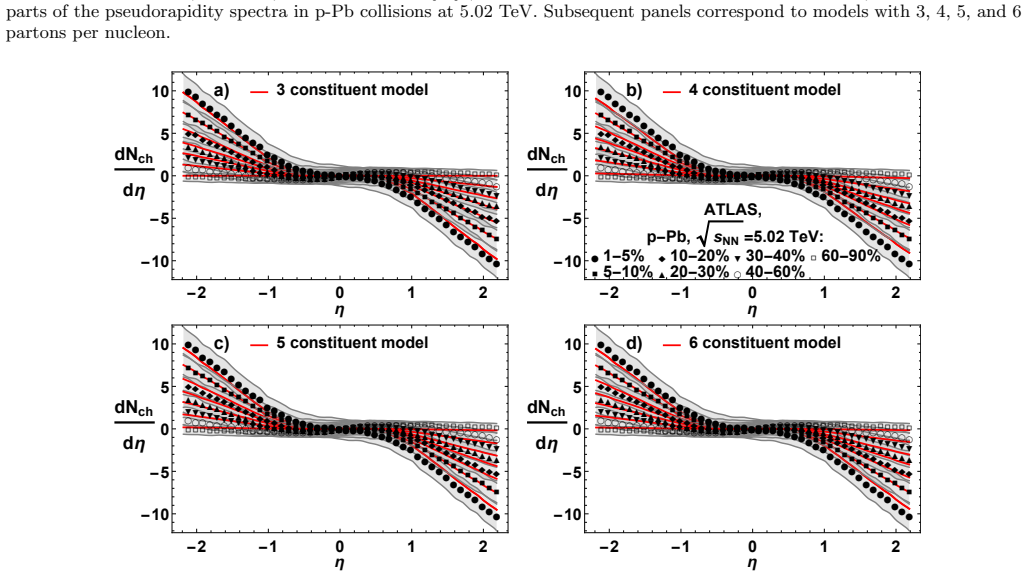
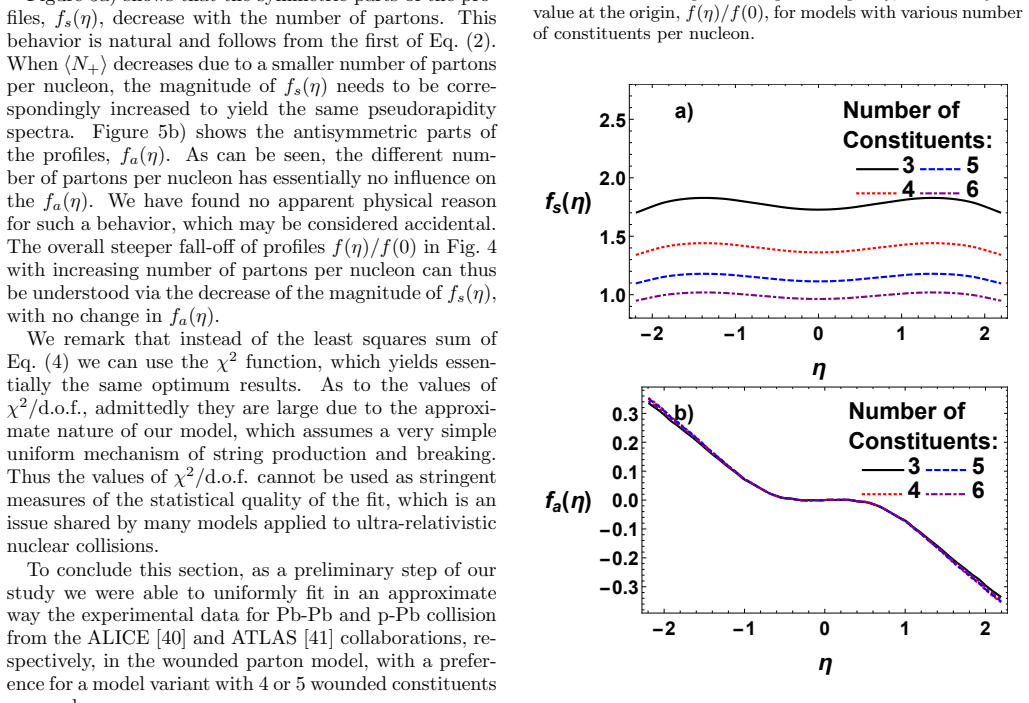
Summary. The paper extends a semi-analytic wounded-constituent string model from RHIC energies to LHC energies. The single-string emission profile f(η) is extracted point-by-point from a joint least-squares fit to Pb-Pb (ALICE) and p-Pb (ATLAS) pseudorapidity spectra at √sNN = 5.02 TeV, after generating wounded-parton numbers with GLISSANDO and overlaying a negative-binomial fluctuation. Passing from pseudorapidity to rapidity via an empirically estimated Jacobian, the authors assume uniform string breaking in rapidity and invert the one-body profile to obtain limiting endpoint distributions G1, G2 (the 'g1 = g2' and 'disjoint' cases). These are then used to compute two-particle correlations and the Legendre coefficient a11, which is compared with ATLAS data for Pb-Pb, p-Pb, and p-p collisions. The central claim, stated in Sec. VII, is that the model with 4 or 5 constituent partons per nucleon and disjoint endpoint distributions reasonably describes the data for all three systems.
Significance. If the central claim is correct, the paper provides a simple, almost analytic explanation of long-range longitudinal correlations at LHC energies in terms of fluctuating string endpoints, with no need for additional physics such as nuclear shadowing or baryon stopping. A genuine strength is that the two-particle correlations and a11 are not fitted to the correlation data; they are predicted from the endpoint distributions derived from the one-body spectra. The model is transparent and reproduces the order of magnitude and centrality trend of the ATLAS a11 data. However, the significance is limited by two unexamined assumptions: the uniform string-breaking kernel, which enters both the extraction of the endpoint distributions and the construction of the two-particle emission profile, and the comparison of a 5.02 TeV model with data at 2.76 TeV (Pb-Pb) and 13 TeV (p-p). The admitted large χ2 values also leave the quantitative goodness of fit unclear.
major comments (3)
- [Sec. IV, step 2; Eqs. (8) and (11)] The uniform string-breaking kernel s(y; y1, y2) is used twice: Eq. (8) inverts the fitted one-body profile f(y) to obtain the endpoint CDFs G1 and G2, and Eq. (11) builds the same-string two-particle emission profile with the same kernel. The predicted a11 is therefore a joint test of fluctuating endpoints together with this particular, uniform breaking law. If the true breaking rate is non-uniform (e.g., enhanced near the endpoints or peaked at the string center), both the extracted G1, G2 and the predicted a11 change, so the ATLAS comparison in Figs. 10 and 12 would not cleanly favor the disjoint endpoint scenario. The paper neither fits a shape parameter for the kernel nor checks the stability of a11 against reasonable alternative kernels. This is a load-bearing assumption for the central universality claim and should be addressed explicitly.
- [Secs. V and VI, Figs. 10 and 12] The model parameters (single-string profile f, negative-binomial parameter q, and the number of constituent partons) are determined at √sNN = 5.02 TeV from Pb-Pb and p-Pb spectra, but the ATLAS a11 data shown in Fig. 10 for Pb-Pb are at 2.76 TeV and those in Fig. 12 for p-p are at 13 TeV. The paper states that the energy mismatch is 'numerically not significant' without providing a quantitative argument. Since the number of constituent partons itself changes with collision energy (3 at RHIC, 4–5 at LHC), the energy dependence of the model parameters is apparently not negligible. The claimed universality across systems and energies would be much strengthened by comparing with data at matched energies or by demonstrating explicitly that the relevant predictions vary only weakly over the quoted energy range.
- [Sec. III, Table I and χ2 discussion] The goodness of fit is not quantitatively characterized. Table I lists the least-squares values L for the 3, 4, 5, and 6 constituent variants, but no number of fitted data points, no number of parameters per point, and no normalization are given, so the reader cannot judge whether L = 140 vs 137 is a meaningful difference. The text also concedes that χ2/d.o.f. values are 'large' and 'cannot be used as stringent measures.' This makes it difficult to assess the central claim that the model 'reasonably describes' the spectra. The authors should provide a more interpretable goodness-of-fit statistic, or at least state the number of fitted points and the typical size of experimental errors.
minor comments (4)
- [Footnote 1, Sec. III] The exclusion of the most central 1% p-Pb data from the fit is mentioned only in a footnote; this selection should be described and justified in the main text, because it could influence the extracted f(η) and hence the endpoint distributions.
- [Sec. IV, Eqs. (5)–(7)] The text says the Jacobian dη/dy is obtained from ALICE data for the 5% most central Pb-Pb collisions, but it is not stated whether this same Jacobian is applied to all systems (Pb-Pb, p-Pb, and p-p) and all centralities; the applicability of a single Jacobian to p-p and p-Pb should be clarified.
- [Sec. V, Eq. (11)] Equation (11) for the two-particle emission profile is taken from reference [1] without derivation; given that this is the main predictive object of the paper, a brief self-contained derivation or at least an intuitive explanation would improve readability.
- [Miscellaneous] Minor typographical issues: footnote 1 contains 'far of the optimal fit' (should be 'far from'); the text around Eq. (3) uses 'k(x;n,q)' with the negative-binomial notation and should clarify that x = 0 is removed.
Circularity Check
No circularity found: the two-particle correlation predictions are not fitted inputs; they are derived from spectra-fitted profiles and compared to independent ATLAS correlation data.
full rationale
The derivation chain is self-contained and falsifiable. The one-body emission profile f(eta) is explicitly obtained by least-squares fits to ALICE and ATLAS pseudorapidity spectra via Eqs. (1)-(4), with the negative-binomial parameter q also fitted to those spectra. The string-end-point CDFs G1 and G2 are then constrained through Eq. (8), under the clearly stated assumption of a uniform string-breaking kernel. The two-particle emission profile, Eq. (11), is not fitted to the correlation data; it follows from the same kernel and the extracted endpoint distributions, and the resulting a11 coefficients are compared with external ATLAS measurements. This comparison has genuine discriminating power: the g1=g2 case overestimates a11 by roughly a factor of 4, while the disjoint case agrees with data, so the two-body observable selects between the two extreme solutions rather than being forced by the one-body fit. The p-p analysis is a genuine out-of-sample test, as it uses the profile fitted to Pb-Pb and p-Pb spectra to predict correlations in p-p collisions at a different energy. The uniform-breaking assumption is an explicit modeling choice, not an input smuggled in from the correlation data; changing the kernel would change the inversion of Eq. (8), but that is a robustness or correctness concern, not circularity. Self-citations to [1] and [2] provide the method, but the method was previously tested against independent d-Au and Au-Au data at 200 GeV, and the present paper states and uses the equations directly rather than relying on an unverified uniqueness theorem.
Assumptions & free parameters
free parameters (3)
- negative binomial parameter q =
0.245, 0.905, 0.785, 0.805 for 3, 4, 5, 6 constituents per nucleon
- single-string emission profile f(eta) =
pointwise profile extracted from joint fit to ALICE Pb-Pb and ATLAS p-Pb pseudorapidity spectra at 5.02 TeV
- number of constituent partons per nucleon =
4 or 5 preferred; variants 3, 4, 5, 6 tested
assumptions (6)
- domain assumption The single-string emission profile f(eta) is universal across collision systems and centralities at a given energy (Eq. 1).
- domain assumption The number of strings equals the number of wounded constituent partons from the Glauber model.
- domain assumption String breaking probability is uniform in rapidity between the string endpoints (Sec. IV, step 2).
- domain assumption The two string endpoints are statistically independent, with distributions g1 and g2.
- domain assumption The rapidity-pseudorapidity conversion factorizes and is obtained from ALICE data for the 5% most central Pb-Pb collisions (Eq. 5).
- domain assumption The two-particle emission profile from a single string has the form f2(y1,y2) = omega^2 G1[min(y1,y2)]{1-G2[max(y1,y2)]} + (1<->2), Eq. (11).
Cite this review
Pith. "Pith review of Longitudinal correlations from fluctuating strings in Pb-Pb, p-Pb, and p-p collisions." pith.science (2026). https://pith.science/paper/BXCUQSE6
@misc{pith2026190901702,
  author       = {Pith},
  title        = {Pith review of: Longitudinal correlations from fluctuating strings in Pb-Pb, p-Pb, and p-p collisions},
  year         = {2026},
  howpublished = {\url{https://pith.science/paper/BXCUQSE6}},
  note         = {Machine review of arXiv:1909.01702}
}
read the original abstract
In a framework of a semi-analytic model with longitudinally extended strings of fluctuating end-points, we demonstrate that the rapidity spectra and two-particle correlations in collisions of Pb-Pb, p-Pb, and p-p at the energies of the Large Hadron Collider can be universally reproduced. In our approach, the strings are pulled by wounded constituents appearing in the Glauber modeling at the partonic level. The obtained rapidity profile for the emission of hadrons from a string yields bounds for the distributions of the end-point fluctuations. Then, limits for the two-particle-correlations in pseudorapidity can be obtained. Our results are favorably compared to recent experimental data from the ATLAS Collaboration.
Figures


Figures from the paper (9 more)



Forward citations
Cited by 1 Pith paper
-
Wounded parton scaling of multiplicities in ultra-relativistic light- and heavy-ion collisions
With four partons per nucleon and one shared entropy-to-multiplicity scale, a wounded-parton Glauber model with negative-binomial fluctuations fits O+O, Ne+Ne, Xe+Xe, and Pb+Pb multiplicity distributions from 1–80% ce...
Reference graph
Works this paper leans on
-
[1]
Choose the variant of the model by deciding on the number of partons per nucleon
-
[2]
GLISSANDO 3 is run to generate event samples with the number of wounded sourcesnA andnB for both the p-Pb and Pb-Pb collisions
-
[3]
For a given value of q samples with string numbers NA and NB are obtained by overlaying a negative binomial distribution according to Eq. (3)
-
[4]
The samples for p-Pb and Pb-Pb are then divided into centrality classes according to the values of N+
-
[5]
The values of ⟨NA⟩ and ⟨NB⟩ in all centrality classes are used to construct the least squares fit of the profiles f(η) to the experimental pseudora- pidity spectra dNch/dη from Eq. (1)
-
[6]
The result is the optimum profile f(η)
Steps 3-5 are repeated to obtain the optimum value ofq, corresponding to a global minimum of the least square function. The result is the optimum profile f(η). In the fitting procedure, the symmetric part of the profile, fs(η), is sensitive to both the Pb-Pb and p-Pb data, whereas the the antisymmetric part,fa(η), depends only on the (asymmetric) p-Pb collis...
work page 2000
-
[7]
Each of the NA and NB wounded sources is asso- ciated to a longitudinally extended string
-
[8]
A string breaking at spatial rapidity y corresponds to a particle emission at rapidity y. The corre- sponding probability distribution for string break- ing, s(y;y1,y 2), is uniform between the end-points y1 and y2, namely s(y;y1,y 2) = ω(θ(y1 < y < y2) + θ(y2 < y < y1)), where ω is a normaliza- tion constant and the function θ equals 1 wherever the condi...
Show all 57 references
-
[9]
The correspond- ing cumulative distribution functions (CDFs) are denoted as G1(y1) and G2(y2)
String-end points y1 and y2 follow distributions g1(y1) and g2(y2), respectively. The correspond- ing cumulative distribution functions (CDFs) are denoted as G1(y1) and G2(y2). Then, the one-body emission profile f(y) can be writ- ten as [1] f(y) = ∫ ∞ −∞ dy1 ∫ ∞ −∞ dy2g1(y1)g2...
-
[10]
g1 = g2
f(y0) = ω/2: In that case the string-end-point distributions g1(y) and g2(y) for both ends of the strings are identical. We label this case as “ g1 = g2”. Of course, in this case also G1(y) =G2(y)
-
[11]
disjoint case
f(y0) =ω: In this case, the supports for the string- end-point distributions g1(y) and g2(y) in rapid- ity are disjoint, hence we refer to this case as the “disjoint case”. The distribution of the left end- point, g1, has support for y≤y0, whereas the dis- tribution of the rig...
-
[12]
This ratio is plotted in Fig
Then the ratio a∗ 11/a11 is a measure of the intrinsic correlations compared to the total. This ratio is plotted in Fig. 11 for the models with 4 and 5 constituents as a function of the number of produced charged particles Nch, both p-Pb and Pb-Pb collisions. As can be seen, f...
2015
-
[13]
Rohrmoser and W
M. Rohrmoser and W. Broniowski, Phys. Rev. C99, 024904 (2019)
2019
-
[14]
Broniowski and P
W. Broniowski and P. Bo˙ zek, Phys. Rev. C93, 064910 (2016)
2016
-
[15]
Andersson, G
B. Andersson, G. Gustafson, G. Ingelman, and T. Sjos- trand, Phys. Rept. 97, 31 (1983)
1983
-
[16]
Wang and M
X.-N. Wang and M. Gyulassy, Phys. Rev. D44, 3501 (1991)
1991
-
[17]
Z.-W. Lin, C. M. Ko, B.-A. Li, B. Zhang, and S. Pal, Phys. Rev. C72, 064901 (2005)
2005
-
[18]
Sj¨ ostrand, S
T. Sj¨ ostrand, S. Ask, J. R. Christiansen, R. Corke, N. De- sai, P. Ilten, S. Mrenna, S. Prestel, C. O. Rasmussen, and P. Z. Skands, Comput. Phys. Commun. 191, 159 (2015)
2015
-
[19]
Bierlich, G
C. Bierlich, G. Gustafson, L. L¨ onnblad, and H. Shah, JHEP 10, 134 (2018)
2018
-
[20]
Ferreres-Sol´ e and T
S. Ferreres-Sol´ e and T. Sj¨ ostrand, Eur. Phys. J.C78, 983 (2018)
2018
-
[21]
Capella, U
A. Capella, U. Sukhatme, C.-I. Tan, and J. Tran Thanh Van, Phys. Rept. 236, 225 (1994)
1994
-
[22]
Werner, I
K. Werner, I. Karpenko, T. Pierog, M. Bleicher, and K. Mikhailov, Phys. Rev. C82, 044904 (2010)
2010
-
[23]
Pierog, I
T. Pierog, I. Karpenko, J. Katzy, E. Yatsenko, and K. Werner(2013), arXiv:1306.0121 [hep-ph]
2013 arXiv
-
[24]
Bia las, M
A. Bia las, M. B leszy´ nski, and W. Czy˙ z, Nucl. Phys. B111, 461 (1976)
1976
-
[25]
R. J. Glauber in Lectures in Theoretical Physics, W. E. Brittin and L. G. Dunham eds., (Interscience, New York,
-
[26]
Czy˙ z and L
W. Czy˙ z and L. C. Maximon, Annals Phys.52, 59 (1969)
1969
-
[27]
Bia las, W
A. Bia las, W. Czy˙ z, and W. Furma´ nski, Acta Phys. Polon. B8, 585 (1977)
1977
-
[28]
Bia las, K
A. Bia las, K. Fia lkowski, W. S lomi´ nski, and M. Zieli´ nski, Acta Phys. Polon. B8, 855 (1977)
1977
-
[29]
Bia las and W
A. Bia las and W. Czy˙ z, Acta Phys. Polon. B10, 831 (1979)
1979
-
[30]
V. V. Anisovich, Yu. M. Shabelski, and V. M. Shekhter, Nucl. Phys. B133, 477 (1978)
1978
-
[31]
Eremin and S
S. Eremin and S. Voloshin, Phys. Rev. C67, 064905 (2003)
2003
-
[32]
P. K. Netrakanti and B. Mohanty, Phys. Rev. C70, 027901 (2004)
2004
-
[33]
Bia las and A
A. Bia las and A. Bzdak, Phys. Lett. B649, 263 (2007)
2007
-
[34]
Bia las and A
A. Bia las and A. Bzdak, Phys. Rev. C77, 034908 (2008)
2008
-
[35]
Alver, M
B. Alver, M. Baker, C. Loizides, and P. Steinberg(2008), arXiv:0805.4411 [nucl-ex]
2008 arXiv
-
[36]
Agakishiev et al
G. Agakishiev et al. (STAR), Phys. Rev. C86, 014904 (2012)
2012
-
[37]
S. S. Adler et al. (PHENIX), Phys. Rev. C89, 044905 (2014)
2014
-
[38]
P. S. C. Loizides, J. Nagle, SoftwareX 1-2, 13 (2015)
2015
-
[39]
Adare et al
A. Adare et al. (PHENIX), Phys. Rev. C93, 024901 (2016)
2016
-
[40]
R. A. Lacey, P. Liu, N. Magdy, M. Csan´ ad, B. Schweid, N. N. Ajitanand, J. Alexander, and R. Pak(2016), 11 arXiv:1601.06001 [nucl-ex]
2016 arXiv
-
[41]
Bo˙ zek, W
P. Bo˙ zek, W. Broniowski, and M. Rybczy´ nski, Phys. Rev. C94, 014902 (2016)
2016
-
[42]
Zheng and Z
L. Zheng and Z. Yin, Eur. Phys. J. A52, 45 (2016)
2016
-
[43]
E. K. G. Sarkisyan, A. N. Mishra, R. Sahoo, and A. S. Sakharov, Phys. Rev. D94, 011501(R) (2016)
2016
-
[44]
J. T. Mitchell, D. V. Perepelitsa, M. J. Tannenbaum, and P. W. Stankus, Phys. Rev. C93, 054910 (2016)
2016
-
[45]
O. S. K. Chaturvedi, P. K. Srivastava, A. Kumar, and B. K. Singh, Eur. Phys. J. Plus 131, 438 (2016)
2016
-
[46]
Loizides, Phys
C. Loizides, Phys. Rev. C94, 024914 (2016)
2016
-
[47]
M. J. Tannenbaum, Mod. Phys. Lett. A33, 1830001 (2017)
2017
-
[48]
Barej, A
M. Barej, A. Bzdak, and P. Gutowski, Phys. Rev. C97, 034901 (2018)
2018
- [49]
-
[50]
Bia las and W
A. Bia las and W. Czy˙ z, Acta Phys. Polon. B36, 905 (2005)
2005
-
[51]
Bo˙ zek, W
P. Bo˙ zek, W. Broniowski, M. Rybczy´ nski, and G. Ste- fanek, Comput. Phys. Commun. 245, 106850 (2019)
2019
-
[52]
Adam et al
J. Adam et al. (ALICE), Phys. Lett. B772, 567 (2017)
2017
-
[53]
Aad et al
G. Aad et al. (ATLAS), Eur. Phys. J. C76, 199 (2016)
2016
-
[54]
B. B. Back et al. (PHOBOS), Phys. Rev. C65, 031901 (2002)
2002
-
[55]
Adam et al
J. Adam et al. (ALICE), Phys. Rev. C91, 064905 (2015)
2015
-
[56]
Bzdak and D
A. Bzdak and D. Teaney, Phys.Rev. C87, 024906 (2013)
2013
-
[57]
Aaboud et al
M. Aaboud et al. (ATLAS), Phys. Rev. C95, 064914 (2017)
2017
Reviewed August 14, 2026 · model on record in the stance chip above.
Discussion (0). Continue with ORCID to comment.