REVIEW 3 major objections 5 minor 1 cited by
Scattering of compact oscillons
T0 review · 3 major / 5 minor · reviewed 2026-08-14 · deepseek-v4-flash
Pith's one-line read Head-on collisions of signum-Gordon oscillons can scatter with almost no radiation, and what radiation remains is a self-similar cascade of smaller oscillons.
desk verdict Solid numerical mapping of two-oscillon scattering with a genuinely new exact construction; the fractal-like radiation claim is an honest but under-supported conjecture. read the letter →
The pith
A machine-rendered reading of the paper's core claim, the machinery that carries it, and where it could break.
The reading
What carries the argument
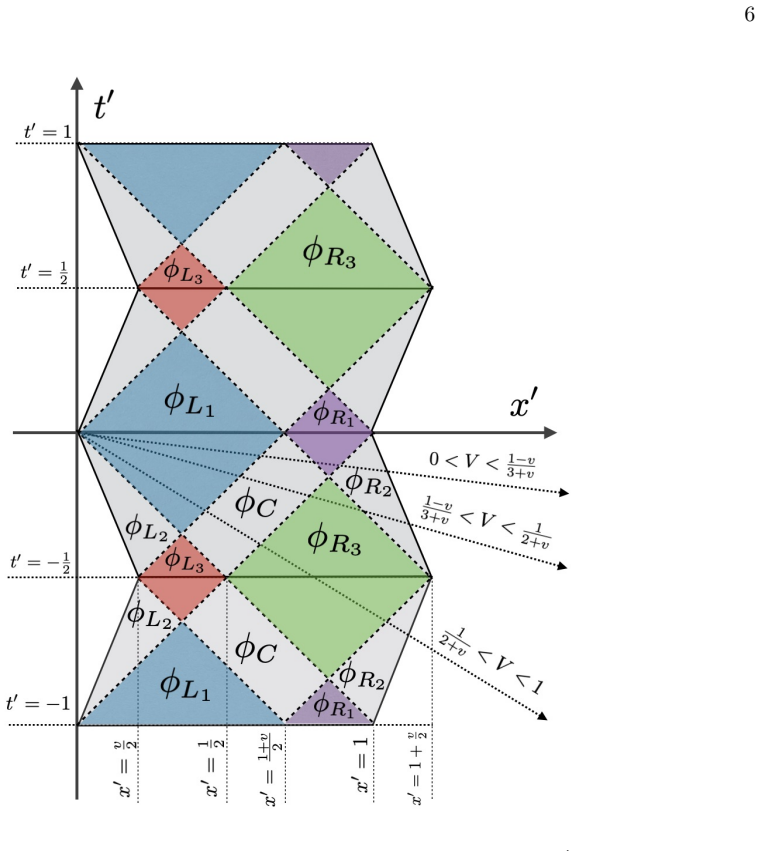
The argument is carried by the exact scaling symmetry of the signum-Gordon equation, $\varphi^{(\lambda)}(t,x)=\lambda^2\varphi(t/\lambda,x/\lambda)$, together with Lorentz covariance and the notion of an oscillon's phase $\alpha$. The scaling symmetry guarantees that exact oscillon solutions exist with arbitrarily small size and energy (energy scales as $\lambda^3$), so any perturbed oscillon can shed energy by emitting smaller oscillons, and a scattering diagram can in principle repeat itself at every scale; this underpins the fractal conjecture. The phase $\alpha$ determines the shape of each incoming oscillon at the moment its support touches the other, and the paper shows that the no-radiation choices lie on curves in $(\alpha,V)$ space, with the special phase shift $\Delta\alpha=1/2$ relating configurations by a global sign flip in the $v=0$ case. Comparison with the exact shock-wave solutions whose zeros lie on hyperbolas $x_k(t)=\pm\sqrt{t^2-4a_k}$ is what identifies the diamond-shaped structures seen in high-velocity collisions.
What would settle it
Run the same symmetric collision (for instance V=0.93, v=0, alpha=0.414) at grid spacings differing by a factor of two and measure both the radiated-energy fraction and the number of resolved oscillon structures in the central cascade; if the near-zero radiation window shifts or the small-scale structures appear or disappear, the fractal and clean-scattering claims as stated fail.
Extended reading notes
Core claim
The core claim, stated on the paper's own terms, is that the radiation emitted by the signum-Gordon model is dominated by oscillons and has a fractal-like nature. In symmetric collisions of two exact compact oscillons, the interaction temporarily shrinks the support to a minimal size and then produces two main outgoing quasi-oscillons; the intervening radiation appears as cascades of smaller oscillons, and repeated blow-ups of the spacetime diagram show similar oscillating structures at successively smaller scales. For velocities roughly above V~0.7 the outgoing quasi-oscillons are regular, and the cascade can be made essentially to vanish by fine-tuning the initial phase alpha (and the border velocity parameter v), yielding almost radiation-free scattering in a non-integrable model. The paper also identifies intermediate shock-wave-like structures that decay into the oscillon cascade. Thus the paper asserts that the signum-Gordon model possesses both clean scattering windows and a self-similar, scale-repeating radiation mechanism.
Load-bearing premise
The load-bearing premise is that the finite-difference fourth-order time-integration grid faithfully resolves the continuum evolution at the smallest scales, a premise the paper itself flags as delicate because halving or doubling the number of grid points can make tiny structures appear or disappear and the low-velocity no-radiation void could be an artefact.
Editorial extensions
If this is right
- If the fractal picture is right, then the signum-Gordon model's radiation is not a continuous spray of small waves but a discrete hierarchy: outgoing energy is carried by nested generations of smaller compact oscillons.
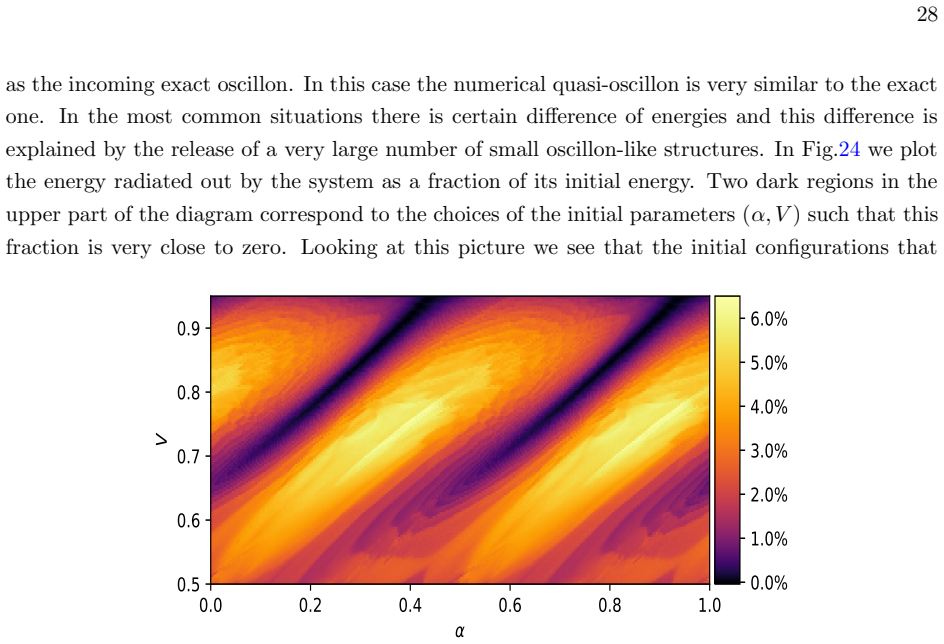
- The near-zero-radiation windows mean a non-integrable model can exhibit integrable-like scattering; two exact oscillons can pass through each other leaving almost nothing behind when V and alpha are tuned.
- The decay of the intermediate shock-wave-like structures into oscillon cascades gives a concrete production channel for quasi-oscillons, and connects the diamond-shaped wave seen in the simulations to the known exact shock solutions.
- Because the exact generalized oscillons with non-uniformly moving borders match the outgoing objects, collisions generically convert one class of exact compact oscillons into a broader class with curved, accelerating borders.
- The radiation-free conditions being achievable with nonzero border velocity v (with four equivalent initial configurations instead of two) widens the family of initial states that scatter cleanly.
Reading between the lines
- One consequence the authors leave implicit: if the cascade is truly self-similar, counting collisions or oscillon-like structures in successive blow-ups should follow a power law (for example, numbers growing by a fixed factor per zoom), which could be tested in the existing high-resolution data.
- The same scaling argument predicts that the emitted energy spectrum should be scale-free; measurements of the radiated energy fraction at several zoom levels could distinguish true self-similarity from a finite-resolution artefact.
- The near-absence of radiation at fine-tuned phases resembles resonance conditions in integrable scattering; a natural extension is to search for an effective conserved quantity that selects those phases, using the zero-line matching conditions as a starting point.
- If the low-velocity no-radiation void is physical rather than numerical, it suggests a velocity threshold near V~0.7 below which the outgoing oscillons reabsorb the radiation, a behaviour the paper notes but does not resolve.
Editorial analysis
A structured set of objections, weighed in public.
Referee Report
Summary. The paper studies collisions of exact compact oscillons in the (1+1)-dimensional signum-Gordon model. After constructing traveling oscillons by Lorentz-boosting known generalized oscillons and parametrizing symmetric/antisymmetric two-oscillon initial data by a phase α, the authors perform extensive numerical scattering simulations as functions of boost V, border speed v, and phase. They report that collisions generically produce two outgoing quasi-oscillons plus jets/cascades of smaller oscillon-like objects; that for fine-tuned high-velocity initial data the cascades nearly vanish, giving clean scattering windows reminiscent of integrable models; that intermediate stages sometimes contain shock-wave-like structures matching exact shock-wave zero hyperbolas; that outgoing oscillons generically have curved (accelerating) borders, for which an exact class with uniformly accelerated borders is constructed; and that high-resolution zooms suggest a fractal-like self-similar structure of the radiation. The paper is candid about numerical limitations in Appendices A and B.
Significance. If the numerical claims hold, the paper offers a striking phenomenology: exact compact oscillons in a non-integrable model can scatter almost elastically, the radiation is dominated by oscillon-like objects at multiple scales, and the model's exact scaling symmetry provides a natural mechanism for self-similar cascades. The analytic constructions—Lorentz-boosted oscillons, endpoint formulas x0(α), shock-wave matching, and accelerated-border oscillons—are internally consistent and constitute a useful contribution independent of the numerics. The paper's honest acknowledgment of resolution sensitivity is a strength, but the headline fractal claim is not yet quantitatively established; as presented it is a conjecture supported mainly by visual zooms.
major comments (3)
- [Section III F and Appendix B] The fractal-like-radiation claim rests on the smallest resolved structures in Fig. 38, yet Appendix B states that changing the number of grid points by a factor of two can make tiny structures appear or disappear and that only larger structures are stable. No grid-convergence study, no quantitative scaling exponent, and no comparison of blow-ups at two independent resolutions is provided; the dilation symmetry (III.53) proves the existence of exact oscillons at every scale but not that the numerically generated cascade is scale-invariant. Please provide a convergence test (e.g., compare N=2^19 and N=2^20 for the same run, quantify L1 differences and the counts/amplitudes of nested oscillons in the zoomed region), or explicitly state in the abstract and conclusions that the fractal nature is an unresolved conjecture.
- [Section III C 3 and Section III D (Figs. 24, 30, 32, 33, 34)] The no-radiation windows and the low-V no-radiation void are produced from lower-resolution scans with N=2^12, without error bars, without a stated definition of Erad, and without a description of how EL and ER are assigned to outgoing oscillons. The text itself says in Section III C 3 that outgoing-oscillon energies are less reliable for small V and in Section III D that the low-V void "could well be a numerical artefact." Because the existence of clean scattering windows is a central claim, please recompute representative strips of the parameter maps at N=2^15 or higher, show that Erad/E converges, and specify the radiation-extraction procedure.
- [Appendix A] The numerical method is standard RK4 applied to a second-order system with a discontinuous sgn(φ) term, but no convergence-order test, energy conservation monitor, or treatment of the sign discontinuity is reported. Given that the model has compact supports and shock-like structures, the continuum limit of the discretization is not automatic. Please add at least one quantitative convergence check (e.g., a scattering run at N=2^15 and N=2^16 with fixed Δt/Δx, reporting pointwise differences and energy drift over the simulation time) and discuss how the sgn(0)=0 convention is implemented in the discrete update.
minor comments (5)
- [Throughout] Numerous typos and grammatical slips remain, e.g., "quase-integravel" in the abstract, "intarval" near Eq. (II.7), "potentails" in the Introduction, "deatil" in Section III B, "decaysed" in Section IV, "in stability" and "the details of the details" in Appendix B. A careful language edit is needed.
- [Figure 33 caption] The caption says the plot is made "while holding fixed the right input oscillon's phase αR = 0," but the text says αL is fixed and αR is varied; the caption should read αL = 0.
- [Sections III C 3 and III D] The quantity Erad/E is never defined by an equation. Please state how the radiation energy is computed and how the outgoing oscillon energies EL and ER are separated from radiation.
- [Figure 38] The amplitude scales in the blow-ups (down to about 3×10^-5) should be stated in the caption together with the grid resolution used, so the reader can judge the smallest scales against the discretization error.
- [Section III C 1, Eq. (III.14)] The derivation of ts and Δxmin assumes the border moves freely until it hits the future light cone; the paper should state that this is a kinematic estimate and quantify the agreement in Fig. 19, where no deviations between the dots and the curves are discussed.
Circularity Check
No significant circularity: scattering outcomes are generated by numerical evolution of exact solutions; fits and self-citations are explicit and not load-bearing.
full rationale
The paper's central results are numerical scattering outcomes starting from exact compact oscillon solutions of the signum-Gordon equation, and those outcomes are not encoded in the inputs by construction. The exact oscillons used as initial data come from prior work [25,26,27], and they are independent exact solutions, not objects defined in terms of the scattering results. The no-radiation windows are found by scanning the velocity and phase parameters (e.g., Figs. 24, 30, 32, 33), not imposed; the special role of phases differing by 1/2 for v = 0 is explained by the derived relation that such a shift changes the field by a sign, which is a symmetry property, not a circular input. The shock-wave comparison in Section III C 2 fits the free parameter a0 and time shift T0 to numerical zero positions and then checks the remaining zeros against the exact shock-wave recurrence; this is an explicit hypothesis test with two fitted parameters and additional non-fitted zeros, not a prediction fabricated from the conclusion. The fractal-like radiation claim is explicitly labeled a conjecture in Section III F ('This statement still has a status of a conjecture'), and its supporting facts are the exact dilation symmetry (III.53), which is an independent mathematical property of the model, and visual blow-ups of nested numerical structures; the dilation symmetry guarantees existence of exact oscillons at arbitrarily small scales but is not used as the definition of the observed radiation. Self-citations to [25,26,27,35,38] provide exact solutions and prior numerics; none of these citations assumes the target claim that scattering radiation is fractal-like. The numerical-resolution caveat in Appendix B ('changing the number of points by a factor of two resulted in the appearance or even disappearance of some tiny structures') is a correctness risk about small-scale reliability, not a circularity, because the claim is not derived from the finite-difference scheme nor from a fitted parameter. Accordingly, no step in the paper's derivation chain reduces, by its own equations or by self-citation, to its own inputs.
Assumptions & free parameters
free parameters (3)
- a0 (shock-wave zero scale) =
0.00541
- T0 (time offset of shock-wave formation) =
0.282
- No-radiation phase pairs (per V and v) =
e.g., alpha=0.414 and 0.914 for V=0.93, v=0
assumptions (4)
- domain assumption The Euler-Lagrange equation with sgn(phi), with sgn(0)=0, defines a well-posed initial value problem on which the RK4 discretization converges.
- standard math Partial solutions (I.3) can be patched across sign boundaries into global continuous solutions; delta contributions from step-function boundaries are ignored because the sum is continuous (II.10).
- standard math Lorentz covariance and scaling symmetry (III.53) hold and are used to build traveling oscillons and to argue for fractal-like radiation.
- domain assumption The estimate of the collision time ts assumes the oscillon borders move freely with constant velocity until they hit the future light cone of the collision event (III.14), (III.19).
Cite this review
Pith. "Pith review of Scattering of compact oscillons." pith.science (2026). https://pith.science/paper/7II5BFEN
@misc{pith2026190901992,
  author       = {Pith},
  title        = {Pith review of: Scattering of compact oscillons},
  year         = {2026},
  howpublished = {\url{https://pith.science/paper/7II5BFEN}},
  note         = {Machine review of arXiv:1909.01992}
}
read the original abstract
We study various aspects of the scattering of generalized compact oscillons in the signum-Gordon model in (1+1) dimensions. Using covariance of the model we construct traveling oscillons and study their interactions and the dependence of these interactions on the oscillons initial velocities and their relative phases. The scattering processes transform the two incoming oscillons into two outgoing ones and lead to the generation of extra oscillons which appear in the form of jet-like cascades. Such cascades vanish for some values of free parameters and the scattering processes, even though our model is non-integrable, resemble typical scattering processes normally observed for integrable or quase-integrable models. Occasionally, in the intermediate stage of the process, we have seen the emission of shock waves and we have noticed that, in general, outgoing oscillons have been more involved in their emission than the initial ones i.e. they have a border in form of curved world-lines. The results of our studies of the scattering of oscillons suggest that the radiation of the signum-Gordon model has a fractal-like nature.
Figures


Figures from the paper (35 more)






Forward citations
Cited by 1 Pith paper
-
Inflaton Self Resonance, Oscillons, and Gravitational Waves in Small Field Polynomial Inflation
For sufficiently small phi0 (below about 0.02 mPl), the inflaton condensate in this polynomial model fragments into long-lived oscillons, producing MHz-GHz gravitational waves and possibly seeding light primordial bla...
Reference graph
Works this paper leans on
-
[1]
For better transparency we present first only the cases with v = 0
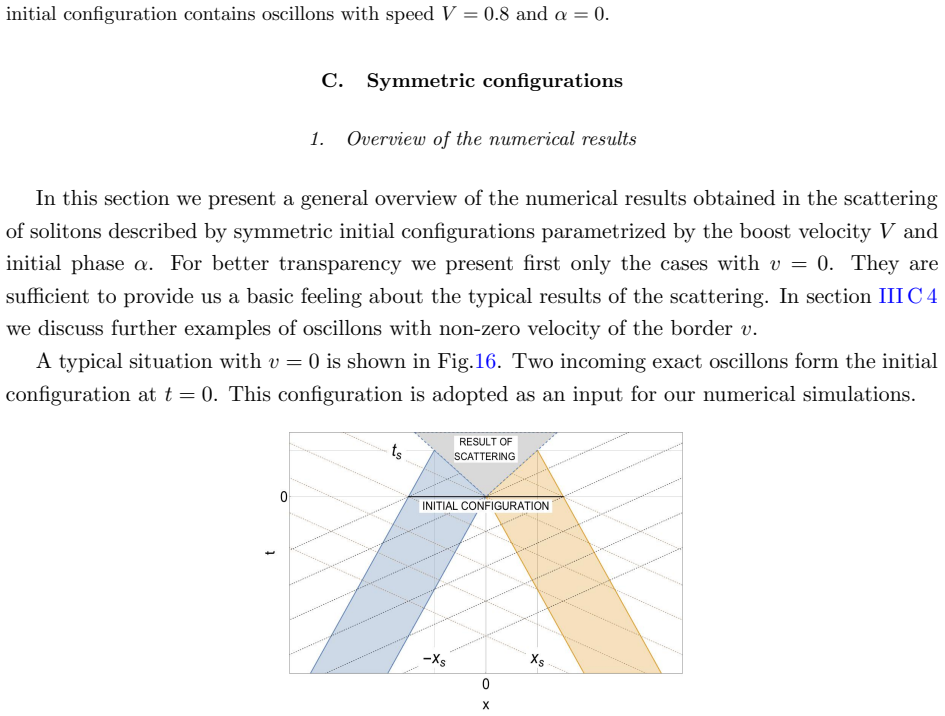
Overview of the numerical results In this section we present a general overview of the numerical results obtained in the scattering of solitons described by symmetric initial configurations parametrized by the boost velocity V and initial phase α. For better transparency we present first only the cases with v = 0. They are sufficient to provide us a basic fee...
-
[2]
Symmetric configurations A numerical study of the scattering process shows that the process depends on many parameters likev1,v2, the relative velocity of the oscillons, their initial distance, time shift and reflections. In order to simplify the set of parameters we have decided to restrict our considerations to symmetric and anti-symmetric initial configur...
-
[3]
Phase of the oscillon Unlike for the case of compact kinks, the scattering process of two oscillons depends on the initial distance between them. This observation follows from the fact that the shape of the oscillons changes with time and the outcome of the scattering process depends strongly 3 on the shapes of oscillons at the moment when their supports ...
-
[4]
Determination of the endpoints x(α) and ˜x(α) of a oscillon We start with the determination of the function x0(α) which describes the position of the right endpoint of the oscillon. To obtain it is sufficient to restrict considerations to v≥ 0 because any non-travelling oscillon satisfies relation φ(t,x ;−v) = φ(t, 1−x). So we shall consider here the boosts ...
-
[5]
( A) (−1, 0) for t′∈ (− 1 2, 0) ( B) (1, 0) for t′∈ (0, 1
-
[6]
( C) (−1, 1) for t′∈ ( 1 2, 1) ( D) (1,−1) for t′∈ (1, 3
-
[7]
There are two different cases dependent on the absolute value of the boost velocity V =|u|
( E) (−1, 2) for t′∈ ( 3 2, 2) ( F ) . There are two different cases dependent on the absolute value of the boost velocity V =|u|. They are separated by the critical case for which the velocity has value Vc≡ 1 2 +v. The straight line y(t′,α ) crosses maxima of τ(t′) i.e. τ(t′ max) = 1 2 at t′ max ={− 1 2, 1 2} for u = +V and at t′ max ={ 1 2, 1} in the cas...
-
[8]
In the case of oscillons with|u| < van additional caution is necessary
Remarks on the initial configurations Having determined the expressions for x0(α) and ˜x0(α) we can now construct arbitrary initial configurations containg generalized exact oscillons which begin to collide at t = 0. In the case of oscillons with|u| < van additional caution is necessary. In Fig.11 we present the worldsheets of two generalized exact oscillon...
Show all 59 references
-
[9]
First we note that for small velocities the numerical solution is very irregular
High velocities - formation of shock waves Next we discuss in more detail some of our numerical results. First we note that for small velocities the numerical solution is very irregular. Looking at figures Fig.17(a)-(c) we clearly see a formation of a strongly perturbed oscillo...
-
[10]
Namely, some symmetric initial configurations evolve in such a way that the resulting field contains only the main quasi- oscillons i.e
Vanishing of the radiation In our numerical studies we have also spotted a very interesting case. Namely, some symmetric initial configurations evolve in such a way that the resulting field contains only the main quasi- oscillons i.e. the amount of radiation generated in this pr...
-
[11]
Moreover, it can also be checked that both initial configurations characterized by phases α and α + 1 2 differ only by the sign i.e
In particular, this shows that the incoming zeros x(0)(t), shown in Fig.23(a), and x(1)(t), shown in Fig.23(b), lie on the same straight line. Moreover, it can also be checked that both initial configurations characterized by phases α and α + 1 2 differ only by the sign i.e. ψ→−...
-
[12]
oscillons which depend on v – the parameter controlling the swaying motion of the oscillon endpoints
Oscillons with v⁄= 0 In this section we present some of our results on the scattering of generalized exact oscillons i.e. oscillons which depend on v – the parameter controlling the swaying motion of the oscillon endpoints. In Fig.25 we show the wordsheets of two such oscillon...
-
[13]
General properties For an oscillon with period T the complete solution can be constructed from the restriction of the solution ϕ(t,x ) to the interval 0 ≤t≤T/2. Similarly to the oscillons already known, we can 36 get periodic and localized solutions imposing the conditions ϕ(0...
-
[14]
In what follows we will use units in whichc = 1
Example The first interesting example we have found is an oscillon with borders having a constant acceleration a in the instantaneous rest frame of the border. In what follows we will use units in whichc = 1. In the reference frame of the oscillon, in which the border has accel...
-
[15]
The complexity of this process excludes any analytical approach to this problem
Our investigations of the scattering processes have been based primarily on the numerical integration of the signum-Gordon equation. The complexity of this process excludes any analytical approach to this problem. We have made many attempts to calculate analytically the evolut...
-
[16]
This subject has been recently studied and the results have been reported in [41]
One can get some analytical results considering the decay of shock waves in a cascade of 44 oscillons. This subject has been recently studied and the results have been reported in [41]
-
[17]
However, these models are basically very different as they do not possess compact solitons
Of course, we can also think of the comparisons of our results with those obtained in other models, such as the Sine-Gordon model of λφ4 model. However, these models are basically very different as they do not possess compact solitons. Of course, their solitons are exponen- tia...
2016
-
[18]
I. L. Bogolyubsky and V. G. Makhankov, Pis’ma v Zhurnal ´Eksperimental’noi i Teoreticheskoi Fiziki, 24 (1976) 15
1976
-
[19]
Gleiser, Pseudostable bubbles, Phys
M. Gleiser, Pseudostable bubbles, Phys. Rev. D 49 (1994) 2978
1994
-
[20]
Gleiser, Oscillons in scalar field theories: applications in higher dimensions and inflation, Int
M. Gleiser, Oscillons in scalar field theories: applications in higher dimensions and inflation, Int. J. Mod. Phys. D 16 (2007) 219 46
2007
-
[21]
Gleiser and M
M. Gleiser and M. Krackow, Resonant Configurations in Scalar Field Theories: Can (Some) Oscillons Live Forever?, [hep-th 1906.04070]
1906 arXiv
-
[22]
Y. M. Shnir, Topological and Non-Topological Solitons in Scalar Field Theories, Cambridge University Press (2018)
2018
-
[23]
Salmi and M
P. Salmi and M. Hindmarsh, Radiation and relaxation of oscillons, Phys. Rev. D 85 (2012) 085033
2012
-
[24]
Fodor, P
G. Fodor, P. Forgacs, P. Grandclement and I. Racz, Oscillons and quasi-breathers in the φ4 Klein- Gordon model, Phys. Rev. D 74 (2006) 124003
2006
-
[25]
Forgacs, Z
G, Fodor, P. Forgacs, Z. Horvath, and A. Luk´ acs, Small amplitude quasibreathers and oscillons, Phys. Rev. D 78 (2008) 025003
2008
-
[26]
Roma´ nczukiewicz and Y
T. Roma´ nczukiewicz and Y. Shnir, Oscillon resonances and creation of kinks in particle collisions, Phys. Rev. Lett. 105 (2010) 081601
2010
-
[27]
Roma´ nczukiewicz and Y
T. Roma´ nczukiewicz and Y. Shnir, Oscillons in the presence of external potential, J. High Energ. Phys. 01 (2018) 101
2018
-
[28]
R. A. C. Correa, W. de Paula, T. Frederico, O. Oliveira, F. E. M. Silveira, Oscillons in φ6-theories: Possible occurrence in MHD, [hep-th 1806.04412]
-
[29]
R. A. C. Correa, A. de Souza Dutra, T. Frederico, Boris A. Malomed, O. de Oliveira, N. Sawado, Creating Oscillons and Oscillating Kinks in Two Scalar Field Theories, [hep-th 1907.07145]
1907 arXiv
-
[30]
Sakstein and M
J. Sakstein and M. Trodden, Oscillons in higher-derivative effective field theories, Phys. Rev. D 98 (2018) 123512
2018
-
[31]
C. Adam, T. Roma´ nczukiewicz, and A. Wereszczynski, Theφ4 model with the BPS preserving defect, J. High Energ. Phys. 03 (2019) 131
2019
-
[32]
Roma´ nczukiewicz, Y
T. Roma´ nczukiewicz, Y. Shnir, Some Recent Developments on Kink Collisions and Related Topics, Kevrekidis P., Cuevas-Maraver J. (eds) A Dynamical Perspective on the φ4 Model
-
[33]
Belendryasova, and V
D, Bazeia, E. Belendryasova, and V. A, Gani, Scattering of kinks in a non-polynomial model, IOP Conf. Series: Journal of Physics: Conf. Series 934 (2017) 012032
2017
-
[34]
Bazeia, E
D. Bazeia, E. Belendryasova, V.A. Gani, Scattering of kinks in a non-polynomial model. J. Phys. Conf. Ser. 934 (2017) 012032
2017
-
[35]
Alonso Izquierdo, Kink dynamics in the MSTB model, Phys
A. Alonso Izquierdo, Kink dynamics in the MSTB model, Phys. Scr. 94 (2019) 085302
2019
-
[36]
M. J. Ablowitz, D. J. Kaup, A. C. Newell, and H. Segur, Method for Solving the Sine-Gordon Equation, Phys. Rev. Lett. 30 (1973) 1262
1973
-
[37]
Ablowitz, David J
Mark J. Ablowitz, David J. Kaup, Alan C. Newell, and Harvey Segur, Nonlinear-Evolution Equations of Physical Significance Phys. Rev. Lett. 31 (1973) 125
1973
-
[38]
Ferreira, W.J
L.A. Ferreira, W.J. Zakrzewski, A simple formula for the conserved charges of soliton theories, J. High Energ. Phys. 09 (2007) 015
2007
-
[39]
Olive, N
D.I. Olive, N. Turok. J.W.R.Underwood, Affine Toda solitons and vertex operators, Nucl. Phys. B 409 (1993) 509
1993
-
[40]
Tajiri and Y
M. Tajiri and Y. Watanabe, Breather solutions to the focusing nonlinear Schrodinger equation, Phys. Rev. E 57 (1998) 3510
1998
-
[41]
Kedziora, A
D.J. Kedziora, A. Ankiewicz, and N. Akhmediev, Second-order nonlinear Schr¨ odinger equation breather solutions in the degenerate and rogue wave limits, Phys. Rev. E 85 (2012) 066601
2012
-
[42]
Arod´ z, P
H. Arod´ z, P. Klimas, T. Tyranowski, Compact oscillons in the signum-Gordon model, Phys. Rev. D77, 047701 (2008)
2008
-
[43]
Arod´ z, Z
H. Arod´ z, Z. Swierczy´ nski, Swaying oscillons in the signum-Gordon model, Phys. Rev. D84 (2011) 067701
2011
-
[44]
´Swierczy´ nski (2017), On the oscillons in the signum-Gordon model, Journal of Nonlinear Mathemat- ical Physics, 24:1, 20-28 47
Z. ´Swierczy´ nski (2017), On the oscillons in the signum-Gordon model, Journal of Nonlinear Mathemat- ical Physics, 24:1, 20-28 47
2017
-
[45]
Arod´ z, P
H. Arod´ z, P. Klimas, T. Tyranowski, Field-Theoretic Models with V-Shaped Potentials, Acta Phys. Pol. B36 (2005) 3861
2005
-
[46]
H.Arod´ z, Topological Compactons, Acta Phys. Pol. B33 (2002)1241
2002
-
[47]
Bazeia, L
D. Bazeia, L. Losano, M.A. Marques, R. Menezes, R. da Rocha, Compact Q-balls, Physics Letters B 758 (2016) 146
2016
-
[48]
Bazeia, M
D. Bazeia, M. A. Marques and R. Menezes, Compact lumps, EPL 111 (2015) 61002
2015
-
[49]
Bazeia, L
D. Bazeia, L. Losano, M.A. Marques, R. Menezes, Compact structures in standard field theory, EPL 107 (2014) 61001
2014
-
[50]
Bazeia, L
D. Bazeia, L. Losano, M.A. Marques, R. Menezes, Compact Chern Simons vortices, Physics Letters B 772 (2017) 253
2017
-
[51]
Bazeia, E
D. Bazeia, E. da Hora, and D. Rubiera-Garcia, Compact vortexlike solutions in a generalized Born- Infeld model, Phys. Rev. D 84 (2011) 125005
2011
-
[52]
Arod´ z, P
H. Arod´ z, P. Klimas, T. Tyranowski, Scaling, self-similar solutions and shock waves for V-shaped field potentials, Phys. Rev. E 73 (2006) 046609
2006
-
[53]
C. Adam, D. Foster, S. Krusch, and A. Wereszczy´ nski, BPS sectors of the Skyrme model and their non-BPS extensions, Phys. Rev. D97 (2018) 036002
2018
-
[54]
C. Adam, P. Klimas, J. Sanchez-Guillen, and A. Wereszczy´ nski, Compact baby Skyrmions, Phys. Rev. D 80 (2009) 105013
2009
-
[55]
Klimas, J
P. Klimas, J. S. Streibel, A. Wereszczy´ nski, W. J. Zakrzewski, Oscillons in a perturbed signum-Gordon model, J. High Energ. Phys. 04 (2018) 102
2018
-
[56]
Klimas and L.R
P. Klimas and L.R. Livramento, Compact Q-balls and Q-shells in CP N−type models, Phys. Rev. D 96 (2017) 016001
2017
-
[57]
C. Adam, J. Sanchez-Guillen, and A. Wereszczy´ nski, A Skyrme-type proposal for baryonic matter, Phys. Lett. B 691 (2010) 105
2010
-
[58]
Hahne, P
F.M. Hahne, P. Klimas, J.S. Streibel, On decay of shock-like waves into compact oscillons, [arXiv:1909.11137]
1909 arXiv
-
[59]
and references therein: J
see e.g. and references therein: J. Brand, B. Piette and W.J.Zakrzewski, Scattering of topological solitons on holes and barriers, J. Phys. A 38, 10403-10412 (2005); B. Piette and W.J.Zakrzewski, Dynamical properties of a Soliton in a Potential Hole, hep-th/0610095, J. Phys. A...
2005 arXiv
Reviewed August 14, 2026 · model on record in the stance chip above.
Discussion (0). Continue with ORCID to comment.