REVIEW 3 major objections 4 minor 75 references
Lyra's cosmology of homogeneous and isotropic universe in Brans-Dicke theory
T0 review · 3 major / 4 minor · reviewed 2026-08-14 · deepseek-v4-flash
Pith's one-line read A Brans-Dicke scalar field in Lyra's geometry drives cosmic acceleration without a cosmological constant.
desk verdict The fitted H(z) is not a solution of the model's own field equations, so the central claim fails; the paper is mostly a routine data fit of a known form with no new physics. read the letter →
The pith
A machine-rendered reading of the paper's core claim, the machinery that carries it, and where it could break.
The reading
What carries the argument
The carrying object is the power-law scalar field ansatz $\varphi = \varphi_0 (a/a_0)^{1/(\omega+1)}$, taken together with the Lyra displacement vector $\beta$ inside the effective density and pressure. This ansatz converts the two Friedmann-type equations into a single algebraic constraint, $\Omega_m + \Omega_\beta = 1 + (5\omega+6)/(6(\omega+1)^2)$, which fixes the $\beta$-energy fraction whenever the matter density and $\omega$ are specified. Feeding that constraint into the Friedmann equation produces the closed-form Hubble function in Eq. (20); the rest of the paper is the cosmographic series derived from that function: $q = -1 + (1+z)H'(z)/H(z)$ for deceleration, the age integral $t_0 = \int_0^\infty dz / [(1+z)H(z)]$, and the jerk expression obtained from derivatives of $H(z)^2$.
What would settle it
Substitute Eq. (20) and the power-law $\varphi$ back into the Raychaudhuri equation (Eq. 6) and compute the deceleration parameter $q$ directly from the field equations; if it does not reproduce Eq. (23) for the fitted $\Omega_{m0}\approx 0.28$ and $\omega = 40000$, the fitted expansion history is not a solution of the model as written.
Extended reading notes
Core claim
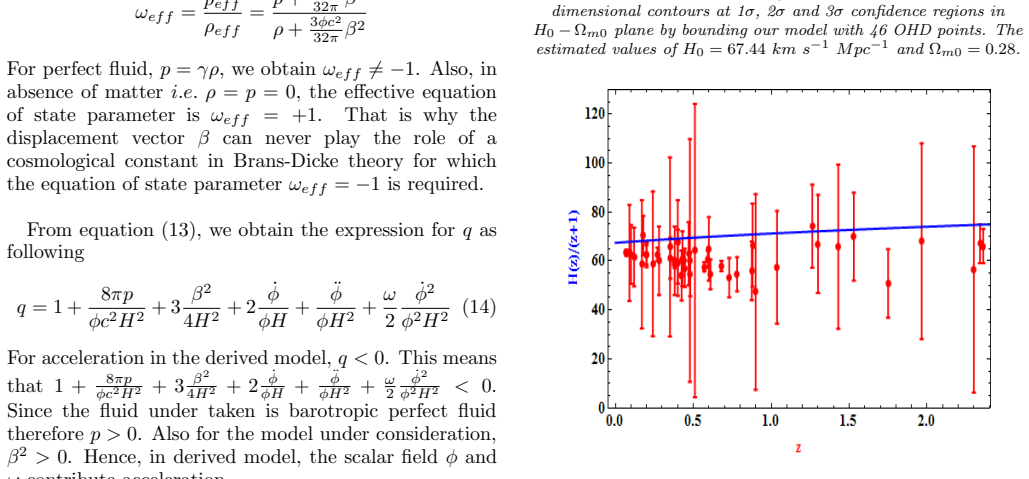
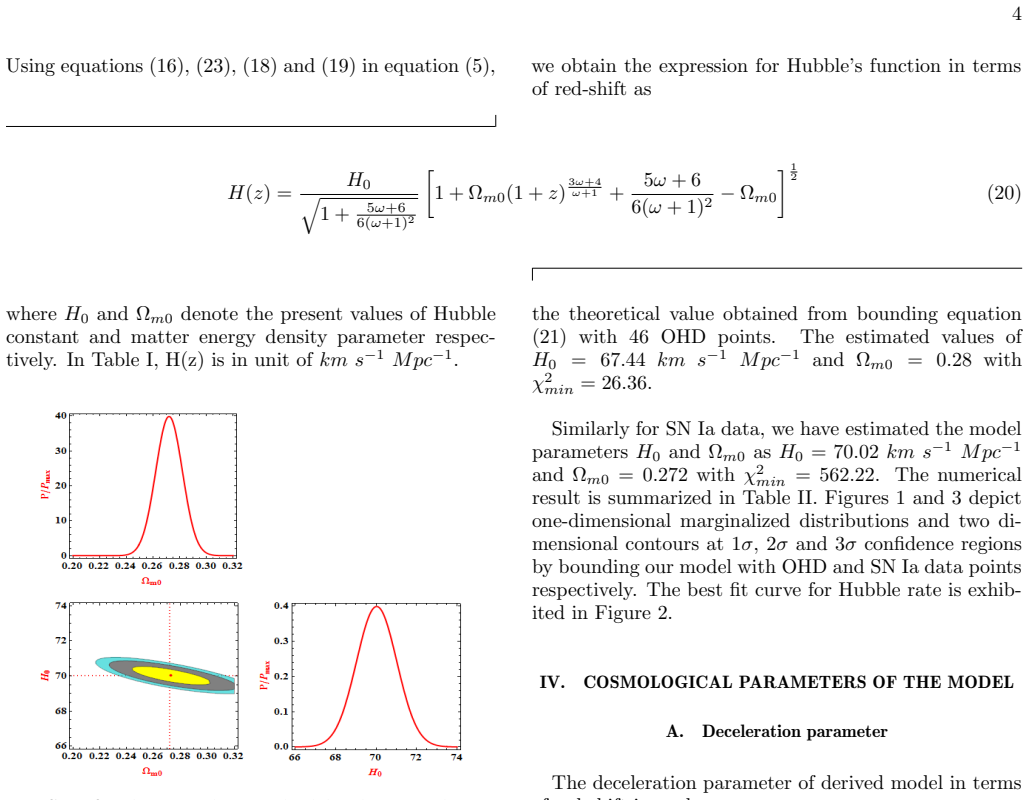
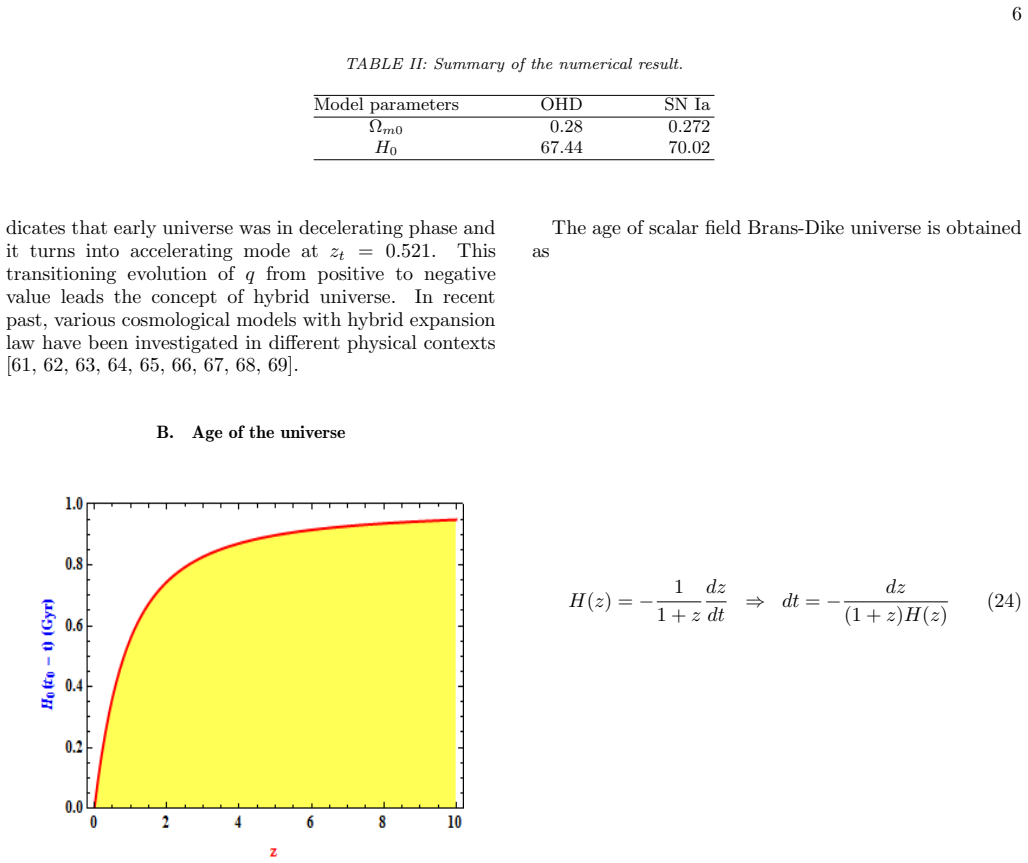
The paper's central claim is that the expansion of a pressureless universe obeying the Brans-Dicke field equations in Lyra's manifold is governed by $H(z) = H_0\,[1+C]^{-1/2}\,\bigl[1+\Omega_{m0}(1+z)^{(3\omega+4)/(\omega+1)} + C - \Omega_{m0}\bigr]^{1/2}$, where $C = (5\omega+6)/(6(\omega+1)^2)$, and that this history fits both the 46-point $H(z)$ sample and the Type Ia supernova sample used in the paper. Fitting yields $H_0=67.44$ km/s/Mpc with $\Omega_{m0}=0.28$ from the Hubble data and $H_0=70.02$ km/s/Mpc with $\Omega_{m0}=0.272$ from the supernova data. The same $H(z)$ is then differentiated to obtain a deceleration parameter that changes sign at $z_t\approx 0.52$ and equals $q_0\approx -0.58$ today, integrated to give an age of about 14.29 Gyr, and differentiated twice to give a present jerk $j_0\approx 0.80$. The authors read these numbers as showing that the model describes a universe that decelerates early, accelerates now, and needs no cosmological constant, with the acceleration supplied by the dynamics of the Brans-Dicke scalar field rather than by Lyra's displacement vector.
Load-bearing premise
The load-bearing premise is that the assumed power-law form of the scalar field really solves the full field equations, so the fitted $H(z)$ is a true solution of the theory and not just a convenient curve; if that premise gives way, the derived expansion history and its parameters no longer describe the model.
Editorial extensions
If this is right
- If Eq. (20) is the correct expansion history, the universe's transition from deceleration to acceleration occurs at $z_t\approx 0.52$, so independent high-redshift probes of the expansion rate should see deceleration above that redshift.
- The model yields a present age of about 14.29 Gyr, which is consistent with independent CMB-based age estimates and removes the need for a cosmological constant to stretch the age.
- The fitted matter density $\Omega_{m0}\approx 0.28$ and Hubble constant $H_0\approx 67.44$ km/s/Mpc from the Hubble data fall inside the ranges reported by CMB experiments, so the model is not immediately excluded by these basic expansion probes.
- Because the predicted present jerk $j_0\approx 0.80$ differs from the $\Lambda$CDM value $j=1$, future cosmographic measurements of higher-order expansion can distinguish this scalar-field model from vacuum-energy cosmology.
Reading between the lines
- Not stated in the paper: at $\omega \approx 40000$ the correction $C = (5\omega+6)/(6(\omega+1)^2)$ is tiny, so the fitted $H(z)$ closely tracks flat $\Lambda$CDM with a rescaled matter density; the successful fit may be largely a test of how close the ansatz is to $\Lambda$CDM, not of the Lyra-specific terms.
- Not stated in the paper: since the displacement vector has effective equation of state $+1$ in the matter-free limit, the acceleration must be carried by the scalar field; a high-precision measurement of the late-time effective equation of state would separate these two contributions.
- Not stated in the paper: applying the same power-law scalar-field ansatz to anisotropic Bianchi models would give the Lyra displacement field a testable shear or anisotropy signature that the isotropic fit cannot reveal.
Editorial analysis
A structured set of objections, weighed in public.
Referee Report
Summary. The manuscript proposes a flat FLRW Brans-Dicke cosmological model formulated in Lyra's geometry with a time-like displacement vector. After writing the field equations (5)-(7), the authors adopt a power-law scalar field φ ∝ a^{1/(ω+1)}, derive the Hubble function (20), and fit its two free parameters H0 and Ωm0 to 46 H(z) points and an SN Ia Gold sample. From the best fit they compute a present deceleration q0=-0.58, a transition redshift zt=0.52, an age of 14.29 Gyr, and j0=0.80, concluding that the model yields late-time cosmic acceleration without a cosmological constant.
Significance. If the model were correct, it would provide an interesting example of an accelerating dust-filled universe without dark energy, with the Brans-Dicke scalar field playing the role usually assigned to a cosmological constant in Lyra geometry. The paper reports a standard χ² likelihood analysis with contour plots, which is a useful route to falsifiability. However, the central expansion history is not a solution of the field equations: the best-fit H(z) violates the scalar-wave equation. Because every subsequent observable (q0, age, jerk, transition redshift) is derived from this H(z), the claimed cosmological conclusions do not follow. The paper also correctly notes that the Lyra displacement vector β cannot act as Λ in Brans-Dicke theory, but this insight is not developed into a workable model.
major comments (3)
- [§III, Eqs. (20) and (23); §II, Eq. (7)] The best-fit Hubble function is not a solution of the model's field equations. For the ansatz (16), one has φ˙/φ = nH with n = 1/(ω+1). With dust (p=0), the scalar-wave equation (7) becomes n(\dot H/H²) + n(n+3) = 3Ωm/(2ω+3). Evaluating this at z=0 with ω=40000 and Ωm0=0.28 gives q0 = -1 - \dot H/H² ≈ +1.58, whereas Eq. (23), obtained from the fitted H(z), gives q0 = -0.58. Both expressions describe the same model at the same point, so Eq. (20) cannot satisfy Eqs. (5)-(7) simultaneously; the fitted H(z) solves only the Friedmann equation used to construct it.
- [§III, Eqs. (15) and (16)] The statement that Eq. (16) is 'the general solution' of Eq. (15) is incorrect. Substituting φ ∝ a^{1/(ω+1)} makes Eq. (15) an identity for arbitrary a(t); it imposes no restriction on H(z). Consequently, the power-law ansatz does not select an expansion history, and the derivation of Eq. (20) uses only Eq. (5) together with the density-parameter decomposition. This is the structural reason why the scalar-wave constraint is lost and why the fitted H(z) is not a solution of the full system.
- [§III, Table I and Eq. (21); §IV, Eqs. (23)-(27)] The observational validation is partly circular and the data handling is inconsistent. The deceleration parameter, transition redshift, age, and jerk are all deterministic functions of H0 and Ωm0 obtained from the same OHD/SNIa fits; their agreement with WMAP/Planck values is therefore a restatement of the fit rather than an independent prediction. In addition, Table I is described in the text as cosmic-chronometer data, but it includes BAO measurements (for example, entries cited to refs. [49], [51], [53], [55], [57]-[59]). Cosmic-chronometer and BAO data have different systematics and should not be combined in a single 'OHD' likelihood without modeling those systematics.
minor comments (4)
- [Throughout] There are numerous typographical errors ('obtian', 'Brans-Dike', 'Plank collaboration', 'co-moving co-ordinate', 'generak', 'red-shift' as one word) that should be corrected in a thorough proofread.
- [§III, Eq. (16) and Eq. (18)] The equation cross-references are unreliable: the sentence before Eq. (16) refers to 'equation (18)' when it should refer to Eq. (15), and the sentence before Eq. (18) says 'Using equation (23) in equation (6)' when it should refer to Eq. (16).
- [§IV.C] The text says the jerk parameter is 'graphed in Figure 5', but Figure 5 is the age plot H0(t0−t) versus z; the jerk plot is Figure 6.
- [§III, SN Ia data] The SN Ia sample is described only as 'Gold Sample and New Gold Sample' from ref. [60]; this is an old compilation, and the paper should state why more recent samples (e.g., Pantheon or DES) were not used.
Circularity Check
q0, age and jerk are re-expressions of fitted H0, Ωm0 from a ΛCDM-form H(z) built on a self-definitional φ ansatz.
-
self definitional
[Section III, Eqs. (15), (16), (18), (20)]
"The general solution of equation (18) is given by φ =φ0 ( a a0 ) 1 ω+1 ... Using equations (16), (23), (18) and (19) in equation (5), we obtain the expression for Hubble's function in terms of red-shift as [Eq. (20)]"
Substituting φ = φ0(a/a0)^n with n = 1/(ω+1) into Eq. (15) makes the left and right sides identical for arbitrary H: ä/a + 2H² = (ω+1)(nḢ+n²H²)+(3ω+2)nH² = Ḣ + 3H². Thus Eq. (15) imposes no restriction on a(t); the 'general solution' is a self-definitional ansatz. Eq. (20) follows by inserting that φ-law plus the closure Ωm+Ωβ = 1+C into Eq. (5) alone, leaving H0 and Ωm0 as free fit parameters. The expansion history used for all later predictions is therefore constructed, not solved from the full BD-Lyra system (5)-(7).
-
fitted input called prediction
[Section III, Eq. (21) and Table II; Section IV.A Eq. (23); Section IV.B Eqs. (26)-(27)]
"For statistical analysis, we define χ2 ... The estimated values of H0 = 67 .44 km s−1 Mpc−1 and Ω m0 = 0 .28 with χ2 min = 26.36. ... From equation (23), one can obtain the present value of deceleration parameter as q0 = −0.58 by putting z = 0, Ω m0 = 0 .28 and ω = 40000. ... H0t0 = 0.983019 ... t0 = 0.983019 H−1 0 = 14.288 Gyrs."
q0, age, and jerk are computed by inserting the best-fit Ωm0 = 0.28 and H0 = 67.44 into kinematically defined formulas (22), (24)-(26), (28). For ω = 40000, Eq. (23) gives q0 ≈ −1 + 1.5Ωm0, so the quoted q0 = −0.58 is just the fitted matter density rewritten; similarly t0 = 0.983/H0 is the fitted Hubble constant rewritten as an age. These quantities therefore contain no new information beyond the fit and cannot serve as independent confirmation of the model, even though the paper presents them as 'nice match' with observations.
1 more flagged steps
-
renaming known result
[Eq. (20) with ω = 40000 used throughout Section IV]
"H(z) = H0 [1 + (5ω+6)/(6(ω+1)^2)]^{-1/2} [1 + Ωm0(1+z)^{(3ω+4)/(ω+1)} + (5ω+6)/(6(ω+1)^2) − Ωm0]^{1/2}"
With ω = 40000, C = (5ω+6)/(6(ω+1)^2) ≈ 2×10^-5 and (3ω+4)/(ω+1) ≈ 3, so Eq. (20) reduces to H² = H0²[Ωm0(1+z)^3 + 1 − Ωm0] — the flat ΛCDM Hubble rate. All of the paper's 'derived' results (q0 = −0.58, zt = 0.521, t0 = 14.29 Gyr, j0 = 0.8002) are the standard ΛCDM values for the same fitted Ωm0 and H0. Presenting them as predictions of Brans-Dicke/Lyra theory is a renaming of the known ΛCDM expansion rather than an independent derivation.
full rationale
The paper's derivation chain is not circular because of self-citation: its references to the authors' own prior Lyra/Brans-Dicke papers are background, not load-bearing, and the WMAP/Planck comparisons are external. The circularity sits in the construction of H(z) and in the use of fitted parameters. Eq. (15) is identically satisfied by φ ∝ a^{1/(ω+1)} for any H(t), so calling this the 'general solution' and then deriving Eq. (20) from Eq. (5) makes the expansion history an input ansatz rather than a consequence of the field equations. The subsequent q0 = −0.58, t0 = 14.29 Gyr, and j0 = 0.8002 are obtained by inserting the best-fit H0 and Ωm0 into formulas that are algebraic rearrangements of those same fitted parameters; hence they are forced by the fit, not independent predictions. For ω = 40000, Eq. (20) collapses to the flat ΛCDM H(z) = H0[Ωm0(1+z)^3 + 1 − Ωm0]^{1/2}, so the 'derived' cosmography is the standard ΛCDM result presented as a new BD-Lyra model. The quoted acceleration epoch and age are therefore not novel predictions of the BD-Lyra field equations, but consequences of the ansatz and fit. Score 6 reflects that the central phenomenology reduces by construction, while stopping short of 8 because the fitted parameters are compared to some external data (WMAP/Planck) and the paper does contain genuine field-equation formalism.
Assumptions & free parameters
free parameters (4)
- H0 =
OHD: 67.44, SNIa: 70.02 km/s/Mpc
- Ωm0 =
OHD: 0.28, SNIa: 0.272
- ω (Brans-Dicke coupling) =
40000
- β (Lyra displacement field) =
implied by Ωβ0 ≈ 0.72 at present
assumptions (4)
- domain assumption Brans-Dicke field equations in Lyra's manifold, Eqs. (1)-(2), with the adopted sign convention for the β^2 terms.
- domain assumption Flat, homogeneous, isotropic FLRW metric and dust matter (p=0) at late times.
- ad hoc to paper The scalar field ansatz φ = φ0(a/a0)^{1/(ω+1)} is an exact solution of the full system.
- domain assumption The 46 OHD points are model-independent and uncorrelated cosmic-chronometer data.
invented entities (1)
-
Lyra displacement field β (with associated Ωβ energy)
Cite this review
Pith. "Pith review of Lyra's cosmology of homogeneous and isotropic universe in Brans-Dicke theory." pith.science (2026). https://pith.science/paper/X5CFV2GW
@misc{pith2026190901998,
  author       = {Pith},
  title        = {Pith review of: Lyra's cosmology of homogeneous and isotropic universe in Brans-Dicke theory},
  year         = {2026},
  howpublished = {\url{https://pith.science/paper/X5CFV2GW}},
  note         = {Machine review of arXiv:1909.01998}
}
abstract
In this paper, we investigate a scalar field Brans-Dicke cosmological model in Lyra's geometry which is based on the modifications in geometrical term as well as energy term of Einstein's field equations. We have examined the validity of proposed cosmological model on observational scale by performing statistical analysis from latest $H(z)$ and SN Ia observational data. We find that the estimated values of Hubble's constant and matter energy density parameter are in agreement with their corresponding values, obtained from recent observations of WMAP and Plank collaboration. We also derived deceleration parameter, age of the universe and jerk parameter in terms of red-shift and computed its present values. The dynamics of deceleration parameter in derived model of the universe shows a signature flipping from positive to negative value and also indicates that the present universe is in accelerating phase.
Figures

Figures from the paper (3 more)


Reference graph
Works this paper leans on
-
[49]
D. Stern et al, Cosmic chronometers: constraining the equation of state of dark energy I: H(z) measurements JCAP 1002 (2010) 008
work page 2010
-
[51]
Gazta Naga et al, Clustering of luminous red galaxies – IV
E. Gazta Naga et al, Clustering of luminous red galaxies – IV. Baryon acoustic peak in the line-of-sight direction and a direct measurement of H(z) MNRAS 399 (2009) 1663
work page 2009
-
[53]
S. Alam et al, The clustering of galaxies in the completed SDSS-III Baryon Oscillation Spectroscopic Survey: cos- mological analysis of the DR12 galaxy sample, MNRAS 470 (2016) 2617
work page 2016
-
[55]
C. Blake et al, The WiggleZ Dark Energy Survey: joint measurements of the expansion and growth history at z <1, MNRAS 425 (2012) 405
work page 2012
-
[57]
L. Anderson et al, The clustering of galaxies in the SDSS- III Baryon Oscillation Spectroscopic Survey: baryon acoustic oscillations in the Data Releases 10 and 11 Galaxy samples, MNRAS 441 (2014) 24
work page 2014
-
[59]
N. G. Busca et al, Baryon acoustic oscillations in theLyα forest of BOSS quasars, Astron & Astrophys. 552 (2013) A96
work page 2013
-
[1]
L. Iorio, Editorial for the special issue 100 years of chronogeometrodynamics: The status of the Einstein’s theory of gravitation in its centennial year, Universe 1 (2015) 38-81
work page 2015
- [2]
Show all 75 references
-
[3]
R. G. Vishwakarma, Einstein and beyond: A critical per- spective on general relativity, Universe 2 (2016) 16
2016
-
[4]
J. B. Jimenez, L. Heisenberg, T. S. Koivisto, The Geo- metrical trinity of gravity, Universe 5 173 (2019)
2019
-
[5]
Kumar, Some FRW models of accelerating universe with dark energy, Astrophys
S. Kumar, Some FRW models of accelerating universe with dark energy, Astrophys. Space Sc. 332 (2011) 449- 454
2011
-
[6]
E. J. Copeland, M. Sami, S. Tsujikawa, Dynamics of dark energy, Int. J. Mod. Phys. D 15 (2006) 1753-1935
2006
-
[7]
A. K. Yadav, F. Rahaman, S. Ray, Dark energy models with variable equation of state parameter, Int. J. Theor. Phys. 50 (2011) 871
2011
-
[8]
A. K. Yadav, Some anisotropic dark energy models in Bianchi type-V space-time, Astrophys. Space Sc. 335 (2011) 565-575
2011
-
[9]
Kumar, A
S. Kumar, A. K. Yadav, Some Bianchi type-V models of Accelerating universe with dark energy, Mod. Phys. Lett. A 26 (2011) 647-659
2011
-
[10]
A. K. Yadav, L. Yadav, Bianchi type III anisotropic dark energy models with constant deceleration parameter, Int. J. Theor. Phys. 50 (2011) 218-227
2011
-
[11]
A. K. Yadav et al, Magnetized dark energy and the late time acceleration, Euro. Phys. J. Plus 127 (2012) 127
2012
-
[12]
Clifton, P
T. Clifton, P. G. Ferreira, A. Padilla, C. Skordis, Mod- ified gravity and cosmology, Physics Reports 513 (2012) 1-189
2012
-
[13]
Capozziello, T
S. Capozziello, T. Harko, T. S. Koivisto, F. S. N. Lobo, G. J. Olmo, Hybrid metric-Palatini gravity, Universe 1 (2015) 199-238
2015
-
[14]
de Martino, M
I. de Martino, M. De Laurentis, S. Capozziello, Con- straining f(R) gravity by the large scale structure, Uni- verse 1 (2015) 123-157
2015
-
[15]
Lyra, Ubereine Modifikation der Riemannschen Ge- ometrie, Math
G. Lyra, Ubereine Modifikation der Riemannschen Ge- ometrie, Math. Z. 54 (1951) 52
1951
-
[16]
Brans, R
C. Brans, R. H. Dicke, Mach’s principle and a relativistic theory of gravitation, Phys. Rev. D 124 (1961) 925
1961
-
[17]
W. D. Halford, Scalar-Tensor theory of gravitation in a Lyra manifold J. Math. Phys. 13 (1972) 1399
1972
-
[18]
Darabi, Y
F. Darabi, Y. Heydarzade, F. Hajkarim, Stability of Ein- stein static universe over Lyra geometry, Can. J. Phys. 93 2015 1566
2015
-
[19]
G. F. R. Ellis, R. Maartens, The emergent universe: in- flationary cosmology with no singularity, Class. Quant. Grav. 21 2004 223
2004
-
[20]
G. P. Singh, K. Desikan, A new class of cosmological models in Lyra geometry, Pramana 49 (1997) 205-212
1997
-
[21]
Pradhan, L
A. Pradhan, L. Yadav, A. K. Yadav, Isotropic homoge- neous universe with a bulk viscous fluid in Lyra geometry Astrophys. Space Sc. 299 (2005) 31
2005
-
[22]
A. K. Yadav, Lyra’s cosmology of inhomogeneous uni- verse with electromagnetic field, Fizika B 19 (2009) 53
2009
-
[23]
Singh, G
T. Singh, G. Singh, Bianchi type III and Kantowski-Sachs cosmological models in Lyra geometry, Int. J. Theor. Phys. 31 (1992) 1433
1992
-
[24]
Singh, G
T. Singh, G. Singh, Lyra’s geometry and cosmology, Fortschritte der Physik 41 (1993) 737-764
1993
-
[25]
A. K. Yadav, A. Haque, Lyra’s cosmology of mas- sive strings in anisotropic Bianchi-II space-time, Int. J. Theor. Phys. 50 (2011) 2850
2011
-
[26]
Rahaman, B
F. Rahaman, B. C. Bhui, G. Bag, Can Lyra geometry ex- plain the singularity free as well as accelerating Universe Astrophys. Space Sc. 295 (2005) 507
2005
-
[27]
V. K. Yadav, L. Yadav, A. K. Yadav, New exact solution of Bianchi type V cosmological model in Lyra’s geometry Rom. J. Phys. 55 (2010) 862
2010
-
[28]
A. K. Yadav, V. K. Bhardwaj, Lyra’s cosmology of hybrid universe in Bianchi-V space-time Res. Astron. Astrophys. 18 (2018) 64
2018
-
[29]
A. K. Yadav, Comment on Brans-Dicke scalar field cos- mological model in Lyra’s geometry, Phys. Rev. D 102 (2020) 108301
2020
-
[30]
Mukherjee, S
P. Mukherjee, S. Chakrabarti, Exact solutions and accel- erating universe in modified Brans-Dicke theories Euro. Phys. J. C. 79 (2019) 681
2019
-
[31]
galaxy differ- ential age
as Gij + 3 2ψiψj− 3 4gijψkψk = − 8πTij φc4 − ω φ2 ( φ,iφ,j− 1 2gijφ,kφ,k ) − 1 φ(φ,i,j−gij□φ) (1) □φ =φ,i ,i = 8πT (3 + 2ω)c2 (2) where Gij, ψi, ω and φ are the curvature tensor, displacement vector field of Lyra’s geometry, Brans- Dicke coupling constant and Brans-Dike scalar ...
1993
-
[32]
G. K. Goswami, Cosmological parameters for spatially flat dust filled universe in Brans-Dicke theory,arXiv: 1710.07281 [gr-qc]
-
[33]
D. C. Maurya, R. Zia, Brans-Dicke scalar field cosmolog- ical model in Lyra’s geometry, arXiv: 1907.07135[gr-qc]
1907 arXiv
-
[34]
S. Sen, A. A. Sen, Late time acceleration in Brans-Dicke cosmology, Phys. Rev. D 63 (2001) 124006
2001
-
[35]
A. K. Yadav, H. Amirhashchi, Constraining an exact Brans-Dicke gravity theory with recent observations, arXiv: 1908.04735 [gr-gc]
1908 arXiv
-
[36]
Bertotti et al, A test of general relativity using radio links with the Cassini spacecraft, Nature 425 (2003) 374
B. Bertotti et al, A test of general relativity using radio links with the Cassini spacecraft, Nature 425 (2003) 374
2003
-
[37]
Akarsu, N
O. Akarsu, N. Katirci, N. Ozedemir, J. A. Vazquez, Anisotropic massive Brans-Dicke gravity extension of the standard ΛCDM model, arXiv: 1903.06679 [gr-qc]
1903 arXiv
-
[38]
Recently, Yousaf [42, 43] has studied some dynamical properties of compact objects within the framework of modified gravity corrections
and minimally interacting holographic dark energy models [39, 40, 41]. Recently, Yousaf [42, 43] has studied some dynamical properties of compact objects within the framework of modified gravity corrections. Motivated by the above discussion, in this paper, we investigate a sca...
-
[39]
A. D. Felice et al, Relaxing nucleosynthesis constraints on Brans-Dicke theories, Phys. Rev. D 74 (2006) 103005
2006
-
[40]
Jawed et al, Modified holographic Ricci dark energy in chameleon Brans–Dicke cosmology and its thermody- namic consequence, Comm
A. Jawed et al, Modified holographic Ricci dark energy in chameleon Brans–Dicke cosmology and its thermody- namic consequence, Comm. Theor. Phys. 63 (2015) 453
2015
-
[41]
K. D. Naidu, D. R. K. Reddy, Y. Aditya, Dynamics of axially symmetric anisotropic modified holographic Ricci dark energy model in Brans-Dicke theory of gravitation, Eur. Phys. J. Plus 133 (2018) 303
2018
-
[42]
Kiran et al, Minimally interacting holographic Dark energy model in Brans-Dicke theory,Astrophys
M. Kiran et al, Minimally interacting holographic Dark energy model in Brans-Dicke theory,Astrophys. Space Sc. 356 (2015) 407
2015
-
[43]
Ramesh, S
G. Ramesh, S. Umadevi, LRS Bianchi type-II mini- mally interacting holographic dark energy model in Saez- Ballester theory of gravitation, Astrophys. Space Sc. 361 (2016) 50. 9
2016
-
[44]
Yousaf, On the role of f(G,T) terms in structure scalars, Eur
Z. Yousaf, On the role of f(G,T) terms in structure scalars, Eur. Phys. J. Plus 134 (2019) 245
2019
-
[45]
Yousaf, Hydrodynamic properties of dissipative fluids associated with tilted observers, Mod
Z. Yousaf, Hydrodynamic properties of dissipative fluids associated with tilted observers, Mod. Phys. Lett. A 34 (2019) 1950333
2019
-
[46]
Macaulay et al, First cosmological results using Type Ia Supernovae from the dark energy survey: measure- ment of the Hubble constant, arXiv: 1811.02376
E. Macaulay et al, First cosmological results using Type Ia Supernovae from the dark energy survey: measure- ment of the Hubble constant, arXiv: 1811.02376
-
[47]
Zhang et al, Four new observational H(z) data from lu- minous red galaxies in the Sloan Digital Sky Survey data release seven, Res
C. Zhang et al, Four new observational H(z) data from lu- minous red galaxies in the Sloan Digital Sky Survey data release seven, Res. Astron. Astrophys 14 (2014) 1221
2014
-
[48]
Simon, L
J. Simon, L. Verde, R. Jimenez, Constraints on the red- shift dependence of the dark energy potential Phys. Rev. D 71 (2005) 123001
2005
-
[50]
Moresco et al, Improved constraints on the expansion rate of the Universe up to z ∼ 1.1 from the spectroscopic evolution of cosmic chronometers, JCAP 08 (2012) 006
M. Moresco et al, Improved constraints on the expansion rate of the Universe up to z ∼ 1.1 from the spectroscopic evolution of cosmic chronometers, JCAP 08 (2012) 006
2012
-
[52]
D. H. Chuang, Y. Wang, Modelling the anisotropic two- point galaxy correlation function on small scales and single-probe measurements of H(z),DA(z) and f(z)σ8(z) from the Sloan Digital Sky Survey DR7 luminous red galaxies, MNRAS 435 (2013) 255
2013
-
[54]
Moresco et al, A 6% measurement of the Hubble pa- rameter at z ∼ 0.45: direct evidence of the epoch of cosmic re-acceleration, JCAP 05 (2016) 014
M. Moresco et al, A 6% measurement of the Hubble pa- rameter at z ∼ 0.45: direct evidence of the epoch of cosmic re-acceleration, JCAP 05 (2016) 014
2016
-
[56]
A. L. Ratsimbazafy et al, The WiggleZ dark Energy Sur- vey: joint measurements of the expansion and growth history at z <1, MNRAS 467 (2017) 3239
2017
-
[58]
Moresco, Raising the bar: new constraints on the Hubble parameter with cosmic chronometers at z ∼ 2, MNRAS 450 (2015) L16
M. Moresco, Raising the bar: new constraints on the Hubble parameter with cosmic chronometers at z ∼ 2, MNRAS 450 (2015) L16
2015
-
[60]
Delubac et al, Which fundamental constants for cos- mic microwave background and baryon-acoustic oscilla- tion?, Astron & Astrophys 584 (2015) A69
T. Delubac et al, Which fundamental constants for cos- mic microwave background and baryon-acoustic oscilla- tion?, Astron & Astrophys 584 (2015) A69
2015
-
[61]
Font-Ribera et al, Quasar-Lyman α forest cross- correlation from BOSS DR11: Baryon Acoustic Oscil- lations, JCAP 1405 (2014) 027
A. Font-Ribera et al, Quasar-Lyman α forest cross- correlation from BOSS DR11: Baryon Acoustic Oscil- lations, JCAP 1405 (2014) 027
2014
-
[62]
R. G. Vishwakarma, J. V. Narlikar, Is it no longer nec- essary to test cosmologies with type SN Ia supernovae? Universe 4 (2018) 73
2018
-
[63]
A. K. Yadav, Transitioning scenario of Bianchi-I universe within f(R,T ) formalism, Braz. J. Phys. 49 (2019) 262
2019
-
[64]
Akarsu, S
O. Akarsu, S. Kumar, R. Ayrzakulov, M. Sami and L. Xu, Cosmology with hybrid expansion law: scalar field reconstruction of cosmic history and observational con- straints J. Cosmol. Astropart. Phys. 1 (2014) 022
2014
-
[65]
A. K. Yadav, P. K. Sahoo, V. K. Bhardwaj, Bulk Viscous Bianchi-I Embedded Cosmological Model in f(R,T ) = f1(R)+f2(R)f3(T ) Gravity,Mod. Phys. Lett. A 34 (2019) 1950145
2019
-
[66]
A. K. Yadav, Bianchi-V string cosmological model and late time acceleration, Res. Astron. Astrophys. 12 (2012) 1467
2012
-
[67]
Pradhan, H
A. Pradhan, H. Amirhashchi, Accelerating dark energy models in Bianchi type V space-time, Mod. Phys. Lett. A 26 (2011) 2261
2011
-
[68]
Mishra, S
B. Mishra, S. K. Tripathy, S.Tarai, Cosmological models with a hybrid scale factor in an extended gravity theory, Mod. Phys. Lett. A 33 (2018) 1850052
2018
-
[69]
P. P. Ray, B. Mishra, S. K. Tripathy, Dynamics of anisotropic dark energy universe embedded in one- directional magnetized fluid Int. J. Mod. Phys. D 28 (2019) 1950093
2019
-
[70]
A. K. Yadav, P. K. Srivastava, L. Yadav, Hybrid expan- sion law for dark energy dominated universe in f(R,T ) Gravity, Int. J. Theor. Phys. 54 (2015) 1671
2015
-
[71]
A. K. Yadav, A transitioning universe with anisotropic dark energy, Astrophys. Space Sc. 361 (2016) 276
2016
-
[72]
Hinshaw et al., Nine-year Wilkinson Microwave Anisotropy Probe (WMAP) observations: cosmological parameter results, Astrophys
G. Hinshaw et al., Nine-year Wilkinson Microwave Anisotropy Probe (WMAP) observations: cosmological parameter results, Astrophys. J. Supp. Sr. 208 (2013) 19
2013
-
[73]
P. A. R. Ade et al., Planck 2013 results XVI cosmological parameters. Astron. Astrophys. 571 (2014) A16
2014
-
[74]
Capozziello, R
S. Capozziello, R. D’Agostino, O. Luongo, Extended gravity cosmography, Int. J. Mod. Phys. D 28 (2019) 1930016
2019
-
[75]
P. K. S. Dunsby and O. Luongo, On the theory and ap- plications of modern cosmography, Int. J. Geom. Meth. Mod. Phys. 13 (2016) 1630002
2016
Reviewed August 14, 2026 · model on record in the stance chip above.
Discussion (0). Continue with ORCID to comment.