REVIEW 3 major objections 4 minor 84 references
Analytic Waveforms for Eccentric Gravitational Wave Bursts
T0 review · 3 major / 4 minor · reviewed 2026-08-14 · deepseek-v4-flash
Pith's one-line read This paper constructs the first analytic waveform models for the gravitational-wave burst from a highly eccentric binary's pericenter passage, and validates them against numerical and numerical-relativity waveforms.
desk verdict First analytic burst waveform family with a faithful EFB-T model in its stated regime; EFB-F is a sketch and the e->1 regime needs more evidence. read the letter →
The pith
A machine-rendered reading of the paper's core claim, the machinery that carries it, and where it could break.
The reading
What carries the argument
The load-bearing object is the re-summation procedure applied to the Bessel-function Fourier series for $\cos V$ and $\sin V$: replace each $J_k(ke)$ and $J'_k(ke)$ with its uniform asymptotic expansion in modified Bessel functions $K_{1/3}$, $K_{2/3}$, extend the harmonic sum to include $k=0$, convert the sum to an integral, match the constant offset to the exact solution at pericenter, and expand in $\epsilon=1-e^2$ while holding the post-parabolic phase variable $\psi = \ell/[\ln((1+\sqrt{1-e^2})/e)-\sqrt{1-e^2}]$ fixed. This produces the hyperbolic-function expressions (33)-(34) that are non-oscillatory and exactly reduce to the closed-form parabolic solution (Barker's equation) in the limit $e\to 1$. The same machinery, applied after the stationary-phase approximation to the Fourier-domain harmonic sum, yields the EFB-F model in terms of hypergeometric functions. The radiation-reaction side is a Taylor expansion of the quadrupole-order evolution equations in the mean anomaly, integrated to an exponential mapping $\ell(t)$.
What would settle it
Compute the match between the EFB-T model and a numerically integrated Newtonian-quadrupole waveform for a $10+10\,M_\odot$ binary at $e_0=0.999$ and $p_0=20M$; if the match falls below 0.97, the claimed faithfulness at high eccentricity fails. A second check is to evaluate Eqs. (33)-(34) against the numerical Kepler solution at $e_0=0.9999$ and see whether the apocenter phase error exceeds a fraction of a radian.
Extended reading notes
Core claim
The central claim is that the slowly convergent Fourier–Bessel series of the Kepler problem can be re-summed into closed-form, non-oscillatory expressions that describe the orbit as a deformation of a parabola, valid over a single pericenter passage. Feeding these expressions into the leading-order quadrupole waveform formula produces the first analytic 'effective fly-by' waveforms for eccentric bursts. The paper reports that the time-domain version achieves match (the standard noise-weighted overlap used in detection searches) above 0.98 against numerical leading-order waveforms for equal $10\,M_\odot$ black holes, and above 0.92 against numerical-relativity fly-by waveforms for $r_p>8.75M$, while the frequency-domain version is analytic but computationally expensive because of hypergeometric functions. A Taylor-series radiation-reaction model plus a recurrence for successive pericenter parameters lets individual EFB-T waveforms be chained into a ten-burst template with match 0.993, although a 1% error in the timing model destroys the match.
Load-bearing premise
The model's accuracy rests on the assumption that the re-summed asymptotic expressions for $\cos V$ and $\sin V$, fixed to the exact answer only at pericenter, stay uniformly accurate over the whole orbit at high eccentricity; the paper verifies this at $e=0.99$ but does not prove it for all template-bank parameters.
Editorial extensions
If this is right
- A matched-filtering search for eccentric-binary bursts in ground-based detector data becomes practical for low-mass systems, since EFB-T templates are analytic and roughly twice as fast to evaluate as numerical quadrupole waveforms.
- The EFB-T model reaches match above 0.98 against numerical Newtonian-quadrupole waveforms over the studied parameter ranges, so it can serve as a faithful stand-in for those waveforms in detection and parameter-estimation studies.
- Chaining individual EFB-T waveforms with a recurrence timing model recovers a ten-burst inspiral sequence with match 0.993, showing that full eccentric inspirals can be assembled from single-burst templates.
- The sharp drop in match against numerical-relativity fly-by waveforms for pericenter distances below $8.75M$ marks the boundary where higher-order relativistic effects must be added to the model.
Reading between the lines
- The same re-summation should extend to the 3PN Fourier-series representations of the two-body problem, since the asymptotic Bessel-function machinery is agnostic to the post-Newtonian order; this would give analytic eccentric-burst waveforms that include relativistic precession and higher-order radiation reaction.
- Because the post-parabolic expressions are non-oscillatory and tied to a single encounter, they could be adapted to model gravitational-wave bursts from unbound or near-unbound encounters, such as hyperbolic black-hole fly-bys, by taking the $\epsilon\to 0$ limit directly.
- The EFB-F model's hypergeometric functions are the main computational bottleneck; deriving uniform asymptotic approximations for those functions at large $\chi$ and $\chi_{\rm orb}^2/\zeta_0^3$ would likely turn the frequency-domain model into the fastest template, rather than the slowest.
- Multi-burst detection might be achieved without any timing model by exploiting the correlations among burst parameters (sky location, inclination, masses) that a repeated source must share, a route the paper lists as future work.
Editorial analysis
A structured set of objections, weighed in public.
Referee Report
Summary. This paper constructs analytic time-domain (EFB-T) and frequency-domain (EFB-F) approximations to the gravitational-wave burst from a highly eccentric binary. Starting from the Fourier-series solution of the Kepler problem, the author replaces Bessel functions with uniform asymptotic expansions, converts harmonic sums to integrals, matches at pericenter, and expands in epsilon = 1 - e^2, yielding closed-form expressions for cos V and sin V. A Taylor-model radiation-reaction prescription is added to evolve p and e through one pericenter passage. The EFB-T polarizations in Eq. (45) are validated against numerical leading-PN quadrupole waveforms via the match statistic and against numerical-relativity fly-by waveforms, and a multi-burst concatenation is tested. The EFB-F model, based on the stationary-phase approximation, is presented but is found computationally impractical.
Significance. If the re-summation is accepted, the EFB-T model is an original and potentially useful contribution: it is the first closed-form time-domain waveform for a single pericenter passage, is about twice as fast as direct numerical Peters-Mathews integration, and achieves match > 0.98 against numerical leading-PN waveforms for low-mass binaries over the tested grid. The author is transparent about limitations, including apocenter errors, the computational cost of EFB-F, degradation of the NR match at small pericenter distances, and the sensitivity of the multi-burst timing model. The re-summation is well grounded in previous work and the numerical checks are honest. However, the central validation gap at eccentricities close to unity must be closed before the template-bank claim is fully established.
major comments (3)
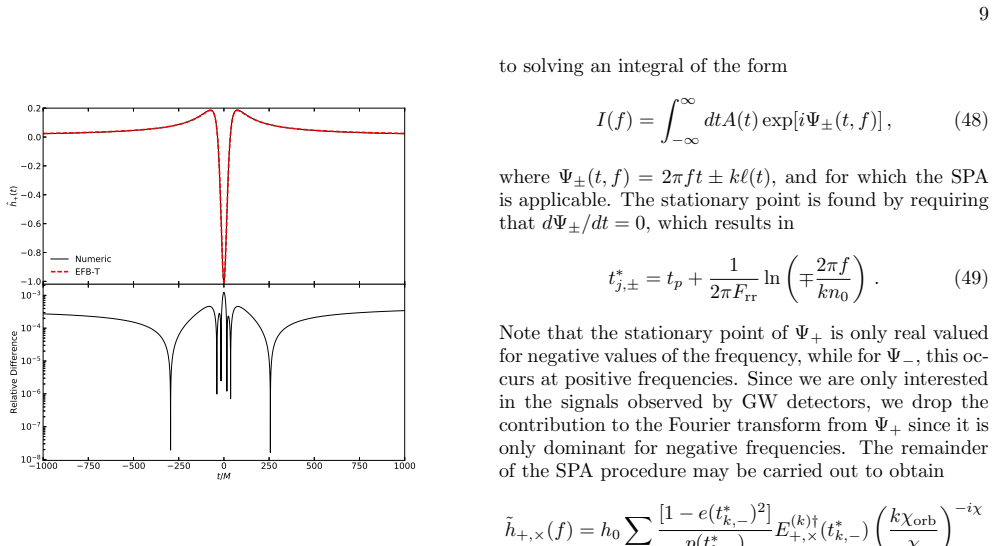
- [Sec. III A, Sec. V B, Fig. 5] The faithfulness claim of match > 0.98 against numerical leading-PN waveforms is established only on the grid e = 0.70-0.90 in Fig. 5, whereas the model's design regime is e -> 1. The pointwise check of the underlying re-summation in Fig. 1 is only at e = 0.99, where sin V disagrees with the numerical solution by ~2e-2 near apocenter. Since the polarizations in Eq. (45) build cos(2V), sin(2V), cos(3V), etc. algebraically from these approximants, the apocenter error can contaminate the higher harmonics and the wave phase over the full orbit; the match grid as presented therefore does not support the template-bank claim in the high-eccentricity burst regime. Please extend the faithfulness study to e >= 0.95, or provide a quantitative error bound showing that the apocenter inaccuracy is suppressed by the burst envelope and noise weighting.
- [Sec. IV, Sec. V A, Eq. (54)] The EFB-F model is advertised as a second analytic waveform, but Sec. V A reports that sampling it took 3-4 hours and did not cover the full frequency range, and the derivation around Eq. (54) is only sketched. In particular, the neglect of the a < 0 contributions in the resummed integrals in Eq. (51) is stated without supporting analysis. Since the abstract and introduction present EFB-F as part of the paper's contribution, the manuscript should either make EFB-F practically usable (for example, by providing a convergent expansion of the hypergeometric functions) or explicitly present it as a formal expression whose numerical evaluation is left to future work.
- [Sec. V C, Figs. 6-8] The NR matches are computed after maximizing over p0 and e0, so the reported values (0.927, 0.945, 0.754) are upper bounds on faithfulness under parameter bias. The text does acknowledge the parameter bias, but it should also state the match at the nominal NR parameters, or quantify the shift in rp and e, so that the reader can judge how much of the mismatch is due to model error and how much is due to parameter adjustment.
minor comments (4)
- [Eq. (28)] Equation (28) is in fact an identity because J0(0) = 1, so the k = 0 extension is harmless; however, the text should state this explicitly to avoid the appearance of an unjustified manipulation.
- [Abstract and Sec. V B] The abstract's statement that the match is 'typically > 0.97' is too strong, since the 10+40 solar-mass case in Fig. 5 has matches well below 0.97 over a large part of the parameter grid; please qualify the statement with the parameter ranges for which it holds.
- [Fig. 1 and Fig. 3] The vertical axes of the error panels appear to show absolute differences on a logarithmic scale, but the captions and axis labels are not explicit about whether absolute values are taken; please clarify.
- [Sec. V A] The discussion of sampling times for EFB-T at e0 = 0.999 and e0 = 0.9999 is useful, but the statement that the sampled EFB-T waveform has more than 2^20 points for e0 = 0.9999 should be accompanied by the chosen sample window and sampling rate, so the reader can reproduce the timing estimate.
Circularity Check
No significant circularity: EFB-T is an analytic approximation to Newtonian quadrupole dynamics, validated against numerical waveforms and external NR benchmarks.
full rationale
The paper's central derivation is self-contained. Section III A starts from the exact Fourier-Bessel series (12)-(13), replaces Bessel functions with their uniform asymptotic expansions (24)-(25), converts the sums to integrals (29)-(32), matches the integration constant at pericenter, and expands in epsilon = 1 - e^2. Every step is exhibited in the paper; the only citations are to standard mathematical expansions (Abramowitz-Stegun), to the original Kepler/Peters-Mathews results, and to prior papers [65],[66] for the general re-summation technique. The prior work is not used as a black-box uniqueness theorem or as a substitute for validation: the approximation is checked against direct numerical integration in Figs. 1-3 and against external NR waveforms in Sec. V C. The match against numerical Peters-Mathews waveforms is a faithfulness test of the analytic approximation against the same underlying equations, and the NR comparison is an independent benchmark; template parameters are varied only to assess the maximum achievable match, not to claim that the true parameters are predicted. No fitted parameter is relabeled as a prediction, and no waveform output is fed back into the derivation. The k=0 extension in Eq. (28) is an identity because J_0(0)=1, so it introduces no hidden input. Self-citations ([25],[44],[65]) are methodological or contextual and are not load-bearing for the accuracy claims. No circular step can be exhibited from the paper's equations or citations.
Assumptions & free parameters
assumptions (7)
- standard math Uniform asymptotic expansion of Bessel functions J_k(ke) and J'_k(ke) is valid for the regime of interest.
- ad hoc to paper Replacing harmonic sums by integrals with lower limit k=0 and matching at pericenter yields uniformly valid asymptotic series.
- domain assumption Stationary phase approximation is valid for the Fourier transform of the burst.
- domain assumption Leading-order post-Newtonian (Newtonian gravity plus quadrupole radiation) is sufficient to model the burst dynamics.
- domain assumption Adiabatic approximation: secular evolution of (p,e) is small over one orbit, so a Taylor expansion in mean anomaly is valid.
- domain assumption Waveform is valid only for one pericenter passage, with mean anomaly in [-pi, pi].
- ad hoc to paper High-eccentricity expansion in epsilon = 1 - e^2 is truncated at second order.
Cite this review
Pith. "Pith review of Analytic Waveforms for Eccentric Gravitational Wave Bursts." pith.science (2026). https://pith.science/paper/24DHG5SC
@misc{pith2026190902143,
  author       = {Pith},
  title        = {Pith review of: Analytic Waveforms for Eccentric Gravitational Wave Bursts},
  year         = {2026},
  howpublished = {\url{https://pith.science/paper/24DHG5SC}},
  note         = {Machine review of arXiv:1909.02143}
}
abstract
We here present the first analytic effective fly-by (EFB) waveforms designed to accurately capture the burst of gravitational radiation from the closest approach of highly eccentric compact binaries. The waveforms are constructed by performing a re-summation procedure on the well-known Fourier series representation of the two-body problem at leading post-Newtonian order. This procedure results in two models: one in the time-domain, and one in the Fourier domain, which makes use of the stationary phase approximation. We discuss the computational efficiency of these models, and find that the time-domain model is roughly twice as fast as a numerical quadrupole waveform. We compare the time-domain model to both numerical, leading post-Newtonian order, quadrupole waveforms and numerical relativity fly-by waveforms using the match statistic. While the match is typically $>0.97$ when compared to the quadrupole waveforms, it is much lower when comparing to the numerical relativity fly-by waveforms, due to neglecting relativistic effects within the model. We further show how to use these individual waveforms to detect a repeated burst source.
Figures


Figures from the paper (6 more)


Reference graph
Works this paper leans on
-
[1]
+e2 0 sin2ι]ζ − 3 4 + 3iχ 2 0 Γ(3− 3iχ 2 ) (1−e2 0)1/4(−8 + 18iχ + 9χ2)Γ(1− iχ 2 ) (C3) A+ 4,8,1/2 = ( 1 2 + i 2)3 3 2−iχ(1 + cos2ι)(1−e2 0)1/4ζ − 9 4 + 3iχ 2 0 Γ( 2 3− iχ 2 )Γ( 4 3− iχ 2 )√ 2π3/2(i + 3χ)(5i + 3χ)χorb { cos(2β)(−1 +e2 0)(5i + 18χ− 9iχ2)χorb + 2 √ 1−e2 0 sin(2β) [ 9(2i +χ)χ2 orb + 2iζ 3 0 ]} (C4) A+ 4,8,−1/2 = ( 1 2 + i 2)3 3 2−iχ(1 + cos2...
-
[2]
+e2 0 sin2ι][9(2i +χ)χ2 orb + 2iζ 3 0] } , (C7) A+ 5,7,−1/2 = ( 1 8 + i 8)3 1 2−iχ[cos(2β)(1 + cos2ι)(−2 +e2
-
[3]
+e2 0 sin2ι](1− 3iχ)ζ − 9 4 + 3iχ 2 0 (9χ2 orb + 4ζ 3 0)Γ( 1 6− iχ 2 )Γ( 5 6− iχ 2 )√ 2(1−e2 0)1/4π3/2(2i + 3χ)(4i + 3χ)χorb , (C8) A+ 7,11,1/2 = ( 1 4− i 4)3 1 2−iχ cos(2β)(1 + cos2ι)(1−e2 0)5/4(−5 + 18iχ + 9χ2)ζ 3 4 (−5+2iχ)[9(3i +χ)χ2 orb + 2iζ 3 0]√ 2π3/2(4i + 3χ)(8i + 3χ)χorb × Γ (1 6− iχ 2 ) Γ (5 6− iχ 2 ) (C9) A+ 7,11,−1/2 =−( 1 8 + i 8)3 1 2−iχ co...
-
[4]
sin(2β)ζ − 3 4 + 3iχ 2 0 Γ(3− 3iχ 2 ) (1−e2 0)1/4(−8 + 18iχ + 9χ2)Γ(1− iχ 2 ) (C13) A× 4,8,1/2 = (1 +i)3 3 2−iχ cosι(1−e2 0)1/4ζ − 9 4 + 3iχ 2 0 Γ( 2 3− iχ 2 )Γ( 4 3− iχ 2 )√ 2π3/2(i + 3χ)(5i + 3χ)χorb { i(−1 +e2
-
[5]
sin(2β)(−5 + 18iχ + 9χ2)χorb + 2 cos(2β) √ 1−e2 0[9(2i +χ)χ2 orb + 2iζ 3 0] } (C14) A× 4,8,−1/2 = (1 +i)3 3 2−iχ cos(2β) cosι(1−e2 0)3/4ζ − 9 4 + 3iχ 2 0 (9χ2 orb + 4ζ 3 0)Γ( 2 3− iχ 2 )Γ( 4 3− iχ 2 )√ 2π3/2(−5 + 3iχ)(i + 3χ)χorb (C15) A× 1,5,1/2 = (1 +i)3 1 2−iχ cos(2β) cosι(1−e2 0)3/4ζ − 3 4 + 3iχ 2 0 Γ( 1 6− iχ 2 )Γ( 5 6− iχ 2 )√ 2π3/2 (C16) A× 5,7,1/2...
-
[6]
sin(2β)[9(2−iχ)χ2 orb + 2ζ 3 0] } (C17) A× 5,7,−1/2 =−( 1 4− i 4)3 1 2−iχ cosι(−2 +e2
-
[7]
sin(2β)(i + 3χ)ζ − 9 4 + 3iχ 2 0 (9χ2 orb + 4ζ 3 0)Γ( 1 6− iχ 2 )Γ( 5 6− iχ 2 )√ 2(1−e2 0)1/4π3/2(2i + 3χ)(4i + 3χ)χorb (C18) A× 7,11,1/2 =−( 1 2 + i 2)3 1 2−iχ cosι(1−e2 0)5/4 sin(2β)(−5 + 18iχ + 9χ2)ζ 3 4 (−5+2iχ)[9(3−iχ)χ2 orb + 2ζ 3 0]Γ( 1 6− iχ 2 )Γ( 5 6− iχ 2 )√ 2π3/2(4i + 3χ)(8i + 3χ)χorb (C19) A× 7,11,−1/2 = ( 1 4 + i 4)3 1 2−iχ cosι(1−e2 0)5/4 si...
-
[8]
S. Naoz, B. Kocsis, A. Loeb, and N. Yunes, The Astro- physical Journal 773, 187 (2013), arXiv:1206.4316 [astro- ph.SR]. 21
arXiv 2013
Show all 84 references
-
[9]
Kocsis and J
B. Kocsis and J. Levin, Phys. Rev. D. 85, 123005 (2012), arXiv:1109.4170 [astro-ph.CO]
2012 arXiv
-
[10]
R. M. O’Leary, B. Kocsis, and A. Loeb, Mon. Not. R. Astron. Soc. 395, 2127 (2009), arXiv:0807.2638
2009 arXiv
-
[11]
Samsing, (2017), arXiv:1711.07452 [astro-ph.HE]
J. Samsing, (2017), arXiv:1711.07452 [astro-ph.HE]
2017 arXiv
-
[12]
Samsing, M
J. Samsing, M. MacLeod, and E. Ramirez-Ruiz, (2013), arXiv:1308.2964 [astro-ph.HE]
2013 arXiv
-
[13]
Samsing, D
J. Samsing, D. J. D’Orazio, K. Kremer, C. L. Rodriguez, and A. Askar, (2019), arXiv:1907.11231 [astro-ph.HE]
2019 arXiv
-
[14]
Kremer et al
K. Kremer et al. , Phys. Rev. D99, 063003 (2019), arXiv:1811.11812 [astro-ph.HE]
2019 arXiv
-
[15]
Zevin, J
M. Zevin, J. Samsing, C. Rodriguez, C.-J. Haster, and E. Ramirez-Ruiz, Astrophys. J. 871, 91 (2019), arXiv:1810.00901 [astro-ph.HE]
2019 arXiv
-
[16]
Samsing, D
J. Samsing, D. J. D’Orazio, A. Askar, and M. Giersz, (2018), arXiv:1802.08654 [astro-ph.HE]
2018 arXiv
-
[17]
Samsing, A
J. Samsing, A. Askar, and M. Giersz, Astrophys. J. 855, 124 (2018), arXiv:1712.06186 [astro-ph.HE]
2018 arXiv
-
[18]
N. W. C. Leigh et al., Mon. Not. Roy. Astron. Soc. 474, 5672 (2018), arXiv:1711.10494 [astro-ph.GA]
2018 arXiv
-
[19]
C. L. Rodriguez, P. Amaro-Seoane, S. Chatterjee, and F. A. Rasio, Phys. Rev. Lett. 120, 151101 (2018), arXiv:1712.04937 [astro-ph.HE]
2018 arXiv
-
[20]
Antonini, S
F. Antonini, S. Chatterjee, C. L. Rodriguez, M. Morscher, B. Pattabiraman, V. Kalogera, and F. A. Rasio, Astrophys. J. 816, 65 (2016), arXiv:1509.05080 [astro-ph.GA]
2016 arXiv
-
[21]
Samsing and D
J. Samsing and D. J. D’Orazio, Mon. Not. Roy. Astron. Soc. 481, 5445 (2018), arXiv:1804.06519 [astro-ph.HE]
2018 arXiv
-
[22]
D. J. D’Orazio and J. Samsing, Mon. Not. Roy. Astron. Soc. 481, 4775 (2018), arXiv:1805.06194 [astro-ph.HE]
2018 arXiv
-
[23]
Samsing and D
J. Samsing and D. J. D’Orazio, Phys. Rev. D99, 063006 (2019), arXiv:1807.08864 [astro-ph.HE]
2019 arXiv
-
[24]
Prince, American Astronomical Society Meeting 202, 3701 (2003)
T. Prince, American Astronomical Society Meeting 202, 3701 (2003)
2003
-
[25]
Kawamura et al., Laser interferometer space antenna
S. Kawamura et al., Laser interferometer space antenna. Proceedings, 8th International LISA Symposium, Stan- ford, USA, June 28-July 2, 2010 , Class. Quant. Grav. 28, 094011 (2011)
2011
-
[26]
Abramovici, W
A. Abramovici, W. E. Althouse, R. W. Drever, Y. Gursel, S. Kawamura, et al., Science 256, 325 (1992)
1992
-
[27]
G. M. Harry (LIGO Scientific Collaboration), Class.Quant.Grav. 27, 084006 (2010)
2010
-
[28]
Aasi et al
J. Aasi et al. (LIGO Scientific), Class. Quant. Grav. 32, 074001 (2015), arXiv:1411.4547 [gr-qc]
2015 arXiv
-
[29]
C. L. Rodriguez, P. Amaro-Seoane, S. Chatterjee, K. Kremer, F. A. Rasio, J. Samsing, C. S. Ye, and M. Zevin, Phys. Rev. D98, 123005 (2018), arXiv:1811.04926 [astro-ph.HE]
2018 arXiv
-
[30]
Yunes and F
N. Yunes and F. Pretorius, Phys.Rev. D80, 122003 (2009), arXiv:0909.3328 [gr-qc]
2009 arXiv
-
[31]
B. P. Abbott et al. (LIGO Scientific, Virgo), (2019), arXiv:1903.04467 [gr-qc]
2019 arXiv
-
[32]
Loutrel, N
N. Loutrel, N. Yunes, and F. Pretorius, Phys.Rev. D90, 104010 (2014), arXiv:1404.0092 [gr-qc]
2014 arXiv
- [33]
-
[34]
H. Yang, W. E. East, V. Paschalidis, F. Pretorius, and R. F. P. Mendes, Phys. Rev. D98, 044007 (2018), arXiv:1806.00158 [gr-qc]
2018 arXiv
-
[35]
B. C. Stephens, W. E. East, and F. Pretorius, Astrophys. J. 737, L5 (2011), arXiv:1105.3175 [astro-ph.HE]
2011 arXiv
-
[36]
S. V. Chaurasia, T. Dietrich, N. K. Johnson-McDaniel, M. Ujevic, W. Tichy, and B. Br¨ ugmann, Phys. Rev. D98, 104005 (2018), arXiv:1807.06857 [gr-qc]
2018 arXiv
-
[37]
L. J. Papenfort, R. Gold, and L. Rezzolla, Phys. Rev. D98, 104028 (2018), arXiv:1807.03795 [gr-qc]
2018 arXiv
-
[38]
Chirenti, R
C. Chirenti, R. Gold, and M. C. Miller, Astrophys. J. 837, 67 (2017), arXiv:1612.07097 [astro-ph.HE]
2017 arXiv
-
[39]
W. E. East, V. Paschalidis, F. Pretorius, and S. L. Shapiro, Phys. Rev. D93, 024011 (2016), arXiv:1511.01093 [astro-ph.HE]
2016 arXiv
-
[40]
M. W. Choptuik, L. Lehner, and F. Pretorius, (2015), arXiv:1502.06853 [gr-qc]
2015 arXiv
-
[41]
Rosofsky, R
S. Rosofsky, R. Gold, C. Chirenti, E. A. Huerta, and M. C. Miller, Phys. Rev. D99, 084024 (2019), arXiv:1812.06126 [gr-qc]
2019 arXiv
-
[42]
C. M. Poisson, E. and Will, Gravity: Newtonian, Post- Newtonian, Relativistic (Cambridge University Press, Cambridge, 2014)
2014
- [43]
-
[44]
W. E. East, F. Pretorius, and B. C. Stephens, Phys. Rev. D. 85, 124009 (2012), arXiv:1111.3055 [astro-ph.HE]
2012 arXiv
-
[45]
W. E. East, S. T. McWilliams, J. Levin, and F. Preto- rius, Phys. Rev. D. 87, 043004 (2013), arXiv:1212.0837 [gr-qc]
2013 arXiv
-
[46]
Salemi (LIGO Scientific, Virgo), (2019), arXiv:1907.09384 [astro-ph.HE]
F. Salemi (LIGO Scientific, Virgo), (2019), arXiv:1907.09384 [astro-ph.HE]
2019 arXiv
-
[47]
K. S. Tai, S. T. McWilliams, and F. Pretorius, Phys. Rev. D90, 103001 (2014), arXiv:1403.7754 [gr-qc]
2014 arXiv
-
[48]
Cabero et al., Class
M. Cabero et al., Class. Quant. Grav. 36, 155010 (2019), arXiv:1901.05093 [physics.ins-det]
2019 arXiv
-
[49]
B. P. Abbott et al. (LIGO Scientific, Virgo), Class. Quant. Grav. 33, 134001 (2016), arXiv:1602.03844 [gr- qc]
2016 arXiv
-
[50]
B. P. Abbott et al. (LIGO Scientific, Virgo), (2018), arXiv:1811.12907 [astro-ph.HE]
2018 arXiv
-
[51]
Loutrel and N
N. Loutrel and N. Yunes, Class. Quant. Grav. 34, 135011 (2017), arXiv:1702.01818 [gr-qc]
2017 arXiv
- [52]
-
[53]
Rebei, E
A. Rebei, E. A. Huerta, S. Wang, S. Habib, R. Haas, D. Johnson, and D. George, Phys. Rev. D100, 044025 (2019), arXiv:1807.09787 [gr-qc]
2019 arXiv
-
[54]
George and E
D. George and E. A. Huerta, Phys. Lett. B778, 64 (2018), arXiv:1711.03121 [gr-qc]
2018 arXiv
-
[55]
George and E
D. George and E. A. Huerta, in NiPS Summer School 2017 Gubbio, Perugia, Italy, June 30-July 3, 2017 (2017) arXiv:1711.07966 [gr-qc]
2017 arXiv
-
[56]
H. Shen, D. George, E. A. Huerta, and Z. Zhao, (2019), 10.1109/ICASSP.2019.8683061, arXiv:1903.03105 [astro- ph.CO]
2019
-
[57]
H.-M. Luo, W. Lin, Z.-C. Chen, and Q.-G. Huang, Front. Phys.(Beijing) 15, 14601 (2020)
2020
-
[58]
K. Kim, T. G. F. Li, R. K. L. Lo, S. Sachdev, and R. S. H. Yuen, (2019), arXiv:1912.07740 [astro-ph.IM]
2019 arXiv
-
[59]
George and E
D. George and E. A. Huerta, Phys. Rev. D97, 044039 (2018), arXiv:1701.00008 [astro-ph.IM]
2018 arXiv
-
[60]
Gabbard, M
H. Gabbard, M. Williams, F. Hayes, and C. Messenger, Phys. Rev. Lett. 120, 141103 (2018), arXiv:1712.06041 [astro-ph.IM]
2018 arXiv
-
[61]
H. Shen, E. A. Huerta, and Z. Zhao, (2019), arXiv:1903.01998 [gr-qc]
2019 arXiv
-
[62]
Chang et al., (2019), arXiv:1903.04590 [astro-ph.IM]
P. Chang et al., (2019), arXiv:1903.04590 [astro-ph.IM]
2019 arXiv
- [63]
-
[64]
T. D. Gebhard, N. Kilbertus, I. Harry, and B. Sch¨ olkopf, Phys. Rev. D 100, 063015 (2019) , Phys. Rev. D100, 063015 (2019), arXiv:1904.08693 [astro-ph.IM]. 22
2019 arXiv
-
[65]
Huerta, H
E. Huerta, H. Shen, N. Loutrel, F. Pretorius, and J. Sam- sing, In preparation (2020)
2020
-
[66]
Krolak, J
A. Krolak, J. A. Lobo, and B. J. Meers, Phys. Rev. D 43, 2470 (1991)
1991
-
[67]
D. G. Blair, The Detection of Gravitational Waves, by Edited by David G. Blair, Cambridge, UK: Cambridge University Press, 2005 (2005)
2005
-
[68]
Martel and E
K. Martel and E. Poisson, Phys. Rev. D60, 124008 (1999), arXiv:gr-qc/9907006 [gr-qc]
1999 arXiv
-
[69]
S. A. Usman et al. , Class. Quant. Grav. 33, 215004 (2016), arXiv:1508.02357 [gr-qc]
2016 arXiv
-
[70]
Sachdev et al., (2019), arXiv:1901.08580 [gr-qc]
S. Sachdev et al., (2019), arXiv:1901.08580 [gr-qc]
2019 arXiv
-
[71]
Taracchini et al
A. Taracchini et al. , Phys. Rev. D89, 061502 (2014), arXiv:1311.2544 [gr-qc]
2014 arXiv
-
[72]
Loutrel and N
N. Loutrel and N. Yunes, Class. Quant. Grav. 34, 044003 (2017), arXiv:1607.05409 [gr-qc]
2017 arXiv
-
[73]
Forseth, C
E. Forseth, C. R. Evans, and S. Hopper, Phys. Rev. D93, 064058 (2016), arXiv:1512.03051 [gr-qc]
2016 arXiv
-
[74]
Yunes, K
N. Yunes, K. G. Arun, E. Berti, and C. M. Will, Phys. Rev. D 80, 084001 (2009)
2009
-
[75]
Moreno-Garrido, E
C. Moreno-Garrido, E. Mediavilla, and J. Buitrago, Monthly Notices of the Royal Astronomical Society 274, 115 (1995), http://oup.prod.sis.lan/mnras/article- pdf/274/1/115/18539844/mnras274-0115.pdf
1995
- [76]
-
[77]
Abramowitz and I
M. Abramowitz and I. A. Stegun, Handbook of Mathe- matical Functions with Formulas, Graphs, and Mathe- matical Tables (Dover Publications, Mineola, New York, 1972)
1972
-
[78]
P. C. Peters and J. Mathews, Physical Review 131, 435 (1963)
1963
-
[79]
J. P. Boyd, Acta Applicandae Mathematica 56, 1
-
[80]
Johansson et al
F. Johansson et al. , mpmath: a Python library for arbitrary-precision floating-point arithmetic (version 0.19) (2013), http://mpmath.org/
2013
-
[81]
Barsotti, P
L. Barsotti, P. Fritschel, M. Evans, and S. Gras, LIGO Document T1800044-v5 (2018)
2018
-
[82]
Buonanno, B
A. Buonanno, B. Iyer, E. Ochsner, Y. Pan, and B. S. Sathyaprakash, Phys. Rev. D80, 084043 (2009), arXiv:0907.0700 [gr-qc]
2009 arXiv
-
[83]
Boetzel, A
Y. Boetzel, A. Susobhanan, A. Gopakumar, A. Klein, and P. Jetzer, Phys. Rev. D96, 044011 (2017), arXiv:1707.02088 [gr-qc]
2017 arXiv
-
[84]
Kremer, S
K. Kremer, S. Chatterjee, K. Breivik, C. L. Rodriguez, S. L. Larson, and F. A. Rasio, Phys. Rev. Lett. 120, 191103 (2018), arXiv:1802.05661 [astro-ph.HE]
2018 arXiv
Reviewed August 14, 2026 · model on record in the stance chip above.
Discussion (0). Continue with ORCID to comment.