REVIEW 2 major objections 4 minor 1 cited by
Quantum-enhanced screened dark energy detection
T0 review · 2 major / 4 minor · reviewed 2026-08-14 · deepseek-v4-flash
Pith's one-line read A guided BEC interferometer could rule out the simplest chameleon dark energy model and shrink symmetron parameter space by up to 26 orders of magnitude.
desk verdict A genuinely interesting guided-BEC proposal whose chameleon headline is undercut by an unexamined BEC self-screening effect and an inconsistent QCRB formula. read the letter →
The pith
A machine-rendered reading of the paper's core claim, the machinery that carries it, and where it could break.
The reading
What carries the argument
The load-bearing object is the phase-shift formula $\theta(r)=mc^2T/(2\hbar)\left[r_s/r - 2\log A(\Phi(r))\right]$, which converts a scalar-field profile into a measurable interferometric phase difference. It is obtained from a covariant Bose-field Lagrangian by reducing the conformal metric to a position-dependent shift in the BEC chemical potential in the Gross-Pitaevskii equation. Two supporting mechanisms carry the quantitative predictions: the effective-potential picture $V_{\mathrm{eff}}(\Phi)=V(\Phi)+A(\Phi)\rho$, which sets how chameleon and symmetron masses depend on ambient density, and the quantum Cramér-Rao bound $(\Delta\kappa)^2 \ge 1/(N H(\kappa))$, which fixes the best possible sensitivity of a coherent $10^6$-atom BEC and turns a null phase measurement into excluded model parameters.
What would settle it
Compute the $n=1$ chameleon field profile inside the chamber with the BEC treated as a uniform-density region of roughly $10^{14}$ atoms/cm$^3$, using the density-dependent effective mass of Eq. (A2); if the resulting phase difference across the 100 $\mu$m BEC separation falls below the quantum-noise floor quoted in the paper, the predicted constraints fail. A simpler laboratory check is to repeat the proposed measurement with condensates of different densities and see whether the per-atom phase shift changes with BEC density.
Extended reading notes
Core claim
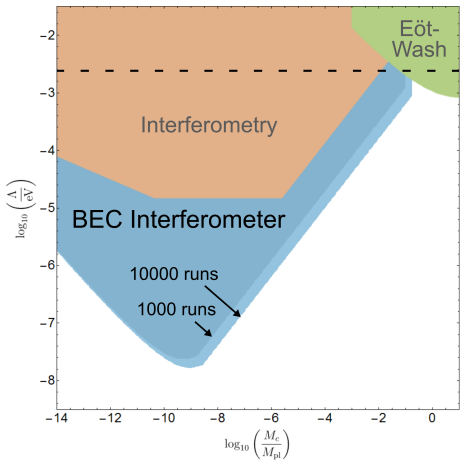
On its own terms, the paper's central claim is that a guided BEC interferometer can measure the phase imprint of a conformally coupled scalar field with enough precision to exclude the remaining parameter space of the $n=1$ chameleon at the dark-energy scale $\Lambda=2.4\,\mathrm{meV}$ and to improve symmetron constraints by 16--26 orders of magnitude in $\lambda$. The phase shift is derived to lowest order as $\theta(r)=mc^2T/(2\hbar)\left[r_s/r - 2\log A(\Phi(r))\right]$, where $A(\Phi)$ is the conformal coupling; the scalar field's contribution is a modification of the gravitational redshift. The authors evaluate the quantum Fisher information for a $10^6$-atom BEC with a 500 ms coherence time, use the geometry of a 5 cm vacuum chamber and a 9.5 mm aluminium source sphere, and compare the resulting bounds with existing atom-interferometry and torsion-balance constraints. They conclude that an implementation would either discover the $n=1$ chameleon at the cosmological energy density or rule it out, and that any conformally coupled scalar model could be constrained in the same way.
Load-bearing premise
The load-bearing premise is that the dense BEC acts as a passive probe and does not perturb the scalar-field profile it is meant to measure; the paper argues this is harmless for the symmetron but leaves it unexamined for the chameleon, where a denser condensate would make the field heavier and flatten the very gradient the interferometer would detect.
Editorial extensions
If this is right
- A null measurement would rule out the $n=1$ chameleon at the cosmological dark-energy scale $\Lambda=2.4\,\mathrm{meV}$, eliminating the simplest chameleon model as a dark-energy explanation.
- The same experiment would improve constraints on $M_c$ for positive-$n$ chameleon models by more than two orders of magnitude and close the gap to torsion-balance constraints for $n\le 5$.
- Symmetron parameter space would be excluded over 16 to 26 orders of magnitude in $\lambda$ across the accessible $M_s$ range, with $\mu_s$ between roughly $10^{-5.5}$ and $10^{-4}$ eV.
- Because the phase imprint is generic to conformally coupled scalars, any such model—not just chameleons and symmetrons—can be constrained with the same interferometer.
- Any implementation will either discover the $n=1$ chameleon at the cosmological energy density or rule it out, along with sharpening bounds on other screened scalar models.
Reading between the lines
- Because the phase-shift formula is derived for a generic conformally coupled scalar, the same sensitivity analysis could be applied directly to galileon or dilaton models; the only new work would be computing their screened field profiles in the chamber.
- The chameleon self-screening question could be settled before building anything: a numerical solution with the BEC treated as a high-density sphere would either confirm the passive-probe assumption or shrink the claimed excluded region.
- The near-26-order symmetron improvement is dominated by the $\lambda$-coupling entering the phase at order $\lambda^{-1}$; if future constraints push $\lambda$ into the measured regime, the same apparatus becomes a direct measurement of $\lambda$ rather than an exclusion test.
- A dual-species or dual-density BEC scheme could subtract common-mode noise and also serve as an in-situ check of whether the condensate back-reacts on the scalar field.
Editorial analysis
A structured set of objections, weighed in public.
Referee Report
Summary. The paper proposes a guided Bose-Einstein condensate (BEC) interferometer as a laboratory probe for screened scalar fields, specifically the chameleon and symmetron models that can act as dark energy candidates. The authors derive the lowest-order phase shift induced by a conformally coupled scalar on a BEC (Appendix B), then use the quantum Cramer-Rao bound to forecast exclusion regions in the model parameter spaces under concrete experimental assumptions: 10^6 atoms, 500 ms integration, a 5 cm spherical vacuum chamber at 6e-10 Torr, an aluminium source sphere of radius 9.5 mm, and a 100 micron splitting. The headline claims are that the n=1 chameleon at the dark energy scale Lambda=2.4 meV would be ruled out, and that symmetron parameter space would shrink by 16 to 26 orders of magnitude in lambda. The paper is a sensitivity forecast rather than a measurement, and it explicitly leaves technical noise for future work.
Significance. If the forecast is correct, the proposal would be experimentally significant: it would close the gap between existing atom-interferometry and Eot-Wash constraints for chameleon models and dramatically shrink symmetron parameter space, potentially ruling out the simplest chameleon model as an explanation of dark energy. The paper is transparent about its assumptions, uses standard QFI tools, and Appendix B gives a careful first-principles derivation of the phase shift, which is a strength. The symmetron analysis in Appendix C also demonstrates awareness of the BEC's own density as a potential backreaction issue. The central claim, however, rests on the assumption that the BEC is a passive probe of the chameleon field profile, and the paper does not quantify the self-screening of the BEC for chameleons, even though Eq. (A2) shows the chameleon mass grows sharply with density. This is a load-bearing gap that must be addressed before the headline exclusion claim can be accepted.
major comments (2)
- [Appendix C, Eq. (C1)] The quantum Cramer-Rao bound as written in Eq. (C1), (Delta theta_-)^2 >= 1/sqrt(N H(theta_-)), disagrees with the standard bound stated in Eq. (8), (Delta kappa)^2 >= 1/(N H(kappa)). The former implies Delta theta_- scales as (N H)^(-1/4), whereas the latter gives (N H)^(-1/2). Since Eqs. (C4), (C6), and (C7) all use the Eq. (C1) form to derive the constraint curves in Figs. 2-4, the displayed exclusion regions must be recalculated. If Eq. (C1) were taken literally, the forecast sensitivities would be substantially weaker than the standard QCRB; the authors should either correct the typo and confirm the figures used the correct expression, or state explicitly which form was used in the numerics.
- [Appendix C, chameleon constraints and Fig. 2] The manuscript does not analyze the backreaction of the BEC on the chameleon field, although Appendix C explicitly considers this issue for the symmetron. Eq. (A2) gives m_c^2 = 2 Lambda^5 (rho/(2 M_c Lambda^5))^{3/2}, so the chameleon mass inside a BEC with density ~10^13-10^14 cm^-3 is orders of magnitude larger than in the surrounding vacuum at ~10^7 cm^-3. In the low-M_c branch of Fig. 2 (M_c/M_Pl < 10^-10), the in-condensate Compton wavelength becomes comparable to or smaller than a typical 5-10 micron BEC width, so each cloud would be self-screened and the field inside both arms would sit at the same high-density minimum. This would suppress the phase difference in Eq. (C2) relative to the vacuum profile, potentially removing the newly excluded region that is the centerpiece of the paper. The authors need either a quantitative estimate of the chameleon field profile inside and around the BEC for this parameter range, or a clear argument for why the BEC is optically thin to the chameleon field, before the headline claim can be considered supported.
minor comments (4)
- [Appendix C, first paragraph of chameleon section] The sentence 'There are three major sections in the BEC interferometer constraints in Fig. 4' should refer to Fig. 2, since the three-section structure is discussed for the chameleon model whose constraints are shown in Fig. 2; Fig. 4 shows the symmetron constraints.
- [Eq. (C2)] Eq. (C2) would be clearer if the quantities N and H were defined here explicitly as the number of measurements and the quantum Fisher information, respectively, or if the reader were referred to Eq. (8) and the definition H(theta_-)=N0 in the main text.
- [Appendix C, Eq. (C5) and surrounding text] The notation m_infty -> hbar/R_vac in the text is informal; it would help to state explicitly that in the chamber-limited regime the effective mass is approximated by 1/R_vac in natural units, since the arrow notation may be confused with a limit taken.
- [Main text, experimental parameters] The sentence about van der Waals and Casimir-Polder forces being 'not relevant at the 10 mm scale' is slightly at odds with the stated effective distance of 8.8 mm; it may be worth noting that the quoted distance already accounts for the relevant geometry.
Circularity Check
No significant circularity: the predicted constraints are a sensitivity forecast from external field profiles and standard QFI, with no fitted input renamed as a prediction.
full rationale
The paper's central claim is that a proposed BEC interferometer would improve existing chameleon and symmetron constraints. The constraint curves in Figs. 2–4 are obtained by inserting externally known chameleon/symmetron field profiles (from Burrage–Sakstein and Elder et al.) into the phase-shift formula (C2) and applying the quantum Cramer–Rao bound (C1); no parameter is fitted to data and then renamed a prediction. The ξ=0.55 'fudge factor' in Eq. (C5) is inherited from Elder et al. (2016), not fitted to the proposed experiment's target. Appendix B re-derives the phase shift from a covariant BEC Hamiltonian; although it cites [19,57,58], two of which are by overlapping authors, the derivation is self-contained and does not import a uniqueness theorem or ansatz that defines the target result. The main limitations are physical assumptions rather than circularity: the authors omit technical noise in the main text, and Appendix C checks BEC backreaction for the symmetron ('the Compton wavelength of the symmetron is far greater than the width of the BEC... whether or not the BEC is screened does not play a role') but gives no analogous chameleon backreaction estimate, leaving a correctness risk for the headline chameleon bound. Such risks do not reduce the derivation to its inputs by construction, so the circularity score is 0.
Assumptions & free parameters
free parameters (4)
- BEC atom number N0 =
10^6
- Interrogation time T =
500 ms
- Chamber geometry (source radius, chamber radius, distance, split) =
R=9.5 mm, L=5 cm, d=8.8 mm, split=100 um
- Chamber fudge factor xi =
0.55
assumptions (5)
- domain assumption Conformal coupling and the specific chameleon and symmetron potentials (Eqs. 1-6) describe dark energy and fifth forces.
- domain assumption The BEC is described by a non-relativistic scalar field in the Bogoliubov approximation, and the lowest-order phase shift is the chemical potential shift (Appendix B).
- standard math The quantum Fisher information for estimating the phase with a fully condensed coherent BEC is H=N0.
- domain assumption The chameleon and symmetron field profiles in the chamber are given by the approximate analytic expressions in Appendix C, including the chamber-limited solution with xi=0.55.
- domain assumption Gravitational effects of the Earth and other environmental backgrounds can be eliminated by differential measurements.
Cite this review
Pith. "Pith review of Quantum-enhanced screened dark energy detection." pith.science (2026). https://pith.science/paper/6ORK4S7B
@misc{pith2026190902272,
  author       = {Pith},
  title        = {Pith review of: Quantum-enhanced screened dark energy detection},
  year         = {2026},
  howpublished = {\url{https://pith.science/paper/6ORK4S7B}},
  note         = {Machine review of arXiv:1909.02272}
}
read the original abstract
We propose an experiment based on a Bose-Einstein condensate interferometer for strongly constraining fifth-force models. Additional scalar fields from modified gravity or higher dimensional theories may account for dark energy and the accelerating expansion of the Universe. These theories have led to proposed screening mechanisms to fit within the tight experimental bounds on fifth-force searches. We show that our proposed experiment would greatly improve the existing constraints on these screening models by many orders of magnitude.
Figures


Figures from the paper (3 more)


Forward citations
Cited by 1 Pith paper
-
Direct detection of solar chameleons with electron recoil data from XENONnT
XENONnT electron-recoil data bound solar chameleons to log10 β_eff < −6.9, independent of the potential index n for inverse power-law chameleons at the dark-energy scale.
Reference graph
Works this paper leans on
-
[1]
Chameleon constraints, Figures 2 and 3 in the main text There are three major sections in the BEC interferometer constraints in Fig. 4; the negatively sloped section where Mc/Mpl < 10−10, the vertical lines bounding the region on the large Mc side of the figure, and the positively sloped section between them. In the limit of an infinitely wide vacuum chambe...
- [2]
-
[3]
I. K. Wehus and F. Ravndal, Int. J. Mod. Phys. A19, 4671 (2004), arXiv:hep-ph/0210292 [hep-ph]
work page Pith review arXiv 2004
-
[4]
ℏ2 ⏐⏐⏐∂i ˆφ†∂i ˆφ ⏐⏐⏐≪m2c2 ˆφ† ˆφ, 12 where i runs over spatial indices. To lowest order in ζ2 and rs/r, the resulting Hamiltonian density is H = ℏ2 2m ∑ i ∂iφ†∂iφ +Veff ˆφ† ˆφ + 1 2λNR ˆφ† ˆφ† ˆφˆφ, (B6) where Veff =VNR + 1 2mc2 [ ζ2− rs ravg ] . (B7) The potentials have been rescaled in the form VNR = V 2m, λNR = λ 2m (B8) as these are the form of the e...
-
[5]
Symmetron constraints, Figure 4 in the main text The value ofµs to which these constraints apply is limited by the geometry of the proposed experiment, as the Compton wavelength in low density regions is approximately 1 /µs. For the field to evolve to its vacuum minimum within the chamber, the Compton wavelength 15 must be smaller than the vacuum chamber r...
-
[6]
Brans and R
C. Brans and R. H. Dicke, Phys. Rev. 124, 925 (1961)
1961
-
[7]
Y. Fujii and K. Maeda, The scalar-tensor theory of gravitation , Cambridge Monographs on Mathematical Physics (Cambridge University Press, 2007)
work page 2007
-
[8]
S. Perlmutter et al. (Supernova Cosmology Project), Astrophys. J. 517, 565 (1999), arXiv:astro-ph/9812133 [astro-ph]
arXiv 1999
Show all 64 references
-
[9]
A. G. Riess et al. (Supernova Search Team), Astron. J. 116, 1009 (1998), arXiv:astro- ph/9805201 [astro-ph]
1998
-
[10]
Clifton, P
T. Clifton, P. G. Ferreira, A. Padilla, and C. Skordis, Phys. Rept. 513, 1 (2012), arXiv:1106.2476 [astro-ph.CO]
2012 arXiv
-
[11]
Joyce, B
A. Joyce, B. Jain, J. Khoury, and M. Trodden, Phys. Rept. 568, 1 (2015), arXiv:1407.0059 [astro-ph.CO]
2015 arXiv
-
[12]
J. O. Dickey, P. L. Bender, J. E. Faller, X. X. Newhall, R. L. Ricklefs, J. G. Ries, P. J. Shelus, C. Veillet, A. L. Whipple, J. R. Wiant, J. G. Williams, and C. F. Yoder, Science 265, 482 (1994)
1994
-
[13]
E. G. Adelberger, B. R. Heckel, and A. E. Nelson, Annu. Rev. Nucl. Part. S. 53, 77 (2003)
2003
-
[14]
D. J. Kapner, T. S. Cook, E. G. Adelberger, J. H. Gundlach, B. R. Heckel, C. D. Hoyle, and H. E. Swanson, Phys. Rev. Lett. 98, 021101 (2007)
2007
-
[15]
Ishak, Living Rev
M. Ishak, Living Rev. Rel. 22, 1 (2019), arXiv:1806.10122 [astro-ph.CO]
2019 arXiv
-
[16]
Burrage and J
C. Burrage and J. Sakstein, Living Rev. Rel. 21, 1 (2018), arXiv:1709.09071 [astro-ph.CO]
2018 arXiv
-
[17]
A. D. Ludlow, M. M. Boyd, J. Ye, E. Peik, and P. O. Schmidt, Rev. Mod. Phys. 87, 637 (2015)
2015
-
[18]
Schlippert, H
D. Schlippert, H. Albers, L. L. Richardson, D. Nath, H. Heine, C. Meiners, E. Wodey, A. Bil- 17 lon, J. Hartwig, C. Schubert, N. Gaaloul, W. Ertmer, and E. M. Rasel, Proceedings of the 50th Rencontres de Moriond ”Gravitation: 100 years after GR”, La Thuile (Italy) (2015)
2015
-
[19]
Overstreet, P
C. Overstreet, P. Asenbaum, T. Kovachy, R. Notermans, J. M. Hogan, and M. A. Kasevich, Phys. Rev. Lett. 120, 183604 (2018)
2018
-
[20]
Becker, M
D. Becker, M. D. Lachmann, S. T. Seidel, H. Ahlers, A. N. Dinkelaker, J. Grosse, O. Hellmig, H. M¨ untinga, V. Schkolnik, T. Wendrich, A. Wenzlawski, B. Weps, R. Corgier, T. Franz, N. Gaaloul, W. Herr, D. L¨ udtke, M. Popp, S. Amri, H. Duncker, M. Erbe, A. Kohfeldt, A. Kubelka...
2018
-
[21]
Burrage, E
C. Burrage, E. J. Copeland, and E. A. Hinds, JCAP 1503, 042 (2015), arXiv:1408.1409 [astro-ph.CO]
2015 arXiv
-
[22]
M. Jaffe, P. Haslinger, V. Xu, P. Hamilton, A. Upadhye, B. Elder, J. Khoury, and H. M¨ uller, Nature Physics 13, 938 (2017)
2017
-
[23]
Hartley, C
D. Hartley, C. K¨ ading, R. Howl, and I. Fuentes, Phys. Rev. D 99, 105002 (2019)
2019
-
[24]
Burrage and J
C. Burrage and J. Sakstein, Journal of Cosmology and Astroparticle Physics 2016, 045 (2016)
2016
-
[25]
Khoury and A
J. Khoury and A. Weltman, Phys. Rev. D69, 044026 (2004), arXiv:astro-ph/0309411 [astro- ph]
2004 arXiv
-
[26]
Khoury and A
J. Khoury and A. Weltman, Phys. Rev. Lett. 93, 171104 (2004), arXiv:astro-ph/0309300 [astro-ph]
2004 arXiv
-
[27]
Dehnen, H
H. Dehnen, H. Frommert, and F. Ghaboussi, International Journal of Theoretical Physics 31, 109 (1992)
1992
-
[28]
Gessner, Astrophysics and Space Science 196, 29 (1992)
E. Gessner, Astrophysics and Space Science 196, 29 (1992)
1992
-
[30]
Pietroni, Phys
M. Pietroni, Phys. Rev. D 72, 043535 (2005)
2005
-
[31]
K. A. Olive and M. Pospelov, Phys. Rev. D 77, 043524 (2008)
2008
-
[32]
P. Brax, C. van de Bruck, A.-C. Davis, and D. Shaw, Phys. Rev. D 82, 063519 (2010)
2010
-
[33]
Hinterbichler and J
K. Hinterbichler and J. Khoury, Phys. Rev. Lett. 104, 231301 (2010), arXiv:1001.4525 [hep- th]
2010 arXiv
-
[34]
Hinterbichler, J
K. Hinterbichler, J. Khoury, A. Levy, and A. Matas, Phys. Rev. D84, 103521 (2011), 18 arXiv:1107.2112 [astro-ph.CO]
2011 arXiv
-
[35]
Burrage, A
C. Burrage, A. Kuribayashi-Coleman, J. Stevenson, and B. Thrussell, JCAP 1612, 041 (2016), arXiv:1609.09275 [astro-ph.CO]
2016 arXiv
-
[36]
Y. Shin, M. Saba, T. A. Pasquini, W. Ketterle, D. E. Pritchard, and A. E. Leanhardt, Phys. Rev. Lett. 92, 050405 (2004)
2004
-
[37]
J. E. Debs, P. A. Altin, T. H. Barter, D. D¨ oring, G. R. Dennis, G. McDonald, R. P. Anderson, J. D. Close, and N. P. Robins, Phys. Rev. A 84, 033610 (2011)
2011
-
[38]
Berrada, S
T. Berrada, S. van Frank, R. B¨ ucker, T. Schumm, J.-F. Schaff, and J. Schmiedmayer, Nature Communications 4, 2077 (2013)
2013
-
[39]
M¨ untinga, H
H. M¨ untinga, H. Ahlers, M. Krutzik, A. Wenzlawski, S. Arnold, D. Becker, K. Bongs, H. Dit- tus, H. Duncker, N. Gaaloul, C. Gherasim, E. Giese, C. Grzeschik, T. W. H¨ ansch, O. Hellmig, W. Herr, S. Herrmann, E. Kajari, S. Kleinert, C. L¨ ammerzahl, W. Lewoczko-Adamczyk, J. Ma...
2013
-
[40]
G. D. McDonald, C. C. N. Kuhn, K. S. Hardman, S. Bennetts, P. J. Everitt, P. A. Altin, J. E. Debs, J. D. Close, and N. P. Robins, Phys. Rev. Lett. 113, 013002 (2014)
2014
-
[41]
A. D. Cronin, J. Schmiedmayer, and D. E. Pritchard, Rev. Mod. Phys. 81, 1051 (2009)
2009
-
[42]
Albiez, R
M. Albiez, R. Gati, J. F¨ olling, S. Hunsmann, M. Cristiani, and M. K. Oberthaler, Phys. Rev. Lett. 95, 010402 (2005)
2005
-
[43]
D. S. Naik, G. Kuyumjyan, D. Pandey, P. Bouyer, and A. Bertoldi, Quantum Science and Technology 3, 045009 (2018)
2018
-
[44]
Berrada, S
T. Berrada, S. van Frank, R. B¨ ucker, T. Schumm, J.-F. Schaff, J. Schmiedmayer, B. Jul´ ıa-D´ ıaz, and A. Polls, Phys. Rev. A 93, 063620 (2016)
2016
-
[45]
S. L. Braunstein and C. M. Caves, Phys. Rev. Lett. 72, 3439 (1994)
1994
-
[46]
M. G. A. Paris, International Journal of Quantum Information 07, 125 (2009)
2009
-
[47]
ˇSafr´ anek and I
D. ˇSafr´ anek and I. Fuentes, Phys. Rev. A94, 062313 (2016)
2016
-
[48]
Monras, Phys
A. Monras, Phys. Rev. A 73, 033821 (2006)
2006
-
[49]
Pinel, P
O. Pinel, P. Jian, N. Treps, C. Fabre, and D. Braun, Physical Review A 88, 040102(R) (2013)
2013
-
[50]
ˇSafr´ anek, A
D. ˇSafr´ anek, A. R. Lee, and I. Fuentes, New Journal of Physics 17, 073016 (2015). 19
2015
-
[51]
Kok and B
P. Kok and B. W. Lovett, Introduction to optical quantum information processing (Cambridge University Press, 2010)
2010
-
[52]
K. M. R. van der Stam, E. D. van Ooijen, R. Meppelink, J. M. Vogels, and P. van der Straten, Review of Scientific Instruments 78, 013102 (2007), https://doi.org/10.1063/1.2424439
2007 doi
-
[53]
D. G. Fried, T. C. Killian, L. Willmann, D. Landhuis, S. C. Moss, D. Kleppner, and T. J. Greytak, Phys. Rev. Lett. 81, 3811 (1998)
1998
-
[54]
Greytak, D
T. Greytak, D. Kleppner, D. Fried, T. Killian, L. Willmann, D. Landhuis, and S. Moss, Physica B: Condensed Matter 280, 20 (2000)
2000
-
[55]
G.-B. Jo, Y. Shin, S. Will, T. A. Pasquini, M. Saba, W. Ketterle, D. E. Pritchard, M. Ven- galattore, and M. Prentiss, Phys. Rev. Lett. 98, 030407 (2007)
2007
-
[56]
S. Zhou, D. Groswasser, M. Keil, Y. Japha, and R. Folman, Phys. Rev. A 93, 063615 (2016)
2016
-
[57]
Hamilton, M
P. Hamilton, M. Jaffe, P. Haslinger, Q. Simmons, H. M¨ uller, and J. Khoury, Science 349, 849 (2015)
2015
-
[58]
G. R. Dvali, G. Gabadadze, and M. Porrati, Phys. Lett. B485, 208 (2000), arXiv:hep- th/0005016 [hep-th]
2000
-
[59]
Damour and A
T. Damour and A. M. Polyakov, Nucl. Phys. B423, 532 (1994), arXiv:hep-th/9401069 [hep- th]
1994 arXiv
-
[60]
P. Brax, C. van de Bruck, A.-C. Davis, B. Li, and D. J. Shaw, Phys. Rev. D83, 104026 (2011), arXiv:1102.3692 [astro-ph.CO]
2011 arXiv
-
[61]
Fagnocchi, S
S. Fagnocchi, S. Finazzi, S. Liberati, M. Kormos, and A. Trombettoni, New Journal of Physics 12, 095012 (2010)
2010
-
[62]
Hartley, T
D. Hartley, T. Bravo, D. R¨ atzel, R. Howl, and I. Fuentes, Phys. Rev. D 98, 025011 (2018)
2018
-
[63]
Pitaevskii and S
L. Pitaevskii and S. Stringari, Bose-Einstein Condensation (Oxford University Press, 2003)
2003
-
[64]
C. J. Pethick and H. Smith, Bose-Einstein Condensation in Diulte Gases (Cambridge Uni- versity Press, 2002)
2002
-
[65]
Elder, J
B. Elder, J. Khoury, P. Haslinger, M. Jaffe, H. Mller, and P. Hamilton, Phys. Rev. D94, 044051 (2016), arXiv:1603.06587 [astro-ph.CO]. 20
2016 arXiv
Reviewed August 14, 2026 · model on record in the stance chip above.
Discussion (0). Continue with ORCID to comment.