REVIEW 3 major objections 5 minor 4 cited by
Ab-Initio Solution of the Many-Electron Schr\"odinger Equation with Deep Neural Networks
T0 review · 3 major / 5 minor · reviewed 2026-08-14 · deepseek-v4-flash
Pith's one-line read The paper introduces the Fermionic Neural Network, a deep-learning wavefunction ansatz that, using only atomic positions and charges, reaches lower variational energies than CCSD(T) on stretched nitrogen and hydrogen chains and recovers…
desk verdict FermiNet is the real breakthrough: a continuous-space neural wavefunction ansatz that beats CCSD(T) on stretched systems, though the 'no data' claim is overstated by the HF pretraining and the out-of-the-box robustness is not fully demonstrated. read the letter →
The pith
A machine-rendered reading of the paper's core claim, the machinery that carries it, and where it could break.
The reading
What carries the argument
The load-bearing object is the generalized Slater determinant: the orbital in each determinant is not a function of one electron's position but a permutation-equivariant function $\varphi^k_i(x_j; \{x_{/j}\})$ of the whole electronic configuration, so exchanging two electrons swaps rows or columns of the determinant matrix and the wavefunction is antisymmetric by construction. The network feeds single-electron features (electron-nucleus vectors and distances) through one stream and pairwise electron features through another, symmetrically averages same-spin activations, and after several residual tanh layers forms spin-up and spin-down determinant blocks weighted by exponentially decaying envelopes that enforce the boundary conditions. The energy is minimized with a Kronecker-factored approximate natural-gradient optimizer, and the cusp conditions are captured because interparticle distances are included directly as inputs.
What would settle it
Retrain the FermiNet on stretched N2 at one bond length, say 3.5 a0, from several independent random seeds and with a different optimizer; if the spread of final variational energies exceeds the reported gap to CCSD(T), the claimed accuracy is not the ansatz's true optimum.
Extended reading notes
Core claim
The discovery is that antisymmetry, the main obstacle to using neural networks for electrons, can be built into a Slater-determinant ansatz by letting every orbital depend on all electron coordinates in a permutation-equivariant way. With this ansatz, a single network trained by energy minimization yields, from only atomic positions and charges, dissociation curves for N2 and H10 that are significantly closer to exact or experimental references than unrestricted CCSD(T), and equilibrium energies that match DMC and AFQMC on small systems. The paper further reports that the ansatz reproduces the exact FCI energy surface of the H4 rectangle where coupled cluster predicts a spurious cusp.
Load-bearing premise
The comparisons assume that the optimization routine reaches a near-global minimum of the variational energy for every system, so the reported numbers are the true FermiNet limits; the paper gives empirical convergence evidence but notes that stable convergence was highly dependent on the hyperparameters.
Editorial extensions
If this is right
- A single architecture and one hyperparameter set transfer across atoms, diatomics, and small organic molecules, so the method can be applied to a new system without system-specific ansatz design.
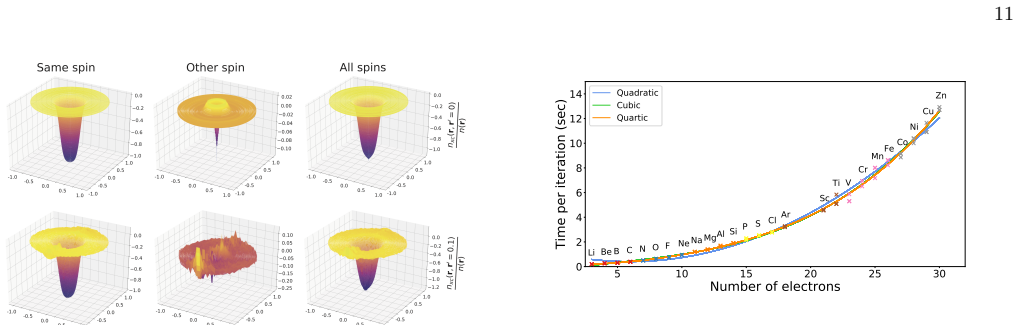
- Since the wavefunction lives in the continuum, FermiNet results avoid basis-set extrapolation error; widening the one-electron stream provides a systematic, if polynomial, route to lower energies.
- The FermiNet can be used as a trial wavefunction for projector quantum Monte Carlo, which would carry its accuracy into DMC and AFQMC calculations.
- For out-of-equilibrium and multireference-like systems, variational optimization with FermiNet avoids the non-variational failures of single-reference coupled cluster, as shown by the H4 rectangle and stretched N2.
Reading between the lines
- If the measured $O(N^{-0.395})$ decay of error with one-electron stream width continues, extrapolating FermiNet energies to infinite width would give a basis-free analogue of complete-basis-set extrapolation; the paper fits the scaling but does not perform that extrapolation.
- Because the ansatz is set in continuous space with no lattice or basis, adapting it to periodic boundary conditions is a natural next step toward solids and surfaces, a direction the present paper does not address.
- The paper's derivation that the optimizer is equivalent to stochastic reconfiguration suggests the practical gains come partly from the optimization algorithm, so architectural advances for the ansatz and preconditioner advances for the optimizer may compound rather than compete.
Signed reviews
Editorial analysis
A structured set of objections, weighed in public.
Referee Report
Summary. The paper introduces the Fermionic Neural Network (FermiNet), a variational wavefunction ansatz for continuous-space many-electron systems. The ansatz builds antisymmetric wavefunctions from determinants whose entries are permutation-equivariant functions of all electron coordinates, computed by a neural network with one-electron and two-electron streams, plus an exponentially decaying envelope. Parameters are optimized by minimizing the variational energy via VMC with KFAC natural-gradient updates and Metropolis sampling. The authors report ground-state energies for first-row atoms, small molecules, the H4 rectangle, the N2 dissociation curve, and the H10 chain, comparing against exact/FCI, CCSD(T), DMC, AFQMC, and experimental references. The central claim is that the same architecture with a single default hyperparameter set, using no data other than atomic positions and charges, outperforms coupled cluster on strongly correlated dissociation curves and approaches projector-QMC accuracy at equilibrium.
Significance. If the results hold, this is a substantial advance: it demonstrates that a flexible neural-network ansatz can represent strongly correlated molecular wavefunctions in continuous space well enough to beat single-reference CCSD(T) on stretched systems and to rival DMC/AFQMC at equilibrium, using a variational method with polynomial scaling. The paper contains several strong elements worth credit: all reported energies are variational upper bounds; the results are cross-checked against exact, FCI, and experimental references; the custom reverse-mode gradient for singular determinants is a genuine technical contribution; Appendix B gives a universality argument for generalized Slater determinants; and the non-interacting-chain check in Appendix E directly addresses size consistency. The main weaknesses are the absence of released code, the acknowledged sensitivity of convergence to hyperparameters, and the overstated 'no data' wording given the Hartree-Fock pretraining step.
major comments (3)
- [Abstract and Appendix A 1] The abstract's claim that the method uses 'no data other than atomic positions and charges' is contradicted by the pretraining procedure in Appendix A 1, where the network is 'pretrained to match Hartree-Fock (HF) orbitals computed using PySCF' in an STO-3G basis. The HF orbitals are a fitted target for the pretraining loss, and the STO-3G basis is an external modeling choice beyond atomic positions and charges. I recommend rephrasing the claim (for example, 'no empirical data' or 'no data beyond the Hamiltonian and the atomic positions/charges') and adding a short demonstration that the final energies are insensitive to the pretraining basis.
- [Appendix A 1 and Table V] Appendix A states that 'Accurate and stable convergence was highly dependent on the hyperparameters used,' and Table V had to be altered for bicyclobutane. Because the central N2 and H10 results (Figs. 5 and 6) are obtained with one default hyperparameter set, and no sensitivity analysis or released code is provided, the manuscript does not currently support the 'out-of-the-box' claim made in Section I and the Discussion. Please add a hyperparameter-robustness study (at least on one stretched system, perturbing the Table V values) and release the code with defaults, or weaken the transferability claim proportionately.
- [Section III B and Table II] The statement in Section III B that the FermiNet is 'more accurate than CCSD(T) in the largest basis set we could practically run' should not be conflated with outperforming CCSD(T) in the complete-basis limit: the CCSD(T)/CBS column in Table II is below the FermiNet energy for most listed molecules, and CCSD(T) is non-variational. The abstract's stronger claim concerns dissociation curves, which is supported by Figs. 4-6, but the equilibrium-geometry comparisons should be worded to distinguish finite-basis CCSD(T) from basis-set-extrapolated CCSD(T).
minor comments (5)
- [Section II B] The text refers to 'the Hamiltonian of the system as given in Eqn. I,' but the Hamiltonian is labeled Eq. (1); please fix the cross-reference.
- [Eq. (7)] There is a typo in the second determinant of Eq. (7): 'det[φ^↓_i(r^↓_j;{r^↓_{/j}});{r^↑};])' has a misplaced semicolon and parenthesis.
- [Table I caption] The caption says electron affinities for Be, N, and Ne are not computed because their anions are unstable; the beryllium anion is often regarded as borderline, so a brief justification or citation would help.
- [Figure 10 caption] The caption reports a power-law exponent with a bootstrap error bar but does not describe the bootstrap procedure; please provide details in the caption or in Appendix A.
- [Appendix A 1] The description of the pretraining distribution uses p_pre(X) as an equal mixture of the product of Hartree-Fock orbitals and ψ²(X); it would be clearer to state explicitly how the two halves of the MCMC batch are generated in practice.
Circularity Check
No significant circularity: FermiNet energies are obtained by variational minimization against the Hamiltonian, with all benchmarks external; HF pretraining is an initialization, not a fitted target.
full rationale
The paper's derivation chain is self-contained and not circular. The FermiNet ansatz is a parameterized antisymmetric wavefunction whose parameters are optimized by minimizing the variational energy E(theta)=<psi_theta|H|psi_theta>/<psi_theta|psi_theta> with respect to the Hamiltonian of the system (Eq. 1 and Section II.B). The reported ground-state energies and dissociation curves are the outcome of this minimization; no experimental, CCSD(T), DMC, or AFQMC energies enter the training objective. The Hartree-Fock pretraining described in Appendix A is an initialization strategy: the pretraining loss matches FermiNet orbitals to PySCF STO-3G HF orbitals, but the subsequent local-energy minimization is free to move away, and the paper reports the final variational energy, not the pretrained value. Thus HF pretraining is not a fitted parameter renamed as a prediction. All benchmarks (Tables I-II, Figures 5-6) are external comparisons to experiment, FCI, CCSD(T), DMC, and AFQMC results from the literature, so the accuracy claims are not defined in terms of the inputs. The universality statement in Appendix B is a mathematical construction, not a computational shortcut, and is explicitly acknowledged to require discontinuous orbitals that the FermiNet cannot learn; it is not load-bearing for the numerical results. The paper invokes no uniqueness theorem and no load-bearing self-citation from the authors. The main caveats - the abstract's 'no data' phrasing versus HF pretraining, and Appendix A's admission that convergence was highly dependent on hyperparameters and that bicyclobutane used altered defaults - concern reproducibility and interpretation, not circularity, because the reported energies are not forced by construction to equal the benchmarks.
Assumptions & free parameters
free parameters (2)
- Default architecture sizes (L=4 layers, n1=256 one-electron units, n2=32 two-electron units, nk=16 determinants) =
L=4, n1=256, n2=32, nk=16
- KFAC and sampling hyperparameters =
damping 1e-3, norm constraint 1e-3, covariance decay 0.95, batch size 4096, local energy clipping 5.0, MCMC proposal…
assumptions (8)
- standard math Variational principle: the minimum of the energy expectation over an ansatz is an upper bound to the true ground-state energy.
- domain assumption Born-Oppenheimer approximation with fixed nuclear positions and charges as input.
- domain assumption Nonrelativistic Hamiltonian in Hartree atomic units (Eq. 1), with no external data.
- domain assumption A wavefunction antisymmetric within spin-up and spin-down blocks gives correct expectation values for spin-independent observables.
- ad hoc to paper Finite-width tanh neural networks seeded with distance inputs can sufficiently approximate the electron-nuclear and electron-electron cusps.
- ad hoc to paper KFAC with the given hyperparameters converges to a low-energy minimum of the variational energy for all tested systems.
- domain assumption Metropolis-Hastings sampling with all-electron Gaussian moves and 10 steps between updates gives unbiased local-energy estimates.
- ad hoc to paper Hartree-Fock pretraining with a minimal basis does not trap the network in a poor local minimum.
Cite this review
Pith. "Pith review of Ab-Initio Solution of the Many-Electron Schr\"odinger Equation with Deep Neural Networks." pith.science (2026). https://pith.science/paper/IPVFHNLM
@misc{pith2026190902487,
  author       = {Pith},
  title        = {Pith review of: Ab-Initio Solution of the Many-Electron Schr\"odinger Equation with Deep Neural Networks},
  year         = {2026},
  howpublished = {\url{https://pith.science/paper/IPVFHNLM}},
  note         = {Machine review of arXiv:1909.02487}
}
read the original abstract
Given access to accurate solutions of the many-electron Schr\"odinger equation, nearly all chemistry could be derived from first principles. Exact wavefunctions of interesting chemical systems are out of reach because they are NP-hard to compute in general, but approximations can be found using polynomially-scaling algorithms. The key challenge for many of these algorithms is the choice of wavefunction approximation, or Ansatz, which must trade off between efficiency and accuracy. Neural networks have shown impressive power as accurate practical function approximators and promise as a compact wavefunction Ansatz for spin systems, but problems in electronic structure require wavefunctions that obey Fermi-Dirac statistics. Here we introduce a novel deep learning architecture, the Fermionic Neural Network, as a powerful wavefunction Ansatz for many-electron systems. The Fermionic Neural Network is able to achieve accuracy beyond other variational quantum Monte Carlo Ans\"atze on a variety of atoms and small molecules. Using no data other than atomic positions and charges, we predict the dissociation curves of the nitrogen molecule and hydrogen chain, two challenging strongly-correlated systems, to significantly higher accuracy than the coupled cluster method, widely considered the most accurate scalable method for quantum chemistry at equilibrium geometry. This demonstrates that deep neural networks can improve the accuracy of variational quantum Monte Carlo to the point where it outperforms other ab-initio quantum chemistry methods, opening the possibility of accurate direct optimization of wavefunctions for previously intractable many-electron systems.
Figures


Figures from the paper (7 more)




Forward citations
Cited by 4 Pith papers
-
Hamilton-Zero: A Neural Tensor-Network Foundation Model for Ground States of Arbitrary Quadratic Qubit Hamiltonians
A neural foundation model trained on hundreds of thousands of quadratic qubit Hamiltonians produces variational ground-state energy bounds that transfer across system sizes and topologies, though large-scale extrapola...
-
Hyperdeterminant wavefunctions
Hyperdeterminant wavefunctions with a locality structure, plus VMPI effective theories and projective expansion, give a practical variational framework for fractional Chern insulators and quantum spin liquids.
-
Pre-Strings Lectures on Artificial Intelligence
Lecture notes define neural-network field theory and survey how it recovers known QFT/string results plus applied AI techniques for string problems.
-
A brief review of the Deep BSDE method for solving high-dimensional partial differential equations
A review by the method's inventors that describes the Deep BSDE approach to high-dimensional PDEs and surveys follow-up work.
Reference graph
Works this paper leans on
-
[1]
author author A. Krizhevsky , author I. Sutskever , \ and\ author G. E. \ Hinton ,\ in\ http://dl.acm.org/citation.cfm?id=2999134.2999257 booktitle NIPS ,\ Vol. volume 25 \ ( year 2012 )\ pp.\ pages 1097--1105 NoStop
arXiv 2012
-
[2]
Silver , author A
author author D. Silver , author A. Huang , author C. J. \ Maddison , author A. Guez , author L. Sifre , author G. Van Den Driessche , author J. Schrittwieser , author I. Antonoglou , author V. Panneershelvam , author M. Lanctot , et al. ,\ @noop journal journal Nature \ volume 529 ,\ pages 485 ( year 2016 ) NoStop
2016
-
[3]
Gilmer , author S
author author J. Gilmer , author S. S. \ Schoenholz , author P. F. \ Riley , author O. Vinyals , \ and\ author G. E. \ Dahl ,\ in\ @noop booktitle Proceedings of the 34th International Conference on Machine Learning (ICML) ,\ Vol. volume 70 \ ( organization JMLR.org ,\ year 2017 )\ pp.\ pages 1263--1272 NoStop
2017
-
[4]
author author K. T. \ Schütt , author M. Gastegger , author A. Tkatchenko , author K.-R. \ Müller , \ and\ author R. J. \ Maurer ,\ @noop journal journal Nat. Commun. \ volume 10 ,\ pages 5024 ( year 2019 ) NoStop
2019
-
[5]
Mills , author M
author author K. Mills , author M. Spanner , \ and\ author I. Tamblyn ,\ @noop journal journal Phys. Rev. A \ volume 96 ,\ pages 042113 ( year 2017 ) NoStop
2017
-
[7]
Cheng , author M
author author L. Cheng , author M. Welborn , author A. S. \ Christensen , \ and\ author T. F. \ Miller III ,\ @noop journal journal J. Chem. Phys. \ volume 150 ,\ pages 131103 ( year 2019 ) NoStop
2019
-
[8]
author author R. J. \ Bartlett \ and\ author M. Musia ,\ @noop journal journal Rev. Modern Phys. \ volume 79 ,\ pages 291 ( year 2007 ) NoStop
2007
-
[9]
Troyer \ and\ author U
author author M. Troyer \ and\ author U. J. \ Wiese ,\ @noop journal journal Phys. Rev. Lett. \ volume 94 ,\ pages 170201 ( year 2005 ) NoStop
2005
Show all 117 references
-
[10]
Born \ and\ author R
author author M. Born \ and\ author R. Oppenheimer ,\ @noop journal journal Annalen der Physik \ volume 389 ,\ pages 457 ( year 1927 ) NoStop
1927
-
[11]
author author G. H. \ Booth \ and\ author A. Alavi ,\ @noop journal journal J. Chem. Phys. \ volume 132 ,\ pages 174104 ( year 2010 ) NoStop
2010
-
[12]
author author W. M. C. \ Foulkes , author L. Mitas , author R. J. \ Needs , \ and\ author G. Rajagopal ,\ @noop journal journal Rev. Modern Phys. \ volume 73 ,\ pages 33 ( year 2001 ) NoStop
2001
-
[13]
author author R. P. \ Feynman \ and\ author M. Cohen ,\ @noop journal journal Phys. Rev. \ volume 102 ,\ pages 1189 ( year 1956 ) NoStop
1956
-
[14]
Bajdich , author L
author author M. Bajdich , author L. Mitas , author G. Drobn\' y , author L. K. \ Wagner , \ and\ author K. E. \ Schmidt ,\ @noop journal journal Phys. Rev. Lett. \ volume 96 ,\ pages 130201 ( year 2006 ) NoStop
2006
-
[15]
Or\' u s ,\ @noop journal journal Ann
author author R. Or\' u s ,\ @noop journal journal Ann. Phys. \ volume 349 ,\ pages 117 ( year 2014 ) NoStop
2014
-
[16]
Carleo \ and\ author M
author author G. Carleo \ and\ author M. Troyer ,\ @noop journal journal Science \ volume 356 ,\ pages 602 ( year 2017 ) NoStop
2017
-
[17]
Choo , author G
author author K. Choo , author G. Carleo , author N. Regnault , \ and\ author T. Neupert ,\ @noop journal journal Phys. Rev. Lett. \ volume 121 ,\ pages 167204 ( year 2018 ) NoStop
2018
-
[18]
Nagy \ and\ author V
author author A. Nagy \ and\ author V. Savona ,\ @noop journal journal Phys. Rev. Lett. \ volume 122 ,\ pages 250501 ( year 2019 ) NoStop
2019
-
[19]
Nomura , author A
author author Y. Nomura , author A. S. \ Darmawan , author Y. Yamaji , \ and\ author M. Imada ,\ @noop journal journal Phys. Rev. B \ volume 96 ,\ pages 205152 ( year 2017 ) NoStop
2017
-
[21]
Luo \ and\ author B
author author D. Luo \ and\ author B. K. \ Clark ,\ @noop journal journal Phys. Rev. Lett. \ volume 122 ,\ pages 226401 ( year 2019 ) NoStop
2019
-
[22]
Saito ,\ @noop journal journal J
author author H. Saito ,\ @noop journal journal J. Phys. Soc. Japan \ volume 87 ,\ pages 074002 ( year 2018 ) NoStop
2018
-
[25]
Taddei , author M
author author M. Taddei , author M. Ruggeri , author S. Moroni , \ and\ author M. Holzmann ,\ @noop journal journal Phys. Rev. B \ volume 91 ,\ pages 115106 ( year 2015 ) NoStop
2015
-
[26]
Ruggeri , author S
author author M. Ruggeri , author S. Moroni , \ and\ author M. Holzmann ,\ @noop journal journal Phys. Rev. Lett. \ volume 120 ,\ pages 205302 ( year 2018 ) NoStop
2018
-
[27]
note Since this manuscript appeared online, several other works using neural networks as Ans \"a tze for continuous-space fermionic systems have appeared. hermann2019deep, choo2019fermionic The first hermann2019deep also augments the typical Slater-Jastrow Ansatz with a deep n...
-
[28]
author author S. Zhang ,\ title Ab initio electronic structure calculations by auxiliary-field quantum monte carlo , \ in\ @noop booktitle Handbook of Materials Modeling : Methods: Theory and Modeling ,\ editor edited by\ editor W. Andreoni \ and\ editor S. Yip \ ( publisher S...
2018
-
[29]
Vaswani , author N
author author A. Vaswani , author N. Shazeer , author N. Parmar , author J. Uszkoreit , author L. Jones , author A. N. \ Gomez , author . Kaiser , \ and\ author I. Polosukhin ,\ in\ @noop booktitle Advances in Neural Information Processing Systems (NeurIPS) \ ( year 2017 )\ pp...
2017
-
[30]
Senior , author R
author author A. Senior , author R. Evans , author J. Jumper , author J. Kirkpatrick , author L. Sifre , author T. Green , author C. Qin , author A. Žídek , author A. Nelson , author A. Bridgland , author H. Penedones , author S. Petersen , author K. Simonyan , author S. Cross...
-
[31]
u tt , author F. Arbabzadah , author S. Chmiela , author K. R. \ M \
author author K. T. \ Sch \"u tt , author F. Arbabzadah , author S. Chmiela , author K. R. \ M \"u ller , \ and\ author A. Tkatchenko ,\ @noop journal journal Nat. Commun. \ volume 8 ,\ pages 1 ( year 2017 ) NoStop
2017
-
[32]
u tt , author H. E. \ Sauceda , author P.-J. \ Kindermans , author A. Tkatchenko , \ and\ author K.-R. \ M \
author author K. T. \ Sch \"u tt , author H. E. \ Sauceda , author P.-J. \ Kindermans , author A. Tkatchenko , \ and\ author K.-R. \ M \"u ller ,\ @noop journal journal J. Chem. Phys. \ volume 148 ,\ pages 241722 ( year 2018 ) NoStop
2018
-
[33]
Shawe-Taylor ,\ in\ @noop booktitle ICANN ,\ Vol
author author J. Shawe-Taylor ,\ in\ @noop booktitle ICANN ,\ Vol. volume 1 \ ( year 1989 )\ pp.\ pages 158--162 NoStop
1989
-
[34]
author author S. J. \ Chakravorty , author S. R. \ Gwaltney , author E. R. \ Davidson , author F. A. \ Parpia , \ and\ author C. F. \ Fischer ,\ @noop journal journal Phys. Rev. A \ volume 47 ,\ pages 3649 ( year 1993 ) NoStop
1993
-
[35]
author author B. K. \ Clark , author M. A. \ Morales , author J. McMinis , author J. Kim , \ and\ author G. E. \ Scuseria ,\ 10.1063/1.3665391 journal journal J. Chem. Phys. \ volume 135 ,\ pages 244105 ( year 2011 ) ,\ note arXiv: 1106.2456 NoStop
2011 arXiv
-
[36]
Neuscamman , author C
author author E. Neuscamman , author C. J. \ Umrigar , \ and\ author G. K.-L. \ Chan ,\ 10.1103/PhysRevB.85.045103 journal journal Physical Review B \ volume 85 ,\ pages 045103 ( year 2012 ) ,\ note arXiv: 1108.0900 NoStop
2012 arXiv
-
[37]
Assaraf , author S
author author R. Assaraf , author S. Moroni , \ and\ author C. Filippi ,\ 10.1021/acs.jctc.7b00648 journal journal J. Chem. Theory Comput. \ volume 13 ,\ pages 5273 ( year 2017 ) NoStop
2017 doi
-
[38]
Otis \ and\ author E
author author L. Otis \ and\ author E. Neuscamman ,\ @noop journal journal Phys. Chem. Chem. Phys. \ volume 21 ,\ pages 14491 ( year 2019 ) NoStop
2019
-
[39]
Sabzevari , author A
author author I. Sabzevari , author A. Mahajan , \ and\ author S. Sharma ,\ 10.1063/1.5125803 journal journal J. Chem. Phys. \ volume 152 ,\ pages 024111 ( year 2020 ) ,\ note publisher: American Institute of Physics NoStop
2020 doi
-
[40]
Martens \ and\ author R
author author J. Martens \ and\ author R. Grosse ,\ in\ @noop booktitle ICML ,\ Vol. volume 37 \ ( year 2015 )\ pp.\ pages 2408--2417 NoStop
2015
-
[41]
Amari ,\ @noop journal journal Neural Comput
author author S. Amari ,\ @noop journal journal Neural Comput. \ volume 10 ,\ pages 251 ( year 1998 ) NoStop
1998
-
[42]
Sorella ,\ @noop journal journal Phys
author author S. Sorella ,\ @noop journal journal Phys. Rev. Lett. \ volume 80 ,\ pages 4558 ( year 1998 ) NoStop
1998
-
[43]
Toulouse \ and\ author C
author author J. Toulouse \ and\ author C. Umrigar ,\ @noop journal journal J. Chem. Phys. \ volume 126 ,\ pages 084102 ( year 2007 ) NoStop
2007
-
[44]
Seth , author P
author author P. Seth , author P. L. \ Ríos , \ and\ author R. J. \ Needs ,\ @noop journal journal J. Chem. Phys. \ volume 134 ,\ pages 084105 ( year 2011 ) NoStop
2011
-
[45]
Klopper , author R
author author W. Klopper , author R. A. \ Bachorz , author D. P. \ Tew , \ and\ author C. H\" a ttig ,\ @noop journal journal Phys. Rev. A \ volume 81 ,\ pages 022503 ( year 2010 ) NoStop
2010
-
[46]
Cencek \ and\ author J
author author W. Cencek \ and\ author J. Rychlewski ,\ @noop journal journal Chem. Phys. Lett. \ volume 320 ,\ pages 549 ( year 2000 ) NoStop
2000
-
[47]
Filippi \ and\ author C
author author C. Filippi \ and\ author C. Umrigar ,\ @noop journal journal J. Chem. Phys. \ volume 105 ,\ pages 213 ( year 1996 ) NoStop
1996
-
[48]
Giner , author R
author author E. Giner , author R. Assaraf , \ and\ author J. Toulouse ,\ @noop journal journal Mol. Phys. \ volume 114 ,\ pages 910 ( year 2016 ) NoStop
2016
-
[49]
Dash , author S
author author M. Dash , author S. Moroni , author A. Scemama , \ and\ author C. Filippi ,\ @noop journal journal J. Chem. Theory Comput. \ volume 14 ,\ pages 4176 ( year 2018 ) NoStop
2018
-
[50]
author author R. J. \ Le Roy , author Y. Huang , \ and\ author C. Jary ,\ @noop journal journal J. Chem. Phys. \ volume 125 ,\ pages 164310 ( year 2006 ) NoStop
2006
-
[51]
Gdanitz ,\ @noop journal journal Chem
author author R. Gdanitz ,\ @noop journal journal Chem. Phys. Lett. \ volume 283 ,\ pages 253 ( year 1998 ) NoStop
1998
-
[52]
Motta , author D
author author M. Motta , author D. M. \ Ceperley , author G. K.-L. \ Chan , author J. A. \ Gomez , author E. Gull , author S. Guo , author C. A. \ Jim\'enez-Hoyos , author T. N. \ Lan , author J. Li , author F. Ma , author A. J. \ Millis , author N. V. \ Prokof'ev , author U. ...
2017
-
[53]
Van Voorhis \ and\ author M
author author T. Van Voorhis \ and\ author M. Head-Gordon ,\ @noop journal journal J. Chem. Phys. \ volume 113 ,\ pages 8873 ( year 2000 ) NoStop
2000
-
[54]
Burton \ and\ author A
author author H. Burton \ and\ author A. Thom ,\ @noop journal journal J. Chem. Theory Comput. \ volume 12 ,\ pages 67 ( year 2016 ) NoStop
2016
-
[55]
Lyakh , author M
author author D. Lyakh , author M. Musiał , author V. Lotrich , \ and\ author R. Bartlett ,\ @noop journal journal Chem. Rev. \ volume 112 ,\ pages 182 ( year 2011 ) NoStop
2011
-
[56]
Badinski , author P
author author A. Badinski , author P. Haynes , author J. Trail , \ and\ author R. Needs ,\ @noop journal journal J. Phys. Condens. Matter \ volume 22 ,\ pages 074202 ( year 2010 ) NoStop
2010
-
[57]
Motta , author C
author author M. Motta , author C. Genovese , author F. Ma , author Z.-H. \ Cui , author R. Sawaya , author G. K. \ Chan , author N. Chepiga , author P. Helms , author C. Jimenez-Hoyos , author A. J. \ Millis , et al. ,\ @noop journal journal arXiv preprint arXiv:1911.01618 \ ...
1911 arXiv
-
[58]
author author R. Q. \ Hood , author M. Y. \ Chou , author A. J. \ Williamson , author G. Rajagopal , author R. J. \ Needs , \ and\ author W. M. C. \ Foulkes ,\ @noop journal journal Phys. Rev. Lett. \ volume 78 ,\ pages 3350 ( year 1997 ) NoStop
1997
-
[59]
Sun , author T
author author Q. Sun , author T. C. \ Berkelbach , author N. S. \ Blunt , author G. H. \ Booth , author S. Guo , author Z. Li , author J. Liu , author J. D. \ McClain , author E. R. \ Sayfutyarova , author S. Sharma , author S. Wouters , \ and\ author G. K.-L. \ Chan ,\ @noop ...
2018
-
[60]
Flyvbjerg \ and\ author H
author author H. Flyvbjerg \ and\ author H. G. \ Petersen ,\ 10.1063/1.457480 journal journal J. Chem. Phys. \ volume 91 ,\ pages 461 ( year 1989 ) NoStop
1989 doi
-
[61]
Umrigar , author M
author author C. Umrigar , author M. Nightingale , \ and\ author K. Runge ,\ @noop journal journal J. Chem. Phys. \ volume 99 ,\ pages 2865 ( year 1993 ) NoStop
1993
-
[62]
author author R. M. \ Lee , author G. J. \ Conduit , author N. Nemec , author P. L\'opez R\' os , \ and\ author N. D. \ Drummond ,\ 10.1103/PhysRevE.83.066706 journal journal Phys. Rev. E \ volume 83 ,\ pages 066706 ( year 2011 ) NoStop
-
[63]
Needs , author M
author author R. Needs , author M. Towler , author N. Drummond , , \ and\ author P. L. \ Rios ,\ @noop title CASINO: User's Guide Version 2.13 , \ ( year 2015 ) NoStop
2015
-
[64]
author author R. M. \ Parrish , author L. A. \ Burns , author D. G. A. \ Smith , author A. C. \ Simmonett , author A. E. \ DePrince , author E. G. \ Hohenstein , author U. Bozkaya , author A. Y. \ Sokolov , author R. Di Remigio , author R. M. \ Richard , author J. F. \ Gonthie...
2017
-
[65]
DePrince \ and\ author C
author author A. DePrince \ and\ author C. Sherrill ,\ @noop journal journal J. Chem. Theory Comput. \ volume 9 ,\ pages 2687 ( year 2013 ) NoStop
2013
-
[66]
Feller ,\ @noop journal journal J
author author D. Feller ,\ @noop journal journal J. Chem. Phys. \ volume 96 ,\ pages 6104 ( year 1992 ) NoStop
1992
-
[67]
Helgaker \ and\ author W
author author T. Helgaker \ and\ author W. Klopper ,\ @noop journal journal J. Chem. Phys. \ volume 106 ,\ pages 9639 ( year 1997 ) NoStop
1997
-
[68]
Petz \ and\ author C
author author D. Petz \ and\ author C. Sudár ,\ @noop journal journal J. Math. Phys. \ volume 37 ,\ pages 2662 ( year 1996 ) NoStop
1996
-
[69]
Mazzola , author A
author author G. Mazzola , author A. Zen , \ and\ author S. Sorella ,\ 10.1063/1.4755992 journal journal J. Chem. Phys. \ volume 137 ,\ pages 134112 ( year 2012 ) ,\ note publisher: American Institute of Physics NoStop
2012 doi
-
[70]
author author M. B. \ Giles ,\ in\ @noop booktitle Advances in Automatic Differentiation ,\ editor edited by\ editor C. H. \ Bischof , editor H. M. \ B \"u cker , editor P. Hovland , editor U. Naumann , \ and\ editor J. Utke \ ( year 2008 )\ pp.\ pages 35--44 NoStop
2008
-
[71]
author author L. A. \ Curtiss , author K. Raghavachari , author P. C. \ Redfern , author V. Rassolov , \ and\ author J. Pople ,\ @noop journal journal J. Chem. Phys. \ volume 109 ,\ pages 7764 ( year 1998 ) NoStop
1998
-
[74]
& Wiese, U.J
Troyer, M. & Wiese, U.J. Computational complexity and fundamental limitations to fermionic quantum Monte Carlo simulations. Phys. Rev. Lett. , 94 (17), 170201 (2005)
2005
-
[75]
& Hinton, G
Krizhevsky, A., Sutskever, I. & Hinton, G. E. Imagenet classification with deep convolutional neural networks. NeurIPS , 1097–1105 (2012)
2012
-
[76]
Silver, D., Huang, A., Maddison, C. J., Guez, A., Sifre, L., Van Den Driessche, G., Schrittwieser, J., Antonoglou, I., Panneershelvam, V., Lanctot, M., Dieleman, S., Grewe, D., Nham, J., Kalchbrenner, N., Sutskever, I., Lillicrap, T., Leach, M., Kavukcuoglu, K., Graepel, T. & ...
2016
-
[77]
Mastering the game of Go with deep neural networks and tree search
Silver, D., et al. Mastering the game of Go with deep neural networks and tree search. Nature , 529 , 484-489 (2016)
2016
-
[78]
& Troyer, M
Carleo, G. & Troyer, M. Solving the quantum many-body problem with artificial neural networks. Science , 355 , 602-606 (2017)
2017
-
[79]
Bartlett, R. J. & Musiał, M. Coupled-cluster theory in quantum chemistry. Rev. Modern Phys. , 79 , 291 (2007)
2007
-
[80]
S., Riley, P
Gilmer, J., Schoenholz, S. S., Riley, P. F., Vinyals, O. & Dahl, G.E. Neural message passing for quantum chemistry. ICML , 1263-1272 (2017)
2017
-
[81]
utt, K. T., Gastegger, M., Tkatchenko, A., M\
Sch\"utt, K. T., Gastegger, M., Tkatchenko, A., M\"uller, K.-R. & Maurer, R. J. Unifying machine learning and quantum chemistry with a deep neural network for molecular wavefunctions. Nat. Commun. , 10 , 5024 (2019)
2019
-
[82]
& Tamblyn, I
Mills, K., Spanner, M. & Tamblyn, I. Deep learning and the Schr \"o dinger equation. Phys. Rev. A , 96 (4), 042113 (2019)
2019
-
[83]
Sinitskiy, A. V. & Pande, V. S. Physical machine learning outperforms ``human learning" in quantum chemistry. arXiv preprint arXiv:1908.00971 (2019)
2019 arXiv
-
[84]
S., & Miller III, T
Cheng, L., Welborn, M., Christensen, A. S., & Miller III, T. F., A universal density matrix functional from molecular orbital-based machine learning: Transferability across organic molecules. J. Chem. Phys. , 150 , 113103 (2019)
2019
-
[85]
& Oppenheimer, R
Born, M. & Oppenheimer, R. Zur Quantentheorie der Molekeln. Annalen der Physik , 389 , 457-484 (1927)
1927
-
[86]
Booth, G. H. & Alavi, A. Approaching chemical accuracy using full configuration-interaction quantum Monte Carlo: a study of ionization potentials. J. Chem. Phys. , 132 , 174104 (2010)
2010
-
[87]
Foulkes, W. M. C., Mitas, L., Needs, R. J. & Rajagopal, G. Quantum Monte Carlo simulations of solids. Rev. Modern Phys. , 73 , 33 (2001)
2001
-
[88]
& Cohen, M
Feynman, R.P. & Cohen, M. Energy spectrum of the excitations in liquid helium. Phys. Rev. , 102 (5), 1189 (1956)
1956
-
[89]
& Schmidt, K.E
Bajdich, M., Mitas, L., Drobný, G., Wagner, L.K. & Schmidt, K.E. Pfaffian pairing wave functions in electronic-structure quantum Monte Carlo simulations. Phys. Rev. Lett. , 96 , 130201 (2006)
2006
-
[90]
Or\' u s, R., A practical introduction to tensor networks: Matrix product states and projected entangled pair states. Ann. Phys. , 349 , 117 (2014)
2014
-
[91]
& Neupert, T
Choo, K., Carleo, G., Regnault, N. & Neupert, T. Symmetries and many-body excitations with neural-network quantum states. Phys. Rev. Lett. , 121 , 167204 (2018)
2018
-
[92]
& Savona, V
Nagy, A. & Savona, V. Variational quantum Monte Carlo method with a neural-network Ansatz for open quantum systems. Phys. Rev. Lett. , 122 , 250501 (2019)
2019
-
[93]
S., Yamaji, Y
Nomura, Y., Darmawan, A. S., Yamaji, Y. & Imada, M. Restricted Boltzmann machine learning for solving strongly correlated quantum systems. Phys. Rev. B , 96 , 205152 (2017)
2017
-
[94]
Deep learning-enhanced variational Monte Carlo method for quantum many-body physics
Yang, L., et al. Deep learning-enhanced variational Monte Carlo method for quantum many-body physics. arXiv preprint arXiv:1905.10730
1905 arXiv
-
[95]
& Clark, B
Luo, D. & Clark, B. K. Backflow transformations via neural networks for quantum many-body wave functions. Phys. Rev. Lett. , 122 , 226401 (2019)
2019
-
[96]
Method to solve quantum few-body problems with artificial neural networks
Saito, H. Method to solve quantum few-body problems with artificial neural networks. J. Phys. Soc. Japan , 87 (7), 074002 (2018)
2018
-
[97]
& K \"u hne, T
Kessler, J., Calcavecchia, C. & K \"u hne, T. D. Artificial neural networks as trial wave functions for quantum Monte Carlo. arXiv preprint arXiv:1904.10251 (2019)
2019 arXiv
-
[98]
Han, J., Zhang, L. & E, W. Solving many-electron Schr \"o dinger equation using deep neural networks. arXiv preprint arXiv:1807.07014 (2018)
2018 arXiv
-
[99]
& Holzmann, M
Taddei, M., Ruggeri, M., Moroni, S. & Holzmann, M. Iterative backflow renormalization procedure for many-body ground state wave functions of strongly interacting normal Fermi liquids. Phys. Rev. B , 91 , 205152 (2015)
2015
-
[100]
& Holzmann, M
Ruggeri, M., Moroni, S. & Holzmann, M. Nonlinear Network description for many-body quantum systems in continuous space. Phys. Rev. Lett. , 120 , 205302 (2018)
2018
-
[101]
a tzle, Z. & No \'e , F. Deep neural network solution of the electronic Schr \
Hermann, J., Sch \"a tzle, Z. & No \'e , F. Deep neural network solution of the electronic Schr \"o dinger equation. arXiv preprint arXiv:1909.08423 (2019)
2019 arXiv
-
[102]
& Carleo, G
Choo, K., Mezzacapo, A. & Carleo, G. Fermionic neural-network states for ab-initio electronic structure. arXiv preprint arXiv:1909.12852 (2019)
2019 arXiv
-
[103]
Ab Initio Electronic Structure Calculations by Auxiliary-Field Quantum Monte Carlo
Zhang, S. Ab Initio Electronic Structure Calculations by Auxiliary-Field Quantum Monte Carlo. In Handbook of Materials Modeling (Springer, Cham, 2018)
2018
-
[104]
Building symmetries into feedforward networks
Shawe-Taylor, J. Building symmetries into feedforward networks. ICANN , 158-162 (1989)
1989
-
[105]
Optimizing neural networks with Kronecker-factored approximate curvature
Martens, J., & Grosse, R. Optimizing neural networks with Kronecker-factored approximate curvature. ICML , 2408-2417 (2015)
2015
-
[106]
Green function Monte Carlo with stochastic reconfiguration
Sorella, S. Green function Monte Carlo with stochastic reconfiguration. Phys. Rev. Lett. , 80 , 4558 (1998)
1998
-
[107]
and Neuscamman, E
Otis, L. and Neuscamman, E. Complementary first and second derivative methods for Ansatz optimization in variational Monte Carlo. Phys. Chem. Chem. Phys. , 21 , 14491-14510 (2019)
2019
-
[108]
Seth, P., Ríos, P. L. & Needs, R. J. Quantum Monte Carlo study of the first-row atoms and ions. J. Chem. Phys. , 134 , 084105 (2011)
2011
-
[109]
J., Gwaltney, S
Chakravorty, S. J., Gwaltney, S. R., Davidson, E. R., Parpia, F. A. & Fischer, C. F. Ground-state correlation energies for atomic ions with 3 to 18 electrons. Phys. Rev. A , 47 , 3649 (1993)
1993
-
[110]
A., Tew D
Klopper, W., Bachorz R. A., Tew D. P., and Hättig C. Sub-meV accuracy in first-principles computations of the ionization potentials and electron affinities of the atoms H to Ne. Phys. Rev. A 81 , 022503 (2010)
2010
-
[111]
& Assaraf, R
Giner, E. & Assaraf, R. & Toulouse, J.Quantum Monte Carlo with reoptimised perturbatively selected configuration-interaction wave functions. Mol. Phys. , 114 , 910-920 (2016)
2016
-
[112]
& Filippi, C
Dash, M., Moroni, S., Scemama, A. & Filippi, C. Perturbatively selected configuration-interaction wave functions for efficient geometry optimization in quantum Monte Carlo. J. Chem. Theory Comput. , 14 , 4176-4182 (2018)
2018
-
[113]
& Umrigar, C.J
Filippi, C. & Umrigar, C.J. Multiconfiguration wave functions for quantum Monte Carlo calculations of first‐row diatomic molecules. J. Chem. Phys. , 105 , 213-226 (1996)
1996
-
[114]
& Rychlewski, J
Cencek, W. & Rychlewski, J. Benchmark calculations for He2+ and LiH molecules using explicitly correlated gaussian functions. Chem. Phys. Lett. , 320 , 549-552 (2000)
2000
-
[115]
& Head-Gordon, M
Van Voorhis, T. & Head-Gordon, M. Benchmark variational coupled cluster doubles results. J. Chem. Phys. , 113 , 8873-8879 (2000)
2000
-
[116]
Burton, H. G. A., Thom, A. J. W. Holomorphic Hartree–Fock Theory: An Inherently Multireference Approach. J. Chem. Theory Comput. 12 167 (2016)
2016
-
[117]
I., Musiał, M., Lotrich, V
Lyakh, D. I., Musiał, M., Lotrich, V. F. & Bartlett, R. J. Multireference nature of chemistry: the coupled-cluster view. Chem. Rev. , 112 , 182-243 (2011)
2011
-
[118]
J., Huang, Y
Le Roy, R. J., Huang, Y. & Jary, C. An accurate analytic potential function for ground-state N _2 from a direct-potential-fit analysis of spectroscopic data. J. Chem. Phys. , 125 , 164310 (2006)
2006
-
[119]
Gdanitz, R. J. Accurately solving the electronic Schrödinger equation of atoms and molecules using explicitly correlated ( r_ 12 -)MR-CI: the ground state potential energy curve of N2. Chem. Phys. Lett. , 283 , 253-261 (1998)
1998
-
[120]
Darwent, B. D. Bond dissociation energies in simple molecules. National Standard Reference Data System , NSRDS-NBS-31 (1970)
1970
-
[121]
Irikura, K. K. Experimental vibrational zero-point energies: Diatomic molecules. J. Phys. Chem. Ref. Data , 36 (2), 389-397 (2007)
2007
-
[122]
M., Chan, G
Motta, M., Ceperley, D. M., Chan, G. K. L., Gomez, J. A., Gull, E., Guo, S., Jiménez-Hoyos, C. A., Lan, T. N., Li, J., Ma, F., Millis, A. J., Prokof'ev, N. V., Ray, U., Scuseria, G. E., Sorella, S., Stoudenmire, E. M., Sun, Q., Tupitsyn, I. S., White, S. R., Zgid, D. & Zhang, ...
2017
-
[123]
Towards the solution of the many-electron problem in real materials: equation of state of the hydrogen chain with state-of-the-art many-body methods
Motta, M., et al. Towards the solution of the many-electron problem in real materials: equation of state of the hydrogen chain with state-of-the-art many-body methods. Phys. Rev. X , 7 , 031059 (2017)
2017
Reviewed August 14, 2026 · model on record in the stance chip above.
Discussion (0). Continue with ORCID to comment.