REVIEW 4 major objections 5 minor 1 cited by
Departing from thermality of analogue Hawking radiation in a Bose-Einstein condensate
T0 review · 4 major / 5 minor · reviewed 2026-08-14 · deepseek-v4-flash
Pith's one-line read The paper claims that in a one-dimensional Bose-Einstein condensate analogue black hole, the Hawking-partner correlation spectrum departs significantly from a thermal Bose distribution at finite wavelengths, while the long-wavelength…
desk verdict A genuinely new completeness argument makes this a serious analogue-gravity paper, but the headline non-thermality claim currently rests on an unlabeled zero-temperature curve compared with a finite-temperature experiment. read the letter →
The pith
A machine-rendered reading of the paper's core claim, the machinery that carries it, and where it could break.
The reading
What carries the argument
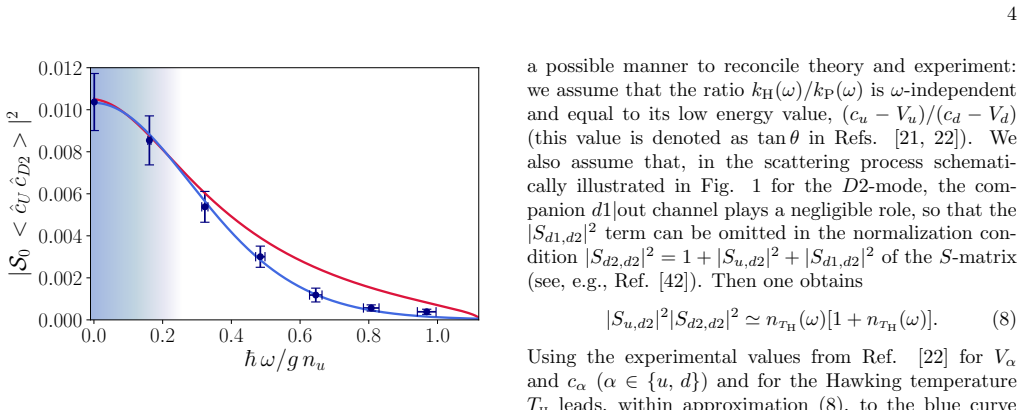
The load-bearing object is the complete expansion (3) of the fluctuation field, which adds the zero modes $\hat{P}$ and $\hat{Q}$ — the global phase degree of freedom and its conjugate, required for the canonical commutation relation — and the evanescent channel $u|_{\mathrm{eva}}$ to the standard Bogoliubov modes $U$, $D_1$, $D_2$. On top of this, the argument rests on the Fourier relation (5) between $G_2(x,x')$ and the Hawking-partner amplitude, combined with the frequency-dependent windowing condition (7), $L_u/|V_{g,H}(\omega)| = L_d/V_{g,P}(\omega)$, which fixes the integration rectangle by equal group-velocity traversal times. This windowing is what makes the extracted correlation agree with the exact scattering amplitude; the previously used $\omega$-independent windowing is what produces the spurious thermal spectrum.
What would settle it
Re-analyze the experimental data of Ref. [22] using the frequency-dependent windowing condition (7): if the extracted Hawking-partner correlation follows a thermal Bose distribution across the full measured frequency range, the claimed departure from thermality is refuted. A complementary check would compute $G_2$ from an incomplete basis that omits the zero modes and see whether it still matches the measured correlation map; matching would show the zero modes are not essential.
Extended reading notes
Core claim
The central claim is that the Hawking-partner correlation signal in the step-like BEC analogue black hole, computed from the density correlation function $G_2$ through the Fourier relation (5), deviates from the thermal Bose form $n_{\mathrm{TH}}(\omega)[1+n_{\mathrm{TH}}(\omega)]$ at finite frequencies. The deviation becomes visible only when $G_2$ is built from a complete basis for the quantum fluctuations, including the evanescent channel and the zero-mode operators $\hat{P}$ and $\hat{Q}$; omitting these pieces leaves the basis incomplete and produces a different, apparently thermal spectrum. The paper further shows that the experimental data of Ref. [22] are reproduced in real space by this complete calculation, and that the thermal conclusion of that experiment follows from replacing the frequency-dependent windowing condition (7) with a wavelength-independent one. Within the model, the Hawking temperature remains well defined from the low-frequency slope, but the radiation is not globally thermal.
Load-bearing premise
The load-bearing premise is that the quantum field can be split into a classical condensate plus small linearized Bogoliubov fluctuations, an approximation the paper acknowledges is not strictly valid in one dimension and whose justification is borrowed from an earlier analysis rather than established here.
Editorial extensions
If this is right
- The measured density correlations around the horizon can be reproduced at zero temperature, provided evanescent channels and zero modes are included; an incomplete basis misses the correct correlation pattern.
- The Hawking temperature remains a well-defined observable: it is fixed by the long-wavelength limit of the correlation signal even though the full spectrum is non-thermal.
- The thermal spectrum reported in Ref. [22] is reinterpreted as an artifact of an unfounded, $\omega$-independent integration window; using the group-velocity windowing (7) predicts a measurable departure from thermality.
- Re-analyzing the published experimental data with the proposed windowing should reveal the non-thermal behaviour predicted here.
Reading between the lines
- If the departure is confirmed, thermality in analogue systems should be treated as a long-wavelength property, not a global one; other analogue platforms may show similar finite-wavelength deviations even where the low-frequency Hawking temperature is clean.
- The same complete-basis corrections could affect other observables built from the quantum fluctuations, such as entanglement or non-separability measures, not just the density correlation function.
- The windowing prescription provides a concrete, testable data-analysis protocol: apply the group-velocity condition (7) to existing experimental correlation maps and compare the extracted spectrum with the exact scattering calculation.
Editorial analysis
A structured set of objections, weighed in public.
Referee Report
Summary. The paper studies quantum fluctuations in a one-dimensional Bose-Einstein condensate realizing an analogue acoustic black hole with a step potential. The authors develop a linearized Bogoliubov description of the fluctuations using a complete basis that includes evanescent channels and zero modes, compute the density correlation function G2, and show that it reproduces the measured correlations of Ref. [22] once finite-temperature effects at kBT = 0.2gnu are included. They then use a Fourier relation, Eq. (5), to extract the Hawking-partner correlation signal from G2, compare it with the experimental data, and argue that the exact theoretical signal deviates from a thermal Bose distribution at finite wavelengths. The main claim is that the apparent thermality in previous analyses is an artifact of an unfounded long-wavelength windowing, while the long-wavelength slope still determines the Hawking temperature.
Significance. If correct, the paper provides a concrete mechanism for departures from thermality in analogue Hawking radiation, settles the role of zero modes and evanescent channels in the density-correlation analysis, and offers a falsifiable prescription for re-analyzing existing experimental data. The calculation is well posed: the red curve in Fig. 4 follows from the model with no free fitting, and the real-space agreement in Fig. 3 is a genuine nontrivial success. The paper also honestly acknowledges its main approximations, namely the 1D Bogoliubov separation and the borrowing of its justification from the authors' own earlier work. The central claim is timely and relevant to the active debate on analogue Hawking radiation in Bose-Einstein condensates.
major comments (4)
- [Fig. 4 and Eq. (5)] The caption of Fig. 4 does not state the temperature at which the red theoretical curve is computed. Figure 3 shows that the zero-temperature G2 differs visibly from the finite-temperature G2 at kBT = 0.2gnu (T ≃ 1.9TH), and Eq. (5) Fourier-transforms G2, so the extracted |S0⟨ĉU ĉD2⟩|² is temperature dependent. Since the experiment of Ref. [22] is performed at T ≈ 1.9TH and fig. 3 shows that the finite-temperature curve is the one matching the experimental data, a zero-temperature red curve cannot be the proper model for the experimental comparison. The claimed departure from thermality therefore requires, but does not provide, the finite-temperature version of the red curve.
- [‘Departing from thermality’ and Eq. (8)] The blue thermal curve is constructed using exactly the type of approximation the paper criticizes: an ω-independent ratio kH/kP and neglect of the d1|out channel. This is acknowledged to be self-consistent within the long-wavelength approach, but the central assertion that this procedure is ‘unfounded’ is not supported by a quantitative demonstration that the proposed windowing (7) changes the experimental dots in Fig. 4. The authors appropriately propose a re-analysis of the data of Ref. [22] as future work, but that means the paper's headline claim is a prediction rather than a completed verification; the manuscript should state this distinction explicitly and, ideally, provide the finite-temperature processing of the experimental data.
- [Fig. 3 and Eq. (4)] The finite-temperature calculation underlying the orange curve in Fig. 3 is not derived. The text states that kBT = 0.2gnu gives T ≃ 1.9TH, but does not explain how thermal occupations are introduced into the correlation functions in the presence of the zero-mode state |BH⟩, nor how this value of kBT was chosen. Since the temperature dependence of G2 propagates through Eq. (5) into the Hawking-partner signal, this missing specification is load-bearing for the central claim and must be supplied.
- [Eqs. (2)–(3)] The validity of splitting the 1D field into a classical condensate plus linearized Bogoliubov fluctuations is delegated to Ref. [31]. Because every correlation function in the paper, including the departure-from-thermality prediction, relies on this linearization, the manuscript should include at least a concise statement of the density regime where the approximation is controlled, or a benchmark against an independent 1D method. As written, the supporting argument is borrowed from the authors' own earlier work rather than established here.
minor comments (5)
- [Fig. 3 caption] The caption should define TH explicitly and state the upstream density nu used to set kBT = 0.2gnu, so that the value T ≃ 1.9TH is reproducible without referring to the experimental paper.
- [Fig. 4 caption and text] The text refers to a ‘bluish region’ and a ‘blue region’ interchangeably; please use a single term consistently, and clarify whether the blue region corresponds to the 10% accuracy domain or to the approximation used for the blue curve.
- [Eq. (8)] The notation nTH(ω) is introduced without an equation number or an explicit definition; please state that it denotes the Bose factor [exp(ℏω/kBTH) − 1]⁻¹.
- [General] There are minor language issues, including ‘one is lead to introduce’ (should be ‘led’) and ‘degree of liberty’ (should be ‘degree of freedom’).
- [Conclusion] The word ‘unfounded’ for the previous windowing procedure is strong; given that the authors show the procedure is internally self-consistent but inaccurate at finite dispersion, a phrase such as ‘not justified by the exact dispersion’ would be more precise and less contentious.
Circularity Check
No significant circularity: the non-thermal prediction is a computed consequence of the model, not an input or a renamed fit.
full rationale
The central derivation is self-contained. The paper constructs the Bogoliubov mode expansion (Eq. 3), including zero modes needed for the canonical commutation relation, and computes G2 directly from the chosen quantum state. The extraction of the Hawking-partner correlation via Eq. (5) is an identity relating a Fourier window of G2 to an S-matrix element; it is not fitted to the claim of non-thermality. The blue thermal curve is explicitly obtained by making two long-wavelength approximations (omega-independent wavevector ratio and neglect of the d1|out channel), while the red curve uses the full expression without those approximations. The departure from thermality is therefore a consequence of the dispersion relation and the scattering calculation, not an assumption. The comparison with the experiment of Ref. [22] is an external benchmark, and the parameters such as Vd/cd = 2.90 are chosen to match the experimental configuration, which is standard benchmarking rather than circular fitting. The self-citations (Refs. [31], [42], [44]) support technical ingredients such as the zero-mode structure and dispersion relations; none of them is invoked as a uniqueness theorem forbidding alternatives, and none is used to define the non-thermal result. The temperature ambiguity of the red curve in Fig. 4 is a legitimate missing-support or correctness concern, but it is not a circularity: the model's red curve is not defined in terms of the experimental data points it is compared with. No derived quantity reduces by construction to an input parameter, so the circularity score is 0.
Assumptions & free parameters
free parameters (2)
- Upstream flow ratio Vu/cu (or downstream Vd/cd = 2.90) =
Vd/cd = 2.90; Vu/cu = 0.59
- Finite temperature kBT (Fig. 3) =
0.2 g n_u (T ~ 1.9 T_H)
assumptions (7)
- domain assumption The classical field plus linearized quantum fluctuations (Bogoliubov) splitting is a valid approximation in one dimension over the relevant density range.
- domain assumption The asymptotic mode decomposition U, D1, D2 plus zero modes P and Q forms a complete basis for the quantum fluctuations.
- domain assumption The quantum state of the analogue horizon is the zero-excitation state |BH> with P|BH>=0 and b_L|BH>=0.
- domain assumption Steinhauer's Fourier relation (Eq. 5) with the frequency-dependent windowing (Eq. 7) correctly extracts the Hawking-partner scattering amplitude from G2.
- domain assumption The background step potential and densities are described by a half dark soliton plus plane wave with matching obtained from the Gross-Pitaevskii equation.
- domain assumption The experimental data of Ref. [22] and its quoted flow velocities and sound speeds are accurate.
- standard math Bogoliubov dispersion and S-matrix unitarity (|Sd2,d2|^2 = 1 + |Su,d2|^2 + |Sd1,d2|^2).
Cite this review
Pith. "Pith review of Departing from thermality of analogue Hawking radiation in a Bose-Einstein condensate." pith.science (2026). https://pith.science/paper/ENFAJ2TU
@misc{pith2026190902509,
  author       = {Pith},
  title        = {Pith review of: Departing from thermality of analogue Hawking radiation in a Bose-Einstein condensate},
  year         = {2026},
  howpublished = {\url{https://pith.science/paper/ENFAJ2TU}},
  note         = {Machine review of arXiv:1909.02509}
}
read the original abstract
We study the quantum fluctuations in a one dimensional Bose-Einstein condensate realizing an analogous acoustic black hole. The taking into account of evanescent channels and of zero modes makes it possible to accurately reproduce recent experimental measurements of the density correlation function. We discuss the determination of Hawking temperature and show that in our model the analogous radiation presents some significant departure from thermality.
Figures


Forward citations
Cited by 1 Pith paper
-
Doppler shifted Hawking radiation from acoustic black holes in ultra-relativistic heavy-ion collisions
Even when the central flow is boost invariant, large-rapidity deviations can slow the acoustic horizon's recession, giving finite redshift Hawking radiation that may affect momentum distributions.
Reference graph
Works this paper leans on
-
[22]
J. R. M. de Nova, K. Golubkov, V. I. Kolobov, and J. Steinhauer, Nature (London) 569, 688 (2019) doi:10.1038/s41586-019-1241-0
-
[31]
A. Fabbri and N. Pavloff SciPost Phys. 4, 019 (2018) doi:10.21468/SciPostPhys.4.4.019
-
[1]
S. W. Hawking, Nature (London) 248, 30 (1974) doi:10.1038/248030a0; Commun. Math. Phys. 43, 199 (1975) doi:10.1007/BF02345020
doi:10.1038/248030a0 1974
-
[2]
M. Visser, Phys. Rev. Lett. 80, 3436 (1998) doi:10.1103/PhysRevLett.80.3436
-
[3]
W. G. Unruh, Phys. Rev. Lett. 46, 1351 (1981) doi:10.1103/PhysRevLett.46.1351
-
[4]
G. Rousseaux, C. Mathis, P. Ma¨ ıssa, T. G. Philbin, and U. Leonhardt, New J. Phys. 10, 053015 (2008) doi:10.1088/1367-2630/10/5/053015
-
[5]
S. Weinfurtner, E. W. Tedford, M. C. J. Penrice, W. G. Unruh, and G. A. Lawrence, Phys. Rev. Lett106, 021302 (2011) doi:10.1103/PhysRevLett.106.021302
-
[6]
L.-P. Euv´ e, F. Michel, R. Parentani, T. G. Philbin, and G. Rousseaux, Phys. Rev. Lett. 117, 121301 (2016) doi:10.1103/PhysRevLett.117.121301
Show all 59 references
-
[7]
Cardoso, A
V. Cardoso, A. Coutant, M. Richartz, and S. Weinfurtner, Phys. Rev. Lett. 117, 271101 (2016) doi:10.1103/PhysRevLett.117.271101
2016 doi
-
[8]
Torres, S
T. Torres, S. Patrick, A. Coutant, M. Richartz, E. W. Tedford, and S. Weinfurtner, Nat. Phys. 13, 833 (2017) doi:10.1038/nphys4151
2017 doi
- [9]
- [10]
-
[11]
Philbin, C
T.G. Philbin, C. Kuklewicz, S. Robertson, S. Hill, F. K¨ onig, and U. Leonhardt, Science 319, 1367 (2008) doi:10.1126/science.1153625
2008 doi
-
[12]
Belgiorno, S
F. Belgiorno, S. L. Cacciatori, M. Clerici, V. Gorini, G. Ortenzi, L. Rizzi, E. Rubino, V. G. Sala, and D. Faccio Phys. Rev. Lett. 105, 203901 (2010) doi:10.1103/PhysRevLett.105.203901
2010 doi
-
[13]
Rubino, F
E. Rubino, F. Belgiorno, S. L. Cacciatori, M. Clerici, V. Gorini, G. Ortenzi, L. Rizzi, V. G. Sala, M. Kole- sik and D. Faccio, New J. Phys. 13, 085005 (2011) doi:10.1088/1367-2630/13/8/085005
2011 doi
-
[14]
Elazar, V
M. Elazar, V. Fleurov, and S. Bar-Ad Phys. Rev. A 86, 063821 (2012) doi:10.1103/PhysRevA.86.063821
2012 doi
-
[15]
K. E. Webb, M. Erkintalo, Y. Xu, N. G. R. Broderick, J. M. Dudley, G. Genty, and S. G. Murdoch, Nat. Commun. 5, 4969 (2014) doi:10.1038/ncomms5969
2014 doi
-
[16]
Vocke, C
D. Vocke, C. Maitland, A. Prain, K. E. Wilson, F. Bian- calana, E. M. Wright, F. Marino, and D. Faccio, Optica 5, 1099 (2018) doi:10.1364/OPTICA.5.001099
2018 doi
-
[17]
Drori, Y
J. Drori, Y. Rosenberg, D. Bermudez, Y. Silberberg, and U. Leonhardt, Phys. Rev. Lett. 122, 010404 (2019) doi:10.1103/PhysRevLett.122.010404
2019 doi
-
[18]
Nguyen, D
H.S. Nguyen, D. Gerace, I. Carusotto, D. San- vitto, E. Galopin, A. Lemaˆ ıtre, I. Sagnes, J. Bloch, and A. Amo, Phys. Rev. Lett. 114, 036402 (2015) doi:10.1103/PhysRevLett.114.036402
2015 doi
-
[19]
Lahav, A
O. Lahav, A. Itah, A. Blumkin, C. Gordon, S. Rinott, A. Zayats, and J. Steinhauer, Phys. Rev. Lett. 105, 240401 (2010) doi:10.1103/PhysRevLett.105.240401
2010 doi
- [20]
- [21]
-
[23]
Michel and R
F. Michel and R. Parentani, Phys. Rev. A 91, 053603 (2015) doi:10.1103/PhysRevA.91.053603
2015 doi
-
[24]
Michel, J.-F
F. Michel, J.-F. Coupechoux, and R. Parentani Phys. Rev. D 94, 084027 (2016) doi:10.1103/PhysRevD.94.084027
2016 doi
-
[25]
Tettamanti, S
M. Tettamanti, S. L. Cacciatori, A. Parola and I. Carusotto, EPL 114, 60011 (2016) doi:10.1209/0295- 5075/114/60011
2016 doi
-
[26]
J. R. M. de Nova, S. Finazzi, and I. Carusotto, Phys. Rev. A 94, 043616 (2016) doi:10.1103/PhysRevA.94.043616
2016 doi
-
[27]
Finke, P
A. Finke, P. Jain, and S. Weinfurtner, New J. Phys. 18, 113017 (2016) doi:10.1088/1367-2630/18/11/113017
2016 doi
-
[28]
Y.-H. Wang, T. Jacobson, M. Edwards, and C. W. Clark, SciPost Phys. 3, 022 (2017) doi:10.21468/SciPostPhys.3.3.022
2017 doi
-
[29]
Parola, M
A. Parola, M. Tettamanti, and S. L. Cacciator, EPL 119, 50002 (2017) doi:10.1209/0295-5075/119/50002
2017 doi
-
[30]
Robertson, F
S. Robertson, F. Michel, and R. Parentani, Phys. Rev. D 96, 045012 (2017) doi:10.1103/PhysRevD.96.045012
2017 doi
-
[32]
Coutant and S
A. Coutant and S. Weinfurtner, Phys. Rev. D 97, 025006 (2018) doi:10.1103/PhysRevD.97.025006
2018 doi
-
[33]
J. M. Gomez Llorente and J. Plata, J. Phys. B: At. Mol. Opt. Phys. 52 075004 (2019) doi:10.1088/1361- 6455/ab0bcb
2019 doi
-
[34]
Leonhardt, Ann
U. Leonhardt, Ann. Phys. (Berlin) 530, 1700114 (2018) doi:10.1002/andp.201700114
2018 doi
-
[35]
Steinhauer, Ann
J. Steinhauer, Ann. Phys. (Berlin) 530, 1700459 (2018) doi:10.1002/andp.201700459
2018 doi
-
[36]
W. G. Unruh, Phys. Rev. D 51, 2827 (1995) doi:10.1103/PhysRevD.51.2827
1995 doi
-
[37]
Corley and T
S. Corley and T. Jacobson, Phys. Rev. D 54, 1568 (1996) doi:10.1103/PhysRevD.54.1568
1996 doi
- [38]
- [39]
-
[40]
Leboeuf, N
P. Leboeuf, N. Pavloff and S. Sinha, Phys. Rev. A 68, 063608 (2003) doi:10.1103/PhysRevA.68.063608
2003 doi
-
[41]
Macher and R
J. Macher and R. Parentani, Phys. Rev. A 80, 043601 (2009) doi:10.1103/PhysRevA.80.043601
2009 doi
-
[42]
Recati, N
A. Recati, N. Pavloff and I. Carusotto, Phys. Rev. A 80, 043603 (2009) doi:10.1103/PhysRevA.80.043603
2009 doi
-
[43]
Coutant, R
A. Coutant, R. Parentani, and S. Finazzi, Phys. Rev. D 85, 024021 (2012) doi:10.1103/PhysRevD.85.024021
2012 doi
-
[44]
Larr´ e, A
P.- ´E. Larr´ e, A. Recati, I. Carusotto, and N. Pavloff, Phys. Rev. A 85, 013621 (2012) doi:10.1103/PhysRevA.85.013621
2012 doi
-
[45]
Boiron, A
D. Boiron, A. Fabbri, P.- ´E. Larr´ e, N. Pavloff, C. I. West- brook, and P. Zi´ n, Phys. Rev. Lett.115, 025301 (2015) 6 doi:10.1103/PhysRevLett.115.025301
2015 doi
-
[46]
See Supplemental Material [url] which recalls previous results, details some characteristics of the zero modes and of the analysis of the Hawking spectrum and includes Refs. [47–49]
-
[47]
Villain, M
P. Villain, M. Lewenstein, R. Dum, Y. Castin, L. You, A. Imamo˘ glu, and T. A. B. Kennedy, J. Mod. Optics44, 1775 (1997), doi:10.1080/09500349708231846
1997 doi
-
[48]
Bilas and N
N. Bilas and N. Pavloff Phys. Rev. A 72, 033618 (2005), doi:10.1103/PhysRevA.72.033618
2005 doi
-
[49]
Deuar, A
P. Deuar, A. G. Sykes, D. M. Gangardt, M. J. Davis, P. D. Drummond and K. V. Kheruntsyan, Phys. Rev. A 79, 043619 (2009), doi:10.1103/PhysRevA.79.043619
2009 doi
-
[50]
Lewenstein and L
M. Lewenstein and L. You, Phys. Rev. Lett. 77, 3489 (1996) doi:10.1103/PhysRevLett.77.3489
1996 doi
-
[51]
Leonhardt, T
U. Leonhardt, T. Kiss, and P. ¨Ohberg, J. Opt. B: Quan- tum Semiclassical. Opt. 5, S42 (2003) doi:10.1088/1464- 4266/5/2/357
2003 doi
-
[52]
Ring and P
P. Ring and P. Shuck, The Nuclear Many-Body Problem (Springer-Verlag, Berlin, 1980)
1980
-
[53]
J. P. Blaizot and G. Ripka, Quantum Theory of Finite Systems (MIT Press, Cambridge, MA, 1986)
1986
-
[54]
Balbinot, A
R. Balbinot, A. Fabbri, S. Fagnocchi, A. Recati and I. Carusotto, Phys. Rev. A 78, 021603(R) (2008) doi:10.1103/PhysRevA.78.021603
2008 doi
-
[55]
Carusotto, S
I. Carusotto, S. Fagnocchi, A. Recati, R. Balbinot and A. Fabbri, New J. Phys. 10, 103001 (2008) doi:10.1088/1367-2630/10/10/103001
2008 doi
-
[56]
Steinhauer, Phys
J. Steinhauer, Phys. Rev. D 92, 024043 (2015) doi:10.1103/PhysRevD.92.024043
2015 doi
-
[57]
C. J. Pethick and H. Smith, Bose-Einstein Condensa- tion in Dilute Gases, (Cambridge University Press, Cam- bridge, England, 2002)
2002
-
[58]
L. P. Pitaevskii and S. Stringari, Bose-Einstein Conden- sation, International Series of Monographs on Physics, (Oxford University Press, Oxford, United Kingdom, 2016)
2016
-
[59]
J. R. M. de Nova, F. Sols and I. Zapata, New. J. Phys. 17, 105003 (2015) doi:10.1088/1367-2630/17/10/105003
2015 doi
Reviewed August 14, 2026 · model on record in the stance chip above.
Discussion (0). Continue with ORCID to comment.