REVIEW 4 major objections 5 minor 2 cited by
Searching for a solar relaxion/scalar with XENON1T and LUX
T0 review · 4 major / 5 minor · reviewed 2026-08-14 · deepseek-v4-flash
Pith's one-line read The Sun's core would shine scalars that liquid xenon can absorb; XENON1T and LUX data bound the scalar–electron coupling at $g_{\phi ee} < 2\times10^{-15}$.
desk verdict Solid, honest limits paper: first LXe bounds on solar scalars coupled to electrons, with a defensible S2 result from resonant production; a few unpropagated systematics but the central numbers hold. read the letter →
The pith
A machine-rendered reading of the paper's core claim, the machinery that carries it, and where it could break.
The reading
What carries the argument
The load-bearing device is the scalar-photon matrix-element relation $|\mathcal{M}(e\to e+\phi)|^2/|\mathcal{M}(e\to e+\gamma)|^2 \simeq g_{\phi ee}^2 v_\phi^2/(4\pi\alpha_{\rm em})$, where $v_\phi=k/\omega$ is the scalar velocity and $\alpha_{\rm em}$ is the fine-structure constant. This single ratio lets the authors convert well-measured photon processes into scalar processes: electron-ion Bremsstrahlung and Compton production in the Sun, photoelectric absorption in xenon, and, through detailed balance with tabulated solar opacities, recombination and bound-bound production from heavy elements. The relation is stated as confirmed only in the non-relativistic limit, yet it carries the entire flux and cross-section calculation, so the predicted event rate scales as $g_{\phi ee}^4$ and every bound inherits its uncertainty.
What would settle it
Compute the exact electron-ion Bremsstrahlung rate for scalar emission in a screened solar plasma at energies $\omega\approx0.1$–$0.3$ keV and compare it with the photon rate scaled by $g_{\phi ee}^2 v_\phi^2/(4\pi\alpha_{\rm em})$; a deviation by an order of magnitude would move the S2 coupling bound by about $10^{1/4}\approx1.8$ and could erase the claimed exclusion.
Extended reading notes
Core claim
The central claim is that existing liquid xenon dark matter detectors can serve as scalar telescopes: a light scalar $\phi$ produced in the Sun with energies of order the solar core temperature (keV) reaches Earth and is absorbed by xenon electrons, depositing its full energy as an electronic recoil. The absorption rate is obtained by rescaling the photoelectric cross-section by $g_{\phi ee}^2 v_\phi^2/(4\pi\alpha_{\rm em})$, the same ratio that governs solar production. Applying this to XENON1T and LUX, the paper finds $g_{\phi ee}<2\times10^{-15}$ at 90% CL (S2-only, $m_\phi \lesssim 0.1$ keV), with the sensitivity boosted by resonant production of scalars at the solar plasma frequency $\omega\approx\omega_p\approx 0.1$–$0.3$ keV. In relaxion/Higgs-portal language this is $\sin\theta<7\times10^{-10}$ for a standard electron-Higgs coupling, and it is a direct noble-liquid bound that comes within an order of magnitude of stellar-evolution limits.
Load-bearing premise
The whole calculation rests on a single proportionality: a scalar is emitted or absorbed exactly like a photon, with its rate reduced by the factor $g_{\phi ee}^2 v_\phi^2/(4\pi\alpha_{\rm em})$; the paper verifies this relation only in the non-relativistic limit, so if the solar plasma or sub-keV energies alter it, the limits shift by an unquantified factor.
Editorial extensions
If this is right
- The XENON1T S2-only analysis excludes $g_{\phi ee}>2\times10^{-15}$ for scalars below about 0.1 keV, a stronger direct limit than any previous laboratory search for solar scalars coupled to electrons.
- For a relaxion or Higgs-portal singlet, the bound becomes $\sin\theta<7\times10^{-10}$, which lies inside the naturalness window $\sin\theta\lesssim7\times10^{-9}(m_\phi/100\,{\rm eV})$, so the experiment probes theoretically preferred parameters.
- Because the event rate scales as $g_{\phi ee}^4$, a 20 ton-year XENONnT exposure improves the coupling limit only to about $3\times10^{-15}$, a modest gain rather than a dramatic jump.
- The resonant solar production peak near $\omega\approx\omega_p\approx0.1$–$0.3$ keV is what makes the S2 analysis powerful; detectors with even lower ionization thresholds would capture more of this peak.
- The remaining gap to the stellar-cooling bound ($g_{\phi ee}<7\times10^{-16}$) is a factor of three, so a modest improvement in exposure or background could make direct detection the leading constraint.
Reading between the lines
- If the matrix-element ratio holds at sub-keV energies in a plasma, the same rescaling applies to any electron target, so semiconductor or gaseous detectors with thresholds below 100 eV could test the resonant flux peak and potentially surpass stellar-cooling limits.
- The strong sensitivity of the S2 bound to the resonant peak implies that the exact solar plasma frequency profile, not just the total flux, controls the limit; a refined solar model with position-dependent Debye screening would be a direct test of the calculation.
- The same Sun-as-source logic could be applied to scalars with muon or nucleon couplings, though the absorption signal in xenon would have to be replaced by a different detection channel.
- If future low-threshold experiments see a signal consistent with the resonant peak, comparing spectral shape across two targets would distinguish a solar scalar from background or from other new particles such as axions.
Signed reviews
Editorial analysis
A structured set of objections, weighed in public.
Referee Report
Summary. This paper computes the flux of sub-keV scalar particles produced in the solar core through electron-ion Bremsstrahlung, Compton-like scattering, atomic transitions, and resonant longitudinal-plasmon excitation, and estimates their absorption rate in liquid xenon through a scaled photoelectric cross-section. Using LUX and XENON1T data, the authors quote 90% CL upper limits g_φee < 7e-15 (XENON1T S1-only) and g_φee < 2e-15 (XENON1T S2-only), with the S2 limit valid for m_φ ≲ 0.1 keV and driven by the resonant peak near ω_p ~ 0.2 keV. These are translated into Higgs-mixing bounds for a relaxion-like scalar, reaching sinθ < 7e-10 for the standard electron-Higgs coupling.
Significance. If the central result holds, the S2-only bound is the strongest direct detector limit on a solar scalar coupled to electrons and probes natural Higgs-portal parameter space. The paper has genuine strengths: the non-resonant production formulas are cross-checked by a direct non-relativistic computation, the flux calculation uses tabulated solar opacity via detailed balance without free normalizations, and the S1 analysis includes several explicit systematic checks with reported <5% shifts. The claims are carefully delimited by mass ranges, and the scaling of the sensitivity with exposure and with g^4 is made explicit. However, the headline S2 limit rests on the least-documented part of the calculation, namely the resonant production formula Eq. (12), and on a partial background model, so the quantitative claim needs substantiation before it can be accepted.
major comments (4)
- [Section II, Eq. (12)] The S2-only headline limit Eq. (17) is produced by the resonant peak at ω ~ 0.2 keV shown in Fig. 2. The resonant production rate is given by Eq. (12), but this formula is presented without derivation and, more importantly, without specifying how the longitudinal damping rate Γ_L is computed from the solar opacity data or from any other input. The direct non-relativistic cross-check claimed in the text covers only Eqs. (5) and (9), not Eq. (12). Since the event rate scales as g^4, a factor-of-10 error in the resonant flux changes the quoted bound by about 1.8, so the current text leaves the headline number unreproducible. The authors should derive Eq. (12), give the explicit expression and numerical implementation of Γ_L (including the relevant plasma absorption channels and their relation to k(ω)), and validate the resonant flux against Ref. [32] or a dedicated independent calculation.
- [Section III, Eq. (13)] The absorption cross-section used for both S1 and S2 limits is obtained by applying the free-electron matrix-element relation Eq. (4) to the measured photoelectric cross-section of xenon. The authors state that Eq. (4) was verified in the non-relativistic limit for the bremsstrahlung and Compton production amplitudes, but Eq. (13) involves bound atomic electrons and final-state interactions in the photoelectric process, which are not validated by that check. Since all quoted limits scale directly with this cross-section, the relation needs either a dedicated derivation for atomic absorption (e.g., with xenon wavefunctions and a treatment of the bound-state matrix elements) or an explicit estimate of the error incurred by using the free-electron ratio. Without this, the absolute normalization of every quoted limit is uncertain.
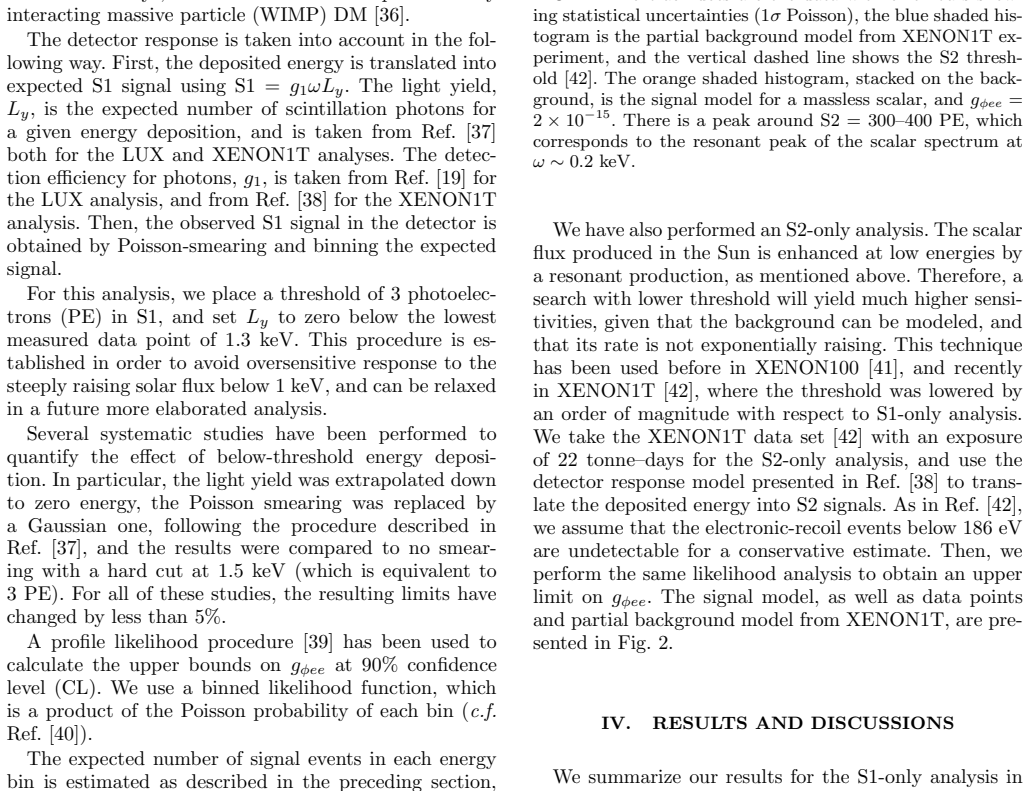
- [Section III, S2-only analysis and Fig. 2] The 90% limit Eq. (17) is obtained with a 'partial background model' from XENON1T, but the manuscript does not specify which background components are included, how the model is normalized, or which systematic uncertainties are propagated. In the resonant region the signal is a modest contribution on top of a sizable background, so a few-percent background normalization or shape error can shift the limit by more than the precision implied by Eq. (17). The authors should either use the full background model of Ref. [42] or repeat the fit with nuisance parameters and report the resulting systematic error on g_φee.
- [Section II and Fig. 3] The mass-dependent limits shown in Fig. 3 are not documented. Section II states that the flux is computed in the massless limit, while the results claim bounds for m_φ up to 1 keV and present upper limits for masses above 0.01 keV. The factors v_φ in Eqs. (4)-(13) and the kinematic lower bound ω > m_φ depend on the mass. The authors should state explicitly how the scalar mass is implemented in the flux and cross-section used to produce Fig. 3, including the treatment of the phase-space threshold.
minor comments (5)
- [Section II, Eq. (7)] The function F(a) is defined in Eq. (7), but the parameter a is not defined in the displayed equation; from Eq. (6) it is a = ω/T. Please define this explicitly.
- [Section II] The text describes Γ_bb as production from transitions of 'bounded electrons'; this should read 'bound electrons'.
- [Section III, S2-only analysis] The number of bins and the exact S2 energy window used for the S2-only profile likelihood are not stated. Please specify the S2 range and how the 186 eV threshold is mapped into S2, so that the analysis is reproducible.
- [Abstract and Eq. (19)] The abstract quotes sinθ < 2e-9 (7e-10) without labeling whether these correspond to the S1 or S2 limits; the body text Eq. (19) gives 7e-10 and 1e-12 for κ_e = 1 and 600. Please make the correspondence between the abstract values and Eq. (19) explicit.
- [Fig. 3] The axis labels and caption of Fig. 3 are garbled in the version provided; the final submission should have readable labels for the coupling and scalar mass axes.
Circularity Check
No significant circularity: the flux and absorption calculations are anchored to external matrix-element relations, solar opacity data, and measured XENON1T/LUX data, with no fitted parameter disguised as a prediction.
full rationale
The paper's derivation chain is not circular. The central relation, Eq. (4), is imported from Avignone et al. [16] as an external matrix-element ratio and is used consistently for both solar production and detector absorption; it is not fitted to the data in this paper. The flux in Eq. (3) is computed by integrating explicitly stated Bremsstrahlung and Compton rates, Eqs. (5)-(9), plus opacity-based atomic-transition rates via detailed balance, Eq. (11), using independent solar-model and opacity inputs [27,28,31]. The absorption cross-section, Eq. (13), is tied to tabulated photoelectric cross-sections from [34,35], again with no free parameter tuned to XENON1T or LUX data. The 90% CL bounds are obtained by a likelihood comparison between predicted event rates and public experimental data, with backgrounds taken from the experimental papers. The self-citations that involve the present authors [2,6,12] are motivational or contextual and are not load-bearing for the headline result. The main physics-risk concern, noted by the skeptical reader, is that the resonant production rate, Eq. (12), is not directly derived or numerically documented in the paper; however, that is an uncertainty in an imported physical formula, not a case of the prediction reducing by construction to its own inputs. The paper would fail or shift quantitatively if Eq. (12) were wrong, but the logical structure of the derivation remains externally anchored.
Assumptions & free parameters
assumptions (4)
- domain assumption The scalar couples to electrons only through -g_phi ee phi ebar e, and this single interaction governs both production and absorption.
- domain assumption The scalar-photon matrix element relation |M(e->e+phi)|^2 / |M(e->e+gamma)|^2 = g^2 v_phi^2 / (4 pi alpha_em) holds for solar production and LXe absorption.
- domain assumption The Vinyoles solar model (Ref. 31) and the OP opacity data (Refs. 27, 28) accurately describe the solar interior for the volume integration in Eq. (3).
- domain assumption In-medium resonant mixing of the scalar with the longitudinal photon mode follows Eq. (12), with plasma frequency and damping rate determined by the solar medium.
Cite this review
Pith. "Pith review of Searching for a solar relaxion/scalar with XENON1T and LUX." pith.science (2026). https://pith.science/paper/WAXGIYHR
@misc{pith2026190902568,
  author       = {Pith},
  title        = {Pith review of: Searching for a solar relaxion/scalar with XENON1T and LUX},
  year         = {2026},
  howpublished = {\url{https://pith.science/paper/WAXGIYHR}},
  note         = {Machine review of arXiv:1909.02568}
}
abstract
We consider liquid xenon dark matter detectors for searching a light scalar particle produced in the solar core, specifically one that couples to electrons. Through its interaction with the electrons, the scalar particle can be produced in the Sun, mainly through Bremsstrahlung process, and subsequently it is absorbed by liquid xenon atoms, leaving prompt scintillation light and ionization events. Using the latest experimental results of XENON1T and Large Underground Xenon, we place bounds on the coupling between electrons and a light scalar as $g_{\phi ee} < 7 \times 10^{-15}$ from S1-only analysis, and as $g_{\phi ee} < 2 \times 10^{-15}$ from S2-only analysis. These can be interpreted as bounds on the mixing angle with the Higgs, $\sin \theta < 2 \times 10^{-9} \, \left(7 \times 10^{-10}\right)$, for the case of a relaxion that couples to the electrons via this mixing. The bounds are a factor few weaker than the strongest indirect bound inferred from stellar evolution considerations.
Figures


Figures from the paper (1 more)

Forward citations
Cited by 2 Pith papers
-
Minimal Electroweak Baryogenesis via Domain Walls
Domain wall cores in the minimal Z2-symmetric singlet extension can restore electroweak symmetry and, while sweeping through space, could produce the matter-antimatter asymmetry in a parameter region far lighter and m...
-
Direct detection of solar chameleons with electron recoil data from XENONnT
XENONnT electron-recoil data bound solar chameleons to log10 β_eff < −6.9, independent of the potential index n for inverse power-law chameleons at the dark-energy scale.
Reference graph
Works this paper leans on
- [32]
- [42]
-
[1]
P. W. Graham, D. E. Kaplan, and S. Rajendran, Phys. Rev. Lett. 115, 221801 (2015), arXiv:1504.07551
arXiv 2015
- [2]
-
[3]
Constraints on Relaxion Windows
K. Choi and S. H. Im, JHEP 12, 093 (2016), arXiv:1610.00680
work page Pith review arXiv 2016
- [4]
- [5]
-
[6]
Relaxion and light (pseudo)scalars at the HL-LHC and lepton colliders
C. Frugiuele, E. Fuchs, G. Perez, and M. Schlaffer, JHEP 10, 151 (2018), arXiv:1807.10842
work page Pith review arXiv 2018
Show all 49 references
-
[7]
Fradette, M
A. Fradette, M. Pospelov, J. Pradler, and A. Ritz, Phys. Rev. D99, 075004 (2019), arXiv:1812.07585
2019 arXiv
-
[8]
Arvanitaki, J
A. Arvanitaki, J. Huang, and K. Van Tilburg, Phys. Rev. D91, 015015 (2015), arXiv:1405.2925
2015 arXiv
-
[9]
P. W. Graham, D. E. Kaplan, J. Mardon, S. Rajendran, and W. A. Terrano, Phys. Rev. D93, 075029 (2016), arXiv:1512.06165
2016 arXiv
-
[10]
Arvanitaki, S
A. Arvanitaki, S. Dimopoulos, and K. Van Tilburg, Phys. Rev. X8, 041001 (2018), arXiv:1709.05354
2018 arXiv
-
[11]
M. S. Safronova et al. , Rev. Mod. Phys. 90, 025008 (2018), arXiv:1710.01833
2018 arXiv
- [12]
- [13]
- [14]
-
[15]
Dimopoulos, G
S. Dimopoulos, G. D. Starkman, and B. W. Lynn, Phys. Lett. 168B, 145 (1986)
1986
-
[16]
F. T. Avignone, III et al. , Phys. Rev. D35, 2752 (1987)
1987
- [17]
-
[18]
Aprile et al
XENON100, E. Aprile et al. , Phys. Rev. D90, 062009 (2014), arXiv:1404.1455, [Erratum: Phys. Rev.D95,no.2,029904(2017)]
2014 arXiv
-
[19]
LUX, D. S. Akerib et al. , Phys. Rev. Lett. 118, 261301 (2017), arXiv:1704.02297
2017 arXiv
- [20]
-
[21]
KIMS, Y. S. Yoon et al. , JHEP 06, 011 (2016), arXiv:1604.01825
2016 arXiv
- [22]
-
[23]
H. An, M. Pospelov, and J. Pradler, Phys. Rev. Lett. 111, 041302 (2013), arXiv:1304.3461
2013 arXiv
-
[24]
I. M. Bloch, R. Essig, K. Tobioka, T. Volansky, and T.-T. Yu, JHEP 06, 087 (2017), arXiv:1608.02123
2017 arXiv
-
[25]
Hochberg, T
Y. Hochberg, T. Lin, and K. M. Zurek, Phys. Rev. D95, 023013 (2017), arXiv:1608.01994
2017 arXiv
- [26]
-
[27]
N. R. Badnell et al. , Mon. Not. Roy. Astron. Soc. 360, 458 (2005), arXiv:astro-ph/0410744
2005 arXiv
-
[28]
M. J. Seaton, Mon. Not. Roy. Astron. Soc. 362, 1 (2005), arXiv:astro-ph/0411010
2005 arXiv
-
[29]
http://cdsweb.u-strasbg.fr/topbase/TheOP.html
-
[30]
Redondo, JCAP 1312, 008 (2013), arXiv:1310.0823
J. Redondo, JCAP 1312, 008 (2013), arXiv:1310.0823
2013 arXiv
- [31]
-
[33]
H. An, M. Pospelov, and J. Pradler, Phys. Lett. B725, 190 (2013), arXiv:1302.3884
2013 arXiv
-
[34]
W. J. Veigele, Atom. Data Nucl. Data Tabl. 5, 51 (1973)
1973
-
[35]
M. J. Berger et al., Xcom: Photon cross sections databas., Online, 2010
2010
-
[36]
Aprile et al
XENON, E. Aprile et al. , Phys. Rev. Lett. 121, 111302 (2018), arXiv:1805.12562
2018 arXiv
-
[37]
LUX, D. S. Akerib et al., Phys. Rev. D95, 012008 (2017), arXiv:1610.02076
2017 arXiv
- [38]
-
[39]
Cowan, K
G. Cowan, K. Cranmer, E. Gross, and O. Vitells, Eur. Phys. J. C71, 1554 (2011), arXiv:1007.1727, [Erratum: Eur. Phys. J.C73,2501(2013)]
2011 arXiv
-
[40]
Patrignani et al
Particle Data Group, C. Patrignani et al. , Chin. Phys. C40, 100001 (2016)
2016
-
[41]
Aprile et al
XENON, E. Aprile et al. , Phys. Rev. D94, 092001 (2016), arXiv:1605.06262, [Erratum: Phys. Rev.D95,no.5,059901(2017)]
2016 arXiv
- [43]
-
[44]
G. G. Raffelt, Stars as laboratories for fundamental physics (, 1996)
1996
-
[45]
J. A. Grifols, E. Masso, and S. Peris, Mod. Phys. Lett. A4, 311 (1989)
1989
-
[46]
Altmannshofer, J
W. Altmannshofer, J. Brod, and M. Schmaltz, JHEP 05, 125 (2015), arXiv:1503.04830
2015 arXiv
- [47]
-
[48]
Battaglieri et al
M. Battaglieri et al. , US Cosmic Visions: New Ideas in Dark Matter 2017: Community Report, in U.S. Cosmic Visions: New Ideas in Dark Matter College Park, MD, USA, March 23-25, 2017 , 2017, arXiv:1707.04591
2017 arXiv
- [49]
Reviewed August 14, 2026 · model on record in the stance chip above.
Discussion (0). Continue with ORCID to comment.