REVIEW 3 major objections 5 minor 19 references
Soft-gluon corrections for single top quark production in association with electroweak bosons
T0 review · 3 major / 5 minor · reviewed 2026-08-14 · deepseek-v4-flash
Pith's one-line read This paper claims that approximate NNLO soft-gluon corrections raise predicted FCNC single-top cross sections by 49% for tZ and 36% for tγ at 13 TeV, so rate limits on anomalous top couplings must be rescaled.
desk verdict A conference proceedings that repackages the authors' own prior aNLO/aNNLO results with a new PDF set; useful as a quick reference, but it does not stand alone as a new result and its abstract promises uncertainty discussion the text never delivers. read the letter →
The pith
A machine-rendered reading of the paper's core claim, the machinery that carries it, and where it could break.
The reading
What carries the argument
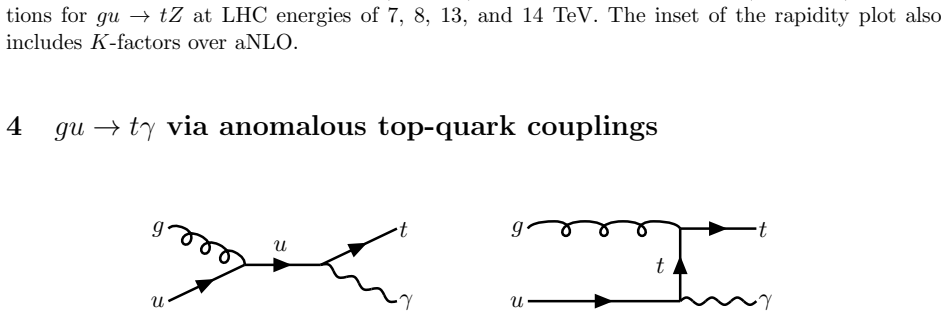
The central object is the soft anomalous dimension $\Gamma_S$ for the partonic process $g q \to t A$, which controls the exponentiation of soft-gluon logarithms near partonic threshold, where the extra energy $s_4 = s + t + u - m_t^2 - m_A^2$ goes to zero. The cross section is built from master formulas (Eqs. (5)-(8)) that express the aNLO and aNNLO corrections as $F^{LO}$ times plus-distributions $[\ln^k(s_4/m_t^2)/s_4]_+$, with coefficients $c_3, c_2, c_1$ determined by the color factors $C_F$, $C_A$, the kinematics, and the factorization/renormalization scales. These formulas turn the soft anomalous dimension into final cross sections and distributions after convolution with PDFs.
What would settle it
Compute the complete NNLO QCD corrections for $gu \to tZ$ and $gu \to t\gamma$ and compare them with the aNNLO results presented here; if the full NNLO-over-LO K-factors differ from 1.49 and 1.36 at 13 TeV by more than the quoted scale uncertainties, the threshold-dominance assumption is contradicted.
Extended reading notes
Core claim
The paper claims that soft-gluon (threshold) logarithms dominate the higher-order QCD corrections for $gq \to tZ$ and $gq \to t\gamma$, so that the approximate corrections built from those logarithms stand in for the complete corrections. Using this approximation, it finds that the aNNLO corrections are large at all LHC energies: for $gu \to tZ$ at 13 TeV the cross section grows by 49% over LO (with aNLO giving 36%), and for $gu \to t\gamma$ at 13 TeV by 36% over LO (with aNLO giving 31%). The aNNNLO corrections are much smaller, suggesting the series has essentially converged. Rapidity and transverse-momentum distributions receive similarly significant enhancements, so the higher-order effects matter for both inclusive and differential measurements.
Load-bearing premise
The calculation assumes that soft-gluon (threshold) logarithms dominate the full QCD corrections, so the 'approximate' NNLO result is close to the complete NNLO result.
Editorial extensions
If this is right
- Searches for anomalous $tqZ$ and $tq\gamma$ couplings at the LHC should use the aNNLO K-factors (1.49 for $tZ$, 1.36 for $t\gamma$ at 13 TeV) rather than LO cross sections when interpreting limits, otherwise the derived bounds on $\kappa_{tqZ}$ and $\kappa_{tq\gamma}$ would be too tight.
- Because the predicted cross section increases, current exclusion limits on FCNC couplings become weaker once these corrections are included.
- The differential $p_T$ and rapidity distributions also change shape with the higher-order corrections, so experimental analyses using kinematic distributions need corrected predictions, not just a flat K-factor.
- The small aNNNLO increment indicates the soft-gluon series is under control, giving confidence that the aNNLO numbers are a stable target for the full NNLO prediction.
Reading between the lines
- Inference: If the soft-gluon dominance assumption holds, a future complete NNLO computation for these processes should land close to the quoted aNNLO K-factors; any sizeable deviation would signal that hard non-threshold radiation is important.
- Inference: The same threshold-logarithm machinery could be carried over to other single-top FCNC final states, such as $tH$, where soft corrections may be comparably large.
- Inference: The K-factors being larger than unity implies that experimental collaborations' existing LO-based limits are numerically over-optimistic, so reinterpreting published limits with these corrections is a direct and testable application.
- Inference: Differential measurements of the top-quark $p_T$ tail could discriminate between LO and aNNLO shapes, providing a data-driven check of the threshold approximation.
Editorial analysis
A structured set of objections, weighed in public.
Referee Report
Summary. The paper studies higher-order QCD corrections to single-top production in association with a Z boson or a photon via anomalous FCNC couplings, specifically the partonic processes gq→tZ and gq→tγ. The authors use the soft-gluon resummation formalism developed in their earlier papers to write approximate NLO, NNLO, and NNNLO formulas (Eqs. (5)-(8)), and present numerical total cross sections and differential distributions in top rapidity and transverse momentum at LHC energies of 7, 8, 13, and 14 TeV using MMHT2014 NNLO PDFs. The central numerical results are the K-factors: at 13 TeV, the aNNLO corrections increase the gu→tZ cross section by 49% (versus 36% at aNLO) and the gu→tγ cross section by 36% (versus 31% at aNLO), with much smaller further aNNNLO contributions. The paper argues that these corrections are important for converting LHC cross-section measurements into limits on anomalous couplings κ_tqZ and κ_tqγ.
Significance. If the quoted aNNLO K-factors are reliable, the paper provides practically useful input for ATLAS/CMS searches for top-quark FCNC couplings; corrections of tens of percent change the extracted coupling limits. The calculation has a clean parametric setup: the only free parameters are the two anomalous couplings, which scale the cross sections quadratically, and the results are not fitted to data. The paper also supplies results at several LHC energies and for multiple distributions, which is useful. Its main limitations are that the central formulas are not derived here, the aNNLO accuracy is not validated against a complete NNLO calculation, and no numerical uncertainties are provided despite being announced in the abstract; these limitations must be addressed before the numbers can be used at face value.
major comments (3)
- [Abstract and Sections 3-4] The abstract states that the paper will "discuss uncertainties," but the text contains no numerical uncertainty estimate (no scale variation, PDF error, or scheme dependence) for any of the quoted cross sections or K-factors. Because the central claim is that aNNLO corrections change the 13 TeV cross sections by tens of percent, a reader cannot judge whether the 49% and 36% numbers are stable without an uncertainty estimate. At minimum, the authors should give the residual scale dependence at aNLO/aNNLO and, if possible, a PDF uncertainty.
- [Section 1 and Section 5] The claim that the aNNLO results are trustworthy rests on the assertion in Section 1 that soft-gluon corrections "dominate (and thus approximate well) the higher-order corrections." The only validation cited, in Section 5, is that the approximations reproduce the complete NLO results of Refs. [6,12]; this says nothing about the size of hard non-soft NNLO terms, which are not included in Eq. (8). Since at 13 TeV the partonic system is farther from threshold than at 7 or 8 TeV, the uncalculated hard NNLO terms could be comparable to the additional aNNLO increment beyond aNLO (roughly 10% of the cross section for tZ and 4% for tγ based on the quoted K-factors). Please either compare with a complete NNLO calculation where one exists, or provide a quantitative argument (e.g., power-suppressed corrections or scale variation) that the missing hard terms are small.
- [Eq. (8) and Section 2] Eq. (8) is presented as the aNNLO soft-gluon correction, but unlike Eq. (5) it contains no δ(s4) term. The coefficient of δ(s4) at aNNLO contributes to the total cross section after integration, and the text does not state whether it is zero, omitted for brevity, or beyond the stated NLL accuracy. Please clarify the logarithmic accuracy of Eq. (8) and, if a δ(s4) term exists, display it or cite the specific equation in Ref. [14] or [15] from which it can be obtained.
minor comments (5)
- [Section 3] The sentence "with a 49% increase in the total cross section at 13 TeV at aNNLO compared to the 36% increase at aNLO" is ambiguous; state explicitly that both numbers are K-factors relative to LO, or give aNNLO/aNLO ratios.
- [Sections 3-4] The text never specifies the central renormalization and factorization scales used for the numerical results, nor the values of α_s and m_t used in the plots; please add this information or give a precise pointer to the corresponding paragraphs of Refs. [14,15].
- [Eq. (4)] The one-loop soft anomalous dimension is given in Feynman gauge; the gauge choice and the definition of the color basis should be stated to make the formula unambiguous.
- [References] Reference [18] contains a typo: "Molytinski" should be "Motylinski."
- [Figures 2 and 5] The right insets of Figs. 2 and 5 are labeled only "1" and "2" on the vertical axis; please use explicit tick labels with the K-factor values.
Circularity Check
No significant circularity: the quoted K-factors are computed from threshold-resummation formulas, not fitted to the cross sections they predict.
full rationale
The central numerical claims (49% for gu->tZ and 36% for gu->tgamma at 13 TeV) are obtained by integrating the soft-gluon master formulas in Eqs. (5)-(8) with fixed external inputs: MMHT2014 PDFs and a hand-chosen benchmark coupling kappa=0.01. No parameter is fitted to the quoted total cross sections or K-factors, and kappa cancels in the K-factors, so the predictions are not forced by construction. The aNLO approximation is checked against the independent complete NLO calculations [6,12], giving external support for the method at one order lower; the aNNLO results are an extrapolation of the same formalism, not a fit to target data. The self-citations to [14,15,17] supply the resummation formalism and higher-loop anomalous dimensions, but the paper explicitly states that two- and three-loop results are not required for the NLL accuracy used here, so the central numbers do not reduce to an unverified self-citation chain. The assumption that soft-gluon terms dominate the full higher-order corrections is a physical approximation whose reliability at aNNLO is not demonstrated by a complete-NNLO comparison, and the abstract promises an uncertainty discussion that is absent from the body; these are correctness and completeness concerns, not circularity. No equation in the paper is defined in terms of the quantity it predicts, and no fitted parameter is renamed as a prediction.
Assumptions & free parameters
free parameters (2)
- kappa_tqZ =
0.01
- kappa_tqgamma =
0.01
assumptions (4)
- domain assumption The anomalous FCNC effective Lagrangian of Eq. (1) describes tqZ and tqgamma production, with the effective scale Lambda taken equal to the top-quark mass.
- domain assumption Soft-gluon corrections dominate the higher-order QCD corrections near partonic threshold, so aNNLO/aNNNLO approximations are valid.
- standard math Standard soft-gluon resummation factorization holds, with the one-loop soft anomalous dimension of Eq. (4) sufficient for NLL accuracy.
- domain assumption MMHT2014 NNLO PDFs are appropriate for LHC kinematics and the chosen factorization scale.
Cite this review
Pith. "Pith review of Soft-gluon corrections for single top quark production in association with electroweak bosons." pith.science (2026). https://pith.science/paper/5G5AGCRI
@misc{pith2026190902619,
  author       = {Pith},
  title        = {Pith review of: Soft-gluon corrections for single top quark production in association with electroweak bosons},
  year         = {2026},
  howpublished = {\url{https://pith.science/paper/5G5AGCRI}},
  note         = {Machine review of arXiv:1909.02619}
}
abstract
We present results for higher-order soft-gluon radiative corrections for single top-quark production in association with electroweak bosons, including $t\gamma$ and $tZ$ production via anomalous FCNC couplings. We provide results for the total cross sections and differential distributions at LHC energies. We use $K$-factors to show the significance of the corrections compared to leading order, and we discuss uncertainties and the importance of the results.
Figures


Figures from the paper (3 more)


Reference graph
Works this paper leans on
-
[14]
Higher-order corrections for $tZ$ production via anomalous couplings
N. Kidonakis, Phys. Rev. D 97, 034028 (2018) [ arXiv:1712.01144]
work page Pith review arXiv 2018
-
[15]
Associated production of a top quark with a photon via anomalous couplings
M. Forslund and N. Kidonakis, Phys. Rev. D 98, 074017 (2018) [ arXiv:1808.09014]
work page Pith review arXiv 2018
-
[1]
CMS Collaboration, JHEP 04 (2016) 035 [ arXiv:1511.03951]
work page Pith review arXiv 2016
-
[2]
CMS Collaboration, JHEP 07 (2017) 003 [ arXiv:1702.01404]
arXiv 2017
-
[3]
ATLAS Collaboration, ATLAS-CONF-2017-070
work page 2017
-
[4]
Single Top Production as a Window to Physics Beyond the Standard Model
T. Tait and C.-P. Yuan, Phys. Rev. D 63, 014018 (2000) [hep-ph/0007298]
work page Pith review arXiv 2000
-
[5]
FCNC top quark production via anomalous tqV couplings beyond leading order
N. Kidonakis and A. Belyaev, JHEP 12, 004 (2003) [hep-ph/0310299]
work page Pith review arXiv 2003
-
[6]
Y. Zhang, B.H. Li, C.S. Li, J. Gao, and H.X. Zhu, Phys. Rev. D 83, 094003 (2011) [arXiv:1101.5346]
work page Pith review arXiv 2011
Show all 19 references
- [7]
- [8]
-
[9]
Degrande, F
C. Degrande, F. Maltoni, J. Wang, and C. Zhang, Phys. Rev. D 91, 034024 (2015) [arXiv:1412.5594]
2015 arXiv
-
[10]
Durieux, F
G. Durieux, F. Maltoni, and C. Zhang, Phys. Rev. D 91, 074017 (2015) [arXiv:1412.7166]
2015 arXiv
-
[11]
Guo, C.-X
Y.-C. Guo, C.-X. Yue, and S. Yang, Eur. Phys. J. C 76, 596 (2016) [arXiv:1603.00604]
2016 arXiv
-
[12]
B.H. Li, Y. Zhang, C.S. Li, J. Gao, and H.X. Zhu, Phys. Rev . D 83, 114049 (2011) [arXiv:1103.5122]
2011 arXiv
-
[13]
Agram, J
J.-L. Agram, J. Andrea, E. Conte, B. Fuks, D. Gele, and P. Lansonneur, Phys. Lett. B 725, 123 (2013) [arXiv:1304.5551]
2013 arXiv
- [16]
- [17]
-
[18]
Harland-Lang, A.D
L.A. Harland-Lang, A.D. Martin, P. Molytinski, and R.S . Thorne, Eur. Phys. J. C 75, 204 (2015) [ arXiv:1412.3989]
2015 arXiv
-
[19]
Dulat, T.-J
S. Dulat, T.-J. Hou, J. Gao, M. Guzzi, J. Huston, P. Nadol sky, J. Pumplin, C. Schmidt, D. Stump, and C.-P. Yuan, Phys. Rev. D 93, 033006 (2016) [ arXiv:1506.07443]. 6
2016 arXiv
Reviewed August 14, 2026 · model on record in the stance chip above.
Discussion (0). Continue with ORCID to comment.