REVIEW 5 minor 1 cited by
Second-order QCD corrections to event shape distributions in deep inelastic scattering
T0 review · 0 major / 5 minor · reviewed 2026-08-14 · deepseek-v4-flash
Pith's one-line read Second-order QCD corrections now cover DIS event shapes
desk verdict First NNLO DIS event shapes: solid fixed-order result, model-dependent data comparison, worth refereeing. read the letter →
The pith
A machine-rendered reading of the paper's core claim, the machinery that carries it, and where it could break.
The reading
What carries the argument
The calculation is built by extending the NNLO corrections to di-jet production in deep inelastic scattering, replacing the jet algorithm with computations of the event shape variables. It combines four-parton tree amplitudes, three-parton one-loop amplitudes, and two-parton two-loop amplitudes using the antenna subtraction method, which isolates and cancels infrared singularities numerically, inside a parton-level Monte Carlo program. The hadronization treatment is the dispersive model, which represents the leading power correction as a universal quantity $P$ times a variable-dependent coefficient $a_F$, shifting the distribution $d\sigma/dF$ to $d\sigma/d(F-a_F P)$ and adding $a_F P$ to mean values; $P$ is expanded to $\alpha_s^3$ at NNLO. The paper also identifies the kinematical ridges and Sudakov shoulders in $C$ and $\tau_T$ that destabilize fixed-order predictions at exceptional values.
What would settle it
Refit $\alpha_0$ in each $Q^2$ bin, or in separate ranges of $F$, using the NNLO predictions; the constant-shift dispersive model predicts a single universal $\alpha_0$ with no systematic trend, so a trend of the fitted $\alpha_0$ with $Q^2$ or with the event shape variable that exceeds the NNLO scale uncertainty would rule out the hadronization treatment.
Extended reading notes
Core claim
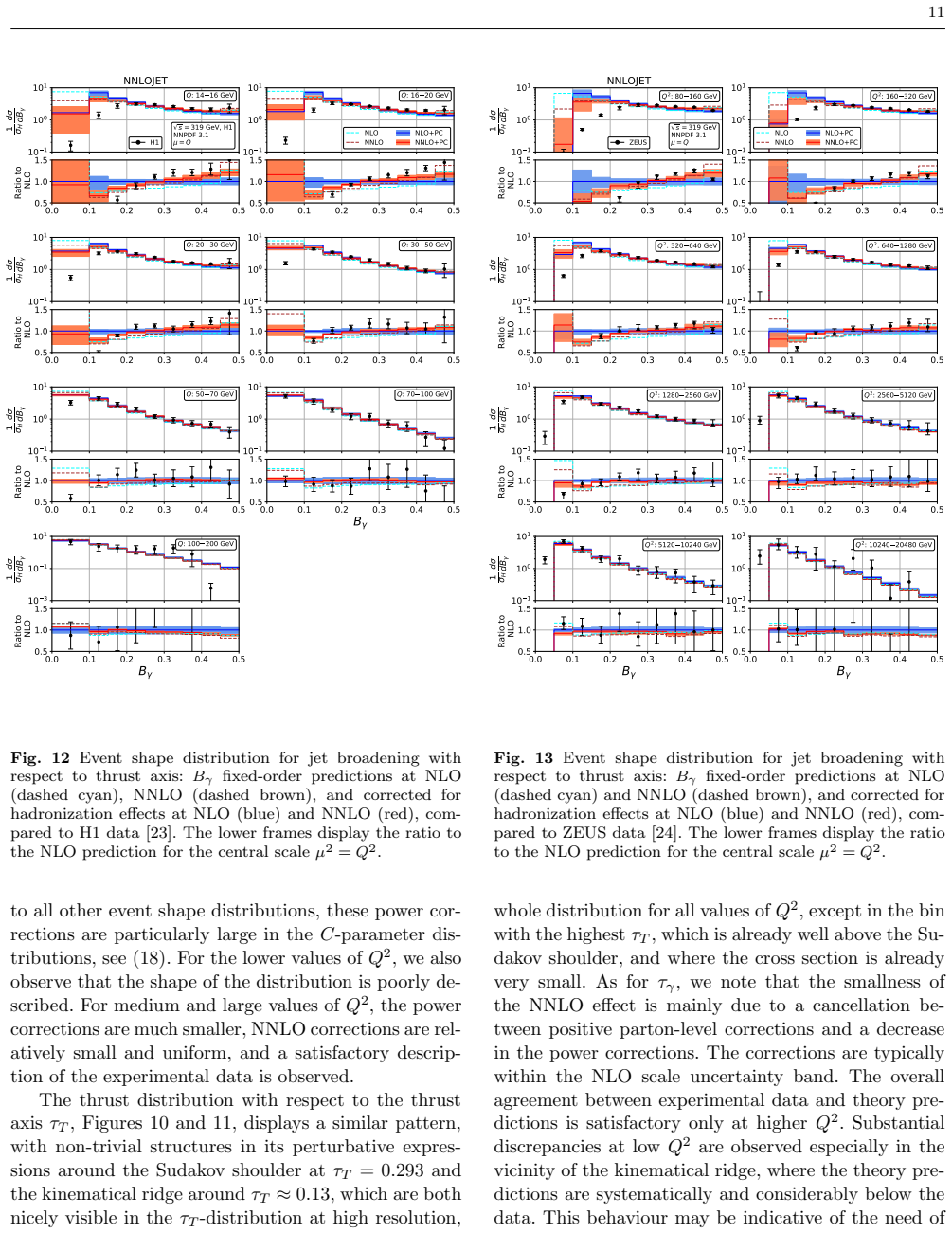
The paper's central claim is that the complete NNLO QCD corrections to the current-hemisphere event shape distributions ($\tau_\gamma$, $\tau_T$, $\rho$, $B_\gamma$, $C$) and their mean values in deep inelastic scattering have been computed and are phenomenologically relevant. In the bulk of the distributions the NNLO corrections are positive, up to about 20% at low and moderate $Q^2$, while they become small or negative at high $Q^2$ and near the upper kinematical boundaries; the NNLO/NLO ratio has a non-trivial shape for every variable. The scale uncertainty is reduced from roughly 10% at NLO to roughly 5% at NNLO, and to below 4% at high $Q^2$, so that the theory uncertainty falls below the experimental errors for moderate and high $Q^2$. When hadronization is modelled by a dispersive power correction that shifts each distribution, the NNLO predictions improve the description of the data. For the mean values, the positive NNLO corrections to the fixed-order result are largely compensated by negative NNLO contributions to the power correction, leaving a small net shift but a substantially smaller scale uncertainty.
Load-bearing premise
The hadron-level comparison assumes that hadronization can be represented by one constant shift per event shape distribution, with $\alpha_0=0.5$ taken from earlier fits; if the true shift depends on the value of the event shape variable, the claimed improvement in the data description does not follow.
Editorial extensions
If this is right
- DIS event shape distributions and mean values are now available at NNLO, with scale uncertainties of a few percent at moderate and high $Q^2$, typically below the experimental errors of the HERA data.
- The improved theory description of the shape of the distributions, particularly at large jet mass and in the broadening variable, strengthens the case for using these observables in precision QCD studies.
- A fully consistent NNLO-based combined fit of $\alpha_s(M_Z)$ and $\alpha_0$ to event shapes is now possible; the theory uncertainty on $\alpha_s$, previously about 5% from NLO scale variation, should be substantially reduced.
- The first bin near $F \to 0$ remains unreliable without resummation, and Sudakov shoulders and kinematical ridges in $C$ and $\tau_T$ require new resummation approaches before fixed-order predictions can be used there.
- High-resolution measurements at future lepton-hadron colliders would be able to resolve the ridge and shoulder structures and test the need for the new resummations.
Reading between the lines
- If the constant-shift hadronization approximation is inadequate, the NNLO improvement may be specific to the bulk of each distribution; fits of $\alpha_0$ in separate $Q^2$ bins or $F$ regions would reveal whether the effective shift varies, which the paper leaves open.
- The compensation between fixed-order and power-correction NNLO terms in the mean values implies that the value of $\alpha_0$ extracted from data may shift when the fit is upgraded from NLO to NNLO, as was seen in $e^+e^-$ event shape moments; this shift can be tested by repeating the combined fit to the existing HERA data.
- The same calculation can be recast into convolution grids for fast re-evaluation, which would enable a practical $\alpha_s(M_Z)$ extraction from the existing HERA data at NNLO.
Editorial analysis
A structured set of objections, weighed in public.
Referee Report
Summary. The paper presents the first next-to-next-to-leading-order (NNLO) QCD calculation of event shape distributions and their mean values in deep inelastic scattering. The calculation is implemented in NNLOJET by adapting the existing NNLO dijet-in-DIS calculation; the paper documents the phase-space cuts, scale choice, PDF set, and the technical low-F cut-offs. The fixed-order results are compared with H1 and ZEUS data after applying dispersive-model hadronization corrections as a constant shift (Eq. 15). The authors find that NNLO corrections reduce scale uncertainties and generally improve the description of the data, while explicitly identifying regions where fixed-order predictions are unreliable (small F, Sudakov shoulders, kinematical ridges).
Significance. This is a substantial step forward: DIS event shapes were previously known only to NLO, and the scale uncertainty on NLO predictions limited precision studies; the present work makes NNLO predictions available for all five standard DIS event shapes and their mean values. The fixed-order part is parameter-free once PDFs and alpha_s are fixed, and it reuses machinery already validated in DIS dijet and single-jet calculations. The authors are commendably explicit about the known limitations of the constant-shift dispersive model and about the instability regions. If the results hold, they also open the door to a consistent NNLO extraction of alpha_s and alpha0 from HERA data.
minor comments (5)
- [Abstract and Section 6] The sentence 'inclusion of the NNLO corrections leads in general to an improved description' should be qualified to specify the regions where the statement is robust (medium/high Q2, away from the first bin and from Sudakov shoulders), because at low Q2 the comparison relies on the constant-shift approximation and the authors themselves note large shifts for the C-parameter.
- [Section 3] The text states that the normalization cross sections are computed to NNLO for all predictions; this means the NLO and NNLO distribution predictions are normalized by the same NNLO total cross section. This choice should be stated explicitly in Section 3 so that the NLO curves are not misinterpreted as normalized to an NLO total cross section.
- [Section 5.1 and Eq. (15)] The statement that the smallness of the NNLO correction to tau_T is due to a cancellation between positive parton-level corrections and decreased power corrections would be more compelling with a quantitative illustration; consider giving P_NNLO/P_NLO values for a few Q bins or plotting the separate contributions.
- [Figures 2 and 3] Axis labels in Figures 2 and 3 are inconsistent or missing for some rows (for example, the label 'T' leaves ambiguity between tau_T and B_T); please label each panel explicitly with the event shape variable.
- [Section 3.1 and Section 5.1] The definition of the 'left-most non-vanishing bin' after the shift depends on the cut values in Eq. (13); please specify exactly which experimental bins are excluded in the comparison, for example by listing the bin indices, to make the comparisons reproducible.
Circularity Check
The NNLO fixed-order computation is non-circular; only the hadron-level comparison inherits a previously fitted power-correction parameter from the same HERA datasets.
-
fitted input called prediction
[Section 4 (Eqs. 14/16/20) and Section 5.2 (Figs. 14-15)]
"In our numerical results, we use α0(µI) = 0.5 at µI = 2 GeV, which has been estimated from fits to event shape moments in DIS [23, 24, 58] and e+e− annihilation [56]."
The dispersive-model power correction P is proportional to α0, and the mean-value comparison uses the additive shift ⟨F⟩ = ⟨F⟩_pert + a_F P (Eq. 20). Since α0=0.5 was fitted to event shape moments from the same H1 [23] and ZEUS [24] experiments that are subsequently compared in Figures 14-15, the hadron-level mean-value improvement is partly inherited from fits to those data rather than produced by the NNLO calculation. The NNLO parton-level corrections are parameter-free and not fitted, so the circularity is partial and does not infect the central fixed-order result.
full rationale
The central claim of the paper, the NNLO QCD correction to DIS event shape distributions, is not circular. The calculation is performed with NNLOJET by reusing the published NNLO di-jet DIS calculation [26,27]; the event-shape observables are obtained by replacing the jet algorithm with the shape definitions, and the fixed-order result is parameter-free once PDFs and αs are specified. Nothing in the matrix elements, antenna subtraction, or scale variation is defined in terms of the H1/ZEUS data or of the final distributions. The stronger 'improved description' claim is more delicate: the hadronization corrections are estimated with the dispersive model using α0=0.5, a value fitted in previous work to event-shape moments including the same H1 and ZEUS data, and then applied as an additive shift to mean values and a constant shift to distributions (Eqs. 15 and 20). Thus the hadron-level comparison is not a from-scratch prediction of the data; it is a consistency check of the NNLO corrections given a power-correction model whose parameter was fixed to similar observables. The paper explicitly acknowledges that using a constant shift P for the full distribution is only an approximation, and it flags the left-most bin as unreliable due to the interplay of the lower cut-off and the shift. No self-citation chain forces the result: the cited NNLO di-jet work provides independent validation of the antenna-subtraction setup, and the a_F coefficients come from independent dispersive-model literature. Score 2 reflects the one parameter inherited from the comparison data, while the core NNLO result remains independent.
Assumptions & free parameters
free parameters (3)
- alpha0(mu_I=2 GeV) =
0.5
- M (Milan factor) =
1.49
- eta0 in broadening shift a'_B =
-0.614
assumptions (4)
- domain assumption The dispersive model describes non-perturbative hadronization corrections as a universal constant shift of the event shape distributions.
- domain assumption NNPDF3.1 parton distributions with alpha_s(MZ)=0.118 are the correct input.
- domain assumption The antenna subtraction method and the NNLOJET implementation correctly compute infrared-safe observables in DIS.
- domain assumption The seven-point scale variation envelope is a reliable estimate of missing higher-order uncertainty.
Cite this review
Pith. "Pith review of Second-order QCD corrections to event shape distributions in deep inelastic scattering." pith.science (2026). https://pith.science/paper/I6625WUH
@misc{pith2026190902760,
  author       = {Pith},
  title        = {Pith review of: Second-order QCD corrections to event shape distributions in deep inelastic scattering},
  year         = {2026},
  howpublished = {\url{https://pith.science/paper/I6625WUH}},
  note         = {Machine review of arXiv:1909.02760}
}
read the original abstract
We compute the next-to-next-to-leading order (NNLO) QCD corrections to event shape distributions and their mean values in deep inelastic lepton-nucleon scattering. The magnitude and shape of the corrections varies considerably between different variables. The corrections reduce the renormalization and factorization scale uncertainty of the predictions. Using a dispersive model to describe non-perturbative power corrections, we compare the NNLO QCD predictions with data from the H1 and ZEUS experiments. The newly derived corrections improve the theory description of the distributions and of their mean values.
Figures
Forward citations
Cited by 1 Pith paper
-
Exploring soft anomalous dimensions for $1/Q$ power corrections
The leading logarithmic correction to the 1/Q power correction for thrust and C-parameter is computed, with a sizeable coefficient S1 ≈ 2.455 and a universal C-to-thrust ratio of 3π/2.
Reference graph
Works this paper leans on
-
[1]
Tests of Quantum Chromo Dynamics at e^+e^- Colliders
S. Kluth, Rept. Prog. Phys. 69 (2006) 1771–1846, arXiv:hep-ex/0603011
work page Pith review arXiv 2006
- [2]
-
[3]
A. Gehrmann-De Ridder, T. Gehrmann, E. W. N. Glover and G. Heinrich, JHEP 12 (2007) 094, arXiv:0711.4711
arXiv 2007
-
[4]
A. Gehrmann-De Ridder, T. Gehrmann, E. W. N. Glover and G. Heinrich, JHEP 05 (2009) 106, arXiv:0903.4658
arXiv 2009
-
[5]
A. Gehrmann-De Ridder, T. Gehrmann, E. W. N. Glover and G. Heinrich, Comput. Phys. Commun. 185 (2014) 3331, arXiv:1402.4140
arXiv 2014
-
[6]
Weinzierl, JHEP 06 (2009) 041, arXiv:0904.1077
S. Weinzierl, JHEP 06 (2009) 041, arXiv:0904.1077
arXiv 2009
- [7]
-
[8]
V. Del Duca, C. Duhr, A. Kardos, G. Somogyi, Z. Sz˝ or, Z. Tr´ ocs´ anyi and Z. Tulip´ ant,Phys. Rev. D94 (2016) 074019, arXiv:1606.03453
arXiv 2016
Show all 61 references
-
[9]
Gehrmann, E
T. Gehrmann, E. W. N. Glover, A. Huss, J. Niehues and H. Zhang, Phys. Lett. B775 (2017) 185–189, arXiv:1709.01097
2017 arXiv
- [10]
- [11]
-
[12]
Abbate, M
R. Abbate, M. Fickinger, A. H. Hoang, V. Mateu and I. W. Stewart, Phys. Rev. D83 (2011) 074021, arXiv:1006.3080
2011 arXiv
-
[13]
P. F. Monni, T. Gehrmann and G. Luisoni, JHEP 08 (2011) 010, arXiv:1105.4560
2011 arXiv
- [14]
-
[15]
A. H. Hoang, D. W. Kolodrubetz, V. Mateu and I. W. Stewart, Phys. Rev. D91 (2015) 094017, arXiv:1411.6633
2015 arXiv
-
[16]
Catani and M
S. Catani and M. H. Seymour, Nucl. Phys. B485 (1997) 291–419, arXiv:hep-ph/9605323. [Erratum: Nucl. Phys.B510,503(1998)]
1997 arXiv
- [17]
-
[18]
Nagy and Z
Z. Nagy and Z. Trocsanyi, Phys. Rev. Lett. 87 (2001) 082001, arXiv:hep-ph/0104315
2001 arXiv
-
[19]
Antonelli, M
V. Antonelli, M. Dasgupta and G. P. Salam, JHEP 02 (2000) 001, arXiv:hep-ph/9912488
2000 arXiv
-
[20]
Dasgupta and G
M. Dasgupta and G. P. Salam, Eur. Phys. J. C24 (2002) 213–236, arXiv:hep-ph/0110213
2002 arXiv
- [21]
-
[22]
Dasgupta and G
M. Dasgupta and G. P. Salam, J. Phys. G30 (2004) R143, arXiv:hep-ph/0312283
2004 arXiv
-
[23]
Aktas et al
H1 Collaboration, A. Aktas et al. , Eur. Phys. J. C46 (2006) 343–356, arXiv:hep-ex/0512014
2006 arXiv
-
[24]
Chekanov et al
ZEUS Collaboration, S. Chekanov et al. , Nucl. Phys. B767 (2007) 1–28, arXiv:hep-ex/0604032
2007 arXiv
- [25]
-
[26]
Currie, T
J. Currie, T. Gehrmann and J. Niehues, Phys. Rev. Lett. 117 (2016) 042001, arXiv:1606.03991. 15
2016 arXiv
-
[27]
Currie, T
J. Currie, T. Gehrmann, A. Huss and J. Niehues, JHEP 07 (2017) 018, arXiv:1703.05977
2017 arXiv
-
[28]
Y. L. Dokshitzer, G. Marchesini and B. R. Webber, Nucl. Phys. B469 (1996) 93–142, arXiv:hep-ph/9512336
1996 arXiv
-
[29]
Dasgupta and B
M. Dasgupta and B. R. Webber, Eur. Phys. J. C1 (1998) 539–546, arXiv:hep-ph/9704297
1998 arXiv
- [30]
-
[31]
Hagiwara and D
K. Hagiwara and D. Zeppenfeld, Nucl. Phys. B313 (1989) 560–594
1989
-
[32]
F. A. Berends, W. T. Giele and H. Kuijf, Nucl. Phys. B321 (1989) 39–82
1989
-
[33]
N. K. Falck, D. Graudenz and G. Kramer, Nucl. Phys. B328 (1989) 317–341
1989
-
[34]
E. W. N. Glover and D. J. Miller, Phys. Lett. B396 (1997) 257–263, arXiv:hep-ph/9609474
1997 arXiv
-
[35]
Z. Bern, L. J. Dixon, D. A. Kosower and S. Weinzierl, Nucl. Phys. B489 (1997) 3–23, arXiv:hep-ph/9610370
1997 arXiv
-
[36]
J. M. Campbell, E. W. N. Glover and D. J. Miller, Phys. Lett. B409 (1997) 503–508, arXiv:hep-ph/9706297
1997 arXiv
-
[37]
Z. Bern, L. J. Dixon and D. A. Kosower, Nucl. Phys. B513 (1998) 3–86, arXiv:hep-ph/9708239
1998 arXiv
-
[38]
L. W. Garland, T. Gehrmann, E. W. N. Glover, A. Koukoutsakis and E. Remiddi, Nucl. Phys. B627 (2002) 107–188, arXiv:hep-ph/0112081
2002 arXiv
-
[39]
L. W. Garland, T. Gehrmann, E. W. N. Glover, A. Koukoutsakis and E. Remiddi, Nucl. Phys. B642 (2002) 227–262, arXiv:hep-ph/0206067
2002 arXiv
-
[40]
Gehrmann and E
T. Gehrmann and E. Remiddi, Nucl. Phys. B640 (2002) 379–411, arXiv:hep-ph/0207020
2002 arXiv
-
[41]
Gehrmann and E
T. Gehrmann and E. W. N. Glover, Phys. Lett. B676 (2009) 146–151, arXiv:0904.2665
2009 arXiv
-
[42]
Gehrmann-De Ridder, T
A. Gehrmann-De Ridder, T. Gehrmann and E. W. N. Glover, JHEP 09 (2005) 056, arXiv:hep-ph/0505111
2005 arXiv
- [43]
- [44]
-
[45]
Currie, T
J. Currie, T. Gehrmann, E. W. N. Glover, A. Huss, J. Niehues and A. Vogt, JHEP 05 (2018) 209, arXiv:1803.09973
2018 arXiv
-
[46]
Andreev et al
H1 Collaboration, V. Andreev et al. , Eur. Phys. J. C77 (2017) 791, arXiv:1709.07251
2017 arXiv
- [47]
-
[48]
Britzger, J
D. Britzger, J. Currie, T. Gehrmann, A. Huss, J. Niehues and R. ˇZlebˇ c´ ık,Eur. Phys. J. C78 (2018) 538, arXiv:1804.05663
2018 arXiv
-
[49]
Niehues and D
J. Niehues and D. M. Walker, Phys. Lett. B788 (2019) 243–248, arXiv:1807.02529
2019 arXiv
-
[50]
Gehrmann, A
T. Gehrmann, A. Huss, J. Niehues, A. Vogt and D. M. Walker, Phys. Lett. B792 (2019) 182–186, arXiv:1812.06104
2019 arXiv
- [51]
- [52]
-
[53]
LHeC Study Group Collaboration, J. L. Abelleira Fernandez et al. , J. Phys. G39 (2012) 075001, arXiv:1206.2913
2012 arXiv
-
[54]
Catani, B
S. Catani, B. R. Webber and G. Marchesini, Nucl. Phys. B349 (1991) 635–654
1991
-
[55]
R. A. Davison and B. R. Webber, Eur. Phys. J. C59 (2009) 13–25, arXiv:0809.3326
2009 arXiv
-
[56]
Gehrmann, M
T. Gehrmann, M. Jaquier and G. Luisoni, Eur. Phys. J. C67 (2010) 57–72, arXiv:0911.2422
2010 arXiv
-
[57]
Y. L. Dokshitzer, A. Lucenti, G. Marchesini and G. P. Salam, JHEP 05 (1998) 003, arXiv:hep-ph/9802381
1998 arXiv
-
[58]
Adloff et al
H1 Collaboration, C. Adloff et al. , Eur. Phys. J. C14 (2000) 255–269, arXiv:hep-ex/9912052. [Erratum: Eur. Phys. J.C18,417(2000)]
2000 arXiv
-
[59]
S. Moch, J. A. M. Vermaseren and A. Vogt, Nucl. Phys. B688 (2004) 101–134, arXiv:hep-ph/0403192
2004 arXiv
-
[60]
Y. L. Dokshitzer, G. Marchesini and G. P. Salam, Eur. Phys. J.direct 1 (1999) 3, arXiv:hep-ph/9812487
1999 arXiv
-
[61]
Andreev et al
H1 Collaboration, V. Andreev et al. , Eur. Phys. J. C77 (2017) 215, arXiv:1611.03421
2017 arXiv
Reviewed August 14, 2026 · model on record in the stance chip above.
Discussion (0). Continue with ORCID to comment.