REVIEW 4 major objections 7 minor 98 references
A physics-informed transformer neural operator for learning generalized solutions of initial boundary value problems
T0 review · 4 major / 7 minor · reviewed 2026-08-11 · deepseek-v4-flash
Pith's one-line read This paper claims a transformer neural operator trained only on PDE residuals generalizes to unseen initial and boundary conditions, with relative errors one-fifth to one-third of the leading physics-informed baseline in five flow problems.
desk verdict A real architectural contribution (cross-attention boundary conditioning) whose headline generalization numbers are inflated by tuning on the unseen set and a favorable error metric; worth reviewing with claims corrected. read the letter →
The pith
A machine-rendered reading of the paper's core claim, the machinery that carries it, and where it could break.
The reading
What carries the argument
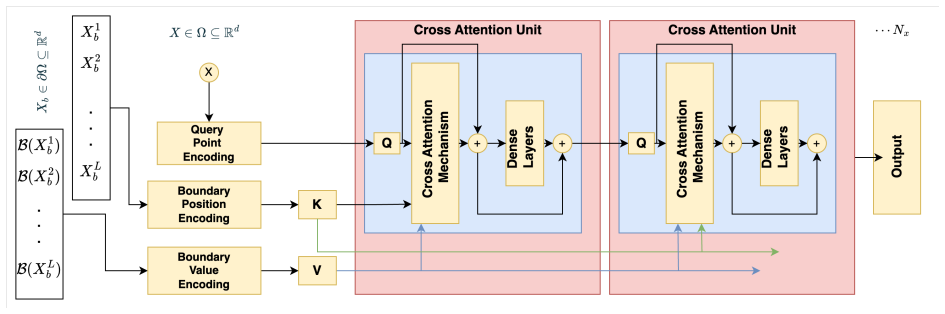
The load-bearing component is the iterative kernel integral operator unit, a multihead cross-attention mechanism implementing the operator-theoretic layer $\mu_{j+1}(X) = \sigma(W_j\mu_j(X) + K_j\mu_j(X) + \gamma_j(X))$. In each unit, the encoded interior query point is scored against encoded boundary coordinates by a scaled dot product; softmax over all boundary tokens yields attention scores, and the output is the attention-weighted sum of encoded boundary values, added through a residual connection and Swish activation. Because the boundary function enters as a variable-length sequence of keys and values, repeated units produce a boundary-aware hidden representation, and a projection MLP maps that representation to the solution field. Lifting operators for the query point, boundary coordinates, and boundary values are all MLPs, and with a single query point the attention cost is $O(N m^2)$ rather than $O(MN m^2)$.
What would settle it
Train PINTO on advection or Burgers with the paper's sinusoidal or random-field initial conditions, then evaluate on an initial condition from a different family, such as a narrow Gaussian pulse or a discontinuous square wave, comparing against a high-resolution numerical solver; if the relative error jumps well above the reported 2–5% range, the generalization is limited to the training distribution. A second, cleaner check is to redo the hyperparameter selection without using the unseen-condition errors (Appendix B) and see whether the reported error gap over the baseline persists.
Extended reading notes
Core claim
The paper's central claim is that the map $\mathcal{G}: \mathcal{A}\to\mathcal{H}$ from initial/boundary conditions to PDE solutions can be learned by a transformer-based operator, PINTO, trained exclusively with the physics loss (the PDE residual and boundary residual in Eq. 3), with no simulation or observation data. The reported result is that this works: for the advection equation, Burgers equation, Kovasznay flow, Beltrami flow, and lid-driven cavity flow, the trained model achieves mean relative errors on unseen conditions of roughly 0.41% to 5.24%, against 2.26% to 11.85% for the physics-informed operator baseline, about one-fifth to one-third of the baseline's error. For advection and Burgers, the same model also produces accurate solutions at times $t>1$, beyond the temporal collocation points used in training, which the baseline does not. The paper attributes this behavior to its cross-attention kernel integral operator units, which make the representation of every interior query point depend on the whole initial/boundary function rather than on a fixed-size encoding.
Load-bearing premise
The argument rests on assuming that minimizing the PDE residual at finitely many collocation points and finitely many sampled initial/boundary conditions produces an operator that stays accurate for all other conditions in the same family, and the paper provides no error bound for that step.
Editorial extensions
If this is right
- A single PINTO model trained with physics loss can be reused for new initial and boundary conditions without retraining and without simulation data, turning PDE solving into fast inference.
- For advection and Burgers, the model predicts correct solutions at $t>1$, beyond the training collocation domain, indicating that the learned operator carries temporal dynamics rather than memorizing the training window.
- Because boundary conditions are encoded as variable-length sequences, the same trained architecture accepts different numbers of boundary points at test time without architectural changes.
- The cross-attention unit is a general conditioning mechanism that can be inserted into other neural operators, such as Fourier or time-marching operators, to make them aware of input functions.
- With reported inference times of tens to hundreds of milliseconds, the approach is a candidate replacement for repeated numerical solves in engineering settings such as wind-farm layout and digital twins.
Reading between the lines
- Inference: The reported generalization is demonstrated only within the same parametric family used for training (sinusoidal initial conditions, Reynolds numbers in a bounded range, lid velocities near the training values), so the title-level claim of 'any' initial and boundary condition is stronger than the evidence shown.
- Inference: Because Appendix B reports selecting hyperparameters by validation on unseen-condition errors, a conservative re-evaluation with hyperparameters fixed before seeing the test set would clarify how much of the reported error gap is architectural rather than tuning advantage.
- Inference: The time-extrapolation results suggest a testable extension: check whether error growth beyond $t>6$ stays bounded and whether the model can resolve shock formation in Burgers without additional training.
- Inference: The same key-value conditioning idea could be applied to geometry, PDE coefficients, or forcing terms; a concrete next experiment would be training PINTO on obstacle positions encoded as boundary sequences, which the paper notes but does not demonstrate.
Editorial analysis
A structured set of objections, weighed in public.
Referee Report
Summary. The paper proposes PINTO, a transformer-based neural operator whose cross-attention 'iterative kernel integral' units condition the solution-domain query points on sequences of initial/boundary coordinates and values. The model is trained purely on strong-form PDE residuals at collocation points, without simulation data, and is evaluated on advection, Burgers, Kovasznay, Beltrami, and lid-driven cavity problems, with PI-DeepONet as the baseline. The authors claim relative errors of one-fifth to one-third of PI-DeepONet's on unseen initial/boundary conditions and an ability to extrapolate the advection and Burgers solutions to times beyond the training domain. The architecture is plausible and the experiments are extensive, but two load-bearing problems undermine the headline claims: the ratios in the paper's own Table 2 contradict the stated 20-33% range for Burgers (44%) and the lid-driven cavity (46%), and the hyperparameters were selected using the same unseen-condition set that later serves as the reported test set (Appendix B), so the reported generalization is partly selected-for.
Significance. The goal addressed by PINTO is genuinely useful: a single model trained without simulation data that solves a PDE family across initial/boundary conditions. The paper's strengths include the public code and data release (GitHub and Zenodo), the documented hyperparameter studies, the matched parameter budgets between PINTO and PI-DeepONet, and the honest disclosure of the modified error metric in Appendix A. The cross-attention conditioning of query points on boundary tokens is a sensible and transferable architectural idea, and the temporal-extrapolation experiments are interesting. If, after a clean re-evaluation, the generalization advantage over physics-informed DeepONet holds at the stated margins, this would be a useful empirical contribution to simulation-free operator learning. At present, however, the abstract and conclusion overstate the evidence: only one of the five test cases falls in the claimed one-fifth-to-one-third ratio range, and the evaluation protocol makes the 'unseen' numbers partially selected, so the contribution cannot be assessed until the quantitative claims are redone.
major comments (4)
- [Abstract, §3.2, §5, Table 2] The paper's central quantitative claim — 'relative errors during testing ... only one-fifth to one-third of other leading physics informed operator learning methods' (Abstract) and 'only 20% to 33% of the relative error of PI-DeepONet's solutions' (Section 5) — is contradicted by the paper's own Table 2. Computing the unseen-condition ratios from that table gives: advection 2.85/11.26 = 25%, Burgers 5.24/11.85 = 44%, Kovasznay 0.41/2.26 = 18%, Beltrami 0.60/4.89 = 12%, and lid-driven cavity 2.78/6.08 = 46%. Only the advection case lies in the claimed 20-33% range; Burgers and the lid-driven cavity are close to half the baseline error, and Kovasznay and Beltrami fall below one-fifth. Additionally, Section 3.2 states that the PI-DeepONet error is 'three times' that of PINTO for Burgers, whereas the actual ratios from Table 2 are 2.26x (unseen) and 2.66x (seen), and for seen advection conditions PINTO (2.11%) is actually worse than PI-DeepONet (1.35%). The quantitative claims in the abstract, Section 3, and Section 5 must be corrected case-by-case to match the data.
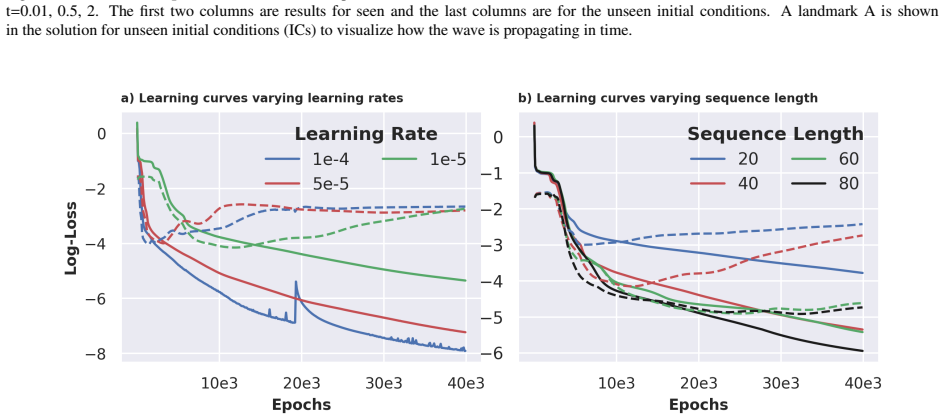
- [§3.1, Appendix B, Table B.5] The generalization evidence is compromised by the hyperparameter-selection protocol. Section 3.1 states that the number of CAUs, sequence length, learning rate, and activation function were chosen 'using validation on unseen initial conditions', and Appendix B confirms that the authors 'chosen the hyperparameters that gave good predictions with low relative errors on the unseen conditions', with Table B.5 reporting the mean relative error on exactly those unseen conditions as the selection criterion. The 20 held-out conditions used to compute the 'unseen' errors in Table 2 are therefore the same set used for model selection; consistently, the validation errors in Table B.5 for advection (2.47-2.61%) nearly coincide with the reported unseen error in Table 2 (2.85%). The paper should either use a train/validation/test three-way split with the test set untouched during selection, or explicitly label the Table 2 'unseen' column as validation performance and temper the generalization claim. It should also document whether PI-DeepONet received equivalent validation-based tuning; as reported, the comparison is asymmetric because only PINTO's hyperparameters were tuned on the evaluation set.
- [Appendix A, Eq. A.5, Tables 2, A.3-A.4] The reported 'relative error' is the adjusted metric |h - h_hat|/(1 + |h|), which Appendix A itself describes as a modification to handle near-zero true values; it is not a standard relative L2 error, and the denominator compresses errors at solution values of order one or larger. The abstract and conclusion state the 'one-fifth to one-third' claim without this qualification, and even with this favorable metric the claim fails for two test cases (see major comment above). The comparison should be recomputed under a standard relative L2 error; Tables A.3 and A.4 show that the ratios are also not consistently in the claimed range under RMSE, nRMSE, or MAPE (e.g., the Kovasznay unseen nRMSE ratio is 0.000715/0.001758 = 0.41). In addition, the standard deviations in Table 2 frequently exceed the means (e.g., advection unseen 2.85% +/- 4.73%, Burgers seen 4.81% +/- 4.43%), indicating large variability across the 20 test conditions, and no significance test is reported for the PINTO-versus-PI-DeepONet differences. Per-condition error distributions and confidence intervals should be reported.
- [§2.1, Eq. 3; §1.2; §5] The paper claims an operator that generalizes 'for any initial and boundary condition', but no consistency or error-bound argument links the training objective in Eq. 3 (strong-form residual over a fixed set of collocation points and K sampled conditions) to the operator condition in Eq. 2 for all b in A. As an empirical paper this gap is acceptable only if the claims are scoped: each test family is narrow (superpositions of sinusoids on the advection equation, Gaussian random fields for Burgers, Reynolds-number intervals, and lid speeds), only 20 unseen conditions are tested per case, and the unseen conditions are interpolating within those families. I recommend explicitly stating that generalization is demonstrated for the sampled parametric families, and either deferring 'any condition' claims or adding a brief discussion of relevant operator-learning generalization theory. Relatedly, the claim in Section 5 that temporal extrapolation is 'the first result of this nature in the neural operator literature' is not substantiated by a literature search and should be softened to 'to our knowledge'.
minor comments (7)
- [Abstract, §1 and §3] The Abstract and Section 1 refer to 'other leading physics informed operator learning methods' in the plural, but the only baseline evaluated is PI-DeepONet; please reword to refer to the single baseline or add additional physics-informed operator baselines.
- [Table 2, §2.1, §4] There are several typos that should be corrected: 'Condtions' in the Table 2 header, 'emperical' in Section 2.1, and 'diffrence' in Section 4.
- [§2.1, Eq. 3] The notation in Eq. 3 uses G(Theta; X) while Section 2.1 defines G_theta(X, b; Theta); please unify the notation.
- [§3.3.1 and §3.3.3 vs Table C.8] Sections 3.3.1 and 3.3.3 state that errors are evaluated on a 64x64 grid, but Table C.8 lists 256x256 grids for the Kovasznay and lid-driven cavity flows; please clarify which grids the reported metrics in Table 2 are computed on.
- [Table C.8] Table C.8 is titled 'Training and inference time' but contains only inference time; please report training times as well, since Section 4's complexity discussion compares training behavior.
- [§3.1, Eq. 9b] Equation (9b) and the surrounding text should specify the value of n_max used to generate the training and testing initial conditions and confirm that the unseen conditions are drawn from the same wavenumber and amplitude range, so the interpolation-versus-extrapolation status of the test set is explicit.
- [Appendix D] The finite-difference interpretation in Appendix D omits the softmax normalization in Eq. 7; since the attention weights are normalized unlike the row-stochastic matrix shown, the derivation should be labeled as an intuition rather than an equivalence.
Circularity Check
Generalization claim is partly selected on the same unseen-condition set used for evaluation, though the core physics-loss training is independent.
-
fitted input called prediction
[Section 3.1 (Advection) and Appendix B, Table B.5; results reported in Table 2]
"Hyperparameter tuning was performed to select the number of CAUs, sequence length, learning rate, and activation functions using validation on unseen initial conditions, as described in Table B.5. ... Since here we are emphasizing the applicability of our proposed architecture to generalize for unseen initial and boundary conditions, we have chosen the hyperparameters that gave good predictions with low relative errors on the unseen conditions. ... Here, the mean of relative error across all the test cases is indicated as the validation metrics."
The 20 initial conditions that Section 3.1 calls 'unseen situations' are the same conditions on which Appendix B selects hyperparameters (CAUs, sequence length, learning rate, activation) by minimizing the mean relative error reported as 'validation metrics' in Table B.5. Table 2 then reports the relative error on 'Unseen Conditions' as if it were an untouched holdout. The headline generalization claim is therefore partly a selected-for value: the configuration was chosen to minimize exactly the error later exhibited as a prediction. This is fitted-input-called-prediction at the evaluation level, although the PDE-residual training objective itself is not circular.
full rationale
The core derivation is not circular: PINTO is trained by minimizing physics and boundary residuals (Eq. 3) without supervision from target solutions, and the validation uses external PDEBENCH, analytical, and finite-volume references; no load-bearing self-citation chain is present. One evaluation-level circularity exists: hyperparameters were tuned on the very unseen-condition set later reported as the test set, so the reported 'unseen' errors are not a fresh holdout. This is a partial leakage rather than a reduction of the method to its inputs; the architecture could still fail on truly unseen conditions. Separately, the abstract's 'one-fifth to one-third' claim is not supported by Table 2 for Burgers (5.24/11.85 = 0.44) and lid-driven cavity (2.78/6.08 = 0.46), and the reported metric is the modified Eq. A.5 rather than a standard relative L2 error; those are correctness concerns, not additional circularity.
Assumptions & free parameters
free parameters (5)
- Physics loss weights lambda_1 and lambda_2 =
Not reported for most cases; boundary loss weight 100 for lid-driven cavity zero boundary
- Number of cross-attention units (CAUs) =
1 for Navier-Stokes cases, 2 to 3 for Burgers, 1 to 2 for advection
- Sequence length L of BPE and BVE tokens =
40 to 100 depending on the test case
- Embedding dimension, number of attention heads, and key dimension =
64, 2 heads, key dimension 64 for all cases
- Learning rate, epochs, optimizer and scheduler =
1e-5 to 1e-3, 20,000 to 50,000 epochs, Adam or AdamW with per-case schedules
assumptions (4)
- standard math Neural operators of the form in Eq. 4, with lifting, kernel integration, and projection layers, can approximate the solution map G.
- domain assumption The PDEs considered are well-posed and have unique solutions for every sampled initial or boundary condition b in A.
- domain assumption A finite discretization of the boundary at L points is sufficient to represent the initial or boundary condition for the cross-attention operator.
- ad hoc to paper Minimizing the strong-form PDE residual at random collocation points is sufficient to enforce the PDE for all points in the domain and for all b in A.
Cite this review
Pith. "Pith review of A physics-informed transformer neural operator for learning generalized solutions of initial boundary value problems." pith.science (2026). https://pith.science/paper/23NBUFEL
@misc{pith2026241209009,
  author       = {Pith},
  title        = {Pith review of: A physics-informed transformer neural operator for learning generalized solutions of initial boundary value problems},
  year         = {2026},
  howpublished = {\url{https://pith.science/paper/23NBUFEL}},
  note         = {Machine review of arXiv:2412.09009}
}
read the original abstract
Initial boundary value problems arise commonly in applications with engineering and natural systems governed by nonlinear partial differential equations (PDEs). Operator learning is an emerging field for solving these equations by using a neural network to learn a map between infinite dimensional input and output function spaces. These neural operators are trained using a combination of data (observations or simulations) and PDE-residuals (physics-loss). A major drawback of existing neural approaches is the requirement to retrain with new initial/boundary conditions, and the necessity for a large amount of simulation data for training. We develop a physics-informed transformer neural operator (named PINTO) that efficiently generalizes to unseen initial and boundary conditions, trained in a simulation-free setting using only physics loss. The main innovation lies in our new iterative kernel integral operator units, implemented using cross-attention, to transform the PDE solution's domain points into an initial/boundary condition-aware representation vector, enabling efficient learning of the solution function for new scenarios. The PINTO architecture is applied to simulate the solutions of important equations used in engineering applications: advection, Burgers, and steady and unsteady Navier-Stokes equations (three flow scenarios). For these five test cases, we show that the relative errors during testing under challenging conditions of unseen initial/boundary conditions are only one-fifth to one-third of other leading physics informed operator learning methods. Moreover, our PINTO model is able to accurately solve the advection and Burgers equations at time steps that are not included in the training collocation points. The code is available at https://github.com/quest-lab-iisc/PINTO
Figures


Figures from the paper (9 more)


Reference graph
Works this paper leans on
-
[1]
Q. Wang, M. Ihme, Y .-F. Chen, J. Anderson, A tensorflow simulation framework for scientific computing of fluid flows on tensor processing units, Computer Physics Communications 274 (2022) 108292
2022
-
[2]
I. G. Ion, D. Loukrezis, H. De Gersem, Tensor train based isogeometric analysis for pde approximation on parameter dependent geometries, Computer Methods in Applied Mechanics and Engineering 401 (2022) 115593
2022
-
[3]
Richter, L
L. Richter, L. Sallandt, N. Nüsken, Solving high-dimensional parabolic pdes using the tensor train format, in: International Conference on Machine Learning, PMLR, 2021, pp. 8998–9009
2021
-
[4]
D. W. Heermann, A. N. Burkitt, Parallel algorithms in computational science, V ol. 24, Springer Science & Business Media, 2012
2012
-
[5]
Z. Li, N. Kovachki, K. Azizzadenesheli, B. Liu, K. Bhattacharya, A. Stuart, A. Anandkumar, Neural operator: Graph kernel network for partial differential equations, arXiv preprint arXiv:2003.03485 (2020)
arXiv 2020
-
[6]
Z. Li, N. Kovachki, K. Azizzadenesheli, B. Liu, K. Bhattacharya, A. Stuart, A. Anandkumar, Fourier neural operator for parametric partial differential equations, arXiv preprint arXiv:2010.08895 (2020)
arXiv 2020
-
[7]
L. Lu, P. Jin, G. Pang, Z. Zhang, G. E. Karniadakis, Learning nonlinear operators via deeponet based on the universal approximation theorem of operators, Nature machine intelligence 3 (3) (2021) 218–229
2021
-
[8]
H. You, Y . Yu, M. D’Elia, T. Gao, S. Silling, Nonlocal kernel network (nkn): A stable and resolution-independent deep neural network, Journal of Computational Physics 469 (2022) 111536
2022
Show all 98 references
-
[9]
Kovachki, Z
N. Kovachki, Z. Li, B. Liu, K. Azizzadenesheli, K. Bhattacharya, A. Stuart, A. Anandkumar, Neural operator: Learning maps between function spaces with applications to pdes, Journal of Machine Learning Research 24 (89) (2023) 1–97
2023
-
[10]
Raissi, P
M. Raissi, P. Perdikaris, G. Karniadakis, Physics-informed neural networks: A deep learning framework for solving forward and inverse problems involving nonlinear partial di fferential equations, Journal of Computa- tional Physics 378 (2019) 686–707. doi:https://doi.org/10.101...
2019 doi
-
[11]
L. Lu, X. Meng, Z. Mao, G. E. Karniadakis, Deepxde: A deep learning library for solving differential equations, SIAM review 63 (1) (2021) 208–228
2021
-
[12]
G. E. Karniadakis, I. G. Kevrekidis, L. Lu, P. Perdikaris, S. Wang, L. Yang, Physics-informed machine learning, Nature Reviews Physics 3 (6) (2021) 422–440
2021
-
[13]
L. Yang, X. Meng, G. E. Karniadakis, B-pinns: Bayesian physics-informed neural networks for forward and inverse pde problems with noisy data, Journal of Computational Physics 425 (2021) 109913
2021
-
[14]
S. Cai, Z. Mao, Z. Wang, M. Yin, G. E. Karniadakis, Physics-informed neural networks (pinns) for fluid me- chanics: A review, Acta Mechanica Sinica 37 (12) (2021) 1727–1738
2021
-
[15]
S. A. Faroughi, N. M. Pawar, C. Fernandes, M. Raissi, S. Das, N. K. Kalantari, S. Kourosh Mahjour, Physics- guided, physics-informed, and physics-encoded neural networks and operators in scientific computing: Fluid and solid mechanics, Journal of Computing and Information Scie...
2024
-
[16]
Yamazaki, A
Y . Yamazaki, A. Harandi, M. Muramatsu, A. Viardin, M. Apel, T. Brepols, S. Reese, S. Rezaei, A finite element- based physics-informed operator learning framework for spatiotemporal partial di fferential equations on arbi- trary domains, Engineering with Computers 41 (1) (2025) 1–29
2025
-
[17]
Kaewnuratchadasorn, J
C. Kaewnuratchadasorn, J. Wang, C.-W. Kim, Physics-informed neural operator solver and super-resolution for solid mechanics, Computer-Aided Civil and Infrastructure Engineering 39 (22) (2024) 3435–3451. 24
2024
-
[18]
V . M. Nguyen-Thanh, X. Zhuang, T. Rabczuk, A deep energy method for finite deformation hyperelasticity, European Journal of Mechanics-A/Solids 80 (2020) 103874
2020
-
[19]
D. W. Abueidda, S. Koric, R. A. Al-Rub, C. M. Parrott, K. A. James, N. A. Sobh, A deep learning energy method for hyperelasticity and viscoelasticity, European Journal of Mechanics-A/Solids 95 (2022) 104639
2022
-
[20]
J. He, D. Abueidda, R. A. Al-Rub, S. Koric, I. Jasiuk, A deep learning energy-based method for classical elastoplasticity, International Journal of Plasticity 162 (2023) 103531
2023
-
[21]
Pathak, S
J. Pathak, S. Subramanian, P. Harrington, S. Raja, A. Chattopadhyay, M. Mardani, T. Kurth, D. Hall, Z. Li, K. Azizzadenesheli, et al., Fourcastnet: A global data-driven high-resolution weather model using adaptive fourier neural operators, arXiv preprint arXiv:2202.11214 (2022)
2022 arXiv
-
[22]
G. Wen, Z. Li, K. Azizzadenesheli, A. Anandkumar, S. M. Benson, U-fno—an enhanced fourier neural operator- based deep-learning model for multiphase flow, Advances in Water Resources 163 (2022) 104180
2022
-
[23]
Bonev, T
B. Bonev, T. Kurth, C. Hundt, J. Pathak, M. Baust, K. Kashinath, A. Anandkumar, Spherical fourier neural operators: Learning stable dynamics on the sphere, in: International conference on machine learning, PMLR, 2023, pp. 2806–2823
2023
-
[24]
H. You, Q. Zhang, C. J. Ross, C.-H. Lee, Y . Yu, Learning deep implicit fourier neural operators (ifnos) with applications to heterogeneous material modeling, Computer Methods in Applied Mechanics and Engineering 398 (2022) 115296
2022
-
[25]
Z. Li, D. Z. Huang, B. Liu, A. Anandkumar, Fourier neural operator with learned deformations for pdes on general geometries, Journal of Machine Learning Research 24 (388) (2023) 1–26
2023
-
[26]
R. J. George, J. Zhao, J. Kossaifi, Z. Li, A. Anandkumar, Incremental spatial and spectral learning of neural operators for solving large-scale pdes (2024). arXiv:2211.15188
2024 arXiv
-
[27]
Kovachki, S
N. Kovachki, S. Lanthaler, S. Mishra, On universal approximation and error bounds for fourier neural operators, Journal of Machine Learning Research 22 (290) (2021) 1–76
2021
-
[28]
Kovachki, Z
N. Kovachki, Z. Li, B. Liu, K. Azizzadenesheli, K. Bhattacharya, A. Stuart, A. Anandkumar, Neural operator: Learning maps between function spaces with applications to pdes, Journal of Machine Learning Research 24 (89) (2023) 1–97. URL http://jmlr.org/papers/v24/21-1524.html
2023
-
[29]
Lehmann, F
F. Lehmann, F. Gatti, M. Bertin, D. Clouteau, 3d elastic wave propagation with a factorized fourier neural operator (f-fno), Computer Methods in Applied Mechanics and Engineering 420 (2024) 116718
2024
-
[30]
S. Wang, H. Wang, P. Perdikaris, Learning the solution operator of parametric partial differential equations with physics-informed deeponets, Science advances 7 (40) (2021) eabi8605
2021
-
[31]
Lanthaler, S
S. Lanthaler, S. Mishra, G. E. Karniadakis, Error estimates for deeponets: A deep learning framework in infinite dimensions, Transactions of Mathematics and Its Applications 6 (1) (2022) tnac001
2022
-
[32]
J. He, S. Kushwaha, J. Park, S. Koric, D. Abueidda, I. Jasiuk, Sequential deep operator networks (s-deeponet) for predicting full-field solutions under time-dependent loads, Engineering Applications of Artificial Intelligence 127 (2024) 107258
2024
-
[33]
W. Xu, Y . Lu, L. Wang, Transfer learning enhanced deeponet for long-time prediction of evolution equations, in: Proceedings of the AAAI Conference on Artificial Intelligence, V ol. 37, 2023, pp. 10629–10636
2023
-
[34]
W. Li, M. Z. Bazant, J. Zhu, Phase-field deeponet: Physics-informed deep operator neural network for fast simulations of pattern formation governed by gradient flows of free-energy functionals, Computer Methods in Applied Mechanics and Engineering 416 (2023) 116299. 25
2023
-
[35]
Goswami, M
S. Goswami, M. Yin, Y . Yu, G. E. Karniadakis, A physics-informed variational deeponet for predicting crack path in quasi-brittle materials, Computer Methods in Applied Mechanics and Engineering 391 (2022) 114587
2022
-
[36]
Goswami, A
S. Goswami, A. Bora, Y . Yu, G. E. Karniadakis, Physics-informed deep neural operator networks, in: Machine Learning in Modeling and Simulation: Methods and Applications, Springer, 2023, pp. 219–254
2023
-
[37]
Goswami, A
S. Goswami, A. D. Jagtap, H. Babaee, B. T. Susi, G. E. Karniadakis, Learning sti ff chemical kinetics using extended deep neural operators, Computer Methods in Applied Mechanics and Engineering 419 (2024) 116674
2024
-
[38]
Haghighat, U
E. Haghighat, U. bin Waheed, G. Karniadakis, En-deeponet: An enrichment approach for enhancing the ex- pressivity of neural operators with applications to seismology, Computer Methods in Applied Mechanics and Engineering 420 (2024) 116681
2024
-
[39]
Kobayashi, J
K. Kobayashi, J. Daniell, S. B. Alam, Improved generalization with deep neural operators for engineering sys- tems: Path towards digital twin, Engineering Applications of Artificial Intelligence 131 (2024) 107844
2024
-
[40]
Zhang, S
J. Zhang, S. Zhang, J. Shen, G. Lin, Energy-dissipative evolutionary deep operator neural networks, Journal of Computational Physics 498 (2024) 112638
2024
-
[41]
J. He, S. Koric, D. Abueidda, A. Najafi, I. Jasiuk, Geom-deeponet: A point-cloud-based deep operator network for field predictions on 3d parameterized geometries, Computer Methods in Applied Mechanics and Engineering 429 (2024) 117130
2024
-
[42]
Koric, D
S. Koric, D. W. Abueidda, Data-driven and physics-informed deep learning operators for solution of heat conduc- tion equation with parametric heat source, International Journal of Heat and Mass Transfer 203 (2023) 123809
2023
-
[43]
Z. Li, N. Kovachki, K. Azizzadenesheli, B. Liu, A. Stuart, K. Bhattacharya, A. Anandkumar, Multipole graph neural operator for parametric partial differential equations, Advances in Neural Information Processing Systems 33 (2020) 6755–6766
2020
-
[44]
Raonic, R
B. Raonic, R. Molinaro, T. De Ryck, T. Rohner, F. Bartolucci, R. Alaifari, S. Mishra, E. de Bézenac, Convo- lutional neural operators for robust and accurate learning of pdes, Advances in Neural Information Processing Systems 36 (2024)
2024
-
[45]
Tiwari, N
K. Tiwari, N. Krishnan, et al., Cono: Complex neural operator for continuous dynamical systems, arXiv preprint arXiv:2310.02094 (2023)
2023 arXiv
-
[46]
Gupta, X
G. Gupta, X. Xiao, P. Bogdan, Multiwavelet-based operator learning for di fferential equations, Advances in neural information processing systems 34 (2021) 24048–24062
2021
-
[47]
Tripura, S
T. Tripura, S. Chakraborty, Wavelet neural operator for solving parametric partial differential equations in com- putational mechanics problems, Computer Methods in Applied Mechanics and Engineering 404 (2023) 115783
2023
-
[48]
J. Rani, T. Tripura, H. Kodamana, S. Chakraborty, P. K. Tamboli, Fault detection and isolation using probabilistic wavelet neural operator auto-encoder with application to dynamic processes, Process Safety and Environmental Protection 173 (2023) 215–228
2023
-
[49]
G. Pang, M. D’Elia, M. Parks, G. E. Karniadakis, npinns: nonlocal physics-informed neural networks for a parametrized nonlocal universal laplacian operator. algorithms and applications, Journal of Computational Physics 422 (2020) 109760
2020
-
[50]
Q. Cao, S. Goswami, G. E. Karniadakis, Laplace neural operator for solving di fferential equations, Nature Machine Intelligence 6 (6) (2024) 631–640
2024
-
[51]
Peyvan, V
A. Peyvan, V . Oommen, A. D. Jagtap, G. E. Karniadakis, Riemannonets: Interpretable neural operators for riemann problems, Computer Methods in Applied Mechanics and Engineering 426 (2024) 116996. 26
2024
-
[52]
Z. Li, N. Kovachki, C. Choy, B. Li, J. Kossaifi, S. Otta, M. A. Nabian, M. Stadler, C. Hundt, K. Azizzadenesheli, et al., Geometry-informed neural operator for large-scale 3d pdes, Advances in Neural Information Processing Systems 36 (2024)
2024
-
[53]
Z. Zhao, C. Liu, Y . Li, Z. Chen, X. Liu, Diffeomorphism neural operator for various domains and parameters of partial differential equations, arXiv preprint arXiv:2402.12475 (2024)
2024 arXiv
-
[54]
V . S. Fanaskov, I. V . Oseledets, Spectral neural operators, in: Doklady Mathematics, V ol. 108, Springer, 2023, pp. S226–S232
2023
-
[55]
Rafiq, G
M. Rafiq, G. Rafiq, H.-Y . Jung, G. S. Choi, Ssno: Spatio-spectral neural operator for functional space learning of partial differential equations, IEEE Access 10 (2022) 15084–15095
2022
-
[56]
Z. Hao, Z. Wang, H. Su, C. Ying, Y . Dong, S. Liu, Z. Cheng, J. Song, J. Zhu, Gnot: A general neural operator transformer for operator learning, in: International Conference on Machine Learning, PMLR, 2023, pp. 12556– 12569
2023
-
[57]
Z. Li, K. Meidani, A. B. Farimani, Transformer for partial di fferential equations’ operator learning, arXiv preprint arXiv:2205.13671 (2022)
2022 arXiv
-
[58]
B. Shih, A. Peyvan, Z. Zhang, G. E. Karniadakis, Transformers as neural operators for solutions of di fferential equations with finite regularity, Computer Methods in Applied Mechanics and Engineering 434 (2025) 117560
2025
-
[59]
H. Li, X. Ye, P. Jiang, G. Qin, T. Wang, Local neural operator for solving transient partial differential equations on varied domains, Computer Methods in Applied Mechanics and Engineering 427 (2024) 117062
2024
-
[60]
Jafarzadeh, S
S. Jafarzadeh, S. Silling, N. Liu, Z. Zhang, Y . Yu, Peridynamic neural operators: A data-driven nonlocal con- stitutive model for complex material responses, Computer Methods in Applied Mechanics and Engineering 425 (2024) 116914
2024
-
[61]
Z. Li, H. Zheng, N. Kovachki, D. Jin, H. Chen, B. Liu, K. Azizzadenesheli, A. Anandkumar, Physics-informed neural operator for learning partial differential equations, ACM/JMS Journal of Data Science 1 (3) (2024) 1–27
2024
-
[62]
Chennault, A
A. Chennault, A. A. Popov, A. N. Subrahmanya, R. Cooper, A. H. M. Rafid, A. Karpatne, A. Sandu, Adjoint- matching neural network surrogates for fast 4d-var data assimilation, arXiv preprint arXiv:2111.08626 (2021)
2021 arXiv
-
[63]
Arcucci, L
R. Arcucci, L. Moutiq, Y .-K. Guo, Neural assimilation, in: Computational Science–ICCS 2020: 20th Interna- tional Conference, Amsterdam, The Netherlands, June 3–5, 2020, Proceedings, Part VI 20, Springer, 2020, pp. 155–168
2020
-
[64]
P. Wu, X. Chang, W. Yuan, J. Sun, W. Zhang, R. Arcucci, Y . Guo, Fast data assimilation (fda): Data assimilation by machine learning for faster optimize model state, Journal of Computational Science 51 (2021) 101323
2021
-
[65]
Fablet, B
R. Fablet, B. Chapron, L. Drumetz, E. Mémin, O. Pannekoucke, F. Rousseau, Learning variational data assimi- lation models and solvers, Journal of Advances in Modeling Earth Systems 13 (10) (2021) e2021MS002572
2021
-
[66]
Chowdhury, R
R. Chowdhury, R. Murugan, D. Subramani, Intelligent onboard routing in stochastic dynamic environments using transformers, in: Proceedings of the 2023 International Conference on Autonomous Agents and Multiagent Systems, 2023, pp. 1688–1696
2023
-
[67]
D. H. Kelley, J. H. Thomas, Cerebrospinal fluid flow, Annual Review of Fluid Mechanics 55 (1) (2023) 237–264. arXiv:https://doi.org/10.1146/annurev-fluid-120720-011638 , doi:10.1146/ annurev-fluid-120720-011638 . URL https://doi.org/10.1146/annurev-fluid-120720-011638 27
2023 doi
-
[68]
Mittal, K
R. Mittal, K. Breuer, J. H. Seo, The flow physics of face masks, Annual Review of Fluid Mechanics 55 (1) (2023) 193–211. arXiv:https://doi.org/10.1146/annurev-fluid-120720-035029 , doi:10.1146/ annurev-fluid-120720-035029 . URL https://doi.org/10.1146/annurev-fluid-120720-035029
2023 doi
-
[69]
Breton, J
S.-P. Breton, J. Sumner, J. N. Sørensen, K. S. Hansen, S. Sarmast, S. Ivanell, A survey of modelling methods for high-fidelity wind farm simulations using large eddy simulation, Philosophical Transactions of the Royal Society A: Mathematical, Physical and Engineering Sciences ...
2017
-
[70]
Gafoor CTP, S
A. Gafoor CTP, S. Kumar Boya, R. Jinka, A. Gupta, A. Tyagi, S. Sarkar, D. N. Subramani, A physics-informed neural network for turbulent wake simulations behind wind turbines, Physics of Fluids 37 (1) (2025)
2025
-
[71]
P. Jin, S. Meng, L. Lu, Mionet: Learning multiple-input operators via tensor product, SIAM Journal on Scientific Computing 44 (6) (2022) A3490–A3514
2022
-
[72]
Mandl, S
L. Mandl, S. Goswami, L. Lambers, T. Ricken, Separable deeponet: Breaking the curse of dimensionality in physics-informed machine learning, arXiv preprint arXiv:2407.15887 (2024)
2024 arXiv
-
[73]
M. Zhu, S. Feng, Y . Lin, L. Lu, Fourier-deeponet: Fourier-enhanced deep operator networks for full waveform inversion with improved accuracy, generalizability, and robustness, Computer Methods in Applied Mechanics and Engineering 416 (2023) 116300
2023
-
[74]
Cao, Choose a transformer: Fourier or galerkin, in: M
S. Cao, Choose a transformer: Fourier or galerkin, in: M. Ranzato, A. Beygelzimer, Y . Dauphin, P. Liang, J. W. Vaughan (Eds.), Advances in Neural Information Processing Systems, V ol. 34, Curran Associates, Inc., 2021, pp. 24924–24940
2021
-
[75]
Harandi, H
A. Harandi, H. Danesh, K. Linka, S. Reese, S. Rezaei, A spectral-based physics-informed finite operator learning for prediction of mechanical behavior of microstructures, arXiv preprint arXiv:2410.19027 (2024)
2024 arXiv
-
[76]
Navaneeth, S
N. Navaneeth, S. Chakraborty, Stochastic projection based approach for gradient free physics informed learning, Computer Methods in Applied Mechanics and Engineering 406 (2023) 115842
2023
-
[77]
B. S. Kumar, quest-lab-iisc /pinto: Pinto (Dec. 2024). doi:10.5281/zenodo.14330860. URL https://doi.org/10.5281/zenodo.14330860
2024 doi
-
[78]
Takamoto, T
M. Takamoto, T. Praditia, R. Leiteritz, D. MacKinlay, F. Alesiani, D. Pflüger, M. Niepert, Pdebench: An exten- sive benchmark for scientific machine learning, Advances in Neural Information Processing Systems 35 (2022) 1596–1611
2022
-
[79]
Kovachki, Z
N. Kovachki, Z. Li, B. Liu, K. Azizzadenesheli, K. Bhattacharya, A. Stuart, A. Anandkumar, Neural operator: Learning maps between function spaces, arXiv preprint arXiv:2108.08481 (2021)
2021 arXiv
-
[80]
L. I. G. Kovasznay, Laminar flow behind a two-dimensional grid, Mathematical Proceedings of the Cambridge Philosophical Society 44 (1) (1948) 58–62. doi:10.1017/S0305004100023999
1948 doi
-
[81]
Taylor, Lxxv
G. Taylor, Lxxv. on the decay of vortices in a viscous fluid, The London, Edinburgh, and Dublin Philosophical Magazine and Journal of Science 46 (274) (1923) 671–674
1923
-
[82]
M. P. Ueckermann, P. F. J. Lermusiaux, 2.29 Finite V olume MATLAB Framework Documentation, MSEAS Report 14, Department of Mechanical Engineering, Massachusetts Institute of Technology, Cambridge, MA (2012). URL http://mseas.mit.edu/?p=2567
2012
-
[83]
K. Song, Y . Jung, D. Kim, I.-C. Moon, Implicit kernel attention, in: Proceedings of the AAAI Conference on Artificial Intelligence, V ol. 35, 2021, pp. 9713–9721. 28
2021
-
[84]
Rishi, A
J. Rishi, A. Gafoor, S. Kumar, D. Subramani, Discrete residual loss functions for training physics-informed neural networks, in: International Conference on Computational Science, Springer, 2024, pp. 363–377
2024
-
[85]
T. Li, Y . Zou, S. Zou, X. Chang, L. Zhang, X. Deng, Learning to solve pdes with finite volume-informed neural networks in a data-free approach, Journal of Computational Physics 530 (2025) 113919
2025
-
[86]
Anandh, D
T. Anandh, D. Ghose, A. Tyagi, A. Gupta, S. Sarkar, S. Ganesan, An e fficient hp-variational pinns framework for incompressible navier-stokes equations, arXiv preprint arXiv:2409.04143 (2024)
2024 arXiv
-
[87]
X. Jin, S. Cai, H. Li, G. E. Karniadakis, Nsfnets (navier-stokes flow nets): Physics-informed neural networks for the incompressible navier-stokes equations, Journal of Computational Physics 426 (2021) 109951
2021
-
[88]
A. Daw, J. Bu, S. Wang, P. Perdikaris, A. Karpatne, Mitigating propagation failures in physics-informed neural networks using retain-resample-release (r3) sampling, in: Proceedings of the 40th International Conference on Machine Learning, ICML’23, JMLR.org, 2023
2023
-
[89]
J. Hou, Y . Li, S. Ying, Enhancing pinns for solving pdes via adaptive collocation point movement and adaptive loss weighting, Nonlinear Dynamics 111 (16) (2023) 15233–15261
2023
-
[90]
Maddu, D
S. Maddu, D. Sturm, C. L. Müller, I. F. Sbalzarini, Inverse dirichlet weighting enables reliable training of physics informed neural networks, Machine Learning: Science and Technology 3 (1) (2022) 015026
2022
-
[91]
Deguchi, M
S. Deguchi, M. Asai, Dynamic & norm-based weights to normalize imbalance in back-propagated gradients of physics-informed neural networks, Journal of Physics Communications 7 (7) (2023) 075005
2023
-
[92]
K. Tang, X. Wan, C. Yang, Das-pinns: A deep adaptive sampling method for solving high-dimensional partial differential equations, Journal of Computational Physics 476 (2023) 111868
2023
-
[93]
Moseley, A
B. Moseley, A. Markham, T. Nissen-Meyer, Finite basis physics-informed neural networks (fbpinns): a scalable domain decomposition approach for solving di fferential equations, Advances in Computational Mathematics 49 (4) (2023) 62
2023
-
[94]
S. Wang, Y . Teng, P. Perdikaris, Understanding and mitigating gradient flow pathologies in physics-informed neural networks, SIAM Journal on Scientific Computing 43 (5) (2021) A3055–A3081
2021
-
[95]
Bergstra, R
J. Bergstra, R. Bardenet, Y . Bengio, B. Kégl, Algorithms for hyper-parameter optimization, Advances in neural information processing systems 24 (2011)
2011
-
[96]
Escapil-Inchauspé, G
P. Escapil-Inchauspé, G. A. Ruz, Hyper-parameter tuning of physics-informed neural networks: Application to helmholtz problems, Neurocomputing 561 (2023) 126826
2023
-
[97]
Kaplarevi ´c-Mališi´c, B
A. Kaplarevi ´c-Mališi´c, B. Andrijevi´c, F. Bojovi´c, S. Nikoli´c, L. Krsti´c, B. Stojanovi´c, M. Ivanovi´c, Identifying optimal architectures of physics-informed neural networks by evolutionary strategy, Applied Soft Computing 146 (2023) 110646
2023
-
[98]
Y . Wang, L. Zhong, Nas-pinn: neural architecture search-guided physics-informed neural network for solving pdes, Journal of Computational Physics 496 (2024) 112603. 29
2024
Reviewed August 11, 2026 · model on record in the stance chip above.
Discussion (0). Continue with ORCID to comment.