REVIEW 3 major objections 5 minor 2 cited by
Theory of anomalous Hall effect from screened vortex charge in a phase disordered superconductor
T0 review · 3 major / 5 minor · reviewed 2026-08-12 · deepseek-v4-flash
Pith's one-line read In the vortex-plasma phase above the superconducting transition, the dc Hall conductivity is controlled by the ac Hall response of the superconducting and normal phases, not by the screened vortex-core charge.
desk verdict A testable and honest scenario for dc Hall in a phase-disordered superconductor, but the central dc-equals-ac claim rests on a conjectural flux-vortex mapping and an unresolved order-of-limits issue; worth a serious referee rather than desk rejection. read the letter →
The pith
A machine-rendered reading of the paper's core claim, the machinery that carries it, and where it could break.
The reading
What carries the argument
The load-bearing object is the gauge-invariant superconducting effective action $S_{\mathrm{eff}} = \int [-C_1 b_0^2 + C_2 b^2 - (C_3 b - C_4(\hat{z}\times b))\cdot\nabla b_0 + C_5(\hat{z}\times b)\cdot\dot{b}]$, written in terms of the gauge-invariant fields $b_\alpha = A_\alpha - \partial_\alpha \phi$. The coefficients $C_1,C_2$ are compressibility and superfluid stiffness; $C_4$ is the Streda response coefficient that sets the charge induced by a flux line (and hence the vortex core charge), while $C_5$ is the high-frequency ac Hall conductivity. The argument turns on the difference $C_4 - C_5$: the naive dc Hall response of the vortex plasma would follow from $C_4$, but the screening contribution to the longitudinal current, Eq. (17), is proportional to $C_4 - C_5$ and cancels in the long-wavelength limit, so the surviving Hall current is $\vec{j}_{L,0} = C_5(\hat{z}\times\vec{E}_T)$. In non-interacting systems $C_4 = C_5$ and both equal the Berry-curvature Hall value; interactions renormalize $C_4$ (by screening) but not $C_5$.
What would settle it
A numerical experiment that creates separated vortex-antivortex pairs in a microscopic model (say by solving time-dependent Bogoliubov-de Gennes or time-dependent Ginzburg-Landau equations with explicit phase winding) and extracts the dc Hall conductivity of the resulting vortex plasma would settle the claim if its result is compared with the ac coefficient $C_5$ of the same model: agreement confirms the cancellation, while a result near $C_4$ falsifies it.
Extended reading notes
Core claim
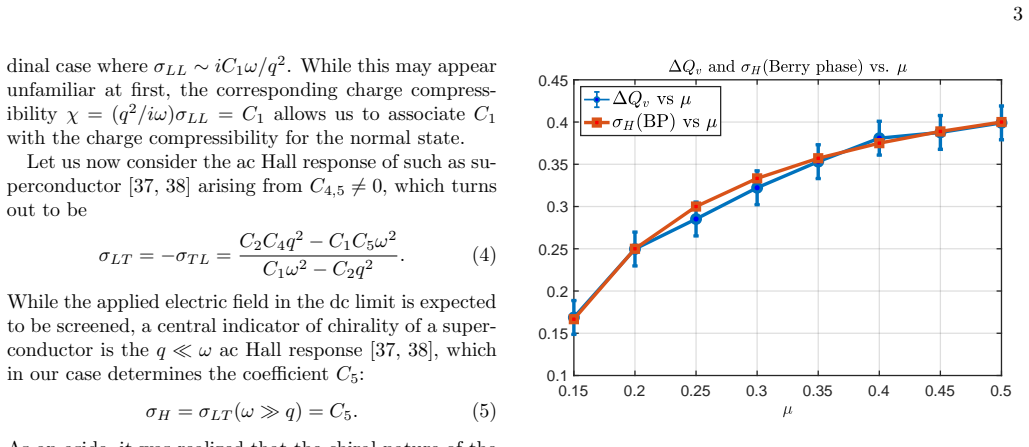
The central claim is that in the phase-disordered (vortex plasma) state above the BKT transition, the dc Hall conductivity matches the ac Hall conductance $C_5$ rather than the vortex-core charge coefficient $C_4$. Using a gauge-invariant effective action for a superconductor with Hall terms $C_4(\hat{z}\times b)\cdot\nabla b_0$ and $C_5(\hat{z}\times b)\cdot\dot{b}$, the vortex-antivortex charge difference is $2C_4\Phi_0$ (the Streda-type response), so flux-flow reasoning would predict a dc Hall effect proportional to $C_4$. However, when a flux-antiflux pair moves apart, the interaction-screening contribution to the longitudinal current is proportional to $(C_4 - C_5)$ and vanishes in the long-wavelength limit (Eq. 17), leaving the current $\vec{j}_{L,0}=C_5(\hat{z}\times\vec{E}_T)$. Thus the Hall response of the vortex plasma is controlled by the unscreened ac coefficient $C_5$, which is close to the normal-state anomalous Hall value. The paper verifies numerically, in a gapped Dirac lattice model with $p_x+ip_y$ pairing, that the vortex-antivortex charge difference is indeed tied to the Berry phase via $C_4$.
Load-bearing premise
The central premise is that a real vortex-antivortex pair in the BKT plasma behaves like a time-dependent flux-antiflux pair whose screening dynamics are captured by the linear-response effective action, a conjecture the authors explicitly flag; if finite-size vortex cores with phase winding screen charge differently, or if the $q\to 0$ limit does not capture the true dc limit of the vortex plasma, the predicted dc-equals-ac Hall equality can fail.
Editorial extensions
If this is right
- In the resistive vortex-plasma phase above $T_{BKT}$, the dc anomalous Hall conductivity should equal the ac Hall conductivity of the gapped superconductor, recovering the normal-state anomalous Hall value.
- Hall measurements just above the superconducting transition of a candidate chiral superconductor can therefore be compared directly with the normal-state Hall value; agreement supports the flux-vortex analogy, while a value set by $C_4$ would contradict it.
- The vortex-antivortex charge asymmetry, which separately controls local charge accumulation, is set by $C_4$ and is numerically confirmed here to follow the Fermi-surface Berry phase in a $p_x+ip_y$ superconductor.
- The screening charge that hides $C_4$ is not lost: it reappears as longitudinal, radially propagating charge-density (plasmon-like) crescents around the moving vortices, so the cancellation is dynamical rather than a removal of Hall physics.
- Because $C_5$ is an unscreened interband response, the dc Hall of the vortex plasma is robust to weak interactions, unlike the screened vortex-core charge.
Reading between the lines
- If the flux-antiflux analogy survives microscopic vortex cores, the dc-vs-ac Hall comparison offers a clean experimental protocol: measure the Hall effect in the same device in the normal state, in the gapped superconductor at microwave frequencies, and in the BKT-fluid regime, and check that the dc value tracks the ac value.
- The cancellation mechanism suggests that any vortex-transport regime with efficient screening (e.g., thermally activated vortex motion near $T_c$ or in disordered films) will exhibit a dc Hall coefficient closer to $C_5$ than to $C_4$; this could be tested with time-dependent Ginzburg-Landau simulations that resolve finite-size vortex cores.
- The angular dependence of the far-field vortex current (the factor $q_y/q_x$ in Eq. 18) implies logarithmic-in-system-size corrections to the dc Hall current in finite samples, which may show up as a weak sample-size dependence in small Hall bars.
- The same effective action applies to any chiral superconductor, so the predicted equality dc=$C_5$ provides a way to extract the coefficient $C_5$ from transport alone, without needing the ac measurement.
Editorial analysis
A structured set of objections, weighed in public.
Referee Report
Summary. The paper studies the anomalous Hall effect in a superconductor above the BKT transition, motivated by recent experiments in tetralayer graphene. The authors introduce a gauge-invariant effective action for a two-dimensional superconductor with response coefficients C1, C2, C4, C5, where C4 is the Streda coefficient controlling the charge response to magnetic fields and C5 is the high-frequency ac Hall coefficient. They numerically compute the charge difference between a vortex and an antivortex in a BdG model with a BHZ normal part and px+ipy pairing, showing that the charge difference is proportional to the Berry-curvature Hall conductivity. The central claim is that in the vortex plasma phase above BKT, the dc Hall conductivity is determined by C5 rather than C4, because the screening cloud of a moving vortex-antivortex pair produces a cancellation in Eq. (17) in the long-wavelength limit.
Significance. If the central claim were established, the paper would resolve an apparent contradiction between vortex-charge-based Hall response and the unscreened ac Hall conductivity, and would provide a concrete prediction for the phase-disordered state of a chiral superconductor. The numerical BdG calculation is a clear strength: it provides a parameter-free check of the Streda-type relation between vortex charge and Berry curvature. The effective-action expansion is also a useful framework for organizing the response coefficients. However, the main dynamical result rests on a conjectured flux-antiflux analogy and on a delicate order-of-limits; the numerical verification does not extend to the dynamical cancellation. Thus the significance is conditional on a more rigorous treatment of the dc limit.
major comments (3)
- [Vortex charge screening, Eq. (17)] The cancellation of the C4-screening contribution δj_L is obtained by taking q, q_x → 0 at fixed time t, since for fixed t the numerator of Eq. (17) is O(q^2 t^2). A dc Hall conductivity, however, is a long-time steady-state transport coefficient. For any nonzero q, the expression [cos(cqt) − cos(vq_x t)] in Eq. (17) does not vanish as t → ∞; it oscillates with amplitude that does not decay in that limit. Therefore the limits q → 0 and t → ∞ do not commute, and Eq. (17) establishes at most that the instantaneous long-wavelength screening current vanishes immediately after pair creation. To support the claim that the dc Hall conductivity equals C5, the authors need a proper dc limit, e.g., by including dissipation or deriving a Kubo formula with the order of limits specified.
- [Effective action of a Hall superconductor; Vortex charge screening] The effective action Eq. (3) is non-dissipative, as noted right after Eq. (1). Consequently, the screening response in Eq. (17) is an undamped oscillation, and the vortex plasma described by the duality relations (13)–(14) has no intrinsic mechanism to relax to a steady state. The term 'dc Hall conductivity' therefore requires an external definition of the zero-frequency limit; the manuscript does not supply one within the effective-action calculation. The authors should either introduce a dissipative term into the action or explicitly state that the result applies only to a transient response, and adjust the abstract and conclusion accordingly.
- [Conclusion; Vortex charge screening] The dynamical cancellation relies on the conjecture that a vortex-antivortex pair is equivalent to a flux-antiflux pair; the authors state that 'studying vortex formation systematically is beyond the validity of the formalism' and that the mapping is a conjecture. The numerical results in Fig. 2 validate only the static core-charge relation, not the time-dependent screening of a moving vortex. The paper should provide additional evidence for the dynamical analogy, such as a time-dependent BdG or TDGL simulation of vortex-antivortex pair creation, or alternatively temper the claim to state that the equality with C5 is a conjecture supported by the static vortex-charge relation.
minor comments (5)
- [Footnote 1] The footnote uses first-person singular 'I' while the paper has two authors; it should be 'we'.
- [Section 'Hall response of the BKT phase'] The phrase 'Combining with Eq. ??' contains an unresolved equation reference; the intended equation is likely Eq. (8).
- [Section 'Vortex charge screening'] The word 'Heavisider' should be 'Heaviside'.
- [Eq. (18)] Eq. (18) appears garbled: the vector notation is unclear (e.g., the left-hand side is missing the current symbol 'j' and the q-dependence is written in a confused way). A cleaner vector expression would improve readability.
- [Appendices] The text refers to 'Appendix. A' and 'Appendix. B' but the appendices are not explicitly labeled in the manuscript; adding labels would help the reader.
Circularity Check
No significant circularity: the vortex-charge relation is independently checked numerically, and the dc=ac Hall conclusion follows from an explicit response calculation rather than a fit or self-citation.
full rationale
The paper's load-bearing pieces are (i) the gauge-invariant gradient expansion Eq. (3) with coefficients C1,C2,C4,C5, (ii) the numerical BHZ+BdG computation of Delta Qv in Fig. 2, and (iii) the response of a model flux-antiflux pair in Eqs. (15)-(18). None of these is a fitted parameter being renamed as a prediction; C4 and C5 are coefficients of an action, and the Fig. 2 comparison to the Berry-phase Hall formula is an independent microscopic check of the Streda-type relation Delta Qv = 2 C4 Phi0. The final result that the long-wavelength longitudinal current is jL,0 = C5 E_T is obtained by evaluating the derived sigma_LT of Eq. (4) on a specified source and showing the C4-C5 screening term vanishes as q -> 0; that cancellation is a calculation, not an identity imposed at the outset. The paper itself flags its main limitations, stating that 'studying vortex formation systematically is beyond the validity of the formalism in this work' and that the flux-vortex mapping is 'conjecture[d] based on an analogy between fluxes and vortices.' These are physical and completeness caveats about whether the q -> 0 fixed-time limit captures the true dc response of a BKT plasma, not circularity: the conclusion is not assumed among the premises, and no load-bearing argument reduces to a self-citation. Therefore the derivation chain is non-circular, even though its physical validity depends on the stated conjecture and on an order-of-limits assumption.
Assumptions & free parameters
assumptions (5)
- domain assumption The effective action can be truncated to quadratic order in the gauge-invariant fields b_alpha with coefficients C1, C2, C4, and C5 as in Eq. (3).
- ad hoc to paper A vortex-antivortex pair can be represented by a moving flux-antiflux pair for the purpose of computing the screening of vortex charge.
- domain assumption The vortex core charge difference is given by the Streda formula Delta Qv = 2 C4 Phi0 in Eq. (8).
- domain assumption Vortex transport in the BKT phase is diffusive and obeys the duality relations with a vortex conductivity sigma_v, as used in Eqs. (13) and (14).
- domain assumption The ac Hall coefficient C5 is unaffected by interactions and retains the normal-state anomalous Hall value, while C4 is screened by interactions.
Cite this review
Pith. "Pith review of Theory of anomalous Hall effect from screened vortex charge in a phase disordered superconductor." pith.science (2026). https://pith.science/paper/2HA4P2LD
@misc{pith2026241108969,
  author       = {Pith},
  title        = {Pith review of: Theory of anomalous Hall effect from screened vortex charge in a phase disordered superconductor},
  year         = {2026},
  howpublished = {\url{https://pith.science/paper/2HA4P2LD}},
  note         = {Machine review of arXiv:2411.08969}
}
read the original abstract
Motivated by recent experiments showing evidence for chiral superconductivity in an anomalous Hall phase of tetralayer graphene, we study the relation between the normal state anomalous Hall conductivity and that in the phase disordered state above the critical temperature of the superconductor. By a numerical calculation of superconductivity in an anomalous Hall metal, we find that a difference in vortex and antivortex charge is determined by the Fermi surface Berry phase. Combining this with the vortex dynamics in a back-ground supercurrent leads to a Hall response in the phase disordered state of the superconductor that is close to the normal state anomalous Hall response. However, using a gauge-invariant superconducting response framework, we find that while vortex charge is screened by interactions, the screening charge, after a time-delay, reappears in the longitudinal current. Thus, the dc Hall conductivity in this phase, instead of matching the screened vortex charge, matches the ac Hall conductance in the superconducting and normal phase, which are similar.
Figures

Forward citations
Cited by 2 Pith papers
-
Magnetic Breakdown and Anomalous Quantum Oscillation in Rhombohedral Tetralayer Graphene
Magnetic breakdown between three Fermi pockets in rhombohedral tetralayer graphene explains the observed high-frequency 'multitone' SdH oscillations as a 2A0 frequency with a beating split.
-
Stripe-tuned superconductivity in single-flavor metals with nontrivial quantum geometry
Strong stripes plus Berry curvature stabilize either nodal transverse p_x or fully gapped longitudinal p_y pairing in a single-flavor metal, tuned by density and B.
Reference graph
Works this paper leans on
-
[1]
Y. Cao, V. Fatemi, A. Demir, S. Fang, S. L. Tomarken, J. Y. Luo, J. D. Sanchez-Yamagishi, K. Watanabe, 6 T. Taniguchi, E. Kaxiras, R. C. Ashoori, and P. Jarillo- Herrero, Nature 556, 10.1038/nature26154 (2018)
-
[2]
Y. Cao, V. Fatemi, S. Fang, K. Watanabe, T. Taniguchi, E. Kaxiras, and P. Jarillo-Herrero, Nature 556, 10.1038/nature26160 (2018)
-
[3]
M. Yankowitz, S. Chen, H. Polshyn, Y. Zhang, K. Watan- abe, T. Taniguchi, D. Graf, A. F. Young, and C. R. Dean, Science 363, 10.1126/science.aav1910 (2019)
-
[4]
X. Lu, P. Stepanov, W. Yang, M. Xie, M. A. Aamir, I. Das, C. Urgell, K. Watanabe, T. Taniguchi, G. Zhang, A. Bachtold, A. H. MacDonald, and D. K. Efetov, Nature 574, 10.1038/s41586-019-1695-0 (2019)
-
[5]
Z. Hao, A. M. Zimmerman, P. Ledwith, E. Kha- laf, D. H. Najafabadi, K. Watanabe, T. Taniguchi, A. Vishwanath, and P. Kim, Science 371, 10.1126/sci- ence.abg0399 (2021)
doi:10.1126/sci- 2021
-
[7]
Y. Cao, J. M. Park, K. Watanabe, T. Taniguchi, and P. Jarillo-Herrero, Nature 595, 10.1038/s41586-021- 03685-y (2021)
-
[8]
X. Liu, N. J. Zhang, K. Watanabe, T. Taniguchi, and J. I. A. Li, Nature Physics 18, 522–527 (2022)
work page 2022
-
[9]
Ascendance of Superconductivity in Magic-Angle Graphene Multilayers
Y. Zhang, R. Polski, C. Lewandowski, A. Thomson, Y. Peng, Y. Choi, H. Kim, K. Watanabe, T. Taniguchi, J. Alicea, F. von Oppen, G. Refael, and S. Nadj- Perge, Ascendance of superconductivity in magic-angle graphene multilayers (2021), arXiv:2112.09270 [cond- mat.supr-con]
work page Pith review arXiv 2021
Show all 44 references
-
[10]
J. M. Park, Y. Cao, L. Xia, S. Sun, K. Watanabe, T. Taniguchi, and P. Jarillo-Herrero, Magic-angle mul- tilayer graphene: A robust family of moir´ e superconduc- tors (2021), arXiv:2112.10760 [cond-mat.supr-con]
2021 arXiv
-
[11]
G. W. Burg, E. Khalaf, Y. Wang, K. Watanabe, T. Taniguchi, and E. Tutuc, Nature Materials 21, 884–889 (2022)
2022
-
[12]
H. Zhou, T. Xie, A. Ghazaryan, T. Holder, J. R. Ehrets, E. M. Spanton, T. Taniguchi, K. Watanabe, E. Berg, M. Serbyn, and A. F. Young, Nature 598, 10.1038/s41586-021-03938-w (2021)
2021 doi
-
[13]
H. Zhou, T. Xie, T. Taniguchi, K. Watanabe, and A. F. Young, Nature 598, 10.1038/s41586-021-03926-0 (2021)
2021 doi
-
[14]
H. Zhou, L. Holleis, Y. Saito, L. Cohen, W. Huynh, C. L. Patterson, F. Yang, T. Taniguchi, K. Watanabe, and A. F. Young, Science 375, 10.1126/science.abm8386 (2022)
2022 doi
-
[15]
T. Han, Z. Lu, Y. Yao, L. Shi, J. Yang, J. Seo, S. Ye, Z. Wu, M. Zhou, H. Liu, G. Shi, Z. Hua, K. Watanabe, T. Taniguchi, P. Xiong, L. Fu, and L. Ju, Signatures of chiral superconductivity in rhombohedral graphene (2024), arXiv:2408.15233 [cond-mat.mes-hall]
2024 arXiv
-
[16]
T. Han, Z. Lu, G. Scuri, J. Sung, J. Wang, T. Han, K. Watanabe, T. Taniguchi, H. Park, and L. Ju, Nature Nanotechnology 19, 181 (2024)
2024
-
[17]
Y.-Z. Chou, J. Zhu, and S. D. Sarma, Intravalley spin- polarized superconductivity in rhombohedral tetralayer graphene (2024), arXiv:2409.06701 [cond-mat.supr-con]
2024 arXiv
-
[18]
Geier, M
M. Geier, M. Davydova, and L. Fu, Chiral and topo- logical superconductivity in isospin polarized multilayer graphene (2024), arXiv:2409.13829 [cond-mat.supr-con]
2024 arXiv
-
[19]
M. Kim, A. Timmel, L. Ju, and X.-G. Wen, Topological chiral superconductivity (2024), arXiv:2409.18067 [cond- mat.str-el]
2024 arXiv
-
[20]
Z. D. Shi and T. Senthil, Doping a fractional quantum anomalous hall insulator (2024), arXiv:2409.20567 [cond- mat.str-el]
2024
-
[21]
Minnhagen, Reviews of modern physics 59, 1001 (1987)
P. Minnhagen, Reviews of modern physics 59, 1001 (1987)
1987
-
[22]
Bardeen and M
J. Bardeen and M. Stephen, Physical Review 140, A1197 (1965)
1965
-
[23]
Peotta and P
S. Peotta and P. T¨ orm¨ a, Nature Communications 6, 10.1038/ncomms9944 (2015)
2015 doi
-
[24]
Liang, T
L. Liang, T. I. Vanhala, S. Peotta, T. Siro, A. Harju, and P. T¨ orm¨ a, Physical Review B 95, 10.1103/Phys- RevB.95.024515 (2017)
2017 doi
-
[25]
J. S. Hofmann, E. Berg, and D. Chowdhury, Physical Review B 102, 10.1103/PhysRevB.102.201112 (2020)
2020 doi
-
[26]
T¨ orm¨ a, S
P. T¨ orm¨ a, S. Peotta, and B. A. Bernevig, Nature Reviews Physics 4, 528–542 (2022)
2022
-
[27]
Herzog-Arbeitman, A
J. Herzog-Arbeitman, A. Chew, K.-E. Huhtinen, P. T¨ orm¨ a, and B. A. Bernevig, Many-body superconduc- tivity in topological flat bands (2022), arXiv:2209.00007 [cond-mat.str-el]
2022 arXiv
-
[28]
K. E. Huhtinen, J. Herzog-Arbeitman, A. Chew, B. A. Bernevig, and P. T¨ orm¨ a, Physical Review B 106, 10.1103/PhysRevB.106.014518 (2022)
2022 doi
-
[29]
Mao and D
D. Mao and D. Chowdhury, Proceedings of the National Academy of Sciences of the United States of America 120, 10.1073/pnas.2217816120 (2023)
2023 doi
-
[30]
J. S. Hofmann, E. Berg, and D. Chowdhury, Physical Review Letters 130, 10.1103/PhysRevLett.130.226001 (2023)
2023 doi
-
[31]
Karplus and J
R. Karplus and J. Luttinger, Physical Review 95, 1154 (1954)
1954
-
[32]
Jungwirth, Q
T. Jungwirth, Q. Niu, and A. MacDonald, Physical re- view letters 88, 207208 (2002)
2002
-
[33]
Haldane, Physical review letters 93, 206602 (2004)
F. Haldane, Physical review letters 93, 206602 (2004)
2004
-
[34]
V. M. Yakovenko, Physical review letters 98, 087003 (2007)
2007
-
[35]
Mineev, Physical Review B—Condensed Matter and Materials Physics 76, 212501 (2007)
V. Mineev, Physical Review B—Condensed Matter and Materials Physics 76, 212501 (2007)
2007
-
[36]
Goryo, Physical Review B 61, 4222 (2000)
J. Goryo, Physical Review B 61, 4222 (2000)
2000
-
[37]
R. M. Lutchyn, P. Nagornykh, and V. M. Yakovenko, Physical Review B - Condensed Matter and Materials Physics 77, 10.1103/PhysRevB.77.144516 (2008)
2008 doi
-
[38]
Roy and C
R. Roy and C. Kallin, Physical Review B—Condensed Matter and Materials Physics 77, 174513 (2008)
2008
-
[39]
Altland and B
A. Altland and B. D. Simons, Condensed matter field theory (Cambridge university press, 2010)
2010
-
[40]
J. R. Schrieffer, Theory of superconductivity (CRC press, 2018)
2018
-
[41]
Brydon, D
P. Brydon, D. S. Abergel, D. Agterberg, and V. M. Yakovenko, Physical Review X 9, 031025 (2019)
2019
-
[42]
Streda, Journal of Physics C: Solid State Physics 15, L717 (1982)
P. Streda, Journal of Physics C: Solid State Physics 15, L717 (1982)
1982
-
[43]
B. A. Bernevig, T. L. Hughes, and S.-C. Zhang, science 314, 1757 (2006)
2006
-
[44]
Ariad, Y
D. Ariad, Y. Avishai, and E. Grosfeld, Physical Review B 98, 10.1103/physrevb.98.104511 (2018)
2018 doi
-
[45]
Raghu, D
S. Raghu, D. Podolsky, A. Vishwanath, and D. A. Huse, Physical Review B—Condensed Matter and Materials Physics 78, 184520 (2008). A: Effective action for the superconductor .— Let us consider a simplified action for a superconductor in an anomalous Hall metal, which is obtaine...
2008
Reviewed August 12, 2026 · model on record in the stance chip above.
Discussion (0). Continue with ORCID to comment.