REVIEW 3 major objections 6 minor 3 cited by
Excess Radiation from Axion-Photon Conversion
T0 review · 3 major / 6 minor · reviewed 2026-08-12 · deepseek-v4-flash
Pith's one-line read Resonant conversion of axion-like particles into photons in a weak primordial magnetic field can simultaneously explain the ARCADE-2 radio excess and the EDGES 21cm absorption trough.
desk verdict A genuinely new stochastic-resonance treatment and two testable forecasts, but the shared-origin claim rests on a spectral normalization error and a disputed 21cm dataset. read the letter →
The pith
A machine-rendered reading of the paper's core claim, the machinery that carries it, and where it could break.
The reading
What carries the argument
The load-bearing object is the ALP–photon mixing matrix in an expanding universe, driven by the interaction $-\frac{1}{4}\sqrt{-g}\,g_{a\gamma}F_{\mu\nu}\tilde{F}^{\mu\nu}a$. Conversion is negligible until the plasma frequency $\omega_{\rm pl}(z)$ equals the ALP mass $m_a$, the mass-equal resonance; at that redshift the comoving oscillation length $l_{\rm osc}(z)=2(1+z)/|\Delta_{\rm pl}-\Delta_a|$ grows sharply and the conversion probability peaks. The probability is computed perturbatively with a semi-steady approximation over redshift bins, yielding $P(z_i,z_{i+1})\propto g_{a\gamma}^2\int k^2 P_B(k)\,W(t_1,t_2;k)$ for a stochastic Gaussian magnetic field, and the resulting present-day brightness temperature is $T_{b0}^{\rm AP}(\omega_0)=(\pi^4\gamma/15)\,T_0^4\,\omega_0^{-3}\,P_{\rm tot}(\omega_0,0)$. For 21cm physics the extra background is parameterized as $T_R(z)=T_0(1+z)+rC(1+z)^3\Theta(z_{\rm res}-z)$ with $C=2.698\,\mathrm{K}$, so only the resonance redshift and the fraction $r=T^{\rm AP}_{b0}/T^{\rm obs}_{b0}|_{f_{78}}$ control the trough depth.
What would settle it
A future global 21cm experiment that sets a 95%-confidence upper limit excluding a trough deeper than about $-0.3$ K at 78 MHz would disprove the simultaneous explanation, since the model needs $r\gtrsim0.02$ to explain the ARCADE-2 excess and that $r$ range is what deepens the trough.
Extended reading notes
Core claim
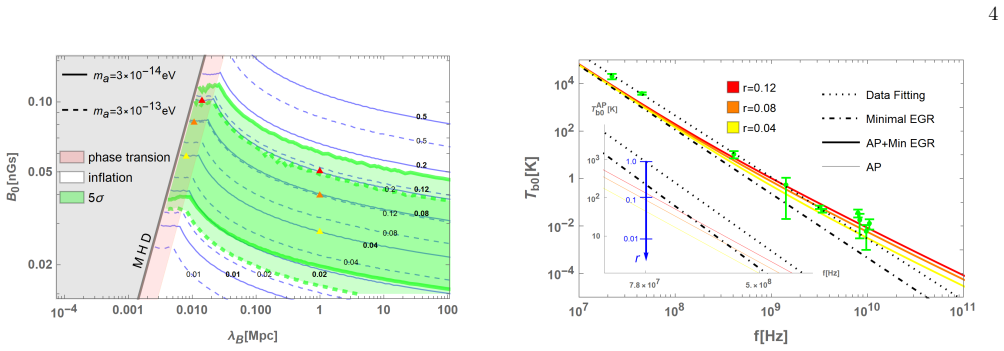
The central claim is that relativistic ALPs with masses in the range $10^{-14}$ to $10^{-12}\,\mathrm{eV}$, an ALP–photon coupling near $g_{a\gamma}=5\times10^{-13}\,\mathrm{GeV}^{-1}$, and an ALP-to-photon energy-density ratio of $\gamma=0.06$ can resonantly convert into photons when the effective photon mass matches the ALP mass in the post-recombination plasma. With a present-day magnetic field strength around $B_0=0.1\,\mathrm{nG}$, the converted radiation produces a brightness temperature scaling as $f^{-2}$ that improves the fit to the ARCADE-2 excess by more than $5\sigma$ over astrophysical synchrotron emission alone. The same photons raise the radiation background at $z\simeq17$ and deepen the 21cm absorption trough into the range reported by EDGES, giving a single source for both anomalies. For a higher ALP mass with resonance at $z\simeq100$, the model predicts an additional absorption trough below 30 MHz.
Load-bearing premise
The 21cm half of the central claim assumes the EDGES absorption trough is a genuine astrophysical signal, which the paper itself calls inconclusive and which a SARAS-3 measurement rejected at 95.3% confidence.
Editorial extensions
If this is right
- ALP-to-photon conversion replaces part of the extragalactic synchrotron explanation for the ARCADE-2 excess, improving the fit from $\chi^2=114$ to $\chi^2=49$ (12 d.o.f.) for the best benchmark.
- The injected radiation deepens the global 21cm absorption line to the EDGES-observed level for $0.02\lesssim r\lesssim0.2$, with the trough depth governing the allowed ALP and magnetic-field parameters.
- For a resonance at $z_{\rm res}\simeq100$ (higher ALP mass), the model predicts a second absorption trough around $f\sim15$ MHz, below the standard 21cm feature.
- Above about 100 GHz the brightness-temperature scaling steepens from $f^{-2}$ to $f^{-3}$, a signature absent in domain-like treatments of the magnetic field.
- Jointly fitting both anomalies converts the radio anomalies into a probe of the ALP mass and coupling and of the primordial magnetic field's strength, correlation length, and spectral index.
Reading between the lines
- One consequence the authors do not draw out: if a future global 21cm experiment rules out a 78 MHz trough deeper than about $-0.3$ K, the two halves of the model separate, and the ARCADE-2-only fit could still survive even though the unified explanation would not.
- The paper's appendix explores red, flat, and blue ALP spectra but stops short of a full scan; a red spectrum $\Omega_{\rm ALP}\sim\omega^{-0.5}$ already fits the radio data better, so a systematic spectral-shape search would sharpen the prediction.
- A laboratory detection of an ALP in the $10^{-14}$–$10^{-12}$ eV mass range with a coupling near $5\times10^{-13}\,\mathrm{GeV}^{-1}$ would independently corroborate the astrophysical scenario, since the benchmark sits just above current quasar X-ray bounds.
Editorial analysis
A structured set of objections, weighed in public.
Referee Report
Summary. The paper attributes the ARCADE-2 radio excess (22 MHz–10 GHz) and the EDGES 21 cm absorption trough at 78 MHz to a single source: resonant ALP–photon conversion in a stochastic primordial magnetic field during the post-recombination epoch. Relativistic ALPs with a frequency-flat abundance, mass ma ≈ 3×10^-14–3×10^-13 eV, photon coupling gaγ = 5×10^-13 GeV^-1, and energy-density ratio γ = 0.06 (close to the Planck ΔNeff limit) convert in a field of amplitude B0 ≈ 0.1 nG with a two-scale power spectrum, producing a present-day brightness spectrum T_b ∝ f^-2. The model is reported to improve the radio fit by Δχ² = 65 (≈5σ) over a synchrotron-only model and to yield fractional contributions r ≈ 0.02–0.2 at 78 MHz. The 21 cm analysis adds the extra background TR(z) = T0(1+z) + rC(1+z)^3 Θ(zres−z) to the standard simulation and finds trough depths compatible with EDGES-2/3 for star-formation efficiencies f* ≈ 1–10%. The paper explicitly labels the 21 cm conclusion provisional because the EDGES signal is disputed (SARAS-3 rejected it at 95.3% CL), and it predicts a spectral slope change above 0.5 GHz and a second trough below 30 MHz for the heavier-mass benchmark.
Significance. The proposed framework is attractive in principle: if calibrated correctly it would unify two long-standing radio anomalies within one dark-sector mechanism, and it yields cleanly falsifiable predictions — the f^-2 scaling above 0.5 GHz, the second absorption trough below 30 MHz for the heavier mass, and a small y-type distortion (Appendix F) consistent with COBE/FIRAS. The conversion-probability calculation in Appendix A is a genuine strength: the semi-steady discretization, the linearized detuning, and the stochastic-resonance suppression factor in Eq. (24) go beyond domain-like Landau–Zener treatments and appear internally consistent. The main limitation is that the amplitude calibration is not supportable as written: the assumed flat ALP spectrum with γ = 0.06 cannot simultaneously satisfy the total-energy normalization and the Planck ΔNeff bound (Major Comment 1), and the stated thermal-production picture would give a near-blackbody spectrum, not a flat radio-band one. Combined with the contested status of the EDGES detection, the paper currently demonstrates a plausible mechanism and a proof of principle rather than an established simultaneous explanation.
major comments (3)
- [Eq. (5), Eqs. (7)/(30), and Appendix B] The conversion amplitude is over-normalized. The paper defines γ = Ω_a/Ω_γ as the total ALP-to-photon energy-density ratio and then uses γ as the per-logarithmic-frequency ratio Ω_ALP(ω0)/Ω_γ0 in Eq. (5) (and in Eqs. (7) and (30) for the 21 cm background). For a frequency-flat spectrum, Ω_ALP(ω) = const, the total is ∫ dlnω Ω_ALP(ω) = Ω_ALP(ω) × Δlnω, so Appendix B's assertion 'Ω_ALP = ∫ d lg ω Ω_ALP(ω) ≃ Ω_ALP(ω) due to the logarithmic integral manner' is incorrect by Δlnω ≈ 5–6 over the 22 MHz–10 GHz band (and by more if the spectrum extends to THz as in Appendix F). Consequently T_b^AP in Eq. (5) is overestimated by this factor, equivalent to overestimating B0 or gaγ by √Δlnω ≈ 2.3, and the same error propagates into the r contours of Fig. 2 that feed the 21 cm analysis. The inconsistency has a physical counterpart: the only production mechanism mentioned (thermal decoupling near 0.1 GeV, Appendix B) produces a quasi-blackbody ALP spectrum with T_ALP ≈ 0.4 T0 and peak near 60–70 GHz, whose per-log energy density at 78 MHz is suppressed by (0.078 GHz/60 GHz)^3 ≈ 2 × 10^-9, making the radio signal negligible. The three statements 'γ = 0.06 (total)', 'flat spectrum over the ARCADE band', and 'ΔNeff ≤ 0.33' cannot hold simultaneously; the analysis must be redone either with per-log normalization γ/Δlnω or with a non-thermal production mechanism for a radio-frequency population, and the viable regions in Figs. 2, 6, and 7 must be recomputed.
- [Introduction and Conclusion] The central 'simultaneous explanation' claim is conditional on the reality of the EDGES trough, which the authors themselves treat as inconclusive ('Despite the inconclusive results on 21cm signal, in this paper we concentrate on the anomaly data reported from EDGES'; 'This conclusion should be considered provisional for reference only'). SARAS-3 (Ref. [14]) rejected the EDGES best-fit profile at 95.3% confidence, and the supporting EDGES-3 results cited in the main text are laboratory memos (Refs. [62–64]), not peer-reviewed publications. If the trough is a systematic, the 21 cm half of the claim cannot be sustained. The abstract's phrasing ('resolve both anomalies simultaneously') and the Conclusion should therefore be revised to present the 21 cm connection as a conditional application of the radio model, not as an established resolution.
- [Radio Excess and 21cm Trough (χ² analysis)] The statistical support for the radio half is weaker than the '5σ' framing suggests. The best fit has χ²_min = 49 with 12 degrees of freedom (χ²_ν ≈ 4), so the ALP-plus-minimal-EGR model is still a formally poor fit to the 14 data points (p ≈ 10^-6 for χ²_ν = 4); the quoted 'more than 5σ' is the Δχ² = 65 improvement over the null model, i.e., a relative statement. Given that the low-frequency excess data are themselves subject to unmodeled systematics (as the introduction notes), the paper should report the absolute goodness of fit and present the radio explanation as a relative improvement that is promising but not yet a high-quality fit.
minor comments (6)
- [Throughout] Units and typos: 'costant' (§ALP-Photon Mixing), 'discritizing' (Appendix A), 'invarinat' (Appendix F), 'affects' → 'effects' (Appendix C), and the inconsistent field-strength notation 'nGs' (Fig. 1 caption) vs 'nG' (text).
- [Appendix F] The sentence 'the scale invariant spectrum is insensitive to both UV and IR cutoffs' is misleading: it is the differential spectrum Ω_ALP(ω) that is cutoff-insensitive, while the total energy ∫ dlnω Ω_ALP(ω) grows with the bandwidth and is centrally relevant to the ΔNeff normalization.
- [Abstract and Fig. 3] The 21 cm agreement in Fig. 3 is obtained by fitting: the paper varies r, z_res (through ma), and f*, and scans fα and fX in Appendix C, so the matching trough is not a free prediction; the genuinely predictive elements are the f^-2 slope above 0.5 GHz and the sub-30 MHz second trough, and the abstract should distinguish these.
- [Radio Excess and 21cm Trough] The benchmark coupling gaγ = 5×10^-13 GeV^-1 is acknowledged to lie 'slightly beyond the region excluded by Chandra' (Ref. [37]); because the normalization correction of Major Comment 1 pushes the required coupling or field strength upward, the paper should quantify how much of the viable region in Figs. 2, 6, and 7 survives existing astrophysical exclusion bounds.
- [Radio Excess and 21cm Trough (χ² analysis)] The χ² statement '14 experimental data' with '12 d.o.f.' should specify which parameters are varied in the fit (presumably B0 and λB) and how the 22, 45, 408, and 1420 MHz survey points are weighted relative to ARCADE-2.
- [Fig. 3 caption] The datasets labeled EDGES-2/3 in the right panel should be marked as preliminary (lab memos Refs. [62–64]) in the figure caption, and the main text should restate that the EDGES-3 'consistency' has not passed peer review.
Circularity Check
No significant circularity: the ALP-photon conversion probability is derived from first principles, the radio excess is fit to external ARCADE-2 data, and the 21cm check uses those parameters against independent EDGES data without re-fitting the 21cm signal into the model.
full rationale
The central derivation is self-contained. The conversion probability P_tot is obtained from the ALP-photon mixing equations in Appendix A using only the external magnetic field model and cosmological plasma evolution; it does not use the ARCADE-2 or EDGES data as input. The radio excess analysis fits the model parameters (B0, lambda_B, ma, ga_gamma) to 14 external radio measurements, and the f^-2 scaling of the brightness temperature emerges from the resonance probability rather than from a fit to the spectral slope. The 21cm calculation is a genuine cross-check: the parameter r is defined using the ARCADE-2-derived excess at 78 MHz, and then the 21cm depth is computed with an external 21cm simulation code (following Refs. [27,28]), with star-formation efficiency f* varied over a reasonable range. The overlap with EDGES is not enforced by construction; it is a nontrivial consistency result. The only self-citation (Ref. [35]) concerns a secondary stochastic-resonance effect that is also derived directly in Appendix A, so it is not load-bearing. A separate concern is noted in Appendix B: the identification of the total ALP-to-photon density ratio gamma with the per-logarithmic-frequency ratio Omega_ALP(omega)/Omega_gamma is only valid if the flat ALP spectrum is supported over about one e-fold; for a flat spectrum over the full ARCADE-2/EDGES band the per-log ratio should be gamma/Delta ln(omega), which would change the predicted amplitude. This is a normalization/correctness risk, not a circular reduction, because the predicted signal is not obtained by presupposing the EDGES result. The paper also explicitly labels the EDGES comparison as provisional given the inconclusive status of the 21cm data. Overall, no circular step that equates a prediction with an input by construction was found.
Assumptions & free parameters
free parameters (8)
- ALP mass ma =
3e-14 eV and 3e-13 eV benchmarks
- ALP-photon coupling ga_gamma =
5e-13 GeV^-1 fiducial, with values roughly 5e-14 to 5e-13 in Fig. 6
- ALP-to-photon energy density ratio gamma =
0.06
- Primordial magnetic field amplitude B0 =
Scanned over the allowed plane; about 0.1 nG in benchmarks
- Magnetic correlation length and cutoffs lambda_B, k_IR, k_UV, k_D =
lambda_B = 0.01 Mpc, k_UV^-1 = 0.01 Mpc, k_IR^-1 = 1 Mpc, k_D around O(100)(1e-9 G/B0) Mpc^-1
- r, the fractional ALP contribution at 78 MHz =
Benchmarks r = 0.04, 0.08, 0.12; viable range 0.02 to 0.2
- Star formation efficiency f* =
1%, 3%, 5%, 10%
- Lyman-alpha and X-ray emissivity factors f_alpha, f_X =
Fiducial f_alpha = f_X = 1; varied over 0.1 to 10 in Appendix C
assumptions (8)
- domain assumption FLRW cosmology with standard recombination and ionization history X_e(z)
- standard math ALP-photon mixing in the short-wavelength approximation with kernel matrix K (Eq. 2)
- domain assumption Primordial magnetic field is a statistically isotropic Gaussian random field with a two-scale power spectrum (Eqs. 3 and 6)
- ad hoc to paper ALP dark radiation is relativistic, has a frequency-independent spectrum, and decouples at about 0.1 GeV with gamma = 0.06
- ad hoc to paper The semi-steady approximation with epsilon = 0.1 and linear expansion of Delta(z) is valid for the post-recombination epoch
- ad hoc to paper The radiation background relevant to 21cm can be approximated as TR(z) = T0(1+z) + r C (1+z)^3 Theta(z_res - z)
- domain assumption 21cm modeling inputs follow Ref. 28, including Lyman-alpha coupling, X-ray heating, and a virial temperature cutoff of 2e4 K
- domain assumption Cotton-Mouton effect and Faraday rotation can be neglected
invented entities (2)
-
Relativistic ALP dark radiation population with flat spectrum and gamma = 0.06
independent evidence
-
Stochastic primordial magnetic field with a two-scale power spectrum
independent evidence
Cite this review
Pith. "Pith review of Excess Radiation from Axion-Photon Conversion." pith.science (2026). https://pith.science/paper/QNC2QNDU
@misc{pith2026241109042,
  author       = {Pith},
  title        = {Pith review of: Excess Radiation from Axion-Photon Conversion},
  year         = {2026},
  howpublished = {\url{https://pith.science/paper/QNC2QNDU}},
  note         = {Machine review of arXiv:2411.09042}
}
read the original abstract
Two notable anomalies in radio observations -- the excess radiation in the Rayleigh-Jeans tail of the cosmic microwave background, revealed by ARCADE2, and the twice-deeper absorption trough of the global 21cm line, identified by EDGES -- remain unresolved. These phenomena may have a shared origin, as the enhancement of the 21cm absorption trough could arise from excess heating. We investigate this scenario through the framework of axion-like particles (ALPs), showing that the resonant conversion of ALPs into photons can produce a photon abundance sufficient to resolve both anomalies simultaneously. Our model naturally explains the observed radio excess between 0.4 and 10GHz while also enhances the 21cm absorption feature at 78MHz. Furthermore, it predicts a novel power-law scaling of the radio spectrum above 0.5GHz and an additional absorption trough below 30MHz, which could be verified through cross-detection in upcoming experiments.
Figures


Figures from the paper (7 more)


Forward citations
Cited by 3 Pith papers
-
Investigating the cosmic distance duality relation with gamma-ray bursts
Combined gamma-ray burst and multi-probe data show no significant violation of the cosmic distance duality relation and prefer a Planck-like Hubble constant.
-
Missing matter in galaxies as a neutrino mixing effect
Neutrino flavor vacuum is claimed to act as dust-like dark matter and to produce a Yukawa correction to gravity that reproduces flat rotation curves and the baryonic Tully-Fisher relation.
-
Axion-Photon Conversion in FLRW with Primordial Magnetic Fields: Explaining the Radio Excess
Resonant conversion of axion-like particles into photons in nanogauss primordial magnetic fields is claimed to explain both the ARCADE2 radio excess and the EDGES 21-cm trough for axion masses near 10^-14 to 10^-12 eV.
Reference graph
Works this paper leans on
- [14]
- [1]
-
[2]
P. Reich and W. Reich, Astronomy and Astrophysics Supplement Series (ISSN 0365-0138), vol. 63, no. 2, Feb. 1986, p. 205-288. 63, 205 (1986). 15 Figure 8: Left: Several mass terms in the mixing matrix during redshift 103 < z <105 at present day’s frequency f = 100GHz. The mass term ∆ pl denoting plasma effect dominates in this redshift range. Middle: Compa...
work page 1986
-
[3]
R. S. Roger, C. H. Costain, T. L. Landecker, and C. M. Swerdlyk, Astron. Astrophys. Suppl. Ser. 137, 7 (1999), astro-ph/9902213
arXiv 1999
- [4]
-
[5]
D. J. Fixsen et al., Astrophys. J. 734, 5 (2011), 0901.0555
arXiv 2011
-
[6]
A dark matter interpretation for the ARCADE excess?
N. Fornengo, R. Lineros, M. Regis, and M. Taoso, Phys. Rev. Lett. 107, 271302 (2011), 1108.0569
work page Pith review arXiv 2011
- [7]
Show all 65 references
-
[8]
B. Cyr, J. Chluba, and S. K. Acharya, Phys. Rev. D 109, L121301 (2024), 2308.03512
2024 arXiv
-
[9]
Mittal and G
S. Mittal and G. Kulkarni, Mon. Not. Roy. Astron. Soc. 510, 4992 (2022), 2110.11975
2022 arXiv
-
[10]
Singal et al., Publ
J. Singal et al., Publ. Astron. Soc. Pac. 130, 036001 (2018), 1711.09979
2018 arXiv
-
[11]
Singal et al., Publ
J. Singal et al., Publ. Astron. Soc. Pac. 135, 036001 (2023), 2211.16547
2023 arXiv
-
[12]
J. D. Bowman, A. E. E. Rogers, R. A. Monsalve, T. J. Mozdzen, and N. Mahesh, Nature 555, 67 (2018), 1810.05912
2018 arXiv
-
[13]
Hills, G
R. Hills, G. Kulkarni, P. D. Meerburg, and E. Puchwein, Nature 564, E32 (2018), 1805.01421
2018 arXiv
-
[15]
P. H. Sims, J. D. Bowman, N. Mahesh, S. G. Murray, J. P. Barrett, R. Cappallo, R. A. Monsalve, A. E. E. Rogers, T. Samson, and A. K. Vydula, Mon. Not. Roy. Astron. Soc. 521, 3273 (2023), 2212.03875
2023 arXiv
-
[16]
P. H. Sims et al. (2025), 2506.20042
2025
-
[17]
Hassan et al., Astrophys
S. Hassan et al., Astrophys. J. Lett. 958, L3 (2023), 2305.02703
2023 arXiv
- [18]
-
[19]
Berlin, D
A. Berlin, D. Hooper, G. Krnjaic, and S. D. McDermott, Phys. Rev. Lett. 121, 011102 (2018), 1803.02804
2018 arXiv
-
[20]
J. B. Mu˜ noz and A. Loeb, Nature 557, 684 (2018), 1802.10094. 16
2018 arXiv
-
[21]
Pospelov, J
M. Pospelov, J. Pradler, J. T. Ruderman, and A. Urbano, Phys. Rev. Lett. 121, 031103 (2018), 1803.07048
2018 arXiv
- [22]
- [23]
-
[24]
K. Choi, H. Seong, and S. Yun, Phys. Rev. D102, 075024 (2020), 1911.00532
2020 arXiv
- [25]
-
[26]
Mittal, A
S. Mittal, A. Ray, G. Kulkarni, and B. Dasgupta, JCAP 03, 030 (2022), 2107.02190
2022 arXiv
-
[27]
Fialkov and R
A. Fialkov and R. Barkana, Mon. Not. Roy. Astron. Soc. 486, 1763 (2019), 1902.02438
2019 arXiv
-
[28]
COSMIC WISPers
and compare with EDGES data. The same model for Lyman-α and X-ray heating as in Ref. [28] and refer- ence therein is employed, where energy transfer between modified radiation background and intergalactic medium is taken into account [27]. We consider several reasonable values...
2018
-
[29]
Caputo, H
A. Caputo, H. Liu, S. Mishra-Sharma, M. Pospelov, J. T. Ruderman, and A. Urbano, Phys. Rev. Lett. 127, 011102 (2021), 2009.03899
2021 arXiv
-
[30]
S. K. Acharya, B. Cyr, and J. Chluba, Mon. Not. Roy. Astron. Soc. 523, 1908 (2023), 2303.17311
2023 arXiv
-
[31]
Chianese, P
M. Chianese, P. Di Bari, K. Farrag, and R. Samanta, Phys. Lett. B 790, 64 (2019), 1805.11717
2019 arXiv
-
[32]
P. S. B. Dev, P. Di Bari, I. Mart ´ ınez-Soler, and R. Roshan, JCAP 04, 046 (2024), 2312.03082
2024 arXiv
-
[33]
Mirizzi, G
A. Mirizzi, G. G. Raffelt, and P. D. Serpico, Phys. Rev. D 76, 023001 (2007), 0704.3044
2007 arXiv
- [34]
- [35]
- [36]
-
[37]
P. A. R. Ade et al. (Planck), Astron. Astrophys. 594, A19 (2016), 1502.01594
2016 arXiv
-
[38]
J. S. Reyn´ es, J. H. Matthews, C. S. Reynolds, H. R. Russell, R. N. Smith, and M. C. D. Marsh, Mon. Not. Roy. Astron. Soc. 510, 1264 (2021), 2109.03261
2021 arXiv
-
[39]
Obata, T
I. Obata, T. Fujita, and Y. Michimura, Phys. Rev. Lett. 121, 161301 (2018), 1805.11753
2018 arXiv
-
[40]
J. F. Bourhill, E. C. I. Paterson, M. Goryachev, and M. E. Tobar, Phys. Rev. D 108, 052014 (2023), 2208.01640
2023 arXiv
-
[41]
Brandenburg, R
A. Brandenburg, R. Durrer, T. Kahniashvili, S. Mandal, and W. W. Yin, JCAP 08, 034 (2018), 1804.01177
2018 arXiv
-
[42]
A. N. Kolmogorov, Proceedings of the Royal Society of London. Series A: Mathematical and Physical Sciences 434, 9 (1991)
1991
-
[43]
Kahniashvili, A
T. Kahniashvili, A. G. Tevzadze, S. K. Sethi, K. Pandey, and B. Ratra, Physical Review D 82 (2010)
2010
-
[44]
Fixsen and J
D. Fixsen and J. Mather, The Astrophysical Journal581, 817 (2002)
2002
-
[45]
J. R. Pritchard and A. Loeb, Rept. Prog. Phys. 75, 086901 (2012), 1109.6012
2012 arXiv
-
[46]
M. C. D. Marsh, J. H. Matthews, C. Reynolds, and P. Carenza, Phys. Rev. D 105, 016013 (2022), 2107.08040
2022 arXiv
- [47]
- [48]
-
[49]
Tashiro, J
H. Tashiro, J. Silk, and D. J. E. Marsh, Phys. Rev. D 88, 125024 (2013), 1308.0314
2013 arXiv
- [50]
-
[51]
Ejlli, D
A. Ejlli, D. Ejlli, A. M. Cruise, G. Pisano, and H. Grote, Eur. Phys. J. C 79, 1032 (2019), 1908.00232
2019 arXiv
-
[52]
Fujita, K
T. Fujita, K. Kamada, and Y. Nakai, Phys. Rev. D 102, 103501 (2020), 2002.07548
2020 arXiv
-
[53]
Domcke and C
V. Domcke and C. Garcia-Cely, Phys. Rev. Lett. 126, 021104 (2021), 2006.01161
2021 arXiv
-
[54]
Caloni, M
L. Caloni, M. Gerbino, M. Lattanzi, and L. Visinelli, JCAP 09, 021 (2022), 2205.01637
2022 arXiv
-
[55]
Arias, D
P. Arias, D. Cadamuro, M. Goodsell, J. Jaeckel, J. Redondo, and A. Ringwald, JCAP 06, 013 (2012), 1201.5902
2012 arXiv
-
[56]
Z. G. Berezhiani and M. Y. Khlopov, Sov. J. Nucl. Phys. 51, 935 (1990)
1990
-
[57]
Z. G. Berezhiani and M. Y. Khlopov, Z. Phys. C 49, 73 (1991)
1991
-
[58]
J. R. Pritchard and A. Loeb, Phys. Rev. D 78, 103511 (2008), 0802.2102
2008 arXiv
-
[59]
A. Hook, G. Marques-Tavares, and C. Ristow, JHEP 05, 086 (2024), 2306.13135
2024 arXiv
-
[60]
D. J. Fixsen, E. S. Cheng, J. M. Gales, J. C. Mather, R. A. Shafer, and E. L. Wright, Astrophys. J. 473, 576 (1996), astro-ph/9605054
1996 arXiv
-
[61]
Schiavone, D
F. Schiavone, D. Montanino, A. Mirizzi, and F. Capozzi, JCAP 08, 063 (2021), 2107.03420
2021 arXiv
- [62]
-
[63]
https://www.haystack.mit.edu/ haystack-memo-series/edges-memos/
-
[64]
https://www.haystack.mit.edu/wp-content/uploads/ 2025/01/memo_EDGES_466.pdf
2025
-
[65]
https://www.haystack.mit.edu/wp-content/uploads/ 2025/05/edgesmemo_481.pdf
2025
Reviewed August 12, 2026 · model on record in the stance chip above.
Discussion (0). Continue with ORCID to comment.