REVIEW 3 major objections 6 minor 1 cited by
Strong Field Scattering of Black Holes: Assessing Resummation Strategies
T0 review · 3 major / 6 minor · reviewed 2026-08-12 · deepseek-v4-flash
Pith's one-line read This paper shows that L-resummed, weob, and SEOB-PM scattering models all break down at high energies, and that NR-calibrated pseudo-5PM terms with Padé-resummed EOB potentials restore partial agreement.
desk verdict New NR scattering data at Γ4-Γ7 make this a useful benchmark paper; the central qualitative finding is solid, but missing convergence tests and reliance on fitted pseudo-5PM terms need attention. read the letter →
The pith
A machine-rendered reading of the paper's core claim, the machinery that carries it, and where it could break.
The reading
What carries the argument
The paper's central objects are the PM expansion of the scattering angle $\theta(\gamma,\ell)=\sum_i 2\theta_i(\gamma)/\ell^i$ and three ways of resumming it. The L-resummation factors out the singular logarithmic behavior $L(x)=\frac{1}{x}\ln\frac{1}{1-x}$ near the critical angular momentum $\ell_0$, where scattering turns into plunge. The weob model rewrites the scattering integral in terms of a PM-expanded EOB radial potential $w(\bar{r},\gamma)$, and the SEOB-PM model instead feeds PM information into the EOB metric potential $A(r)$ in the post-Schwarzschild gauge. A Firsov-type inversion formula (Eq. 4.23) lets the authors extract the NR-informed potential $w_{\mathrm{NR}}$ from their scattering angles, and Padé approximants of $w$ are tested as an additional resummation layer.
What would settle it
Compute the complete 5PM scattering-angle coefficient including radiation-reaction and second-self-force contributions, re-run the L-resummed, weob, and SEOB-PM predictions against the $\Gamma_7$ NR data, and check whether the PM hierarchical shifts and divergences disappear; if they persist, the paper's remedy claim fails.
Extended reading notes
Core claim
The central discovery, on the paper's own terms, is that no current resummation of PM information is reliable in the strong-field, high-energy regime: the L-resummed angles develop divergences tied to the Cauchy estimate of $\ell_0$, the weob potentials become over-attractive at 4PM and develop repulsive cores at low energy when partial 5PM information is added, and the SEOB-PM hierarchy inverts so that 2PM outperforms 4PM above $\Gamma_5$. The paper demonstrates that NR-calibrating a pseudo-5PM coefficient improves the L-resummed model, and that a Padé resummation of the EOB radial potential before calibration gives a proof-of-principle cure for the weob model's high-energy failures.
Load-bearing premise
The load-bearing premise is that the lone 5PM input currently available—the conservative first-self-force term $\theta^{1\mathrm{GSF}}_{5,\mathrm{cons}}$—stands in for the complete 5PM order; if the missing radiative and second-self-force pieces are large, all three resummations' high-energy behavior could change, exactly as the authors warn in Sec. IVC3.
Editorial extensions
If this is right
- If the paper is right, waveform models that rely on these PM resummations cannot be trusted for high-energy or strong-field encounters until more PM orders or better resummations are added.
- Accurate knowledge of the critical angular momentum $\ell_0$ can matter as much as higher-order PM terms: the L-resummed model with NR-calibrated $\ell_0$ stays within a few percent of NR, while the analytic Cauchy estimate degrades to roughly 30 percent residuals at the highest energy.
- Partial 5PM information generally improves accuracy below $\Gamma_4$ but can introduce repulsive cores and over-attractive behavior at other energies, so adding higher orders is not automatically safer.
- Padé-resummed EOB potentials, calibrated to NR after resummation (the $w_{\mathrm{5PM,III}}$ procedure), give the best high-energy scattering angles and avoid the unphysical turning points seen in the plain PM-expanded potential.
- The new NR data at $\Gamma_4$–$\Gamma_7$ provide a benchmark against which future complete 5PM or 6PM predictions, once radiation-reaction and second-self-force contributions are known, can be tested.
Reading between the lines
- The paper leaves open the possibility that full 5PM results, with radiation reaction and 2GSF terms, could change the hierarchy: the authors' own Sec. IVC3 caveat implies their pseudo-5PM fits may absorb effects beyond their nominal order.
- A natural extension is to apply the same NR-calibration plus Padé procedure to spinning and unequal-mass binaries; nothing in the argument limits it to equal-mass nonspinning systems, but that is untested.
- Because the pseudo-5PM coefficients are fit at each energy, using them in a waveform model would require a prescription for interpolating across energies or refitting the coefficient as a smooth function of $\gamma$.
- The universal logarithmic singularity motivating the L-resummation may need refinement at high energy: the self-force-enhanced singularity found in the scalar-field analogue could change $\ell_0$ estimates and rescue the scheme, a direction the paper cites but does not pursue.
Editorial analysis
A structured set of objections, weighed in public.
Referee Report
Summary. The paper extends the existing NR catalogue of equal-mass, non-spinning binary black-hole scattering by adding four new energy sets (Γ4–Γ7, up to γ ≈ 1.96) and re-extracting the low-energy data with a common polynomial-extrapolation pipeline (Sec. II, App. B). It then compares the scattering-angle predictions of three resummation schemes — the L-resummation [82], the w^eob EOB-potential resummation [82], and the SEOB-PM model [84], together with the partial 5PM (conservative, 1GSF) information of Eq. (3.15) — against the NR angles (Sec. IV). The central findings are that all three schemes develop PM-order-hierarchy inversions and divergent or unphysical behaviour in the high-energy regime, that NR-calibrated pseudo-5PM coefficients (θ5,I, θ5,II and w5,I–III) can repair the agreement in-sample at varying levels, and that Padé resummation of the EOB radial potentials is a promising, proof-of-principle remedy (Secs. IVB–IVC). The paper explicitly flags the effective nature of the pseudo-5PM terms and the incompleteness of the 5PM input.
Significance. The high-energy scattering regime is directly relevant to using PM information in the next generation of EOB and phenomenological waveform models, and this paper provides the first systematic, cross-model stress test of the three main resummation proposals at γ up to 1.96. If the central claim holds, it is an important caution: naive inclusion of higher PM orders (and the associated radiative terms) does not improve, and can degrade, strong-field predictions, so resummation strategy — not just PM order — is the key design choice. The manuscript ships the full NR data tables (App. B), uses an extraction pipeline that follows the established references [81,83], compares models in a transparent, side-by-side way, and is explicit about the main caveats (partial 5PM content, effective nature of the calibrated coefficients, proof-of-principle status of the Padé analysis). These are genuine strengths that make the paper useful even where the conclusions are provisional.
major comments (3)
- [IIB, Tables II–VIII] The new Γ4–Γ7 data carry the paper's central empirical claim, but their quoted error bars are derived solely from the variation of the polynomial order in the 1/r puncture-trajectory extrapolation (Sec. IIB). No resolution-convergence study, extraction-radius or fit-window variation, gauge-dependence test, or independent-code comparison is reported for the new runs, and Sec. IIA gives the differencing stencil and gauge choices but no grid resolutions or refinement-level parameters. The agreement with [83] at lower energies provides some pipeline validation, but it does not by itself establish the accuracy of the new high-energy runs. The qualitative conclusion that the models fail by tens to hundreds of degrees at the highest energy would survive modest systematic errors, but the claimed sub-degree precision of many entries in Tables II–VIII is not verifiable from the information given, and the near-plunge points already carry −11° to −16° asymmetric errors (Tables II and VIII). Please add convergence/consistency checks for representative runs (including at least one strong-field point per new energy), report the grid parameters, and state whether the extrapolation-window choice (r ∈ [20,90]M and [30,180]M) is stable at Γ4–Γ7.
- [IIIB Eq. (3.15); IVB2–IVB3, IVC2–IVC3] The abstract's statement that “including higher-order information improves the agreement” rests on two legs, and both are weaker than the sentence suggests. First, the only genuine 5PM input, θ5,cons^{1GSF}, is the conservative first-order-self-force piece; the radiative and 2GSF contributions are unknown, a point the authors themselves make in Sec. IVC3, so the partial-5PM comparisons in Figs. 3, 4, 8 and 14 do not yet characterise the full 5PM order. Second, the pseudo-5PM coefficients θ5,I, θ5,II, w5,I and w5,III are calibrated against the same NR data sets against which the resulting models are then evaluated (Figs. 7, 12, 13), so the reported improvements — e.g., residuals ∼1° at Γ1 and the Padé gains at Γ7 — are in-sample demonstrations of the flexibility of the templates rather than evidence of predictive superiority. The body is appropriately cautious (“effective parameters”, “proof-of-principle”), but the abstract and Sec. V should either carry the same caveats explicitly or be supported by an out-of-sample test (e.g., calibrating on Γ4–Γ6 and evaluating at Γ7).
- [IVC2, Eq. (4.23)] The reconstructed “NR potential” wNR is not a direct measurement: it is obtained by fitting the three-parameter L-resummed template of Eq. (4.24) (ℓ0,NR, θ5,NR, θ6,NR) to the scattering angles and then Abel-inverting the fitted, extrapolated curve with Eq. (4.23). The comparison in Fig. 10 between wNR and the w^eob potentials is therefore only as model-independent as that template; at high energies the fitted curve extrapolates beyond the measured ℓ-range and into the near-plunge region, and this extrapolation uncertainty is not propagated. Part of the reported discrepancy between wNR and the PM-expanded potentials could in principle reflect template bias rather than a genuine failure of the w^eob potentials. Please state this limitation when interpreting Fig. 10, or test the sensitivity of wNR to the assumed functional form.
minor comments (6)
- [Table V] The row “1.07727 6.80 5.440 214.3263 +0.8919 −0.0007” lists a value of Γ that is inconsistent with the other rows of the table; it should read Γ = 1.07277.
- [V] In the conclusions, “psuedo-5PM” should read “pseudo-5PM” (the misspelling appears twice).
- [App. B] The rule for flagging data with an asterisk is described only as “due to unbound/plunge uncertainty”; please quantify the selection criterion and state explicitly whether the excluded points affect any of the reported fits.
- [Fig. 5] The figure compares Cauchy estimates of ℓ0 with NR-derived values, but the procedure for extracting ℓ0 from the NR data and the handling of its uncertainties are not described in Sec. II; a sentence specifying the procedure (or a pointer to the [82] prescription) would help reproducibility.
- [Abstract] The arXiv abstract and the main-text abstract differ in the phrasing of the central claim (“Each model is shown to demonstrate pathological behaviour” vs. “All of the models struggle to accurately capture the behavior”); please harmonize the two versions.
- [IVC3] The sentence “…with divergent behaviour in the ¯r → 0 being dictated by w5,I[83]” has an ambiguous citation placement; clarify whether [83] is the source of this behaviour or whether the bracket is a typographical artifact.
Circularity Check
Core NR-vs-analytic comparison is independent, but the NR-calibrated pseudo-5PM and Padé branches reduce to fits against the same data; transparent effective-parameter caveats limit severity.
-
fitted input called prediction
[Sec. IV B 2, Eqs. (4.7)-(4.9) and Fig. 7]
"In the first scheme (I), we only fit for θ5 with the critical angular momentum determined using the Cauchy estimate from Eq. 4.5... In the second scheme (II), we treat both ℓ0 and θ5 as free coefficients to be inferred from the data."
The coefficients θ5,I and θ5,II (and ℓ0 in scheme II) are inferred from the same NR scattering data against which the resulting angles are then compared in Fig. 7. The 'maximum residuals relative to NR being on the order of ∼1◦' therefore measure fitting quality, not predictive accuracy. The paper's conclusion that 'higher-order PM information is likely driving the improvement' cannot be tested by this procedure for the NR-calibrated branch, since the pseudo-5PM term is itself determined by the NR data it is then said to reproduce.
-
fitted input called prediction
[Sec. IV C 4, Eq. (4.27), Figs. 12-13]
"Alternatively, we could apply Padé resummation to Eq. 4.27 and calibrate the free 5PM coefficient that appears in the resulting approximant, which will be denoted by w5PM,III... The NR-tuned Padé approximant shows the best performance... We regard these results as a proof-of-principle that Padé resummation of the EOB-PM potentials is a useful strategy for further improving the accuracy and robustness of the PM-expanded potentials."
The w5PM,III construction calibrates its free 5PM coefficient against the NR data, and the 'best performance' is then evaluated against those same NR scattering angles and potentials. This is a fit-performance check, not an independent prediction. The same applies to w5PM,II, whose 5PM term was first tuned to the NR-derived potential wNR, and to θweob5PM,I, which was obtained by fitting w5,I to wNR before comparing against NR. The proof-of-principle demonstrates that a flexible NR-fitted template can reproduce NR, but it does not independently validate the analytic PM input or the Padé form.
full rationale
The central, load-bearing comparison—that the uncalibrated L-resummed, weob, and SEOB-PM models all become unreliable at high energies—is not circular: the analytical predictions are formed from PM coefficients that are independent of the new NR data, and the disagreement is assessed against NR scattering angles. This part of the work is self-contained and would support the high-energy-failure claim even without the fitting sections. The circularity is confined to the secondary 'improvement' demonstrations. θ5,I/II and w5,III (and, in scheme II, ℓ0) are inferred from the same NR data that are then quoted as the benchmark for agreement; their success is an expected property of fitting, not a prediction. The paper is transparent about this, repeatedly calling the fitted objects 'pseudo-5PM' and 'effective parameters' and cautioning that their physical interpretation is limited, which prevents a higher score. The Padé 'proof-of-principle' is likewise a fit-performance statement. No load-bearing self-citation chain is present: the resummation ansätze are attributed to prior work, and the cited [83] data and method are not used to forbid alternatives. The lack of NR resolution and extraction-window convergence tests is a correctness risk, not a circularity, and does not affect this score.
Assumptions & free parameters
free parameters (9)
- θ5,I pseudo-5PM coefficient =
fitted per Γ1-Γ7, values in Fig. 6
- θ5,II pseudo-5PM coefficient =
fitted per Γ1-Γ7, values in Fig. 6
- ℓ0,II critical angular momentum =
fitted per Γ1-Γ7
- ℓ0,NR critical angular momentum =
fitted per energy in Eq. 4.24
- θ5,NR pseudo-5PM coefficient =
fitted per energy in Eq. 4.24
- θ6,NR pseudo-6PM coefficient =
fitted per energy in Eq. 4.24
- w5,I EOB potential coefficient =
fitted per Γ1-Γ7, values in Fig. 11
- w5,III coefficient inside Padé approximant =
fitted per energy
- Padé approximant order =
[4/1] selected from limited search
assumptions (6)
- domain assumption Universal logarithmic singular form L(ℓ0/ℓ) near the critical angular momentum, Eq. 4.1.
- domain assumption Cauchy's rule gives a valid estimate of the critical angular momentum ℓ0 from PM coefficients, Eq. 4.5.
- domain assumption The partial 5PM conservative 1GSF coefficient θ5,cons^1GSF, Eq. 3.15, is representative of the 5PM order for model assessment.
- domain assumption Bowen-York initial data at X=50M with negligible junk radiation adequately represent the physical scattering setup.
- domain assumption Polynomial extrapolation of puncture trajectories in the chosen fitting windows yields the correct scattering angle.
- standard math The Firsov inversion formula, Eq. 4.23, validly reconstructs the radial potential from scattering angle data.
Cite this review
Pith. "Pith review of Strong Field Scattering of Black Holes: Assessing Resummation Strategies." pith.science (2026). https://pith.science/paper/6T6ZDNOT
@misc{pith2026241109652,
  author       = {Pith},
  title        = {Pith review of: Strong Field Scattering of Black Holes: Assessing Resummation Strategies},
  year         = {2026},
  howpublished = {\url{https://pith.science/paper/6T6ZDNOT}},
  note         = {Machine review of arXiv:2411.09652}
}
abstract
Recent developments in post-Minkowksian (PM) calculations have led to a fast-growing body of weak-field perturbative information. As such, there is major interest within the gravitational wave community as to how this information can be used to improve the accuracy of theoretical waveform models. In this work, we build on recent efforts to validate high-order PM calculations using numerical relativity simulations. We present a new set of high-energy scattering simulations for equal-mass, non-spinning binary black holes, further expanding the existing suite of NR simulations. We outline the basic features of three recently proposed resummation schemes (the $\mathscr{L}$-resummed model, the $w^\mathrm{eob}$ model and the SEOB-PM model) and compare the analytical predictions to our NR data. Each model is shown to demonstrate pathological behaviour at high energies, with common features such as PM hierarchical shifts and divergences. The NR data can also be used to calibrate pseudo-5PM corrections to the scattering angle or EOB radial potentials. In each case, we argue that including higher-order information improves the agreement between the analytical models and NR, though the extent of improvement depends on how this information is incorporated and the choice of analytical baseline. Finally, we demonstrate that further resummation of the EOB radial potentials could be an effective strategy to improving the model agreement.
Figures


Figures from the paper (15 more)




Forward citations
Cited by 1 Pith paper
-
High-Post-Newtonian-Order Dynamics Induced by Tail-of-Tail Interactions: The Non-Geodesic Terms
The authors compute tail-of-tail contributions to the effective-one-body Q potential through p_r^12 and derive new second-order self-force redshift predictions for eccentric binaries.
Reference graph
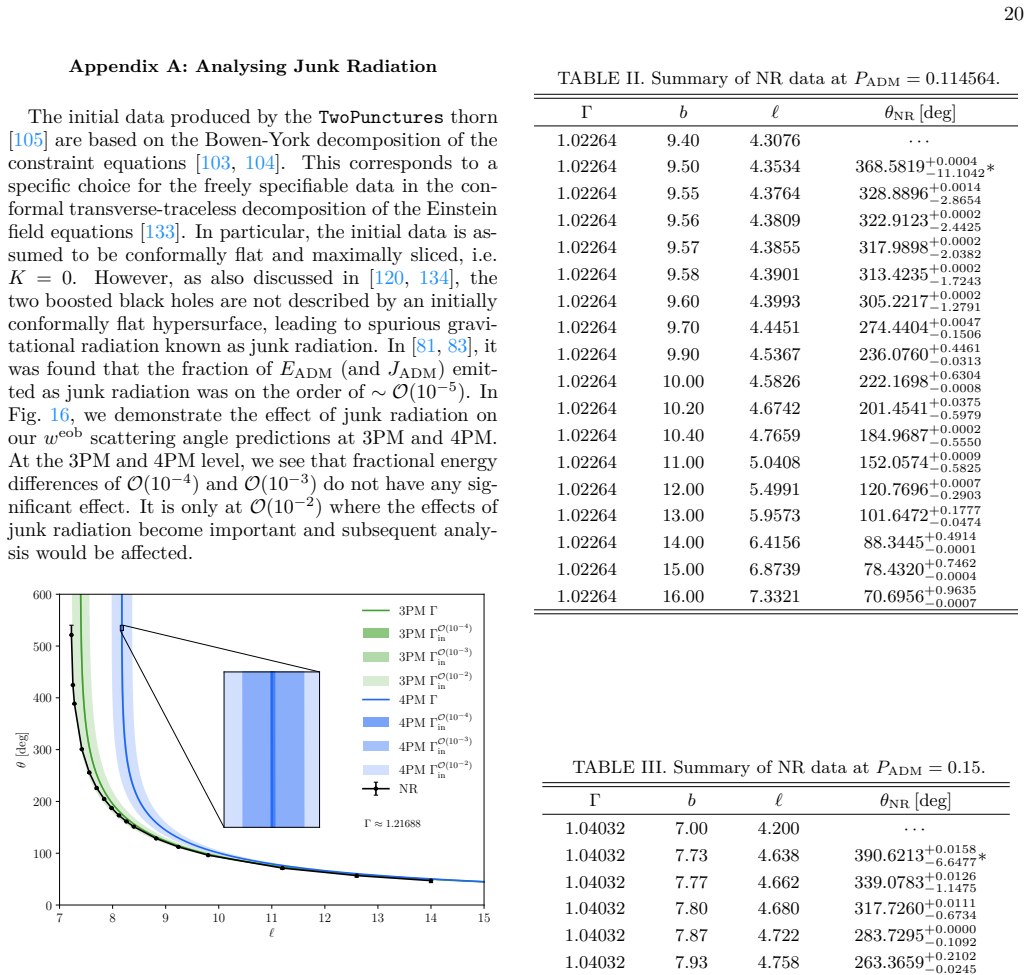
Works this paper leans on
-
[82]
A tale of two exponentiations inN = 8 supergravity at subleading level,
Paolo Di Vecchia, Stephen G. Naculich, Rodolfo Russo, Gabriele Veneziano, and Chris D. White, “A tale of two exponentiations inN = 8 supergravity at subleading level,” JHEP03, 173 (2020), arXiv:1911.11716 [hep-th]
arXiv 2020
-
[84]
Danilo Chiaramello and Alessandro Nagar, “Faith- ful analytical effective-one-body waveform model for spin-aligned, moderately eccentric, coalescing black hole binaries,” Phys. Rev. D 101, 101501 (2020), arXiv:2001.11736 [gr-qc]
arXiv 2020
-
[83]
The eikonal approach to grav- itational scattering and radiation atO(G3),
Paolo Di Vecchia, Carlo Heissenberg, Rodolfo Russo, and Gabriele Veneziano, “The eikonal approach to grav- itational scattering and radiation atO(G3),” JHEP07, 169 (2021), arXiv:2104.03256 [hep-th]
arXiv 2021
-
[1]
In this model, one adopts the post-Schwarzschild (PS) gauge [36] in which the met- ric potentials are fixed to those of Schwarzschild, with ˆQ(r,γ ) admitting a PM expansion
The weob Resummation of the Scattering Angle The weob model was first proposed in [82], as a re- formulation of the scattering angle in terms of a PM- expanded EOB potential. In this model, one adopts the post-Schwarzschild (PS) gauge [36] in which the met- ric potentials are fixed to those of Schwarzschild, with ˆQ(r,γ ) admitting a PM expansion. It is c...
-
[2]
However, the analysis was lim- ited to a single fixed energy,Γ1
Performance of the L-Resummation In [82], theL-resummed model demonstrated signifi- cant improvements in accuracy compared to NR data at each successive PM order. However, the analysis was lim- ited to a single fixed energy,Γ1. We expand on [82] in a few directions. First, we extend the baseline model to in- clude the recently derived 5PM conservative con...
-
[3]
Performance of the weob Resummation The work of [82] showed that at the lowest energy, Γ1, theweob model significantly improves on the perfor- mance of the PM-expanded scattering angles, with the 4PM predictions giving remarkably accurate predictions when compared to NR data (see Fig. 8). When anal- ysed at the higher energiesΓ2 and Γ3 (see Fig. 18), the ...
-
[4]
The starting point fol- lows the mass-shell condition, allowing us to re-express the radial momentum (Eq
Reconstructing the NR Potentials We can use our sequence of NR simulations to extract a radiation-reacted gravitational potential that is central to understanding scattering [82]. The starting point fol- lows the mass-shell condition, allowing us to re-express the radial momentum (Eq. 3.20) as p2 ¯r =p2 ∞−Veff(¯r,γ,ℓ ), (4.21) where Veff denotes an effect...
-
[5]
R. Abbott et al. (LIGO Scientific, Virgo), “GWTC- 2: Compact Binary Coalescences Observed by LIGO and Virgo During the First Half of the Third Ob- serving Run,” Phys. Rev. X 11, 021053 (2021), arXiv:2010.14527 [gr-qc]
arXiv 2021
Show all 146 references
-
[6]
However, we could further resum the EOB-PM poten- tials to help mitigate against the slow-convergence and improvethestabilityofthepotentialstowardsthestrong- field regime
Padé resummation of the w-potentials As discussed in [83], we have been using PM-expanded EOB radial potentials of the formw(¯u)∼ ¯u + ¯u2 +··· . However, we could further resum the EOB-PM poten- tials to help mitigate against the slow-convergence and improvethestabilityofthep...
-
[7]
The SEOB-PM Hamiltonian is based on a test-mass in a deformed Kerr spacetime [24, 28, 29, 128–132]
The SEOB-PM Resummation of the Scattering Angle An EOB Hamiltonian based on the PM expansion was recently presented in [84], incorporating full non- spinning and spinning information at (physical) 4PM and partial information at 5PM. The SEOB-PM Hamiltonian is based on a test-m...
-
[8]
Performance of the SEOB-PM Resummation In [84], the complete non-spinning SEOB-PM model waspresentedat Γ1 upto4PM,withcomparisonsagainst the weob model at Γ2 and Γ3. In this section, we extend these results to show the performance of the SEOB-PM model against the available NR ...
-
[9]
Evolution of binary black hole space- times,
Frans Pretorius, “Evolution of binary black hole space- times,” Phys. Rev. Lett.95, 121101 (2005), arXiv:gr- qc/0507014
2005
-
[10]
L-Resummation 4 5 6 7 8 9 10 𝓁 0 50 100 150 200 250 300 350 400θ [deg] □ ≈ 1.04032 1PM 2PM 3PMcons 3PM 4PMcons 4PM 5PM1GSF cons L 2PM L 3PMcons L 3PM L 4PMcons L 4PM L 5PM1GSF cons NR 4.5 5.0 5.5 6.0 6.5 7.0 7.5 8.0 𝓁 0 50 100 150 200 250 300 350 400 450θ [deg] □ ≈ 1.05548 1PM...
-
[11]
The weob Model 4 5 6 7 8 9 10 𝓁 0 50 100 150 200 250 300 350 400θ [deg] □ ≈ 1.04032 1PM 2PM 3PMcons 3PM 4PMcons 4PM 5PM1GSF cons NR weob 1PM weob 2PM weob 3PMcons weob 3PM weob 4PMcons weob 4PM weob 5PM1GSF cons 4.5 5.0 5.5 6.0 6.5 7.0 7.5 8.0 𝓁 0 50 100 150 200 250 300 350 40...
-
[12]
The SEOB-PM Model 4 5 6 7 8 9 10 𝓁 0 50 100 150 200 250 300 350 400θ [deg] □ ≈ 1.04032 1PM 2PM 3PM 3PMcons 4PM 4PMcons 5PM1GSF cons SEOB-PM 1PM SEOB-PM 2PM SEOB-PM 3PM SEOB-PM 3PMcons SEOB-PM 4PM SEOB-PM 4PMcons NR 4.5 5.0 5.5 6.0 6.5 7.0 7.5 8.0 𝓁 0 50 100 150 200 250 300 350...
-
[13]
Cosmic Explorer: The U.S. Contribution to Gravitational-Wave Astronomy be- yond LIGO,
David Reitze et al., “Cosmic Explorer: The U.S. Contribution to Gravitational-Wave Astronomy be- yond LIGO,” Bull. Am. Astron. Soc.51, 035 (2019), arXiv:1907.04833 [astro-ph.IM]
2019 arXiv
-
[14]
The Einstein Telescope: A third-generation gravitational wave observatory,
M. Punturo et al. , “The Einstein Telescope: A third-generation gravitational wave observatory,” Class. Quant. Grav.27, 194002 (2010)
2010
-
[15]
Laser Interferome- ter Space Antenna,
Pau Amaro-Seoane et al. (LISA), “Laser Interferome- ter Space Antenna,” (2017), arXiv:1702.00786 [astro- ph.IM]
2017 arXiv
-
[16]
GWTC- 1: A Gravitational-Wave Transient Catalog of Compact Binary Mergers Observed by LIGO and Virgo during the First and Second Observing Runs,
B. P. Abbottet al.(LIGO Scientific, Virgo), “GWTC- 1: A Gravitational-Wave Transient Catalog of Compact Binary Mergers Observed by LIGO and Virgo during the First and Second Observing Runs,” Phys. Rev. X9, 031040 (2019), arXiv:1811.12907 [astro-ph.HE]
2019 arXiv
-
[17]
Mappingeccentricityevolutionsbetweennumericalrel- ativityandeffective-one-bodygravitationalwaveforms,
Alice Bonino, Patricia Schmidt, and Geraint Pratten, “Mappingeccentricityevolutionsbetweennumericalrel- ativityandeffective-one-bodygravitationalwaveforms,” Phys. Rev. D110, 104002 (2024), arXiv:2404.18875 [gr- qc]
2024 arXiv
-
[18]
GWTC-3: Compact Binary Coalescences Observed by LIGO and Virgo during the Second Part of the Third Observing Run,
R. Abbott et al. (KAGRA, VIRGO, LIGO Scientific), “GWTC-3: Compact Binary Coalescences Observed by LIGO and Virgo during the Second Part of the Third Observing Run,” Phys. Rev. X13, 041039 (2023), arXiv:2111.03606 [gr-qc]
2023 arXiv
-
[19]
4-OGC: Catalog of Gravi- tational Waves from Compact Binary Mergers,
Alexander H. Nitz, Sumit Kumar, Yi-Fan Wang, Shilpa Kastha, ShichaoWu, MarlinSchäfer, RahulDhurkunde, and Collin D. Capano, “4-OGC: Catalog of Gravi- tational Waves from Compact Binary Mergers,” As- trophys. J. 946, 59 (2023), arXiv:2112.06878 [astro- ph.HE]
2023 arXiv
-
[20]
New binary black hole mergers in the LIGO- Virgo O3a data,
Seth Olsen, Tejaswi Venumadhav, Jonathan Mushkin, Javier Roulet, Barak Zackay, and Matias Zaldar- riaga, “New binary black hole mergers in the LIGO- Virgo O3a data,” Phys. Rev. D 106, 043009 (2022), arXiv:2201.02252 [astro-ph.HE]
2022 arXiv
-
[21]
Gravitational Radiation from Post- Newtonian Sources and Inspiralling Compact Binaries,
Luc Blanchet, “Gravitational Radiation from Post- Newtonian Sources and Inspiralling Compact Binaries,” Living Rev. Rel.17, 2 (2014), arXiv:1310.1528 [gr-qc]
2014 arXiv
-
[22]
Accurate evolutions of orbiting black- hole binaries without excision,
Manuela Campanelli, C. O. Lousto, P. Marronetti, and Y. Zlochower, “Accurate evolutions of orbiting black- hole binaries without excision,” Phys. Rev. Lett. 96, 111101 (2006), arXiv:gr-qc/0511048
2006 arXiv
-
[23]
Gravitational wave extraction from an inspiraling configuration of merg- ing black holes,
John G. Baker, Joan Centrella, Dae-Il Choi, Michael Koppitz, and James van Meter, “Gravitational wave extraction from an inspiraling configuration of merg- ing black holes,” Phys. Rev. Lett.96, 111102 (2006), arXiv:gr-qc/0511103
2006 arXiv
-
[24]
Geor- gia Tech Catalog of Gravitational Waveforms,
Karan Jani, James Healy, James A. Clark, Lionel Lon- don, Pablo Laguna, and Deirdre Shoemaker, “Geor- gia Tech Catalog of Gravitational Waveforms,” Class. Quant. Grav.33, 204001 (2016), arXiv:1605.03204 [gr- qc]
2016 arXiv
-
[25]
The SXS Collaboration catalog of binary black hole simulations,
Michael Boyleet al., “The SXS Collaboration catalog of binary black hole simulations,” Class. Quant. Grav.36, 195006 (2019), arXiv:1904.04831 [gr-qc]
2019 arXiv
-
[26]
Third RIT bi- nary black hole simulations catalog,
James Healy and Carlos O. Lousto, “Third RIT bi- nary black hole simulations catalog,” Phys. Rev. D102, 104018 (2020), arXiv:2007.07910 [gr-qc]
2020 arXiv
-
[27]
Eccentric bi- nary black holes: Comparing numerical relativity and small mass-ratio perturbation theory,
Antoni Ramos-Buades, Maarten van de Meent, Har- ald P. Pfeiffer, Hannes R. Rüter, Mark A. Scheel, Michael Boyle, and Lawrence E. Kidder, “Eccentric bi- nary black holes: Comparing numerical relativity and small mass-ratio perturbation theory,” Phys. Rev. D 106, 124040 (2022), ...
2022 arXiv
-
[28]
Catalog of precessing black- hole-binary numerical-relativity simulations,
Eleanor Hamiltonet al., “Catalog of precessing black- hole-binary numerical-relativity simulations,” Phys. Rev. D109, 044032 (2024), arXiv:2303.05419 [gr-qc]
2024 arXiv
-
[29]
Theoretical groundwork supporting the precessing-spin two-body dynamics of the effective-one-body waveform models SEOBNRv5,
Mohammed Khalil et al., “Theoretical groundwork supporting the precessing-spin two-body dynamics of the effective-one-body waveform models SEOBNRv5,” Phys. Rev. D108, 124036 (2023), arXiv:2303.18143 [gr- qc]
2023 arXiv
-
[30]
Fast prediction and evalua- tionofgravitationalwaveformsusingsurrogatemodels,
Scott E. Field, Chad R. Galley, Jan S. Hesthaven, Jason Kaye, and Manuel Tiglio, “Fast prediction and evalua- tionofgravitationalwaveformsusingsurrogatemodels,” Phys. Rev. X4, 031006 (2014), arXiv:1308.3565 [gr-qc]
2014 arXiv
-
[31]
ASurrogateModelofGrav- itational Waveforms from Numerical Relativity Simula- tions of Precessing Binary Black Hole Mergers,
Jonathan Blackman, Scott E. Field, Mark A. Scheel, Chad R. Galley, Daniel A. Hemberger, Patricia Schmidt, andRorySmith,“ASurrogateModelofGrav- itational Waveforms from Numerical Relativity Simula- tions of Precessing Binary Black Hole Mergers,” Phys. Rev. D95, 104023 (2017), a...
2017 arXiv
-
[32]
Surrogate models for precessing binary black hole simulations with un- equal masses,
Vijay Varma, Scott E. Field, Mark A. Scheel, Jonathan Blackman, Davide Gerosa, Leo C. Stein, Lawrence E. Kidder, and Harald P. Pfeiffer, “Surrogate models for precessing binary black hole simulations with un- equal masses,” Phys. Rev. Research.1, 033015 (2019), arXiv:1905.0930...
2019 arXiv
-
[33]
Mul- timode frequency-domain model for the gravitational wave signal from nonprecessing black-hole binaries,
Cecilio García-Quirós, Marta Colleoni, Sascha Husa, Héctor Estellés, Geraint Pratten, Antoni Ramos- Buades, Maite Mateu-Lucena, and Rafel Jaume, “Mul- timode frequency-domain model for the gravitational wave signal from nonprecessing black-hole binaries,” Phys. Rev. D102, 0640...
2020 arXiv
-
[34]
Effective one-body approach to general relativistic two-body dynamics,
A. Buonanno and T. Damour, “Effective one-body approach to general relativistic two-body dynamics,” Phys. Rev. D59, 084006 (1999), arXiv:gr-qc/9811091
1999 arXiv
-
[35]
Transi- tion from inspiral to plunge in binary black hole coa- lescences,
Alessandra Buonanno and Thibault Damour, “Transi- tion from inspiral to plunge in binary black hole coa- lescences,” Phys. Rev. D62, 064015 (2000), arXiv:gr- qc/0001013
2000
-
[36]
Coalescence of two spinning black holes: an effective one-body approach,
Thibault Damour, “Coalescence of two spinning black holes: an effective one-body approach,” Phys. Rev. D 64, 124013 (2001), arXiv:gr-qc/0103018
2001 arXiv
-
[37]
Time-domain effective-one- body gravitational waveforms for coalescing com- pact binaries with nonprecessing spins, tides and self-spin effects,
Alessandro Nagar et al., “Time-domain effective-one- body gravitational waveforms for coalescing com- pact binaries with nonprecessing spins, tides and self-spin effects,” Phys. Rev. D 98, 104052 (2018), arXiv:1806.01772 [gr-qc]
2018 arXiv
-
[38]
Multipolar effective one body model for nonspinning black hole binaries,
Alessandro Nagar, Geraint Pratten, Gunnar Riemen- schneider, and Rossella Gamba, “Multipolar effective one body model for nonspinning black hole binaries,” Phys. Rev. D101, 024041 (2020), arXiv:1904.09550 [gr- qc]
2020 arXiv
-
[39]
Mul- tipolar effective one body waveform model for spin- aligned black hole binaries,
Alessandro Nagar, Gunnar Riemenschneider, Geraint Pratten, Piero Rettegno, and Francesco Messina, “Mul- tipolar effective one body waveform model for spin- aligned black hole binaries,” Phys. Rev. D102, 024077 (2020), arXiv:2001.09082 [gr-qc]
2020 arXiv
-
[40]
Laying the foundation of the effective-one-body waveform models SEOBNRv5: Im- proved accuracy and efficiency for spinning nonprecess- ing binary black holes,
Lorenzo Pompili et al., “Laying the foundation of the effective-one-body waveform models SEOBNRv5: Im- proved accuracy and efficiency for spinning nonprecess- ing binary black holes,” Phys. Rev. D 108, 124035 (2023), arXiv:2303.18039 [gr-qc]. 27
2023 arXiv
-
[41]
Black holes and the double copy,
Ricardo Monteiro, Donal O’Connell, and Chris D. White, “Black holes and the double copy,” JHEP12, 056 (2014), arXiv:1410.0239 [hep-th]
2014 arXiv
-
[42]
A Template bank for gravitational waveforms from coalescing binary black holes. I. Non- spinning binaries,
P. Ajith et al., “A Template bank for gravitational waveforms from coalescing binary black holes. I. Non- spinning binaries,” Phys. Rev. D77, 104017 (2008), [Er- ratum: Phys.Rev.D 79, 129901 (2009)], arXiv:0710.2335 [gr-qc]
2008 arXiv
-
[43]
Inspiral-merger-ringdown waveforms for black-hole binaries with non-precessing spins,
P. Ajithet al., “Inspiral-merger-ringdown waveforms for black-hole binaries with non-precessing spins,” Phys. Rev. Lett.106, 241101 (2011), arXiv:0909.2867 [gr-qc]
2011 arXiv
-
[44]
Computationally efficient mod- els for the dominant and subdominant harmonic modes of precessing binary black holes,
Geraint Prattenet al., “Computationally efficient mod- els for the dominant and subdominant harmonic modes of precessing binary black holes,” Phys. Rev. D103, 104056 (2021), arXiv:2004.06503 [gr-qc]
2021 arXiv
-
[45]
ScatteringAm- plitudes and the Conservative Hamiltonian for Binary Systems at Third Post-Minkowskian Order,
Zvi Bern, Clifford Cheung, Radu Roiban, Chia-Hsien Shen, MikhailP.Solon, andMaoZeng,“ScatteringAm- plitudes and the Conservative Hamiltonian for Binary Systems at Third Post-Minkowskian Order,” Phys. Rev. Lett. 122, 201603 (2019), arXiv:1901.04424 [hep-th]
2019 arXiv
-
[46]
Setting the cornerstone for a family of models for gravitational waves from compact bina- ries: The dominant harmonic for nonprecessing quasi- circular black holes,
Geraint Pratten, Sascha Husa, Cecilio Garcia-Quiros, Marta Colleoni, Antoni Ramos-Buades, Hector Estelles, and Rafel Jaume, “Setting the cornerstone for a family of models for gravitational waves from compact bina- ries: The dominant harmonic for nonprecessing quasi- circular ...
2020 arXiv
-
[47]
Gravitational scattering, post- Minkowskian approximation and Effective One- Body theory,
Thibault Damour, “Gravitational scattering, post- Minkowskian approximation and Effective One- Body theory,” Phys. Rev. D 94, 104015 (2016), arXiv:1609.00354 [gr-qc]
2016 arXiv
-
[48]
High-energy gravitational scatter- ing and the general relativistic two-body problem,
Thibault Damour, “High-energy gravitational scatter- ing and the general relativistic two-body problem,” Phys. Rev. D97, 044038 (2018), arXiv:1710.10599 [gr- qc]
2018 arXiv
-
[49]
One loop n point gauge theory am- plitudes, unitarity and collinear limits,
Zvi Bern, Lance J. Dixon, David C. Dunbar, and David A. Kosower, “One loop n point gauge theory am- plitudes, unitarity and collinear limits,” Nucl. Phys. B 425, 217–260 (1994), arXiv:hep-ph/9403226
1994 arXiv
-
[50]
New Relations for Gauge-Theory Amplitudes,
Z. Bern, J. J. M. Carrasco, and Henrik Johansson, “New Relations for Gauge-Theory Amplitudes,” Phys. Rev. D78, 085011 (2008), arXiv:0805.3993 [hep-ph]
2008 arXiv
-
[51]
Gravity as the Square of Gauge Theory,
Zvi Bern, Tristan Dennen, Yu-tin Huang, and Michael Kiermaier, “Gravity as the Square of Gauge Theory,” Phys. Rev. D82, 065003 (2010), arXiv:1004.0693 [hep- th]
2010 arXiv
-
[52]
Perturbative Quantum Gravity as a Double Copy of Gauge Theory,
Zvi Bern, John Joseph M. Carrasco, and Henrik Jo- hansson, “Perturbative Quantum Gravity as a Double Copy of Gauge Theory,” Phys. Rev. Lett.105, 061602 (2010), arXiv:1004.0476 [hep-th]
2010 arXiv
-
[53]
Conservative and radia- tive dynamics in classical relativistic scattering and bound systems,
M. V. S. Saketh, Justin Vines, Jan Steinhoff, and Alessandra Buonanno, “Conservative and radia- tive dynamics in classical relativistic scattering and bound systems,” Phys. Rev. Res. 4, 013127 (2022), arXiv:2109.05994 [gr-qc]
2022 arXiv
-
[54]
From Scattering Amplitudes to Classical Poten- tials in the Post-Minkowskian Expansion,
Clifford Cheung, Ira Z. Rothstein, and Mikhail P. Solon, “From Scattering Amplitudes to Classical Poten- tials in the Post-Minkowskian Expansion,” Phys. Rev. Lett. 121, 251101 (2018), arXiv:1808.02489 [hep-th]
2018 arXiv
-
[55]
ScatteringofSpinningBlackHolesfromExponentiated Soft Factors,
Alfredo Guevara, Alexander Ochirov, and Justin Vines, “ScatteringofSpinningBlackHolesfromExponentiated Soft Factors,” JHEP09, 056 (2019), arXiv:1812.06895 [hep-th]
2019 arXiv
-
[56]
Amplitudes, Observables, and Classical Scattering,
David A. Kosower, Ben Maybee, and Donal O’Connell, “Amplitudes, Observables, and Classical Scattering,” JHEP 02, 137 (2019), arXiv:1811.10950 [hep-th]
2019 arXiv
-
[57]
All things retarded: radiation- reaction in worldline quantum field theory,
Gustav Uhre Jakobsen, Gustav Mogull, Jan Plefka, and Benjamin Sauer, “All things retarded: radiation- reaction in worldline quantum field theory,” JHEP10, 128 (2022), arXiv:2207.00569 [hep-th]
2022 arXiv
-
[58]
Black Hole Binary Dynamics from the Double Copy and Effective Theory,
Zvi Bern, Clifford Cheung, Radu Roiban, Chia-Hsien Shen, Mikhail P. Solon, and Mao Zeng, “Black Hole Binary Dynamics from the Double Copy and Effective Theory,” JHEP10, 206 (2019), arXiv:1908.01493 [hep- th]
2019 arXiv
-
[59]
Post-Minkowskian Scattering Angle in Ein- stein Gravity,
N. E. J. Bjerrum-Bohr, Andrea Cristofoli, and Poul H. Damgaard, “Post-Minkowskian Scattering Angle in Ein- stein Gravity,” JHEP08, 038 (2020), arXiv:1910.09366 [hep-th]
2020 arXiv
-
[60]
Radiative classical gravitational ob- servables atO(G3) from scattering amplitudes,
EnricoHerrmann, JulioParra-Martinez, MichaelS.Ruf, and Mao Zeng, “Radiative classical gravitational ob- servables atO(G3) from scattering amplitudes,” JHEP 10, 148 (2021), arXiv:2104.03957 [hep-th]
2021 arXiv
-
[61]
Scattering Amplitudes and Conserva- tive Binary Dynamics atO(G4),
Zvi Bern, Julio Parra-Martinez, Radu Roiban, Michael S. Ruf, Chia-Hsien Shen, Mikhail P. Solon, and Mao Zeng, “Scattering Amplitudes and Conserva- tive Binary Dynamics atO(G4),” Phys. Rev. Lett.126, 171601 (2021), arXiv:2101.07254 [hep-th]
2021 arXiv
-
[62]
Scattering Amplitudes, the Tail Effect, and Conservative Binary Dynamics atO(G4),
Zvi Bern, Julio Parra-Martinez, Radu Roiban, Michael S. Ruf, Chia-Hsien Shen, Mikhail P. Solon, and Mao Zeng, “Scattering Amplitudes, the Tail Effect, and Conservative Binary Dynamics atO(G4),” Phys. Rev. Lett. 128, 161103 (2022), arXiv:2112.10750 [hep-th]
2022 arXiv
-
[63]
The amplitude for classi- cal gravitational scattering at third Post-Minkowskian order,
N. Emil J. Bjerrum-Bohr, Poul H. Damgaard, Ludovic Planté, and Pierre Vanhove, “The amplitude for classi- cal gravitational scattering at third Post-Minkowskian order,” JHEP 08, 172 (2021), arXiv:2105.05218 [hep- th]
2021 arXiv
-
[64]
Radiated Angular Momentum and Dissi- pative Effects in Classical Scattering,
Aneesh V. Manohar, Alexander K. Ridgway, and Chia- Hsien Shen, “Radiated Angular Momentum and Dissi- pative Effects in Classical Scattering,” Phys. Rev. Lett. 129, 121601 (2022), arXiv:2203.04283 [hep-th]
2022 arXiv
-
[65]
Dynamics of binary systems to fourth Post-Minkowskian order from the effective field the- ory approach,
Christoph Dlapa, Gregor Kälin, Zhengwen Liu, and Rafael A. Porto, “Dynamics of binary systems to fourth Post-Minkowskian order from the effective field the- ory approach,” Phys. Lett. B 831, 137203 (2022), arXiv:2106.08276 [hep-th]
2022 arXiv
-
[66]
Classi- cal black hole scattering from a worldline quantum field theory,
Gustav Mogull, Jan Plefka, and Jan Steinhoff, “Classi- cal black hole scattering from a worldline quantum field theory,” JHEP02, 048 (2021), arXiv:2010.02865 [hep- th]
2021 arXiv
-
[67]
Ra- diated momentum in the post-Minkowskian worldline approach via reverse unitarity,
Massimiliano Maria Riva and Filippo Vernizzi, “Ra- diated momentum in the post-Minkowskian worldline approach via reverse unitarity,” JHEP11, 228 (2021), arXiv:2110.10140 [hep-th]
2021 arXiv
-
[68]
Classical Gravitational Bremsstrahlung from a Worldline Quantum Field Theory,
Gustav Uhre Jakobsen, Gustav Mogull, Jan Plefka, and Jan Steinhoff, “Classical Gravitational Bremsstrahlung from a Worldline Quantum Field Theory,” Phys. Rev. Lett. 126, 201103 (2021), arXiv:2101.12688 [gr-qc]
2021 arXiv
-
[69]
Revisiting the second post- Minkowskian eikonal and the dynamics of binary black holes,
Arnau Koemans Collado, Paolo Di Vecchia, and Rodolfo Russo, “Revisiting the second post- Minkowskian eikonal and the dynamics of binary black holes,” Phys. Rev. D 100, 066028 (2019), arXiv:1904.02667 [hep-th]
2019 arXiv
-
[70]
Radiative contributions to gravitational scattering,
Donato Bini, Thibault Damour, and Andrea Geralico, “Radiative contributions to gravitational scattering,” 28 Phys. Rev. D104, 084031 (2021), arXiv:2107.08896 [gr- qc]
2021 arXiv
-
[71]
Radiation-reaction and angular momentum loss at the second post- Minkowskian order,
Donato Bini and Thibault Damour, “Radiation-reaction and angular momentum loss at the second post- Minkowskian order,” Phys. Rev. D106, 124049 (2022), arXiv:2211.06340 [gr-qc]
2022 arXiv
-
[72]
Radiated momentum and radiation reaction in gravitational two-body scattering including time- asymmetric effects,
Donato Bini, Thibault Damour, and Andrea Ger- alico, “Radiated momentum and radiation reaction in gravitational two-body scattering including time- asymmetric effects,” Phys. Rev. D107, 024012 (2023), arXiv:2210.07165 [gr-qc]
2023 arXiv
-
[73]
Conservative Black Hole Scattering at Fifth Post-Minkowskian and First Self-Force Order,
Mathias Driesse, Gustav Uhre Jakobsen, Gustav Mogull, Jan Plefka, Benjamin Sauer, and Johann Uso- vitsch, “Conservative Black Hole Scattering at Fifth Post-Minkowskian and First Self-Force Order,” Phys. Rev. Lett.132, 241402 (2024), arXiv:2403.07781 [hep- th]
2024 arXiv
-
[74]
Post-Minkowskian Effective Field Theory for Conservative Binary Dynam- ics,
Gregor Kälin and Rafael A. Porto, “Post-Minkowskian Effective Field Theory for Conservative Binary Dynam- ics,” JHEP11, 106 (2020), arXiv:2006.01184 [hep-th]
2020 arXiv
-
[75]
Conservative Dynamics of Binary Systems to Third Post-Minkowskian Order from the Effective Field The- ory Approach,
Gregor Kälin, Zhengwen Liu, and Rafael A. Porto, “Conservative Dynamics of Binary Systems to Third Post-Minkowskian Order from the Effective Field The- ory Approach,” Phys. Rev. Lett.125, 261103 (2020), arXiv:2007.04977 [hep-th]
2020 arXiv
-
[76]
scheme allows us to explore the impact of incorporating higher-order PM information in theL-resummation
are overlaid in grey. scheme allows us to explore the impact of incorporating higher-order PM information in theL-resummation. The second scheme allows us to explore the sensitivity of the framework to the accuracy with which we estimate the critical angular momentum and the i...
-
[77]
Gravitational Bremsstrahlung in the post-Minkowskian effective field theory,
Stavros Mougiakakos, Massimiliano Maria Riva, and Filippo Vernizzi, “Gravitational Bremsstrahlung in the post-Minkowskian effective field theory,” Phys. Rev. D 104, 024041 (2021), arXiv:2102.08339 [gr-qc]
2021 arXiv
-
[78]
Conservative Dynamics of Binary Sys- tems at Fourth Post-Minkowskian Order in the Large- Eccentricity Expansion,
Christoph Dlapa, Gregor Kälin, Zhengwen Liu, and Rafael A. Porto, “Conservative Dynamics of Binary Sys- tems at Fourth Post-Minkowskian Order in the Large- Eccentricity Expansion,” Phys. Rev. Lett.128, 161104 (2022), arXiv:2112.11296 [hep-th]
2022 arXiv
-
[79]
Radiation-reaction in the Effective Field Theory ap- proach to Post-Minkowskian dynamics,
Gregor Kälin, Jakob Neef, and Rafael A. Porto, “Radiation-reaction in the Effective Field Theory ap- proach to Post-Minkowskian dynamics,” JHEP01, 140 (2023), arXiv:2207.00580 [hep-th]
2023 arXiv
-
[80]
Radiation Re- action and Gravitational Waves at Fourth Post- Minkowskian Order,
Christoph Dlapa, Gregor Kälin, Zhengwen Liu, Jakob Neef, and Rafael A. Porto, “Radiation Re- action and Gravitational Waves at Fourth Post- Minkowskian Order,” Phys. Rev. Lett. 130, 101401 (2023), arXiv:2210.05541 [hep-th]
2023 arXiv
-
[81]
Strong-Field Scattering of Two Black Holes: Numer- ics Versus Analytics,
Thibault Damour, Federico Guercilena, Ian Hinder, Seth Hopper, Alessandro Nagar, and Luciano Rezzolla, “Strong-Field Scattering of Two Black Holes: Numer- ics Versus Analytics,” Phys. Rev. D89, 081503 (2014), arXiv:1402.7307 [gr-qc]
2014 arXiv
-
[85]
Effective one-body multipolar waveform model for spin-aligned, quasicircular, eccentric, hyperbolic black hole binaries,
Alessandro Nagar, Alice Bonino, and Piero Ret- tegno, “Effective one-body multipolar waveform model for spin-aligned, quasicircular, eccentric, hyperbolic black hole binaries,” Phys. Rev. D103, 104021 (2021), arXiv:2101.08624 [gr-qc]
2021 arXiv
-
[86]
Effective-one- body multipolar waveforms for eccentric binary black holes with nonprecessing spins,
Antoni Ramos-Buades, Alessandra Buonanno, Mo- hammed Khalil, and Serguei Ossokine, “Effective-one- body multipolar waveforms for eccentric binary black holes with nonprecessing spins,” Phys. Rev. D 105, 044035 (2022), arXiv:2112.06952 [gr-qc]
2022 arXiv
-
[87]
Gravitational waves from com- pact binaries in post-Newtonian accurate hyperbolic or- bits,
Gihyuk Cho, Achamveedu Gopakumar, Maria Haney, and Hyung Mok Lee, “Gravitational waves from com- pact binaries in post-Newtonian accurate hyperbolic or- bits,”Phys.Rev.D 98,024039(2018),arXiv:1807.02380 [gr-qc]
2018 arXiv
-
[88]
Scattering and dynamical capture of two black holes: synergies between numerical and analytical methods,
Simone Albanesi, Alireza Rashti, Francesco Zappa, Rossella Gamba, William Cook, Boris Daszuta, Sebas- tiano Bernuzzi, Alessandro Nagar, and David Radice, “Scattering and dynamical capture of two black holes: synergies between numerical and analytical methods,” (2024), arXiv:24...
2024 arXiv
-
[89]
From Bound- ary Data to Bound States,
Gregor Kälin and Rafael A. Porto, “From Bound- ary Data to Bound States,” JHEP 01, 072 (2020), arXiv:1910.03008 [hep-th]
2020 arXiv
-
[90]
From boundary data to bound states. Part II. Scattering angle to dy- namical invariants (with twist),
Gregor Kälin and Rafael A. Porto, “From boundary data to bound states. Part II. Scattering angle to dy- namical invariants (with twist),” JHEP02, 120 (2020), arXiv:1911.09130 [hep-th]
2020 arXiv
-
[91]
Energetics and scatter- ing of gravitational two-body systems at fourth post- Minkowskian order,
Mohammed Khalil, Alessandra Buonanno, Jan Stein- hoff, and Justin Vines, “Energetics and scatter- ing of gravitational two-body systems at fourth post- Minkowskian order,” Phys. Rev. D106, 024042 (2022), arXiv:2204.05047 [gr-qc]
2022 arXiv
-
[92]
Post-Minkowskian Theory Meets the Spinning Effective-One-Body Approach for Bound- Orbit Waveforms,
Alessandra Buonanno, Gustav Mogull, Raj Patil, and Lorenzo Pompili, “Post-Minkowskian Theory Meets the Spinning Effective-One-Body Approach for Bound- Orbit Waveforms,” (2024), arXiv:2405.19181 [gr-qc]
2024 arXiv
-
[93]
On the numerical integration of Einstein’s field equations,
Thomas W. Baumgarte and Stuart L. Shapiro, “On the numerical integration of Einstein’s field equations,” Phys. Rev. D59, 024007 (1998), arXiv:gr-qc/9810065
1998 arXiv
-
[94]
Strong-field scatteringoftwoblackholes: Numericalrelativitymeets post-Minkowskian gravity,
Thibault Damour and Piero Rettegno, “Strong-field scatteringoftwoblackholes: Numericalrelativitymeets post-Minkowskian gravity,” Phys. Rev. D107, 064051 (2023), arXiv:2211.01399 [gr-qc]
2023 arXiv
-
[95]
Strong-field scattering of two spinning black holes: Numerical rel- ativity versus post-Minkowskian gravity,
Piero Rettegno, Geraint Pratten, Lucy M. Thomas, Pa- tricia Schmidt, and Thibault Damour, “Strong-field scattering of two spinning black holes: Numerical rel- ativity versus post-Minkowskian gravity,” Phys. Rev. D 108, 124016 (2023), arXiv:2307.06999 [gr-qc]
2023 arXiv
-
[96]
Post-Minkowskian theory meets the spinning effective-one-body approach for two-body scattering,
Alessandra Buonanno, Gustav Uhre Jakobsen, and Gustav Mogull, “Post-Minkowskian theory meets the spinning effective-one-body approach for two-body scattering,” Phys. Rev. D 110, 044038 (2024), arXiv:2402.12342 [gr-qc]
2024 arXiv
-
[97]
Localized states for elementary systems,
T. D. Newton and E. P. Wigner, “Localized states for elementary systems,” Rev. Mod. Phys.21, 400–406 (1949)
1949
-
[98]
Equations of motion of rotating bodies in general relativity theory,
W. Tulczyjew, “Equations of motion of rotating bodies in general relativity theory,” Acta Phys. Polon.18, 37 (1959), [Erratum: Acta Phys. Polon.18, 534 (1959)]. 29
1959
-
[99]
Dynamics of extended bodies in general relativity.I.Momentumandangularmomentum,
W. G. Dixon, “Dynamics of extended bodies in general relativity.I.Momentumandangularmomentum,”Proc. Roy. Soc. Lond. A314, 499–527 (1970)
1970
-
[100]
The einstein toolkit,
Steven R. Brandtet al., “The einstein toolkit,” (2024)
2024
-
[101]
Cactus computational toolkit,
“Cactus computational toolkit,” http://www. cactuscode.org/
-
[102]
Simulation factory,
Gabrielle Allen, Peter Diener, Erik Schnetter, Frank Lo- effler, Michael Thomas, Steven R. Brandt, and Ian Hin- der, “Simulation factory,” https://simfactory.org/, accessed: 2023-01-05
2023
-
[103]
Ian Hinder and Barry Wardell, https:// simulationtools.org/
-
[104]
Evolution of three-dimensional gravitational waves: Harmonic slic- ing case,
Masaru Shibata and Takashi Nakamura, “Evolution of three-dimensional gravitational waves: Harmonic slic- ing case,” Phys. Rev. D52, 5428–5444 (1995)
1995
-
[105]
This corresponds to a specific choice for the freely specifiable data in the con- formal transverse-traceless decomposition of the Einstein field equations [133]
are based on the Bowen-York decomposition of the constraint equations [103, 104]. This corresponds to a specific choice for the freely specifiable data in the con- formal transverse-traceless decomposition of the Einstein field equations [133]. In particular, the initial data ...
-
[106]
General Relativistic Collapse to Black Holes and Gravitational Waves from Black Holes,
T. Nakamura, K. Oohara, and Y. Kojima, “General Relativistic Collapse to Black Holes and Gravitational Waves from Black Holes,” Prog. Theor. Phys. Suppl.90, 1–218 (1987)
1987
-
[107]
High-spin binary black hole mergers,
Pedro Marronetti, Wolfgang Tichy, Bernd Bruegmann, Jose Gonzalez, and Ulrich Sperhake, “High-spin binary black hole mergers,” Phys. Rev. D77, 064010 (2008), arXiv:0709.2160 [gr-qc]
2008 arXiv
-
[108]
ANewformalismfornumericalrelativity,
Carles Bona, Joan Masso, Edward Seidel, and Joan Stela,“ANewformalismfornumericalrelativity,”Phys. Rev. Lett.75, 600–603 (1995), arXiv:gr-qc/9412071
1995 arXiv
-
[109]
Gauge conditions for long term nu- merical black hole evolutions without excision,
Miguel Alcubierre, Bernd Bruegmann, Peter Diener, Michael Koppitz, Denis Pollney, Edward Seidel, and Ryoji Takahashi, “Gauge conditions for long term nu- merical black hole evolutions without excision,” Phys. Rev. D67, 084023 (2003), arXiv:gr-qc/0206072
2003 arXiv
-
[110]
Gauge conditions for binary black hole puncture data based on an approximate helical Killing vector,
Wolfgang Tichy, Bernd Bruegmann, and Pablo Laguna, “Gauge conditions for binary black hole puncture data based on an approximate helical Killing vector,” Phys. Rev. D68, 064008 (2003), arXiv:gr-qc/0306020
2003 arXiv
-
[111]
H. O. Kreiss and J.. Oliger,Methods for the approxi- mate solution of time dependent problems(International Council of Scientific Unions, World Meteorological Or- ganization, Geneva, 1973)
1973
-
[112]
High accuracy binary black hole simulations with an extended wave zone,
Denis Pollney, Christian Reisswig, Erik Schnetter, Nils Dorband, and Peter Diener, “High accuracy binary black hole simulations with an extended wave zone,” Phys. Rev. D83, 044045 (2011), arXiv:0910.3803 [gr- qc]
2011 arXiv
-
[113]
A Fast apparent horizon finder for three-dimensional Cartesian grids in numerical rel- ativity,
Jonathan Thornburg, “A Fast apparent horizon finder for three-dimensional Cartesian grids in numerical rel- ativity,” Class. Quant. Grav. 21, 743–766 (2004), arXiv:gr-qc/0306056
2004 arXiv
-
[114]
Introduction to isolated horizons in nu- merical relativity,
Olaf Dreyer, Badri Krishnan, Deirdre Shoemaker, and Erik Schnetter, “Introduction to isolated horizons in nu- merical relativity,” Phys. Rev. D 67, 024018 (2003), arXiv:gr-qc/0206008
2003 arXiv
-
[115]
Time asym- metric initial data for black holes and black hole colli- sions,
Jeffrey M. Bowen and James W. York, Jr., “Time asym- metric initial data for black holes and black hole colli- sions,” Phys. Rev. D21, 2047–2056 (1980)
1980
-
[116]
A Simple con- struction of initial data for multiple black holes,
Steven Brandt and Bernd Bruegmann, “A Simple con- struction of initial data for multiple black holes,” Phys. Rev. Lett.78, 3606–3609 (1997), arXiv:gr-qc/9703066
1997 arXiv
-
[117]
A Single-domain spectral method for black hole puncture data,
Marcus Ansorg, Bernd Bruegmann, and Wolfgang Tichy, “A Single-domain spectral method for black hole puncture data,” Phys. Rev. D70, 064011 (2004), arXiv:gr-qc/0404056
2004 arXiv
-
[118]
Radiation Reaction and Angular Momentum Loss in Small Angle Gravitational Scattering,
Thibault Damour and Nathalie Deruelle, “Radiation Reaction and Angular Momentum Loss in Small Angle Gravitational Scattering,” Phys. Lett. A87, 81 (1981)
1981
-
[119]
The gen- eration of gravitational waves. III. Derivation of bremsstrahlung formulae,
S. J. Kovacs and Kip S. Thorne, “The gen- eration of gravitational waves. III. Derivation of bremsstrahlung formulae,” Astrophys. J.217, 252–280 (1977), 1977ApJ...217..252K
1977
-
[120]
The generation of gravitational waves. IV. Bremsstrahlung,
Jr. Kovacs, S. J. and Kip S. Thorne, “The generation of gravitational waves. IV. Bremsstrahlung,” Astrophys. J. 224, 62–85 (1978), 1978ApJ...224...62K
1978
-
[121]
Gravitational ra- diation reaction along general orbits in the effective one-body formalism,
Donato Bini and Thibault Damour, “Gravitational ra- diation reaction along general orbits in the effective one-body formalism,” Phys. Rev. D86, 124012 (2012), arXiv:1210.2834 [gr-qc]
2012 arXiv
-
[122]
Radiative contribution to classical gravitational scattering at the third order inG,
Thibault Damour, “Radiative contribution to classical gravitational scattering at the third order inG,” Phys. Rev. D102, 124008 (2020), arXiv:2010.01641 [gr-qc]
2020 arXiv
-
[123]
Radiation Reaction from Soft Theorems,
Paolo Di Vecchia, Carlo Heissenberg, Rodolfo Russo, and Gabriele Veneziano, “Radiation Reaction from Soft Theorems,” Phys. Lett. B 818, 136379 (2021), arXiv:2101.05772 [hep-th]
2021 arXiv
-
[124]
Momentum and angular momentum of two gravitating particles,
M. Portilla, “Momentum and angular momentum of two gravitating particles,” J. Phys. A12, 1075–1090 (1979)
1979
-
[125]
Gravitational scatter- ing of two relativistic particles in postlinear approxi- mation,
K. Westpfahl and M. Goller, “Gravitational scatter- ing of two relativistic particles in postlinear approxi- mation,” Lett. Nuovo Cim.26, 573–576 (1979)
1979
-
[126]
On the determination of the last stable orbit forcirculargeneralrelativisticbinariesatthethirdpost- Newtonian approximation,
Thibault Damour, Piotr Jaranowski, and Gerhard Schaefer, “On the determination of the last stable orbit forcirculargeneralrelativisticbinariesatthethirdpost- Newtonian approximation,” Phys. Rev. D62, 084011 (2000), arXiv:gr-qc/0005034
2000 arXiv
-
[127]
Gravita- tional Radiation from Massless Particle Collisions,
Andrei Gruzinov and Gabriele Veneziano, “Gravita- tional Radiation from Massless Particle Collisions,” Class. Quant. Grav.33, 125012 (2016), arXiv:1409.4555 [gr-qc]
2016 arXiv
-
[128]
Unified limiting form of graviton radiation at extreme energies,
Marcello Ciafaloni, Dimitri Colferai, Francesco Corade- schi, and Gabriele Veneziano, “Unified limiting form of graviton radiation at extreme energies,” Phys. Rev. D 93, 044052 (2016), arXiv:1512.00281 [hep-th]
2016 arXiv
-
[129]
The eikonal operator at ar- bitrary velocities I: the soft-radiation limit,
Paolo Di Vecchia, Carlo Heissenberg, Rodolfo Russo, and Gabriele Veneziano, “The eikonal operator at ar- bitrary velocities I: the soft-radiation limit,” JHEP07, 039 (2022), arXiv:2204.02378 [hep-th]
2022 arXiv
-
[130]
Higher Or- derGravitationalDeflectionandSoftBremsstrahlungin Planckian Energy Superstring Collisions,
D. Amati, M. Ciafaloni, and G. Veneziano, “Higher Or- derGravitationalDeflectionandSoftBremsstrahlungin Planckian Energy Superstring Collisions,” Nucl. Phys. B 347, 550–580 (1990)
1990
-
[131]
Black hole scattering near the transition to plunge: Self-force and resummation of post- Minkowskian theory,
Oliver Long, Christopher Whittall, and Leor Barack, “Black hole scattering near the transition to plunge: Self-force and resummation of post- Minkowskian theory,” Phys. Rev. D110, 044039 (2024), arXiv:2406.08363 [gr-qc]
2024
-
[132]
High-velocity collision of two black holes,
Masaru Shibata, Hirotada Okawa, and Tetsuro Ya- mamoto, “High-velocity collision of two black holes,” Phys. Rev. D78, 101501 (2008), arXiv:0810.4735 [gr- qc]
2008 arXiv
-
[133]
Cross section, final spin and zoom-whirl behavior in high-energy black hole collisions,
Ulrich Sperhake, Vitor Cardoso, Frans Pretorius, Emanuele Berti, Tanja Hinderer, and Nicolas Yunes, “Cross section, final spin and zoom-whirl behavior in high-energy black hole collisions,” Phys. Rev. Lett.103, 131102 (2009), arXiv:0907.1252 [gr-qc]
2009 arXiv
-
[134]
Classical and quantum scattering in post-Minkowskian gravity,
Thibault Damour, “Classical and quantum scattering in post-Minkowskian gravity,” Phys. Rev. D102, 024060 30 (2020), arXiv:1912.02139 [gr-qc]
2020 arXiv
-
[135]
Hepsa Ely Silliman memorial lectures, Vol
Jacques Hadamard, Lectures on Cauchy’s Problem in Linear Partial Differential Equations, Mrs. Hepsa Ely Silliman memorial lectures, Vol. 15 (Yale University Press, New Haven, USA, 1923) p. 316, volume 37 of Silliman memorial lectures
1923
-
[136]
Higher Order Rel- ativistic Periastron Advances and Binary Pulsars,
T. Damour and Gerhard Schaefer, “Higher Order Rel- ativistic Periastron Advances and Binary Pulsars,” Nuovo Cim. B101, 127 (1988)
1988
-
[137]
Determination of the forces acting be- tween atoms using the differential effective cross-section for elastic scattering,
O.B. Firsov, “Determination of the forces acting be- tween atoms using the differential effective cross-section for elastic scattering,” ZhETP24, 279 (1953)
1953
-
[138]
Landau and E.M
L.D. Landau and E.M. Lifshitz,Mechanics (Volume 1), Course of theoretical physics (Pergamon Press, 1960)
1960
-
[139]
Improvedfiltersforgravitationalwaves from inspiralling compact binaries,
Thibault Damour, Bala R. Iyer, and B. S. Sathyaprakash,“Improvedfiltersforgravitationalwaves from inspiralling compact binaries,” Phys. Rev. D57, 885–907 (1998), arXiv:gr-qc/9708034
1998 arXiv
-
[140]
New effective-one-body description of coalescing nonprecess- ing spinning black-hole binaries,
Thibault Damour and Alessandro Nagar, “New effective-one-body description of coalescing nonprecess- ing spinning black-hole binaries,” Phys. Rev. D 90, 044018 (2014), arXiv:1406.6913 [gr-qc]
2014 arXiv
-
[141]
New effective- one-body Hamiltonian with next-to-leading order spin- spin coupling,
Simone Balmelli and Thibault Damour, “New effective- one-body Hamiltonian with next-to-leading order spin- spin coupling,” Phys. Rev. D 92, 124022 (2015), arXiv:1509.08135 [gr-qc]
2015 arXiv
-
[142]
Effective one body approach to the dynamics of two spinning black holes with next-to-leading order spin-orbit coupling,
Thibault Damour, Piotr Jaranowski, and Gerhard Schaefer, “Effective one body approach to the dynamics of two spinning black holes with next-to-leading order spin-orbit coupling,” Phys. Rev. D78, 024009 (2008), arXiv:0803.0915 [gr-qc]
2008 arXiv
-
[143]
Effective one body Hamiltonian of two spinning black-holes with next-to-next-to-leading order spin-orbit coupling,
Alessandro Nagar, “Effective one body Hamiltonian of two spinning black-holes with next-to-next-to-leading order spin-orbit coupling,” Phys. Rev. D 84, 084028 (2011), [Erratum: Phys.Rev.D 88, 089901 (2013)], arXiv:1106.4349 [gr-qc]
2011 arXiv
-
[144]
Next generation of ac- curate and efficient multipolar precessing-spin effective- one-body waveforms for binary black holes,
Antoni Ramos-Buades et al., “Next generation of ac- curate and efficient multipolar precessing-spin effective- one-body waveforms for binary black holes,” Phys. Rev. D 108, 124037 (2023), arXiv:2303.18046 [gr-qc]
2023 arXiv
-
[145]
Sources of gravitational radiation,
Jr. J. York, “Sources of gravitational radiation,” in Sources of Gravitational Radiation, edited by L. Smarr (Cambridge University Press, Cambridge, 1979) pp. 83– 126
1979
-
[146]
The High- energy collision of two black holes,
Ulrich Sperhake, Vitor Cardoso, Frans Pretorius, Emanuele Berti, and Jose A. Gonzalez, “The High- energy collision of two black holes,” Phys. Rev. Lett. 101, 161101 (2008), arXiv:0806.1738 [gr-qc]
2008 arXiv
Reviewed August 12, 2026 · model on record in the stance chip above.
Discussion (0). Continue with ORCID to comment.