REVIEW 2 major objections 4 minor 55 references
Non-Variational ADAPT algorithm for quantum simulations
T0 review · 2 major / 4 minor · reviewed 2026-08-12 · deepseek-v4-flash
Pith's one-line read NoVa-ADAPT removes the classical optimizer from ADAPT-VQE and still matches its measurement cost to chemical accuracy.
desk verdict NoVa-ADAPT is a plausible hybrid of ADAPT-VQE and feedback-based methods, but the headline claim of measurement-cost parity rests on a proxy that hides the pool-size factor and needs a shot-level accounting. read the letter →
The pith
A machine-rendered reading of the paper's core claim, the machinery that carries it, and where it could break.
The reading
What carries the argument
The machinery is the gradient-scaled exponential update. At each iteration the energy derivative with respect to every pool operator $A_i$ is measured, $\left.\partial E/\partial\theta\right|_{\theta=0} = i\langle\psi|[H,A_i]|\psi\rangle$; the operator $A_n$ with the largest magnitude is selected and applied as $e^{i\eta_n A_n}$, with $\eta_n = -\gamma\, \left.\partial E_{A_n}/\partial\theta\right|_{\theta=0}$. The paper uses three prescriptions for $\gamma$: a constant, the descent-lemma bound $1/(4\|H\|^2\|A_n\|^2)$, and the second-derivative optimum $\gamma^* = -(\partial^2 E/\partial\eta^2)^{-1}$. This construction transfers the role of the classical optimizer to a fixed, measurement-determined update while preserving ADAPT's problem-tailored circuit growth.
What would settle it
Simulate both algorithms on H4 with finite measurement shots, tallying the total shot count including every gradient estimate, and compare the shot budget needed to reach chemical accuracy; if NoVa-ADAPT's total exceeds ADAPT-VQE's, the claimed parity is an artifact of counting each energy or gradient estimate as one function evaluation. A hardware experiment with characterized gate over-rotation errors could also test the predicted robustness difference.
Extended reading notes
Core claim
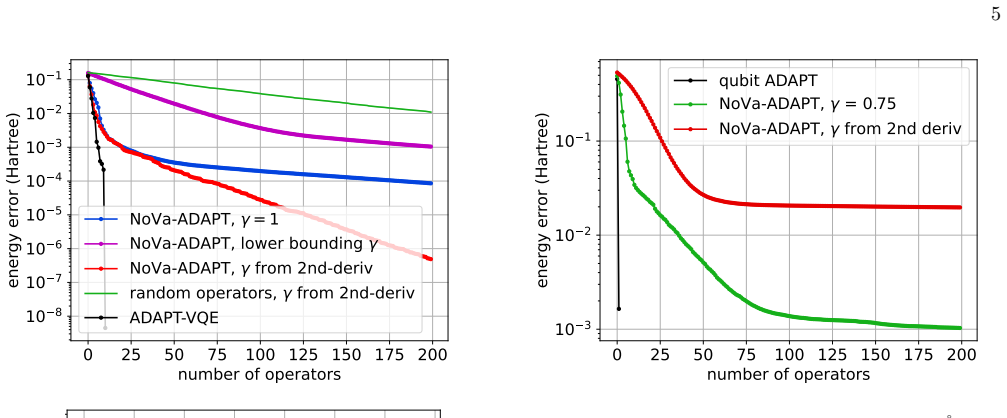
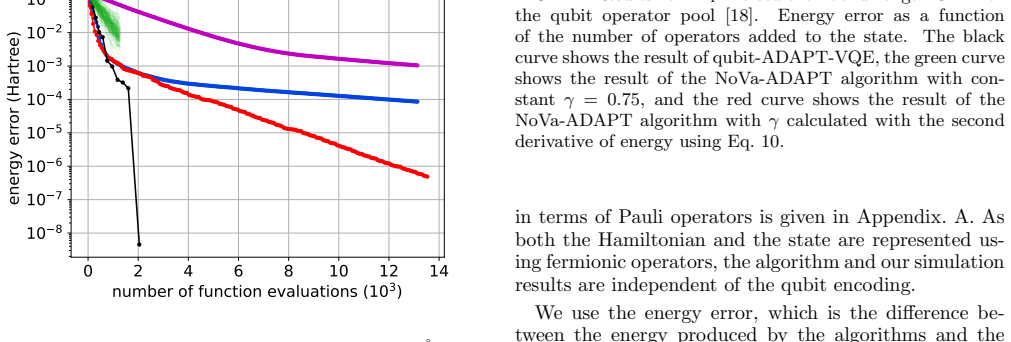
The central claim is that a non-variational version of ADAPT-VQE can match the variational original in measurement cost down to chemical accuracy. Starting from the Hartree–Fock state, the algorithm measures the energy gradients of every operator in the pool, appends the operator with the largest gradient magnitude as $e^{i\eta A}$, and chooses $\eta = -\gamma$ times that gradient. With $\gamma$ taken as a constant, as a descent-lemma lower bound, or as the inverse second derivative, the update lowers the energy at each step without any classical parameter optimization. On the H4 molecule, NoVa-ADAPT uses more operators than ADAPT-VQE but a comparable number of function evaluations to reach chemical accuracy; on a strongly correlated H4 geometry it even escapes the local minimum that traps ADAPT-VQE. The paper presents this as evidence that gradient-based operator selection alone, without a variational subroutine, is sufficient for efficient adaptive ground-state preparation in small molecular systems.
Load-bearing premise
The measurement-cost comparison assumes that estimating the energy and estimating a gradient each cost one function evaluation; if gradient estimates require many more measurement shots than energy estimates, the claimed cost parity between NoVa-ADAPT and ADAPT-VQE could reverse.
Editorial extensions
If this is right
- NoVa-ADAPT reaches chemical accuracy for the H4 molecule with a number of function evaluations comparable to ADAPT-VQE, so the classical optimization subroutine is not essential for this adaptive algorithm's measurement efficiency.
- Because NoVa-ADAPT adds more operators than ADAPT-VQE, its circuits are deeper, so on noisy hardware the savings in optimization must be weighed against increased gate-error exposure.
- The optimization-free update is less sensitive to rotational (parameter) errors, since a range of update sizes still reduce the energy, making it a candidate for devices with imprecise gate control.
- On strongly correlated systems where ADAPT-VQE settles into a local minimum, a constant-step non-variational update can keep lowering the energy and reach chemical accuracy.
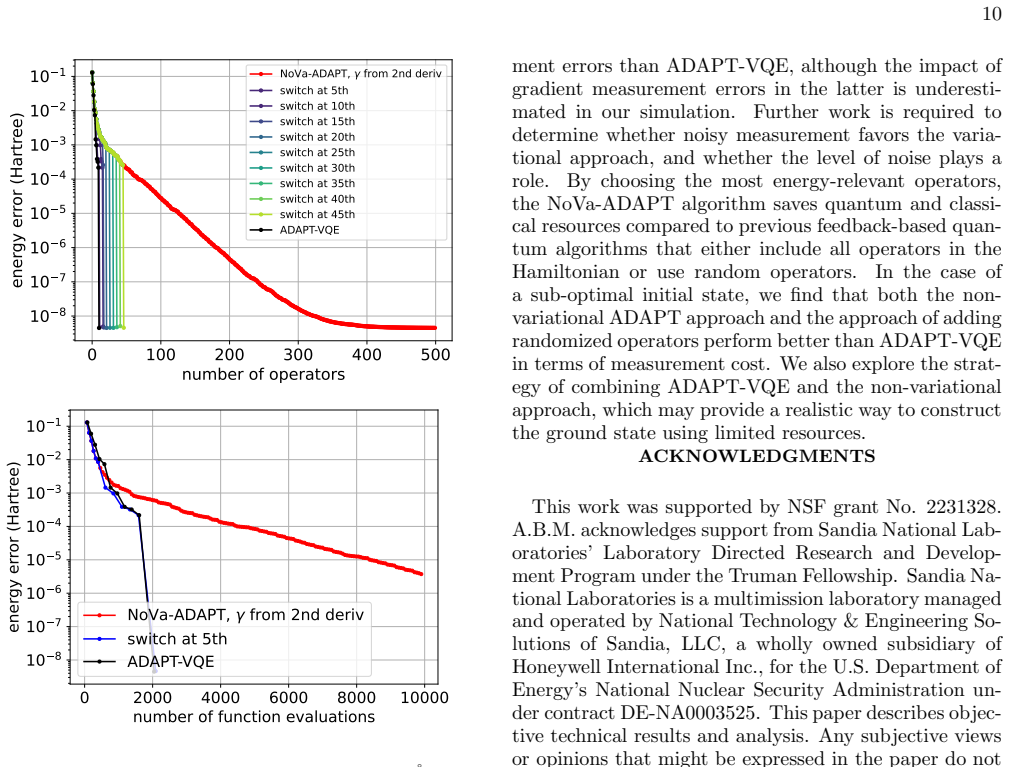
- Starting with a few NoVa-ADAPT iterations and then switching to ADAPT-VQE slightly reduces the measurement cost relative to running ADAPT-VQE alone, suggesting a practical hybrid workflow.
Reading between the lines
- The function-evaluation metric likely understates the true sampling cost of gradient estimates; a shot-level comparison on larger molecules is needed to see whether the parity survives outside the small, noiseless setting.
- The constant-gamma strategy's ability to sidestep a local minimum hints that curvature information (the second-derivative update) guides the path into the trap; a tunable mix of first- and second-order information could give a more robust update rule.
- The same non-variational gradient update could be applied with other operator pools, such as hardware-efficient qubit-ADAPT pools, potentially transferring the measurement-cost result to circuits with different noise characteristics.
- If the predicted robustness to rotational errors holds on real devices, the update rule could be used as a building block inside variational or hybrid algorithms to make parameter optimization less sensitive to control noise.
Editorial analysis
A structured set of objections, weighed in public.
Referee Report
Summary. The manuscript introduces NoVa-ADAPT, a non-variational adaptive quantum state preparation algorithm. At each iteration, the energy gradient with respect to each operator in an ADAPT-style pool is measured; the operator with the largest gradient magnitude is appended, and the rotation parameter is set to a negative multiplicative constant times the measured gradient, avoiding any classical optimization. The paper compares this algorithm with ADAPT-VQE, feedback-based quantum algorithms, and randomized adaptive approaches on an H4 molecule in the STO-3G basis, using the number of operators in the circuit, the number of function evaluations (as a proxy for measurement cost), and energy error relative to exact diagonalization. The main reported findings are that NoVa-ADAPT reaches chemical accuracy with a similar number of function evaluations as ADAPT-VQE despite using more operators, that it can escape a local minimum where ADAPT-VQE gets trapped for a strongly correlated geometry, and that it shows different noise robustness properties. The authors also explore random initial states and a hybrid ADAPT/NoVa scheme.
Significance. If the central cost-parity claim is correct, NoVa-ADAPT is a useful addition to the toolbox of optimization-free adaptive state preparation methods. The paper is notable for directly comparing against several prior feedback-based approaches and for being transparent about the limitations of its noise model. The numerical evidence is limited to H4 (8 qubits) at two geometries, so the generality of the conclusions remains open. The algorithm's basic premise is clearly stated and the results are reproducible in principle from the provided Hamiltonian in Appendix A.
major comments (2)
- [Sec. V, Fig. 1(b); abstract] The claim of 'similar measurement cost to ADAPT-VQE' rests on counting each energy or gradient estimate as one function evaluation. Under this proxy, a full gradient evaluation over the operator pool is treated as a single unit, but Eq. (2) shows that selecting an operator requires estimating i⟨[H,A_i]⟩ for every A_i in the pool, i.e., P separate circuit expectation values for a pool of size P. Because NoVa-ADAPT uses about 100 operators while ADAPT-VQE uses 11 in Fig. 1, the gradient-evaluation bill for NoVa is already ~100P versus ~11P before including ADAPT's BFGS energy evaluations. For a spin-adapted fermionic pool with P~40, this can reverse the apparent parity under shot-level accounting. The authors should either report a shot-level metric (e.g., total number of Pauli expectation-value estimates) or multiply the gradient-evaluation count by the pool size and demonstrate that the conclusion is unchanged.
- [Sec. III, Eq. (10)] Equation (10) for γ* has the wrong sign. Combining Eq. (5), η_n = -γ g with g = ∂E/∂η_n at η_n=0, and the quadratic expansion in Eq. (9), the stationary point with respect to γ is γ* = (∂²E/∂η_n²)^{-1}, not -(...)^{-1} as printed. As written, the formula is inconsistent with Eq. (9). Since the '2nd-deriv' results in Figs. 1, 2, 3, 4, 5, 6, 7, and 8 use γ from this equation, the authors must verify the implementation, correct the equation, and confirm the affected numerical curves.
minor comments (4)
- [Sec. VI, Figs. 6 and 7] The noise model does not inject rotational or gradient errors during the classical optimization steps of ADAPT-VQE, which the text acknowledges underestimates ADAPT-VQE's sensitivity. Please make this caveat more prominent, for example in the figure captions, since the figures otherwise suggest a more definitive robustness comparison than the model supports.
- [Sec. V, Fig. 3] For the random initial state results, the lower panel x-axis is labeled 'number of function evaluations' but the caption describes 'Energy error'; please clarify whether the plotted quantity is energy or energy error, and consider adding error bars or shaded regions for the 100-sample averages.
- [Sec. IV C, Fig. 5] The description of the ACSE comparison would benefit from a sentence stating how the step size ϵ is optimized with BFGS and whether that optimization cost is included in the function-evaluation counts of Fig. 5.
- [Sec. III, Eqs. (7) and (8)] The lower-bounding γ in Eq. (8) is derived from Ref. [36]; the factor 1/4 in Eq. (8) leads to a 1/8 in Eq. (7). Please check that the constants are quoted consistently with the source.
Circularity Check
No circular derivation: NoVa-ADAPT's gate parameters and operator choices are computed from current-state gradient measurements, and the final energies are benchmarked against exact diagonalization.
full rationale
The central claims are benchmark claims, not fitted identities. The update rule in Eqs. (4)-(6) sets eta_n = -gamma times the measured energy gradient, with gamma chosen either as a fixed hyperparameter, as the lower bound in Eq. (8) taken from an external descent lemma, or as a second-derivative estimate in Eq. (10). None of these choices is fitted to the exact ground-state energy that the algorithm is later judged against; the target energies are independent outputs of exact diagonalization. The operator pools and selection rule are adopted from the authors' earlier ADAPT-VQE papers, but those are established algorithmic components with external benchmarks, and the present performance comparison uses the same measured energy-error function for all algorithms rather than importing the conclusion from a citation. The only substantive concern is the paper's function-evaluation accounting in Sec. V, which counts a full-pool gradient estimate as one function evaluation and could undercount NoVa-ADAPT's shot-level measurement cost; that is a metric or accounting limitation, not a circular derivation. I also note that Eq. (10) appears to have a sign error relative to the stationary point of Eq. (9), but an algebraic mistake is not circularity. No circular step can be exhibited from the paper's text and equations.
Assumptions & free parameters
free parameters (1)
- constant gamma step size =
1 for H4 at 1.5 A; 0.75 for H4 at 3 A
assumptions (4)
- standard math The energy derivative of a candidate operator at zero angle equals the commutator expectation value i<[H,A_i]> (Eq. 2).
- domain assumption The descent lemma (Eq. 7) guarantees monotone energy decrease for sufficiently small step sizes and provides a lower-bounding step size (Eq. 8).
- domain assumption The second-order Taylor expansion (Eq. 9) approximates the energy reduction well enough to set the step size gamma* via Eq. 10.
- domain assumption The spin-adapted fermionic operator pool (Eqs. 20-21) contains operators sufficient to reach the ground state while preserving symmetries.
Cite this review
Pith. "Pith review of Non-Variational ADAPT algorithm for quantum simulations." pith.science (2026). https://pith.science/paper/KMJD7MGW
@misc{pith2026241109736,
  author       = {Pith},
  title        = {Pith review of: Non-Variational ADAPT algorithm for quantum simulations},
  year         = {2026},
  howpublished = {\url{https://pith.science/paper/KMJD7MGW}},
  note         = {Machine review of arXiv:2411.09736}
}
read the original abstract
We explore a non-variational quantum state preparation approach combined with the ADAPT operator selection strategy in the application of preparing the ground state of a desired target Hamiltonian. In this algorithm, energy gradient measurements determine both the operators and the gate parameters in the quantum circuit construction. We compare this non-variational algorithm with ADAPT-VQE and with feedback-based quantum algorithms in terms of the rate of energy reduction, the circuit depth, and the measurement cost in molecular simulation. We find that despite using deeper circuits, this new algorithm reaches chemical accuracy at a similar measurement cost to ADAPT-VQE. Since it does not rely on a classical optimization subroutine, it may provide robustness against circuit parameter errors due to imperfect control or gate synthesis.
Figures

Figures from the paper (3 more)


Reference graph
Works this paper leans on
-
[1]
Green curves show the results of constructing the state with operators randomly picked from the pool with γ calculated from the second derivative using Eq. 10, sampled from 100 runs. Magenta curves show the results of the NoVa-ADAPT algorithm with lower bounding γ from Eq. 8. Red curves show the results of the NoVa-ADAPT algorithm with γ calculated from t...
-
[2]
R. P. Feynman, Simulating physics with computers, International Journal of Theoretical Physics 21, 467 (1982)
1982
-
[3]
A. Y. Kitaev, Quantum measurements and the Abelian Stabilizer Problem, arXiv:quant-ph/9511026 (1995)
arXiv 1995
-
[4]
J. D. Whitfield, J. Biamonte, and A. Aspuru-Guzik, Sim- ulation of electronic structure hamiltonians using quan- tum computers, Molecular Physics 109, 735 (2011)
work page 2011
-
[5]
D. S. Abrams and S. Lloyd, Simulation of many-body fermi systems on a universal quantum computer, Phys. Rev. Lett. 79, 2586 (1997)
work page 1997
-
[6]
D. S. Abrams and S. Lloyd, Quantum algorithm provid- ing exponential speed increase for finding eigenvalues and eigenvectors, Phys. Rev. Lett. 83, 5162 (1999)
work page 1999
-
[7]
Preskill, Quantum Computing in the NISQ era and beyond, Quantum 2, 79 (2018)
J. Preskill, Quantum Computing in the NISQ era and beyond, Quantum 2, 79 (2018)
2018
-
[8]
A. Peruzzo, J. McClean, P. Shadbolt, M.-H. Yung, X.-Q. Zhou, P. J. Love, A. Aspuru-Guzik, and J. L. O’Brien, A variational eigenvalue solver on a photonic quantum processor, Nature Communications 5 (2014)
work page 2014
Show all 55 references
-
[9]
Bauer, D
B. Bauer, D. Wecker, A. J. Millis, M. B. Hastings, and M. Troyer, Hybrid quantum-classical approach to corre- lated materials, Phys. Rev. X 6, 031045 (2016)
2016
-
[10]
X. Yuan, S. Endo, Q. Zhao, Y. Li, and S. C. Benjamin, Theory of variational quantum simulation, Quantum 3, 191 (2019)
2019
-
[11]
Motta, C
M. Motta, C. Sun, A. T. Tan, M. J. O’Rourke, E. Ye, A. J. Minnich, F. G. Brandao, and G. K.-L. Chan, De- termining eigenstates and thermal states on a quantum computer using quantum imaginary time evolution, Na- ture Physics 16, 205 (2020)
2020
-
[12]
Gomes, A
N. Gomes, A. Mukherjee, F. Zhang, T. Iadecola, C.-Z. Wang, K.-M. Ho, P. P. Orth, and Y.-X. Yao, Adaptive variational quantum imaginary time evolution approach for ground state preparation, Advanced Quantum Tech- nologies 4, 2100114 (2021)
2021
-
[13]
J. R. McClean, J. Romero, R. Babbush, and A. Aspuru- Guzik, The theory of variational hybrid quantum- classical algorithms, New Journal of Physics 18, 023023 (2016)
2016
-
[14]
J. I. Colless, V. V. Ramasesh, D. Dahlen, M. S. Blok, M. E. Kimchi-Schwartz, J. R. McClean, J. Carter, W. A. de Jong, and I. Siddiqi, Computation of molecular spec- tra on a quantum processor with an error-resilient algo- rithm, Phys. Rev. X 8, 011021 (2018)
2018
-
[15]
Kandala, A
A. Kandala, A. Mezzacapo, K. Temme, M. Takita, M. Brink, J. M. Chow, and J. M. Gambetta, Hardware- efficient variational quantum eigensolver for small molecules and quantum magnets, Nature 549, 242 EP (2017)
2017
-
[16]
Y. Shen, X. Zhang, S. Zhang, J.-N. Zhang, M.-H. Yung, and K. Kim, Quantum implementation of the unitary coupled cluster for simulating molecular electronic struc- ture, Phys. Rev. A 95, 020501 (2017)
2017
-
[17]
Hempel, C
C. Hempel, C. Maier, J. Romero, J. McClean, T. Monz, H. Shen, P. Jurcevic, B. P. Lanyon, P. Love, R. Babbush, A. Aspuru-Guzik, R. Blatt, and C. F. Roos, Quantum chemistry calculations on a trapped-ion quantum simu- lator, Phys. Rev. X 8, 031022 (2018)
2018
-
[18]
H. R. Grimsley, S. E. Economou, E. Barnes, and N. J. Mayhall, An adaptive variational algorithm for exact molecular simulations on a quantum computer, Nature Communications 10, 3007 (2019)
2019
-
[19]
H. L. Tang, V. Shkolnikov, G. S. Barron, H. R. Grim- sley, N. J. Mayhall, E. Barnes, and S. E. Economou, Qubit-adapt-vqe: An adaptive algorithm for construct- ing hardware-efficient ans¨ atze on a quantum processor, PRX Quantum 2, 020310 (2021)
2021
-
[20]
P. G. Anastasiou, Y. Chen, N. J. Mayhall, E. Barnes, and S. E. Economou, Tetris-adapt-vqe: An adaptive algo- rithm that yields shallower, denser circuit ans¨ atze (2022), arXiv:2209.10562 [quant-ph]
2022 arXiv
-
[21]
Chen, H.-Y
C.-F. Chen, H.-Y. Huang, J. Preskill, and L. Zhou, Local minima in quantum systems, arXiv e-prints , arXiv:2309.16596 (2023), arXiv:2309.16596 [quant-ph]
2023 arXiv
-
[22]
Bittel and M
L. Bittel and M. Kliesch, Training variational quantum algorithms is np-hard, Phys. Rev. Lett. 127, 120502 (2021)
2021
-
[23]
D. A. Mazziotti, Anti-hermitian contracted schr¨ odinger equation: Direct determination of the two-electron re- duced density matrices of many-electron molecules, Phys. Rev. Lett. 97, 143002 (2006)
2006
-
[24]
A. B. Magann, K. M. Rudinger, M. D. Grace, and M. Sarovar, Feedback-based quantum optimization, Phys. Rev. Lett. 129, 250502 (2022)
2022
-
[25]
A. B. Magann, K. M. Rudinger, M. D. Grace, and M. Sarovar, Lyapunov-control-inspired strategies for quantum combinatorial optimization, Phys. Rev. A 106, 062414 (2022)
2022
-
[26]
Abdul Rahman, H
S. Abdul Rahman, H. G. Clausen, ¨O. Karabacak, and R. Wisniewski, Adaptive sampling noise mitiga- tion technique for feedback-based quantum algorithms, in International Conference on Computational Science (Springer, 2024) pp. 321–329
2024
-
[27]
G. Pexe, L. Rattighieri, A. Malvezzi, and F. Fanchini, Us- ing a feedback-based quantum algorithm to analyze the critical properties of the annni model without classical optimization, arXiv preprint arXiv:2406.17937 (2024)
2024 arXiv
-
[28]
S. A. Rahman, ¨O. Karabacak, and R. Wisniewski, Feedback-based quantum algorithm for constrained op- timization problems, arXiv preprint arXiv:2406.08169 (2024)
2024 arXiv
-
[29]
S. A. Rahman, ¨O. Karabacak, and R. Wisniewski, Feedback-based quantum algorithm for excited states cal- culation, arXiv preprint arXiv:2404.04620 (2024)
2024
-
[30]
R. K. Malla, H. Sukeno, H. Yu, T.-C. Wei, A. Weichsel- baum, and R. M. Konik, Feedback-based quantum algo- rithm inspired by counterdiabatic driving, arXiv preprint arXiv:2401.15303 (2024)
2024 arXiv
-
[31]
D. Arai, K. N. Okada, Y. Nakano, K. Mitarai, and K. Fu- jii, Scalable circuit depth reduction in feedback-based quantum optimization with a quadratic approximation, arXiv preprint arXiv:2407.17810 (2024)
2024 arXiv
-
[32]
L. T. Brady and S. Hadfield, Focqs: Feedback optimally controlled quantum states (2024), arXiv:2409.15426 [quant-ph]
2024 arXiv
-
[33]
Chandarana, K
P. Chandarana, K. Paul, K. R. Swain, X. Chen, and A. del Campo, Lyapunov controlled counterdiabatic quantum optimization (2024), arXiv:2409.12525 [quant- ph]
2024 arXiv
-
[34]
J. B. Larsen, M. D. Grace, A. D. Baczewski, and A. B. 13 Magann, Feedback-based quantum algorithms for ground state preparation, Phys. Rev. Res. 6, 033336 (2024)
2024
-
[35]
SCHULTE-HERBR ¨UGGEN, S
T. SCHULTE-HERBR ¨UGGEN, S. J. GLASER, G. DIRR, and U. HELMKE, Gradient flows for op- timization in quantum information and quantum dynamics: Foundations and applications, Reviews in Mathematical Physics 22, 597 (2010)
2010
-
[36]
Wiersema and N
R. Wiersema and N. Killoran, Optimizing quantum cir- cuits with riemannian gradient flow, Phys. Rev. A 107, 062421 (2023)
2023
-
[37]
A. B. Magann, S. E. Economou, and C. Arenz, Ran- domized adaptive quantum state preparation, Physical Review Research 5, 10.1103/physrevresearch.5.033227 (2023)
2023 doi
-
[38]
Malvetti, C
E. Malvetti, C. Arenz, G. Dirr, and T. Schulte- Herbr¨ uggen, Randomized Gradient Descents on Rieman- nian Manifolds: Almost Sure Convergence to Global Minima in and beyond Quantum Optimization, arXiv e-prints , arXiv:2405.12039 (2024), arXiv:2405.12039 [math.OC]
2024 arXiv
-
[39]
V. O. Shkolnikov, N. J. Mayhall, S. E. Economou, and E. Barnes, Avoiding symmetry roadblocks and minimiz- ing the measurement overhead of adaptive variational quantum eigensolvers, Quantum 7, 1040 (2023)
2023
-
[40]
L. W. Bertels, H. R. Grimsley, S. E. Economou, E. Barnes, and N. J. Mayhall, Symmetry breaking slows convergence of the adapt variational quantum eigen- solver, Journal of Chemical Theory and Computation18, 6656 (2022), pMID: 36239978
2022
-
[41]
Warren, L
A. Warren, L. Zhu, N. J. Mayhall, E. Barnes, and S. E. Economou, Adaptive variational algorithms for quantum Gibbs state preparation, arXiv e-prints , arXiv:2203.12757 (2022), arXiv:2203.12757 [quant-ph]
2022 arXiv
-
[42]
A. M. Romero, J. Engel, H. L. Tang, and S. E. Economou, Solving nuclear structure problems with the adaptive variational quantum algorithm, Phys. Rev. C 105, 064317 (2022)
2022
-
[43]
Grimsley, G
H. Grimsley, G. Barron, E. Barnes, S. Economou, and N. Mayhall, Adaptive, problem-tailored variational quan- tum eigensolver mitigates rough parameter landscapes and barren plateaus, npj Quantum Inf 9, 19 (2023)
2023
-
[44]
C. K. Long, K. Dalton, C. H. W. Barnes, D. R. M. Arvidsson-Shukur, and N. Mertig, Layering and sub- pool exploration for adaptive variational quantum eigen- solvers: Reducing circuit depth, runtime, and suscepti- bility to noise, Phys. Rev. A 109, 042413 (2024)
2024
-
[45]
J. S. Van Dyke, K. Shirali, G. S. Barron, N. J. Mayhall, E. Barnes, and S. E. Economou, Scaling adaptive quan- tum simulation algorithms via operator pool tiling, Phys. Rev. Res. 6, L012030 (2024)
2024
-
[46]
Ramˆ oa, L
M. Ramˆ oa, L. P. Santos, N. J. Mayhall, E. Barnes, and S. E. Economou, Reducing measurement costs by recycling the Hessian in adaptive variational quantum algorithms, arXiv e-prints , arXiv:2401.05172 (2024), arXiv:2401.05172 [quant-ph]
2024 arXiv
-
[47]
Ramˆ oa, P
M. Ramˆ oa, P. G. Anastasiou, L. P. Santos, N. J. Mayhall, E. Barnes, and S. E. Economou, Reducing the Resources Required by ADAPT-VQE Using Coupled Exchange Operators and Improved Subroutines, arXiv e-prints , arXiv:2407.08696 (2024), arXiv:2407.08696 [quant-ph]
2024 arXiv
-
[48]
R. C. Farrell, M. Illa, A. N. Ciavarella, and M. J. Savage, Scalable circuits for preparing ground states on digital quantum computers: The schwinger model vacuum on 100 qubits, PRX Quantum 5, 020315 (2024)
2024
-
[49]
Beck, First-Order Methods in Opti- mization (Society for Industrial and Ap- plied Mathematics, Philadelphia, PA, 2017) https://epubs.siam.org/doi/pdf/10.1137/1.9781611974997
A. Beck, First-Order Methods in Opti- mization (Society for Industrial and Ap- plied Mathematics, Philadelphia, PA, 2017) https://epubs.siam.org/doi/pdf/10.1137/1.9781611974997
2017 doi
-
[50]
S. E. Smart and D. A. Mazziotti, Quantum solver of con- tracted eigenvalue equations for scalable molecular simu- lations on quantum computing devices, Phys. Rev. Lett. 126, 070504 (2021)
2021
-
[51]
Nakata, C
Y. Nakata, C. Hirche, C. Morgan, and A. Winter, Uni- tary 2-designs from random x- and z-diagonal unitaries, Journal of Mathematical Physics 58, 10.1063/1.4983266 (2017)
2017 doi
-
[52]
J.-N. Boyn, A. O. Lykhin, S. E. Smart, L. Gagliardi, and D. A. Mazziotti, Quantum-classical hybrid algorithm for the simulation of all-electron correlation, The Journal of Chemical Physics 155, 244106 (2021)
2021
-
[53]
A. Y. Kitaev, Quantum computations: algorithms and error correction, Russ. Math. Surv. 52, 1191 (1997)
1997
-
[54]
C. M. Dawson and M. A. Nielsen, The solovay-kitaev algorithm, Quantum Info. Comput. 6, 81–95 (2006)
2006
-
[55]
N. J. Ross and P. Selinger, Optimal ancilla-free clifford+t approximation of z-rotations, Quantum Info. Comput. 16, 901–953 (2016)
2016
Reviewed August 12, 2026 · model on record in the stance chip above.
Discussion (0). Continue with ORCID to comment.