REVIEW 4 major objections 3 minor 1 cited by
Does the stability of f(R) theories imply the stability of the dual scalar-tensor theory ?
T0 review · 4 major / 3 minor · reviewed 2026-08-12 · deepseek-v4-flash
Pith's one-line read The paper argues that Ostrogradsky instability in f(R) gravity appears exactly as instability of the dual scalar-tensor potential: for polynomial f(R), stability holds only for even powers with positive coefficients.
desk verdict A clean re-derivation of known f(R) stability conditions for polynomial models, but the claimed one-to-one correspondence is undercut by the cuspy minimum for even n>2 and by overgeneralization beyond the cases actually checked. read the letter →
The pith
A machine-rendered reading of the paper's core claim, the machinery that carries it, and where it could break.
The reading
What carries the argument
The central object is the Einstein-frame scalar potential $V(\sigma)$ obtained from the auxiliary-field action by a conformal transformation, with the scalar defined through $f'(R)=e^{(2-d)\sigma/2}$. The two load-bearing conditions are $f'(R)>0$, which keeps the scalar kinetic term in the correct sign, and positivity of $f''(R)$, which is equivalent to the even-power/positive-coefficient conditions for the polynomial models. The extrema of $V$ are located by $A f'(A)=2f(A)$, and the minimum condition involves the sign of $f''(A)$ at the extremum.
What would settle it
Take $f(R)=R+\alpha R^4$ with $\alpha>0$. Near $\sigma=0$ the potential behaves as $V(\sigma)\sim|\sigma|^{4/3}$, so $V''(0)$ diverges; solving the perturbed scalar equation around $\sigma=0$, or computing the fluctuation determinant, would show whether small fluctuations have well-defined frequencies. If those fluctuations are ill-defined or grow, the classification of this model as stable would be overturned.
Extended reading notes
Core claim
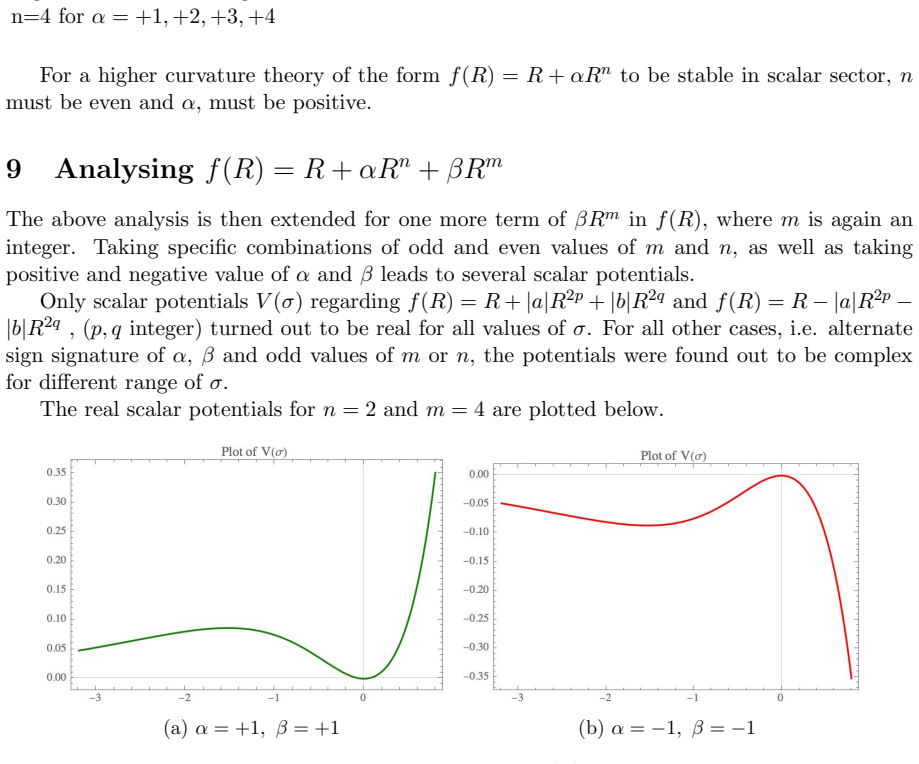
Starting from the auxiliary-field form of the f(R) action and the conformal transformation $g_{\mu\nu}\to e^{\sigma}g_{\mu\nu}$, the paper derives the Einstein-frame potential $$V(\$\sigma$)=\frac{f'(A)A-f(A)}{(f'(A))^{d/(d-2)}},$$ with $f'(A)=e^{-\sigma}$ in four dimensions, and takes stability of the dual theory to mean $V$ is real, bounded below, and has at least one minimum. For $f(R)=R+\alpha R^n$, the derived potential is imaginary for odd $n$, and for even $n$ it has a minimum at $\sigma=0$ only when $\alpha>0$, whereas negative $\alpha$ makes it unbounded below. The two-term extension $R+\alpha R^n+\beta R^m$ is stable in the scalar sector only when both exponents are even and both coefficients are positive. Since these are exactly the cases in which $f''(R)>0$ everywhere, with $f'(R)>0$ ensured by the conformal choice, the paper concludes a one-to-one correspondence between scalar-sector instability and Ostrogradsky instability.
Load-bearing premise
The argument equates stability of the scalar-tensor dual with three properties of the potential — real-valued, bounded below, and having at least one minimum — and for even $n>2$ the minimum at $\sigma=0$ is a cusp ($V\propto|\sigma|^{4/3}$), so the paper assumes this cuspy minimum can serve as a stable vacuum without analyzing perturbations around it.
Editorial extensions
If this is right
- For polynomial f(R) models, checking the Einstein-frame scalar potential is equivalent to checking $f'(R)>0$ and $f''(R)>0$.
- The Starobinsky model $R+\alpha R^2$ is stable for positive $\alpha$ and unstable for negative $\alpha$, matching the scalar-potential analysis.
- Models with odd powers of $R$ or negative coefficients are excluded as stable by both the scalar-sector criterion and the $f''(R)>0$ condition.
- For two-term models $R+\alpha R^n+\beta R^m$, stability requires both exponents even and both coefficients positive.
- The correspondence offers a shortcut: stability of a polynomial f(R) gravity can be assessed from the shape of the dual scalar potential without analyzing higher-derivative equations directly.
Reading between the lines
- Applied beyond polynomials, the paper's criterion would predict that any f(R) whose Taylor expansion contains only even powers beyond $R$ with positive coefficients is stable; this is a testable extension but not proven here.
- For even $n>2$ and $\alpha>0$, the minimum of $V(\sigma)$ at $\sigma=0$ is a cusp with $V\propto|\sigma|^{4/3}$, so cosmological perturbation theory around that vacuum may require a non-standard treatment that the paper does not provide.
- The demonstrated one-to-one correspondence holds for polynomial f(R) with integer powers; for non-integer powers or functions where $f'(R)$ vanishes somewhere, the conformal mapping breaks down and the correspondence may fail.
Signed reviews
Editorial analysis
A structured set of objections, weighed in public.
Referee Report
Summary. The paper rewrites f(R) gravity in the Einstein frame via a conformal transformation, obtaining a scalar-tensor action with potential V(σ)=(f'(A)A-f(A))/(f'(A))^{d/(d-2)}. It proposes that the f(R) theory is stable if the dual scalar potential is real, bounded below, and has at least one minimum, and that the sign of the scalar kinetic term rules out f'(R)<0. The authors then analyze f(R)=R+αR^n and f(R)=R+αR^n+βR^m for integer powers, using plots and parametric examples, and conclude that scalar-sector stability requires even powers and positive coefficients. This is summarized as a one-to-one correspondence between scalar instability and Ostrogradsky instability. The central claim is therefore that checking the Einstein-frame potential is equivalent to checking f'(R)>0 and f''(R)>0 for these polynomial models.
Significance. If established, the intended result would be practically useful: it would give a quick stability diagnostic for polynomial f(R) models and would explicitly connect the conformal-frame scalar potential with the standard no-ghost/no-tachyon conditions. The paper does derive the potential and the extremum conditions (Eqs. (20)-(21)) in the right direction, and the suggestion that odd powers or negative coefficients lead to instability is plausible for the families considered. However, the manuscript currently does not provide a sufficiently rigorous stability criterion: the cuspy minima for even n>2 are not analyzed perturbatively, and the claimed general equivalence goes beyond what is proved. There is also a printed sign error in Eq. (19) and an apparent sign typo in Eq. (22). These issues prevent acceptance in the present form.
major comments (4)
- [§3, Eq. (19)] Equation (19) contains a sign error. From V=(f'A-f)/(f')^2, the derivative with respect to f' is dV/df' = -A/(f')^2 + 2f/(f')^3, not A/(f')^2 + 2f/(f')^3. With the printed sign, setting dV/dσ=0 would give Af'=-2f, contradicting Eq. (20). The correct derivative restores Eq. (20) and Eq. (21), so the final conditions survive, but the displayed equation and the immediately preceding chain-rule step must be corrected.
- [§3 and §7] The stability criterion in Section 3—real, bounded below, at least one minimum—is too weak for the central claim. For f(R)=R+αR^n with even n>2 and α>0 (Section 7.1, Eq. (30) for n=4), the conformal relation f'=e^{-σ} gives R∝(e^{-σ}-1)^{1/(n-1)}, whose derivative diverges at σ=0; consequently V(σ) behaves as |σ|^{n/(n-1)} near the claimed minimum, is C^1 but not C^2, V'' diverges, and linearized scalar perturbations are ill-defined. The paper supplies no nonlinear perturbation or stability analysis, so the classification of these models as stable is not established. Additionally, at R=0 one has f''(0)=0 for these models, so the asserted equivalence with the standard condition f''>0 is not demonstrated; Section 10's statement that f'' is 'positive for any integer p or any value of R' is inaccurate (it is non-negative, vanishing at R=0 for p>1).
- [§8 and §10] The final one-to-one correspondence is stated for 'higher curvature theories' in general, but Sections 4-9 establish at most a classification for the two polynomial families R+αR^n and R+αR^n+βR^m with integer n,m. Section 9 says that higher powers and arbitrary α,β were 'checked' without showing the analysis, and no general argument is provided. Either the conclusion should be restricted to the polynomial families with a complete proof for all n,m, or the general claim should be supported by an explicit argument.
- [§2, Eq. (14)] For f'(R)<0, Eq. (14) flips the sign of both the Ricci term and the scalar kinetic term. The paper concludes instability solely from the sign of the scalar kinetic term, but the wrong-sign R term itself indicates a ghost in the gravitational sector. The necessity of f'(R)>0 should be argued more carefully, since inspecting the kinetic term in an action whose gravitational part is non-standard is not a complete stability test.
minor comments (3)
- [§4, Eq. (22)] In Eq. (22), the factor e^{-σ d/2} appears to be a typo; from Eq. (10) and f'=e^{(2-d)σ/2} the prefactor should be e^{+σ d/2}. For d=4 this gives e^{2σ}, which is the factor used in Eqs. (23)-(31).
- [Throughout] The spelling 'Ostragadsky' should be 'Ostrogradsky', and headings such as 'Stablility analysis' should be corrected to 'Stability analysis'. There are also minor grammatical slips ('It there any one to one correspondence?', 'minima' used as singular).
- [§11, Eq. (32)] The stress-energy tensor in Eq. (32) has an incorrect index structure: the second term should be -(1/2)g_{αβ}(∇^μφ∇_μφ+V(φ)), not g_{αβ}(∇^μ∇_μ+V(φ)).
Circularity Check
No significant circularity: the scalar-tensor potential is derived by standard conformal transformation and the stability comparison is an independent result.
full rationale
The paper derives the Einstein-frame scalar-tensor action from the f(R) action via the standard conformal transformation (Eqs. 5-10). The scalar potential V(σ) is computed directly from f(R) for the polynomial models, and scalar-sector stability is judged by the properties of V(σ) (real, bounded below, at least one minimum) without imposing f''(R)>0. The equivalence with the Ostrogradsky conditions f'(R)>0 and f''(R)>0 emerges only in Section 10, after the stability analysis of the potential. No parameter is fitted, no prediction is a renamed input, and the paper cites no self-work for load-bearing claims. The main concerns are non-circular: for even n>2 and α>0 the minimum of V(σ) is a cusp with divergent V'', so perturbative stability is not established; and the final 'one-to-one' claim generalizes from finitely many polynomial examples to all higher curvature theories. These are correctness/scope gaps, not circular reasoning.
Assumptions & free parameters
assumptions (5)
- standard math Standard conformal transformation formulas for the metric, Ricci scalar, and measure in d dimensions (Eqs 5-7).
- standard math The f(R) action is classically equivalent to the auxiliary-field action (4).
- domain assumption Stability of the scalar-tensor dual is defined by V(σ) being real for all real σ, having at least one minimum, and being bounded below.
- domain assumption The analysis is restricted to polynomial f(R)=R+αR^n and R+αR^n+βR^m with integer n,m.
- ad hoc to paper For f'(R)<0, the sign of the scalar kinetic term in Eq (14) alone determines instability, while the flipped sign of the Ricci term is not treated.
Cite this review
Pith. "Pith review of Does the stability of f(R) theories imply the stability of the dual scalar-tensor theory ?." pith.science (2026). https://pith.science/paper/QWX6ZUQN
@misc{pith2026241109992,
  author       = {Pith},
  title        = {Pith review of: Does the stability of f(R) theories imply the stability of the dual scalar-tensor theory ?},
  year         = {2026},
  howpublished = {\url{https://pith.science/paper/QWX6ZUQN}},
  note         = {Machine review of arXiv:2411.09992}
}
abstract
Higher curvature f(R) gravity theories are often plagued with Ostragadsky instability. In this work we show that such instability manifests itself in the corresponding dual scalar tensor theory in the scalar sector Lagrangian. We explicitly demonstrate the correspondence between the instabilities that appear in an $f(R)$ model and its corresponding scalar tensor theory. Considering various forms of f(R) gravity this feature is illustrated for different choices of the parameters of the theory.
Figures


Figures from the paper (3 more)


Forward citations
Cited by 1 Pith paper
-
Investigating the effects of gravitational lensing by Hu-Sawicki $\boldsymbol{f(R)}$ gravity black holes
For Hu-Sawicki f(R) black holes, the paper claims smaller critical impact parameters and negative deflection at large impact parameters than Schwarzschild, plus observables for Sgr A* and M87*, but the strong-lensing ...
Reference graph
Works this paper leans on
-
[1]
General covariance and the foundations of general relativity: eight decades of dispute
John D Norton. General covariance and the foundations of general relativity: eight decades of dispute. Reports on progress in physics, 56(7):791, 1993
work page 1993
-
[2]
Salvatore Capozziello and Mariafelicia De Laurentis. Extended theories of gravity. Physics Reports, 509(4-5):167–321, 2011
work page 2011
-
[3]
f (r) theories of gravity.Reviews of Modern Physics, 82(1):451–497, 2010
Thomas P Sotiriou and Valerio Faraoni. f (r) theories of gravity.Reviews of Modern Physics, 82(1):451–497, 2010
work page 2010
-
[4]
Introduction to modified gravity and gravitational alternative for dark energy
Shin’Ichi Nojiri and Sergei D Odintsov. Introduction to modified gravity and gravitational alternative for dark energy. International Journal of Geometric Methods in Modern Physics, 4(01):115–145, 2007
work page 2007
-
[5]
6+ 1 lessons from f (r) gravity
Thomas P Sotiriou. 6+ 1 lessons from f (r) gravity. In Journal of Physics: Conference Series, volume 189, page 012039. IOP Publishing, 2009
work page 2009
-
[6]
Investigating f (r) gravity and cosmologies
Vaibhav Kalvakota. Investigating f (r) gravity and cosmologies. 2021
work page 2021
-
[7]
Linearized f (r) gravity: gravitational radiation and solar system tests
Christopher PL Berry and Jonathan R Gair. Linearized f (r) gravity: gravitational radiation and solar system tests. Physical Review D—Particles, Fields, Gravitation, and Cosmology, 83(10):104022, 2011
work page 2011
-
[8]
A new type of isotropic cosmological models without singularity
Alexei A Starobinsky. A new type of isotropic cosmological models without singularity. Physics Letters B, 91(1):99–102, 1980
1980
Show all 19 references
-
[9]
Unified cosmic history in modified gravity: from f (r) theory to lorentz non-invariant models
Shin’ichi Nojiri and Sergei D Odintsov. Unified cosmic history in modified gravity: from f (r) theory to lorentz non-invariant models. Physics Reports, 505(2-4):59–144, 2011
2011
-
[10]
The theorem of ostrogradsky
Richard P Woodard. The theorem of ostrogradsky. arXiv preprint arXiv:1506.02210, 2015
2015 arXiv
-
[11]
The scalar-tensor theory of gravitation
Yasunori Fujii and Kei-ichi Maeda. The scalar-tensor theory of gravitation. Cambridge University Press, 2003
2003
-
[12]
Modified gravity with negative and positive pow- ers of curvature: Unification of inflation and cosmic acceleration
Shin’ichi Nojiri and Sergei D Odintsov. Modified gravity with negative and positive pow- ers of curvature: Unification of inflation and cosmic acceleration. physical Review D, 68(12):123512, 2003. 11
2003
-
[13]
The conformal frame freedom in theories of gravitation
Eanna E Flanagan. The conformal frame freedom in theories of gravitation. Classical and Quantum Gravity, 21(15):3817, 2004
2004
-
[14]
Conformal transformations and conformal invariance in gravitation
Mariusz P Dabrowski, Janusz Garecki, and David B Blaschke. Conformal transformations and conformal invariance in gravitation. Annalen der Physik, 521(1):13–32, 2009
2009
-
[15]
Spectrum of relict gravitational radiation and the early state of the universe
AA Starobinskii. Spectrum of relict gravitational radiation and the early state of the universe. JETP Letters, 30(11):682–685, 1979
1979
-
[16]
Classical and quantum cosmology of the starobinsky inflationary model
Alexander Vilenkin. Classical and quantum cosmology of the starobinsky inflationary model. Physical Review D, 32(10):2511, 1985
1985
-
[17]
Dark matter from r 2 gravity
Jose AR Cembranos. Dark matter from r 2 gravity. Physical review letters, 102(14):141301, 2009
2009
-
[18]
The perturbation spectrum evolving from a nonsingular initially de-sitter cosmology and the microwave background anisotropy
Alexei A Starobinskii. The perturbation spectrum evolving from a nonsingular initially de-sitter cosmology and the microwave background anisotropy. Soviet Astronomy Letters, vol. 9, Sept.-Oct. 1983, p. 302-304. Translation Pisma v Astronomicheskii Zhurnal, vol. 9, Oct. 1983, p...
1983
-
[19]
Ostrogradsky in theories with multiple fields.Journal of Cosmology and Astroparticle Physics, 2016(06):041, 2016
Claudia De Rham and Andrew Matas. Ostrogradsky in theories with multiple fields.Journal of Cosmology and Astroparticle Physics, 2016(06):041, 2016. 12
2016
Reviewed August 12, 2026 · model on record in the stance chip above.
Discussion (0). Continue with ORCID to comment.