REVIEW 3 major objections 4 minor 53 references
Compatibility between $e^+e^-$ and $\tau$ decay data in the di-pion channel and implications for $a_\mu^\mathrm{SM}$ and CVC tests
T0 review · 3 major / 4 minor · reviewed 2026-08-12 · deepseek-v4-flash
Pith's one-line read The isospin-breaking corrections linking $e^+e^-$ and tau di-pion data are under control, so tau decays can serve as a competitive input for the muon g-2, with a 2.7 sigma gap between experiment and the Standard Model.
desk verdict Useful proceedings summary of tau-based IB corrections with CMD-3, but the 'under control' claim rests on a model-selection choice that may be too narrow. read the letter →
The pith
A machine-rendered reading of the paper's core claim, the machinery that carries it, and where it could break.
The reading
What carries the argument
The central object is the isospin-breaking factor $R_{IB}(s)=[FSR(s)/G_{EM}(s)]\,[\beta^3_{\pi^+\pi^-}(s)/\beta^3_{\pi^+\pi^0}(s)]\,|F_V(s)/f_+(s)|^2$, used together with the short-distance electroweak correction $S_{EW}$ to convert tau spectra into $e^+e^-$ cross-sections. The paper concentrates on the last factor, the ratio of the neutral (electromagnetic) and charged (weak) pion form factors, where $\rho$–$\omega$ mixing and the neutral/charged $\rho$ mass and width differences enter. It evaluates this ratio with five parametrizations, takes Gounaris–Sakurai and a dispersive representation (with a conformal polynomial) as reference, and adds their difference linearly as a systematic uncertainty.
What would settle it
A sub-percent lattice QCD determination of $|F_V(s)/f_+(s)|^2$ over the $\rho$-resonance region that deviates from the dispersive input by more than the quoted GS-versus-dispersive spread would falsify the claim that the isospin-breaking corrections are under control.
Extended reading notes
Core claim
The authors revisit the isospin-breaking (IB) corrections relating $\sigma(e^+e^- \to \pi^+\pi^-)$ to the $\tau^- \to \pi^-\pi^0\nu_\tau$ spectrum, focusing on the ratio of the neutral electromagnetic form factor $F_V(s)$ to the charged weak form factor $f_+(s)$. They compare several parametrizations (Gounaris–Sakurai, Kühn–Santamaría, Guerrero–Pich, Seed, and a dispersive one) and, based on fits to data and analyticity tests, adopt the dispersive result as reference with the GS difference added linearly as a systematic. Their main results are $\Delta B^{\pi\pi}_{CVC} = (+0.63^{+0.09}_{-0.08})\times 10^{-2}$ and $\Delta a^{had,LO}_\mu[\pi\pi,\tau] = (-15.15^{+2.37}_{-2.90})\times 10^{-10}$, which translate into $\Delta a_\mu \equiv a^{exp}_\mu - a^{SM}_\mu = (14.8^{+5.1}_{-5.4})\times 10^{-10}$, a $2.7\sigma$ difference. They conclude that the IB corrections are reliable, supporting the use of tau data in updated SM predictions of $a_\mu$ and in precision CVC tests.
Load-bearing premise
The conclusion rests on the assumption that the difference between the Gounaris–Sakurai and dispersive parametrizations of the pion form factor ratio spans the true model uncertainty in $|F_V(s)/f_+(s)|^2$, so that no bias larger than this spread hides in the correction.
Editorial extensions
If this is right
- Tau-based determinations of $a_\mu^{HVP}$ can now be included in the Standard Model average, providing an independent cross-check on $e^+e^-$ data that are internally inconsistent.
- The CVC relation between tau and $e^+e^-$ di-pion spectra can be tested at the $\sim 0.1\%$ level once more precise tau spectral functions become available.
- The residual $\Delta a_\mu = (14.8^{+5.1}_{-5.4})\times 10^{-10}$, a $2.7\sigma$ gap, is consistent with tau-based HVP predictions and suggests the KLOE-versus-CMD-3 disagreement in $e^+e^-$ data is the main driver of the earlier larger discrepancy.
- A future high-statistics tau spectral function measurement would directly map onto the same pion form factor and can arbitrate between the competing $e^+e^-$ datasets.
- The same machinery can be extended to other exclusive hadronic channels to further test CVC and reduce the uncertainty on the hadronic vacuum polarization.
Reading between the lines
- If the corrections are truly under control, the unresolved KLOE-versus-CMD-3 discrepancy in $e^+e^-$ data becomes the dominant systematic in the data-driven $a_\mu$ determination, shifting experimental priorities toward resolving that measurement conflict.
- The GS-versus-dispersive spread may underestimate model uncertainty if both parametrizations share a common bias (for example in $G_{EM}$ or the $\rho$–$\omega$ interference); a third independent determination, such as a lattice calculation of the form factor ratio, would test this.
- A differential measurement of tau and $e^+e^-$ spectra could extract $|F_V(s)/f_+(s)|^2$ empirically at each $s$, validating the correction factor locally rather than only through integrated branching fractions.
- Should the future $e^+e^-$ average be dominated by CMD-3-like data, the tau and $e^+e^-$ based values of $a_\mu^{HVP}$ may agree within $1\sigma$, which would recast the muon $g-2$ discrepancy as primarily an experimental data tension rather than a sign of new physics.
Editorial analysis
A structured set of objections, weighed in public.
Referee Report
Summary. This proceedings paper revisits the isospin-breaking (IB) corrections that relate the e+e- -> pi+ pi- cross section and the tau- -> pi- pi0 nu_tau decay spectrum, focusing on the ratio |F_V/f_+|^2 of the neutral and charged pion form factors. The author evaluates five form-factor parametrizations (GS, KS, GP, Seed, dispersive), selects GS and the dispersive result as reference, and adds the GS-versus-dispersive difference linearly as a model systematic. The main outputs are the IB corrections to the CVC prediction for B(tau -> pi pi nu_tau), Delta B_CVC^{pi pi} = (+0.63^{+0.09}_{-0.08}) x 10^-2, and to the tau-data-based hadronic vacuum polarization contribution, Delta a_mu^{HVP,LO}[pi pi, tau] = (-15.15^{+2.37}_{-2.90}) x 10^-10, implying a_mu^exp - a_mu^SM = (14.8^{+5.1}_{-5.4}) x 10^-10, a 2.7 sigma difference. The paper concludes that the IB uncertainty is under control and that tau data can be used for precision CVC tests and for the SM prediction of a_mu.
Significance. If the central claim holds, the paper provides a timely tau-data-based cross-check of the hadronic vacuum polarization contribution to the muon anomalous magnetic moment, particularly relevant after the CMD-3 measurement. The author should be credited for computing the IB corrections separately for five different form-factor parameterizations, for splitting the correction into individual physical sources, and for comparing explicitly with the recent literature (Refs. [19,22]). The result is presented with asymmetric uncertainties and the preferred reference is defined transparently. However, the significance of the paper is conditional on the model-selection criterion and on the validation deferred to the companion paper Ref. [1]; these are the load-bearing points for the quoted uncertainties and for the 2.7 sigma conclusion.
major comments (3)
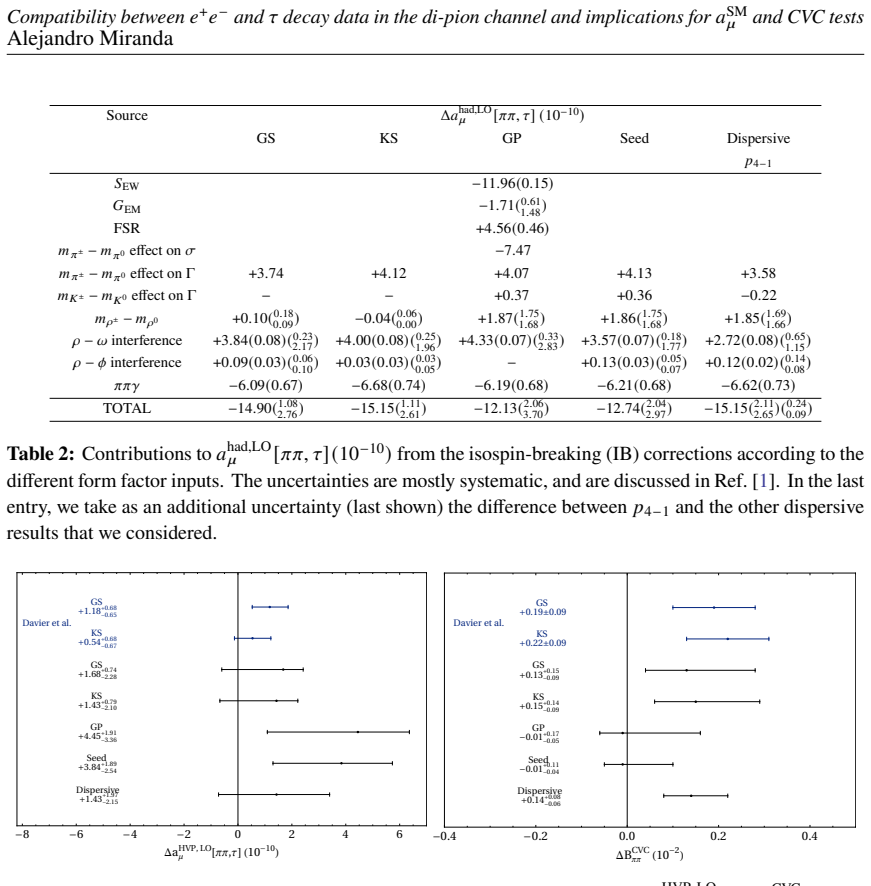
- [Section 4, Table 2] The quoted central result for Delta a_mu^{HVP,LO}[pi pi, tau] uses the Dispersive p4-1 value as reference and adds linearly only its difference from the GS value. However, Table 2 also lists GP and Seed totals of -12.13 and -12.74, which differ from the reference -15.15 by +3.02 and +2.41 (in units of 10^-10), respectively; both exceed the quoted +2.37/-2.90 uncertainty band. For Delta B_CVC^{pi pi} (Table 1), GP and Seed give +0.48 x 10^-2 versus the reference +0.63 x 10^-2, a shift of 0.15 x 10^-2 compared with the quoted +/-0.09/0.08 uncertainty. The GS-versus-dispersive spread therefore does not, by itself, cover the model variation shown in the paper unless the fit/analyticity selection criterion reported only in Ref. [1] is strong enough to exclude GP and Seed. Please either report that criterion quantitatively in this manuscript or enlarge the model uncertainty to include the GP/Seed spread.
- [Section 3] The manuscript does not state whether the form-factor parametrizations (GS, KS, GP, Seed, dispersive) are fitted to e+e- data, tau data, or both. Since the same R_IB(s) correction is later applied to tau spectra to obtain Delta a_mu^{HVP,LO}[pi pi, tau] and to predict B(tau -> pi pi nu_tau) in Fig. 2, any use of the tau spectral data in the fits introduces a correlation or partial circularity that is not quantified. Please specify the data sets entering each fit and, if tau data are included, provide a version of the correction obtained with fits to e+e- data alone or estimate the induced shift in the central values.
- [Section 4] The preference for GS and Dispersive is justified by the statements that fits to data and analyticity tests work best for these parameterizations and work better when KLOE is excluded, with all details deferred to Ref. [1]. Because the model-selection step is load-bearing for the uncertainty budget, the manuscript should at least present summary fit-quality and analyticity-test information (for example chi^2/dof or p-values for each parameterization, with and without KLOE). Without this information, the reader cannot verify that the selection criterion is not data-dependent in a way that biases the quoted central values and the resulting 2.7 sigma conclusion.
minor comments (4)
- [Section 5] In the concluding paragraph, 'a 2.7 sigma difference, with agrees nicely with Refs. [19,22]' should read 'which agrees nicely with Refs. [19,22]'.
- [Section 2, Ref. [35]] The citation for the final-state radiation factor FSR is given as Ref. [35], which is Drees and Hikasa, 'Scalar top production in e+e- annihilation'; this appears unrelated to pion final-state radiation. Please check and replace the citation.
- [Tables 1 and 2] The uncertainty notation in the tables (e.g. -0.08(0)(120), +0.63(86)(03), -11.96(0.15)) is not defined in the text. Please define explicitly which parentheses denote statistical, systematic, or additional model uncertainties, or use labeled subscripts so the reader can interpret the entries.
- [Figure 2] The entry labeled 'CMD3 23 IB from Davier et al. 09' appears to be an external comparison point rather than a result of this paper; please clarify whether it is shown only for comparison and which IB corrections it uses.
Circularity Check
Partial circularity: the IB ratio |F_V/f_+|^2 is evaluated with form factors fitted to the same e+e- and tau spectra, so the corrected tau spectrum and the resulting Delta a_mu and CVC tests are partly forced by those inputs; model-selection and uncertainty are additionally deferred to a same-author companion paper.
-
fitted input called prediction
[Section 2, Eqs. (3)-(5); Section 4, Tables 1-2]
"R_IB(s)= FSR(s)/G_EM(s) * [beta^3_{pi+pi-}(s)/beta^3_{pi+pi0}(s)] * |F_V(s)/f_+(s)|^2. ... We have computed the IB corrections in Eqs. (5) and (6), according to the different form factor parametrizations: GS, KS, GP, Seed and Dispersive. Both the fits to data and the analyticity tests (see Ref. [1]) work best (and better when KLOE is excluded) for GS and Dispersive."
The correction factor R_IB is evaluated using F_V and f_+ parametrizations that are fitted to the e+e- and tau spectra. For a good fit, the corrected tau spectrum dGamma/ds * |F_V/f_+|^2 is proportional to the e+e- cross-section used to fit F_V. Substituting Eq. (4) into Eq. (5) then makes Delta a_mu[pi pi, tau] approximately the difference between two fitted spectra, rather than an independent tau-based prediction. The same reduction applies to Eq. (6): the 'prediction' from e+e- contains 1/f_+^2, which encodes the tau spectrum fed into the fit. The quoted agreement and the Delta a_mu central value are therefore partially forced by the very data used to construct R_IB.
-
self citation load bearing
[Section 4, Tables 1-2 notes; references [1],[12],[13]]
"Both the fits to data and the analyticity tests (see Ref. [1]) work best (and better when KLOE is excluded) for GS and Dispersive. Taking this into account, we will take the latter as our reference result and add linearly a systematic uncertainty coming from its difference with GS in our final results. ... In the last entry, we take as an additional uncertainty (last shown) the difference between our preferred option for the conformal polynomial (p4-1) and the other dispersive results that we considered [1]."
The model-selection step is not justified inside this paper: the claim that GS and Dispersive fit best and pass analyticity tests is delegated to Ref. [1], a companion paper by the same group (Castro, Miranda, Roig), and the p4-1 conformal-polynomial uncertainty is also defined relative to other dispersive results considered in [1]. The conclusion that the IB uncertainty is 'under control' therefore rests on a same-author source rather than on an independent machine-checked, code-reproduced, or external benchmark. This is load-bearing because choosing a different data-allowed model changes the central values by more than the quoted uncertainty (e.g., GP and Seed totals in Table 2 differ by roughly +2 to +3 x 10^-10 from the quoted -15.15).
full rationale
The central circular step is in the construction of R_IB. Eq. (4) defines R_IB(s) proportional to |F_V(s)/f_+(s)|^2, and Sections 3-4 state that these form factors are parametrized and then fitted to data, with the fits selecting the GS and dispersive models used as reference. When such fits are good, dGamma/ds * |F_V/f_+|^2 reproduces sigma(e+e-), so the 'corrected tau spectrum' entering Eq. (5) and the CVC test is the e+e- spectrum that was used to fit F_V; Delta a_mu[pi pi, tau] and Delta B_CVC are then substantially differences of two fitted spectra rather than independent predictions. This is a genuine, though partial, reduction-by-construction. The partial nature comes from the fact that the correction is a small, physics-motivated ratio and the models have limited freedom; not every feature of the data is absorbed. The second issue is the self-citation chain: the model-selection ('fits ... work best') and the p4-1 conformal-polynomial uncertainty are both referred to Ref. [1], a same-author companion paper, so the 'uncertainty is under control' conclusion is not independently established within this document. The GP and Seed rows in Tables 1-2 show that a different, data-allowed model choice shifts the totals beyond the quoted error, which underscores that the quoted uncertainty is conditional on the self-cited selection. For these reasons the score is 6, not 0-2: the predictive/CVC claim is partially forced by its inputs, but the paper still contains non-trivial physical content and does not reduce to a pure identity.
Assumptions & free parameters
free parameters (3)
- Form factor fit parameters (GS, KS, GP, Seed) =
Not listed; fitted to e+e- and tau data
- Dispersive conformal polynomial coefficients =
Not listed; fitted to data
- Reference parametrization selection (dispersive over GS) =
Dispersive with p4-1 chosen
assumptions (4)
- domain assumption CVC (conserved vector current) relates the e+e- to pi+pi- cross section and the tau to pi-pi0 nu spectral function in the isospin limit, as used in Eq. (3).
- domain assumption The short-distance electroweak correction S_EW (Marciano-Sirlin) and the long-distance QED correction G_EM at O(p^4) from Resonance Chiral Theory fully describe the radiative corrections between the two channels.
- domain assumption The dispersive form factor phase shift is constructed from the Seed model with rho-omega-phi mixing and a conformal polynomial for inelastic effects, following Ref. [53].
- ad hoc to paper The difference between the GS and dispersive reference results, added linearly as an extra systematic, adequately covers the model uncertainty of the form factor ratio.
Cite this review
Pith. "Pith review of Compatibility between $e^+e^-$ and $\tau$ decay data in the di-pion channel and implications for $a_\mu^\mathrm{SM}$ and CVC tests." pith.science (2026). https://pith.science/paper/XMUAPUJU
@misc{pith2026241110226,
  author       = {Pith},
  title        = {Pith review of: Compatibility between $e^+e^-$ and $\tau$ decay data in the di-pion channel and implications for $a_\mu^\mathrmSM$ and CVC tests},
  year         = {2026},
  howpublished = {\url{https://pith.science/paper/XMUAPUJU}},
  note         = {Machine review of arXiv:2411.10226}
}
abstract
We have revisited the isospin-breaking corrections relating $\sigma(e^+e^-\to\pi^+\pi^-)$ and $\Gamma(\tau^-\to\pi^-\pi^0\nu_\tau)$. We confirm that the associated uncertainty is under control, so that tau data can also be used to predict accurately the leading hadronic contribution to the muon anomalous magnetic moment and precision conserved vector current tests can be carried out.
Figures

Reference graph
Works this paper leans on
-
[1]
G. L. Castro, A. Miranda and P. Roig, “Isospin breaking corrections in 2𝜋 production in tau decays and𝑒+𝑒− annihilation: consequences for the muon𝑔− 2 and CVC tests,” [arXiv:2411.07696 [hep-ph]]
-
[2]
Final Report of the Muon E821 Anoma- lous Magnetic Moment Measurement at BNL,
G. W. Bennett et al. [Muon g-2], “Final Report of the Muon E821 Anoma- lous Magnetic Moment Measurement at BNL,” Phys. Rev. D 73 (2006), 072003, doi:10.1103/PhysRevD.73.072003, [arXiv:hep-ex/0602035 [hep-ex]]
arXiv 2006
-
[3]
B.Abi etal. [Muong-2],“ MeasurementofthePositiveMuonAnomalousMagneticMomentto 6 Compatibilitybetween 𝑒+𝑒− and𝜏 decaydatainthedi-pionchannelandimplicationsfor 𝑎SM 𝜇 andCVCtests Alejandro Miranda 0.46ppm,”Phys.Rev.Lett. 126(2021)no.14,141801,doi:10.1103/PhysRevLett.126.141801, [arXiv:2104.03281 [hep-ex]]
arXiv 2021
-
[4]
Measurement of the Positive Muon Anoma- lous Magnetic Moment to 0.20 ppm ,
D. P. Aguillard et al. [Muon g-2], “ Measurement of the Positive Muon Anoma- lous Magnetic Moment to 0.20 ppm ,” Phys. Rev. Lett. 131 (2023) no.16, 161802, doi:10.1103/PhysRevLett.131.161802, [arXiv:2308.06230 [hep-ex]]
arXiv 2023
-
[5]
TheanomalousmagneticmomentofthemuonintheStandardModel ,
T.Aoyama,etal. “TheanomalousmagneticmomentofthemuonintheStandardModel ,”Phys. Rept. 887 (2020), 1-166, doi:10.1016/j.physrep.2020.07.006, [arXiv:2006.04822 [hep-ph]]
arXiv 2020
-
[6]
A. Anastasiet al.[KLOE-2], “Combination of KLOE𝜎𝑒+𝑒−→ 𝜋+𝜋−𝛾(𝛾) measurements and determination of𝑎𝜋+𝜋− 𝜇 in the energy range0.10 < 𝑠 <0.95 GeV2,” JHEP 03 (2018), 173, doi:10.1007/JHEP03(2018)173, [arXiv:1711.03085 [hep-ex]]
arXiv 2018
-
[7]
J. P. Lees et al. [BaBar], “Precise Measurement of the 𝑒+𝑒− → 𝜋+𝜋−(𝛾) Cross Sec- tion with the Initial-State Radiation Method at BABAR,” Phys. Rev. D86 (2012), 032013, doi:10.1103/PhysRevD.86.032013, [arXiv:1205.2228 [hep-ex]]
arXiv 2012
-
[8]
Leading hadronic contribution to the muon magnetic moment from lattice QCD,
S. Borsanyi, et al. “Leading hadronic contribution to the muon magnetic moment from lattice QCD,” Nature 593 (2021) no.7857, 51-55 doi:10.1038/s41586-021-03418-1 [arXiv:2002.12347 [hep-lat]]
arXiv 2021
Show all 53 references
-
[9]
High precision calculation of the hadronic vacuum polarisation contri- bution to the muon anomaly,
A. Boccaletti,et al.“High precision calculation of the hadronic vacuum polarisation contri- bution to the muon anomaly,” [arXiv:2407.10913 [hep-lat]]
-
[10]
Measurement of the 𝑒+𝑒− → 𝜋+𝜋− cross section from threshold to 1.2 GeV with the CMD-3 detector,
F. V. Ignatovet al. [CMD-3], “Measurement of the 𝑒+𝑒− → 𝜋+𝜋− cross section from threshold to 1.2 GeV with the CMD-3 detector,” Phys. Rev. D109 (2024) no.11, 112002 doi:10.1103/PhysRevD.109.112002 [arXiv:2302.08834 [hep-ex]]
2024
-
[11]
Measurement of the Pion Form Factor with CMD-3 Detector and its Implication to the Hadronic Contribution to Muon (g-2),
F. V. Ignatovet al.[CMD-3], “Measurement of the Pion Form Factor with CMD-3 Detector and its Implication to the Hadronic Contribution to Muon (g-2),” Phys. Rev. Lett.132(2024) no.23, 231903, doi:10.1103/PhysRevLett.132.231903, [arXiv:2309.12910 [hep-ex]]
2024
-
[12]
New 𝜏-based evaluation of the hadronic contribution to the vacuum polarization piece of the muon anomalous magnetic moment,
J. A. Miranda and P. Roig, “New 𝜏-based evaluation of the hadronic contribution to the vacuum polarization piece of the muon anomalous magnetic moment,” Phys. Rev. D102 (2020), 114017, doi:10.1103/PhysRevD.102.114017, [arXiv:2007.11019 [hep-ph]]
2020 arXiv
-
[13]
𝜏 data-driven evaluation of Euclidean win- dows for the hadronic vacuum polarization ,
P. Masjuan, A. Miranda and P. Roig, “ 𝜏 data-driven evaluation of Euclidean win- dows for the hadronic vacuum polarization ,” Phys. Lett. B 850 (2024), 138492, doi:10.1016/j.physletb.2024.138492, [arXiv:2305.20005 [hep-ph]]
2024
-
[14]
Improveddeterminationofthehadroniccontribution to the muon (g-2) and to alpha (M(z)) using new data from hadronic tau decays,
R.Alemany,M.DavierandA.Höcker,“ Improveddeterminationofthehadroniccontribution to the muon (g-2) and to alpha (M(z)) using new data from hadronic tau decays,” Eur. Phys. J. C2 (1998), 123-135, doi:10.1007/s100520050127 [arXiv:hep-ph/9703220 [hep-ph]]
1998 arXiv
-
[15]
Isospin violation and the magnetic moment of the muon,
V. Cirigliano, G. Ecker and H. Neufeld, “Isospin violation and the magnetic moment of the muon,”Phys.Lett.B 513(2001),361-370,doi:10.1016/S0370-2693(01)00764-X,[arXiv:hep- ph/0104267 [hep-ph]]. 7 Compatibilitybetween 𝑒+𝑒− and𝜏 decaydatainthedi-pionchannelandimplicationsfor 𝑎SM...
2001
-
[16]
Radiativetaudecayandthemagneticmomentofthe muon,
V.Cirigliano,G.EckerandH.Neufeld,“ Radiativetaudecayandthemagneticmomentofthe muon,” JHEP08 (2002), 002, doi:10.1088/1126-6708/2002/08/002, [arXiv:hep-ph/0207310 [hep-ph]]
2002 arXiv
-
[17]
Confronting spectral functions from𝑒+𝑒− annihilation and tau decays: Consequences for the muon magnetic moment,
M. Davier, S. Eidelman, A. Hocker and Z. Zhang, “Confronting spectral functions from𝑒+𝑒− annihilation and tau decays: Consequences for the muon magnetic moment,” Eur. Phys. J. C 27 (2003), 497-521 doi:10.1140/epjc/s2003-01136-2 [arXiv:hep-ph/0208177 [hep-ph]]
2003 arXiv
-
[18]
Updated estimate of the muon magnetic moment using revised results from𝑒+𝑒− annihilation,
M. Davier, S. Eidelman, A. Hocker and Z. Zhang, “Updated estimate of the muon magnetic moment using revised results from𝑒+𝑒− annihilation,” Eur. Phys. J. C31 (2003), 503-510 doi:10.1140/epjc/s2003-01362-6 [arXiv:hep-ph/0308213 [hep-ph]]
2003 arXiv
-
[19]
TheDiscrepancyBetweentauande+e-SpectralFunctionsRevisited and the Consequences for the Muon Magnetic Anomaly,
M.Davier,A.Hoecker,G.LópezCastro,B.Malaescu,X.H.Mo,G.ToledoSánchez,P.Wang, C.Z.YuanandZ.Zhang,“TheDiscrepancyBetweentauande+e-SpectralFunctionsRevisited and the Consequences for the Muon Magnetic Anomaly,” Eur. Phys. J. C66(2010), 127-136, doi:10.1140/epjc/s10052-009-1219-4, [...
2010 arXiv
-
[20]
Reevaluation of the Hadronic Contribu- tionstotheMuong-2andtoalpha( 𝑀𝑍),
M. Davier, A. Hoecker, B. Malaescu and Z. Zhang, “Reevaluation of the Hadronic Contribu- tionstotheMuong-2andtoalpha( 𝑀𝑍),”Eur.Phys.J.C 71(2011),1515,[erratum: Eur.Phys. J. C72(2012), 1874], doi:10.1140/epjc/s10052-012-1874-8, [arXiv:1010.4180 [hep-ph]]
2011 arXiv
-
[21]
Update of the ALEPH non- strange spectral functions from hadronic𝜏 decays,
M. Davier, A. Höcker, B. Malaescu, C. Z. Yuan and Z. Zhang, “Update of the ALEPH non- strange spectral functions from hadronic𝜏 decays,” Eur. Phys. J. C74 (2014) no.3, 2803, doi:10.1140/epjc/s10052-014-2803-9, [arXiv:1312.1501 [hep-ex]]
2014 arXiv
-
[22]
Tensionsin𝑒+𝑒−→𝜋+𝜋−(𝛾) measurements: the new landscape of data-driven hadronic vacuum polarization predictions forthemuon 𝑔−2,
M.Davier,A.Hoecker,A.M.Lutz,B.MalaescuandZ.Zhang,“ Tensionsin𝑒+𝑒−→𝜋+𝜋−(𝛾) measurements: the new landscape of data-driven hadronic vacuum polarization predictions forthemuon 𝑔−2,”Eur.Phys.J.C 84(2024)no.7,721doi:10.1140/epjc/s10052-024-12964-7 [arXiv:2312.02053 [hep-ph]]
2024 arXiv
-
[23]
Branching ratios and spectral functions of tau decays: Fi- nal ALEPH measurements and physics implications,
S. Schael et al. [ALEPH], “Branching ratios and spectral functions of tau decays: Fi- nal ALEPH measurements and physics implications,” Phys. Rept. 421 (2005), 191-284, doi:10.1016/j.physrep.2005.06.007, [arXiv:hep-ex/0506072 [hep-ex]]
2005 arXiv
-
[24]
High-Statistics Study of the tau- to pi- pi0 nu(tau) Decay,
M. Fujikawaet al.[Belle], “High-Statistics Study of the tau- to pi- pi0 nu(tau) Decay,” Phys. Rev. D78(2008), 072006, doi:10.1103/PhysRevD.78.072006, [arXiv:0805.3773 [hep-ex]]
2008 arXiv
-
[25]
Hadronic structure in the decay tau- to pi- pi0 neutrino(tau),
S. Andersonet al.[CLEO], “Hadronic structure in the decay tau- to pi- pi0 neutrino(tau),” Phys. Rev. D61 (2000), 112002, doi:10.1103/PhysRevD.61.112002, [arXiv:hep-ex/9910046 [hep-ex]]
2000 arXiv
-
[26]
Measurement of the strong coupling constant alpha(s) and the vector and axial vector spectral functions in hadronic tau decays,
K. Ackerstaffet al.[OPAL], “Measurement of the strong coupling constant alpha(s) and the vector and axial vector spectral functions in hadronic tau decays,” Eur. Phys. J. C7 (1999), 571-593, doi:10.1007/s100529901061, [arXiv:hep-ex/9808019 [hep-ex]]
1999 arXiv
-
[27]
Hadronic contributions to the muon g-2 factor,
M. Gourdin and E. De Rafael, “Hadronic contributions to the muon g-2 factor,” Nucl. Phys. B 10(1969), 667-674, doi:10.1016/0550-3213(69)90333-2. 8 Compatibilitybetween 𝑒+𝑒− and𝜏 decaydatainthedi-pionchannelandimplicationsfor 𝑎SM 𝜇 andCVCtests Alejandro Miranda
1969 doi
-
[28]
Hadroniccontributionstog-2oftheleptonsandtotheeffec- tivefinestructureconstant 𝛼(𝑀2 𝑍),
S.EidelmanandF.Jegerlehner,“ Hadroniccontributionstog-2oftheleptonsandtotheeffec- tivefinestructureconstant 𝛼(𝑀2 𝑍),”Z.Phys.C 67(1995),585-602doi:10.1007/BF01553984 [arXiv:hep-ph/9502298 [hep-ph]]
1995 arXiv
-
[29]
SUGGESTED BOSON - LEPTON PAIR COUPLINGS AND THE ANOMALOUS MAGNETIC MOMENT OF THE MUON,
S. J. Brodsky and E. De Rafael, “SUGGESTED BOSON - LEPTON PAIR COUPLINGS AND THE ANOMALOUS MAGNETIC MOMENT OF THE MUON,” Phys. Rev.168 (1968), 1620-1622 doi:10.1103/PhysRev.168.1620
1968 doi
-
[30]
Effective-fieldtheoryanalysisofthe 𝜏−→𝜋−𝜋0𝜈𝜏 decays,
J.A.MirandaandP.Roig,“ Effective-fieldtheoryanalysisofthe 𝜏−→𝜋−𝜋0𝜈𝜏 decays,”JHEP 11 (2018), 038, doi:10.1007/JHEP11(2018)038, [arXiv:1806.09547 [hep-ph]]
2018 arXiv
-
[31]
Hadronic𝜏 Decays as New Physics Probes in the LHC Era,
V. Cirigliano, A. Falkowski, M. González-Alonso and A. Rodríguez-Sánchez, “Hadronic𝜏 Decays as New Physics Probes in the LHC Era,” Phys. Rev. Lett.122 (2019) no.22, 221801, doi:10.1103/PhysRevLett.122.221801, [arXiv:1809.01161 [hep-ph]]
2019 arXiv
-
[32]
Exclusive hadronic tau decays as probes of non-SM interactions ,
S. Gonzàlez-Solís, A. Miranda, J. Rendón and P. Roig, “ Exclusive hadronic tau decays as probes of non-SM interactions ,” Phys. Lett. B 804 (2020), 135371, doi:10.1016/j.physletb.2020.135371, [arXiv:1912.08725 [hep-ph]]
2020
-
[33]
Semileptonic tau decays beyond the Standard Model,
V. Cirigliano, D. Díaz-Calderón, A. Falkowski, M. González-Alonso and A. Rodríguez- Sánchez, “Semileptonic tau decays beyond the Standard Model,” JHEP 04 (2022), 152, doi:10.1007/JHEP04(2022)152, [arXiv:2112.02087 [hep-ph]]
2022 arXiv
-
[34]
Electroweak Radiative Corrections to tau Decay,
W. J. Marciano and A. Sirlin, “Electroweak Radiative Corrections to tau Decay,” Phys. Rev. Lett. 61 (1988), 1815-1818, doi:10.1103/PhysRevLett.61.1815
1988 doi
-
[35]
Scalar top production in e+ e- annihilation,
M. Drees and K. i. Hikasa, “Scalar top production in e+ e- annihilation,” Phys. Lett. B252 (1990), 127-134 doi:10.1016/0370-2693(90)91094-R
1990 doi
-
[36]
Long-distance radiative corrections to the di-pion tau lepton decay,
F. Flores-Báez, A. Flores-Tlalpa, G. López Castro and G. Toledo Sánchez, “Long-distance radiative corrections to the di-pion tau lepton decay,” Phys. Rev. D74 (2006), 071301, doi:10.1103/PhysRevD.74.071301, [arXiv:hep-ph/0608084 [hep-ph]]
2006 arXiv
-
[37]
Model-dependent radiative corrections to tau to pi- pi0 nu revisited,
A.Flores-Tlalpa,F.Flores-Báez,G.LópezCastroandG.ToledoSánchez,“ Model-dependent radiative corrections to tau to pi- pi0 nu revisited,” Nucl. Phys. B Proc. Suppl.169 (2007), 250-254, doi:10.1016/j.nuclphysbps.2007.03.011, [arXiv:hep-ph/0611226 [hep-ph]]
2007 arXiv
-
[38]
TheRoleofResonancesinChiralPerturbation Theory,
G.Ecker,J.Gasser,A.PichandE.deRafael,“ TheRoleofResonancesinChiralPerturbation Theory,” Nucl. Phys. B321 (1989), 311-342, doi:10.1016/0550-3213(89)90346-5
1989 doi
-
[39]
ChiralLagrangiansforMassive Spin 1 Fields,
G.Ecker,J.Gasser,H.Leutwyler,A.PichandE.deRafael,“ ChiralLagrangiansforMassive Spin 1 Fields,” Phys. Lett. B223 (1989), 425-432, doi:10.1016/0370-2693(89)91627-4
1989 doi
-
[40]
𝑉𝑉′𝑃 form factors in resonancechiral theory and the𝜋−𝜂−𝜂′ light-by-light contribution to the muon𝑔− 2,
P. Roig, A. Guevara and G. LópezCastro, “𝑉𝑉′𝑃 form factors in resonancechiral theory and the𝜋−𝜂−𝜂′ light-by-light contribution to the muon𝑔− 2,” Phys. Rev. D89 (2014) no.7, 073016, doi:10.1103/PhysRevD.89.073016, [arXiv:1401.4099 [hep-ph]]. 9 Compatibilitybetween 𝑒+𝑒− and𝜏 dec...
2014 arXiv
-
[41]
Pseudoscalar pole light-by-light contri- butions to the muon (𝑔− 2) in Resonance Chiral Theory ,
A. Guevara, P. Roig and J. J. Sanz-Cillero, “ Pseudoscalar pole light-by-light contri- butions to the muon (𝑔− 2) in Resonance Chiral Theory ,” JHEP 06 (2018), 160, doi:10.1007/JHEP06(2018)160, [arXiv:1803.08099 [hep-ph]]
2018 arXiv
-
[42]
Axial-vectorexchangecontributiontothehadroniclight-by- lightpieceofthemuonanomalousmagneticmoment ,
P.RoigandP.Sánchez-Puertas,“ Axial-vectorexchangecontributiontothehadroniclight-by- lightpieceofthemuonanomalousmagneticmoment ,”Phys.Rev.D 101(2020)no.7,074019, doi:10.1103/PhysRevD.101.074019, [arXiv:1910.02881 [hep-ph]]
2020 arXiv
-
[43]
Twoandthreepseudoscalarproductionine +e−annihilation and their contributions to (g-2)𝜇,
W.Qin,L.Y.DaiandJ.Portolés,“ Twoandthreepseudoscalarproductionine +e−annihilation and their contributions to (g-2)𝜇,” JHEP 03 (2021), 092, doi:10.1007/JHEP03(2021)092, [arXiv:2011.09618 [hep-ph]]
2021 arXiv
-
[44]
Two body final states production in electron- positron annihilation and their contributions to (g-2) 𝜇,
S. J. Wang, Z. Fang and L. Y. Dai, “ Two body final states production in electron- positron annihilation and their contributions to (g-2) 𝜇,” JHEP 07 (2023), 037, doi:10.1007/JHEP07(2023)037, [arXiv:2302.08859 [hep-ph]]
2023 arXiv
-
[45]
Electron-positron annihilation into𝐾 ¯𝐾𝜋 and their contri- butions to(𝑔− 2)𝜇,
B. H. Qin, W. Qin and L. Y. Dai, “Electron-positron annihilation into𝐾 ¯𝐾𝜋 and their contri- butions to(𝑔− 2)𝜇,” [arXiv:2403.14294 [hep-ph]]
-
[46]
Improved𝜋0,𝜂,𝜂 ′ transition form factorsinresonancechiraltheoryandtheir 𝑎HLbL 𝜇 contribution,
E. J. Estrada, S. Gonzàlez-Solís, A. Guevara and P. Roig, “Improved𝜋0,𝜂,𝜂 ′ transition form factorsinresonancechiraltheoryandtheir 𝑎HLbL 𝜇 contribution,”[arXiv:2409.10503[hep-ph]]
-
[47]
The Width difference of rho vector mesons,
F. V. Flores-Baez, G. L. Castro and G. Toledo Sánchez, “ The Width difference of rho vector mesons,” Phys. Rev. D 76 (2007), 096010 doi:10.1103/PhysRevD.76.096010 [arXiv:0708.3256 [hep-ph]]
2007 arXiv
-
[48]
Finitewidthcorrectionstothevectormesondominancepre- diction for𝜌→𝑒+𝑒−,
G.J.GounarisandJ.J.Sakurai,“ Finitewidthcorrectionstothevectormesondominancepre- diction for𝜌→𝑒+𝑒−,” Phys. Rev. Lett.21(1968), 244-247 doi:10.1103/PhysRevLett.21.244
1968 doi
-
[49]
Tau decays to pions,
J. H. Kühn and A. Santamaría, “Tau decays to pions,” Z. Phys. C 48 (1990), 445-452 doi:10.1007/BF01572024
1990 doi
-
[50]
Effective field theory description of the pion form-factor,
F. Guerrero and A. Pich, “Effective field theory description of the pion form-factor,” Phys. Lett. B 412 (1997), 382-388 doi:10.1016/S0370-2693(97)01070-8 [arXiv:hep-ph/9707347 [hep-ph]]
1997 arXiv
-
[51]
Dispersive representation of the pion vector form factor in 𝜏→𝜋𝜋𝜈𝜏 decays,
D. Gómez Dumm and P. Roig, “Dispersive representation of the pion vector form factor in 𝜏→𝜋𝜋𝜈𝜏 decays,”Eur.Phys.J.C 73(2013)no.8,2528doi:10.1140/epjc/s10052-013-2528-1 [arXiv:1301.6973 [hep-ph]]
2013 arXiv
-
[52]
A dispersive analysis of the pion vector form factor and 𝜏−→ 𝐾−𝐾𝑆𝜈𝜏 decay,
S. Gonzàlez-Solís and P. Roig, “A dispersive analysis of the pion vector form factor and 𝜏−→ 𝐾−𝐾𝑆𝜈𝜏 decay,” Eur. Phys. J. C79 (2019) no.5, 436 doi:10.1140/epjc/s10052-019- 6943-9 [arXiv:1902.02273 [hep-ph]]
2019 arXiv
-
[53]
Two-pion contribution to hadronic vacuum polarization,
G. Colangelo, M. Hoferichter and P. Stoffer, “Two-pion contribution to hadronic vacuum polarization,”JHEP 02(2019),006doi:10.1007/JHEP02(2019)006[arXiv:1810.00007[hep- ph]]. 10
2019 arXiv
Reviewed August 12, 2026 · model on record in the stance chip above.
Discussion (0). Continue with ORCID to comment.