REVIEW 2 major objections 4 minor 2 cited by
Unlocking multiphoton emission from a single-photon source through mean-field engineering
T0 review · 2 major / 4 minor · reviewed 2026-08-12 · deepseek-v4-flash
Pith's one-line read A two-level system's hidden multiphoton fluctuations can be exposed and controlled by homodyning the mean field.
desk verdict Solid experimental demonstration of mean-field control of multiphoton statistics, but the SI has a real geometry error and the theory-data comparison ignores detector binning. read the letter →
The pith
A machine-rendered reading of the paper's core claim, the machinery that carries it, and where it could break.
The reading
What carries the argument
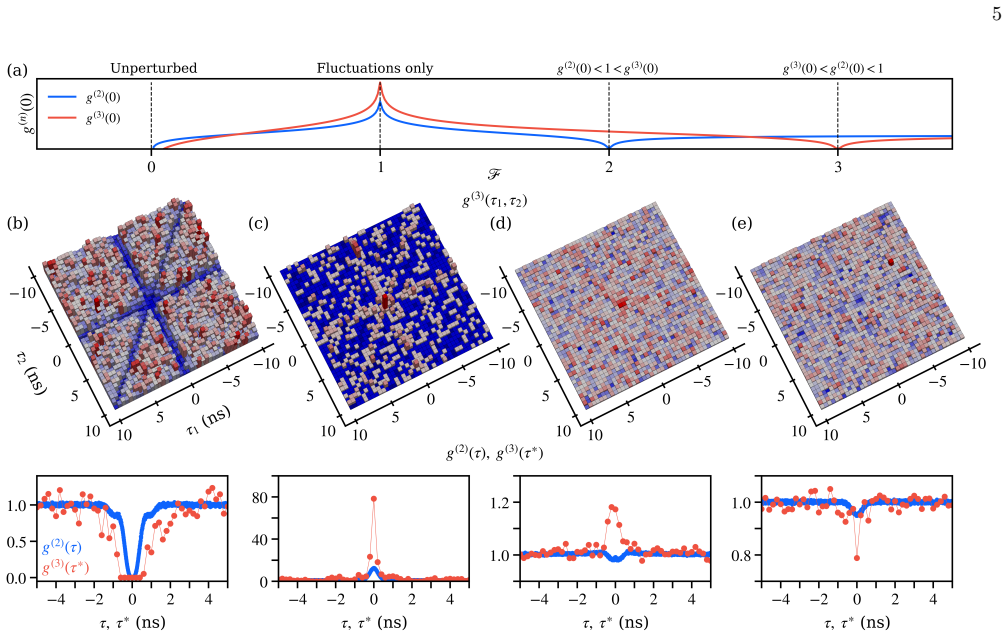
The load-bearing object is the quantum fluctuation operator $\varsigma\equiv\sigma-\langle\sigma\rangle$, the part of the two-level-system operator left after the coherent mean field is subtracted. In the Heitler regime it obeys $\langle\varsigma^\dagger\varsigma\rangle\ll|\langle\sigma\rangle|^2$, making the fluctuations quantitatively small yet qualitatively decisive. The second ingredient is the homodyne addition of a local oscillator $F\langle\sigma\rangle e^{i\phi}$, with $\phi=\pi$ chosen to cancel the mean field at $F=1$; the signal operator is $s=\sigma+F\langle\sigma\rangle e^{i\pi}$. The identity that carries the argument is the exact formula $g^{(n)}(0)=\frac{F^{2(n-1)}(F-n)^2}{(F-1)^{2n}}$ for the $n$-th order Glauber correlator in the Heitler limit, obtained from the master-equation solution for the homodyned signal; it encodes both the universal divergence at $F=1$ and the order-selective zeros at $F=n$.
What would settle it
If the central formula is right, shrinking the three-photon histogram bin from 500 ps to about 50 ps at fixed driving $\Omega\approx0.15$ should make the $F=1$ bunching peak grow and the $F=n$ suppression deepen as the detector resolves the divergent and zero structure; observing no such sharpening, or finding that the ordering at $F=3.38$ and $F=4.17$ fails to reverse, would falsify the prediction.
Extended reading notes
Core claim
The paper's central claim is that the single-photon character of resonance fluorescence is a mean-field artifact. The TLS operator is split into a coherent mean field $\langle\sigma\rangle$ and a quantum fluctuation $\varsigma=\sigma-\langle\sigma\rangle$; in the Heitler regime the mean field dominates the intensity yet the fluctuations carry the multiphoton correlations. Homodyning the signal with a coherent field $F\langle\sigma\rangle e^{i\pi}$ allows independent control of the mean field, and at $F=1$ the signal reduces to the bare fluctuations. For vanishing driving the $n$-photon coincidences of the homodyned signal take the exact form $g^{(n)}(0)=\frac{F^{2(n-1)}(F-n)^2}{(F-1)^{2n}}$, so all orders bunch at $F=1$ and the $n$-th order is individually suppressed at $F=n$. The paper reports $g^{(2)}(0)=12.7\pm0.6$ and $g^{(3)}(0)=78\pm57$ at cancellation, and at finite driving the expected ordering reversal between $g^{(2)}(0)<1<g^{(3)}(0)$ and $g^{(3)}(0)<1$ around $F=3.38$ and $F=4.17$.
Load-bearing premise
The quantitative comparison treats the measured two- and three-photon correlators as ideal steady-state values, even though the paper itself notes that the 500 ps histogram binning, roughly 20 ps detector jitter, and the radial integration window used for $g^{{(3)}}$ smooth away the sharp zeros and divergences of the theory.
Editorial extensions
If this is right
- At $F=1$ the homodyned emission becomes superbunched to all orders, with the hierarchy $g^{(n+1)}(0)\gg g^{(n)}(0)\gg1$, even though the total intensity drops to the fluctuation level.
- At $F=n$ the $n$-photon coincidence can be suppressed independently, producing two-photon antibunching together with three-photon bunching at $F=2$ and the reverse at $F=3$.
- As the driving approaches the Heitler limit, the bunching at $F=1$ and the individual suppressions sharpen and move toward the asymptotic positions, which the paper demonstrates across $\Omega\approx0.40,0.28,0.15$.
- The standard result at $F=0$ is recovered as one of the zeros of the formula, so the theory contains ordinary single-photon antibunching as a special case.
- For $n\geq3$ the quantum fluctuations supply more $n$-photon coincidences than the coherent field contains, implying a multiphoton amplification that could drive deterministic photon sorting and photonic phase-transistor schemes.
Reading between the lines
- The paper does not test orders beyond $n=3$; if the identity is exact, measuring $g^{(4)}(0)$ at $F\approx1$ with a brighter emitter should show the hierarchy $g^{(4)}\gg g^{(3)}$ continuing, and at $F=4$ a clear four-photon suppression.
- The same mean-field cancellation should work for coherently driven emitters coupled to cavities or multi-level systems, where the fluctuation operator is different but the Heitler argument still separates a dominant coherent component from quantum fluctuations.
- A practical extension would use the $F=n$ zeros as a continuously tunable photon-number notch filter: sweeping $F$ changes which coincidence order is suppressed, which could serve as a control knob in photonic quantum circuits.
Signed reviews
Editorial analysis
A structured set of objections, weighed in public.
Referee Report
Summary. The paper theoretically and experimentally studies the multiphoton statistics of the homodyned resonance fluorescence of a two-level system. The authors derive an exact expression for the zero-delay Glauber correlators g^(n)(0) of the homodyned signal, Eq. (12), which in the Heitler limit (Ω→0, phase π) reduces to the simple formula g^(n)(0) = F^{2(n-1)}(F-n)^2/(F-1)^{2n}, Eq. (6). This predicts a divergence of all orders at F=1 and individual suppression of the n-photon correlator at F=n. Experiments on a single InGaAs quantum dot at Ω≈0.15 show strong g(2) and g(3) bunching at F≈1 and a reversal of the ordering between g(2) and g(3) between F=3.38 and F=4.17, consistent with the predicted two-photon and three-photon antibunching resonances.
Significance. If the results hold, this is a clean demonstration of mean-field engineering as a tool to control multiphoton emission from the simplest quantum emitter. The theoretical derivation is exact and the Heitler-limit formula is parameter-free, which are notable strengths. The experimental observations of strong bunching at F=1 and the n-dependent suppression at F=n are qualitatively striking and, to my knowledge, constitute a new experimental benchmark. The measurements are not circular: the multiphoton correlators are independently counted, and the driving strength is extracted from separate intensity data. However, the quantitative agreement with theory is not yet established because of unaccounted finite-time-resolution effects and an inconsistency in the g(3) extraction procedure; the qualitative ordering relations may survive these corrections, but the current paper overstates the level of agreement.
major comments (2)
- [Methods and Fig. 2 comparison with Eq. (12)] The theoretical curves in Figs. 2 and 4 are pointwise zero-delay values from Eq. (12), while the experimental symbols are extracted from finite histogram bins (500 ps binning for g(3)(τ1,τ2), 200 ps binning after radial integration, and ~20 ps detector jitter). No convolution or deconvolution with the instrument response is applied to the theory before comparison. At F=1 and Ω≈0.15, Eq. (12) gives g(2)(0)≈50, whereas the reported value is 12.7±0.6, a factor-of-four discrepancy that is not discussed. The Methods text itself states that a large bin size 'reduces the timing resolution' and makes 'features like bunching or antibunching become less noticeable,' so this effect cannot be neglected. The authors should either plot the binned/convolved theoretical curves or quantify the finite-resolution correction and show that the claimed good agreement survives.
- [Supplementary B, radial integration for g(3)(τ*)] The radial-integration procedure for extracting g(3)(τ*) is internally inconsistent. The text states that θ is the angle with respect to the τ1 axis and that the integration center π/4 corresponds to the antidiagonal line τ1=−τ2. Under the stated transformation τ1=τ* cosθ, τ2=τ* sinθ, θ=π/4 is the diagonal τ1=τ2, which is one of the two-photon coincidence lines that the text explicitly says should be excluded; the antidiagonal lies at θ=3π/4. The integration window (π/12, π/2−π/12) therefore includes the diagonal τ1=τ2 over the full radial range, so the extracted g(3)(τ*) values may be contaminated by two-photon coincidences. Please correct the definition of the integration window or of the polar transformation and re-extract the data.
minor comments (4)
- [Fig. 2 caption] The two 'undetermined cases with g(3)(0)=0' should be reported as upper limits (no coincidence events) rather than plotted as zero values on the horizontal axis, since zero events do not imply g(3)(0)=0 but only a statistical upper bound.
- [Methods, g(3) binning description] The sentence 'A bin size of 500 ps is chosen for the g(3)(τ1, τ2) results presented in Fig. 2' appears to refer to Fig. 3 (the two-dimensional landscapes), since Fig. 2 shows point values g(3)(0) rather than the full τ1,τ2 dependence.
- [Supplementary B] The word 'Cartisean' should be 'Cartesian'.
- [Abstract] In the abstract, 'W e show' contains an extra space; please fix this typo.
Circularity Check
No circular derivation: theory is rederived from the TLS master equation; the correlation predictions are independent observables and are not forced by the intensity calibration.
full rationale
The derivation chain is not circular. The theoretical formulas in Eqs. (6), (11), and (12) are obtained from the standard resonance-fluorescence master equation: the steady state (9)-(10) is solved explicitly, and the homodyne correlators are written out in full in Eq. (11), with Eq. (6) as the Heitler limit. The citation [41] in the Methods is to the authors' prior work, but the formula is restated completely and is a direct consequence of the displayed master-equation solution, so the self-citation is not load-bearing. The only fitted parameters, I<σ> and Iς, are calibrated from the F- and phase-dependent intensity in Supplementary A using Eq. (16); the driving Ω is then derived from Eq. (3) of the same model. Using this Ω to draw the solid g(2)(0) and g(3)(0) curves is a standard one-observable calibration followed by prediction of different observables: the second- and third-order Glauber correlators are not equal to the intensity by construction, so their measured values (e.g., g(2)=12.7±0.6 and g(3)=78±57 at F≈1) are not statistically forced. No uniqueness theorem or ansatz is imported to forbid alternative models. The manuscript's own Methods does concede that the 500 ps bin size reduces timing resolution and makes bunching and antibunching features less noticeable, and the g(3)(τ*) radial-integration window described in Supplementary B is internally inconsistent (it states that the center π/4 is the antidiagonal, while the stated transformation τ*=τ1/cosθ places the antidiagonal at 3π/4). These are data-analysis and verification weaknesses that can reduce the quantitative strength of the comparison, but they do not make any theoretical prediction equivalent to its inputs. Overall, the experimental claims are benchmarked against independent multiphoton correlation measurements, so no damaging circularity is present; at most there are minor, non-load-bearing self-citations to the authors' earlier theoretical papers [30,37,41].
Assumptions & free parameters
free parameters (3)
- I⟨σ⟩ (coherent mean-field count rate) =
252.2 cts/ms for Omega≈0.15; 849.7 cts/ms for Omega≈0.28; 1193.1 cts/ms for Omega≈0.40
- Iς (fluctuation count rate) =
47.5 cts/ms for Omega≈0.15; 521.4 cts/ms for Omega≈0.28; 1504.0 cts/ms for Omega≈0.40
- Driving strength Omega =
0.15, 0.28, 0.40
assumptions (5)
- domain assumption The emitter is an ideal two-level system with only spontaneous emission decay, described by the Lindblad master equation ∂tρ = i[ρ,H]+(γσ/2)Lσρ.
- domain assumption The homodyne local oscillator is a coherent state that does not interact with the emitter and interferes perfectly with the collected emission.
- standard math The system is in the steady state described by Eqs. (9)-(10), and all correlations are computed from steady-state moments.
- standard math The Heitler limit Omega to 0 can be taken at fixed F in Eq. (12) to obtain Eq. (6).
- standard math The photon-number distribution can be reconstructed from Glauber correlators via Eq. (13), from Ref. [37].
Cite this review
Pith. "Pith review of Unlocking multiphoton emission from a single-photon source through mean-field engineering." pith.science (2026). https://pith.science/paper/WQO5PDJR
@misc{pith2026241110441,
  author       = {Pith},
  title        = {Pith review of: Unlocking multiphoton emission from a single-photon source through mean-field engineering},
  year         = {2026},
  howpublished = {\url{https://pith.science/paper/WQO5PDJR}},
  note         = {Machine review of arXiv:2411.10441}
}
read the original abstract
Single-photon emission from a two-level system offers promising perspectives for the development of quantum technologies, where multiphotons are generally regarded as accidental, undesired and should be suppressed. In quantum mechanics, however, multiphoton emission can turn out to be even more fundamental and interesting than the single-photon emission, since in a coherently driven system, the multiphoton suppression arises from quantum interferences between virtual multiphoton fluctuations and the mean field in a Poisson superposition of all number states. Here, we demonstrate how one can control the multiphoton dynamics of a two-level system by disrupting these quantum interferences through a precise and independent homodyne control of the mean field. We show that, counterintuitively, quantum fluctuations always play a major qualitative role, even and in fact especially, when their quantitative contribution is vanishing as compared to that of the mean field. Our findings provide new insights into the paradoxical character of quantum mechanics and open pathways for mean-field engineering as a tool for precision multiphoton control.
Figures


Figures from the paper (3 more)


Forward citations
Cited by 2 Pith papers
-
Quantum metrology through spectral measurements in quantum optics
Frequency-resolved photon counting with a coherently displaced local oscillator can saturate the quantum Fisher information for parameters of a driven two-level emitter, and two-color photon correlations give up to a ...
-
Coherent superposition of emitted and resonantly scattered photons from a two-level system driven by an even-$\pi$ pulse
A two-level quantum dot driven by an even-pi pulse emits a quantum superposition of its own photon and a scattered laser photon, explaining the observed g(2) ~ 3 bunching without invoking photon-pair emission.
Reference graph
Works this paper leans on
-
[1]
The Quantum Theory of Radiation (Oxford University Press, Oxford, 1954), 3 edn
Heitler, W. The Quantum Theory of Radiation (Oxford University Press, Oxford, 1954), 3 edn
work page 1954
-
[2]
Jessen, P. S. et al. Observation of quantized motion of Rb atoms in an optical field. Phys. Rev. Lett. 69, 49– 52 (1992). URL https://link.aps.org/doi/10.1103/ PhysRevLett.69.49
work page 1992
-
[3]
Astafiev, O. et al. Resonance fluorescence of a single arti- ficial atom. Science 327, 840–843 (2010). URL https:// www.science.org/doi/abs/10.1126/science.1181918. https://www.science.org/doi/pdf/10.1126/science.1181918
-
[4]
Wrigge, G., Gerhardt, I., Hwang, J., Zumofen, G. & Sandoghdar, V. Efficient coupling of photons to a sin- gle molecule and the observation of its resonance fluo- rescence. Nature Phys. 4, 60–66 (2008). URL https: //doi.org/10.1038/nphys812
doi:10.1038/nphys812 2008
-
[5]
H¨ offges, J., Baldauf, H., Eichler, T., Helmfrid, S. & Walther, H. Heterodyne measurement of the fluorescent radiation of a single trapped ion. Opt. Commun. 133, 170–174 (1997). URL https://www.sciencedirect.com/ science/article/pii/S0030401896006219
work page 1997
-
[6]
Joshi, C., Yang, F. & Mirhosseini, M. Resonance fluo- rescence of a chiral artificial atom. Phys. Rev. X 13, 021039 (2023). URL https://link.aps.org/doi/10. 1103/PhysRevX.13.021039
work page 2023
-
[7]
Muller, A. et al. Resonance fluorescence from a coherently driven semiconductor quantum dot in a cavity. Phys. Rev. Lett. 99, 187402 (2007). URL https://link.aps.org/ doi/10.1103/PhysRevLett.99.187402
-
[8]
Dalibard, J. & Reynaud, S. Correlation signals in resonance fluorescence: interpretation via photon scattering amplitudes. J. Phys. France 44, 1337– 1343 (1983). URL https://doi.org/10.1051/jphys: 0198300440120133700
doi:10.1051/jphys: 1983
Show all 44 references
-
[9]
J., Lane, A
Carmichael, H. J., Lane, A. S. & Walls, D. F. Resonance fluorescence from an atom in a squeezed vacuum. Phys. Rev. Lett. 58, 2539–2542 (1987). URL https://link. aps.org/doi/10.1103/PhysRevLett.58.2539
1987 doi
-
[10]
Toyli, D. M. et al. Resonance fluorescence from an artificial atom in squeezed vacuum. Phys. Rev. X 6, 031004 (2016). URL https://link.aps.org/doi/10. 1103/PhysRevX.6.031004
2016
-
[11]
Campagne-Ibarcq, P. et al. Observing interferences between past and future quantum states in reso- nance fluorescence. Phys. Rev. Lett. 112, 180402 (2014). URL https://link.aps.org/doi/10.1103/ PhysRevLett.112.180402. 9
2014
-
[12]
Liu, S. et al. Violation of Bell inequality by pho- ton scattering on a two-level emitter. Nature Phys. 20, 1429–1433 (2024). URL https://doi.org/10.1038/ s41567-024-02543-8
2024
-
[13]
Boos, K. et al. Signatures of dynamically dressed states. Phys. Rev. Lett. 132, 053602 (2024). URL https://link. aps.org/doi/10.1103/PhysRevLett.132.053602
2024 doi
-
[14]
C., Berm´ udez Feijoo, S
L´ opez Carre˜ no, J. C., Berm´ udez Feijoo, S. & Stobi´ nska, M. Entanglement in resonance fluorescence. npj Nanopho- ton. 1, 3 (2024). URL https://doi.org/10.1038/ s44310-023-00001-6
2024
-
[15]
Masters, L. et al. On the simultaneous scattering of two photons by a single two-level atom. Nature Photon. 17, 972–976 (2023). URL https://doi.org/10.1038/ s41566-023-01260-7
2023
-
[16]
Faraon, A. et al. Coherent generation of non-classical light on a chip via photon-induced tunnelling and block- ade. Nature Phys. 4, 859–863 (2008). URL https: //doi.org/10.1038/nphys1078
2008 doi
-
[17]
& Savona, V
Flayac, H. & Savona, V. Unconventional photon block- ade. Phys. Rev. A 96, 053810 (2017). URL https: //link.aps.org/doi/10.1103/PhysRevA.96.053810
2017 doi
-
[18]
Snijders, H. J. et al. Observation of the uncon- ventional photon blockade. Phys. Rev. Lett. 121, 043601 (2018). URL https://link.aps.org/doi/10. 1103/PhysRevLett.121.043601
2018
-
[19]
Vaneph, C. et al. Observation of the unconventional pho- ton blockade in the microwave domain. Phys. Rev. Lett. 121, 043602 (2018). URL https://link.aps.org/doi/ 10.1103/PhysRevLett.121.043602
2018 doi
-
[20]
Wang, D. et al. Turning a molecule into a coherent two- level quantum system. Nature Phys. 15, 483–489 (2019). URL https://doi.org/10.1038/s41567-019-0436-5
2019 doi
-
[21]
Tomm, N. et al. Realization of a coherent and ef- ficient one-dimensional atom. Phys. Rev. Lett. 133, 083602 (2024). URL https://link.aps.org/doi/10. 1103/PhysRevLett.133.083602
2024
-
[22]
Prasad, A. S. et al. Correlating photons using the col- lective nonlinear response of atoms weakly coupled to an optical mode. Nature Photon. 14, 719–722 (2020). URL https://doi.org/10.1038/s41566-020-0692-z
2020 doi
-
[23]
& Rauschenbeutel, A
Cordier, M., Schemmer, M., Schneeweiss, P., Volz, J. & Rauschenbeutel, A. Tailoring photon statistics with an atom-based two-photon interferometer. Phys. Rev. Lett. 131, 183601 (2023). URL https://link.aps.org/doi/ 10.1103/PhysRevLett.131.183601
2023 doi
-
[24]
& Eberly, J
Allen, L. & Eberly, J. Optical Resonance and Two-Level Atoms (Dover, 1987)
1987
-
[25]
& Sargent, M
Meystre, P. & Sargent, M. Elements of quantum optics (Springer Science & Business Media, 2007)
2007
-
[26]
Squeezing and anomalous moments in resonance fluorescence
Vogel, W. Squeezing and anomalous moments in resonance fluorescence. Phys. Rev. Lett. 67, 2450– 2452 (1991). URL https://link.aps.org/doi/10.1103/ PhysRevLett.67.2450
1991
-
[27]
& Mlynek, J
Breitenbach, G., Schiller, S. & Mlynek, J. Measurement of the quantum states of squeezed light. Nature 387, 471– 475 (1997). URL https://doi.org/10.1038/387471a0
1997 doi
-
[28]
Schulte, C. H. H. et al. Quadrature squeezed photons from a two-level system. Nature 525, 222–225 (2015). URL https://doi.org/10.1038/nature14868
2015 doi
-
[29]
Fischer, K. A. et al. Self-homodyne measurement of a dynamic Mollow triplet in the solid state. Nature Photon. 10, 163–166 (2016). URL https://doi.org/10.1038/ nphoton.2015.276
2016
-
[30]
C., Laussy, F
Zubizarreta Casalengua, E., L´ opez Carre˜ no, J. C., Laussy, F. P. & Valle, E. d. Conventional and un- conventional photon statistics. Laser Photonics Rev. 14, 1900279 (2020). URL https://onlinelibrary. wiley.com/doi/abs/10.1002/lpor.201900279. https://onlinelibrary.wiley.com...
2020 doi
-
[31]
Nguyen, H. S. et al. Ultra-coherent single photon source. Appl. Phys. Lett. 99, 261904 (2011). URL https://doi. org/10.1063/1.3672034
2011 doi
-
[32]
Matthiesen, C., Vamivakas, A. N. & Atat¨ ure, M. Subnat- ural linewidth single photons from a quantum dot. Phys. Rev. Lett. 108, 093602 (2012). URL https://link.aps. org/doi/10.1103/PhysRevLett.108.093602
2012 doi
-
[33]
C., Casalengua, E
L´ opez Carre˜ no, J. C., Casalengua, E. Z., Laussy, F. P. & del Valle, E. Joint subnatural-linewidth and single- photon emission from resonance fluorescence. Quantum Sci. Technol. 3, 045001 (2018). URL https://dx.doi. org/10.1088/2058-9565/aacfbe
2018 doi
-
[34]
Phillips, C. L. et al. Photon statistics of fil- tered resonance fluorescence. Phys. Rev. Lett. 125, 043603 (2020). URL https://link.aps.org/doi/10. 1103/PhysRevLett.125.043603
2020
-
[35]
Hanschke, L. et al. Origin of antibunching in res- onance fluorescence. Phys. Rev. Lett. 125, 170402 (2020). URL https://link.aps.org/doi/10.1103/ PhysRevLett.125.170402
2020
-
[36]
Zubizarreta Casalengua, E., Laussy, F. P. & del Valle, E. Two photons everywhere. Philos. Trans. R. Soc. London, Ser. A 382, 20230315 (2024). URL https://royalsocietypublishing.org/doi/abs/ 10.1098/rsta.2023.0315
2024
-
[37]
C., del Valle, E
Zubizarreta Casalengua, E., L´ opez Carre˜ no, J. C., del Valle, E. & Laussy, F. P. Structure of the harmonic os- cillator in the space of n-particle Glauber correlators. J. Math. Phys. 58, 062109 (2017)
2017
-
[38]
Tomm, N. et al. Photon bound state dynamics from a single artificial atom. Nature Phys. 1–6 (2023). URL https://doi.org/10.1038/s41567-023-01997-6
2023 doi
-
[39]
Zubizarreta Casalengua, E. et al. Multiphoton emission from a two-level system (2025). In preparation
2025
-
[40]
M., Pohl, T., Lodahl, P
Yang, F., Lund, M. M., Pohl, T., Lodahl, P. & Mølmer, K. Deterministic photon sorting in waveguide QED sys- tems. Phys. Rev. Lett. 128, 213603 (2022). URL https:// link.aps.org/doi/10.1103/PhysRevLett.128.213603
2022 doi
-
[41]
C., Laussy, F
Zubizarreta Casalengua, E., L´ opez Carre˜ no, J. C., Laussy, F. P. & del Valle, E. Tuning photon statistics with coherent fields. Phys. Rev. A 101, 063824 (2020). URL https://link.aps.org/doi/10. 1103/PhysRevA.101.063824
2020
-
[42]
Warburton, R. J. et al. Optical emission from a charge- tunable quantum ring. Nature 405, 926–929 (2000). URL https://doi.org/10.1038/35016030
2000 doi
-
[43]
& Atat¨ ure, M
Nick Vamivakas, A., Zhao, Y., Lu, C.-Y. & Atat¨ ure, M. Spin-resolved quantum-dot resonance fluorescence. Na- ture Phys. 5, 198–202 (2009). URL https://doi.org/10. 1038/nphys1182
2009
-
[44]
C., Zubizarreta Casalengua, E., Silva, B., del Valle, E
L´ opez Carre˜ no, J. C., Zubizarreta Casalengua, E., Silva, B., del Valle, E. & Laussy, F. P. Loss of antibunching. Phys. Rev. A 105, 023724 (2022). URL https://link. aps.org/doi/10.1103/PhysRevA.105.023724. Unlocking multiphoton emission from a single-photon source through m...
2022 doi
Reviewed August 12, 2026 · model on record in the stance chip above.
Discussion (0). Continue with ORCID to comment.